
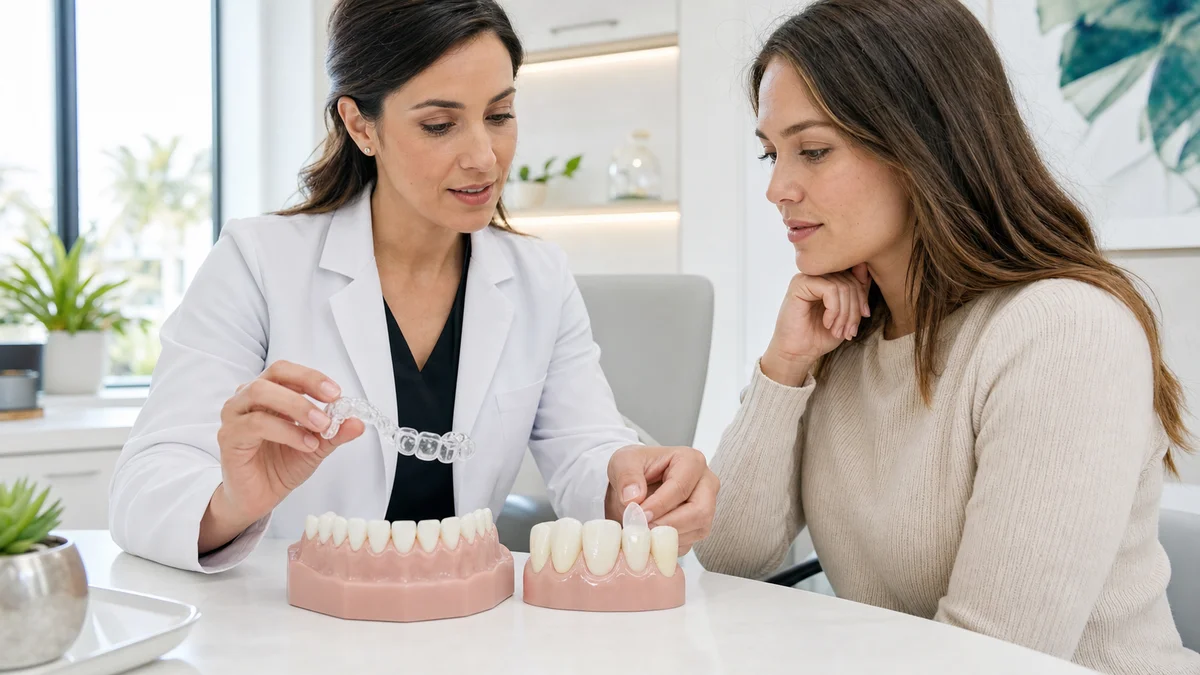
Quick answer: Clear aligners gradually move natural teeth and can improve alignment or selected bite problems; veneers cover the visible surfaces of existing teeth to change colour, shape, or proportion. Aligners usually preserve enamel but require wear and retention. Veneers can create faster visual change but may require irreversible preparation. A clinical examination determines which goal and risk profile apply.
Comparing clear aligners vs veneers is not simply comparing two ways to make a smile look straighter. The treatments act on different tissues and pursue different primary goals. Clear aligners are a sequence of custom removable trays that apply planned forces to move teeth through supporting bone. Porcelain veneers are thin restorations bonded to the visible surfaces of teeth that remain in place. One changes position; the other changes the visible contour and colour of a surface.
That difference matters because a tooth can look crooked for several reasons. It may be rotated, crowded, tipped, displaced by a bite problem, unusually shaped, worn, chipped, intrinsically discoloured, or visually uneven because the gumline differs. An aligner cannot bleach a dark tooth or replace lost enamel. A veneer cannot correct every root position, jaw relationship, or functional bite discrepancy. Selecting a treatment before identifying the cause can trade a short-term appearance change for unnecessary tissue removal, an unstable bite, or a result that does not address the patient’s real concern.
This guide explains how dentists and orthodontic clinicians may structure shared decision-making. It does not diagnose an individual case. The appropriate records may include an oral examination, periodontal assessment, photographs, digital scans, bite evaluation, and radiographs selected according to clinical need. Active decay, gum disease, pulpal problems, or uncontrolled risk factors should be managed before elective definitive treatment.
1. Clear Aligners Move Teeth; Veneers Reshape Visible Surfaces
Clear aligners are designed as staged appliances. Each tray represents a planned step, and the sequence applies controlled pressure to selected teeth. Tooth-coloured attachments, elastics, interproximal enamel reduction, or other auxiliaries may be recommended when clinically appropriate. The American Association of Orthodontists notes that clear aligners can treat some, but not all, orthodontic problems. Suitability depends on the type and complexity of movement, the bite, tooth and root positions, periodontal support, and the patient’s ability to wear and care for the appliances.
A veneer does not move the root or reposition the whole tooth. It can alter the visible front outline, making a slightly rotated or undersized tooth appear more symmetrical from the front. This is sometimes described as “instant orthodontics,” but that phrase can be misleading. Masking position by adding or removing material is biologically different from correcting position. In a crowded arch, creating a visually straight line with veneers may require more preparation on prominent teeth and added bulk on recessed surfaces.
Start by describing the problem without naming a procedure:
- “My teeth overlap and are difficult to clean.”
- “My front teeth are straight but their shapes are uneven.”
- “One tooth is darker after an old injury.”
- “My bite feels edge-to-edge and the front teeth keep wearing.”
- “I like the position but not the colour.”
Those statements lead to different diagnostic pathways. At Redent Klinik, a treatment discussion should begin with the health, position, and function of the natural teeth rather than with a catalogue image.
2. What Clear Aligners Can and Cannot Predictably Address
Clear aligners may be used to correct selected crowding, spacing, rotations, tipping, arch coordination, and bite relationships. They can also create or redistribute space before restorative work. Digital planning helps visualise intended stages, but an animation is a treatment plan, not a biological guarantee. Teeth do not always track the virtual setup exactly. Refinement scans, additional trays, attachment changes, elastics, or a change in appliance may be needed.
Patient participation is central because the trays are removable. They must usually be worn for most of the day according to the prescriber’s instructions and removed for eating, oral hygiene, and most drinks other than plain water. Inconsistent wear can delay movement, reduce fit, and make the next tray inappropriate. Conversely, forcing an ill-fitting tray into place without advice is not a safe response. Fit problems, persistent pain, gum injury, unexpected mobility, or bite changes should be reviewed by the treating clinician.
Aligners cannot by themselves repair a fractured edge, hide severe intrinsic discolouration, rebuild missing tooth volume, or replace a restoration. They may improve the position first, after which whitening, contouring, bonding, or a veneer is assessed on a more favourable foundation. Complex skeletal discrepancies, impacted teeth, severe movements, or cases requiring precise control may need braces, other appliances, surgery, or a combined plan. A preference for a transparent appliance should not override clinical feasibility.
3. What Veneers Can and Cannot Safely Accomplish
A porcelain veneer is a custom ceramic layer bonded to an existing tooth. It can change visible colour, width, length, surface texture, and contour. It may close selected small spaces or make minor positional differences less noticeable. The quality of enamel available for bonding, the existing restoration pattern, tooth vitality, gum levels, bite, and the requested degree of change influence whether the plan is conservative and realistic.
The American Dental Association advises that veneer treatment can be irreversible because enamel is removed. The amount of preparation varies, and some cases can be minimal, but “no-prep” is not a universal feature. If a tooth projects forward, merely adding ceramic may make it bulky; reducing that prominence may require more preparation. If the tooth sits inward, adding material may affect cleansability, speech, contact, or bite. A diagnostic wax-up or trial design can help evaluate proportions before definitive work.
Veneers do not make the underlying tooth immune to decay, gum disease, trauma, or fracture. They can chip, crack, loosen, wear, or need replacement. They should not be placed over untreated decay or active periodontal disease. A dark tooth may need vitality testing or other treatment before its colour is masked. A patient with heavy grinding or an unfavourable overbite may have higher mechanical risk. A licensed dentist should diagnose these factors and discuss alternatives before preparation.
4. Clear Aligners vs Veneers Decision Table
The table offers a structured starting point, not a personal recommendation. More than one option may be reasonable, and combined or staged care may preserve more healthy tissue than choosing either treatment alone.
| Starting concern | Usually relevant pathway | Reason | Question to resolve |
|---|---|---|---|
| Healthy teeth are crowded, rotated, or spaced | Orthodontic assessment; clear aligners may be considered | The concern primarily involves tooth position | Can aligners deliver the required root and bite control, or would braces or another method be more predictable? |
| Teeth are well positioned but shape, size, or intrinsic shade is a concern | Conservative aesthetic assessment; veneers may be one option | Changing position may not address the surface problem | Could whitening, contouring, or composite bonding meet the goal with less irreversible treatment? |
| Mild crowding plus chipped or undersized teeth | Staged orthodontic-restorative plan | Moving teeth first may reduce preparation and distribute space more evenly | What final tooth proportions and restorative space should guide the orthodontic setup? |
| Prominent front teeth and a request for a rapid visual correction | Orthodontic and restorative comparison before consent | Masking prominence with veneers may require substantial tooth reduction | How much enamel would be removed compared with moving the teeth? |
| Deep bite, edge-to-edge bite, or repeated chipping | Functional bite assessment first | Covering the surface alone may not remove damaging contacts | Does the bite need correction before any ceramic is placed? |
| Active decay, bleeding gums, or poor plaque control | Disease stabilisation first | Both orthodontic movement and definitive bonding require a healthy, maintainable environment | What health targets must be reached before elective treatment begins? |
| Patient cannot commit to removable appliance wear | Discuss fixed orthodontic alternatives or non-orthodontic limits | Aligner effectiveness depends heavily on consistent wear | Is a fixed appliance more realistic, and would veneers actually address the diagnosis? |
“Faster” and “less invasive” are separate concepts. A veneer may change appearance in fewer appointments but permanently alter tooth structure. Aligners may take longer but often preserve intact surfaces. However, aligners also require biological movement, monitoring, disciplined wear, and long-term retention. The better plan is the one that treats the diagnosed issue with an acceptable total burden, not automatically the one with fewer calendar days.
5. Enamel Preservation, Reversibility, and Future Options
Clear aligner trays generally do not require broad removal of the visible enamel surface. Some plans include small bonded attachments and carefully measured interproximal reduction between selected teeth. These steps should be justified, documented, and explained. Attachments are removed after active treatment, but orthodontic movement itself changes tooth position and may reveal different gum contours, embrasures, or wear patterns. Teeth also have a lifelong tendency to move, which is why retention is part of the treatment rather than an optional extra.
Porcelain veneer preparation varies from minimal contouring to more extensive reduction, depending on position, colour, shape, and restorative space. Once enamel is removed, the tooth will generally continue to need a restoration. Replacement may require further intervention, and a future veneer cannot always be identical in preparation or margin position. Before consent, ask for the expected preparation depth, which surfaces are involved, and how the plan affects future repair.
Preserving enamel can be especially important for reliable bonding. Orthodontics may create a position that allows a thinner, more conservative veneer or eliminates the need for one. On the other hand, moving a tooth that is already heavily restored or compromised may require coordination with restorative care. The clinician should evaluate whether the sequence preserves options rather than treating each step in isolation.
6. Bite Function and Root Position
A front-facing photo shows crowns but not roots, bone, or all tooth contacts. Orthodontic treatment plans movement in three dimensions and considers how upper and lower teeth meet. Rotating a crown visually without managing the root may leave unstable contact or limited space. Aligners can plan root movement, but some movements are more difficult than others and may require auxiliaries or another appliance.
Veneers change the surfaces that guide the bite. Adding length to front teeth can affect speech, jaw movement, and contacts. If a patient has a deep overbite, edge-to-edge relationship, crossbite, or heavy parafunction, thin ceramic may receive repeated stress. Simply making every front edge level does not guarantee functional harmony. A dentist should identify where the teeth contact at rest, during chewing, and during jaw excursions.
Radiographs may be indicated to assess roots, supporting bone, impacted teeth, previous trauma, or pathology before movement. Periodontal measurements matter because orthodontic forces act through tissues that support the teeth. Gum recession, reduced bone, unusual root shape, or previous root resorption can change the risk-benefit calculation. Digital impressions and photographs cannot replace every diagnostic view beneath the gumline.
7. Treatment Time, Daily Routine, and Monitoring
Clear aligner treatment unfolds over a sequence of trays. Duration depends on the starting condition, goals, response, wear, missed visits, refinements, and whether additional procedures are needed. An advertised average cannot predict an individual’s course. Patients typically need to insert and remove trays correctly, keep them clean, attend monitoring visits, and communicate when fit or symptoms change. Eating with trays or repeatedly drinking sugary or acidic beverages while they cover the teeth can increase oral health concerns.
Veneer care may involve assessment, records, planning, tooth preparation, provisional restorations where needed, laboratory manufacture, try-in, bonding, and review. Although active treatment can be shorter than orthodontics, a safe pathway may be longer if gums need stabilisation, whitening is planned, the bite needs adjustment, or a diagnostic trial reveals a need to revise shapes. Fast delivery is not evidence that diagnosis and consent were complete.
Daily-life questions help reveal whether a plan is realistic:
- Can you wear and manage removable trays for the prescribed hours?
- Can you brush before reinserting aligners after meals?
- Are work, travel, speech, or instrument-playing demands relevant?
- Will you attend reviews and wear retainers after movement?
- Can you avoid habits that place veneers at risk, such as biting hard objects?
- Do you understand how temporary restorations may look and feel?
A theoretically ideal option can become a poor practical option if the patient cannot follow its essential maintenance. Honest discussion is better than pretending compliance has no role.
8. Appearance, Colour, Shape, and Gumline
Aligners move the patient’s own teeth, so their natural colour, translucency, restorations, chips, and wear remain after alignment. Better position can improve symmetry and light reflection, and it may make cleaning easier, but it does not automatically create a uniform shade. After movement and stabilisation, some patients consider professional whitening, conservative contouring, or bonding. Existing fillings and crowns do not whiten like natural enamel and may need reassessment.
Veneers can directly alter shade and shape, but natural results require more than choosing a bright colour. Ceramic thickness, underlying tooth shade, cement, translucency, texture, neighbouring teeth, lip dynamics, and lighting affect the result. Treating one tooth can be more challenging than treating several because it must match. Treating many teeth simply for uniformity increases the number of teeth exposed to irreversible work.
Neither option guarantees a perfectly level gumline. Orthodontic movement can change the position of tooth margins relative to gums, and recession risk must be considered where tissues are thin or teeth are moved beyond supporting bone. Veneer margins can become more visible if gums recede. Periodontal health and tissue phenotype should be assessed before an aesthetic promise is made.
9. When a Combined Plan May Preserve More Tooth
The most thoughtful answer to clear aligners vs veneers is sometimes “both, in the correct sequence,” or “aligners plus a more conservative restoration.” For example, mild movement can create balanced spaces around undersized lateral incisors. Once positions are stable, additive composite or thin veneers may restore proportion with less preparation. Aligning a prominent tooth before restoring it can also reduce the need to remove facial enamel merely to make the arch look straight.
Combined planning requires the orthodontic and restorative endpoints to be agreed before movement begins. The team may use a digital setup, wax-up, photographs, or temporary mock-up to define final widths and contacts. If movement closes every space without considering the intended restoration, the final proportions may be compromised. If veneers are prepared before needed movement, trays may no longer fit and ceramic may be exposed to unnecessary forces.
Sequence commonly follows this logic: control disease, define the restorative goal, complete tooth movement, retain and stabilise positions, reassess gums and bite, perform whitening if planned, and then finalise the least extensive restoration that meets the goal. Individual timing varies, and not every patient needs every stage.
10. Risks, Red Flags, and Patient Safety
Both treatments require professional diagnosis. The AAO states that moving teeth changes the bite and can affect oral health; in-person assessment and monitoring help identify root, bone, and gum factors that a scan alone cannot show. Mail-order or unsupervised movement can miss disease or fail to recognise harmful tracking. A tray is not safe merely because it is transparent and removable.
The ADA similarly warns against veneer services that remove the licensed dentist from diagnosis and treatment. Placing veneers over unhealthy teeth can worsen existing problems. Be cautious if a provider guarantees a permanent result, dismisses X-rays without considering clinical need, proposes irreversible preparation before treating disease, or cannot explain alternatives and maintenance.
Contact the treating professional promptly for severe or persistent pain, swelling, trauma, a veneer that moves, an aligner that suddenly does not fit, unexpected tooth mobility, gum injury, or a major bite change. Emergency symptoms such as facial swelling with breathing or swallowing difficulty require urgent local medical or dental care. Online guidance cannot determine the cause.
11. Cost, Insurance, and Long-Term Maintenance
Prices cannot be compared responsibly without complete plans. Aligner cost can reflect records, appliance complexity, number of stages, refinements, monitoring, attachments, replacement trays, and retainers. Veneer cost can reflect the number of teeth, material, laboratory work, provisionals, diagnostic design, gum treatment, bite protection, and future maintenance. A low initial quote may omit steps essential to a stable result.
Insurance treatment varies by jurisdiction and policy. Orthodontic benefits may have age limits, lifetime maximums, waiting periods, or exclusions. Veneers are often considered cosmetic unless a policy recognises a restorative indication. Obtain a written pre-treatment estimate, but understand that insurer approval is not a clinical recommendation and does not guarantee payment if findings or policy interpretation change.
Long-term commitments also differ. Teeth can move throughout life, and the NHS advises retention after orthodontic treatment; stopping retainer wear makes movement likely. Retainers can wear, break, or need replacement. Veneers require routine dental care and can eventually need repair or replacement. Neither route is “finish once and forget.” To discuss an examination-based sequence and written estimate, use the Redent Klinik contact page.
Frequently Asked Questions
Are clear aligners better than veneers for crooked teeth?
If the main issue is tooth position, an orthodontic assessment is generally the more direct starting point because aligners move teeth rather than cover them. Veneers may visually mask minor discrepancies but can require enamel removal, especially when a tooth is prominent. Clear aligners are not suitable for every movement, so braces or another method may be recommended. “Better” depends on the bite, roots, gums, complexity, and patient cooperation.
Are veneers faster than clear aligners?
Veneers can sometimes change visible shape and shade in fewer appointments than orthodontic movement. That does not make them interchangeable or automatically safer. The faster change may involve irreversible preparation and will not correct every root or bite problem. A complete veneer pathway can also include disease control, planning, provisionals, laboratory work, and reviews. Treatment time should be considered alongside biological cost and diagnostic fit.
Can clear aligners change tooth colour or shape?
No. Aligners reposition teeth but do not bleach enamel, repair chips, or change natural tooth anatomy. Improved alignment can make a smile appear more balanced, yet colour and shape concerns may remain. After movement and stabilisation, the dentist can reassess whitening, contouring, composite bonding, or veneers. Planning these goals before orthodontics can help create appropriate final space.
Can veneers replace the need for orthodontics?
Veneers may camouflage selected minor positional differences, but they do not move roots or correct all bite relationships. Using ceramic to mask substantial crowding or protrusion may require excessive reduction or create bulky contours. An orthodontic opinion is valuable when tooth position is a significant part of the concern. Sometimes limited movement reduces or eliminates the need for veneers.
Do clear aligners damage enamel?
Aligners do not normally require broad facial enamel removal, but treatment can include attachments and limited interproximal reduction when justified. Plaque and acidic or sugary liquids trapped under trays can increase decay or erosion risk. Oral hygiene, appropriate wear, professional monitoring, and removing trays for food and most drinks are important. Any enamel reduction should be measured, explained, and performed by a qualified clinician.
Do veneers last forever?
No. Porcelain veneers can chip, crack, debond, wear, or require replacement, and the underlying tooth can still develop decay or gum recession. Their service depends on diagnosis, preparation, bonding, bite, habits, hygiene, trauma, and follow-up. Avoid any promise of lifetime or guaranteed results. Ask what repair and replacement could involve before treatment begins.
Will I need a retainer after clear aligners?
Yes, retention is a standard part of orthodontic care because teeth can move after active treatment. The type and wear schedule are individual. Removable retainers require consistent use and safe storage; fixed retainers need careful cleaning and checks. If a retainer breaks, feels wrong, or no longer fits, contact the treating clinician rather than forcing it.
Can I have aligners first and veneers later?
Yes, this can be a conservative staged approach in selected cases. Movement may improve tooth position and distribute space so later restorations can be thinner or fewer. The final restorative dimensions should guide the orthodontic plan from the beginning. After movement, the teeth need retention and reassessment before definitive bonding. Some patients may find that alignment plus whitening or bonding meets the goal without porcelain.
Which option is better if I grind my teeth?
Grinding requires individual assessment before either treatment. It can affect aligner wear, attachments, tooth movement, ceramic fracture risk, and the bite. A clinician should evaluate the pattern and consequences of parafunction, then discuss whether movement, material changes, bite management, or a protective appliance is appropriate. A veneer should not be presented as immune to heavy forces.
Can I choose clear aligners from an online scan alone?
A scan records visible tooth surfaces but cannot by itself assess roots, bone, decay, pulp health, or every periodontal risk. Safe orthodontic planning may require an in-person examination and clinically justified radiographs, followed by monitoring. An attractive digital simulation does not prove that the planned movement is biologically suitable or that teeth are tracking safely.
How should I decide between clear aligners vs veneers?
Ask a licensed clinician to define whether the primary problem is position, shape, shade, damage, bite, or a combination. Compare the least invasive feasible options, expected preparation, orthodontic wear, retention, risks, maintenance, alternatives, and total written cost. If extensive preparation of healthy teeth is proposed or the diagnosis remains unclear, a second professional opinion can support informed consent.
Conclusion: Choose the Treatment That Matches the Diagnosis
The essential distinction in clear aligners vs veneers is movement versus surface restoration. Aligners can reposition natural teeth and selected bites but demand wear, monitoring, and retention. Veneers can directly alter shape and shade but may require irreversible enamel preparation and future replacement. Neither treatment is universally more advanced, natural, or appropriate.
A high-quality plan identifies disease and functional risk first, clarifies the patient’s actual goal, and preserves healthy tissue where reasonably possible. Sometimes that means aligners, sometimes a veneer, sometimes another treatment, and sometimes a carefully staged combination. The decision should follow examination and informed consent, not a promise based on speed or a single photograph.
Sources
- American Association of Orthodontists: Orthodontic FAQs and Clear Aligners
- American Association of Orthodontists: Dental Retainers
- NHS: Orthodontic Treatments and Retainers
- American Dental Association MouthHealthy: Veneers
- American Dental Association
- National Institute of Dental and Craniofacial Research: Oral Hygiene
- World Health Organization: Oral Health