
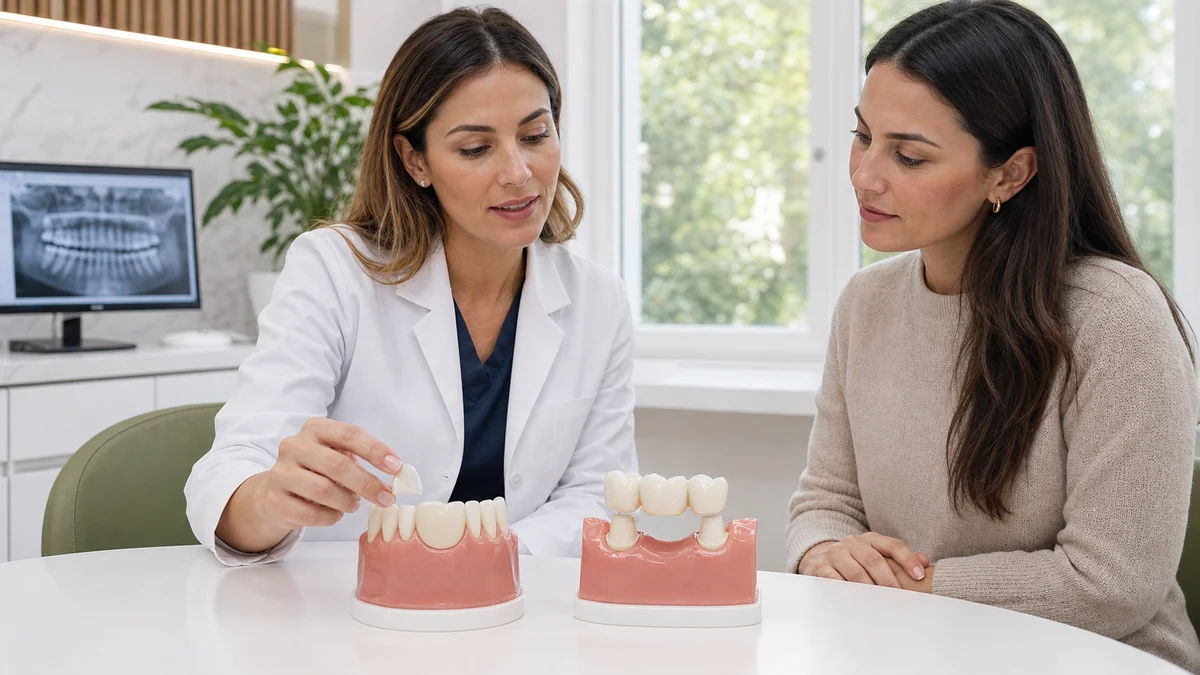
Quick answer: Porcelain veneers improve the visible surface of teeth that are still present, while a dental bridge replaces one or more missing teeth. Neither is universally better. The safer choice depends first on whether a tooth exists, then on tooth and gum health, bite forces, supporting teeth, cleaning ability, expectations, and a dentist’s examination.
Asking porcelain veneers or dental bridge which is better sounds like a comparison between two versions of the same treatment. Clinically, however, they usually solve different problems. A porcelain veneer is a thin, custom-made covering bonded to the front of an existing tooth. It may be considered when a tooth is present but its colour, shape, proportion, surface, or minor alignment is a concern. A bridge includes an artificial tooth, called a pontic, that spans a space and is supported by neighbouring teeth or, in some designs, implants. Its primary purpose is to replace missing dental structure and restore continuity across a gap.
That distinction prevents a common decision error: choosing from photographs before identifying the diagnosis. A veneer cannot recreate the root, chewing support, or space-filling function of a missing tooth. A conventional bridge, meanwhile, is usually an unnecessarily extensive way to change only the colour or contour of a sound front tooth. The useful question is therefore not which restoration looks more premium. It is which option addresses the actual condition while preserving healthy tissue, controlling disease, supporting function, and remaining maintainable over time.
This guide explains the clinical logic a dentist may use during shared decision-making. It is educational rather than diagnostic. X-rays, periodontal findings, vitality tests, photographs, bite analysis, and a review of your medical and dental history may change the available choices. Treatment recommendations should follow an in-person assessment by a licensed dental professional.
1. Start With the Problem, Not the Material
The fastest way to separate the options is to ask whether the tooth you want to treat is present. If the natural tooth is present and reasonably healthy, a dentist can assess whether conservative reshaping, whitening, orthodontics, composite bonding, or a veneer could meet the goal. If the tooth is absent, a veneer has no tooth surface to bond to. The conversation then moves to accepting or closing the space, a removable denture, a tooth-supported bridge, a resin-bonded bridge, or an implant-supported restoration where appropriate.
This does not mean every present tooth is a veneer candidate or every gap needs a bridge. Active decay, gum inflammation, insufficient enamel, extensive existing restorations, cracks, root problems, an unfavourable bite, or heavy grinding may alter the plan. Likewise, a gap may be stable and acceptable, or the neighbouring teeth may not be suitable bridge supports. The latest NHS England care pathway guidance emphasises personalised planning according to a patient’s risk and disease profile rather than treating fixed prosthodontics as a one-size-fits-all choice.
- Tooth present, mainly an appearance concern: assess the cause and consider the least invasive option that can predictably address it.
- Tooth missing: discuss whether replacement is needed and compare bridge, implant, removable, orthodontic, or no-treatment pathways.
- Tooth present but badly weakened: a veneer may provide too little coverage; a different restorative strategy may be required.
- Disease active: stabilise decay, gum disease, and hygiene before elective definitive restoration.
At Redent Klinik, planning begins with the condition of the whole mouth, not simply the appearance of one photograph. That sequence matters because a restoration can only be as maintainable as the tooth, gums, bite, and daily care around it.
2. What Porcelain Veneers Can and Cannot Do
A porcelain veneer is a laboratory-made ceramic layer bonded to the visible surface of a tooth. It can modify contour, shade, apparent width, length, symmetry, and some limited positional discrepancies. Because the restoration relies on the existing tooth, the quality and quantity of enamel, the condition of the margins, and the forces on that tooth all matter. The American Dental Association’s patient guidance notes that enamel may be removed during veneer treatment and describes the procedure as irreversible when that occurs.
Veneers are not a treatment for active decay or gum disease. Placing a cosmetic covering over an unhealthy tooth does not remove the disease process and may make later management more complicated. A dentist must first determine why a tooth looks dark, worn, chipped, or uneven. For example, discolouration can arise from surface staining, a previous injury, a non-vital pulp, decay, restorative material, or developmental changes. Those causes do not all have the same treatment.
Porcelain is durable but not indestructible. Veneers may chip, crack, debond, wear, or eventually need replacement. The underlying and surrounding tooth can still develop decay. A deep overbite, edge-to-edge contact, clenching, grinding, nail biting, or frequent biting on hard objects can increase mechanical demands. The decision should include how much tooth tissue will be altered, what happens if the restoration fails, and whether a less invasive option could reasonably meet the objective.
3. What a Dental Bridge Can and Cannot Do
A dental bridge is a fixed restoration used to replace a missing tooth or teeth. The artificial replacement is joined to retainers supported by neighbouring teeth or implants, depending on the design. A conventional tooth-supported bridge often requires the supporting teeth to be prepared for crowns. A resin-bonded bridge may use one or more wings bonded to the back of a supporting tooth and can be more conservative in selected situations. The span, bite, tooth position, available enamel, support, and space influence which designs are feasible.
A bridge may restore appearance and provide a chewing surface, but it does not turn the artificial tooth into a natural tooth with a root and living pulp. Forces are transferred through the supports. The supporting teeth therefore need careful assessment for cracks, decay, previous root treatment, periodontal support, crown-to-root relationship, alignment, and existing restorations. Preparing healthy adjacent teeth solely to support a conventional bridge is a meaningful biological trade-off and should be discussed alongside alternatives.
Cleaning is also different from cleaning around separate natural teeth. Floss cannot pass vertically between connected bridge units in the usual way. Patients generally need a floss threader, interdental brush, water-flossing device, or another tool recommended for the specific design to clean beneath the pontic and around margins. A bridge can look excellent on the day it is fitted yet become difficult to maintain if the patient cannot reach plaque-retentive areas. Design and daily access are therefore part of treatment quality, not afterthoughts.
4. Porcelain Veneers or Dental Bridge Which Is Better for Your Situation?
The table below is a decision aid, not a prescription. It shows why the answer changes with the clinical starting point. More than one pathway can be reasonable, and a dentist may recommend preliminary treatment before any definitive restoration.
| Clinical situation | Usually relevant pathway | Why | Key question before deciding |
|---|---|---|---|
| A front tooth is present, healthy, but its shape or intrinsic colour is a concern | Conservative aesthetic assessment; porcelain veneer may be one option | A veneer needs an existing tooth and can alter its visible surface | Could whitening, orthodontics, contouring, or composite bonding meet the goal with less irreversible treatment? |
| One tooth is missing and the adjacent teeth are suitable supports | Bridge assessment; also compare implant, removable, orthodontic, and no-treatment options | A bridge can span a gap; a veneer cannot replace an absent tooth | What preparation, support, hygiene access, and long-term risks does the proposed bridge design involve? |
| A tooth is present but extensively damaged or heavily restored | Full restorative assessment | A veneer may not provide enough coverage or retention | Is the tooth restorable, vital, structurally sound, and suitable for a partial or full-coverage restoration? |
| Active gum disease, decay, or poor plaque control is present | Disease control first | Definitive restorations placed in an unstable environment have avoidable biological risk | What measurable signs will show that oral health is stable enough to proceed? |
| Heavy grinding, clenching, or an unfavourable bite is suspected | Occlusal and risk assessment before either option | Excess force can affect ceramic, bonding, supports, and opposing teeth | Can the risk be controlled, and would another material or design be more appropriate? |
| The patient wants the fastest cosmetic change without examination | Pause and obtain a licensed dental assessment | Appearance alone cannot reveal decay, pulpal disease, periodontal support, or bite risk | Has the diagnosis, consent discussion, and alternative analysis been completed? |
A useful rule is that the least invasive treatment is not always the smallest-looking restoration. It is the option that addresses the diagnosed problem with the lowest reasonable total burden over time. Repeated repairs, inaccessible margins, untreated disease, or an option that cannot deliver the required function can make an apparently conservative choice less conservative in practice.
5. Tooth Preservation and Reversibility
Both treatments can involve irreversible steps, although the amount and location of preparation vary considerably. For a porcelain veneer, a dentist may remove a controlled amount of enamel to create space, define margins, and allow the ceramic to sit naturally. Some cases can be prepared minimally, but “no-prep” should not be treated as a universal promise. Adding ceramic without adequate space may create over-contoured margins, bulk, or hygiene challenges. Suitability depends on the existing tooth position and desired change.
For a conventional bridge, one or both neighbouring teeth may be reduced so crowns can support the pontic. That can be appropriate when those teeth already need substantial restorations, but it is a larger compromise when they are intact. A resin-bonded bridge may preserve more tooth structure, yet it has its own selection and debonding considerations. The dentist should identify the proposed bridge type rather than discussing “a bridge” as though every design requires the same preparation.
Ask to see where margins will be located, which teeth will be changed, and how future repair or replacement would work. The initial appearance is only one stage in a restoration’s life cycle. An informed plan considers what remains of the natural tooth after preparation, how the restoration can be removed, what a failure might damage, and what options would remain afterward.
6. Bite, Gum Health, and Supporting Teeth
Static photographs cannot show how teeth contact during biting and movement. A veneer on a front tooth may be repeatedly loaded when the lower jaw moves forward or sideways. A bridge may concentrate forces on its abutments, particularly if the span is long, the support is limited, or the patient has strong parafunctional habits. A clinical bite assessment helps the dentist decide whether the design, material, thickness, and contact pattern are realistic.
Gum health changes both appearance and prognosis. Inflamed gums can bleed, swell, recede, and make margin placement less predictable. Periodontal bone loss can reduce the support available to a bridge abutment. Recession around a veneer can reveal an edge or change the visible tooth proportion. This is why stable periodontal health and manageable plaque levels should precede elective definitive treatment.
The supporting teeth for a bridge deserve individual attention. They may require radiographs, vitality testing, periodontal measurements, and an assessment of cracks and restorability. A tooth that looks intact at a glance may have a large hidden filling, recurrent decay, short roots, or reduced bone support. Equally, a restored adjacent tooth may be a logical abutment if it already needs a crown. The balance cannot be determined from the gap alone.
7. Appearance: Natural Results Without Overpromising
Porcelain can reproduce translucency, surface texture, and colour variation, but the final appearance is influenced by the underlying tooth shade, ceramic thickness, cement, margin position, lighting, and surrounding teeth. A very dark tooth may require a different ceramic strategy from a mildly discoloured tooth. Changing one tooth can be harder than treating several because it must match natural neighbours under different light sources.
A bridge presents a different aesthetic challenge. The artificial tooth must appear to emerge naturally from the gum area while the retainers harmonise with supporting teeth. The shape of the ridge after tooth loss, the amount of tissue shrinkage, smile line, tooth proportions, and pontic design can affect the illusion. In some cases, soft-tissue management or a different replacement route may be discussed. No ethical provider can guarantee an exact biological or cosmetic result before assessment.
Useful planning tools may include calibrated photographs, digital scans, shade records, a diagnostic wax-up, and a provisional or trial design. These tools help communicate shape and proportion, but they do not eliminate material limits, healing variation, or maintenance needs. Ask what aspect is a simulation and what aspect can be predictably reproduced in the mouth.
8. Hygiene and Maintenance After Treatment
Neither porcelain nor a fixed bridge makes the surrounding biology maintenance-free. Plaque can accumulate at margins, exposed root surfaces can decay, and gums can become inflamed. The National Institute of Dental and Craniofacial Research advises brushing twice daily with fluoride toothpaste and cleaning between teeth regularly. Your dentist or hygienist may adapt the method to the restoration and your dexterity.
For veneers, daily care usually resembles care for natural teeth, with attention to the gumline and interdental contacts. Abrasive habits and using teeth as tools should be avoided. If grinding is diagnosed, a professionally designed protective appliance may be discussed. New sensitivity, a rough edge, movement, bite discomfort, swelling, or gum changes should be assessed rather than ignored.
A bridge requires a plan for the connected area beneath the artificial tooth. Before treatment, ask to handle or see the recommended cleaning tools. If you cannot use one device, alternatives may include:
- super floss or ordinary floss used with a threader;
- an interdental brush sized by a dental professional;
- a water-flossing device as an adjunct where suitable;
- a specialised single-tuft brush for difficult margins;
- professional hygiene visits scheduled according to individual risk.
A practical design should allow you to clean it. If a proposed bridge would create inaccessible areas, raise that concern during planning rather than after cementation.
9. Cost, Insurance, and the Full Treatment Pathway
It is unsafe to select between these treatments from a headline price. The number of units, bridge design, ceramic, laboratory work, diagnostic records, temporary restorations, gum treatment, decay management, root canal needs, bite protection, and follow-up can all change the pathway. A veneer fee applies to an existing tooth, while bridge pricing commonly reflects several connected units and the condition of supporting teeth. The totals are not directly comparable without a written plan.
Insurance and public coverage vary by country, policy, clinical indication, exclusions, waiting periods, and whether a procedure is classified as cosmetic or restorative. The ADA notes that veneers are often considered cosmetic and may not be covered unless deemed medically necessary. A bridge may be treated differently, but coverage should never be assumed. Ask the insurer for a written pre-treatment estimate and confirm what happens if preliminary care becomes necessary.
A useful written estimate separates diagnosis, disease control, definitive restoration, provisional care, laboratory charges, maintenance, and possible additional procedures. It should also explain which costs are estimates rather than guarantees. For an individual assessment and a treatment sequence based on current findings, use the Redent Klinik contact page.
10. A Safe Consultation Checklist
Shared decision-making is stronger when the patient understands both the proposed treatment and the alternatives. Bring your priorities to the consultation: appearance, chewing, speech, treatment time, tolerance for preparation, ability to clean, budget range, and future flexibility. Tell the dentist about grinding, sports, smoking, dry mouth, reflux, medications, previous dental trauma, anxiety, and any history of restorations repeatedly breaking or debonding.
Before consenting, ask:
- What diagnosis is this treatment addressing?
- Is the tooth present, restorable, vital, and periodontally supported?
- Exactly how much natural tooth structure will be altered, and on which teeth?
- What alternatives include less preparation, no treatment, orthodontics, bonding, an implant, or a removable option?
- How will the restoration interact with my bite and any grinding habit?
- How will I clean every margin and the area beneath a bridge?
- What are the realistic failure modes, and how would each be managed?
- Which parts of the result are predictable and which remain uncertain?
- What is included in the written estimate and follow-up plan?
Be cautious about a recommendation made without checking the teeth and gums, about irreversible treatment performed by an unlicensed person, or about promises of permanent, guaranteed, or maintenance-free results. The ADA specifically advises patients to use a licensed dentist for veneer treatment because unsupervised procedures can cause harm.
Frequently Asked Questions
Can porcelain veneers close the space left by a missing tooth?
A veneer needs an existing tooth to bond to and does not replace a missing root or create a true artificial tooth. Very small spaces between present teeth may sometimes be redistributed or visually reduced with orthodontics, bonding, or veneers, but a genuine missing-tooth space requires a separate assessment. Depending on the findings, options may include accepting the space, orthodontic closure, a bridge, an implant-supported tooth, or a removable appliance.
Porcelain veneers or dental bridge which is better if one front tooth is absent?
If a front tooth is absent, a veneer alone cannot replace it. A bridge may be one fixed replacement option, but the dentist should also assess the ridge, adjacent teeth, bite, smile line, bone, gum health, age, and alternatives. A resin-bonded bridge may be considered in selected cases; a conventional bridge involves different preparation. “Better” depends on the support, risk profile, appearance goals, maintenance, and long-term plan.
Is a bridge more invasive than a veneer?
A conventional tooth-supported bridge can involve preparing neighbouring teeth for retainers, so its total preparation may be greater than that of one veneer. However, designs differ. A resin-bonded bridge may require much less preparation, while multiple veneers can alter several teeth. Invasiveness should be assessed by the amount of healthy tissue changed, the number of teeth involved, biological risk, and future consequences rather than by the treatment name alone.
Can a veneer be placed on a tooth with a large filling?
Possibly, but a large filling can reduce available enamel and change bonding, strength, and fracture considerations. A veneer may not provide sufficient coverage for a severely weakened tooth. The dentist must assess remaining tooth structure, cracks, decay, pulp health, bite, and restoration size. A different partial-coverage or full-coverage restoration may be more appropriate, but that decision requires clinical and often radiographic findings.
Do veneers and bridges last forever?
No dental restoration should be described as permanent in the sense of never needing maintenance, repair, or replacement. Veneers can chip, debond, wear, or develop problems at their margins. Bridges can loosen, fracture, accumulate plaque, or be affected by decay, gum disease, or problems in supporting teeth. Longevity varies with diagnosis, design, materials, technique, bite forces, hygiene, habits, health, and follow-up.
Which option is easier to clean?
A single veneer is generally cleaned similarly to a natural tooth, including brushing and interdental cleaning. A bridge has connected units and requires cleaning beneath the artificial tooth as well as around retainers. That does not make a bridge unmanageable, but it does require suitable tools and technique. The best design is one the patient can maintain consistently, so cleaning access should be discussed before treatment.
Should gum disease be treated before veneers or a bridge?
Yes. Active gum disease, bleeding, swelling, and uncontrolled plaque can make restorative margins and tissue levels less predictable and may compromise support. Disease control and stable oral hygiene usually come before elective definitive restorations. The dentist may reassess gum response after treatment and then decide whether the planned veneer or bridge remains appropriate.
Can I choose from photos without an X-ray or examination?
Photos are useful for communication but cannot show roots, bone support, hidden decay, pulp status, cracks, or all bite relationships. Not every patient needs the same set of radiographs, but a licensed dentist should decide which diagnostic records are justified after reviewing the history and examining the mouth. Choosing an irreversible restoration from an image alone can miss conditions that materially change safety and prognosis.
Are porcelain veneers always cosmetic while bridges are always necessary?
No. Classification depends on the diagnosis, purpose, jurisdiction, and insurer. Veneers are commonly elective and cosmetic, yet they may form part of restorative care in selected situations. A bridge can restore a missing tooth, but replacing every gap is not automatically necessary or appropriate. Function, stability, risk, patient preference, and alternatives should be considered, and coverage should be confirmed in writing.
What is the safest next step if I am still unsure?
Arrange a comprehensive examination with a licensed dentist and ask for a diagnosis-based comparison. Request the proposed design, preparation plan, alternatives, risks, hygiene method, expected maintenance, and written estimate. If the recommendation involves several healthy teeth or you remain uncertain about irreversible treatment, seeking a second professional opinion can help you make an informed decision.
Conclusion: Better Means Better Matched to the Diagnosis
The answer to porcelain veneers or dental bridge which is better begins with anatomy. Veneers alter the visible surface of teeth that exist. Bridges replace teeth that do not. From there, the appropriate pathway depends on disease control, remaining enamel and tooth structure, supporting teeth, gums, bite, cleaning ability, aesthetic expectations, alternatives, and the consequences of future repair.
A sound recommendation does not force two different treatments into a beauty contest. It identifies the problem, preserves healthy tissue where reasonably possible, explains uncertainty, and builds a restoration the patient can maintain. That is why a licensed clinical assessment and informed consent are more valuable than a universal answer.