
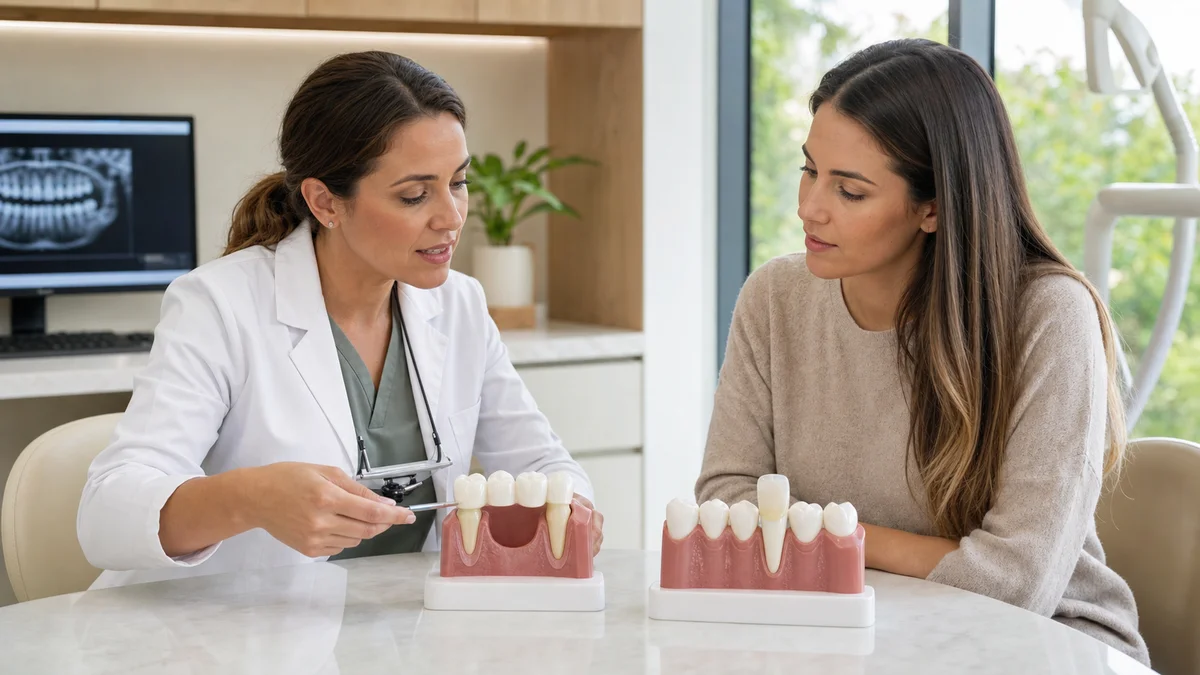
Quick answer: Dental bridge vs veneers is usually not a choice between equivalent treatments. A bridge replaces a missing tooth by using adjacent teeth or implants for support. A veneer changes the visible front surface of an existing tooth. The right option depends on whether a tooth is absent, restorable, healthy enough to preserve, and compatible with your bite.
People searching dental bridge vs veneers may be trying to close a visible space, improve uneven front teeth, or avoid an implant. Yet the two restorations solve fundamentally different anatomical problems. A dental bridge contains a replacement tooth, called a pontic, connected to retainers. A veneer is a thin restoration bonded to a tooth that is still present. Placing a veneer where no tooth exists cannot replace the missing root and crown.
The distinction matters because both treatments can require irreversible changes. A conventional bridge often needs preparation of supporting teeth. A porcelain veneer usually requires some enamel removal, and the American Dental Association’s patient guidance notes that veneer treatment is not reversible once enamel has been removed. Neither should be selected from photographs, price lists, or a desired shade alone.
This guide compares indications, tooth preparation, appearance, function, risks, maintenance, and cost structure without promising a result or lifespan. A reliable recommendation requires an examination, appropriate imaging, gum assessment, bite analysis, and discussion of alternatives. For an overview of care for international and English-speaking patients, visit Redent Klinik in English.
The Core Dental Bridge vs Veneers Difference
The simplest question is whether a natural tooth occupies the space. If a tooth is missing, a bridge, implant-supported crown, removable partial denture, orthodontic space management, or sometimes no immediate replacement may be discussed. A veneer cannot float over an empty socket. It needs an existing tooth surface for bonding and support.
If the tooth is present but its color, shape, surface, or proportion is the concern, veneers may be one option after conservative alternatives are considered. Whitening may address color without cutting tooth structure. Orthodontic treatment may reposition teeth rather than masking alignment. Composite bonding may alter selected areas with a different preparation and repair profile. A crown may be required when a tooth has lost too much structure for a veneer, but that also depends on the diagnosis.
A visible gap is not proof of a missing tooth. The space may result from naturally small teeth, tooth migration, gum disease, an enlarged frenum, or a mismatch between tooth and arch size. Closing it with overly wide veneers can create poor proportions or hygiene traps. An orthodontic or multidisciplinary plan may provide a more stable and conservative result.
Similarly, a retained root, impacted tooth, or non-restorable tooth can make a space appear suitable for a cosmetic fix while disease remains underneath. Clinical and radiographic assessment comes before shade selection. Active decay and gum disease should be treated before either bridgework or veneers.
Decision Table: Which Clinical Problem Are You Solving?
| Clinical situation | Option that may be discussed | Main trade-off | Question to ask |
|---|---|---|---|
| One tooth is missing between two teeth | Conventional bridge, adhesive bridge, implant crown, or removable option | Support teeth, surgery, hygiene, cost, and future repair differ | What is the healthiest support strategy for this gap? |
| Front tooth exists but has localized shape or color concern | Whitening, bonding, veneer, or another restoration | Amount of enamel alteration and repairability | What is the least invasive way to meet the goal? |
| Several front teeth are spaced but healthy | Orthodontics, bonding, veneers, or combination treatment | Tooth movement versus irreversible surface preparation | Will changing position produce better proportions than adding width? |
| Adjacent teeth already need crowns | A conventional bridge may restore supports and replace the gap | Shared support means one unit can affect the whole bridge | What is the prognosis of each supporting tooth? |
| Adjacent teeth are intact and healthy | Adhesive bridge or implant may preserve more tooth tissue in selected cases | Suitability depends on bite, space, bone, and location | Can the neighboring teeth remain largely unprepared? |
| Tooth is heavily broken or structurally weak | Build-up, crown, extraction and replacement, or specialist care | A veneer may not provide adequate coverage or support | Is there enough sound tooth for predictable restoration? |
| Gums are inflamed or teeth are mobile | Disease control before elective definitive restoration | Starting cosmetic work may hide or worsen active problems | What must be stabilized first? |
This table is a conversation guide, not a diagnosis. Multiple options can be reasonable for the same gap, and the best plan can change when the health of supporting teeth, bone, gum level, or bite is examined.
How a Dental Bridge Replaces a Missing Tooth
A fixed dental bridge spans a gap. In a conventional design, crowns on teeth beside the gap support the pontic. The supporting teeth must tolerate preparation and the additional functional load. Their roots, fillings, nerve health, gum support, position, and long-term restorability should be evaluated before they are committed to the bridge.
An adhesive bridge uses one or more wings bonded to the back of supporting teeth and can require less tooth reduction in selected situations. It is often discussed for particular anterior spaces, but bite contacts, enamel availability, gap size, and tooth position affect suitability. A bonded wing can detach, and rebonding or another treatment may be needed.
An implant-supported bridge is different from a tooth-supported bridge. It uses implants rather than natural abutment teeth, which avoids preparing neighboring teeth but adds surgery, healing, anatomical requirements, and implant maintenance. A removable partial denture is another replacement category and can be adapted more easily if the dentition changes.
Bridge planning must also consider the shape of the pontic against the gum. A design that looks natural but cannot be cleaned can retain plaque and inflame tissue. The dental laboratory, clinician, and patient all contribute to selecting material, contour, shade, connectors, and access for hygiene.
- Confirm why the tooth is missing and whether the site is healthy.
- Assess the structural and periodontal prognosis of possible support teeth.
- Compare conventional, adhesive, implant-supported, and removable options.
- Plan pontic shape, bite contacts, material, appearance, and cleaning access.
- Discuss what happens if a support tooth or part of the bridge later needs care.
How Veneers Change Existing Teeth
A veneer covers the facial, or visible front, surface of an existing tooth and may wrap slightly around edges. Porcelain veneers are usually fabricated outside the mouth and bonded later. Direct composite veneers or bonding are shaped in the mouth and can sometimes require less enamel removal, although preparation depends on the case.
Veneers can be considered for selected concerns involving shape, color, surface defects, wear, or proportion. They should not be placed over untreated decay, active gum disease, or a tooth that lacks enough healthy structure. Deep overbite, severe grinding, unfavorable tooth position, or limited enamel can affect the choice and risk profile.
The phrase “no-prep veneer” does not mean no diagnosis, no risk, or suitability for every smile. Adding material without creating space can make a tooth bulky, alter gum contours, or affect the bite. Some cases genuinely allow minimal preparation; others need enamel reduction for controlled contours and shade.
Veneers may chip, crack, debond, stain at margins, or require replacement. Natural tooth structure underneath remains vulnerable to decay around edges. Once a tooth has been prepared, it will usually continue to need a restoration. This long-term commitment should be understood before elective treatment.
Tooth Preparation and Preservation
Tooth preservation is one of the most important differences in dental bridge vs veneers. A conventional bridge may remove substantial tooth structure from two or more abutment teeth to create space for crowns. If those teeth already contain large restorations or need crowns, that preparation may align with their restorative needs. If they are intact, the biological cost deserves careful discussion.
A veneer generally removes less tooth structure than a full crown, but it is not automatically harmless. Enamel does not regenerate after it is cut. Bonding is often most reliable when adequate enamel remains, so overly aggressive preparation can undermine the very substrate needed for adhesion.
An adhesive bridge can be more conservative than a conventional bridge because a wing bonds to enamel. Composite bonding and orthodontics can also preserve more tooth structure than porcelain veneers in selected cases. An implant avoids preparation of adjacent teeth but involves the bone and soft tissues at the missing site.
The right comparison is therefore not “bridge is invasive, veneer is conservative.” It is: which tissues must be altered to solve this exact problem, what disease is present, and what future options remain? A minimally invasive treatment that does not solve the underlying problem is not truly conservative.
Appearance: Replacing a Tooth Versus Reshaping a Smile
A bridge in the visible zone must recreate a missing tooth while harmonizing with neighboring teeth and gum contours. Challenges include the width of the gap, loss of bone or gum volume, asymmetrical gum levels, and the color of support teeth. A pontic cannot recreate a natural root, so the emergence from the gum is an optical and prosthetic design challenge.
Veneers work with existing roots and gum positions. They can alter tooth width, length, shade, edge form, and apparent alignment. However, adding identical bright veneers across a smile can look artificial if facial proportions, translucency, texture, and natural variation are ignored.
Sometimes a missing front tooth is replaced with a bridge while veneers are placed on neighboring teeth for color or proportion. This combined plan affects more teeth and should not be proposed merely to make shade matching easier. Whitening, selective bonding, or laboratory characterization may reduce the number of treated teeth.
A diagnostic wax-up or digital preview can help communicate the intended shape, but it does not guarantee the biological or final visual outcome. Temporary restorations can test speech, lip support, length, and bite. Patients should see the difference between a simulation and an irreversible commitment.
Function, Bite, and Speech
Front teeth guide jaw movements, support speech sounds, and help bite food. Back teeth handle higher chewing loads. The design of a bridge or veneer must match its location and function. Material chosen for a low-load aesthetic area may not suit a high-force posterior site.
A bridge distributes force through its abutments or implants. Connector dimensions, span length, pontic position, support health, and opposing teeth affect the plan. A long span or unfavorable support can increase mechanical stress. A veneer depends on bonding, remaining enamel, tooth stiffness, and controlled bite contacts.
Grinding or clenching can contribute to chipping, wear, debonding, or fracture. A night guard may be discussed, but it cannot remove every risk. Treating severe wear may require analysis of the entire bite rather than placing isolated veneers on short teeth.
After treatment, a restoration that feels high, changes speech unexpectedly, traps food, or causes increasing discomfort should be reviewed. Patients should not try to reshape a bridge or veneer at home. Small professional adjustments can protect the restoration and opposing teeth.
Dental Bridge vs Veneers Costs: Compare the Whole Plan
The cost comparison cannot be reduced to a price per tooth. A bridge quote may include examination, temporary bridge, abutment preparation, impressions or scanning, laboratory work, material, cementation, and reviews. It may not include root canal treatment, core build-ups, gum treatment, extractions, or replacement of an old restoration on a support tooth.
A veneer quote can vary with the number of teeth, material, direct or laboratory fabrication, trial design, temporaries, shade complexity, gum preparation, and bite protection. Whitening before shade selection may be separate. Treating more teeth to create symmetry increases both cost and biological commitment.
Insurance treatment varies by jurisdiction and contract. A bridge replacing a missing tooth may be categorized differently from veneers placed primarily for appearance. Do not assume that “medically necessary” automatically means full reimbursement or that all veneers are excluded. Submit the written diagnosis, itemized plan, codes, and alternatives to the payer before treatment.
Compare likely maintenance and future repair, not only the initial fee. If a bridge abutment fails, several connected units may be affected. If one veneer chips, repair may be more localized, but color matching an older veneer can be difficult. No dentist can promise a fixed lifetime for either restoration.
Risks and Limitations of Each Option
Bridge risks can include decay at crown margins, gum inflammation, loss of support, fracture, debonding, food trapping, sensitivity, or later need for root canal treatment. The condition of an abutment may change underneath a connected restoration. An adhesive bridge may detach, while a conventional bridge may be more difficult to remove without damage.
Veneer risks can include sensitivity, marginal staining, gum recession, chipping, fracture, debonding, color mismatch, and decay around margins. Excessive preparation can expose dentin and reduce bond predictability. A veneer cannot reinforce every weakened tooth, and hiding a crack does not treat its structural cause.
Both treatments can disappoint aesthetically if expectations, tooth proportions, gum levels, or material limitations are not discussed. Neither restoration remains immune to trauma, biting hard objects, or uncontrolled grinding. Elective treatment should include alternatives and the option of no immediate intervention when clinically reasonable.
Seek prompt dental review for increasing pain, swelling, a loose restoration, a change in bite, or a sharp fractured edge. A displaced bridge or veneer that creates an airway concern requires urgent care. Severe swelling with trouble breathing or swallowing is a medical emergency.
Cleaning and Maintenance
Both restorations require twice-daily brushing with fluoride toothpaste and cleaning between teeth. Veneers are cleaned around their margins much like natural teeth. A bridge also needs cleaning under the pontic, where ordinary floss cannot pass down from the contact point.
Floss threaders, bridge floss, appropriately sized interdental brushes, or a water flosser may be recommended. The correct tool depends on contour and gum space. Forcing an oversized brush can traumatize tissue; a tool that is too small may not clean effectively.
Professional reviews assess margins, gum response, decay risk, bite, fractures, and hygiene access. Radiographs may be taken when clinically justified, not automatically at every visit. Patients with dry mouth, gum disease history, high decay risk, diabetes, or smoking exposure may need a different preventive schedule.
- Brush gently twice daily with fluoride toothpaste.
- Clean veneer contacts and bridge abutments every day.
- Use a threader or other recommended aid beneath a bridge pontic.
- Avoid using teeth or restorations to open packaging or bite hard objects.
- Attend risk-based reviews and report looseness, pain, or bite changes early.
When Travel for Treatment Is Part of the Decision
Dental travel can make bridge or veneer treatment attractive, but laboratory stages, temporaries, try-ins, adjustments, and review appointments must be planned. A fast schedule should not compress diagnosis or disease control. Active gum disease, decay, or unresolved pain should be stabilized before definitive cosmetic work.
Ask who will manage a temporary bridge failure, a loose veneer, sensitivity, or bite adjustment after you return home. A local dentist may not accept responsibility for another provider’s treatment, and matching a material or component can require records. Include possible return travel in the practical cost.
Request copies of radiographs, scans, photographs, laboratory prescriptions, material information, invoices, and treatment notes. Clarify the language of consent and aftercare instructions. A warranty is useful only if its scope, exclusions, review schedule, and travel responsibilities are realistic.
To discuss records and arrange an English-language assessment, you may contact Redent Klinik. Any remote opinion or quote remains provisional until the teeth, gums, bite, and imaging are assessed in person.
A Step-by-Step Consultation Checklist
- Identify whether the concern is a missing tooth, tooth shape, color, position, or disease.
- Confirm which teeth are present and restorable.
- Treat active decay, gum disease, infection, and unstable bite first.
- Ask for the most conservative reasonable alternatives.
- Compare conventional bridge, adhesive bridge, implant, removable replacement, bonding, orthodontics, and veneers where relevant.
- Review preparation depth and what healthy tissue will be removed.
- Discuss provisional restorations, laboratory stages, shade, and material.
- Understand maintenance, repair, and the effect of failure on other teeth.
- Receive an itemized written plan before irreversible treatment.
Frequently Asked Questions
Can veneers replace a missing tooth?
No. A veneer bonds to the front of an existing tooth. A missing tooth requires a replacement strategy such as a bridge, implant-supported crown, removable prosthesis, or another plan based on the gap and oral health.
Can a bridge close a gap when no tooth is missing?
A conventional bridge is intended to replace missing tooth structure across a true gap. If all teeth are present but spaced, orthodontics, bonding, veneers, or treatment of an underlying cause may be more appropriate. Diagnosis comes before labeling the space.
Which removes more tooth structure?
A conventional bridge usually requires crown preparation of its support teeth, often more reduction than a veneer. However, the exact amount depends on design, material, existing restorations, and tooth position. Adhesive bridges and bonding may be more conservative in selected cases.
Is a bridge better when neighboring teeth already have large fillings?
It may be a reasonable option if those teeth need full coverage and have a sound periodontal and endodontic prognosis. Large fillings alone do not prove suitability. Cracks, root health, remaining structure, and load must be assessed.
Are veneers reversible?
Porcelain veneer treatment is generally not reversible when enamel is removed. The tooth will usually continue to need a restoration. Minimal-preparation and composite options still require diagnosis and may involve surface alteration or future maintenance.
What lasts longer, a dental bridge or veneers?
No fixed personal lifespan can be promised. Bridge outcomes depend on support teeth, span, hygiene, material, and bite. Veneer outcomes depend on enamel bonding, preparation, bite, habits, and maintenance. Repair and replacement needs differ.
Can I whiten a bridge or porcelain veneers later?
Whitening changes natural tooth color but does not reliably change the shade of porcelain restorations. If future whitening is planned, it is often discussed before final shade selection. Existing restorations may need replacement to match a lighter shade.
Which is easier to clean?
Veneers are generally cleaned around their margins and contacts like natural teeth. A bridge adds a pontic that must be cleaned underneath with specialized aids. Actual ease depends on contours, spacing, gum health, and patient dexterity.
Can grinding damage both treatments?
Yes. Clenching and grinding can contribute to chipping, fracture, wear, debonding, or overload. Bite analysis and a protective appliance may be discussed, but no guard guarantees that a restoration will never be damaged.
Dental bridge vs veneers: which one looks more natural?
Both can look natural when properly indicated and designed. A bridge must recreate a missing tooth and gum emergence; a veneer modifies an existing tooth. Tissue levels, proportions, shade, texture, material, and technician-clinician communication matter more than the label.
Final Takeaway
The main lesson in dental bridge vs veneers is that these treatments are not interchangeable. A bridge replaces a missing tooth. A veneer modifies the visible surface of a tooth that remains in the mouth. Choosing one without defining the problem risks unnecessary preparation or an incomplete solution.
Prioritize disease control and natural-tooth preservation. Ask whether intact neighboring teeth must be prepared for a bridge, whether orthodontics or bonding can avoid veneers, and how every option affects future repair. Appearance matters, but it must coexist with function, cleanability, and a stable bite.
This article is educational and does not provide a diagnosis, fixed price, insurance decision, or result guarantee. A licensed dentist must examine your teeth, gums, bite, and appropriate imaging before recommending treatment.
Official Sources
- American Dental Association MouthHealthy: Veneers
- American Dental Association: Materials for indirect restorations
- NHS: Dental treatments, bridges, and veneers
- National Institute of Dental and Craniofacial Research: Oral hygiene
- American Dental Association
- World Health Organization: Oral health fact sheet