
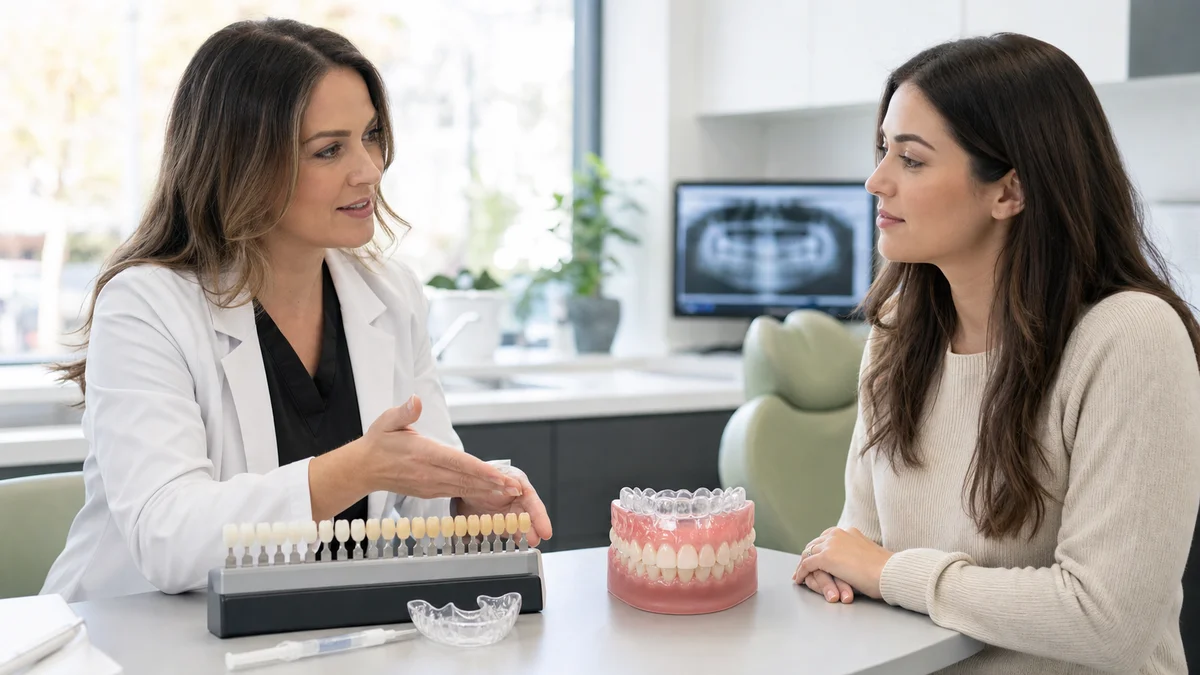
Quick answer: teeth whitening or Invisalign which is better depends on what you want to change. Whitening lightens the colour of suitable natural teeth; Invisalign clear aligners move teeth to improve selected alignment and bite problems. Neither replaces diagnosis, disease control or the other treatment. Some patients may benefit from a carefully sequenced combination after an in-person dental and orthodontic assessment.
Searching for teeth whitening or Invisalign which is better can make two very different treatments look like rival routes to a better smile. Whitening changes colour through a bleaching process. Invisalign is a brand of clear aligner orthodontic treatment that applies controlled force to move existing teeth. It can change position, spacing and selected bite relationships, but it does not bleach enamel. Whitening can reduce suitable stains, but it cannot straighten a rotated tooth or correct a bite.
The visible concern may involve both colour and position. Crowding can create shadows that make teeth look darker. Stain can draw attention to an otherwise acceptable alignment. Existing fillings, crowns or veneers may not match natural teeth. Gum inflammation, decay, enamel defects or a non-vital tooth can also change appearance and should not be treated as a generic cosmetic stain.
This guide helps separate those possibilities and explains how treatment may be sequenced. It does not diagnose discolouration, promise a particular shade or determine Invisalign suitability from photographs. At Redent Klinik, a plan begins with oral health, tooth and root condition, bite, expectations and informed consent rather than an instant package.
What Does Each Treatment Actually Change?
Tooth whitening uses peroxide-based agents in many professional and over-the-counter systems to change the colour of natural tooth structure. Depending on the product and diagnosis, it may be delivered in the clinic, through dentist-supplied home trays or through consumer products used as directed. Whitening toothpastes mainly remove some surface stain and do not work in the same way as chemical bleaching.
Invisalign clear aligners are removable orthodontic appliances. A planned sequence of trays moves teeth in stages. Small tooth-coloured attachments, elastics, enamel reduction between selected teeth or other auxiliaries may be used when clinically indicated. The digital setup helps plan movement but does not guarantee that every tooth will track exactly as animated. Reviews and refinements may be necessary.
Only natural teeth respond to bleaching. The American Dental Association notes that tooth-coloured restorations such as crowns, fillings and implants do not whiten. Invisalign can move many natural teeth, but it cannot move an integrated dental implant and does not repair decayed, cracked or severely damaged teeth. These boundaries are central when planning an even final smile.
- Whitening: targets suitable natural-tooth colour and certain stains.
- Invisalign: targets selected tooth positions and bite relationships.
- Restorative care: repairs decay, fractures, worn edges or failing restorations.
- Periodontal care: controls inflammation and disease in gums and supporting tissues.
Teeth Whitening or Invisalign Which Is Better for Your Main Concern?
If teeth are well positioned and the main concern is general yellowing or suitable staining, whitening may be the more direct and conservative discussion. If colour is acceptable but teeth are crowded, rotated or spaced, aligner assessment addresses the actual problem. If both are concerns, treatment may be combined, but sequence should reflect health, attachments, final tooth positions and any planned restorations.
A single dark tooth deserves special attention. It may result from trauma, decay, a large restoration, developmental change or loss of pulp vitality. Applying a general whitening product without diagnosis may not work and can delay necessary care. Internal bleaching, bonding, a veneer or another restoration may be considered in selected diagnosed cases, but each has different risks and indications.
Likewise, a smile that looks uneven may not be a simple alignment problem. Tooth-size differences, missing teeth, gum levels, wear, jaw relationships and old restorations can affect symmetry. Aligners move teeth; they do not change the intrinsic width of a small tooth or rebuild a chipped edge. The final plan may need orthodontic and restorative coordination.
A Decision Table for Colour, Position and Sequence
| Decision factor | Teeth whitening | Invisalign clear aligners | Question to ask |
|---|---|---|---|
| Primary goal | Lighten suitable natural teeth | Move natural teeth into planned positions | Is my main concern colour, alignment, bite or a combination? |
| What must be healthy first | Teeth, gums and sources of sensitivity or discolouration should be assessed | Teeth, roots, gums and supporting bone must be suitable for movement | Which examination and records establish candidacy? |
| Effect on restorations | Does not lighten crowns, fillings, veneers or implant crowns | May move teeth with restorations, but cannot move an implant | Will existing dental work need replacement or coordination? |
| Patient responsibility | Follow product amount, timing and sensitivity instructions | Wear trays as prescribed, maintain hygiene and attend reviews | What daily routine is required for safe progress? |
| Common limitations | Shade response varies and some discolouration does not respond predictably | Some movements need attachments, refinements, braces or other treatment | Which part of my goal may remain after this option? |
| Maintenance | Colour can change again with time and habits | Retainers are required because teeth can move after treatment | What long-term care should I budget and plan for? |
| Important risks | Temporary sensitivity and gum irritation are common concerns | Discomfort, gum changes, root effects, cavities and unwanted movement require monitoring | Which personal factors increase my risk? |
Who May Be a Candidate for Teeth Whitening?
Whitening may be considered for an adult with healthy teeth and gums who wants to reduce suitable extrinsic or intrinsic discolouration. A pre-whitening examination can identify decay, leaking restorations, cracks, gum recession, exposed roots, severe sensitivity or a colour change that requires investigation. Treating disease and identifying the cause comes before an elective bleaching protocol.
External stain from coffee, tea, tobacco or pigmented foods may sometimes improve with professional cleaning or an appropriate whitening toothpaste before chemical bleaching is considered. Intrinsic colour changes are within the tooth and may respond differently. Age-related darkening, developmental conditions and medication-related discolouration can vary greatly in response. A clinician should explain likely limits instead of promising a numbered shade.
Existing restorations need a shade plan. Whitening natural teeth around an unchanged crown or filling can create a mismatch. If a front restoration is due for replacement, a clinician may recommend whitening first, allowing colour to settle and then matching the new restoration. The interval and sequence are individual because immediate shade can shift after treatment and bonding procedures may require timing considerations.
Patients with active cavities, inflamed gums, cracked teeth or significant untreated sensitivity may need care before bleaching. Pregnancy, age, allergies, medical history and product ingredients can also affect advice. Over-the-counter availability does not mean every product is appropriate for every mouth.
Who May Be a Candidate for Invisalign?
Invisalign may be considered for selected crowding, spacing, rotations and bite relationships when natural teeth and supporting tissues are healthy enough to move. Candidacy depends on the exact movement, roots, bone, gum health, jaw relationships, restorations, missing teeth and cooperation. A scan of visible crowns is useful for records, but it is not a complete orthodontic diagnosis.
The American Association of Orthodontists explains that radiographs can reveal root health and impacted teeth that cannot be evaluated by visual inspection alone. An in-person gum examination is also important because moving teeth in poor periodontal health can increase risk. Active decay and gum disease should be controlled before elective orthodontic movement.
Aligners are removable, so the patient must wear them according to the prescribed schedule. Inconsistent wear can lead to poor tracking and longer treatment. Attachments may be visible, and trays can temporarily affect speech or comfort. Complex movements may require additional techniques, a switch to braces or multidisciplinary treatment. Preferring a nearly invisible appliance does not make it clinically suitable.
Patients with implants, crowns, bridges or missing teeth need coordinated planning. An implant does not move, a bridge may connect teeth that cannot be moved independently, and existing restorative contours can affect attachment bonding. Orthodontic movement may create better space for later restorations, but the sequence must be planned before irreversible dental work.
Which Treatment Should Usually Come First?
Oral health comes first in every sequence. Decay, gum inflammation, pain, cracks and unstable restorations should be assessed and managed. If both alignment and whitening are desired, active orthodontic treatment often precedes final shade and restorative decisions because tooth positions, visible surfaces and smile proportions change during movement.
Whitening after attachments are removed can provide more uniform access to enamel and lets the patient evaluate colour in the final alignment. It also allows any new front fillings, bonding, veneers or crowns to be matched to a settled shade. This is a common planning logic, not a rule for every patient. Some clinician-supervised protocols may use whitening at another stage when appropriate.
Do not put whitening gel into Invisalign trays unless the treating clinician has specifically approved the product, dose and method. An orthodontic aligner is designed to move teeth and should not automatically be treated as a bleaching tray. Gel contact, leakage toward the gums, attachment coverage and product compatibility need consideration.
If whitening is completed before aligners, colour may change again during a long orthodontic course because of habits, hygiene and time. That does not make early whitening unsafe in every case, but it can reduce predictability of the final shade. Ask whether a small pre-treatment change is worthwhile or whether waiting will simplify the finished result.
What Whitening Cannot Fix
Whitening cannot straighten teeth, close spaces, correct a deep bite or rotate a tooth. Lightening crowded teeth may reduce colour contrast but shadows and overlap remain. It cannot rebuild worn edges, repair chips or alter tooth size. Those concerns may require orthodontics, bonding, contouring or another restorative approach after diagnosis.
Bleaching cannot change the colour of porcelain, composite fillings, crowns, veneers or implant crowns. Repeated bleaching around restorations can make the mismatch more obvious. Replacement should not be automatic; the dentist should assess the restoration’s health, margins, function and whether the colour difference is acceptable.
Whitening is not a treatment for decay, internal infection or gum disease. A dark area may represent stain, but it may also be a cavity, leaking filling or trauma-related change. Pain, swelling, a sudden single-tooth colour change or persistent sensitivity deserves professional assessment.
Whitening also cannot promise a permanent shade. Diet, tobacco, ageing and oral habits can affect colour over time. Maintenance may involve periodic professional review and a carefully prescribed touch-up rather than continuous product use. More frequent or stronger application is not automatically more effective or safer.
What Invisalign Cannot Fix by Itself
Invisalign does not lighten enamel or change the colour of restorations. Aligning a previously hidden surface may reveal colour variation that was not visible before. A final whitening or restorative discussion may therefore be useful after movement. Tooth shade should be judged when teeth are clean and attachments are removed.
Aligners do not repair decay, restore missing structure or replace teeth. They can move natural teeth around a missing space in selected plans, but the final solution may involve an implant, bridge, bonding or acceptance of space closure. An integrated implant cannot be orthodontically moved.
Tooth movement cannot correct every jaw-size discrepancy. Some skeletal bite problems may require braces, growth-related planning in younger patients or jaw surgery assessment. A digital simulation that displays straight crowns does not prove that roots, bone and facial relationships can safely reach that position.
Aligners also cannot guarantee a perfectly symmetrical smile. Tooth shapes, gum levels, wear and facial proportions remain. Small restorative adjustments may be considered after movement, but they should be conservative and based on health rather than a template.
Risks and Side Effects to Understand
The ADA identifies temporary tooth sensitivity and gum inflammation as common adverse effects of vital tooth whitening. Sensitivity can occur during or after treatment, and exposed roots or existing sensitivity may increase concern. Whitening material that contacts soft tissue can irritate it. The clinician may alter concentration, duration or schedule, but no protocol can promise zero sensitivity.
Unsupervised or improvised methods can harm enamel or gums, especially when acidic or abrasive household substances are used repeatedly. “Natural” does not mean safe. Products should be used according to instructions, and consumers should avoid mixing chemicals or applying higher concentrations in trays not designed for them.
Orthodontic treatment can cause temporary pressure or discomfort. Poor hygiene around attachments and under trays can increase plaque accumulation, cavities, white spot lesions and gum inflammation. Root shortening, recession, loss of support and unwanted movement are among risks clinicians consider. They are not expected to occur in the same way for every patient, but they support the need for records and monitoring.
Aligners can be lost, damaged or fail to fit when movement does not track. Wearing an ill-fitting tray without advice can worsen the discrepancy. Contact the treating team if a tray no longer seats, an attachment breaks, pain is severe or a tooth appears unusually mobile. Do not skip far ahead in the sequence unless instructed.
- Stop or pause whitening and seek advice for severe, persistent pain or soft-tissue injury.
- Keep aligners clean and brush teeth before reinserting them as advised.
- Do not drink sugary or acidic beverages while trays cover the teeth.
- Report broken restorations, gum swelling, new mobility or trays that no longer fit.
- Attend planned reviews even when appearance seems to be improving.
Costs and Timelines Without Fixed Promises
Whitening costs vary by method, examination needs, product, number of visits and whether custom trays are made. Over-the-counter products often have a lower initial cost but use different concentrations and schedules. A cheaper product is not good value if the discolouration is unsuitable, the gums are irritated or a restoration mismatch was not identified.
Invisalign estimates may include records, planning, trays, attachments, enamel reduction where indicated, reviews, refinements and retainers. Providers may package these elements differently. The number of trays alone does not show complexity or predict the final timeline. Patient wear, biological response, missed visits and refinements can change duration.
When treatments are combined, costs should be separated so the patient understands which stages are included. Ask whether whitening, replacement of mismatched restorations, retainers and post-treatment bonding are additional. A written plan should identify known exclusions and explain how an unexpected dental problem would be handled.
Insurance coverage varies. Cosmetic whitening is often excluded, while orthodontic benefits may have age limits, waiting periods or lifetime caps. Only the insurer can confirm a particular policy. Do not rely on a clinic’s general statement that treatment is covered without direct verification.
Maintenance After Whitening and Invisalign
After whitening, ordinary oral hygiene and professional care continue. Brush with fluoride toothpaste, clean between teeth and follow any product-specific advice. Pigmented foods, beverages and tobacco can influence future colour, but extreme dietary restrictions are rarely a substitute for realistic maintenance. Ask before using frequent touch-up cycles.
After Invisalign, retainers are essential because teeth can move throughout life. Retainer design and wear instructions are individual. Retainers can wear, crack or stop fitting and may need replacement. A retainer is not necessarily suitable for delivering whitening gel; use it only as directed.
If final bonding, crowns or veneers are planned, the clinician may allow time for tooth position and colour to stabilise before matching materials. Restorations do not change colour with later bleaching, so future touch-ups can again create differences. A long-term shade and maintenance plan is more useful than chasing a permanent numerical shade.
Neither treatment replaces preventive care. Cavities and gum disease can develop during or after cosmetic and orthodontic treatment. Regular review protects natural teeth, restorations, gum health, bite and retention.
Alternatives and Combined Plans
A professional cleaning may remove some external stain without bleaching. Microabrasion, resin infiltration or conservative bonding may be considered for selected enamel spots after diagnosis. A single non-vital tooth may need a different approach from full-smile external whitening. Veneers or crowns are irreversible restorative treatments and should not be the automatic answer to colour alone.
Braces can provide an alternative when aligners are unsuitable or when the patient would struggle with wear. Limited orthodontic treatment may address a focused concern, while comprehensive treatment considers the full bite. The safest scope depends on diagnosis rather than the number of front teeth visible in a photograph.
Some patients benefit from a sequence of alignment, whitening and minor bonding. Moving teeth first can reduce the amount of restorative material needed to create symmetry. Whitening can establish the final natural-tooth colour, and bonding can then address small shape differences. This sequence preserves more tooth structure than using veneers to disguise major crowding in many suitable cases, but it is not universal.
Other patients may need only one intervention or no elective treatment. Natural shade and minor alignment variation can be healthy. Informed consent includes the option to accept those features and the consequences of postponing care. A clinic should not imply that every normal variation requires correction.
Frequently Asked Questions
Does Invisalign whiten teeth while they move?
No. Clear aligners move teeth but do not contain a bleaching agent. Teeth can look cleaner when hygiene improves, yet their intrinsic colour is not predictably whitened by the trays. Do not place whitening product inside aligners unless the treating clinician has approved the exact method.
Should I whiten before or after Invisalign?
Many plans place final whitening after active alignment and attachment removal so exposed enamel and final tooth positions can be assessed. However, timing depends on sensitivity, existing restorations, treatment length and goals. A clinician-supervised protocol may use another sequence when appropriate.
Can I use whitening strips with Invisalign attachments?
Attachments cover small enamel areas and may affect product contact, while strips may not fit evenly over them. Gum irritation and uneven results are possible. Ask the orthodontic and dental team before combining products. Waiting until attachments are removed may offer a more predictable final assessment.
Will whitening change the colour of fillings or crowns?
No. Bleaching lightens natural teeth but not tooth-coloured restorative materials. Existing restorations can appear darker afterward. Their health and appearance should be reviewed before whitening, and replacement should be considered only when clinically and aesthetically justified.
Can Invisalign fix teeth that only look dark because they overlap?
Alignment can reduce shadow and expose surfaces that were difficult to clean, which may improve overall appearance. It does not chemically change tooth colour. After movement and professional cleaning, the patient can reassess whether whitening is still desired.
Is professional whitening permanent?
No. Shade can change with ageing, diet, tobacco and oral habits. Response and stability vary. A dentist may discuss maintenance or touch-up treatment, but repeated or continuous use should not occur without considering sensitivity, gum health and product instructions.
Can Invisalign replace veneers?
Aligners can correct selected position problems and may reduce the need to remove enamel simply to disguise crowding. They do not change tooth colour or rebuild damaged shape. Veneers may still be considered for a suitable restorative indication after alignment, but neither treatment universally replaces the other.
Teeth whitening or Invisalign which is better for a wedding?
The answer depends on the concern and available time, but a deadline should not override diagnosis or safe schedules. Whitening may create a quicker colour change for a suitable patient; orthodontic movement takes staged biological time. Avoid guaranteed results and leave time to manage sensitivity, refinements or unexpected care.
A 9-Question Consultation Checklist
- Is my main concern tooth colour, position, bite, shape or gum level?
- What is causing the discolouration or alignment issue?
- Are my teeth, roots and gums healthy enough for elective treatment?
- Which fillings, crowns, veneers or implants will not whiten or move?
- What result is realistic, and which limitations will remain?
- If both treatments are planned, what sequence protects predictability?
- What sensitivity, gum, root, enamel and bite risks apply to me?
- What is included in the written estimate, including refinements and retainers?
- What maintenance and urgent-care arrangements follow treatment?
A sound consultation should make the purpose of each step obvious. Be cautious about shade guarantees, aligner plans based only on a selfie, claims that orthodontic trays are automatically safe whitening trays or pressure to replace healthy restorations before the final colour and tooth positions are known.
For questions about records, sequencing and travel arrangements, you can contact Redent Klinik. Remote photographs can support an initial conversation but cannot replace an examination of teeth, roots, gums and bite.
The practical answer to teeth whitening or Invisalign which is better is to treat the feature that actually concerns you. Whitening changes suitable natural-tooth colour. Invisalign moves suitable natural teeth. When both are appropriate, careful sequencing can reduce unnecessary restorative work and create a result that is easier to understand and maintain.
This article is general education and does not provide a diagnosis, fixed price, individual treatment recommendation or outcome guarantee. A licensed dental professional must assess candidacy and discuss reasonable alternatives.