
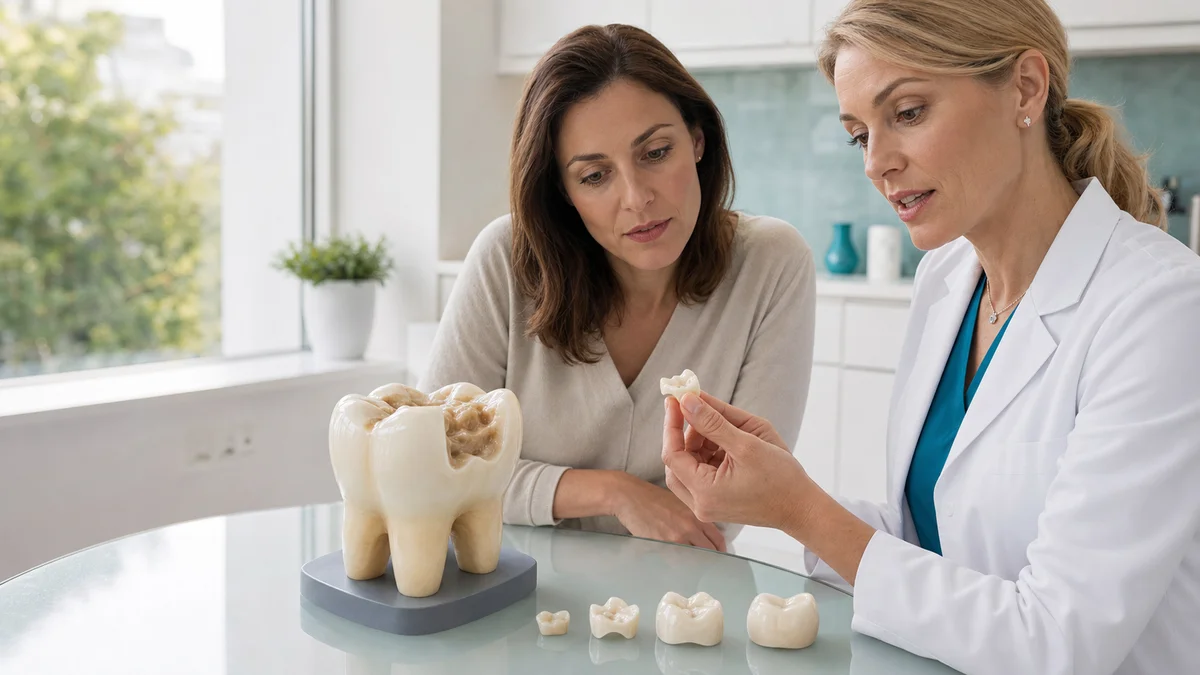
Quick answer: The most appropriate dental crowns alternatives depend on why the tooth needs treatment and how much sound structure remains. A filling, inlay, onlay, bonding, veneer, monitoring, or fragment repair may preserve more tooth in selected cases. None is a universal substitute: a badly broken, cracked, heavily loaded, or root-treated tooth may still need full cuspal coverage after examination.
Searching for dental crowns alternatives often reflects a sensible wish to preserve natural tooth structure, reduce preparation, control cost, or avoid a restoration that surrounds the whole tooth. The key is not to find the least invasive procedure by name. It is to choose the least invasive option that can predictably control disease, seal the defect, tolerate the bite, and remain maintainable.
A crown, also called a cap, covers the prepared clinical crown of a natural tooth. The NHS describes crowns as fixed restorations used for teeth that are broken, decayed, damaged, or sometimes aesthetically unsuitable. The US National Institute of Dental and Craniofacial Research distinguishes fillings for cavities from crowns used to repair badly broken-down teeth and notes that neither fillings nor crowns should be assumed to last for life.
That distinction matters. A small cavity and a weakened molar with missing cusps are not versions of the same problem. A veneer can change the visible face of a front tooth but cannot replace absent chewing cusps. A root canal can treat disease inside a tooth but does not rebuild the outside. An implant replaces a tooth after extraction; it is not a conservative covering for a tooth that can be retained. This guide explains the boundaries so that “alternative” does not become “undertreatment.”
1. Why a Dentist Recommends a Crown
A crown may be recommended when the remaining tooth cannot be restored reliably with a smaller repair. Possible reasons include extensive decay, a fractured cusp, a large failing restoration, severe wear, developmental weakness, a crack pattern that needs protection, or the need to rebuild shape and function after root canal treatment. Crowns can also alter colour and contour, although a purely cosmetic concern may have more conservative options.
The clinical question is how much healthy enamel and dentine remain in useful locations. Two teeth with similar-looking holes can behave differently if one has solid surrounding walls and the other has thin, undermined cusps. The bite matters as well. Back teeth receive different loads from front teeth, and clenching, grinding, missing teeth, or a concentrated contact can increase stress on a restoration.
A crown is not automatically required because a tooth has an old filling or has undergone root canal treatment. The American Association of Endodontists explains that restoration after root canal treatment depends strongly on tooth location and function; posterior teeth generally need greater protection, while some front teeth do not always require crowns. Remaining structure, cracks, access design, and bite still need individual assessment.
Conversely, avoiding a crown at any cost can sacrifice the tooth. Repeatedly enlarging a direct filling in a tooth with unsupported cusps may leave it vulnerable to fracture. The most conservative plan is the one that preserves the tooth over time, not necessarily the one that removes the fewest millimetres today.
2. Diagnosis Comes Before Comparing Dental Crowns Alternatives
An online photograph cannot show pulpal health, a hidden crack, decay beneath an old restoration, margin depth, root condition, periodontal support, or how the teeth meet. A dentist may combine symptom history, visual and tactile examination, bite testing, pulp tests, periodontal measurements, transillumination, magnification, and radiographs selected for clinical need. Old records can help show whether a lesion or crack is changing.
The assessment should separate four kinds of need:
- Disease control: Is there active decay, infection, or gum inflammation?
- Structural protection: Are cusps, walls, or the root at risk of fracture?
- Functional correction: Does the tooth need a stable contact, bite surface, or support for another restoration?
- Appearance: Is the main concern colour, shape, alignment, surface texture, or proportion?
A treatment that solves one category may not solve another. Whitening can improve colour but does not seal decay. Orthodontics can reposition a sound tooth but does not replace a fractured cusp. Root canal treatment can remove inflamed or infected pulp but still requires a secure coronal restoration. Extraction removes the entire tooth and creates a new replacement decision.
3. Dental Crowns Alternatives: A Decision Table
This table is a consultation aid rather than a diagnosis. Suitability depends on examination, material selection, isolation, bite, and the clinician’s ability to create sound margins.
| Clinical situation | Option that may be discussed | What it can preserve or achieve | Main limitation |
|---|---|---|---|
| Early mineral loss without a physical cavity | Prevention and monitoring | Avoids drilling while addressing decay risk | Not appropriate once a defect needs physical restoration or disease is progressing |
| Small to moderate cavity with strong surrounding walls | Direct filling | Replaces only the damaged area, often in one visit | Large fillings may not protect weakened cusps |
| Moderate internal defect with intact cusps | Inlay | Custom restoration within the cusps | Does not cover a cusp that needs structural protection |
| One or more weakened cusps but useful sound tooth remains | Onlay or partial-coverage restoration | Covers selected cusps while preserving other walls | Bonding and margin design are technique-sensitive; not every crack is contained |
| Small chip, local contour defect, or selected cosmetic change | Composite bonding | Often requires limited preparation and can be repaired | May wear, stain, chip, or be insufficient for major structural loss |
| Front surface colour or shape concern with healthy structural support | Veneer | Changes the visible facial surface with less coverage than a crown | Not a substitute for full structural protection or treatment of disease |
| Recent traumatic fracture with a suitable fragment | Fragment reattachment or bonded repair | May retain the original enamel form | Depends on fracture pattern, fragment condition, pulp, root, and bite |
| Tooth cannot be predictably restored | Extraction, then replacement assessment | Removes a source of unmanageable disease or structural failure | Irreversible; creates bone, function, and replacement considerations |
4. Direct Composite or Other Filling Materials
A filling is the most familiar conservative alternative when a cavity or defect is limited and the remaining tooth can support it. The dentist removes diseased or unsupported tissue, prepares the area, and places a restorative material directly. Tooth-coloured composite is commonly bonded in layers. Other materials may be appropriate according to location, moisture control, bite, allergy history, appearance, and local practice.
The ADA’s MouthHealthy resource describes composite resin as suitable for many small to mid-size fillings exposed to moderate chewing pressure. That is not permission to use composite for every large defect. As a filling expands across the tooth and replaces more walls or cusps, polymerisation stress, wear, fracture, contact shape, and remaining tooth flexure become more relevant.
A direct restoration may be a sensible choice when:
- the defect is localised and visible after old material or decay is removed;
- strong enamel and dentine remain around it;
- the cusps are not cracked or substantially undermined;
- the margin can be isolated and bonded or sealed predictably;
- the bite does not place disproportionate force on the repaired area;
- the patient accepts that repair or replacement may be needed later.
A large filling may sometimes be chosen as an interim restoration while symptoms, pulpal health, finances, or a broader plan are clarified. “Interim” should be explicit. The patient should know what finding would trigger review and whether the tooth is protected enough for ordinary chewing.
5. Inlays: Custom Repair Within the Cusps
An inlay is an indirect restoration made outside the mouth, traditionally by a dental laboratory or increasingly through digital design and milling. It fits within the cusp boundaries rather than covering the entire tooth. Materials can include ceramic, metal alloys, or resin-based systems. The exact terminology varies by design and jurisdiction.
An inlay can restore anatomy and contact points while preserving exterior tooth surfaces. It may be considered when a direct filling would be difficult to shape or manage but the cusps remain structurally suitable. The NHS includes inlays among custom-made restorations and distinguishes them from full-coverage crowns.
Its limitation is equally important: an inlay does not protect a weakened cusp simply because it is laboratory-made. If a cusp is cracked, thin, undermined, or heavily loaded, retaining it uncovered may not be conservative over time. The preparation and final material must also allow adequate thickness without creating fragile ceramic or unnecessarily removing sound tissue.
6. Onlays and Partial-Coverage Restorations
An onlay extends over one or more cusps while leaving other useful surfaces intact. It occupies the middle ground between a filling or inlay and a full crown. Related terms include partial crown, overlay, and occlusal veneer, although designs and definitions are not perfectly interchangeable.
This option can be attractive when a tooth needs cuspal protection but retains enough sound structure for a durable partial-coverage design. Adhesive ceramics and resin-based materials can support conservative preparations in selected cases. Metal onlays remain a functional option in some settings. Material choice affects required thickness, bonding, wear, appearance, repair, and how opposing teeth are treated.
An onlay is not automatically safer because it covers less. It requires a design that directs forces appropriately, adequate enamel or another reliable bonding strategy, controllable margins, sufficient material thickness, and careful bite adjustment. A deep margin, extensive crack, very short tooth, contamination risk, or loss of most walls can make a full crown or another treatment more predictable.
Ask the dentist to show which cusps need coverage and which surfaces can be retained. That explanation is more meaningful than asking whether an onlay is “better” in the abstract.
7. Composite Bonding and Fragment Reattachment
Composite bonding can rebuild a small chip, close a selected space, alter a local contour, or mask a limited defect. It is placed directly and often needs less preparation than a veneer or crown. Because composite can be added and repaired, it may be a useful staged or definitive solution for selected front teeth.
After trauma, an intact tooth fragment may sometimes be bonded back in place. Current trauma guidance recognises fragment reattachment among accepted restorative approaches when the fracture, fragment, pulp, root, and supporting tissues allow it. The priority after injury is proper assessment, not immediately choosing a cosmetic covering.
Bonding has limits. Large incisal reconstructions can chip under heavy contact, nail biting, or grinding. Colour and gloss may change. A repair that appears simple can fail if the tooth has a deeper crack, pulpal injury, or an unfavourable bite. Review is especially important after trauma because pulp or root complications may not be obvious on the first day.
8. Veneers for Selected Front-Tooth Concerns
A veneer covers primarily the visible front surface of a tooth. Porcelain veneers are custom-made shells; composite veneers use tooth-coloured restorative material. The ADA describes veneers as a way to alter the front surface, while the NHS notes that some enamel is prepared for a porcelain veneer.
A veneer may be considered when the central problem is colour, shape, a small gap, surface damage, or proportion and the tooth has adequate health and structure. Alternatives can include whitening, orthodontics, enamel reshaping, or bonding, depending on the cause. A diagnostic preview can help test shape and speech before irreversible preparation.
A veneer is not a structural substitute for every crown. It may be unsuitable when most of the tooth is filling material, decay is active, a crack needs broader protection, enamel for bonding is limited, the bite is unfavourable, or a root-treated tooth has major tissue loss. Extending a veneer around more surfaces until it behaves like a crown does not preserve the original distinction.
9. Prevention, Remineralisation, and Monitoring
When decay is at an early non-cavitated stage, the most conservative option may be to control the disease rather than place a restoration. NIDCR explains that early mineral loss can sometimes be stopped or reversed through saliva, fluoride exposure, and preventive care. Diet frequency, plaque control, dry mouth, fluoride availability, and recall planning all influence risk.
Monitoring can also be appropriate for a stable stain, superficial enamel line, or minor wear that does not threaten health or function. The dentist may document photographs, symptoms, measurements, bite, and radiographs where justified. Monitoring is an active plan with defined review criteria, not indefinite neglect.
Once a cavity, fracture, leaking restoration, pain source, or progressive defect requires physical treatment, fluoride alone cannot rebuild the missing anatomy. Delaying necessary care may allow a smaller restoration to become a larger one. Ask what evidence makes monitoring safe and what change would end it.
10. Root Canal Treatment Is Not a Crown Alternative
Root canal treatment addresses inflamed or infected tissue inside the root canal system. A crown, onlay, or filling restores and protects the exterior tooth. The procedures solve different problems and may be needed together. An aligner, veneer, or filling cannot disinfect a necrotic pulp, while root canal treatment alone does not replace lost cusps or create a durable biting surface.
The AAE advises returning for a crown or other final restoration after endodontic treatment. The exact restoration depends on tooth location, remaining walls, access size, cracks, previous fillings, and load. Posterior teeth commonly need cuspal protection. A relatively intact front tooth may sometimes be restored more conservatively.
A post is also not a strengthening alternative. It is used primarily to retain a core when insufficient coronal structure remains to hold that core. Placing a post requires space within the treated root and introduces its own risks. The need for a post, core, and crown should be explained separately rather than bundled as an automatic package.
11. Extraction and Tooth-Replacement Options
Extraction may be discussed when a tooth is vertically fractured, lacks adequate support, has decay extending beyond a restorable boundary, cannot be predictably sealed, or has insufficient structure for a maintainable restoration. It is not a conservative crown substitute. It removes the tooth and creates decisions about healing, bone, space, bite, appearance, and replacement.
Replacement options can include an implant-supported crown, a tooth-supported bridge, a removable partial denture, orthodontic space closure in selected cases, or no immediate replacement. Each has different effects on adjacent teeth, surgery, cleaning, timing, and cost. An implant is a medical device placed in bone; it does not restore the original tooth.
Before extraction, ask whether the tooth is truly non-restorable, whether specialist assessment could change the prognosis, and what the complete replacement pathway would involve. A lower initial extraction fee can lead to a larger total treatment if replacement is needed.
12. Cracks, Root-Treated Teeth, and Heavy Bites Need Extra Caution
Cracked teeth are difficult to judge from appearance alone. Crack direction, depth, symptoms, pulpal status, periodontal findings, and whether the crack extends onto the root affect prognosis. Covering cusps can reduce separation under load in selected cracks, but no restoration can guarantee that a crack will stop or that the tooth will remain symptom-free.
A root-treated posterior tooth may have lost structure from decay, previous restorations, fracture, and access preparation. Because it no longer responds to pulp tests in the same way, absence of temperature sensitivity does not prove structural safety. A final seal and suitable protection should not be unnecessarily delayed.
Clenching and grinding can damage natural teeth and restorations. Management may include bite assessment, changes to restoration design or material, treatment of specific interferences where indicated, and a protective appliance after definitive care. A night guard does not make an under-designed restoration adequate, and it does not cure every cause of tooth wear.
13. Cosmetic Alternatives When the Tooth Is Structurally Healthy
If a crown is proposed mainly to improve appearance, identify the exact visual problem. Surface stain may respond to professional cleaning. Natural colour may be lightened with dentist-supervised whitening in suitable patients. Minor spacing or rotation may be addressed orthodontically. Small contour differences may respond to enamel reshaping or additive bonding. Gum level or tooth proportion can require a broader smile assessment.
These treatments are not interchangeable. Whitening will not change an existing crown’s colour and may create a mismatch. Orthodontics changes position but not intrinsic colour or a defective restoration. Bonding adds material but can alter contacts and bite. A veneer still requires a healthy, maintainable foundation.
Ask for a plan that begins with the cause and preserves options. Completing whitening before selecting the shade of a new restoration can sometimes improve colour matching. Moving a tooth before preparing it may reduce the amount of structure removed. Disease control must come before elective cosmetics.
14. Cost, Insurance, and Dental Crowns Alternatives
There is no responsible fixed price for these choices without an examination and a defined scope. Fees can vary with tooth, surfaces, material, laboratory work, imaging, temporary care, isolation, core build-up, root canal treatment, specialist involvement, digital design, and follow-up. An onlay is not always cheaper than a crown simply because it covers less; technique and laboratory requirements differ.
Compare written plans that state:
- the diagnosis and intended benefit;
- which surfaces or cusps will be prepared;
- the material and whether laboratory work is included;
- whether a core, post, temporary restoration, or root canal is expected;
- the alternatives and consequences of delaying;
- likely maintenance, repair, and replacement scenarios;
- what insurance information is confirmed and what remains an estimate.
A less expensive filling can be good value when it is clinically appropriate. It can be poor value if it leaves a vulnerable cusp and soon fails catastrophically. A crown can be poor value if a small repair would have sufficed. The meaningful comparison includes tissue preservation, prognosis, repairability, and total ownership rather than the first invoice alone.
15. Questions to Ask About Dental Crowns Alternatives
Request a clear explanation tied to your tooth:
- What diagnosis is the crown intended to address?
- How much sound enamel and dentine remain after decay or old material is removed?
- Which cusps or walls are weakened, and can you show me?
- Is there evidence of a crack, pulpal disease, or root problem?
- Could a filling, inlay, onlay, bonding repair, or veneer meet the same goal?
- What risk makes the more conservative option unsuitable?
- Is monitoring safe, and what finding would trigger treatment?
- How will the chosen material interact with my bite and opposing teeth?
- What happens if I postpone treatment?
- What repair or replacement may be needed later?
For an examination-based comparison, visit Redent Klinik. Existing radiographs, photographs, previous treatment records, and information about grinding or trauma can improve planning. To arrange a consultation, use the Redent Klinik contact page.
16. Symptoms That Should Not Wait for an Online Comparison
Seek prompt dental assessment for spontaneous or severe pain, swelling, fever with dental symptoms, pain on biting, a newly mobile fragment, a lost temporary restoration, a bad taste or drainage, trauma, or a tooth that has split. Facial swelling with difficulty breathing or swallowing, eye involvement, rapidly spreading swelling, or significant uncontrolled bleeding requires urgent local care.
Do not place household glue on a tooth or restoration. Avoid repeatedly testing a cracked tooth with hard food. A temporary repair kit cannot diagnose decay, pulp injury, or fracture depth. Keep a dislodged restoration or tooth fragment clean and bring it to the appointment if safe to do so.
If the tooth is comfortable but a dentist has documented a structural concern, ask how urgent it is and which changes to watch for. Lack of pain does not prove that a heavily damaged tooth is stable, while pain does not automatically prove that a crown is the correct treatment.
Frequently Asked Questions
What are the most conservative dental crowns alternatives?
For a suitable tooth, prevention and monitoring remove no structure; bonding and direct fillings usually address a local area; inlays stay within the cusps; and onlays cover selected weakened cusps. “Most conservative” must include the risk of future fracture or leakage. A smaller treatment that cannot withstand the clinical load may not preserve the tooth.
Can a large filling replace a crown?
Sometimes, if enough strong walls and cusps remain and the bite is favourable. As a filling replaces more of the tooth, it may become less able to protect thin or cracked cusps. The dentist should assess the defect after decay and old material are removed, because the true extent may not be visible beforehand.
Is an onlay always better than a crown?
No. An onlay can preserve useful surfaces and protect selected cusps, but it requires a suitable defect, reliable margins, adequate material thickness, and a predictable bonding or cementation strategy. A tooth with extensive tissue loss, deep margins, limited retention, or an unfavourable crack may need full coverage or another approach.
Is a veneer an alternative to a crown on a front tooth?
It may be when the concern is mainly the front surface and the tooth retains healthy structural support and suitable enamel. A veneer does not automatically protect a tooth with major tissue loss, a large filling, active decay, or a crack. Bonding, whitening, orthodontics, or no treatment may be more conservative for some cosmetic concerns.
Does every root canal need a crown?
No universal rule fits every tooth. Posterior teeth generally experience heavier chewing load and often need cuspal protection. Some relatively intact front teeth may be restored with a bonded restoration. Tooth type, remaining walls, access, previous fillings, cracks, and bite determine whether the final restoration is a crown, onlay, filling, or another design.
Can I wait if the tooth does not hurt?
Only after the risk is assessed. Early mineral loss or a stable minor defect may be monitored, but large decay, a weakened cusp, a leaking restoration, or some cracks can progress with little warning. Ask what the diagnosis is, how delay could change restorability, and when review should occur.
Can a dental crown be repaired instead of replaced?
Selected small chips or access openings may sometimes be repaired, and a loose crown may sometimes be recemented if the tooth and crown remain suitable. Decay, fracture, poor margins, material failure, or an incompatible bite may require replacement or another treatment. The crown should be removed or examined as needed before the decision is made.
Are same-day onlays or crowns as good as laboratory restorations?
Digital same-day fabrication can produce appropriate restorations in suitable hands and cases, but timing alone does not determine quality. Diagnosis, preparation design, scanning, material selection, milling, finishing, bonding or cementation, and bite adjustment matter. Laboratory and same-day workflows each have advantages and limitations.
Will insurance pay for an onlay instead of a crown?
Coverage depends on the policy, coding rules, exclusions, waiting periods, annual limits, network, and the insurer’s assessment. Preauthorisation is not a guarantee of payment or clinical success. Obtain a written treatment plan and contact the insurer directly, but do not let an administrative category replace the clinical diagnosis.
Should I get a second opinion before a crown?
A second opinion is reasonable when the diagnosis is unclear, several healthy-looking teeth are proposed for crowns, alternatives were not discussed, symptoms and recommendation do not align, or the plan is extensive and irreversible. Bring existing records. Another opinion may confirm the crown, suggest partial coverage, or identify a different disease that needs treatment first.
Can “biomimetic dentistry” guarantee that I will avoid a crown?
No label can guarantee that outcome. Adhesive and partial-coverage techniques can preserve structure in selected cases, but suitability still depends on remaining tissue, cracks, decay, isolation, margins, material, and bite. Ask for the specific diagnosis, design, evidence, risks, and fallback plan rather than relying on a marketing term.
Conclusion: Preserve Tooth Structure Without Under-Protecting the Tooth
The safest way to compare dental crowns alternatives is to begin with diagnosis and remaining structure. Prevention or monitoring may suit an early lesion. A filling can repair a limited cavity. An inlay restores a contained defect, while an onlay can protect selected cusps. Bonding and veneers serve particular front-tooth needs. Root canal treatment addresses the pulp, and extraction is a separate, irreversible pathway.
A full crown remains appropriate when lesser coverage cannot reliably seal, rebuild, or protect the tooth. Ask the dentist to show the defect, explain the force and fracture concerns, compare realistic alternatives, and document what happens if treatment is delayed. The goal is not to avoid crowns categorically. It is to preserve as much healthy tooth as possible while giving the damaged tooth enough protection to function.
Sources
- National Institute of Dental and Craniofacial Research: Dental Fillings
- NHS: Dental Treatments, Crowns, Fillings, and Veneers
- American Dental Association MouthHealthy: Dental Filling Options
- American Dental Association MouthHealthy: Veneers
- American Association of Endodontists: Root Canal Treatment and Final Restoration
- American Dental Association
- World Health Organization: Oral Health