
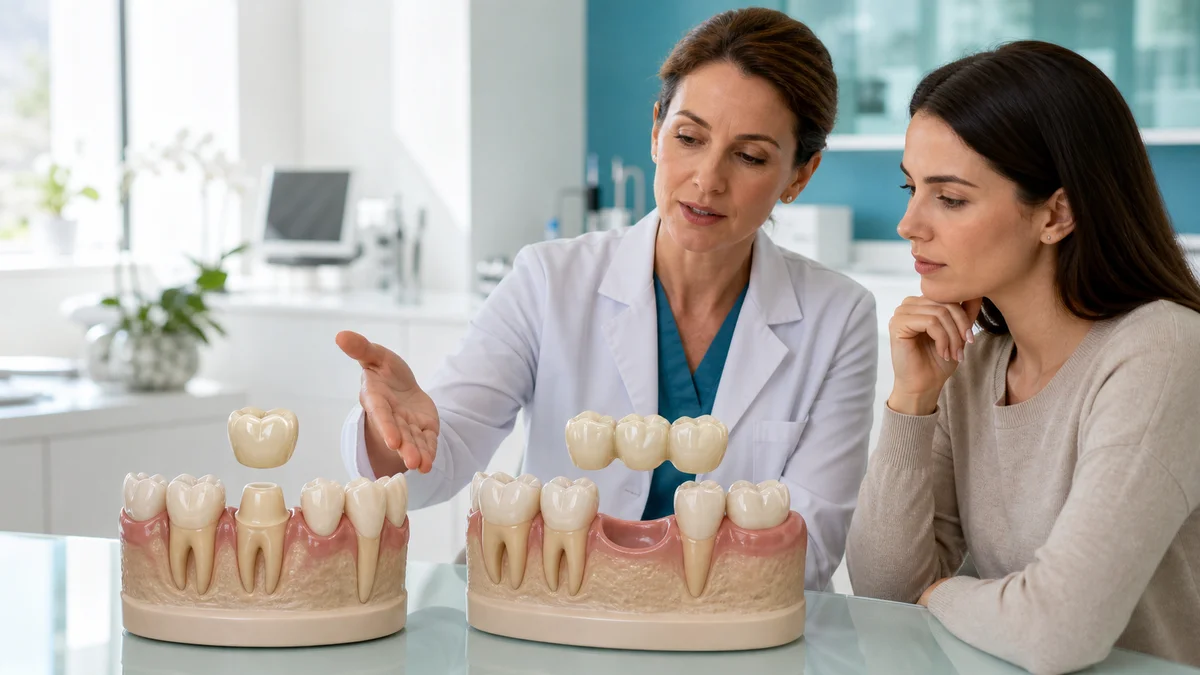
Quick answer: Zirconia crowns or dental bridge which is better is not a direct material contest. A single crown restores a damaged but maintainable tooth; a bridge replaces one or more missing teeth and may itself contain crowns. The right path depends first on whether the tooth exists and can be retained, then on support, bite, hygiene, bridge design, material, maintenance, and patient preference.
People searching zirconia crowns or dental bridge which is better may be deciding whether to save a damaged tooth, replace a tooth that is already missing, or plan what happens after an extraction. These are different clinical situations. Choosing a restoration before defining the problem can lead to unnecessary tooth preparation, delayed disease treatment, or a replacement that cannot be cleaned predictably.
A crown is a fixed cap that restores one existing natural tooth or covers an implant abutment. A dental bridge spans a gap and carries one or more artificial replacement teeth, called pontics. A conventional tooth-supported bridge commonly includes crowns on teeth beside the gap. Zirconia is a ceramic family that can be used to make selected crowns and bridges; it does not decide which treatment category is needed.
The NHS defines a crown as full coverage used when a tooth cannot be restored adequately by other means and a bridge as a fixed restoration replacing one or more missing teeth. The American Dental Association’s MouthHealthy resource similarly explains that a bridge fills a missing-tooth gap and relies on a sound foundation. This article applies those distinctions and does not diagnose an individual or guarantee a result.
1. The First Question: Is There a Tooth to Restore?
If the tooth is present and maintainable, the decision generally begins with how to restore it. A filling, inlay, onlay, veneer, or crown may be considered according to decay, fracture, remaining walls, pulp status, appearance, and bite. A bridge does not repair the damaged tooth. Using a conventional bridge after extraction means giving up the original tooth and preparing one or more neighbouring teeth for support.
If the tooth is already missing, a single crown cannot fill the gap unless it is supported by a dental implant. Missing-tooth options may include a resin-bonded bridge, conventional bridge, cantilever bridge in selected situations, implant-supported crown or bridge, removable partial denture, orthodontic space closure, or accepting the space. Anatomy, function, appearance, age, health, and preference influence the choice.
If extraction is merely proposed, pause between these pathways. Ask whether the tooth is predictably restorable, whether root canal or periodontal treatment could retain it, and what the long-term restorative plan would be. Extraction is irreversible. Saving a tooth at any cost can also be unwise when the root is vertically fractured, support is inadequate, decay is beyond a maintainable boundary, or a reliable seal cannot be achieved.
2. What a Zirconia Crown Actually Does
A zirconia crown is a custom ceramic restoration that surrounds a prepared tooth or implant abutment. It can rebuild missing tooth structure, protect weakened cusps, restore contact and bite, and change contour or colour. Zirconia restorations are digitally designed and milled from specialised blocks or discs, then sintered according to the material system.
Not all zirconia is identical. Formulations differ in translucency, strength, shade, and intended use. A monolithic crown is largely one zirconia material through its thickness. A layered crown has a zirconia framework or core with veneering ceramic added for appearance. Layering can offer aesthetic control but introduces an interface where chipping may occur. Monolithic designs avoid that interface but still require appropriate thickness, finishing, shade, and contour.
A crown should not be chosen solely because zirconia is marketed as strong. The tooth underneath must be diagnosed, disease controlled, and prepared with sufficient retention and resistance while preserving sound structure. The margin must be accessible or otherwise maintainable. The bite needs adjustment and the restoration should be polished appropriately, especially where it contacts opposing teeth.
A crown also does not strengthen a root that has a hopeless fracture or compensate for active periodontal disease. Its prognosis depends on the tooth, the restoration, and patient maintenance as a connected system.
3. What a Dental Bridge Actually Does
A fixed dental bridge replaces a missing tooth or teeth by linking the replacement tooth to supports. In a conventional three-unit bridge, the tooth on each side of a one-tooth gap is prepared for a crown, and the pontic is joined between them. The bridge is cemented as one restoration. It can only be removed by a dental professional.
A bridge can be made from zirconia, metal-ceramic, other ceramics, metal alloys, or combinations depending on design and local availability. The phrase “zirconia crown versus bridge” therefore mixes a material with a restoration type. A zirconia bridge may contain two zirconia retainers that resemble crowns plus the replacement tooth between them.
Other bridge designs change the biological commitment:
- Resin-bonded bridge: a replacement tooth is attached using one or more thin wings bonded mainly to enamel, usually with limited preparation.
- Cantilever bridge: the pontic is supported from one side in carefully selected low-risk situations.
- Implant-supported bridge: implants rather than natural teeth provide support for multiple replacement teeth.
- Conventional bridge: full-coverage retainers on natural teeth support the pontic across the gap.
Span length, connector dimensions, foundation quality, bite, and material indications matter. A material cleared or marketed for one bridge span or design should not be assumed suitable for every span.
4. Zirconia Crowns or Dental Bridge Which Is Better: Decision Table
This table helps identify the correct treatment category. It is not a substitute for examination, imaging selected for need, or a tooth-by-tooth prognosis.
| Clinical situation | Path usually assessed first | Why | Critical question |
|---|---|---|---|
| Damaged tooth remains and has adequate root and periodontal support | Tooth-preserving restoration, possibly a crown or partial-coverage restoration | A bridge is not needed to replace a tooth that can be retained | How much sound structure remains after disease and old material are removed? |
| Tooth remains but has pulpal infection and is restorable | Root canal assessment followed by an appropriate final restoration | External coverage cannot treat infection inside the canal system | Does the tooth need cuspal protection, and when should final restoration occur? |
| One tooth is already missing; adjacent teeth are healthy and unrestored | Compare resin-bonded bridge, implant crown, orthodontic closure, removable option, or no replacement | Preparing healthy neighbours for conventional crowns has a biological cost | Can the gap be restored without full preparation of adjacent teeth? |
| One tooth is missing; adjacent teeth already need crowns | Conventional bridge may be proportionate | The retainers may meet restorative needs that already exist | Are both support teeth strong enough and maintainable? |
| Multiple teeth are missing | Span-specific fixed, implant-supported, or removable assessment | Longer spans increase design, force, and hygiene demands | Is the proposed material indicated for this exact span and connector design? |
| Proposed extraction is based on uncertain prognosis | Restorability review or second opinion | Extraction changes the problem from restoration to replacement | What evidence makes retention unpredictable? |
| Active gum disease or poor plaque control | Disease stabilisation before definitive fixed work | Crown and bridge margins need healthy, maintainable tissues | Can the patient demonstrate sustainable cleaning before treatment? |
5. When Preserving the Natural Tooth Usually Comes First
Natural teeth have a periodontal ligament, sensory feedback, and a biological relationship with surrounding tissues that no prosthesis fully duplicates. When a tooth is maintainable, conserving it may avoid extraction, healing, a gap, and preparation or surgery involving other sites. Preservation can include prevention, filling, onlay, crown, periodontal care, or root canal treatment depending on diagnosis.
That does not mean every tooth should be saved indefinitely. A restoration needs a sound, cleanable foundation. Important considerations include root fracture, decay depth, ferrule or encircling tooth structure, periodontal support, crown-to-root relationship, mobility, furcation involvement, pulpal and periapical disease, the ability to isolate and seal margins, and whether the tooth contributes usefully to the bite.
Ask the clinician to distinguish “technically possible” from “predictably maintainable.” A complex attempt to retain a tooth may involve root canal treatment, post and core, crown lengthening, orthodontic extrusion, and a crown. The combined burden, uncertainty, and future options should be compared with extraction and replacement, not discussed as isolated procedures.
6. When a Tooth-Supported Bridge May Be Reasonable
A conventional bridge can be proportionate when a tooth is missing and the adjacent teeth already have large restorations, structural damage, or independent indications for crowns. The bridge can replace the gap while restoring those teeth. It may also avoid implant surgery and, in selected cases, complete treatment without a surgical healing interval.
Support teeth must withstand their own loads plus forces transmitted through the pontic. Root form, bone support, periodontal health, span, bite, parafunction, crown height, and existing endodontic status matter. A weak support tooth can compromise the entire bridge. Failure in one retainer may require repair or replacement of the connected restoration.
A bridge may be less attractive when the neighbouring teeth are intact and healthy, because conventional preparation removes substantial enamel and dentine. A resin-bonded bridge or implant-supported crown may preserve those teeth in suitable cases. Neither is universally preferable: resin-bonded bridges can debond, and implants introduce surgery, healing, device maintenance, and anatomical requirements.
7. Zirconia as a Material: Strength Is Only One Variable
FDA device records show zirconia ceramic blanks intended for professionally fabricated crowns and selected bridges, with indications that vary by product, region, span, and design. These records support an important point: “zirconia” is a material category, not a promise that every restoration can use the same dimensions or bridge length.
A prosthetic team considers flexural performance, fracture toughness, translucency, minimum thickness, connector area, sintering, colouring, surface treatment, and whether the restoration is monolithic or layered. Laboratory handling and the compatibility of the cementation or bonding protocol also matter.
Appearance can vary. Highly translucent zirconia may suit visible areas but may have different mechanical properties from more opaque formulations. A dark underlying tooth or metal post can influence shade. A bridge connector may need more bulk than a single crown, affecting contour and cleaning space. The best material is the one indicated for the design and managed properly, not simply the whitest or strongest name on an estimate.
8. Natural-Tooth Preparation and the Biological Cost
A crown requires circumferential preparation so restorative material can fit with adequate thickness and a defined margin. A conventional bridge usually requires preparation of at least one support tooth and commonly two. This is irreversible. Existing fillings and disease influence how much additional sound structure is removed.
Preparation can be justified when a tooth already needs substantial restoration. It is harder to justify when intact teeth are reduced solely to support a gap without discussion of less invasive options. Possible consequences include temporary sensitivity, pulpal inflammation, future root canal treatment, margin decay, gum response, or structural complications. These are risks, not inevitable outcomes.
The margin should be placed where it can be finished, recorded, fabricated, and maintained while meeting structural and aesthetic needs. Deep subgingival margins can complicate isolation, impressions or scanning, cement removal, and cleaning. Sometimes periodontal or orthodontic procedures are considered to expose sound tooth structure, but these add time, cost, and biological change.
9. Bite, Span, Connectors, and Bridge Engineering
A single crown restores one unit; a bridge behaves as a connected structure. Pontic length, connector dimensions, curvature, support distribution, and the direction of force influence how it flexes. Longer spans generally create more demanding engineering and may not suit the same material or support as a short bridge.
Clenching, grinding, edge-to-edge contacts, deep bite, missing posterior support, and a strong opposing dentition can increase load. The team may alter material, design, contacts, pontic shape, or support plan. A protective appliance may be recommended after treatment, but it cannot rescue an inadequately designed foundation.
A bridge also needs room for connectors that are structurally adequate but do not trap plaque or make the restoration appear bulky. Front-tooth aesthetics, speech, and gum contour can compete with cleaning access. A diagnostic wax-up or digital preview can help the team discuss these compromises before preparation.
10. Root Canal Treatment, Posts, and Crown Decisions
Root canal treatment manages inflamed or infected pulp inside a tooth. It does not by itself rebuild the exterior. The American Association of Endodontists advises completing an appropriate final restoration after treatment. Posterior teeth commonly need cuspal protection, while the need for a full crown on a front tooth depends on remaining structure, previous restorations, cracks, access, and function.
A post is used primarily to retain a core when insufficient coronal tooth remains. It does not reinforce a weak root. The clinician should explain separately why root canal treatment, a post, a core, and a crown are or are not indicated.
If a potential bridge support tooth needs root canal treatment, its endodontic and structural prognosis becomes part of the entire bridge plan. If that support later fails, the connected bridge may be affected. An implant crown, removable option, or another bridge design may be compared depending on anatomy and patient goals.
11. Cleaning a Crown Versus Cleaning a Bridge
A single crown is brushed like a natural tooth, with attention to the margin and interdental contacts. Floss or an interdental aid should pass beside it as instructed. The tooth can still develop decay at exposed margins or root surfaces, and surrounding gums can become inflamed if plaque accumulates.
A bridge requires cleaning around the retainers and underneath the pontic. Standard floss cannot pass down through a connected contact. The patient may need a floss threader, superfloss, interdental brush, end-tufted brush, or water irrigator as an adjunct. Pontic shape should allow access without creating an obvious gap or food trap.
Before choosing a bridge, ask for a demonstration using a model and confirm that dexterity, vision, caregiver support, and motivation make the method realistic. A restoration that cannot be cleaned is not low-maintenance simply because it is fixed.
12. Risks and Possible Complications
No fixed restoration is permanent or complication-free. A crown can develop decay at the margin, loss of retention, fracture, chipping, wear, colour mismatch, sensitivity, pulpal disease, gum inflammation, or bite discomfort. A bridge shares these risks across multiple retainers and adds pontic, connector, span, and hygiene considerations.
Zirconia itself can fracture, although the pattern depends on formulation and design. Veneering ceramic can chip. Rough or improperly adjusted surfaces may affect opposing enamel or restoration wear. A polished, correctly designed contact behaves differently from a rough surface after unpolished chairside adjustment.
Contact the dentist if a crown or bridge moves, clicks, fractures, becomes painful, traps increasing food, develops a bad taste, or feels high in the bite. The NHS includes broken or loose crowns and bridges among problems that warrant urgent dental advice. A loose bridge should not be glued at home because household products can damage tissues, prevent correct seating, and hide decay.
13. Alternatives When a Tooth Is Missing
A complete missing-tooth discussion includes more than a conventional bridge:
- Resin-bonded bridge: conservative support mainly from enamel, often used for selected short spans.
- Implant-supported crown: replaces the missing tooth without preparing neighbouring teeth but requires surgery and adequate bone and soft tissue.
- Removable partial denture: can replace one or several teeth and is removed for cleaning.
- Orthodontic space closure: moves teeth to close or redistribute space in suitable cases.
- No replacement: may be acceptable where function, stability, and appearance are not compromised, with monitoring.
Cambridge University Hospitals notes that bridges may be resin-bonded to adjacent teeth or conventional designs involving preparation, and that the decision depends on span, adjacent tooth structure, bite, and pulpal status. Implant and denture options bring different burdens and benefits. The correct comparison is individual.
14. Cost and Insurance: Compare Complete Pathways
A fixed price cannot be given safely without diagnosis, design, number of units, material, location, and included services. A single crown estimate may involve examination, imaging, decay removal, core build-up, temporary crown, laboratory work, fitting, and review. Root canal treatment or periodontal procedures may be separate.
A bridge is priced and planned by units and complexity. The estimate may include support-tooth preparation, core or endodontic treatment, pontics, temporaries, laboratory design, connector requirements, and follow-up. A lower per-unit fee does not prove a lower total biological or financial cost.
Request a written comparison that identifies:
- which teeth are being treated or replaced;
- why each support tooth is suitable;
- the zirconia formulation or restoration design where relevant;
- whether the restoration is monolithic or layered;
- temporary care, laboratory stages, and adjustments;
- root canal, post, core, gum, or extraction procedures not included;
- maintenance, repair, and replacement scenarios;
- insurance assumptions versus confirmed benefits.
Insurance classifications differ. A plan may apply deductibles, annual limits, missing-tooth clauses, alternative-benefit rules, waiting periods, frequency limits, or material downgrades. Administrative coverage does not determine whether a tooth is restorable or which design is safest.
15. Longevity Depends on More Than Zirconia
No responsible clinician can promise a crown or bridge will last a fixed number of years. Outcome depends on diagnosis, preparation, support, material indication, laboratory quality, fit, cementation, bite, diet, plaque control, fluoride exposure, gum health, smoking, dry mouth, grinding, trauma, and attendance.
A bridge can remain intact while a support tooth develops decay or periodontal loss. A zirconia crown can remain unfractured but lose retention. Conversely, a small chip or access opening may sometimes be repaired without replacing the entire restoration. Regular review aims to detect changes while options remain manageable.
Keep records of the material, tooth numbers, laboratory, implant system if any, and treatment date. Another clinician may need this information for repair or replacement.
16. Questions to Ask at the Consultation
Use the consultation to connect the recommendation to evidence:
- Is the original tooth present, and is it predictably restorable?
- If extraction is proposed, what finding makes retention unsuitable?
- Does each adjacent tooth independently need a crown?
- Could a filling, onlay, resin-bonded bridge, implant crown, denture, orthodontics, or no replacement work?
- Why is zirconia recommended, and is the exact material indicated for this span?
- Will the restoration be monolithic or layered?
- How much sound tooth must be removed?
- How will I clean under the pontic and around the margins?
- What does my bite or grinding history change?
- What happens if one support tooth later fails?
- Which items are included in the estimate?
- What follow-up and maintenance will I need?
At Redent Klinik, the useful starting point is an examination and a tooth-by-tooth prognosis rather than a material label. Bring previous radiographs, root canal reports, implant records, and details of grinding or failed restorations. To arrange an assessment, use the Redent Klinik contact page.
17. When to Seek Prompt or Urgent Dental Care
Arrange prompt assessment for persistent pain, pain on biting, swelling, a bad taste or drainage, a cracked tooth, a loose crown or bridge, sudden bite change, a dislodged temporary, or trauma. Do not delay diagnosis while comparing materials online. A crown cannot treat spreading infection, and a bridge cannot make a non-restorable support healthy.
Facial swelling with difficulty breathing or swallowing, eye involvement, rapidly spreading swelling, fever with worsening oral symptoms, significant uncontrolled bleeding, or serious facial trauma requires urgent local care. Do not wait for travel to a preferred clinic when emergency signs are present.
Frequently Asked Questions
Is a zirconia crown the same thing as a zirconia bridge?
No. A crown restores one tooth or implant abutment. A bridge replaces a missing tooth or teeth and uses natural teeth or implants for support. A bridge may be made from zirconia and can include crown-like retainers, but its pontics, connectors, span, and support create different design and hygiene requirements.
Zirconia crowns or dental bridge which is better for a broken tooth?
If the broken tooth is present and restorable, a crown, onlay, filling, or another tooth-preserving restoration is usually assessed before a bridge. A bridge becomes relevant if the tooth is missing or must be extracted. Pulp, crack depth, remaining structure, root, gum support, and bite determine whether the tooth can be retained.
Can a bridge save a damaged tooth?
A bridge does not repair a damaged tooth merely by spanning nearby. In a conventional design, support teeth receive crowns and must be structurally and periodontally suitable. If the damaged tooth is one of those supports, it needs its own diagnosis and restoration. If it is hopeless, extraction may create the gap that the bridge replaces.
Should healthy teeth be filed down for a bridge?
Conventional bridges require preparation of support teeth, which may be proportionate when those teeth already need crowns. When adjacent teeth are healthy and intact, discuss resin-bonded bridges, implant-supported crowns, orthodontic closure, removable options, or accepting the gap. Each has limitations, and no option is universally best.
Is zirconia always the best material for a bridge?
No. The best material depends on span, connector space, support, bite, appearance, opposing teeth, laboratory system, repair strategy, and the specific product’s indications. Zirconia formulations vary. Metal-ceramic, other ceramic, metal, or resin-retained designs may be more appropriate in selected situations.
Can zirconia crowns damage opposing teeth?
Opposing wear depends on surface finish, contour, bite, movement, grinding, and the opposing material, not only the word zirconia. A well-polished restoration with appropriate contacts differs from a rough adjusted surface. Report a high bite, new sensitivity, or unusual wear and attend recommended reviews.
How do I floss under a dental bridge?
Because the pontic is connected to its retainers, ordinary floss cannot pass through the contact from above. A dentist or hygienist may demonstrate a threader, superfloss, interdental brush, end-tufted brush, or irrigator as an adjunct. The method depends on pontic contour, tissue, space, and dexterity.
Does a root-treated tooth always need a zirconia crown?
No universal material or design fits every root-treated tooth. Posterior teeth commonly need cuspal protection, but the final restoration may be a crown or partial-coverage design depending on remaining structure, cracks, bite, and material. Some front teeth can be restored more conservatively. Zirconia is one possible material, not an automatic requirement.
Can a dental bridge be replaced with an implant later?
Sometimes, but it requires a new assessment of bone, soft tissue, space, support teeth, health, and the reason the bridge failed. Removing a bridge may reveal decay or structural damage. Grafting or staged care may be needed. Future implant possibility should not be assumed when choosing the original bridge.
What if one support tooth under a bridge fails?
The whole connected bridge may be affected. Options can include repair, endodontic treatment through the bridge, bridge removal, redesign, extraction of the failed support, implants, or a removable prosthesis. The cause, remaining supports, span, material, and restorability determine the pathway. This contingency should be discussed before treatment.
How long do zirconia crowns and bridges last?
There is no guaranteed lifespan. Material survival is only one part of clinical survival. Decay, gum support, fit, bite, chipping, retention, hygiene, dry mouth, smoking, grinding, trauma, and review influence outcome. A personalised maintenance plan is more useful than a promised number of years.
When is a second opinion useful?
Consider one before extracting a potentially restorable tooth, preparing healthy adjacent teeth, placing a long-span bridge, or accepting a plan that does not explain alternatives, material indication, hygiene, and failure scenarios. A second opinion may confirm the plan or identify a more conservative pathway. Bring the same records to make comparisons meaningful.
Conclusion: Choose the Treatment Category Before the Material
The safest answer to zirconia crowns or dental bridge which is better begins with anatomy. If a damaged tooth exists and can be retained, restore that tooth with the least invasive design that provides adequate protection. If a tooth is missing, compare bridge types, implant treatment, removable replacement, orthodontic closure, or no replacement. If extraction is only proposed, establish restorability first.
Zirconia may be an appropriate material for a single crown or selected bridge, but it does not remove the need for sound support, suitable dimensions, careful finishing, a stable bite, and daily cleaning. Ask for a written diagnosis, alternatives, support-tooth prognosis, material and span rationale, maintenance method, and complete estimate. That process answers the real question more safely than choosing a restoration by name.
Sources
- NHS: Dental Treatments, Crowns, and Bridges
- NHS England Digital: Definitions of Crowns and Bridges
- American Dental Association MouthHealthy: Bridges
- Cambridge University Hospitals: Missing-Tooth Options and Bridge Designs
- American Association of Endodontists: Root Canal Treatment and Final Restoration
- US Food and Drug Administration: Zirconia Crown and Bridge Material Indications
- American Dental Association
- World Health Organization: Oral Health