
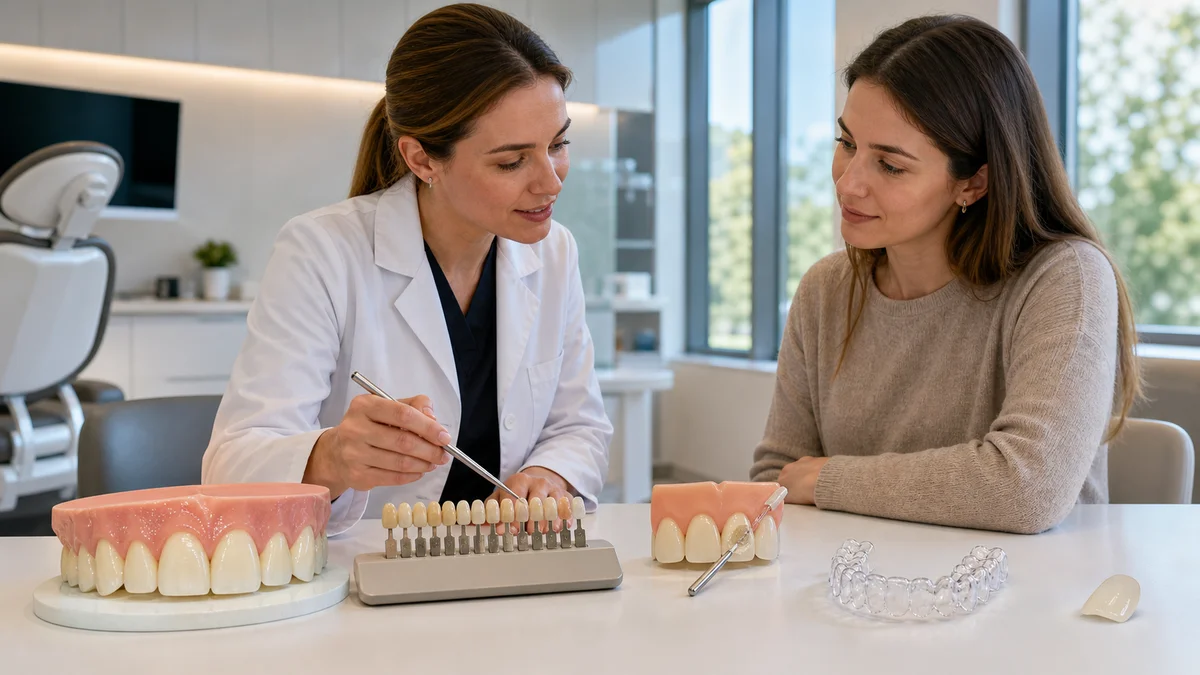
Quick answer: The right porcelain veneers alternatives depend on what you want to change. Whitening may address natural tooth colour, bonding can repair selected chips or contours, and orthodontics can move teeth. Enamel reshaping, treatment of decay or gum disease, monitoring, and accepting natural variation may also fit. A dental examination is needed because these options solve different problems.
People searching for porcelain veneers alternatives are often trying to protect healthy enamel, avoid an irreversible step, simplify maintenance, reduce the scope of treatment, or understand whether their concern can be treated another way. Those are useful questions. A porcelain veneer is a thin ceramic facing bonded to the visible surface of an existing tooth. It can alter colour, shape, apparent position, length, or proportion, but it is not the only way to address every one of those features.
The safest comparison begins with the cause of the concern. A dark tooth after trauma is not the same problem as general yellowing. A small chipped edge is not the same as widespread enamel loss. A tooth that appears crooked may need movement rather than camouflage. Bleeding gums, decay, a crack, or an unstable bite can make elective cosmetic treatment inappropriate until health and function are controlled.
The American Dental Association’s patient guidance states that enamel is removed to place a veneer and describes veneer treatment as not reversible. It also advises treating decay or gum disease first and notes that veneers can chip, crack, wear, or loosen. These points do not make veneers inherently unsuitable. They explain why a licensed dentist should compare benefits, biological cost, maintenance, and realistic alternatives before any tooth is prepared.
1. Start With the Problem, Not the Procedure
“I do not like my smile” can represent several separate clinical and personal concerns. Colour may be caused by external staining, natural dentine shade, medication-related change, enamel development, an old filling, or loss of pulp vitality. Shape may reflect a small chip, wear, natural anatomy, a developmental difference, or previous restorative work. Position may involve spacing, crowding, rotation, tooth size, gum level, or the relationship between the jaws.
Each cause leads to a different discussion. Whitening changes the colour of suitable natural tooth structure but does not move teeth or repair a fracture. Bonding can add tooth-coloured material but does not correct root position. Orthodontics moves teeth but does not make an intrinsically dark tooth lighter. Gum treatment can improve health and tissue stability but should not be marketed as a substitute for every aesthetic concern.
A responsible assessment commonly reviews:
- Health: active decay, gum inflammation, erosion, cracks, sensitivity, pulp status, and previous treatment;
- Structure: available enamel, existing fillings, remaining tooth walls, wear, and fracture history;
- Function: bite contacts, guidance, clenching, grinding, speech, and chewing;
- Appearance: colour, texture, alignment, proportions, gum levels, smile line, and facial context;
- Preferences: tolerance for preparation, treatment time, repair, retention, review, and future replacement.
Photographs and a digital consultation can support communication, but they cannot reveal every cavity, crack, root, bone level, bite contact, or pulpal problem. The dentist may recommend a clinical examination, periodontal measurements, vitality testing, photographs, scans, or radiographs selected for a specific reason. The purpose is not to make a cosmetic plan complicated; it is to avoid placing a cosmetic restoration over an undiagnosed problem.
2. What Porcelain Veneers Change and What They Cannot Treat
Porcelain veneers are indirect restorations, meaning they are fabricated outside the mouth and later bonded to prepared or selected tooth surfaces. Ceramic can provide controlled anatomy, translucency, texture, and surface colour. The final result, however, depends on much more than the ceramic: diagnosis, enamel availability, preparation design, laboratory communication, isolation, adhesive technique, margin position, bite, and maintenance all matter.
A veneer may be discussed for selected discolouration, shape differences, worn or chipped edges, spaces, surface defects, or limited visual correction of tooth position. It does not remove infection, reverse gum disease, move the root, replace a missing tooth, or strengthen every severely damaged tooth. If a tooth has substantial decay, a large restoration, a deep crack, or very little sound structure, a veneer may be too limited. If the tooth is healthy and the concern is minor, it may be more treatment than is needed.
Terms such as “minimal-prep” and “no-prep” describe possible approaches, not guarantees. Adding ceramic without creating appropriate space can produce excessive contour, prominent margins, altered speech, or cleaning difficulty. Conversely, aggressive preparation can reduce enamel available for reliable bonding and increase biological cost. The preparation should follow the starting anatomy and agreed outcome, not a standard package.
Porcelain itself does not make a restoration permanent. A veneer may eventually need polishing, repair, rebonding, or replacement. Natural teeth can still develop decay at exposed surfaces or margins, and gum recession can change what is visible. Anyone comparing alternatives should therefore ask not only “How will it look at placement?” but also “What tissue is changed, how is this maintained, and what happens if it fails?”
3. Porcelain Veneers Alternatives at a Glance
The following table is a decision aid, not a prescription. Several approaches can be combined in a staged plan, and sometimes the safest option is to treat disease or observe before changing appearance.
| Main concern | Option that may be considered | What it can do | Important limit or trade-off |
|---|---|---|---|
| Natural teeth look darker or more yellow | Dentist-supervised whitening | Lightens suitable natural tooth structure without covering it | Does not change tooth shape or lighten crowns, veneers, or fillings |
| Small chip, local space, or contour difference | Direct composite bonding | Adds tooth-coloured material, often with limited preparation | Can stain, wear, chip, or require repair; cannot solve every bite or structural problem |
| Crowding, rotation, spacing, or bite relationship | Braces or clear aligners | Moves suitable teeth and roots rather than masking position | Needs time, monitoring, hygiene, cooperation, and retention; not every case suits aligners |
| Very small edge irregularity or excessive enamel point | Enamel reshaping | Refines a limited contour without adding a restoration | Irreversibly removes enamel and is only suitable for small, carefully measured changes |
| External stain, plaque, or calculus | Professional cleaning and prevention | Addresses surface deposits and supports gum health | Does not change intrinsic tooth colour or major anatomy |
| Decay, a defective filling, or local structural damage | Disease control and a local restoration | Treats the damaged area according to its size and location | A filling is not a cosmetic cover for a tooth needing broader protection |
| Uneven gum inflammation or unstable tissue | Periodontal care first | Controls disease and allows tissue response to be reassessed | Does not automatically change tooth colour, position, or structure |
| Minor natural variation without disease | Monitoring or no treatment | Preserves all tooth structure and future choices | Requires comfort with the current appearance and appropriate review if findings change |
| Several concerns with different causes | Staged combination plan | May use health care, movement, whitening, and limited restoration in sequence | Needs coordination so early steps support the final goal |
4. Professional Whitening When Colour Is the Main Concern
Whitening may be among the most conservative alternatives when the teeth are healthy, the main concern is shade, and the type of discolouration is likely to respond. The NHS explains that whitening bleaches teeth to a lighter colour and is commonly provided through dentist-supervised treatment involving a fitted tray and bleaching gel. The exact method, concentration, schedule, and suitability vary.
Before whitening, a dentist should identify cavities, leaking restorations, gum inflammation, recession, sensitivity, cracks, and the cause of the colour difference. One tooth that darkened after trauma may require vitality assessment rather than simply stronger bleach. White or brown developmental spots may respond unevenly. Very translucent enamel can appear darker because underlying dentine remains visible.
Whitening only affects natural tooth structure. It does not lighten composite bonding, crowns, bridges, or existing veneers. This can create a mismatch, so shade planning should account for visible restorations. If replacement is appropriate, clinicians often allow the whitening result to stabilise before selecting a final restorative shade, but the sequence is personalised.
Temporary sensitivity and gum irritation can occur. More gel or longer wear is not automatically better, and online products of uncertain composition can create avoidable risk. Whitening should not be promised to reach a fixed shade. The clinical goal is a safe improvement within the response of the individual’s teeth, followed by realistic maintenance as diet, ageing, and habits affect colour over time.
5. Composite Bonding for Chips, Gaps, and Local Shape Changes
Direct composite bonding uses tooth-coloured resin placed, shaped, cured, finished, and polished on the tooth. It can repair selected chipped edges, add width to a small tooth, reduce the appearance of a local space, mask some surface defects, or refine symmetry. In suitable cases, it may be mainly additive and preserve more enamel than a porcelain veneer.
Bonding is not synonymous with “no drilling” in every case. A dentist may need to smooth unsupported enamel, remove decay or an old restoration, create space, or refine a surface for a stable transition. The amount should be based on the defect and design. Successful bonding also requires moisture control, an appropriate adhesive protocol, enough material thickness, and bite contacts that do not overload a thin edge.
Advantages can include treatment in fewer clinical stages, direct control of form, and the possibility of repair. Limitations can include staining, loss of surface gloss, edge wear, chipping, and colour change. A large composite facing across several teeth may need regular polishing and occasional repair. That maintenance is not necessarily failure; it should simply be understood before treatment.
Bonding may be unsuitable when a tooth lacks adequate support, a major position correction would create a bulky contour, hygiene would be compromised, or heavy bite forces repeatedly contact the proposed addition. A mock-up or trial addition can help assess length, speech, lip contact, and bite before the final material is placed.
6. Orthodontics When the Concern Is Tooth Position
Braces and clear aligners move teeth through controlled forces and biological remodelling around the roots. They can address selected spacing, crowding, rotation, protrusion, overbite, open bite, or other malocclusion. When a healthy tooth looks “crooked,” moving it may preserve more enamel than preparing its front surface to create the appearance of alignment.
Orthodontic treatment is not automatically simple or purely cosmetic. The NHS notes that good oral hygiene is needed before treatment because orthodontics can increase the risk of decay and gum problems. The FDA explains that clear aligners are removable and may not work for every set of teeth. Suitability depends on diagnosis, root and bone health, the type and amount of movement, age and growth where relevant, cooperation, and the ability to attend monitoring.
Clear aligners are one appliance category, not a guarantee of an invisible or attachment-free process. Tooth-coloured attachments, elastics, interproximal enamel reduction, refinements, or another appliance may be recommended. Braces may offer better control for some movements. After active treatment, retention is generally needed because teeth can move again.
Orthodontics changes position but not tooth colour, a chip, an old filling, or intrinsic shape. A coordinated plan can sometimes align first, whiten later, and use limited bonding only where needed. Starting with the final restorative goal can help the orthodontist create useful spaces and contacts while reducing the number or size of restorations.
7. Enamel Reshaping for Very Small Contour Differences
Enamel reshaping, also called odontoplasty or enameloplasty in some contexts, removes a very small, controlled amount of enamel to soften a pointed corner, level a minor edge irregularity, or improve a local transition. It does not add material, require laboratory work, or cover the tooth. For a limited concern on a healthy tooth, it can be simpler than a veneer.
Its scope is narrow. Enamel has finite thickness and does not regenerate after removal. Excessive reshaping can expose more dentine, alter contact, increase sensitivity, weaken an edge, or make the tooth look too short. The dentist should assess enamel thickness, tooth position, bite, and whether the feature is actually caused by wear or fracture that needs a different response.
Reshaping is not suitable for large chips, significant lengthening, broad colour change, substantial crowding, or a structural defect. It may be combined with a small addition of composite so that less enamel is removed and the final form is balanced. A preview, measurements, and conservative endpoint help keep a small procedure small.
8. Cleaning, Disease Control, and Repair Before Cosmetic Coverage
Surface stain and calculus can make teeth look darker or less even. Professional cleaning may improve appearance while also supporting gum health. It cannot bleach intrinsic colour, but it should often precede final shade assessment. The patient can then decide whether any cosmetic treatment is still desired after deposits and inflammation are addressed.
Active decay and gum disease need diagnosis and control before elective veneers or their cosmetic alternatives. NIDCR describes gum disease as infection of the tissues supporting teeth and notes that treatment aims to control that infection. Inflamed or bleeding tissues make aesthetic margin planning less stable, and untreated disease may continue beneath or around restorations.
Local treatment may include fluoride and risk management for early non-cavitated decay, a filling for a cavity, replacement or repair of a defective restoration, management of erosion, or periodontal care. If a tooth is cracked, traumatised, or has pulp disease, the priorities change again. Cosmetic masking should not delay treatment needed to preserve health.
This sequence protects both the patient and the appearance. Stable gums allow more reliable assessment of tissue levels. Controlled decay risk helps protect restoration margins. A comfortable bite reduces avoidable overload. Only after these foundations are addressed can a clinician judge whether whitening, bonding, orthodontics, a veneer, another restoration, or no further treatment best matches the goal.
9. Monitoring and Choosing No Irreversible Treatment
Natural teeth vary in shade, translucency, texture, symmetry, and alignment. If the feature is healthy, stable, and acceptable to the patient after balanced information, choosing no treatment is a legitimate clinical decision. It preserves enamel, avoids maintenance, and keeps future options open.
Monitoring is not the same as ignoring disease. A dentist can document photographs, symptoms, wear, cracks, gum findings, and radiographs where justified, then specify a review interval and signs that should prompt earlier care. Stable enamel marks or minor asymmetry may need no intervention. Progressive wear, a changing crack, increasing sensitivity, or a darkening traumatised tooth requires reassessment.
People can feel pressure from highly edited images, uniform commercial smile templates, or package-based treatment. A consent discussion should distinguish personal preference from clinical need and explain what cannot be recreated exactly. Teeth exist within moving lips, changing light, gums, speech, and a functioning bite. A preview can inform the decision, but it cannot guarantee the appearance of every photograph.
10. Combining Porcelain Veneers Alternatives in a Staged Plan
The best plan is sometimes a sequence rather than a single substitute. Disease control comes first. Orthodontics may then improve tooth position and distribute space. Whitening can address natural shade after the dentist confirms suitability. Small areas of composite can finish proportions or repair chips. This sequence may reduce the number of teeth restored or the amount of preparation required.
Order matters. Whitening after colour-matched restorations can create a shade mismatch. Moving teeth after final bonding may change contacts and contours. Restoring worn edges without understanding the bite may lead to repeated fracture. Periodontal inflammation can change gum levels after a cosmetic margin has already been designed.
A staged plan should define:
- which finding is being treated at each stage;
- what must be stable before the next stage begins;
- whether temporary previews or provisional changes are needed;
- how orthodontic retention and restorative maintenance interact;
- what would cause the plan to change;
- which outcome is realistic without a veneer and which may still require one.
Staging also creates decision points. After cleaning, alignment, or whitening, a patient may decide that no further treatment is needed. That is a valuable outcome, not an incomplete package. If a veneer remains appropriate for one or two teeth, the earlier steps may allow a more limited and coherent design.
11. How Bite, Grinding, and Existing Restorations Change the Choice
Front teeth guide jaw movement and may receive significant force during biting, speech habits, nail biting, or grinding. An alternative that looks conservative can still fail if it is placed where the bite repeatedly strikes a thin edge. The dentist should assess static and moving contacts, wear patterns, missing teeth, jaw relationship, and reported habits.
Composite can often be repaired, but recurring chips may signal an unresolved force problem. Porcelain can resist staining but may chip or debond. Orthodontics can improve some relationships but also creates a retention obligation. A protective appliance may be recommended after treatment for selected patients, yet it does not make an unsuitable design safe and cannot guarantee prevention of fracture.
Existing restorations affect bonding, colour, and preparation. Whitening will not change them. A large front filling may leave less enamel for a new veneer. Replacing sound restorations solely to make all teeth identical increases treatment scope and should be carefully justified. Sometimes repairing a local margin or accepting a small shade difference preserves more tissue than replacing the entire restoration.
12. Comparing Cost Without Buying the Wrong Treatment
No responsible comparison can give one fixed price for all patients or countries. Cost can depend on the number of teeth, diagnostic records, material, laboratory work, clinician time, orthodontic complexity, whitening method, repairs needed first, retention, reviews, and local regulations. A lower starting fee does not necessarily mean lower lifetime maintenance, while a higher fee does not prove superior diagnosis or outcome.
Compare written plans with the same scope. Ask whether the estimate includes examination, imaging when indicated, mock-ups, temporary restorations, refinements, retainers, review appointments, repairs, and any treatment required before cosmetic care. Insurance coverage varies by policy and medical necessity; the insurer and treating provider should confirm details rather than relying on general online claims.
For treatment outside your home area, include travel, the number and timing of visits, management of sensitivity or breakage, and who will provide follow-up. Remote photographs can help start a conversation, but a final irreversible plan should be based on an appropriate clinical assessment by a licensed professional.
13. Questions to Ask Before Choosing an Alternative
Useful questions keep the consultation tied to diagnosis and long-term consequences:
- What exactly causes the colour, shape, spacing, or alignment concern?
- Are my teeth and gums healthy enough for elective treatment now?
- How much enamel would each option remove, add to, or leave untouched?
- Could whitening, bonding, orthodontics, reshaping, or monitoring meet the same goal?
- Would combining smaller treatments preserve more structure?
- How will the plan affect my bite, speech, cleaning, and gum margins?
- What maintenance, retention, repair, or replacement should I expect?
- Can I see a diagnostic preview, and what can that preview not guarantee?
- What happens if I choose no treatment or delay the cosmetic stage?
- Which warning signs would require a different health-focused plan?
For an examination-led discussion, visit Redent Klinik. Bring details about sensitivity, trauma, grinding, previous orthodontics, whitening, and existing restorations. To arrange an assessment, use the Redent Klinik contact page. A consultation should clarify options and uncertainty without guaranteeing a fixed result.
14. When to Seek Prompt Dental Assessment
Cosmetic comparison should pause if you have spontaneous or severe pain, facial swelling, fever with dental symptoms, a bad taste or drainage, pain on biting, a newly mobile tooth or fragment, trauma, persistent bleeding, or a rapidly changing dark tooth. Difficulty breathing or swallowing, spreading facial swelling, eye involvement, or uncontrolled bleeding requires urgent local medical or dental care.
Do not cover a painful or damaged tooth with an unlicensed cosmetic product, household adhesive, or mail-order shell. The ADA warns that unlicensed veneer services can expose patients to infection, nerve damage, and treatment over unhealthy teeth. A licensed dentist needs to assess health before placing or prescribing a restoration or appliance.
Frequently Asked Questions About Porcelain Veneers Alternatives
What are the least invasive porcelain veneers alternatives?
If teeth are healthy, monitoring or no treatment preserves all structure. Professional cleaning may remove surface deposits, while suitable whitening changes natural shade without covering teeth. Orthodontics moves teeth rather than masking position, and additive bonding may repair selected contours with limited preparation. “Least invasive” must still solve the diagnosed problem safely; an option that creates bulk, overload, or untreated disease is not conservative.
Can composite bonding look as natural as porcelain veneers?
Composite bonding can produce a natural result in selected cases when colour, translucency, anatomy, finish, and bite are carefully managed. Porcelain and composite have different optical, wear, stain, repair, and fabrication characteristics. Neither material guarantees a particular appearance. The size of the change, available enamel, maintenance expectations, clinician technique, and individual tooth all influence the result.
Can whitening replace porcelain veneers for dark teeth?
Whitening may be appropriate when suitable natural teeth are healthy and colour is the main concern. Response varies with the cause of discolouration. It will not lighten fillings, crowns, or veneers, and one dark tooth after trauma needs clinical assessment. Developmental marks or deep intrinsic colour may respond unevenly. A dentist can explain the likely range and alternatives without promising a fixed shade.
Are clear aligners always safer than veneers?
No treatment is universally safer. Aligners preserve facial enamel from veneer preparation and can correct suitable tooth positions, but they require diagnosis, monitoring, good hygiene, cooperation, and retention. They can involve attachments or enamel reduction between teeth, and they do not change colour or repair damage. Veneers may address a surface problem that movement cannot. The safer choice matches the actual condition.
Can enamel reshaping fix uneven front teeth?
It can refine very small edge or contour differences when enough enamel is present and the bite allows it. It cannot lengthen a tooth, correct major crowding, or repair broad damage. Because removed enamel does not grow back, the change should be measured and limited. Small composite additions or orthodontic movement may preserve more enamel in some situations.
Is “no-prep” bonding or a no-prep veneer completely reversible?
Not necessarily. Additive bonding may preserve enamel, but removal or replacement can still affect the surface, and the material requires maintenance. A marketed no-prep veneer may still involve cleaning, roughening, contour adjustment, permanent bonding, or future replacement. Adding thickness without sufficient space can also create bulky contours. Ask what will happen to each tooth rather than relying on the label.
Do porcelain veneers alternatives last forever?
No cosmetic or restorative treatment should be promised for life. Composite can stain, wear, or chip; teeth can move after orthodontics without retention; whitening can fade; and natural teeth can develop disease. Even choosing no cosmetic treatment requires ordinary prevention and review. Expected maintenance depends on diagnosis, technique, materials, bite, habits, hygiene, and future health.
Can I choose an alternative from photographs alone?
Photographs can show colour and visible form, but they cannot fully reveal cavities, pulp health, roots, bone support, cracks, gum pockets, enamel thickness, or bite forces. They are useful for an initial conversation and preview. A licensed dentist should determine the records and examination needed before prescribing movement, bleaching, preparation, or a definitive restoration.
Should gum disease be treated before bonding, whitening, or orthodontics?
Active gum disease should be assessed and controlled before elective cosmetic care. Bleeding, swelling, pocketing, mobility, and plaque can affect safety, cleaning, bonding margins, and tissue stability. Whitening can irritate unhealthy tissues, and orthodontic treatment requires good hygiene. The care sequence depends on severity and response, but stable health is the foundation for predictable cosmetic planning.
Conclusion: Choose the Smallest Treatment That Solves the Right Problem
The most useful way to compare porcelain veneers alternatives is to separate colour, shape, position, structure, health, and personal preference. Whitening can address suitable natural shade. Bonding can add local form. Orthodontics can move teeth. Reshaping can refine a very small contour. Cleaning, decay care, and periodontal treatment address health rather than disguise it. Monitoring or no treatment can preserve every future option.
Porcelain veneers remain a valid option for selected patients when their benefits justify preparation and maintenance. They should not be treated as the default answer to every smile concern, and alternatives should not be promoted as universally reversible or risk-free. A patient-safe plan uses examination, shared decision-making, realistic previews, and an honest account of what each option can and cannot do.
Sources
- American Dental Association MouthHealthy: Veneers
- American Dental Association: Materials for Indirect Restorations
- NHS: Dental Treatments, Whitening, Orthodontics, and Veneers
- US Food and Drug Administration: Braces and Clear Aligners
- National Institute of Dental and Craniofacial Research: Gum Disease
- National Institute of Dental and Craniofacial Research: Tooth Decay
- American Dental Association
- World Health Organization: Oral Health