
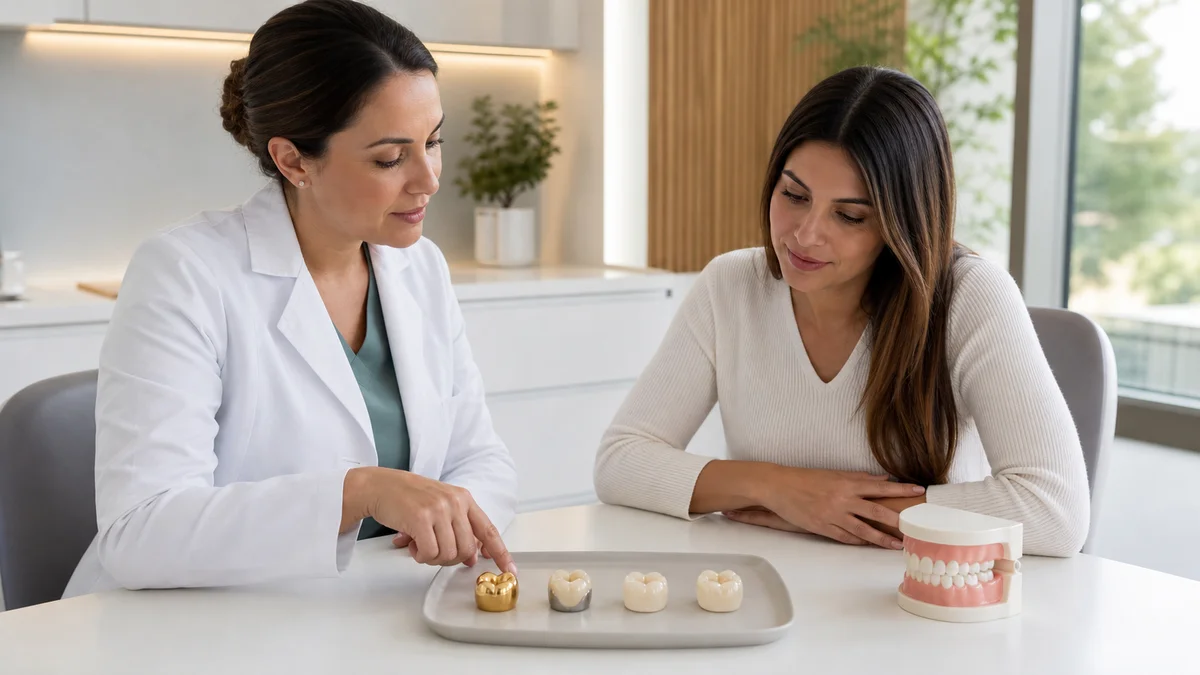
A useful dental crowns comparison does not simply name the strongest or most attractive material. A crown must fit the remaining tooth, bite, gumline, location and treatment goal. Full metal, porcelain-fused-to-metal, zirconia and glass-ceramic crowns can all be appropriate, but their thickness, appearance, bonding, fracture behavior and repair considerations differ.
Material is only one part of success. Decay control, gum health, tooth preparation, margin placement, laboratory accuracy, occlusion, cementation and maintenance can matter as much as the label on the box. This guide compares common choices without promising a fixed lifespan or treating an online description as a personalized prescription.
What a Dental Crown Does
A crown is a fixed restoration that covers most or all of the visible part of a prepared natural tooth. The American Dental Association’s MouthHealthy guidance notes that crowns can strengthen a tooth with a large filling, protect a weak tooth, restore a broken tooth, support a bridge, improve a severely discolored or misshapen tooth, or restore a dental implant.
A crown cannot make every compromised tooth maintainable. The dentist must assess decay, cracks, remaining walls, root health, gum and bone support, ferrule, bite and the ability to keep the margins clean. A tooth may need a filling, core, root canal treatment, periodontal care, orthodontic movement or another stage before a crown. Some teeth cannot be restored predictably and may require a replacement discussion instead.
The word “crown” also describes two different clinical situations:
- Tooth-supported crown: fits over a prepared natural tooth or a core retained by that tooth.
- Implant crown: is the visible restoration attached to an implant and abutment; it is not placed over a natural tooth.
The same ceramic name can behave differently in these situations because support, retention, connection design and biological risks differ. Research on implant crowns should not be transferred automatically to crowns on natural teeth.
Dental Crowns Comparison Table
| Material or design | Potential advantages | Important trade-offs | Typical discussion |
|---|---|---|---|
| Full metal alloy | High toughness, thin sections may be possible, no veneering porcelain to chip | Metallic appearance, alloy composition and sensitivity considerations | Posterior tooth with limited space or high load where appearance is less important |
| Porcelain-fused-to-metal (PFM) | Established metal framework with tooth-colored porcelain surface | More opaque than some ceramics; veneering porcelain can chip; metal margin may become visible | Need for framework strength plus acceptable tooth color |
| Monolithic zirconia | High strength, tooth-colored, no separate veneering layer over most surfaces | Translucency varies; adjustment and polishing affect the opposing tooth; shade matching can be demanding | Posterior load, limited restorative space or bruxism risk after full bite assessment |
| Layered zirconia | Strong framework with a more characterizable ceramic surface | Veneering ceramic introduces a chipping interface; design and laboratory support matter | Visible tooth where esthetic layering is prioritized |
| Lithium disilicate or related glass ceramic | Translucency, shade control and adhesive bonding potential | Requires material-specific thickness and bonding or cementation; not ideal for every load or preparation | Anterior and selected posterior teeth when appearance is important and conditions are favorable |
| Feldspathic porcelain | High translucency and detailed optical layering | Lower fracture resistance than high-strength ceramics; careful case selection is essential | Highly visible areas with adequate support and controlled load |
| Resin or composite crown | Easy to modify and useful for provisional or selected longer-term applications | Wear, staining and fracture behavior may limit use compared with definitive ceramic or metal designs | Temporary phase, diagnostic trial or specifically selected definitive case |
These descriptions are tendencies, not guarantees. “Zirconia” and “ceramic” each include several formulations and manufacturing methods. Crown thickness, connector or coping design, surface finish and cementation can alter performance. Ask for the specific material and design rather than relying on a broad marketing category.
1. Full Metal Crowns
Full metal crowns may be cast from high-noble, noble or base-metal alloys. They are tough, tolerate relatively thin sections and avoid a separate brittle veneering layer. These characteristics can be useful for a posterior tooth with limited vertical space or high functional demand.
The obvious limitation is color. Even a well-made gold-colored or silver-colored crown does not resemble natural enamel. It may be acceptable on a tooth that is not visible in speech or smiling, but patient preference matters. Alloy composition should be documented, especially when there is a known or suspected metal sensitivity.
Metal is not automatically the most conservative solution in every preparation, and it does not make an inadequate tooth prognosis good. Margin design, core strength and periodontal access still matter. A metal crown can develop decay at its edge or become loose just like another crown if biological or mechanical conditions fail.
2. Porcelain-Fused-to-Metal Crowns
A PFM crown combines a metal substructure with veneering porcelain. The framework provides support while the outer ceramic creates a tooth-colored surface. The design has a long clinical history and can be used in anterior or posterior positions after proper planning.
Because metal blocks light, PFM crowns may look more opaque than translucent all-ceramic restorations. If the gum recedes, a dark metal or opaque margin may become visible. The veneering porcelain can chip and expose the framework, although a small chip may sometimes be polished or repaired rather than requiring immediate replacement.
PFM preparation often needs enough space for both framework and porcelain. If clearance is inadequate, the crown may be overcontoured or the porcelain may be thin. The dentist and technician balance esthetics, strength and preservation of tooth structure.
3. Monolithic Zirconia Crowns
Monolithic zirconia crowns are milled largely from one zirconia material rather than relying on a separate porcelain veneer over every functional surface. Zirconia formulations vary in strength and translucency; a more translucent product does not necessarily have the same mechanical properties as a more opaque one.
High strength and tooth color make monolithic zirconia common for posterior teeth. It may allow a relatively conservative design in selected situations, but minimum thickness and connector rules remain manufacturer- and system-specific. A crown should not be made thinner than the material and preparation can support simply to save tooth structure.
Occlusal adjustment must be finished and polished properly. A rough ceramic surface can be unfavorable to the opposing tooth. The dentist should check contacts in normal bite and jaw movements, especially for a patient who clenches or grinds.
4. Layered Zirconia Crowns
Layered zirconia uses a zirconia framework or substructure with a more translucent veneering ceramic in visible areas. The technician can build depth, shade and surface character beyond what some monolithic materials provide. This can be useful where the crown is prominent in the smile.
The trade-off is the interface between framework and veneering ceramic. Chipping may occur if the veneer is unsupported, too thick, under unfavorable stress or affected by processing. Modern designs can limit veneering to the facial area while retaining monolithic zirconia on the biting surface, but the final decision is case-specific.
When comparing monolithic and layered zirconia, ask where the layers are, how the bite contacts them and how a chip would be managed. The material name alone does not describe the architecture.
5. Lithium Disilicate and Other Glass-Ceramic Crowns
Glass ceramics can reproduce enamel-like translucency and integrate well with natural tooth color. Lithium disilicate is a commonly used reinforced glass ceramic for crowns, onlays and veneers. It can be pressed or milled and often works with adhesive bonding protocols when the preparation and moisture control are suitable.
Optical quality makes glass ceramic attractive for front teeth and selected premolars or molars. However, sufficient material thickness, rounded internal geometry and appropriate load management are essential. A deep subgingival margin, poor isolation, very limited space or a severely destructive bite may change the choice.
Some glass-ceramic crowns can be conventionally cemented under specific conditions, while others benefit from resin bonding. The dentist should follow the material and cement manufacturer’s protocol. Surface treatment errors can compromise retention or ceramic integrity.
6. Feldspathic Porcelain Crowns
Feldspathic porcelain can provide exceptional translucency and detailed shade layering. It has traditionally been valued for visible anterior restorations. Its lower strength compared with reinforced glass ceramic or zirconia requires careful support, thickness and bite selection.
The Leeds Teaching Hospitals crown guidance describes all-ceramic or porcelain crowns as tooth-colored options where visibility is important and the bite is not heavy. This is a broad patient explanation; actual materials and modern designs vary. A clinician should identify the specific ceramic rather than calling every tooth-colored crown “porcelain.”
7. Resin and Composite Crowns
Resin-based crowns are often used as temporary restorations while a laboratory crown is made or while the dentist evaluates gum response, bite, esthetics or a complex treatment plan. They can be adjusted and repaired relatively easily. A carefully made provisional crown also protects the prepared tooth and helps preserve tooth position.
Some resin or hybrid materials are used for longer-term milled restorations in selected cases. They should not be assumed equivalent to all ceramics. Wear, discoloration, water uptake, surface polish and fracture behavior depend on formulation and thickness. Ask whether the proposed crown is temporary, medium-term or intended as the definitive restoration.
When a Crown Is Better Than a Filling, Onlay or Veneer
A full crown requires removal of tooth structure around the tooth. If enough healthy structure remains, a direct filling, inlay, onlay or partial-coverage restoration may preserve more enamel. The American College of Prosthodontists notes that more conservative treatments such as veneers, inlays or onlays may be indicated instead of a crown in some conditions.
A crown may be favored when the tooth is extensively weakened, has a large failing restoration, is fractured, has severe wear, requires major shape change or needs circumferential coverage. Root canal treatment can increase restorative complexity, but not every root-filled tooth automatically requires the same crown. Tooth type, remaining walls, access cavity, ferrule and loading matter.
Questions to ask before agreeing to full coverage include:
- How much sound enamel and dentin remain?
- Could an onlay or partial crown protect the weak cusps?
- Is decay or a crack extending below the gum?
- Does the tooth have enough ferrule for a predictable restoration?
- Is root canal treatment complete and symptom-free where relevant?
- Will crown preparation endanger the pulp in a vital tooth?
- How will the margin be cleaned after treatment?
Front Tooth Crown Comparison
For an anterior tooth, shade, translucency, surface texture and how the crown meets the gum are prominent. Glass ceramic or layered ceramic may reproduce natural light behavior more readily than an opaque high-strength material. Zirconia may still be appropriate where masking a dark core or adding strength is important.
The color of the prepared tooth, post or implant abutment affects the result. A thin translucent crown over a dark foundation can appear gray. The technician may need photographs, shade maps and information about the underlying stump color. Whitening should be completed before final shade selection when it is part of the plan, because crowns do not whiten like natural teeth.
Gum stability matters. Placing a margin too deep only to hide it can make cleaning and tissue health more difficult. In selected cases, orthodontic or periodontal treatment may improve the foundation before a crown is made.
Back Tooth Crown Comparison
Posterior crowns experience heavier forces and require stable contacts. Full metal, monolithic zirconia, PFM and reinforced glass ceramic may all be considered, depending on clearance, esthetic preference, bite and supporting tooth. The choice is not simply “strongest material.” A crown that is too rigid, rough, overcontoured or poorly adjusted can still create problems.
For a patient with bruxism, the dentist evaluates wear patterns, cracks, muscle symptoms and available space. Material selection can reduce some technical risks but cannot stop clenching. A protective night guard may be discussed after the bite is stable, but it does not guarantee that a crown will never chip or fracture.
The adjacent and opposing teeth matter. A crown must allow flossing, avoid food trapping and meet the opposing tooth without harmful high spots. The clinician should check contacts after cementation and revisit them if the bite feels wrong once anesthesia wears off.
Natural Tooth Crowns Versus Implant Crowns
A natural tooth is suspended by a periodontal ligament and can have decay, pulp disease or root fracture. An implant is integrated with bone, lacks a periodontal ligament and has different biological tissues around its restoration. Implant crowns may be screw-retained or cement-retained and connect through an abutment.
Do not use an implant-crown study to claim that the same material is superior on natural teeth. The 2018 systematic review of zirconia-ceramic and metal-ceramic implant crowns found both valid options but different technical patterns in the available evidence. It also noted that newer monolithic zirconia designs lacked the same duration of data at that time.
For an implant crown, the comparison includes retrieval, screw access, residual cement risk, abutment material, connection, soft-tissue contour and hygiene. The dentist should specify whether the proposal is tooth-supported or implant-supported before discussing evidence or cost.
What the Evidence Can and Cannot Prove
Material research changes as formulations and manufacturing improve. A brand introduced recently cannot have decades of clinical follow-up. Laboratory fracture strength can inform design but does not equal real-world survival because patients vary in bite, hygiene, disease and maintenance.
Any dental crowns comparison should therefore identify whether evidence concerns a natural tooth or implant, an anterior or posterior site, and a monolithic or layered design. Without that context, apparently precise survival figures can answer a different clinical question from the one facing the patient.
A Cochrane review of metal-free crown and bridge materials found insufficient reliable evidence to declare metal-free restorations universally more effective than metal-ceramic or other conventional options. That uncertainty supports individualized decisions rather than promotional claims.
Do not compare percentages from studies unless the crown type, support, location, patient group, follow-up and definition of failure match. “Survival” may mean the crown remained in place despite a repair, while “success” may require no complication. A personal prognosis cannot be reduced to one published average.
Crown Preparation and Tooth Preservation
The NHS dental treatments guidance explains that the tooth is shaped so a crown can be fixed over it and that a temporary crown may be used while a laboratory prepares the final one. The amount and pattern of reduction depend on material, margin, tooth alignment and damage.
Preparation should create enough room without sacrificing avoidable sound tissue. Too little clearance can produce an overcontoured or weak restoration; excessive reduction can threaten the pulp or reduce retention. A severely damaged tooth may need a bonded core or post-and-core, but a post does not strengthen a root and is used only when retention is needed.
Digital scanning and conventional impressions can both produce accurate records when used correctly. Chairside CAD/CAM can make some crowns in one visit, while complex shade, tissue or laboratory requirements may favor a separate technician. Speed alone does not define quality.
Temporary Crowns and the Trial Phase
A temporary crown protects the tooth, limits sensitivity, maintains contacts and previews shape. It should permit cleaning and should not be ignored if it loosens or breaks. Without it, teeth can move and the gum can change, complicating final fit.
Avoid very sticky or hard foods if the clinician advises, clean the area carefully and contact the practice if the temporary dislodges, the bite feels high, pain worsens or the gum swells. Do not use household glue. Bring the temporary crown to the appointment if it comes out.
For extensive or cosmetic treatment, longer provisional evaluation can test speech, bite, tooth length and hygiene. The final material should not be ordered until unresolved functional problems are addressed.
How the Dentist Checks the Final Crown
Before final cementation or screw tightening, the clinician evaluates seating, margins, proximal contacts, contour, shade, occlusion and patient comfort. An X-ray may be justified to assess a margin or implant connection that cannot be seen directly. The crown is cleaned and treated according to its material.
A high bite can cause tenderness or overload. A tight contact can prevent flossing, while an open contact can trap food. Overcontour can inflame gum. These are design and fit issues, not inevitable features of a particular ceramic.
After cementation, some short-lived sensitivity may occur in a vital tooth, but persistent spontaneous pain, pain that worsens, swelling or pain on biting requires review. A crown can protect a tooth without guaranteeing that the pulp will remain healthy.
Maintenance, Repairs and Reasons Crowns Fail
A crown is not immune to plaque or decay. The tooth can develop caries at the margin, and gum disease can progress around it. Brush with fluoride toothpaste, clean between teeth with the method recommended for the contact and attend reviews based on risk. Implant crowns require specific interdental access and monitoring of surrounding tissues.
Common reasons for review include:
- Loss of cement or screw loosening;
- Chipping or fracture of ceramic;
- Fracture of the supporting tooth, core, post or root;
- Decay at a margin;
- Pulp inflammation or infection;
- Gum recession or inflammation;
- Food trapping from contact or contour changes;
- Wear or roughness affecting the opposing tooth;
- Shade mismatch after changes in neighboring teeth.
A small chip may be polished or repaired; a loose crown may sometimes be recemented after the cause is identified. Recurrent decay, a major fracture or an irreparable margin may require replacement. A loose crown should be assessed promptly because delay can allow movement, leakage or fracture.
Cost, Insurance and Written Treatment Plans
Crown fees vary with country, material, laboratory, clinician, foundation treatment, imaging and complexity. A low advertised fee may not include a core, post, temporary, root canal treatment, gum procedure or protective appliance. A high price does not guarantee a biologically sound preparation or fit.
For a financial dental crowns comparison, compare complete treatment scopes rather than material names alone. Confirm whether the estimate includes the provisional crown, laboratory characterization, foundation restoration, cementation, planned reviews and management of an early adjustment.
Ask for a written plan identifying the tooth, diagnosis, crown material, whether it is tooth- or implant-supported, temporary stage, additional procedures and review policy. Insurance may classify materials or apply alternate benefits, waiting periods or frequency limits. Predetermination is useful but may not guarantee payment.
At Redent Klinik, crown planning can compare material and design after assessing the tooth, smile and bite. Patients can use the Redent Klinik contact page to arrange an evaluation and share existing radiographs or treatment records. Final suitability and fees require an appropriate clinical examination.
10 Questions to Choose a Crown
- Is a full crown necessary, or could a more conservative restoration work?
- How much healthy tooth remains and what is the long-term prognosis?
- Is this a crown on a natural tooth or a dental implant?
- How visible is the tooth in speech and smiling?
- What load, grinding or space constraints affect the design?
- Which exact material and architecture are proposed?
- How much tooth reduction does that design require?
- Will the crown be bonded, conventionally cemented or screw-retained?
- What complications are most relevant and which are repairable?
- What cleaning, review and protective care will be needed?
Frequently Asked Questions
Which material wins a dental crowns comparison?
No material wins every comparison. Full metal may suit high load and limited space, zirconia may balance strength with tooth color, glass ceramic may favor translucency, and PFM may provide a supported ceramic surface. The remaining tooth, location, bite, appearance and technique determine suitability.
Is zirconia stronger than porcelain?
Zirconia generally has higher strength than traditional feldspathic porcelain, but “porcelain” includes different ceramics and designs. Strength alone does not guarantee success. Translucency, thickness, support, surface finish, bonding, occlusion and the condition of the tooth also matter.
Which crown looks most natural?
Glass ceramic and layered ceramics can provide high translucency and detailed shade control, but the best result depends on the foundation color, technician, tooth position, gum and neighboring teeth. A more opaque zirconia may be useful when a dark core must be masked.
Are metal crowns safer than ceramic crowns?
Both can be safe when appropriately selected and made. Metal composition, known sensitivities, esthetic preferences, ceramic fracture behavior and opposing-tooth wear should be considered. Safety also depends on preparation, fit, cement and maintenance, not only the crown material.
Can I replace a PFM crown with zirconia?
Possibly, but removal may sacrifice additional tooth structure and the underlying tooth must be reassessed. A new material does not correct decay, fracture or inadequate support automatically. Replace a functioning crown only after discussing benefit, risk and the reason for change.
Does a root canal tooth always need a crown?
Not always. Posterior teeth with substantial structural loss often need cuspal protection, while some anterior teeth may be restored differently. Remaining walls, crack risk, access size, bite and ferrule guide the choice. Root canal treatment alone does not prescribe one universal restoration.
Can a crown decay underneath?
The crown material does not decay, but the natural tooth can develop caries at or below the margin. Plaque control, fluoride, diet, margin fit and regular assessment matter. New sensitivity, odor, food trapping or a loose crown should be examined.
How long does a dental crown last?
There is no guaranteed lifespan. Many crowns function for years, but tooth condition, material, fit, bite, hygiene, disease and accidents influence longevity. Study averages cannot predict an individual crown. Maintenance and early repair of problems can help preserve the restoration.
Is a same-day crown as good as a laboratory crown?
Either can be successful when the indication, scan or impression, design, material processing and cementation are appropriate. Same-day production favors speed; a laboratory may offer additional characterization or complex design. The clinical execution matters more than visit count alone.
What should I do if my crown feels high?
Contact the dentist for a bite check rather than waiting for the tooth to adapt. A high contact can cause tenderness or overload. Do not try to file the crown yourself. Seek faster review if pain is severe, swelling develops or the crown becomes loose.
Final Dental Crowns Comparison
A responsible dental crowns comparison starts with whether a crown is needed and whether the tooth can support it. Full metal prioritizes toughness and low visibility requirements. PFM combines a metal framework and tooth-colored surface. Zirconia provides high strength with variable translucency. Glass ceramic emphasizes optical integration and adhesive possibilities.
The final choice should integrate tooth preservation, material thickness, bite, margin, laboratory design, cementation and patient priorities. Ask for the exact material and architecture, understand realistic complications and plan maintenance. A technically impressive crown cannot compensate for untreated decay, unstable gum disease or a tooth with an unfavorable prognosis.
Official Sources and Further Reading
- American Dental Association MouthHealthy: Crowns
- American College of Prosthodontists: Caps and crowns
- NHS: Dental treatments and crowns
- Leeds Teaching Hospitals NHS Trust: Crowns
- Cochrane: Metal-free materials for crowns and bridges
- PubMed: Zirconia-ceramic and metal-ceramic implant crowns systematic review
- American Dental Association
- World Health Organization: Oral health fact sheet
Sources reviewed July 2026. This article provides general education and does not replace clinical examination, diagnosis, material-specific instructions or informed consent.