
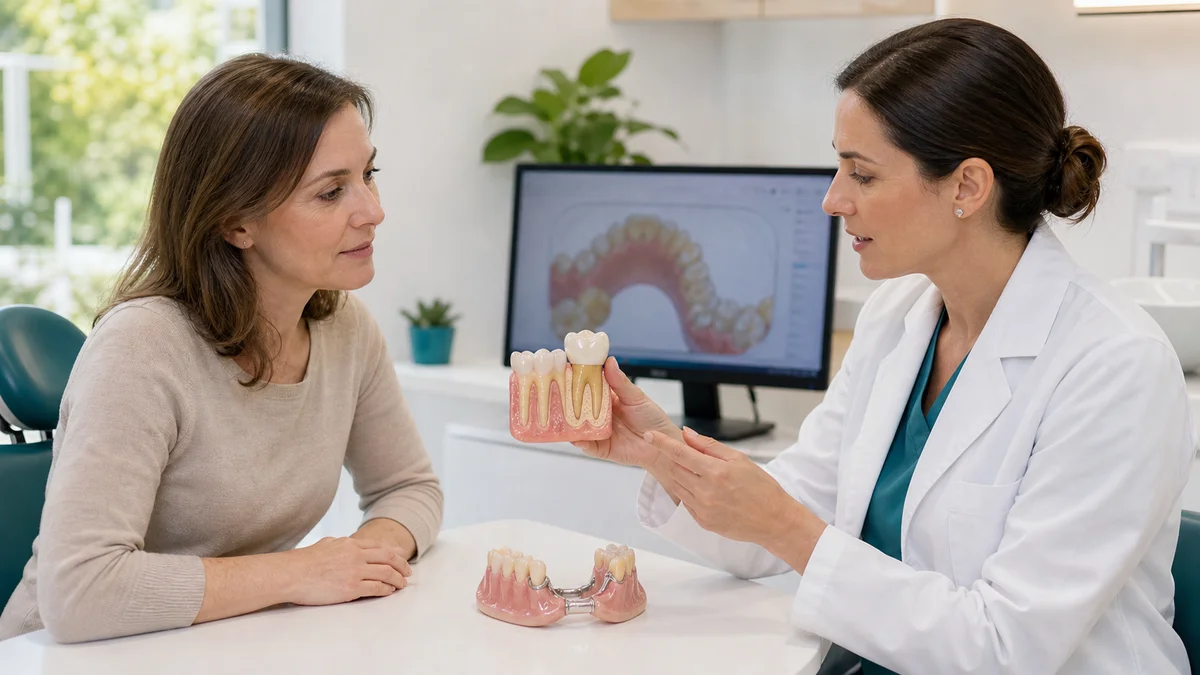
Quick answer: dental crowns vs dentures is usually not a choice between equivalent treatments. A crown covers and helps restore a tooth that remains in the mouth; a denture replaces one, several, or all missing teeth and is commonly removable. The right pathway depends on whether teeth are restorable, how many are missing, support, hygiene, function, and follow-up needs.
Dental crowns vs dentures can sound like a simple comparison of two ways to improve a smile. Clinically, however, they usually solve different problems. A crown is a custom covering placed over a prepared natural tooth, or over an implant when a missing tooth has already been replaced with an implant fixture. A denture replaces missing teeth and may also replace some lost gum contour. Most conventional dentures can be removed by the patient.
The first question is therefore not “Which one is better?” It is “Which teeth are present, and can they be predictably restored?” A heavily filled, cracked, worn, or root-treated tooth may be considered for a crown when enough sound structure and periodontal support remain. A space with no tooth cannot receive a conventional tooth-supported crown by itself. It may instead be managed with a denture, bridge, implant-supported crown, or another agreed plan.
This guide explains the decision without diagnosing anyone online or promising that one option will last for a set number of years. Examination, radiographs when clinically justified, gum assessment, bite analysis, medical history, expectations, dexterity, and budget all matter. You can review the clinic’s broader patient information at Redent Klinik in Istanbul; the clinic does not present remote image review as a substitute for an in-person diagnosis.
What Is the Core Difference Between a Crown and a Denture?
A conventional dental crown is a fixed indirect restoration that completely or substantially covers the visible part of a real tooth. The tooth is shaped so the crown can fit over it, and the restoration is cemented or bonded in place. Crowns may be made from ceramics, metal-based materials, or other systems chosen for the tooth’s location, available space, bite, appearance, and clinical requirements.
A denture is a prosthesis that replaces missing teeth. A complete denture replaces all teeth in an upper or lower arch. A partial denture replaces one or more missing teeth while some natural teeth remain. Depending on its design, a partial denture may gain support or retention from teeth, rests, clasps, precision components, gums, or implants. A conventional removable denture is taken out for cleaning.
This distinction prevents a common misunderstanding. A crown does not normally fill a toothless gap unless it is part of an implant restoration or a bridge design. A denture does not cover and reinforce a single damaged tooth in the way a crown does. A patient may have both treatments in the same mouth because each addresses a different site.
The NHS overview of dental treatments describes a crown as a cap that covers a real tooth and dentures as removable replacements for missing teeth. Its denture guidance also distinguishes complete dentures from partial dentures. Those definitions are useful starting points, but an individual plan still depends on clinical findings and alternatives.
Dental Crowns vs Dentures: A 9-Point Decision Table
The table below compares typical pathways rather than guaranteeing a particular design. Implant-supported crowns and implant-retained dentures add surgical, restorative, and maintenance considerations that are discussed separately.
| Decision area | Dental crown | Denture | Question for the dentist |
|---|---|---|---|
| What it treats | A damaged but restorable tooth, or one implant site | One, several, or all missing teeth | Which teeth are present, restorable, or missing? |
| Support | Natural tooth structure or an implant | Remaining teeth, gums, implants, or a combination | What structures will carry chewing forces? |
| Removal | Usually fixed and not removed by the patient | Commonly removable; some implant designs differ | Who can remove it, and how is it cleaned? |
| Tooth preparation | Natural tooth usually requires irreversible shaping | May need rests or minor tooth modifications; extraction may be involved | What natural tissue must be altered or removed? |
| Number of teeth | Usually planned tooth by tooth | Can replace multiple teeth or a full arch | Is a single-site or arch-level solution required? |
| Stability | Fixed to its support when in service | Depends on design, fit, anatomy, teeth, and implants | What movement should be expected during function? |
| Daily care | Brush, interdental cleaning, and margin care | Remove and clean the prosthesis plus gums and remaining teeth | Can I perform the required cleaning safely? |
| Future repair | May need recementing, root treatment, repair, or replacement | May need adjustment, reline, tooth repair, or replacement | What changes are expected if tissues or teeth change? |
| Alternatives | Filling, onlay, extraction and replacement, or monitoring in selected cases | Bridge, implant restoration, different denture design, or accepting a space in selected cases | What are the benefits and limits of each reasonable option? |
A table cannot determine whether a tooth is restorable. For example, a tooth may appear large enough for a crown but have a deep crack, active decay below the gum, inadequate ferrule, severe mobility, or poor periodontal support. Conversely, a worn or extensively restored tooth should not be extracted merely because a denture package seems simpler. Reversible and tooth-preserving choices deserve consideration before irreversible treatment.
When Is a Natural Tooth Potentially Suitable for a Crown?
A crown may be discussed when a tooth has substantial loss of structure from decay, a large failing restoration, fracture, developmental shape issue, or severe wear. Some root canal-treated teeth require cuspal coverage because their remaining structure and loading pattern create fracture concerns. The indication depends on the individual tooth; not every filled or root-treated tooth automatically needs a crown.
The dentist assesses how much healthy tooth remains above the gum, whether decay can be removed, the location and depth of any crack, root form, periodontal support, mobility, gum health, and bite forces. If the tooth cannot be isolated, prepared, or restored with an adequate margin and resistance form, a crown may not offer a predictable path. Additional procedures do not automatically make a tooth restorable.
Symptoms can also change the sequence. Ongoing pulpal pain, infection, tenderness, or uncertain crack symptoms may require further testing or endodontic assessment before definitive crown work. Placing a crown without resolving an underlying disease process can lead to more treatment through or beneath the restoration.
The National Institute of Dental and Craniofacial Research notes that crowns can repair badly broken-down teeth and that fillings and crowns do not last a lifetime. Its dental materials information also explains that indirect restorations are custom made and may require multiple visits. These points support realistic planning: a crown can restore function, but it remains a restoration that needs maintenance and may eventually require intervention.
When Does a Denture Address the Actual Problem?
A partial denture may be considered when one or more teeth are missing and a removable replacement suits the clinical situation and patient’s priorities. It can replace several spaces in one prosthesis, including gaps that would otherwise require multiple fixed restorations. Its design depends on the distribution and health of remaining teeth, ridge anatomy, bite, aesthetics, and the path used to insert and remove it.
A complete denture may be considered when no natural teeth remain in an arch or when all remaining teeth have been assessed as non-restorable and an extraction plan has been accepted. The decision to remove the last teeth must be based on their individual prognosis, not only on convenience. Immediate dentures can be inserted around the time of extraction, but healing tissues change shape and may require adjustments, relining, or later replacement.
NHS denture guidance explains that immediate dentures often need adjustment or replacement as the mouth heals. It also notes that dentures can become loose as gums and jawbone change, and that pain, slipping, clicking, or damage should be reviewed by a dentist. A new denture is therefore not a one-time object independent of the mouth; fit and function can change.
Some patients choose a removable option because surgery is unsuitable, they prefer a non-surgical path, multiple teeth must be replaced, or cleaning a removable prosthesis feels more manageable. Others find removal, bulk, movement, altered taste, speech adaptation, or clasps difficult. These are legitimate tradeoffs to discuss, not signs that one person has chosen a universally inferior treatment.
Can Crowns and Dentures Be Used Together?
Yes. A person may have crowns on weakened but restorable teeth and a partial denture replacing other teeth that are absent. In a coordinated plan, selected crowns may be shaped with rest seats, guide surfaces, or other features that help a partial denture follow a planned path. This requires communication between the restorative and denture stages before the crowns are made.
A crown can also be fitted to a dental implant to replace one missing tooth. In that situation, “crown” describes the visible restoration while the implant fixture replaces the root. Multiple implants may support a bridge or help retain a denture. The words crown and denture therefore describe different prosthetic units, not mutually exclusive philosophies.
Coordination matters because a crown made without considering a future partial denture may have an unsuitable contour or lack space for a clasp or rest. Similarly, a denture designed around unhealthy teeth may lose support if those teeth later fail. A phased plan should identify which teeth have a favorable, guarded, or poor prognosis and explain how a future change would affect the prosthesis.
Where treatment is complex, a prosthodontic opinion may be useful. Prosthodontics covers fixed and removable restorations, including crowns, bridges, implants, and dentures. Referral does not guarantee that a particular treatment will be offered; it provides additional diagnosis and planning for cases that exceed routine complexity.
Fixed Versus Removable Does Not Mean Better Versus Worse
A fixed crown often feels more like part of the tooth because the patient does not remove it. That does not make it maintenance-free. Plaque can collect at crown margins, recurrent decay can occur on exposed tooth surfaces, and gum disease can compromise support. Interdental access, margin position, crown contour, and the patient’s cleaning technique influence maintainability.
A removable denture can be taken out for cleaning and inspection. That may help some patients or caregivers, especially when several teeth and broad tissue surfaces must be replaced. Removal can also feel inconvenient, and a poorly fitting prosthesis may move, rub, trap food, or affect confidence. Fit should be reviewed rather than managed indefinitely with increasing amounts of adhesive.
Complete dentures rely heavily on ridge form, saliva, muscular control, extension, and accurate fit. Upper and lower dentures often behave differently because tongue movement and available support differ. A lower complete denture may be more challenging for some patients. Implant retention can be discussed when appropriate, but it adds surgery, components, hygiene, repair, and cost.
The better option is the one that fits the diagnosis, preserves appropriate tissues, restores acceptable function, and can be maintained by that patient. A fixed label cannot compensate for poor support or inaccessible cleaning. A removable design is not automatically a compromise when it meets the person’s needs and clinical constraints.
Preparation, Impressions, Temporaries, and Treatment Time
For a natural-tooth crown, treatment commonly includes examination, any necessary disease control, tooth preparation, an impression or digital scan, a provisional restoration, laboratory or chairside fabrication, and final fitting. The dentist checks margins, contact with neighboring teeth, bite, appearance, and cementation conditions. Some systems permit same-day production, but same-day availability is not guaranteed or suitable in every case.
Tooth preparation is irreversible because natural structure is removed to create space and form for the crown. The amount depends on material, existing damage, alignment, and design. A temporary crown protects the prepared tooth while the definitive restoration is made, but it may be more prone to loosening or fracture and requires care.
Denture treatment can include preliminary impressions or scans, custom impressions, jaw relation records, tooth selection, try-in, delivery, and post-insertion adjustments. The number of appointments changes with complexity, healing, and whether an immediate or definitive design is made. New dentures may require a period of adaptation for chewing and speech.
If extractions are planned, the tissues and ridge change during healing. An immediate denture offers teeth during that period but may require repeated adjustments and a later reline or replacement. A definitive denture made after healing has a different timeline. Patients should know which stage is included in a treatment quote and what future work is expected.
Materials and Design: Names Alone Do Not Prove Quality
Crowns may use ceramic, metal-ceramic, metal, or resin-based provisional materials. Selection depends on location, available thickness, appearance, bite, opposing materials, allergies or sensitivities, laboratory system, and retrievability where relevant. “All ceramic” or a brand name alone does not establish that the restoration is appropriate or well made.
Denture bases and teeth may use acrylic resins, metal frameworks, flexible polymers, or combinations. A cobalt-chromium framework can provide a thinner, rigid partial denture in suitable cases, while acrylic designs may be useful in other clinical or transitional situations. Flexible materials have specific indications and limitations; they are not automatically more comfortable or repairable.
Design quality includes support, retention, stability, tissue coverage, border extension, occlusion, tooth position, appearance, phonetics, and hygiene access. For crowns, it includes fit, margin integrity, proximal contact, contour, occlusion, material handling, and the health of the supporting tooth. These factors cannot be judged from a material label or a photograph alone.
Ask for a plain-language description of the proposed material, why it suits the site, what alternatives exist, and how it can be repaired or replaced. If a cross-border treatment is planned, request the exact material and component records so future clinicians are not forced to identify them from appearance.
Daily Cleaning and Professional Maintenance
Crowned teeth still need twice-daily brushing with fluoride toothpaste and cleaning between teeth using an appropriate method. The crown itself cannot develop decay, but the natural tooth at or below its edge can. Bleeding gums, persistent sensitivity, a bad taste, movement, pain on biting, or a lost crown should prompt professional assessment.
Removable dentures should be cleaned daily using the method advised for their material. NHS and ADA patient guidance recommend cleaning the mouth as well as the denture, including remaining teeth, gums, tongue, and palate. Abrasive toothpaste can scratch some denture materials. Cleaning over a towel or a sink partly filled with water can reduce damage if the prosthesis is dropped.
Dentures are commonly removed at night unless the treating dentist gives a specific reason otherwise. The storage method depends on the material and cleanser instructions. Very hot water may distort some bases. Adhesive should not be used to conceal a persistently poor fit, soreness, fracture, or rapid change; the cause needs assessment.
- Clean crown margins and neighboring contacts every day, not only the visible crown surface.
- Brush remaining natural teeth and soft tissues even when wearing a complete or partial denture.
- Remove and clean a removable denture according to material-specific professional advice.
- Keep review appointments so fit, tissues, decay risk, bite, and wear can be checked.
- Seek care for pain, swelling, looseness, fracture, persistent ulcers, or changes in chewing.
- Do not use household glue or attempt to reshape a crown or denture at home.
Risks, Failure Paths, and Repairability
A crowned tooth may later develop recurrent decay, gum problems, pulpal symptoms, fracture, loss of retention, wear, chipping, or root fracture. Some problems can be treated through or by replacing the crown; others may make the tooth non-restorable. A crown does not guarantee that the supporting tooth will remain healthy indefinitely.
A denture may cause pressure areas, ulceration, reduced stability, food trapping, speech or chewing difficulty, clasp problems, tooth wear, framework fracture, or acrylic tooth loss. Remaining teeth can develop decay or gum disease if hygiene and design are poor. Complete denture fit can change as the ridge remodels, even when the original prosthesis was well made.
Repairability should be part of the first discussion. Some denture fractures or lost teeth can be repaired; extensive framework damage or major fit changes may require replacement. A crown can sometimes be recemented if both crown and tooth are suitable, but a loose crown may signal decay, fracture, or cement failure and should not simply be pushed back repeatedly.
Urgent assessment is appropriate for spreading facial swelling, fever with dental infection, uncontrolled bleeding, trauma, difficulty swallowing or breathing, or severe escalating pain. Difficulty breathing or swallowing requires emergency medical care. Routine online comparison content cannot determine the seriousness of a specific symptom.
Cost and Value: Compare Complete Treatment Pathways
When comparing dental crowns vs dentures, costs vary with the number of teeth, diagnosis, materials, laboratory work, preparatory treatment, extractions, temporary stages, adjustments, and follow-up. A single crown quote should state whether examination, imaging, core build-up, provisional crown, root canal treatment, final material, and reviews are included or separate. Root canal treatment should not be assumed merely because a crown is planned.
A denture quote should identify complete or partial design, upper or lower arch, material, extractions, immediate and definitive stages, try-ins, post-insertion adjustments, relines, and repairs. A low immediate-denture price may not include the definitive prosthesis required after tissue changes. A higher figure may include more stages rather than a superior outcome.
Value also includes preservation of appropriate teeth, ease of cleaning, access to repairs, communication, records, and a realistic contingency plan. Removing restorable teeth to avoid the cost of individual crowns can create irreversible biological and functional consequences. Equally, repeatedly crowning teeth with poor prognosis can consume time and money without creating a stable foundation.
Insurance or public coverage rules depend on the country, plan, clinical indication, waiting periods, annual limits, and provider network. Written pre-authorization can help but may not guarantee final payment. Ask the provider and insurer which codes and stages are proposed, what the patient portion may be, and how a changed treatment plan affects coverage.
- Request a diagnosis and tooth-by-tooth prognosis before comparing fees.
- Separate disease-control treatment from the definitive crown or denture stage.
- Ask whether temporary, immediate, and definitive restorations are separate charges.
- Include adjustments, relines, hygiene visits, repairs, and future replacement in planning.
- Check laboratory, material, cancellation, remake, and payment terms in writing.
- Do not treat a financing approval as evidence that a procedure is clinically suitable.
Alternatives That Should Be Discussed Before Consent
For a damaged tooth, alternatives may include monitoring, prevention, a direct filling, an inlay or onlay, root canal treatment where indicated, periodontal or orthodontic measures in selected cases, or extraction followed by replacement or acceptance of the space. The options depend on disease extent and cannot be ranked without examination.
For a missing tooth, alternatives may include a removable partial denture, tooth-supported bridge, resin-bonded bridge, implant-supported crown, orthodontic space management, or no replacement in selected situations. Each changes cost, preparation, surgery, time, hygiene, and risk to adjacent structures. A person’s values and medical suitability matter.
For multiple or complete tooth loss, alternatives can include different removable denture designs, implant-retained overdentures, fixed implant-supported prostheses, or staged plans. Implant treatment may improve retention in selected cases but does not eliminate cleaning, component wear, tissue disease, or future repair. It also requires adequate assessment and may involve surgery and healing time.
Informed consent should explain the recommended option, material risks, likely maintenance, reasonable alternatives, and what may happen without treatment. It should also identify uncertainties, such as whether a crack extends too deeply or how tissues will change after extraction. Consent is an ongoing conversation, not only a signature.
A Practical Appointment Checklist
Bring a current medication list, relevant medical history, previous dental records if available, and a description of what bothers you during eating, speaking, cleaning, or smiling. Tell the dentist about dry mouth, smoking or nicotine use, grinding, previous denture difficulties, gagging, dexterity limits, and any upcoming travel.
- Which teeth are healthy, restorable, questionable, or non-restorable, and why?
- Is the proposed crown restoring a natural tooth or an implant?
- If extraction is proposed, what tooth-preserving alternatives were considered?
- Does the denture replace one area, several areas, or a complete arch?
- Will the denture be immediate, transitional, definitive, or implant-retained?
- What natural tooth preparation or surgery is irreversible?
- What provisional restoration will be used during treatment?
- How will I clean the restoration with my current dexterity?
- What adjustments, relines, repairs, or replacement may be expected?
- Which stages and materials are included in the written fee?
- What symptoms require urgent contact, and who provides care if I travel home?
- Can I receive copies of radiographs, material details, and the final treatment record?
For an individual preliminary discussion, use the Redent Klinik contact page. A remote exchange can help organize records and travel questions, but the final tooth prognosis and treatment plan must be confirmed clinically.
Dental Crowns vs Dentures: Frequently Asked Questions
Are crowns and dentures alternatives for the same problem?
Usually not. A conventional crown covers a tooth that remains, while a denture replaces missing teeth. They become part of the same broader discussion when deciding whether a damaged tooth can be restored or must be removed and replaced. Examination determines which pathway is relevant.
Can a crown replace a missing tooth?
A crown can be attached to a dental implant to replace one missing tooth, or crowns can form parts of a bridge supported by adjacent teeth. A conventional crown cannot float in an empty space without support. Implant and bridge options have different preparation, surgery, hygiene, and risk considerations.
Can I have crowns under a partial denture?
Yes, selected crowned teeth may support or guide a partial denture when planned together. The crown contour can incorporate features for the denture. The supporting tooth must have a suitable prognosis, and the combined design must allow cleaning and future maintenance.
Do all root canal-treated teeth need crowns?
No universal rule applies to every tooth. Location, remaining structure, access cavity, cracks, existing restorations, and bite affect the need for cuspal coverage. The dentist should explain the fracture risk and reasonable restorative options for that specific tooth.
Are dentures always removable?
Conventional complete and partial dentures are removable by the patient. Implant-retained overdentures are also generally patient-removable, while some full-arch implant prostheses are fixed and removed only professionally. Ask exactly who can remove the proposed prosthesis and how it is maintained.
Will a denture stop the jaw from changing?
No. Gums and jaw ridges can change after tooth loss and over time, so a denture may become loose or require adjustment, relining, or replacement. Regular examination is still important even when no natural teeth remain.
Does a crown last forever?
No restoration can be guaranteed for life. A crown or supporting tooth may develop wear, chipping, decay, gum problems, pulpal disease, loosening, or fracture. Good design, hygiene, risk control, and reviews support longevity but do not remove all future treatment needs.
Which option is easier to clean?
That depends on design and dexterity. A crown stays in place and requires careful margin and interdental cleaning. A removable denture can be cleaned outside the mouth, but the remaining teeth and soft tissues also need care. The practical technique should be demonstrated before treatment.
Is the cheapest option the most conservative?
Not necessarily. A low fee may exclude preparatory treatment, temporary stages, definitive work, or maintenance. Conservatism refers to preserving appropriate healthy tissue and avoiding unnecessary intervention, not simply choosing the lowest initial cost. Compare complete pathways and biological consequences.
Can online photos show whether I need crowns or dentures?
Photos may help describe appearance but cannot reliably show root condition, decay depth, cracks, periodontal support, bite, or bone. A diagnosis requires clinical examination and appropriate tests. Remote review should be presented as preliminary information, not a final extraction or restoration decision.
Conclusion: Preserve What Is Restorable, Replace What Is Missing
Dental crowns vs dentures is most useful as a diagnostic framework, not a contest. Crowns generally restore teeth that can remain; dentures replace teeth that are absent and may restore broader arch form. Some patients need both, and others are better served by a filling, onlay, bridge, implant restoration, or another option.
Start with a tooth-by-tooth prognosis. Ask what tissue must be removed, what supports the restoration, whether it is fixed or removable, how it will be cleaned, and what failure or repair would look like. Compare written treatment stages rather than material labels or promotional lifespan claims.
This article provides general education and does not offer a diagnosis, guaranteed outcome, fixed price, or individual treatment recommendation. Decisions about preserving, crowning, extracting, or replacing teeth should follow an in-person assessment, informed consent, and a maintenance plan that the patient can realistically follow.
Authoritative Sources
- NHS: Dental treatments, including crowns and dentures
- NHS: Dentures, fitting, care, and when to seek review
- National Institute of Dental and Craniofacial Research: Fillings and crowns
- National Institute of Dental and Craniofacial Research: Dental materials
- American Dental Association MouthHealthy: Dentures and daily care
- American College of Prosthodontists: Fixed and removable prosthodontics
- American Dental Association
- World Health Organization: Oral health fact sheet