
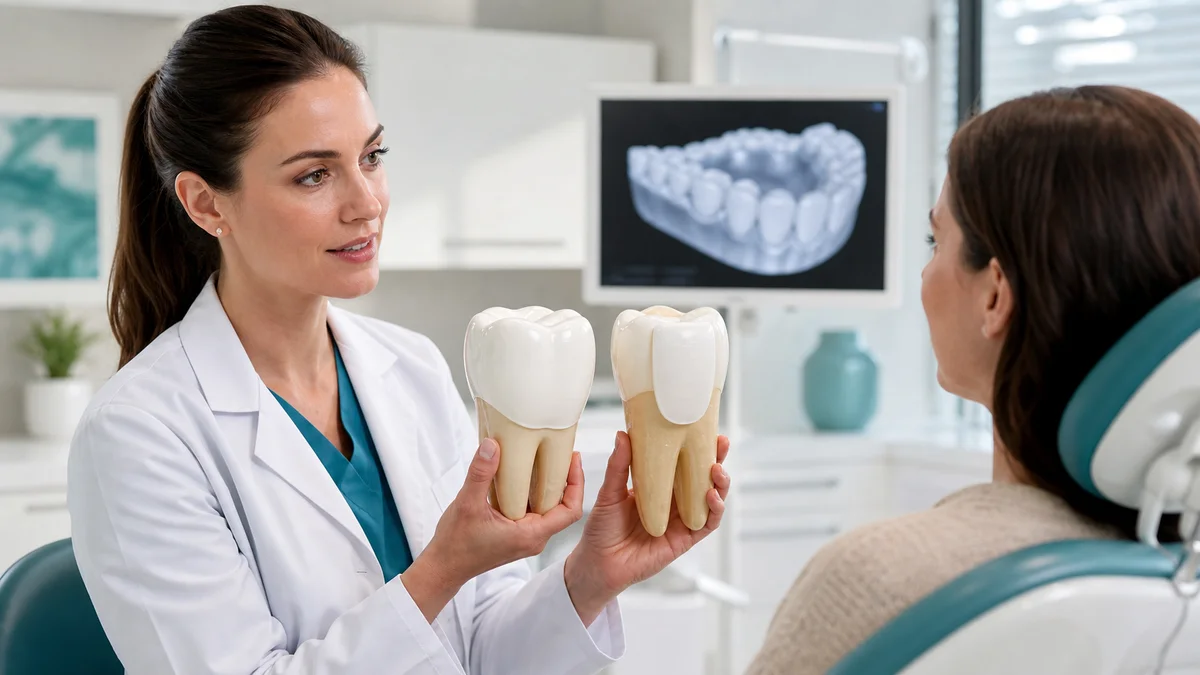
Quick answer: zirconia crowns vs veneers is a comparison of coverage as much as material. A zirconia crown surrounds most of a prepared tooth and may suit more extensive structural damage; a veneer mainly covers the front surface and is usually considered for selected aesthetic or shape changes. Tooth health, enamel, bite, preparation, bonding, appearance, and future repair determine suitability.
Zirconia crowns vs veneers is often presented online as a contest between a strong restoration and a beautiful one. That framing is incomplete. A zirconia crown is a full-coverage or near-full-coverage restoration made from zirconium dioxide ceramic. A veneer is a thin restoration placed mainly on the front surface of a tooth and may be made from porcelain-type ceramic or composite resin. The two designs remove, cover, and load tooth tissue differently.
The first decision is not which product looks best in a photograph. It is whether the tooth needs broad structural coverage, limited surface correction, a direct restoration, orthodontic movement, disease control, or no irreversible treatment. A crown may be excessive for a healthy tooth with a minor colour concern. A veneer may be inadequate for a tooth with extensive decay, a deep crack, very little remaining structure, or a large existing restoration.
This guide does not diagnose a tooth from images, promise a fixed lifespan, or claim that zirconia is unbreakable. It explains the questions that should precede consent: what tissue remains, how much must be prepared, where the restoration will bond, what the bite demands, how colour and translucency will be managed, and what happens if the restoration later needs replacement. For broader context, visit the Redent Klinik English website.
What Exactly Is a Zirconia Crown?
A crown is a custom indirect restoration that covers most or all of the visible part of a prepared tooth. Zirconia describes the ceramic material used to make that crown. Different zirconia formulations and manufacturing protocols can have different optical and mechanical properties, so the material name alone does not describe the exact restoration.
A crown may be considered when a tooth has substantial structural loss, a large failing restoration, severe wear, fracture risk, or a need for cuspal coverage. Some root canal-treated teeth benefit from crowns, but not every root-treated tooth automatically requires one. Location, remaining walls, crack status, bite, access cavity, and existing restorations affect the decision.
Preparing a tooth for a crown is irreversible. The dentist removes enough tooth structure to create space, define a margin, and provide a form that allows the restoration to fit and function. The amount varies with the tooth, damage, alignment, material, and design. An over-contoured crown created to avoid necessary space can make cleaning difficult and compromise appearance or gum health.
Zirconia may be selected for its combination of strength, biocompatibility, digital manufacturability, and tooth-coloured appearance. These advantages do not eliminate the need for accurate preparation, fit, polishing, occlusion, cementation, hygiene, and review. A strong material can still chip, debond, fracture, wear opposing teeth if rough, or fail because the supporting tooth develops disease.
What Is a Veneer and What Does It Cover?
A veneer covers mainly the front surface of a tooth rather than surrounding the entire crown of the tooth. The American Dental Association’s MouthHealthy guidance makes this distinction explicit. Veneers may be used for selected changes in colour, shape, proportion, surface texture, small fractures, or spacing when the tooth and bite are suitable.
Porcelain or other ceramic veneers are generally fabricated outside the mouth and bonded to prepared tooth surfaces. Composite veneers may be built directly by the dentist or fabricated indirectly. The material, preparation, margin, bonding substrate, colour, bite, and number of teeth all affect the result and future maintenance.
“Thin” does not mean non-invasive. Some veneers require limited preparation, while others require more reduction to manage tooth position, colour, contour, or restorative space. Even preparations described as minimal may be irreversible. A no-preparation approach is only suitable in selected shapes and positions; adding material without space can create bulky contours or difficult margins.
Veneers depend heavily on diagnosis and adhesive conditions. Bonding predominantly to enamel is generally a different situation from bonding to large areas of dentin, existing filling material, or a heavily damaged tooth. A veneer should not be placed over untreated decay, active gum disease, unexplained pain, or an unstable bite merely to mask appearance.
Zirconia Crowns vs Veneers: 10-Point Decision Table
The table compares typical full-coverage zirconia crowns with front-surface veneers. It does not replace examination, and it does not assume every veneer uses the same ceramic.
| Decision area | Zirconia crown | Veneer | Question to ask |
|---|---|---|---|
| Coverage | Covers most or all prepared tooth surfaces | Mainly covers the front surface | Why does this tooth need partial or full coverage? |
| Typical purpose | Broader structural restoration and protection | Selected shape, colour, proportion, or surface correction | Is the problem structural, aesthetic, or both? |
| Preparation | Usually requires circumferential and occlusal/incisal reduction | Usually more limited but still may be irreversible | How much enamel and dentin will be removed? |
| Remaining tooth | May manage more extensive loss if a restorable foundation remains | Needs a suitable tooth and bonding surface | Is there enough sound tooth and enamel? |
| Material | Zirconia ceramic with formulation-specific properties | Often ceramic or composite; not necessarily zirconia | What exact material and design are proposed? |
| Translucency | Varies by zirconia type and thickness | Can be selected for optical layering and surface aesthetics | How will colour, opacity, and neighbouring teeth be matched? |
| Bonding or cementation | Protocol depends on preparation retention and zirconia surface treatment | Often relies strongly on adhesive bonding | What substrate will the restoration attach to? |
| Bite risk | Needs adequate thickness, contour, and polished contacts | Edge loading and grinding may increase risk | How will clenching, guidance, and contacts be managed? |
| Repair | May need polishing, repair, recementation, or replacement | May chip, stain at margins, debond, or need replacement | What can be repaired and what requires remaking? |
| Alternative | Onlay, filling, endodontic-restorative plan, extraction in non-restorable cases | Whitening, orthodontics, contouring, composite bonding, or monitoring | What less invasive options were considered? |
The widest coverage is not automatically the safest plan, and the thinnest restoration is not automatically the most conservative. Conservatism means preserving healthy tissue while creating a restoration with a realistic chance of functioning and being maintained. A veneer that must be repeatedly replaced or a crown placed without structural need can both increase cumulative tissue loss.
How Much Tooth Preparation Is Really Needed?
Preparation should be driven by the existing tooth, intended restoration, material thickness, path of insertion, colour change, margin position, and bite. A crown generally requires reduction around the tooth and on the biting or incisal surface. A veneer generally focuses on the facial surface and may extend toward contacts or over the incisal edge depending on design.
The starting tooth position matters. A tooth that already projects outward may require more reduction to avoid an over-contoured veneer. A tooth positioned inward may permit additive contour in selected cases. Orthodontic movement before restoration can sometimes place teeth in a position that allows less removal and more balanced proportions.
Dark underlying colour presents another tradeoff. More opaque material or increased thickness may mask colour, but opacity can reduce natural light transmission. Aggressive reduction to create masking space can approach dentin or the pulp. The clinician and laboratory should discuss whether whitening, internal treatment, composite masking, a different ceramic, or a crown is more appropriate.
Ask the dentist to show the planned preparation on photographs, scans, a diagnostic wax-up, or a mock-up when useful. A mock-up can help preview contour and speech without promising that the final outcome will be identical. It also helps identify when an additive design would be too bulky.
Enamel, Dentin, Decay, and Cracks Change the Choice
Healthy enamel is a valuable bonding substrate and should not be removed without a clear reason. A veneer plan often aims to preserve substantial enamel where possible. If a tooth has large fillings, exposed dentin, active decay, erosion, or fracture, the bonding conditions and structural demands differ from those of a minimally restored tooth.
A crown requires a restorable foundation. Deep decay, a crack extending below a maintainable level, root fracture, inadequate periodontal support, or insufficient sound structure can make a tooth unsuitable even if a crown could technically be fabricated. Additional procedures such as a core build-up, root canal treatment, crown lengthening, or orthodontic extrusion have their own risks and do not guarantee restorability.
Cracked teeth require careful symptom history, clinical tests, transillumination, magnification, and appropriate imaging. Neither a veneer nor a crown can guarantee that an existing crack will never progress. If the crack extends unfavourably, extraction may eventually be necessary. Uncertainty should be communicated before irreversible preparation.
Untreated caries or gum inflammation should be stabilised before elective aesthetic work. The NIDCR explains that indirect restorations such as crowns and veneers are custom made, while repeated replacement can remove more natural structure over time. That supports a disease-first approach rather than using restorations to conceal active problems.
Strength and Fracture Resistance Without “Unbreakable” Claims
Zirconia is often chosen where higher strength is desirable, but strength values from a material sheet do not predict the life of an individual crown. Thickness, connector or margin design, surface damage, firing, milling, finishing, support, cement space, bite, and parafunction all influence performance. The tooth beneath the crown may fail even when the zirconia remains intact.
Veneers are thinner and rely on a bonded tooth-restoration complex. Ceramic veneers can perform well in selected conditions, but edge loading, insufficient support, large dentin exposure, bruxism, nail biting, biting hard objects, and trauma can increase chipping or debonding risk. Composite veneers may be easier to repair in some situations but can wear or stain differently.
Opposing teeth also matter. A rough ceramic surface can contribute to wear, while careful finishing and polishing are important after adjustments. The dentist should evaluate contacts during normal closing and jaw movements. A night guard may be discussed for selected patients, but it does not eliminate all forces or guarantee restoration survival.
No ethical treatment plan should promise that zirconia cannot break or that veneers will last for a fixed number of years. A more useful discussion covers personal risk factors, signs of failure, maintenance, repairability, and what additional tooth structure may be lost if replacement becomes necessary.
Translucency, Opacity, Shade, and Surface Character
Natural teeth are not a single flat colour. Enamel, dentin, thickness, hydration, surface texture, light direction, and neighbouring teeth influence appearance. A restoration may need to transmit, scatter, or block light depending on the underlying tooth. The chosen ceramic and thickness should support that optical goal.
Zirconia formulations differ in translucency and strength. A highly translucent zirconia is not automatically ideal for masking a dark tooth, and a more opaque zirconia may look less natural in a highly visible single front tooth if not designed carefully. Layering ceramic, staining, surface texture, and laboratory skill influence the final appearance.
Veneers can provide detailed control of front-surface shape and colour, especially when the underlying tooth and preparation support adhesive ceramics. Very thin restorations may allow underlying colour to show. Trying to achieve an extreme colour change without enough space may lead to opacity or contour compromises.
Shade selection should consider neighbouring teeth, planned whitening, lip position, lighting, photographs, and patient preferences. Teeth should not be permanently restored to match a temporary dehydrated shade immediately after preparation. Patients should understand that natural teeth can change colour over time while ceramic colour is more stable.
Bonding, Cementation, Fit, and Margin Health
Veneers commonly depend on adhesive bonding. The tooth is isolated, the ceramic and tooth surfaces are treated according to their materials, and resin cement or composite is used to attach the veneer. Contamination, inadequate enamel, incorrect surface treatment, poor fit, and unfavourable loading can compromise the bond.
Zirconia crowns may be conventionally cemented or adhesively bonded depending on preparation retention, material, and clinical protocol. Zirconia requires material-specific surface treatment; protocols used for glass ceramics are not simply interchangeable. The dentist should follow the selected product system rather than relying on a universal cement claim.
Margin quality matters for both designs. An open, overhanging, deeply inaccessible, or over-contoured margin can retain plaque and irritate tissues. Subgingival placement may be needed in selected cases for existing damage or appearance, but deeper is not automatically better. A maintainable margin and healthy gums support long-term review.
Fit is not judged only by whether the restoration seats. Proximal contacts, emergence profile, bite, edge position, surface finish, cleansability, and tissue response should be checked. Persistent bleeding, floss shredding, pain on biting, sensitivity, or a bite that feels high deserves reassessment.
Which Smile Concerns May Be Better Managed Another Way?
Colour alone may be addressed with professional whitening when appropriate. Existing fillings and restorations will not whiten like natural teeth, so sequencing matters. Whitening before shade selection can reduce the need for an overly opaque restoration, but sensitivity, expectations, and the cause of discolouration should be reviewed.
Misalignment, crowding, rotation, or spacing may be better managed with orthodontics alone or before restorative treatment. Moving teeth can improve position and allow smaller restorations, though orthodontics has its own time, retention, root, gum, and compliance considerations. Restorations should not be used automatically as “instant orthodontics.”
Small chips, shape irregularities, or limited spaces may be managed with composite bonding or enamel recontouring in selected cases. These approaches can be more additive and repairable, although composite may stain, wear, or chip and still needs maintenance. An onlay may preserve more tooth than a full crown for some damaged posterior teeth.
If the main concern is gum level, inflammation, tooth proportions, or altered passive eruption, periodontal assessment may be needed before deciding on ceramic contours. Adding longer or bulkier teeth without addressing the cause can worsen proportions or hygiene. Sometimes no treatment or monitoring is the most conservative choice.
- Professional whitening for selected colour concerns before final shade matching.
- Orthodontic movement for position, rotation, spacing, or bite-related problems.
- Composite bonding for limited additive shape changes or repairable correction.
- Inlay or onlay coverage when full circumferential preparation is unnecessary.
- Periodontal treatment when gum health or tissue level drives the appearance.
- Observation when the tooth is healthy and the benefit of intervention is small.
Planning Multiple Front Teeth Without Creating a Template Smile
When several front teeth are being considered, the plan should begin with facial proportions, lip movement, tooth display, midline, tooth dimensions, gum levels, speech, and bite. The aim is not to force every patient into identical broad, bright teeth. Age, facial character, existing anatomy, and personal preference should guide shape and surface texture.
Clinical photographs, digital scans, a wax-up, and a removable or intraoral mock-up can support communication. These tools help discuss length, width, incisal position, phonetics, and contour before preparation. They are planning aids, not guarantees that biology or manufacturing will reproduce a digital image perfectly.
The number of treated teeth should not be chosen solely for symmetry in marketing photographs. Treating more healthy teeth increases irreversible intervention and future maintenance. Sometimes colour transition can be managed with whitening or limited restorations; in other cases, stopping at an obvious visual boundary creates a mismatch. The rationale should be individual and explicit.
Provisional restorations can test appearance, bite, speech, and cleansability before definitive work. Feedback should be specific: sound changes, lip support, tooth length, texture, and function. A patient should not be pressured to approve definitive ceramics while numb or before having a reasonable opportunity to evaluate the planned design.
Maintenance, Longevity, and the Replacement Cycle
Crowns and veneers require twice-daily brushing with fluoride toothpaste, cleaning between teeth, and periodic professional review. Ceramic cannot decay, but the tooth at its margin can. Gum disease, recession, root exposure, and recurrent decay may compromise appearance and support even when the restoration itself remains intact.
The NIDCR states that crowns and fillings do not last a lifetime and may need replacement. The same realistic principle applies to veneers. Longevity varies with diagnosis, preparation, material, bond, bite, hygiene, diet, saliva, tobacco use, trauma, and maintenance. Population averages cannot guarantee an individual outcome.
A chipped restoration may sometimes be polished or repaired with composite, depending on size, location, material, and cause. Debonded restorations may or may not be reusable. Recurrent decay, a deep fracture, major contour change, repeated debonding, or loss of tooth structure can require a new restoration or a different treatment.
Replacement often requires removing the existing restoration and may remove additional tooth tissue. That is why the first indication matters. Patients should know the likely future pathway if gums recede, colour changes, a neighboring tooth is restored, or the pulp develops symptoms.
- Brush margins gently but thoroughly with fluoride toothpaste.
- Clean contacts using a method that passes without shredding or trauma.
- Avoid using restored teeth to open packages or bite hard non-food objects.
- Discuss grinding, sports protection, dry mouth, and tobacco risk.
- Arrange review for persistent sensitivity, pain, movement, chips, or gum bleeding.
- Keep material, shade, photographs, scans, and laboratory records where available.
Cost and Written Treatment Scope
When comparing zirconia crowns vs veneers, a quote should identify the number and exact teeth, diagnosis, preparatory work, provisional stage, material, laboratory process, appointments, adjustments, reviews, and remake conditions. A per-tooth figure without this scope cannot show the complete pathway.
A crown quote may or may not include removal of an old restoration, core build-up, root canal treatment, post, gum treatment, provisional crown, or night guard. These items should not be added automatically; they should be based on findings. Root canal treatment is not a routine requirement simply because a crown is planned.
A veneer quote should clarify ceramic or composite, direct or indirect technique, preparation, mock-up, provisional restorations, try-in, bonding, finishing, and follow-up. If whitening or orthodontics is proposed first, its timing and separate cost should be visible. “Smile package” language should not hide tooth-by-tooth indications.
Cross-border treatment adds travel, accommodation, appointment changes, and local follow-up. A lower initial fee may not include repairs or an additional visit. Ask how urgent symptoms will be managed at home and whether another dentist can access the material and treatment records.
- Which teeth need treatment, and what is the diagnosis for each?
- Why is full coverage or a veneer recommended for that tooth?
- How much enamel and dentin are expected to be removed?
- What exact zirconia or veneer material and fabrication route are planned?
- Are build-ups, temporaries, mock-ups, and laboratory fees included?
- What conditions could change the plan or fee after preparation?
- How are shade, surface texture, and neighbouring teeth coordinated?
- What are the adjustment, repair, remake, and cancellation terms?
- Who provides urgent review or maintenance after travel?
- Can the patient receive radiographs, scans, material, shade, and treatment records?
Patient-Safety Checks Before Irreversible Cosmetic Treatment
A licensed dentist should perform the examination, diagnose disease, discuss alternatives, prepare teeth, supervise fabrication, and manage complications. ADA patient guidance warns about unlicensed “veneer technicians,” noting risks including infection and nerve damage and the possibility of covering unhealthy teeth. A salon or technician without a dentist cannot provide a safe substitute for diagnosis.
Consent should occur before teeth are irreversibly prepared. It should cover the purpose, expected benefits, material risks, alternatives, uncertainty, maintenance, and likely future replacement. Computer simulations and social media images should not be represented as guaranteed results.
Active pain, swelling, decay, gum bleeding, mobility, unexplained sensitivity, or bite dysfunction deserves assessment before elective ceramics. Severe escalating pain, spreading facial swelling, fever with dental infection, trauma, or difficulty swallowing or breathing requires prompt care; breathing or swallowing difficulty is a medical emergency.
If you are considering treatment in Istanbul, you can share your questions and available records through the Redent Klinik contact page. Remote review may help organise an appointment but cannot establish final preparation depth, crack status, gum health, or suitability.
Zirconia Crowns vs Veneers: Frequently Asked Questions
Is a zirconia crown always stronger than a veneer?
Zirconia material may have high strength, but clinical performance depends on design, thickness, support, surface condition, fit, bite, and the underlying tooth. A veneer and crown serve different structural purposes, so a material strength number does not establish which treatment is appropriate.
Does a veneer preserve more tooth than a crown?
A veneer often requires less coverage and may preserve more tooth in a well-selected case. However, preparation varies with tooth position, colour, damage, and design. A heavily reduced veneer is not automatically more conservative than an appropriately indicated crown or additive alternative.
Can zirconia crowns look natural on front teeth?
They can be designed for front teeth, but appearance depends on zirconia formulation, thickness, underlying colour, laboratory work, surface texture, and neighbouring teeth. More translucent is not always better, especially when masking a dark substrate. A try-in and realistic shade discussion are important.
Are veneers suitable for badly broken teeth?
Not necessarily. A badly broken tooth may lack the enamel, support, or geometry needed for a veneer. The dentist must assess decay, cracks, pulp, remaining structure, gum support, and bite. A crown, onlay, other restoration, or extraction may be discussed depending on restorability.
Do crowns or veneers require root canal treatment?
Neither treatment should automatically require root canal therapy. It is performed when the pulp diagnosis indicates it, not simply to make preparation easier. Extensive damage, previous symptoms, deep decay, or later pulpal disease can affect the need, and risks should be discussed.
Can I replace veneers with crowns later?
Sometimes a future crown is possible, but it depends on remaining tooth structure, damage, gum health, and the reason the veneer failed. Moving to a crown removes more tissue and is not a harmless routine upgrade. The replacement pathway should be considered before the first preparation.
Are no-prep veneers completely reversible?
Not always. Even designs marketed as no-prep may require surface modification, finishing, or later removal that affects enamel. Added thickness can change contours and bite. Suitability is limited to selected tooth positions and shapes, so “reversible” should not be promised without qualification.
Which option is better for teeth grinding?
Grinding changes risk for both treatments. The dentist should assess wear pattern, cracks, muscle symptoms, bite, restoration design, and whether a protective appliance is reasonable. A strong material or night guard cannot guarantee that the restoration or supporting tooth will not fail.
Can zirconia crowns or veneers stain?
Ceramic colour is generally more stable than natural teeth or composite, but surface deposits, roughness, cement margins, gum changes, and neighbouring tooth colour can alter appearance. Composite veneers may stain differently. Professional cleaning and polishing must suit the material.
How should I choose between zirconia crowns vs veneers?
Start with diagnosis, not a material preference. Ask whether each tooth is healthy, structurally damaged, discoloured, malpositioned, or heavily restored; then compare preparation, bonding, bite, aesthetics, maintenance, alternatives, and replacement consequences. The answer can differ from tooth to tooth.
Conclusion: Choose Coverage Only After the Diagnosis
Zirconia crowns vs veneers should be decided by how much structure must be restored, not by which term sounds more premium. A zirconia crown offers broad coverage for a suitably restorable tooth. A veneer offers front-surface correction in selected teeth with appropriate structure, enamel, alignment, and bite.
Ask to see why each tooth needs treatment, how much tissue will be removed, what material and bonding protocol are planned, and what less invasive alternatives exist. Include the replacement cycle, gum margins, repairability, and access to future care in the decision.
This article is general education, not an individual diagnosis, fixed price, lifespan promise, or outcome guarantee. Final treatment should follow clinical examination, appropriate records, disease control, informed consent, and a maintenance plan reviewed for each tooth.
Authoritative Sources
- American Dental Association MouthHealthy: Veneers, coverage, care, and patient safety
- National Institute of Dental and Craniofacial Research: Dental materials and indirect restorations
- National Institute of Dental and Craniofacial Research: Fillings and crowns
- NHS England Digital: Clinical treatment definitions for crowns and veneers
- NHS England: Urgent and non-urgent dental care guidance
- American College of Prosthodontists
- American Dental Association
- World Health Organization: Oral health fact sheet