
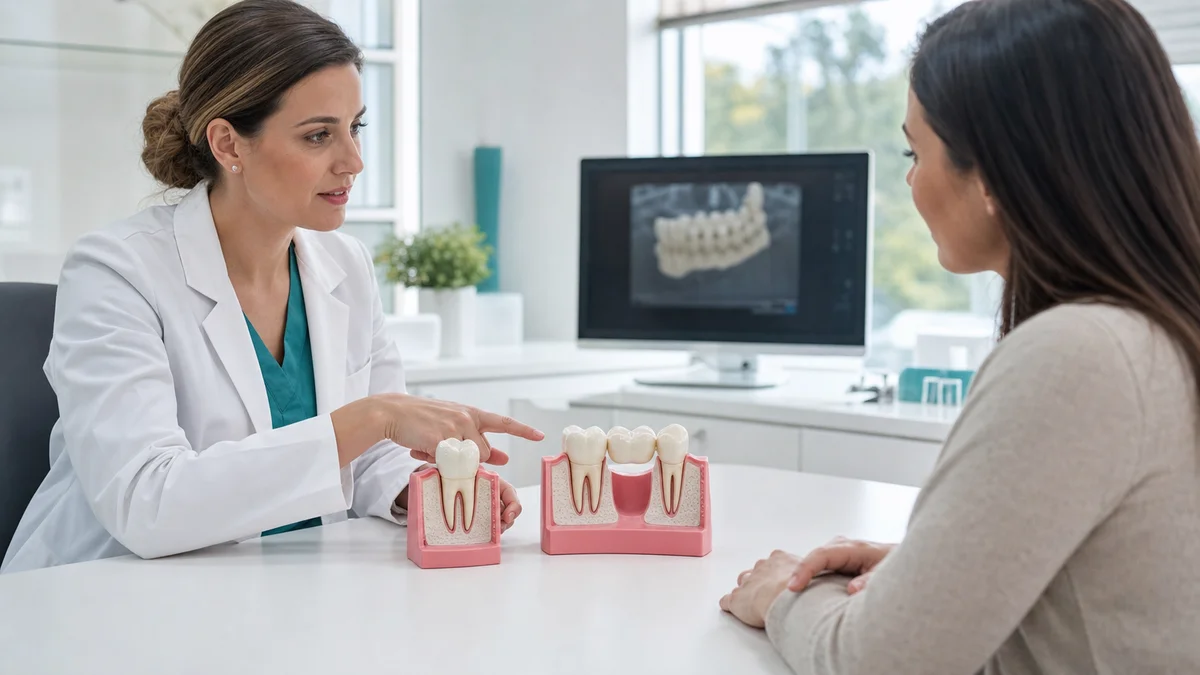
Quick answer: dental crowns vs dental bridge compares a restoration for an existing tooth with a prosthesis that spans a missing-tooth space. A crown covers one prepared tooth or implant. A traditional bridge joins crowns on supporting teeth to an artificial replacement tooth. Tooth restorability, gap size, support, preparation, bite, hygiene, implant suitability, and future repair determine the safer plan.
Dental crowns vs dental bridge is easy to misunderstand because both treatments may contain crown-shaped ceramic teeth and both are usually fixed in the mouth. Their primary jobs are different. A standalone crown restores a tooth that is still present, or it can be the visible restoration on a dental implant. A bridge replaces at least one missing tooth by connecting an artificial tooth, called a pontic, to supporting teeth or implants.
The first question is therefore whether the site contains a damaged tooth or an empty space. A broken but restorable tooth may need a filling, onlay, crown, or another tooth-preserving plan. A gap cannot be restored by a conventional standalone crown. It may be managed with a tooth-supported bridge, resin-bonded bridge, implant-supported crown, removable partial denture, orthodontic space management, or no replacement in selected circumstances.
This article does not determine restorability from a photograph, promise a fixed lifespan, or label one option universally superior. The decision depends on clinical examination, appropriate radiographs, gum and bone support, root condition, gap dimensions, neighbouring teeth, bite, cleaning ability, medical factors, and personal priorities. You can review the clinic’s general approach through the Redent Klinik English website.
What Is a Dental Crown?
A dental crown is a custom indirect restoration that covers most or all of the visible portion of a prepared natural tooth. It can restore shape, provide cuspal coverage, rebuild contact with neighbouring teeth, and help distribute biting forces. Crowns may use ceramic, zirconia, metal-ceramic, metal, or other systems selected for the clinical site.
A crown may be considered when decay, fracture, wear, or a large existing restoration leaves insufficient structure for a direct filling. Some root canal-treated teeth benefit from coverage, but root canal treatment does not automatically require a crown in every tooth. Remaining walls, location, access cavity, cracks, bite, and periodontal support affect the recommendation.
Natural-tooth crown preparation is irreversible. The dentist removes diseased tissue and shapes the tooth to create restorative space, a finish line, and a stable form. A provisional crown commonly protects the tooth while the definitive restoration is made. The final crown is fitted, contacts and bite are checked, and it is cemented or bonded according to the material and preparation.
A crown can also sit on a dental implant. In that situation, the crown replaces the visible tooth while the implant fixture replaces the root. This implant crown does not require preparation of neighbouring teeth, but it involves a surgical and restorative pathway with its own eligibility, healing, components, and maintenance.
What Is a Dental Bridge?
A fixed dental bridge replaces one or more missing teeth. In a conventional tooth-supported design, crowns or retainers are placed on teeth beside the gap and joined to one or more pontics. The patient does not remove the bridge for daily cleaning; only a dental professional can remove most fixed designs.
The American Dental Association’s MouthHealthy guidance describes a bridge as artificial teeth that literally bridge a gap and attach to surrounding teeth for support. The NHS similarly distinguishes a bridge as a fixed replacement for missing teeth. These definitions highlight that the foundation, not only the visible pontic, determines the bridge’s prognosis.
Bridge designs vary. A conventional bridge may use supports on both sides of a gap. A cantilever bridge gains support from one side and requires careful force assessment. A resin-bonded bridge uses a wing bonded to a supporting tooth and may need less preparation in suitable anterior cases. Implant-supported bridges use implants instead of natural abutment teeth.
Not every gap should be bridged. The span, ridge shape, gum level, space, root and bone support of abutment teeth, alignment, bite, aesthetic demand, and cleaning access must be evaluated. A long span or weak foundation can create unfavourable force and maintenance problems.
Dental Crowns vs Dental Bridge: 11-Point Decision Table
| Decision area | Standalone dental crown | Dental bridge | Question for the dentist |
|---|---|---|---|
| Primary purpose | Restores an existing tooth or implant | Replaces one or more missing teeth | Is the site a damaged tooth or a gap? |
| Number of units | Usually one restoration per site | Multiple connected units | How many retainers and pontics are planned? |
| Support | One natural tooth or implant | Natural teeth, implants, or a selected combination | What carries the bridge load? |
| Tooth preparation | Preparation of the tooth being restored | May require preparation of teeth next to the space | Are healthy neighbouring teeth being altered? |
| Missing root | Natural crown does not replace a root; implant crown uses an implant | Pontic replaces the visible tooth but not a natural root | How will the empty bone site be monitored? |
| Hygiene | Clean around the crown and contacts | Clean around retainers and beneath the pontic | Can I pass cleaning aids under the bridge? |
| Foundation risk | Failure usually centres on one support | One abutment problem may affect the connected bridge | What happens if one supporting tooth fails? |
| Aesthetics | Matches neighbours at one site | Must manage tooth shape plus the gap and ridge | How will the pontic meet the gum visually? |
| Repair | May be recemented, repaired, or replaced depending on cause | Repair may involve several connected units | Can one unit be repaired independently? |
| Alternative | Filling, onlay, monitoring, or extraction if non-restorable | Implant, removable denture, resin-bonded bridge, orthodontics, or no replacement | What less invasive options fit this site? |
| Cost basis | Usually quoted for one crown plus preparatory treatment | Quoted by several units plus abutment and gap management | Which stages and units are included? |
The table shows why a bridge should not be compared with the price of one crown. A three-unit bridge commonly includes two retainers and one pontic, but designs differ. A bridge may also need disease control, core build-ups, provisional work, root canal care when independently indicated, or ridge management. Each item should be explained rather than assumed.
Is the Existing Tooth Restorable or Already Missing?
Restorability is the central diagnostic fork. A tooth with a large filling or fracture may still have sufficient sound structure, root integrity, periodontal support, and maintainable margins for a crown. A tooth with a deep vertical fracture, extensive decay below a restorable level, severe mobility, inadequate bone support, or an unfavourable root problem may not.
Extraction is irreversible and should not be proposed simply because a bridge package is convenient. Each tooth deserves an individual prognosis. Clinical tests, periodontal charting, radiographs, crack assessment, and endodontic evaluation when indicated help determine whether preservation is reasonable.
If the tooth is already absent, a crown alone is not the tooth-supported solution. An implant-supported crown is one replacement route, but that requires adequate medical and anatomical assessment. A bridge uses other teeth or implants to support the replacement. A removable denture may replace several gaps without preparing every adjacent tooth.
The patient should understand uncertainty. A badly cracked tooth may appear restorable until decay or an old restoration is removed. A supporting tooth may have hidden disease that changes a bridge plan. Consent and the written fee should describe how the treatment changes if the initial foundation proves unsuitable.
What Makes a Tooth Suitable to Support a Bridge?
Bridge abutment teeth need adequate periodontal support, root form, remaining structure, and alignment. Their pulps and existing restorations are assessed, along with mobility, decay, cracks, crown-to-root relationship, and the forces expected across the span. A visually intact tooth is not automatically a sound abutment.
The number and position of missing teeth affect load. As span length increases, the bridge and supports may flex or receive greater force. Cantilever designs concentrate forces differently. Bruxism, deep bite, limited restorative space, and unfavourable jaw relationships can increase risk and alter material or design selection.
Preparing an intact neighbouring tooth for a conventional bridge sacrifices natural structure. That may be reasonable when the tooth already needs a crown, but it is a different biological decision when both neighbours are untouched and healthy. A resin-bonded bridge or implant may preserve more tooth in selected cases, though each has limitations.
A root canal-treated abutment is not automatically unsuitable, but its remaining structure, ferrule, post and core, root condition, and load require careful assessment. Root canal treatment should not be performed on a healthy tooth merely as a routine bridge-preparation step.
Conventional, Cantilever, Resin-Bonded, and Implant Bridges
A conventional fixed bridge commonly uses crowns on teeth at both sides of the gap. It can provide robust retention but requires substantial preparation. It may be logical when those teeth already need full coverage. The connected design means future disease in one support can affect the entire prosthesis.
A cantilever bridge has support at one side. It may be considered in selected low-load sites with suitable foundation and occlusion. It is not simply a way to avoid preparing a second tooth in every gap. Lever forces and pontic size must be carefully controlled.
A resin-bonded bridge uses one or more wings bonded to enamel, often with limited preparation. It can be conservative for selected missing front teeth, especially where enamel and bite are favourable. Debonding, metal show-through in some designs, occlusal interference, and limited suitability for certain spaces are considerations.
An implant-supported bridge is anchored by implants rather than natural abutment teeth. It can avoid preparation of adjacent teeth and replace multiple teeth, but it involves surgery, healing, adequate bone and soft tissue, component access, hygiene, and future maintenance. Implant treatment is not automatically preferable or possible.
- Conventional bridge: stronger retention potential, with significant abutment preparation.
- Cantilever bridge: support from one side, requiring strict force and site selection.
- Resin-bonded bridge: more conservative bonding in selected enamel-rich sites.
- Implant-supported bridge: avoids natural-tooth abutments but adds surgical requirements.
- Removable partial denture: replaces one or several spaces and is removed for cleaning.
- Orthodontic or no-replacement plan: appropriate only in selected diagnosed situations.
Tooth Preparation and the Irreversible Tissue Cost
A standalone crown preparation removes tissue from the tooth that needs restoration. A conventional bridge may require similar full-coverage preparation on one or more abutment teeth beside a gap. If those abutments are healthy, the bridge creates a biological cost that should be balanced against implant surgery, a resin-bonded option, or another plan.
Preparation must create space for material while maintaining adequate tooth form and avoiding unnecessary pulpal risk. Too little reduction can lead to bulky contours or thin material. Too much can weaken the tooth, reduce retention, expose more dentin, or injure the pulp. Existing tooth position and restorative space affect the amount.
Provisional crowns or a provisional bridge protect prepared teeth, maintain appearance and contacts, and allow some evaluation of shape and bite. They are temporary and can loosen, fracture, or feel different from the definitive work. Patients should know how to clean and whom to contact if a provisional moves.
The NIDCR notes that indirect restorations are custom made and that repeated replacement can remove more natural structure. This cumulative effect supports careful first-time indication and designs that remain maintainable. “Fixed” does not mean permanent for life.
Pontic Design, Gum Contour, and the Missing-Tooth Ridge
The pontic is the artificial tooth suspended in the gap. Its underside should balance appearance, speech, comfort, food control, and access for cleaning. A shape that presses too deeply into tissue can cause inflammation or be difficult to clean. A large gap between the pontic and tissue may trap food or look unnatural.
After tooth loss, the ridge can shrink or change contour. A bridge replaces the visible tooth but does not reproduce a natural root in the bone. In a front-tooth gap, tissue loss may make the replacement look long or create dark spaces. The clinician may discuss soft-tissue management, ridge augmentation, pink ceramic, orthodontics, or a different replacement path.
Immediate appearance after extraction can change as tissues heal. A provisional solution may be used before definitive impressions. Rushing to a final pontic contour before healing stabilises can create later mismatch. Timing is individual and should not be promised from a standard package.
The patient should see how to pass floss threaders, interdental brushes, or other recommended aids under the pontic. If the design cannot be cleaned with the patient’s dexterity, the plan should be reconsidered before cementation.
Materials, Connectors, and Aesthetic Tradeoffs
Crowns and bridges may use zirconia, glass ceramics in selected indications, metal-ceramic systems, metals, resins for provisional work, or combinations. Material selection depends on span, connector dimensions, available thickness, bite force, position, desired translucency, underlying colour, and repair pathway.
A material suitable for a single crown is not automatically suitable for every bridge span. Bridges require connectors between retainers and pontics, and those connectors need adequate dimensions. Limited space can force a choice between strength, contour, and cleansability. Material manufacturer indications and laboratory design matter.
Front-tooth work must coordinate shade, translucency, surface texture, tooth proportions, and gum levels. The pontic emerges from a ridge rather than a periodontal ligament, so matching a natural emergence profile can be challenging. A try-in or provisional can support communication but cannot guarantee an identical final result.
Material names are not quality certificates. Accurate preparation, impression or scan, laboratory communication, fit, contact, polished surfaces, cementation, and maintenance affect clinical performance. A premium label cannot correct a weak abutment or inaccessible pontic.
Cleaning a Crown Compared With Cleaning a Bridge
A crowned tooth requires brushing with fluoride toothpaste and cleaning at both side contacts. The restoration cannot develop decay, but exposed natural tooth at or below the margin can. Gum inflammation, recurrent decay, root sensitivity, and loss of retention remain possible.
A bridge requires all crown-margin care plus cleaning beneath each pontic and around connectors. Standard floss cannot drop through connected units from the chewing surface, so a floss threader, super floss, interdental brush, or other device may be recommended. The method must suit the space and avoid tissue injury.
Water flossers can support plaque removal for some people but do not automatically replace all mechanical cleaning. A dental professional should demonstrate the selected technique. Arthritis, visual impairment, gagging, limited dexterity, or caregiver support can influence which design is realistically maintainable.
Bleeding, bad taste, food trapping, persistent odour, pain on biting, a loose restoration, or floss repeatedly shredding should be reviewed. Increasing mouthwash use cannot compensate for an open margin, poor contour, decay, or an uncleanable bridge design.
- Brush twice daily with fluoride toothpaste around all crown and bridge margins.
- Clean both sides of a standalone crown using an appropriate interdental method.
- Pass a suitable aid beneath the bridge pontic every day.
- Protect polished ceramic from abrasive home products or metal tools.
- Attend reviews for gum health, decay, bite, mobility, and material wear.
- Seek care rather than using household glue on a loose crown or bridge.
Risks, Failure Patterns, and Repair Questions
A crown can develop loss of cement, ceramic chipping, wear, recurrent decay, gum problems, pulpal symptoms, root fracture, or failure of the underlying build-up. Some loose crowns can be recemented if the crown and tooth remain suitable. Others require new treatment because the cause is decay, fracture, or poor fit.
A bridge adds connected-unit risks. Cement loss at one retainer may permit leakage while the other side appears stable. One abutment may develop decay, pulpal disease, periodontal loss, or fracture. A connector or pontic can chip or fracture. Repair may be possible in selected cases, but sometimes the whole bridge must be removed.
Connected restorations complicate diagnosis because movement or symptoms may be subtle. Regular examination and radiographs when clinically justified help assess margins and supporting structures. Patients should not wait for a bridge to fall out before reporting persistent pain, bad taste, swelling, or movement.
Severe escalating pain, spreading facial swelling, fever with dental infection, uncontrolled bleeding, trauma, or difficulty swallowing or breathing requires prompt care. Breathing or swallowing difficulty is a medical emergency. Online comparison material cannot triage an individual safely.
Implant Crown or Bridge: When Is It a Relevant Alternative?
An implant-supported crown can replace one missing tooth without preparing neighbouring teeth. This may preserve sound tooth structure, but the patient must be suitable for surgery and have adequate bone and soft-tissue conditions. Medical history, smoking, periodontal risk, anatomy, space, and hygiene are assessed.
Implant treatment usually includes assessment, surgery, healing, components, the crown, and long-term maintenance. Bone grafting is not required for everyone but may be discussed if anatomy is insufficient. Timing should follow biology rather than a guaranteed calendar.
An implant does not decay, yet tissues around it can become inflamed and lose bone. Components can loosen, wear, chip, or fracture. The crown’s emergence, contact, and hygiene access are important. An implant is not a maintenance-free replacement for a natural tooth.
A bridge may remain preferable when adjacent teeth already need crowns, surgery is unsuitable or unwanted, anatomy is limiting, or the patient’s priorities support a fixed tooth-borne path. An implant may be preferable in other diagnosed situations. The choice should compare complete pathways rather than only surgery versus no surgery.
Cost: Compare Units, Foundations, and Future Maintenance
When assessing dental crowns vs dental bridge, one crown fee should not be compared with the total fee for a multi-unit bridge. A bridge quote should state every retainer and pontic, material, provisional, laboratory stage, support treatment, reviews, and remake terms.
A crown quote may exclude removal of an old crown, decay control, core build-up, post, root canal treatment, periodontal care, or a night guard. These should be prescribed only when indicated. A bridge may require those items for more than one abutment, which changes both cost and biological complexity.
Alternative quotes should be equally complete. An implant comparison needs surgery, imaging, grafting if indicated, components, provisionalisation, crown, and maintenance. A removable denture comparison should include impressions, try-ins, delivery, adjustments, relines, and future replacement.
Insurance decisions depend on location, plan terms, waiting periods, missing-tooth clauses, frequency limits, networks, and clinical documentation. Pre-authorisation can be useful but may not guarantee final payment. Treatment suitability must not be inferred from coverage approval or finance availability.
Written Questions Before Accepting Treatment
- Is the problem a damaged tooth, a missing tooth, or both?
- What is the prognosis of every possible abutment tooth?
- Which bridge design is proposed, and why does it fit this site?
- How many retainers and pontics are included?
- Are healthy neighbouring teeth being prepared, and what alternatives preserve them?
- What material and connector design are planned?
- How will the pontic meet the tissue and be cleaned?
- What provisional restoration will be used during treatment?
- What happens if one abutment later needs root canal treatment or extraction?
- Which preparatory treatments and laboratory stages are included in the fee?
- What repair, remake, cancellation, and urgent-care terms apply?
- Can the patient receive radiographs, scans, material details, and treatment records?
If you are considering treatment in Istanbul, the Redent Klinik contact page can be used to organise records and appointment questions. Remote review is preliminary and cannot confirm crack depth, tooth restorability, abutment support, or final bridge design.
Dental Crowns vs Dental Bridge: Frequently Asked Questions
Is a dental bridge just several crowns?
A conventional bridge often includes crown-like retainers connected to one or more artificial teeth, but it functions as a single prosthesis. The pontic has no natural root, and support comes from abutment teeth or implants. Connected units change cleaning, force distribution, and repair.
Can a standalone crown fill a missing-tooth gap?
Not without support. A crown can be fitted to a dental implant, or crown retainers can form part of a bridge. A conventional crown placed on a natural tooth restores that tooth; it does not independently suspend itself in an empty space.
Must healthy teeth be filed down for every bridge?
Conventional bridges usually require preparation of abutment teeth. Resin-bonded or implant-supported designs may avoid full preparation in suitable cases. The choice depends on location, enamel, bite, span, support, appearance, and patient factors, so alternatives should be discussed.
Is a bridge better if adjacent teeth already need crowns?
It may be a logical option because those teeth already need coverage, but suitability still depends on their prognosis, roots, bone, spacing, bite, span, and hygiene. Connecting weak teeth does not automatically create a strong foundation.
How do I floss under a dental bridge?
Because bridge units are connected, cleaning usually requires a floss threader, super floss, interdental brush, or another recommended device beneath the pontic. A clinician or hygienist should demonstrate a method that fits the bridge and the patient’s dexterity.
Does a bridge prevent bone loss in the gap?
A tooth-supported pontic replaces the visible tooth but does not place a root in the bone. Ridge shape can continue to change after tooth loss. An implant interacts with bone differently, but implants also have biological risks and do not guarantee stable tissue dimensions.
Can one part of a bridge be replaced?
Sometimes a local chip can be polished or repaired, but connected construction often means a major problem requires removal or replacement of the whole bridge. Access, material, damage, abutment condition, and whether the bridge can be removed intact determine options.
Do crowns and bridges last forever?
No. Materials, cement, supporting teeth, gums, and bite can change. Decay, periodontal disease, chipping, loosening, fracture, or pulpal problems may require intervention. Good design and maintenance support longevity but cannot provide a lifetime guarantee.
Is an implant crown always better than a bridge?
No. An implant can preserve adjacent teeth but requires surgical suitability, adequate anatomy, healing, components, hygiene, and maintenance. A bridge can avoid surgery and may suit teeth already needing crowns. The complete risks and benefits are individual.
Which is cheaper in dental crowns vs dental bridge?
A single crown usually involves fewer units than a bridge, but they address different needs. Compare complete diagnosis-based pathways, including preparatory care, retainers, pontics, provisionals, laboratory work, implant surgery if relevant, maintenance, and future replacement rather than headline prices.
Conclusion: Restore a Tooth or Replace a Gap
Dental crowns vs dental bridge becomes clearer once the treatment target is named. A crown restores an existing tooth or finishes an implant. A bridge replaces a missing tooth by relying on supports and connected units. Those different foundations create different preparation, hygiene, risk, and repair paths.
Begin with a tooth-by-tooth prognosis and a map of the missing space. Ask why each support is chosen, whether healthy teeth can be preserved, how the pontic will be cleaned, and what happens if one abutment fails. Compare conventional, resin-bonded, implant, removable, orthodontic, and no-replacement options when clinically relevant.
This article is general education, not a diagnosis, fixed price, outcome promise, or lifespan guarantee. Final treatment should follow clinical examination, appropriate records, disease control, informed consent, and a maintenance plan that the patient can carry out.
Authoritative Sources
- American Dental Association MouthHealthy: Crowns
- American Dental Association MouthHealthy: Bridges
- NHS: Dental treatments, crowns, bridges, and implants
- National Institute of Dental and Craniofacial Research: Dental materials and indirect restorations
- National Institute of Dental and Craniofacial Research: Fillings and crowns
- University College London Hospitals: Prosthodontic services
- American Dental Association
- World Health Organization: Oral health fact sheet