
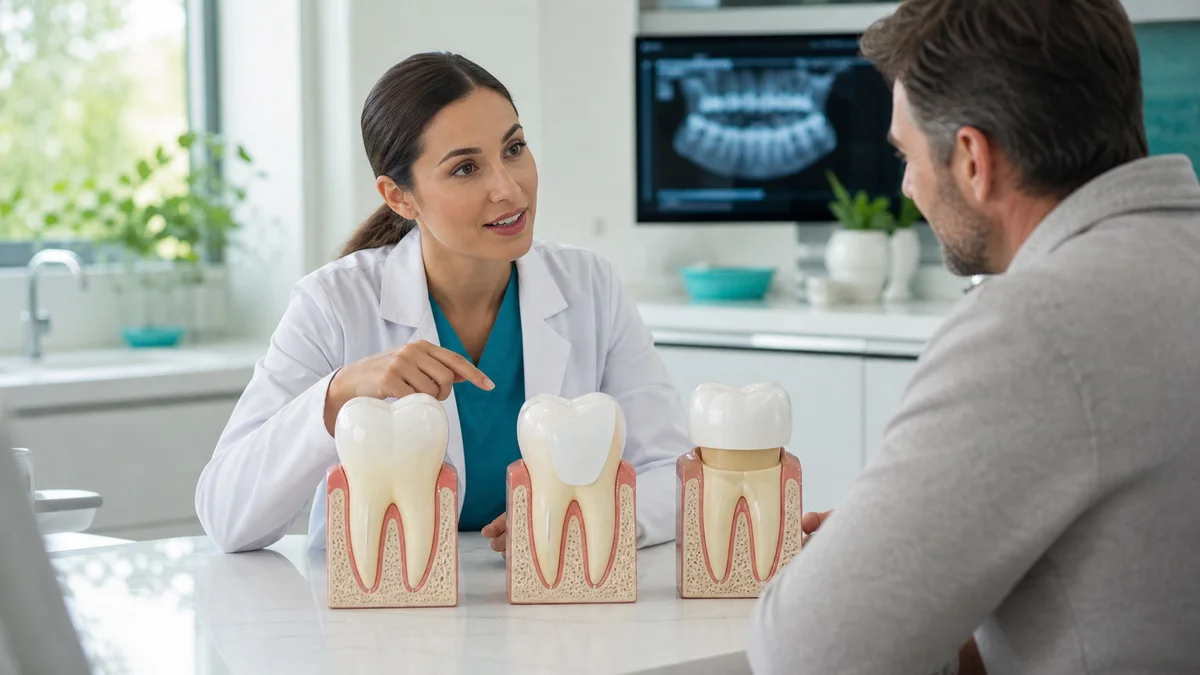
Quick answer: veneers or dental crowns which is better depends on the tooth, not a universal ranking. Veneers mainly cover the front surface and may suit selected colour, shape, or proportion concerns. Crowns cover most of a prepared tooth and may suit greater structural damage. Healthy enamel, decay, cracks, fillings, bite, gum health, alternatives, preparation, and future replacement determine the safer choice.
Veneers or dental crowns which is better is a common question from people who want a clearer, more even smile or need damaged teeth restored. Yet “better” can mean several different things: less tooth removal, greater structural coverage, a more predictable colour change, easier repair, lower initial cost, or a plan that remains maintainable over time. Those goals do not always point to the same treatment.
A veneer is a custom covering placed mainly on the front surface of a tooth. A crown covers most or all surfaces of a prepared natural tooth, or it may be the visible restoration on a dental implant. These designs are not interchangeable skins. They differ in indication, preparation, bonding surface, force distribution, margin extent, pulp risk, and the amount of future tooth tissue available if replacement becomes necessary.
The safest comparison begins before material selection. The dentist must identify whether the concern is active disease, structural weakness, colour, position, shape, bite, gum level, or a combination. This article offers general education and a scenario-based framework, not an online diagnosis or result promise. For broader information about the clinic, visit the Redent Klinik English website.
Veneer and Crown Coverage Are Fundamentally Different
The American Dental Association’s MouthHealthy guidance distinguishes veneers from crowns because a veneer covers the front surface rather than the entire tooth structure. Porcelain veneers are thin custom shells, while composite veneers use tooth-coloured resin that is bonded and sculpted. Both require professional diagnosis and care.
A crown is a full-coverage or near-full-coverage indirect restoration. It may be considered when a tooth has substantial decay, a very large restoration, fracture, severe wear, or insufficient remaining structure for a smaller filling. Some root canal-treated teeth benefit from a crown, depending on location, remaining walls, access cavity, cracks, and bite.
Coverage matters because every prepared surface is an irreversible biological commitment. A veneer can preserve more structure in a properly selected, enamel-rich tooth. A crown can provide necessary broad coverage when the tooth is structurally compromised. Using a veneer on a tooth that needs full support may be inadequate; crowning a healthy tooth for a minor surface issue may be excessive.
The NHS describes a veneer as a thin front facing and a crown as a cap that covers a real tooth. These definitions are a starting point, not an indication. The clinical question is why a particular tooth needs a particular amount of coverage.
12-Scenario Decision Table: Veneers, Crowns, or Another Path?
| Tooth scenario | Veneer may be discussed | Crown may be discussed | Alternative or first step |
|---|---|---|---|
| Healthy tooth with mild surface stain | Only after conservative options and realistic colour goals | Usually excessive without structural need | Diagnosis, cleaning, whitening, or observation |
| Small chip with sound enamel | Possible for broader shape correction | Usually more coverage than needed | Polishing, fragment repair, or composite bonding |
| Minor spacing or proportion concern | Possible if position and bite allow additive design | Not normally first choice for healthy teeth | Orthodontics, bonding, or no treatment |
| Rotated or protruding tooth | May require excessive preparation | Full coverage does not make aggressive reduction conservative | Orthodontic movement first |
| Large existing filling | Bonding surface and structural support may be limited | May provide necessary coverage if restorable | Onlay or other partial coverage |
| Fractured cusp | Usually not the structural solution for a back tooth | May be considered depending on fracture extent | Onlay, crown, crack assessment, endodontic review |
| Root canal-treated back tooth | Rarely the main posterior coverage plan | May be appropriate based on remaining structure | Onlay or other cuspal coverage in selected cases |
| Deep crack | Does not stabilise all crack patterns | May protect selected restorable cracks but cannot guarantee survival | Crack diagnosis; extraction if non-restorable |
| Severe wear or short teeth | May be part of an additive plan in selected cases | May be required for heavily damaged teeth | Full-mouth bite and cause assessment first |
| Dark single tooth | Masking depends on thickness and substrate | More opacity and coverage may help if structurally indicated | Endodontic assessment, whitening, bonding |
| Active decay or gum disease | Not before disease control | Not before disease control | Stabilisation, hygiene, periodontal care |
| Bruxism or edge-to-edge bite | Higher loading risk may alter design | Material strength does not remove tooth or bite risk | Occlusal diagnosis, risk control, protective plan |
The table does not decide treatment from a label. A “small chip” can conceal a crack, and a dark tooth can have pulpal disease, trauma history, or an old root filling. A large filling may leave enough enamel for partial coverage or too little sound structure for any restoration. Examination establishes which row actually describes the tooth.
Healthy Enamel and Minimal Aesthetic Concerns
Healthy enamel is valuable. A person with sound teeth and a modest colour or shape concern should understand that both veneers and crowns can begin a lifelong restoration cycle. Even when initial preparation is small, future removal, repair, or replacement may alter additional tissue.
Professional cleaning can address some external stain. Whitening may improve natural tooth colour when appropriate, although fillings, crowns, and veneers do not whiten in the same way. Composite bonding can add limited shape or close small spaces in selected cases and may be repaired more directly than ceramic.
Orthodontics may correct rotation, crowding, protrusion, or spacing without covering the tooth. It involves time, movement risks, retention, and compliance, but it can place teeth in positions that reduce restorative preparation. Restorations should not be marketed as automatic “instant orthodontics.”
If the expected benefit is small and the teeth are healthy, observation is a legitimate option. A patient should not be pressured to treat a fixed number of teeth for symmetry or to match a social-media template. Consent should include the option of no irreversible treatment.
Chips, Fractures, and Cracks Need Different Answers
A superficial enamel chip may need only smoothing, fragment reattachment, or composite repair. A veneer can be considered when broader facial shape or colour correction is also desired. A crown may be more preparation than the tooth requires.
A fractured cusp, especially around a large filling, raises structural questions. Partial cuspal coverage with an onlay may preserve more tooth than a full crown in selected cases. A crown may be indicated when damage is extensive or the remaining tooth cannot support a smaller restoration.
Cracked teeth require diagnosis based on symptoms, crack location and extent, bite tests, magnification, transillumination, periodontal probing, and appropriate imaging. The American Association of Endodontists explains that treatment and prognosis vary by crack type. A crown can protect selected cracked teeth, but it cannot guarantee that a crack will stop or the tooth will survive.
If a crack extends below a restorable level or the tooth has split, extraction may be necessary. A veneer is not a cosmetic seal for a structurally dangerous crack. Uncertainty and the possibility of future tooth loss should be discussed before preparing any restoration.
Large Fillings, Root Canal Treatment, and Remaining Structure
Teeth with large fillings may have weakened cusps, cracks, recurrent decay, or limited bonding surfaces. The dentist assesses how much sound enamel and dentin remain, whether margins can be kept clean, and whether a filling, onlay, or crown provides the appropriate coverage. A veneer mainly addresses the facial surface and may not manage missing structural support elsewhere.
A root canal-treated tooth is not dead material; it remains supported by root, periodontal ligament, bone, and surrounding tissue. Its restoration depends on tooth type and remaining structure. Back teeth often face substantial chewing forces and may need cuspal coverage. Some front teeth with conservative access and sound structure may require a different plan.
Posts do not strengthen roots automatically. A post may retain a core when insufficient coronal structure remains, but it also requires root-space preparation and carries risks. Root canal treatment should never be performed merely to create room for a cosmetic crown.
Before asking veneers or dental crowns which is better for a heavily restored tooth, ask whether the tooth is restorable and what ferrule, margin, root, and periodontal support are available. A premium ceramic cannot compensate for a poor foundation.
Tooth Position, Spacing, and Bite May Point to Orthodontics
A veneer changes the visible surface but does not move the root. A crown can change apparent angulation more extensively, yet correcting a protruding or rotated tooth by preparation may remove substantial healthy tissue and approach the pulp. The final contour can also become bulky if insufficient space exists.
Orthodontic treatment can redistribute spaces, align roots, improve contacts, and create more suitable positions for limited restorations. In some cases, a short orthodontic phase makes additive bonding or thinner veneers possible. In others, orthodontics alone meets the goal.
The bite must be evaluated in static closure and jaw movements. Deep bite, edge-to-edge contact, missing posterior support, crossbite, and guidance patterns can place high force on veneer edges or crown ceramics. A strong material does not remove force from the supporting tooth.
Mock-ups and digital simulations can help visualise proposed tooth positions, but they do not show biological risk or guarantee an outcome. The patient should understand whether the plan changes actual position or only masks it with restorative contour.
Colour Change, Translucency, and the Dark Tooth Problem
Natural teeth have layered colour and translucency. The appearance of a veneer or crown depends on the underlying tooth, material, thickness, cement, surface texture, lighting, and neighbouring teeth. A photograph taken with bright filters is not a reliable shade assessment.
Veneers can create subtle colour changes while preserving a natural light effect when the substrate is favourable. A very dark tooth may show through a thin veneer or require more opaque material. Increasing opacity can reduce natural translucency; increasing thickness may require more preparation.
A crown offers broader masking but should not be chosen solely because it can hide colour. The cause of darkening must be assessed. Previous trauma, pulpal necrosis, old root canal treatment, metal posts, decay, or internal stains may require disease-specific management before restoration.
Whitening before final shade selection may reduce restorative intervention or improve matching. Existing restorations will not whiten like natural teeth, so sequencing is important. Teeth should not be matched while dehydrated immediately after preparation.
Gum Health, Margins, and Tooth Proportions
Bleeding, swelling, plaque, active periodontal disease, and unstable gum levels should be managed before elective veneers or crowns. Restorations placed in inflamed tissues can have inaccurate margins, compromised bonding, and unpredictable appearance as gums heal.
Margin position affects cleansability and aesthetics. Deep subgingival margins may be necessary for existing damage in selected cases, but deeper is not automatically more aesthetic. An over-contoured margin can retain plaque and make the tooth look bulky.
Short-looking teeth may result from wear, altered eruption, gum coverage, lip position, or tooth form. Adding length without diagnosing the cause can create bite or proportion problems. Periodontal, orthodontic, restorative, or combined options may be discussed.
Recession can expose crown or veneer margins later. Thin tissue, aggressive brushing, periodontal disease, smoking, and tooth position can influence risk. The plan should explain how future gum change could alter appearance and sensitivity.
Porcelain, Composite, Zirconia, and Other Material Choices
Veneers may be made from glass ceramics, porcelain-type systems, or composite resin. Crowns may use zirconia, glass ceramics in selected sites, metal-ceramic, metal, resin provisionals, or other materials. The treatment design comes first; material follows indication, thickness, support, bite, colour, and laboratory workflow.
Composite veneers may require less removal in selected additive cases and can often be repaired directly, but they can wear, stain, or lose polish. Ceramic veneers may offer different optical stability and surface characteristics while requiring careful bonding and laboratory fabrication.
Zirconia crowns can provide high strength, yet zirconia formulations differ in translucency and mechanical properties. Glass ceramics can provide different optical and bonding characteristics. Neither material name proves that the preparation, fit, surface, bite, or margin is correct.
The NIDCR explains that indirect restorations such as crowns and veneers are custom made and may involve digital design, milling, or laboratory production. It also highlights that repeated replacement can remove additional tooth structure. This makes maintainability as important as the first material choice.
- Ask for the exact material and why it suits that tooth and preparation.
- Separate restoration design from a brand or generic “porcelain” label.
- Discuss how the material bonds or cements to enamel, dentin, core, or post.
- Review translucency, masking, thickness, surface finish, and opposing teeth.
- Ask what can be polished or repaired and what requires complete replacement.
- Request material, shade, scan, and laboratory records where available.
Preparation Depth, Pulp Risk, and Reversibility
Both treatments may require irreversible preparation. A veneer usually removes less tissue when the tooth position, colour, and design are favourable. A crown normally requires circumferential and incisal or occlusal reduction. Actual depth depends on the starting tooth and restorative space.
Preparation into dentin can increase sensitivity and changes adhesive conditions. Excessive removal may approach the pulp, particularly in young or small teeth. Some teeth later develop pulpal symptoms and require root canal treatment, although this is not an automatic or intended step.
“No-prep veneer” does not always mean fully reversible. Surface modification, finishing, or later removal can affect enamel. Adding material without space may create bulky contours, altered contacts, or bite interference. Suitability is limited to selected tooth positions.
Patients should ask to see the proposed preparation and understand which surfaces will be altered. A diagnostic wax-up or mock-up can support communication. It cannot reveal all crack, pulp, or gum risks and should not be treated as informed consent by itself.
Bonding, Cementation, and Why Isolation Matters
Veneers often rely heavily on adhesive bonding. Enamel, dentin, composite cores, and ceramic surfaces require different treatment. Moisture or contamination, poor fit, incorrect surface preparation, and unfavourable loading can compromise the bond.
Crowns may use adhesive or conventional cementation depending on material and preparation retention. Zirconia surface treatment differs from glass ceramic protocols. A universal marketing label for cement does not replace material-specific instructions and clinical judgement.
Isolation helps protect the bonding field from saliva, blood, or moisture. Gum inflammation and deep margins can make isolation more difficult. This is another reason disease control and margin planning precede elective ceramic work.
Final checks include seating, margin, contact, contour, shade, bite, surface finish, and cleansability. Persistent floss shredding, gum bleeding, pain on biting, movement, or a high bite should be reassessed rather than accepted as a normal adaptation.
Bruxism, Sports, Habits, and Functional Risk
Clenching and grinding expose teeth, restorations, muscles, and joints to repeated force. They do not automatically prohibit veneers or crowns, but they change design, material, edge position, number of treated teeth, and maintenance. Existing wear facets and fractures provide clues.
Nail biting, chewing ice or pens, opening packaging with teeth, and contact sports can chip natural enamel and restorations. ADA veneer guidance advises avoiding hard-object habits and using protection for activities that can injure the mouth.
A night guard may be considered for selected patients, but it is not a warranty. It must fit accurately, be worn, cleaned, and reviewed. The underlying causes and full bite still need evaluation.
A patient with unexplained facial pain, severe wear, limited opening, or unstable occlusion may need broader diagnosis before multiple restorations. Covering teeth does not treat every muscle, joint, airway, or behavioural factor.
Maintenance, Complications, and the Next Restoration
Veneers and crowns require brushing with fluoride toothpaste, daily interdental cleaning, and professional reviews. Ceramic does not decay, but the tooth at its margins can. Recession, recurrent decay, gum disease, wear, and trauma can affect the restoration or support.
Veneers can chip, debond, fracture, wear, or develop margin staining. Composite can lose polish or stain. Crowns can loosen, chip, fracture, wear opposing teeth if rough, or conceal decay and core problems. The supporting tooth may develop pulpal disease or root fracture.
A small chip may be polished or repaired in selected cases. A debonded veneer or crown may or may not be reusable depending on fit, damage, contamination, and the supporting tooth. Household glue must never be used.
Replacement can require removing the old restoration and additional tooth tissue. A veneer may later need another veneer, a crown, endodontic treatment, or extraction depending on why it failed. A crown replacement may require a new core or a different prognosis. The future path belongs in the first consent conversation.
- Brush twice daily with fluoride toothpaste around all margins.
- Clean between teeth using an aid that passes without shredding or trauma.
- Report persistent sensitivity, pain, movement, chips, or gum bleeding.
- Avoid using restored teeth as tools or biting very hard non-food objects.
- Use sports or night protection when professionally recommended.
- Keep regular reviews even when the restorations look and feel normal.
Cost and Value: Count the Biological and Future Costs
When asking veneers or dental crowns which is better, compare complete treatment scopes rather than headline per-tooth prices. Examination, radiographs, disease control, removal of old restorations, build-ups, provisionals, mock-ups, laboratory work, bonding or cementation, reviews, and protective appliances may be separate.
A veneer package may include a fixed number of front teeth despite different indications. Ask for tooth-by-tooth rationale. A crown quote may not include core build-up, post, root canal treatment, periodontal treatment, or replacement of an old crown. These services should only be prescribed when indicated.
Value includes preserved healthy tissue, maintainable margins, realistic aesthetics, repair access, records, and continuity of care. A lower initial fee can become costly if the plan requires repeated travel or excludes adjustments. A higher fee is not proof of better diagnosis or outcome.
Insurance coverage varies by country, plan, clinical necessity, waiting periods, exclusions, frequency limits, and network. Cosmetic veneers may be excluded. Pre-authorisation may not guarantee final payment. Financing approval does not prove clinical suitability.
A 12-Question Consent Checklist
- What is the diagnosis and prognosis for each tooth?
- Is the main problem disease, structure, colour, position, shape, or bite?
- Why is a veneer, crown, partial restoration, or no treatment recommended?
- How much enamel and dentin will be removed?
- Which less invasive options were considered?
- What exact material and preparation design are planned?
- What substrate will the restoration bond or cement to?
- How will colour, translucency, gum margins, and neighbouring teeth be managed?
- How do grinding, sports, habits, and bite affect risk?
- What provisional or mock-up stage is included?
- What repair, remake, cancellation, and urgent-care terms apply?
- What is the likely treatment path if the first restoration fails?
For appointment planning in Istanbul, use the Redent Klinik contact page. Photos and records can help organise a preliminary discussion, but they cannot confirm crack extent, enamel availability, preparation depth, gum stability, or final suitability.
Veneers or Dental Crowns Which Is Better: Frequently Asked Questions
Which removes less natural tooth, a veneer or crown?
A veneer often needs less coverage and can preserve more structure in a suitable tooth. Actual reduction depends on tooth position, colour, damage, existing fillings, and material. An aggressively prepared veneer is not automatically more conservative than an appropriately indicated crown or onlay.
Can veneers strengthen a badly damaged tooth?
Veneers mainly cover the front surface and may not provide the structural coverage needed for a heavily damaged tooth. The dentist must assess cracks, decay, remaining walls, pulp, bite, and gum support. An onlay, crown, other restoration, or extraction may be relevant.
Does every root canal-treated tooth need a crown?
No universal rule applies. Back teeth and teeth with extensive structural loss often need cuspal coverage, while some front teeth may have different needs. Remaining structure, access design, cracks, location, and bite determine whether a crown, onlay, or another restoration is suitable.
Are veneers reversible?
ADA patient guidance states that veneer treatment is not reversible. Even minimal or no-prep approaches may involve surface changes and future maintenance. Removing or replacing a veneer can alter more enamel, so the long-term restoration cycle should be understood before treatment.
Do crowns require root canal treatment?
Not routinely. Root canal treatment is based on pulp diagnosis, infection, trauma, or symptoms, not on convenience for crown preparation. Some teeth can develop pulpal disease after restorative treatment, and that risk should be discussed without presenting it as inevitable.
Which looks more natural?
Either can look natural when diagnosis, material, thickness, underlying colour, laboratory work, surface texture, gum level, and neighbouring teeth are coordinated. A veneer may preserve more light transmission in selected teeth; a crown may mask more. No material guarantees a natural result.
Which is better for teeth grinding?
Grinding increases risk for natural teeth and both restorations. The plan should evaluate wear, cracks, contacts, jaw movement, muscles, material, design, and possible protection. A stronger crown or a night guard cannot guarantee that the restoration or tooth will not fail.
Can I have veneers on some teeth and crowns on others?
Yes, when each tooth has a different structural indication and the materials, shade, contours, and bite can be coordinated. The number of crowns should not be increased simply to simplify colour matching. Each prepared tooth needs its own diagnosis and consent.
Do veneers or crowns last forever?
No. Both can chip, loosen, fracture, develop margin problems, or require replacement, while supporting teeth can develop decay, gum disease, pulpal symptoms, or fracture. Hygiene and reviews support longevity but do not create a lifetime guarantee.
So, veneers or dental crowns which is better for me?
The answer requires an examination. Healthy enamel with limited surface concerns may favour no treatment, whitening, bonding, orthodontics, or a veneer. Greater structural damage may favour an onlay or crown. Active disease or a non-restorable tooth changes the pathway entirely.
Conclusion: Better Means the Right Coverage for That Tooth
Veneers or dental crowns which is better has no responsible one-word answer. Veneers mainly change a selected front surface; crowns provide broader coverage. The better plan uses only the coverage needed after disease, structure, position, bite, gum health, and alternatives have been assessed.
Protect healthy enamel, avoid masking untreated disease, and ask why every tooth is included. Review material, preparation, bonding, colour, function, maintenance, and the replacement cycle before consent. “Neither” can be the best answer when whitening, orthodontics, bonding, monitoring, or no treatment meets the goal with less tissue loss.
This article is general education, not a diagnosis, fixed price, lifespan promise, or outcome guarantee. Final decisions should follow clinical examination, appropriate records, disease control, informed consent, and a realistic maintenance plan.
Authoritative Sources
- American Dental Association MouthHealthy: Veneers, coverage, care, and patient safety
- American Dental Association MouthHealthy: Crowns
- NHS: Dental treatments, crowns, and veneers
- National Institute of Dental and Craniofacial Research: Dental materials
- American Association of Endodontists: Cracked teeth
- NHS England: Urgent and non-urgent dental care guidance
- American Dental Association
- World Health Organization: Oral health fact sheet