
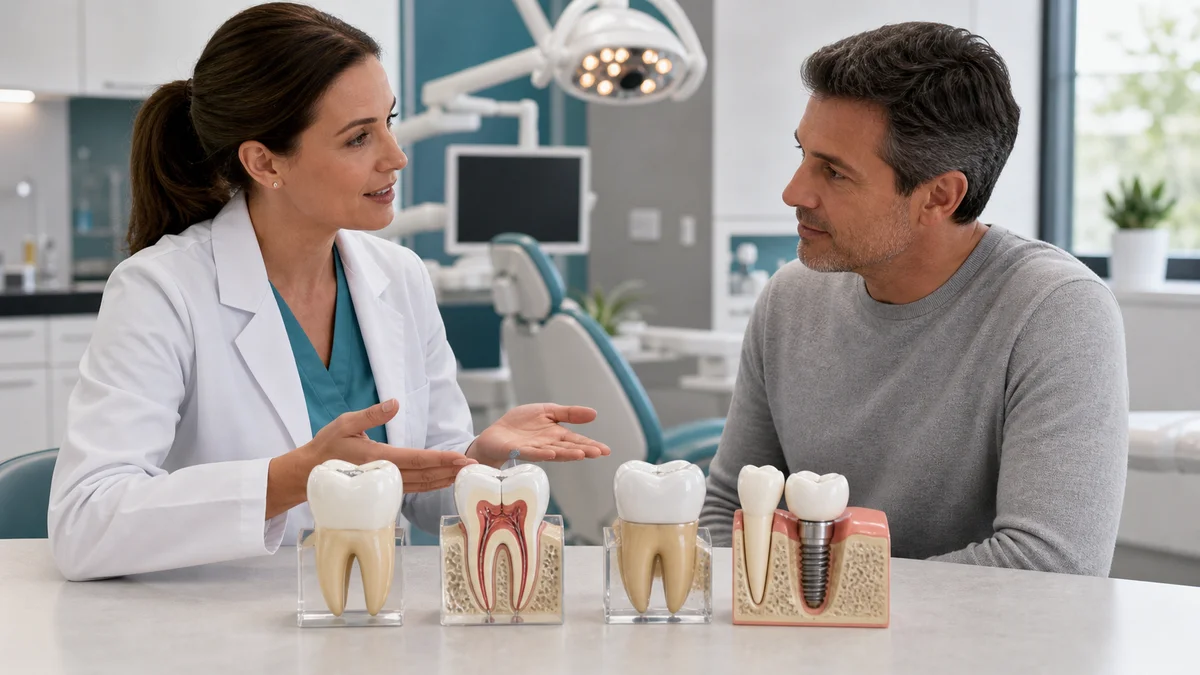
A useful root canal comparison is not simply “root canal or something cheaper.” It compares what each treatment is designed to solve. A filling repairs lost tooth structure. Root canal treatment manages inflamed, dead, or infected pulp inside a tooth. A crown or onlay protects and restores the part above the gum. Extraction removes a tooth that cannot or should not be retained, while an implant, bridge, or removable prosthesis may replace the resulting space.
Those paths can overlap. One tooth may need root canal treatment followed by a bonded restoration; another may need root canal treatment and a crown. A shallow lesion may need prevention or a filling instead, and a severely fractured or unrestorable tooth may be better served by extraction. The safe choice follows examination, appropriate tests, radiographs when indicated, periodontal and bite assessment, and a discussion of restorability. This evidence-based guide is written for review by Dentist Esma Çevrük Çakır and does not diagnose an individual tooth.
Quick answer: A root canal comparison starts with diagnosis, not procedure names. A filling may suit decay that has not irreversibly damaged the pulp; root canal treatment may retain a restorable tooth with diseased pulp; a crown may protect weakened structure afterward. Extraction is considered when retention is unsuitable, with replacement planned according to bone, gums, bite, health, and priorities.
1. Root Canal Comparison at a Glance
The “root canal” is an anatomical space inside a tooth, while root canal treatment is the clinical procedure used to clean, shape, fill, and seal that space when the pulp cannot recover or has become infected. The roots normally remain in the jaw. The procedure does not automatically rebuild every missing cusp, repair every crack, or complete the final exterior restoration.
That distinction prevents a common planning error. Comparing a root canal with a crown as if they were interchangeable is like comparing treatment of an internal disease with reconstruction of an exterior shell. Some teeth need one, some need both, and some need neither. The following table summarizes the principal paths without presenting any option as universally superior.
| Treatment path | Main problem addressed | Pulp removed? | Tooth retained? | Key limitation |
|---|---|---|---|---|
| Prevention or monitoring | Early, non-cavitated decay risk or a stable finding | No | Yes | Requires reliable review and risk control; not suitable for untreated infection |
| Filling | A cavity or limited structural defect | Usually no | Yes | Cannot predictably resolve irreversible pulp disease |
| Vital pulp treatment | Selected pulp exposures or inflammation where vitality may be preserved | Partly or not fully, depending on procedure | Yes | Suitability is diagnosis- and case-specific |
| Root canal treatment | Irreversibly inflamed, dead, or infected pulp in a restorable tooth | Yes, from the internal canal system | Yes | Needs an effective seal and suitable final restoration; no outcome is guaranteed |
| Onlay or crown | Protection and reconstruction of weakened exterior tooth structure | No, unless separate pulp treatment is indicated | Yes | Does not disinfect infected canals |
| Retreatment or endodontic surgery | Persistent or recurrent disease after previous root canal treatment | The canal space is treated again or the root end is approached surgically | Potentially | Feasibility depends on anatomy, restorations, cracks, support, and prior work |
| Extraction, with or without replacement | A tooth that is non-restorable, unsuitable to retain, or not chosen for retention | The whole tooth is removed | No | Creates a healing and space-management decision; replacement is a separate treatment |
The best path is therefore the least invasive treatment that can reasonably control disease, preserve useful structure, restore function, and remain maintainable. “Least invasive” does not mean postponing necessary care. Waiting can turn a treatable pulpal problem into swelling, bone involvement, or loss of restorability.
2. What the Diagnosis Must Establish First
Symptoms are important, but they are not a diagnosis. Cold sensitivity may arise from exposed dentine, decay, a leaking restoration, a crack, gum recession, or pulpal inflammation. Pain on biting may relate to a crack, an uneven restoration, periodontal inflammation, or disease around a root. A tooth can also lose vitality with little or no pain. A responsible comparison therefore combines the history with reproducible clinical findings.
A dentist may consider several elements:
- When discomfort began, whether it is spontaneous, and whether heat, cold, sweetness, pressure, or position triggers it
- Whether a sensation stops promptly or lingers after the trigger is removed
- Cold, heat, or electrical pulp tests compared with control teeth where appropriate
- Tapping, biting, palpation, mobility, and periodontal probing findings
- Decay depth, cracks, fractures, previous trauma, and the quality of existing fillings or crowns
- Dental radiographs or other imaging when justified, interpreted alongside the examination
- Remaining sound tooth structure, root form, gum and bone support, and the ability to isolate and restore the tooth
- Bite forces, grinding, nearby missing teeth, oral hygiene, decay risk, and the patient’s health and priorities
Pulpal and apical diagnoses can change as disease develops. A test result may also be unclear in a recently injured tooth, a heavily restored tooth, or a tooth with calcified canals. When findings do not agree, observation, repeat testing, specialist assessment, or additional imaging may be safer than beginning irreversible treatment on uncertain evidence.
3. Filling vs Root Canal Treatment
A filling removes decayed or damaged tissue and restores the resulting defect. It can be appropriate when the pulp remains healthy or has inflammation expected to recover after the irritant is controlled. The National Institute of Dental and Craniofacial Research explains that early decay may sometimes be reversed with fluoride before a cavity forms, while established cavities are commonly treated by removing decay and placing a filling.
Root canal treatment becomes a different discussion when the pulp is irreversibly inflamed, dead, or infected. In that situation, simply sealing a deep cavity may leave diseased tissue inside the tooth. The American Association of Endodontists describes root canal treatment as removal of the inflamed or infected pulp followed by cleaning, shaping, filling, and sealing the internal space.
When a filling may be the more conservative path
A filling may be considered when decay can be removed or managed while preserving a pulp that is expected to remain healthy, when symptoms and tests do not indicate irreversible disease, and when adequate tooth structure remains for a direct restoration. Deep decay does not automatically mean every tooth needs a root canal; the pattern of symptoms, pulp exposure, contamination, clinical findings, and restorability matter.
When “try a filling first” can be unsafe
A trial filling is not a substitute for diagnosis when findings indicate necrosis, infection, an abscess, or irreversible pulp inflammation. It may postpone effective treatment and allow symptoms to return or worsen. Equally, root canal treatment should not be performed merely because a filling is large. Irreversible treatment needs clinical justification.
4. Vital Pulp Therapy vs Full Root Canal Treatment
Vital pulp therapy is an umbrella term for procedures intended to keep all or part of a living pulp healthy. Depending on the tooth and diagnosis, that may involve indirect pulp treatment, direct pulp capping, or removal of only a portion of the pulp. It is not a home remedy or a universally applicable shortcut. Isolation, control of contamination, material selection, a reliable seal, and follow-up are central to the decision.
Full root canal treatment removes pulp tissue from the canal system. It is considered when the pulp is not expected to recover or has become necrotic or infected. The boundary between vital pulp therapy and full treatment depends on more than decay depth. Age and maturity of the tooth, symptoms, bleeding characteristics when the pulp is exposed, radiographic findings, fracture pattern, restorative plan, and clinician judgment can all influence suitability.
Patients should ask whether preserving pulp vitality is a reasonable option, what findings support that choice, what follow-up is required, and what would happen if symptoms develop later. A conservative option is valuable only when it has a sound biological basis and the patient can return for review.
5. Root Canal vs Crown: Why Many Teeth Need Both
A crown is a cap that covers the exterior of a prepared tooth. Root canal treatment works inside the tooth. A crown cannot remove bacteria or diseased pulp from the canals, and root canal treatment cannot replace missing cusps or automatically protect a weakened tooth from every fracture. The two procedures answer different questions.
After root canal treatment, the access opening must be sealed and the tooth restored. The definitive restoration might be a bonded filling, onlay, or crown depending on the tooth’s position, remaining walls, existing restorations, crack risk, and bite. Back teeth often carry substantial chewing load, but the word “molar” alone does not determine the plan. Front teeth may have different structural and aesthetic requirements.
The NHS notes that a crown may be needed when a tooth was badly infected, while the ADA’s MouthHealthy guidance explains that a temporary filling is replaced with a permanent filling or crown at follow-up. The important word is “may”: the final restoration should be selected for the actual structure and loading, not by an automatic package.
- Ask which walls and cusps remain and whether any crack is present.
- Confirm whether the quoted root canal fee includes only internal treatment or also the final restoration.
- Ask how long the temporary restoration is intended to remain and what foods to avoid meanwhile.
- Understand whether a core, post, onlay, or crown is proposed and what each component contributes.
- Request alternatives that preserve more sound tooth tissue when they are clinically suitable.
6. Root Canal vs Extraction
Root canal treatment aims to retain a natural tooth that remains restorable and useful. Extraction removes the tooth. Extraction may be appropriate when a root fracture extends unfavorably, decay or fracture leaves insufficient restorable structure, periodontal support is inadequate, the tooth cannot be predictably cleaned or sealed, or the overall treatment plan does not support retention. Patient preferences, health, access to follow-up, and financial constraints also deserve transparent discussion.
Extraction is not necessarily a one-appointment end to the problem. Healing, pain control, the effect on chewing, bone and gum changes, and whether the space should be replaced all need planning. An implant or bridge is not included in an extraction and cannot be assumed to be possible without further assessment. Conversely, attempting to save a tooth with a very poor structural outlook can expose the patient to additional procedures without a durable benefit.
The choice should compare complete pathways: diagnosis, root canal treatment, final restoration, maintenance, and possible retreatment versus extraction, healing, any grafting, replacement, maintenance, and consequences for adjacent teeth. No honest clinician can promise that either path will last for life.
7. Extraction Replacement: Implant, Bridge, Partial Denture, or Space
If extraction is selected, replacement planning depends on the tooth, visible area, bite, neighboring teeth, bone volume, gum health, medical factors, smoking, hygiene, and patient preference. Not every missing tooth must be replaced immediately, but leaving a space can have functional, aesthetic, or positional consequences. These should be assessed rather than assumed.
An implant-supported crown avoids preparing adjacent teeth but requires a suitable site, surgery, healing, and long-term hygiene around the implant. A conventional bridge can replace a tooth without implant surgery but uses neighboring teeth for support and usually requires their preparation. A resin-bonded bridge may be more conservative in selected areas. A removable partial denture can replace one or more teeth and may be easier to modify, but it is removable and has its own support and maintenance considerations.
Comparing a root canal only with the first step of extraction creates a misleading financial picture. Ask for itemized estimates covering the complete realistic pathway, including the restoration after root canal treatment or the chosen replacement after extraction. Prices cannot be responsibly fixed online because anatomy, complexity, materials, laboratory work, additional procedures, and local fees differ.
8. First Treatment vs Retreatment vs Endodontic Surgery
A tooth can become painful or show disease months or years after root canal treatment. Possible contributors include untreated anatomy, a new cavity, leakage, a loose or fractured restoration, a crack, or recontamination. Persistent symptoms do not automatically mean extraction, and a symptom-free tooth does not automatically prove healing. Clinical and radiographic review is needed.
Nonsurgical retreatment reopens the tooth, removes prior filling materials where possible, disinfects and refills the canal system, and then requires a new secure restoration. Endodontic surgery may approach the root tip and surrounding tissue when disease persists and nonsurgical access is unsuitable or insufficient. Extraction remains another option when the tooth is non-restorable or the burden and outlook of further treatment do not align with the patient’s goals.
Retreatment planning can be complex when posts, crowns, separated instruments, perforations, calcified anatomy, or suspected cracks are present. Referral to an endodontist may be useful for diagnosis, microscopy, advanced techniques, or surgery. A specialist opinion does not guarantee retention; it improves the quality of the decision when anatomy or previous treatment makes the case difficult.
9. Twelve Clinical Scenarios in a Root Canal Comparison
The following scenarios are educational patterns, not diagnoses. Similar symptoms can lead to different treatments after testing.
| Scenario | Path that may enter the discussion | Why the decision can change |
|---|---|---|
| 1. White-spot enamel lesion with no cavity | Fluoride, diet and plaque control, monitoring | Activity of the lesion, decay risk, and ability to review |
| 2. Small cavity with normal pulp findings | Filling | Actual depth, cracks, isolation, and remaining structure |
| 3. Deep decay with short, provoked sensitivity | Conservative decay management, filling, or selected vital pulp care | Pulp tests, exposure, symptoms, contamination, and seal |
| 4. Lingering or spontaneous pain from a restorable tooth | Root canal treatment may be considered | Confirmation of the pain source and pulpal diagnosis |
| 5. Dead pulp with a root-area infection but useful tooth structure | Root canal treatment and definitive restoration | Root anatomy, periodontal support, crack status, and ability to seal |
| 6. Root canal completed in a relatively intact front tooth | Bonded restoration, sometimes another protective restoration | Access size, color, existing restorations, trauma, and bite |
| 7. Root-treated back tooth with missing cusps | Onlay or crown after core assessment | Remaining walls, crack risk, ferrule, and chewing load |
| 8. Previously treated tooth with recurrent apical disease | Retreatment, surgery, extraction, or monitoring in selected circumstances | Symptoms, lesion behavior, anatomy, restoration, cracks, and patient factors |
| 9. Vertical root fracture | Extraction is commonly discussed | Fracture location, tooth type, and whether any segment can be managed |
| 10. Severe decay extending below a maintainable margin | Restorability assessment, possible crown-lengthening or orthodontic extrusion, or extraction | Bone, gum, root length, aesthetics, complexity, and long-term cleansability |
| 11. Cracked cusp without irreversible pulp disease | Bonded onlay or crown without automatic root canal treatment | Crack depth, symptoms, pulp response, and remaining structure |
| 12. Facial swelling, fever, or difficulty swallowing | Urgent assessment and local treatment; emergency escalation when indicated | Spread, airway or systemic risk, source tooth, restorability, and medical condition |
This matrix shows why a photograph or online symptom checklist cannot select treatment. It cannot test pulp vitality, reveal the full crack pattern, measure periodontal support, or establish whether pain comes from the tooth being discussed.
10. Procedure, Visits, Comfort, and Recovery
Root canal treatment normally begins with diagnosis, local anesthesia, and isolation of the tooth, commonly with a dental dam. An opening allows instruments and disinfecting solutions to reach the canal system. The canals are cleaned, shaped, filled, and sealed. Depending on anatomy, infection, symptoms, treatment stage, and clinician judgment, one or more appointments may be needed. A temporary restoration may be used before the final exterior restoration.
The NHS describes local anesthesia and notes that treatment commonly takes two or more appointments, although schedules vary. Modern anesthesia is intended to keep treatment comfortable, but an acutely inflamed tooth, jaw fatigue, anxiety, or individual sensitivity can affect the experience. Patients should tell the dental team if they feel discomfort, need a pause, have medication concerns, or have had previous difficulty becoming numb.
Mild tenderness around the tooth can occur after treatment and should trend toward improvement. The patient should follow individualized medication instructions and avoid heavy chewing on a tooth with a temporary or incomplete restoration. The AAE advises contacting the treating clinician for severe pain or pressure lasting more than a few days, visible swelling, an uneven bite, loss of a temporary restoration, an allergic reaction, or the return of prior symptoms.
11. Risks and Limitations of Every Path
No dental procedure has a guaranteed outcome. Root canal anatomy can be narrow, curved, calcified, branching, or difficult to access. Infection may persist or recur. Instruments can separate, perforations can occur, and an existing crack may progress. A treated tooth can still develop decay, periodontal disease, restorative leakage, or fracture. Retreatment, surgery, or extraction may later become necessary.
Fillings, onlays, and crowns can wear, chip, debond, leak, or need replacement. Tooth preparation removes tissue, and a crown cannot rescue every fracture. Extraction carries risks such as pain, bleeding, swelling, dry socket, infection, injury to nearby structures, and healing problems; the exact risks depend on location and anatomy. Implants and bridges also require maintenance and can develop biological or mechanical complications.
A strong consent conversation compares reasonable benefits, material risks, alternatives, the option of no immediate treatment when clinically acceptable, and the likely consequences of delay. It should also make uncertainty visible. A dentist can estimate prognosis from current findings but cannot promise a particular lifespan for a tooth or restoration.
12. Cost and Insurance: Compare Complete Care, Not Headlines
A fixed online price would be misleading. Root canal fees can vary with the tooth, canal number and anatomy, infection, previous treatment, urgency, imaging, specialist involvement, and location. The final filling, onlay, core, post, or crown may be a separate stage. Extraction costs vary with surgical complexity, and replacement may involve imaging, grafting, an implant, laboratory work, bridge preparation, or a removable appliance.
Insurance policies may classify diagnostic care, root canal treatment, crowns, extraction, implants, and cosmetic or replacement procedures differently. Waiting periods, annual limits, exclusions, preferred-provider rules, and preauthorization can apply. A preauthorization is usually an estimate rather than a guarantee of payment. Confirm current terms directly with the insurer and request a written clinical plan from the clinic.
- Ask for diagnosis, tooth number, proposed procedure, and alternatives in writing.
- Separate urgent disease control from the definitive restoration and elective additions.
- Check whether imaging, temporary work, laboratory fees, specialist care, and reviews are included.
- Compare root canal plus restoration with extraction plus the realistic replacement path.
- Ask what could change the plan or fee after treatment begins.
- Do not delay urgent assessment solely while seeking a cosmetic or headline-price quote.
Patients considering care at Redent Klinik can request an individualized evaluation. A quote becomes meaningful only after current clinical findings and the complete treatment sequence are understood.
13. How to Make a Safer Root Canal Comparison Decision
Begin by asking the clinician to name the pulpal diagnosis, the condition around the root, and the structural diagnosis separately. Then ask whether the tooth is restorable and maintainable. A tooth can have treatable canal disease but insufficient structure for a durable restoration; another can be structurally cracked yet have a healthy pulp. Those are different problems.
Useful questions include:
- Which examination and imaging findings support the diagnosis?
- Is the pulp expected to recover, or is it irreversibly inflamed, dead, or infected?
- Is there a crack, and how does its location affect restorability?
- How much sound tooth structure and periodontal support remain?
- Could a filling or vital pulp procedure preserve more tissue safely?
- After root canal treatment, what definitive restoration is recommended and why?
- If extraction is proposed, does the space need replacement, and what complete options are realistic?
- Would endodontic or restorative specialist input materially change the decision?
- What warning signs require urgent contact, and what follow-up will test healing?
- What are the expected maintenance needs and plausible reasons for future treatment?
A second opinion can be reasonable when the diagnosis is uncertain, a tooth has already been treated, a crack is suspected, extraction of a strategically important tooth is proposed, or the alternatives carry very different consequences. Seeking another opinion should not postpone urgent care for spreading infection or systemic symptoms.
14. Urgent Signs That Should Not Wait for a Root Canal Comparison
Online education is not emergency triage. Prompt dental assessment is appropriate for rapidly increasing pain, swelling, trauma, a broken tooth with significant symptoms, or a lost temporary restoration after canal treatment. Fever, facial swelling, difficulty opening the mouth, spreading swelling, feeling systemically unwell, or problems swallowing or breathing can require urgent or emergency escalation.
Antibiotics are not a replacement for drainage, root canal treatment, extraction, or another local procedure when a dental source needs treatment. They are prescribed according to clinical indications, including signs of spreading or systemic infection. Patients should not use leftover antibiotics or another person’s medication.
When contacting a clinic, describe the location, onset, swelling, temperature, swallowing or breathing difficulty, medical conditions, allergies, pregnancy status, and current medicines. This helps the team determine the appropriate timing and setting for assessment.
15. Frequently Asked Questions About Root Canal Comparison
Is a root canal better than a filling?
Neither is universally better. A filling is more conservative when decay or damage can be restored and the pulp is healthy or expected to recover. Root canal treatment addresses irreversible pulp inflammation, pulp death, or infection in a tooth suitable for retention. Choosing a filling when infected tissue remains can delay treatment; performing a root canal on a recoverable pulp removes tissue unnecessarily. Tests and restorability determine the path.
Does every root canal need a crown?
No automatic rule fits every tooth. The final restoration depends on tooth position, remaining walls and cusps, prior fillings, access size, cracks, bite forces, and aesthetic needs. Some teeth may be restored with a bonded filling or onlay, while others need cuspal coverage with a crown. What every treated tooth needs is a timely, well-sealed restoration appropriate to its structural risk.
Is extraction always cheaper than root canal treatment?
The initial extraction fee may be lower in some settings, but that is not the complete comparison. Healing, review, grafting, and replacement with an implant, bridge, or denture can add procedures and cost. Some spaces may not require immediate replacement, but that decision has functional and aesthetic implications. Compare written estimates for complete clinically realistic pathways rather than one isolated appointment.
Can antibiotics replace root canal treatment?
Usually not when infected or necrotic tissue inside a tooth is the source. Antibiotics do not mechanically clean and seal the canal system. They may be prescribed when there are specific signs of spreading or systemic infection, according to professional judgment, while the source still requires local dental management. Taking antibiotics without definitive assessment can temporarily alter symptoms while disease remains.
Can a tooth need root canal treatment without pain?
Yes. A pulp can lose vitality after decay, trauma, or other injury with little or no current pain. Radiographic changes, discoloration, swelling, a draining gum lesion, or abnormal test responses may lead to investigation. The absence of pain does not prove health, and pain alone does not prove a root canal is required. Diagnosis combines the history, tests, examination, and imaging.
How long does a root-treated tooth last?
No clinician can guarantee a lifespan for an individual tooth. Longevity is influenced by the initial diagnosis, anatomy, infection control, quality of the canal seal, prompt final restoration, remaining structure, cracks, periodontal support, bite forces, hygiene, decay risk, and follow-up. A well-treated and restored tooth can remain functional for many years, but it can still need repair, retreatment, surgery, or extraction.
Is root canal retreatment worth considering?
It may be when the tooth remains restorable, useful, and periodontally supported, and when a correctable cause of persistent disease is suspected. Existing crowns, posts, canal anatomy, perforations, instruments, cracks, and the alternative replacement pathway affect feasibility. An endodontic assessment can compare nonsurgical retreatment, surgery, monitoring in selected cases, and extraction without promising that the tooth can be saved.
Can a crown fix a tooth that needs a root canal?
A crown can protect and rebuild exterior structure, but it does not remove infected or irreversibly inflamed pulp. If testing confirms pulpal disease, covering the tooth alone can leave the biological problem untreated. On the other hand, a cracked or heavily restored tooth with a healthy pulp may need cuspal protection without root canal treatment. Structural and pulpal diagnoses must be made separately.
Can I decide from an X-ray alone?
Usually not. A radiograph can show decay, restorations, roots, bone changes, and aspects of prior treatment, but it does not directly reproduce symptoms, pulp vitality, crack extent, restorability, or every anatomical detail. Images must be interpreted with clinical tests and examination. A normal-looking image does not exclude all pulpal disease, and a dark area requires professional interpretation rather than self-diagnosis.
What should I do while waiting for an appointment?
Avoid chewing hard foods on the affected tooth, keep the area clean, and follow advice from a qualified clinician or pharmacist about medicines that are safe for you. Do not place aspirin or caustic substances on the gum, and do not start leftover antibiotics. Seek urgent help if swelling spreads, fever develops, you feel significantly unwell, or swallowing or breathing becomes difficult.
16. The Practical Next Step
The practical outcome of this root canal comparison is a sequence: diagnose the pulp and tissues around the root, decide whether the tooth is restorable, choose the least invasive disease-controlling option, and plan the definitive restoration or replacement before treatment starts. Cost, timing, anxiety, and personal priorities matter, but they should be discussed alongside biological and structural findings.
Bring details of symptoms, previous trauma, old dental records, medicines, allergies, medical conditions, and questions to the appointment. Ask to see the relevant findings and request a written plan that separates root canal treatment from the final restoration. For an individualized assessment, use the Redent Klinik contact page. A final recommendation can only follow an examination by a licensed dental professional.
Sources
- American Dental Association — professional and patient oral-health resources.
- World Health Organization oral health fact sheet — oral disease prevention and public-health context.
- American Association of Endodontists: Root Canal Explained — indications, procedure stages, restoration, alternatives, and follow-up.
- American Association of Endodontists: Post-Treatment Care — recovery guidance and signs that warrant contact with the treating clinician.
- NHS: Root Canal Treatment — current patient guidance on indications, stages, restoration, and recovery.
- NHS: Dental Treatments — distinctions among fillings, crowns, and root canal treatment.
- MouthHealthy by the American Dental Association: Root Canals — treatment steps, temporary and final restorations, and aftercare.
- National Institute of Dental and Craniofacial Research: Tooth Decay — progression, diagnosis, prevention, and filling treatment for cavities.