
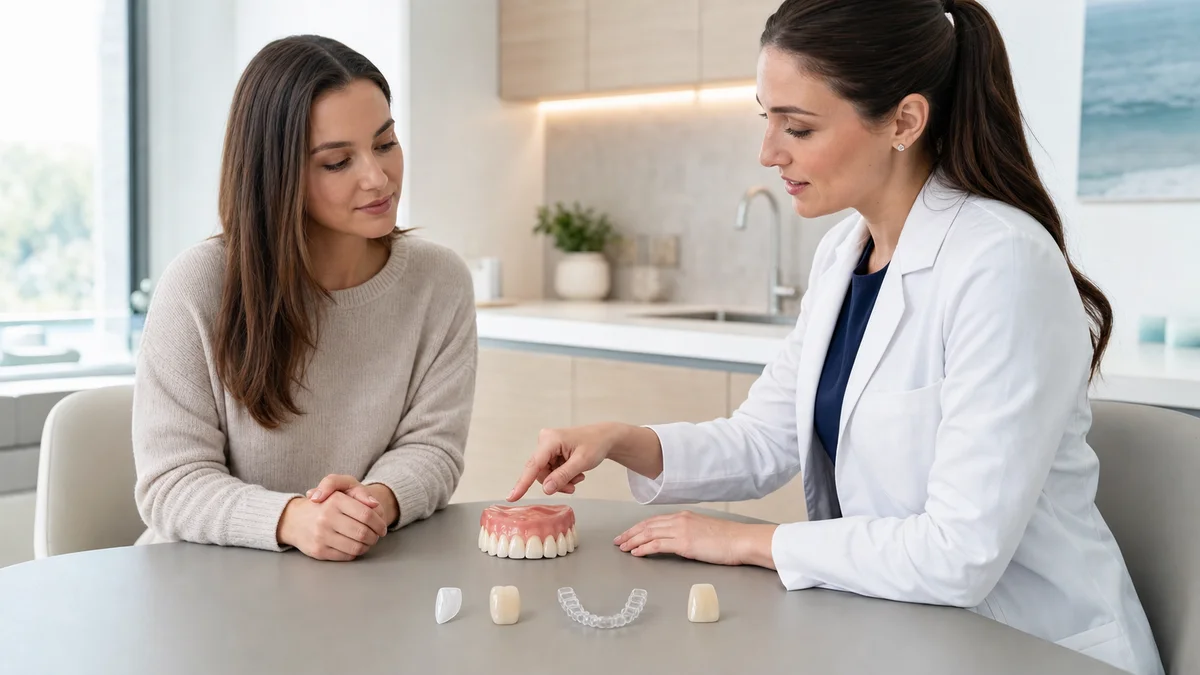
Quick answer: A useful veneers comparison does more than rank porcelain against composite. It compares how much healthy enamel may change, how much colour or shape must be masked, how future damage can be repaired, and what maintenance the bite requires. The safest option is the least irreversible treatment that predictably addresses the diagnosed concern.
A veneers comparison often begins with two material names and ends with a winner. Real treatment decisions are less tidy. The same material may be sensible for one tooth and unnecessarily invasive for another. A small chipped edge, a deep internal discolouration, a rotated tooth and a heavily restored tooth are four different clinical jobs. They should not be forced into one cosmetic package.
This guide uses four practical “budgets” to compare options: the enamel budget, the optical budget, the repair budget and the maintenance budget. A budget is not a price. It is the amount of biological change, visual correction, future intervention and ongoing care that a plan asks the tooth and patient to accept. Looking at all four helps prevent a photograph or material label from making the decision alone.
Veneers are custom facings bonded to the visible surface of teeth. They may change colour, contour, apparent alignment or small spaces, but they do not treat active decay, inflamed gums or every bite problem. This article provides general education, not a diagnosis. A dentist must examine the teeth, gums, existing restorations and bite before recommending a specific preparation or material.
Start the veneers comparison With the Clinical Job
Before comparing porcelain, ceramic or composite, define what is being changed. “I want a better smile” is a valid goal, but it is too broad for informed consent. The concern should be translated into observable features: surface stain, intrinsic colour, a local chip, worn edges, asymmetry, spacing, tooth position, an old filling, enamel erosion or a combination of these.
Each feature points to a different range of options. Colour alone may be approached with professional cleaning, whitening or selective restoration before a full facial veneer is considered. Tooth position may be better changed with orthodontics because a veneer changes appearance without moving the root. A local chip may need only a small bonded repair. A tooth with extensive structural damage may require a restorative plan that is different from an elective veneer.
The American Dental Association’s patient guidance explains that veneers can mask chipped, stained, misshapen or apparently crooked teeth, while also distinguishing them from crowns, which cover more tooth structure. It also warns that decay and gum disease should be treated first. This is why the correct opening question is not “Which veneer is best?” but “What diagnosis are we trying to solve, and what is the smallest treatment that can solve it?”
- Colour problem: Is it external stain, natural shade, internal discolouration or a mismatched restoration?
- Shape problem: Is the change limited to an edge, one surface or the full visible contour?
- Position problem: Is the tooth rotated, tilted, crowded or simply perceived as uneven?
- Health problem: Is there decay, erosion, a crack, gum inflammation, sensitivity or an old restoration?
- Bite problem: Is there edge-to-edge contact, a deep overbite, clenching, grinding or another load concern?
- Expectation problem: Is the desired shade or symmetry compatible with the surrounding natural teeth?
Budget 1: How Much Enamel Can the Tooth Afford to Change?
Enamel is the outer hard tissue of the crown. The ADA’s tooth anatomy information notes that mature enamel does not contain living cells and cannot regrow damage from wear or decay. Early mineral loss can sometimes be managed preventively, but enamel removed mechanically for a restoration does not grow back. That makes tissue removal an important part of any elective decision.
A veneer may require little preparation, a more conventional preparation or, in selected anatomy, an additive approach with little or no intentional reduction. These labels are not interchangeable promises. If an already prominent or rotated tooth receives extra material without enough planning, the result may become bulky, affect the gum margin or create a contour that is difficult to clean. “No-prep” is an indication, not a universal upgrade.
Bonding mainly to enamel is often desirable, but the dentist must assess how much enamel is actually present. Existing fillings, erosion, previous preparation and tooth position can expose or replace parts of the enamel surface. A preparation described in fractions of a millimetre online still cannot predict the tissue change for a particular tooth. The plan should show where reduction is proposed and why.
The enamel budget therefore asks three questions: Can the goal be reached without removing tissue? If preparation is required, what is the minimum justified change? What happens if the veneer later needs replacement? A conservative first treatment matters because future restorations may need additional intervention over the person’s lifetime.
In a responsible veneers comparison, the preparation drawing is as important as the material name. It shows whether one option preserves more enamel now and leaves a more manageable foundation for future care.
Budget 2: How Much Colour and Shape Must Be Masked?
The optical budget describes the work a restoration must do. A translucent veneer may imitate enamel beautifully when the underlying tooth has a suitable colour and the desired change is modest. The same translucency may not adequately hide a very dark substrate, a metal post or a mismatched core. Greater masking may need a different material, thickness, opacity strategy or pretreatment.
Masking is not simply choosing the whitest shade. Teeth have value, translucency, surface texture, internal character and changing appearance under different light. The final result also depends on the colour of the tooth beneath, the resin cement or bonding material, restoration thickness and laboratory or chairside technique. A flat sample viewed on a screen cannot reproduce all of these interactions.
Shape correction has its own limit. Material can add volume, close a modest space or restore a chipped edge, but it cannot safely disguise every rotation or crowding pattern. If an apparent alignment change would require excessive reduction on one side and excessive bulk on the other, orthodontic movement may preserve more tooth tissue. A diagnostic wax-up, digital design or reversible mock-up can reveal these compromises before preparation.
Patients should evaluate a proposed design in more than one view. A front photograph can hide side profile, tooth thickness, gum transition and bite contacts. The mock-up should be discussed for length, width, lip support, speech, smile line and cleaning access. It is a communication tool, not a guarantee that biology and material will reproduce a simulation exactly.
This optical part of the veneers comparison should state what can be masked predictably and what compromise may remain. A realistic limit is safer than promising that every dark, rotated or restored tooth can be made identical.
Budget 3: Can Future Damage Be Repaired Conservatively?
Every veneer can require maintenance. A restoration may stain, roughen, chip, crack, debond or need replacement; the tooth can still develop decay at an exposed margin. A good comparison therefore includes the likely repair pathway, not just how the restoration looks when new.
Direct composite is applied and sculpted on the tooth with a resin-based material. It can often be polished, added to or locally repaired in the mouth. That repairability may be valuable for a young patient, a local defect or a plan where future modification is likely. Composite can also pick up surface change, wear or staining and may require periodic refinishing. “Repairable” does not mean maintenance-free.
Indirect ceramic veneers are made outside the mouth and bonded after fit, contour and shade checks. Ceramics can offer stable surface finish and sophisticated optical control, but a crack or fracture may not be handled like a small composite chip. Some defects may be repairable; others may require replacement. The choice depends on defect size, location, bite, underlying tooth and the ability to achieve a reliable bond.
The American Dental Association’s overview of indirect restorative materials describes ceramics as a family with different intended uses and properties rather than one universal substance. A quote that says only “premium porcelain” does not identify the ceramic, design, laboratory or repair policy. Patients can ask for the actual material and records after treatment.
Repair planning turns a one-day appearance review into a lifetime veneers comparison. The relevant question is not whether failure is possible, but how a specific chip, stain, margin problem or debonding event would be assessed and managed.
Budget 4: What Will the Bite and Maintenance Demand?
A veneer lives within a moving bite. Front teeth may guide jaw movements and receive repeated contact during speech, chewing or habits. Clenching, grinding, nail biting, opening packaging with teeth or chewing hard objects can increase mechanical demand. The ADA notes that veneers may not be appropriate in some people with grinding, clenching or a deep overbite; this requires an individual assessment rather than a blanket exclusion.
The maintenance budget includes home care, professional review, possible polishing, a protective appliance when clinically indicated and the time needed to address changes. A night guard does not make an unsuitable design suitable and cannot guarantee that a veneer will not fail. It is one possible part of a broader bite and habit plan.
Gum health is equally important. Veneer margins and emergence contours must allow plaque removal. Inflamed or receding gums can change the visible edge and may expose a margin that was previously hidden. The World Health Organization identifies dental caries and periodontal disease among the main oral conditions and emphasizes prevention, fluoride toothpaste and plaque control. Cosmetic coverage does not replace disease control.
After placement, a bite that feels high, new persistent sensitivity, gum swelling, a rough or mobile restoration, pain on biting or a visible fracture deserves dental review. Urgent symptoms such as facial swelling, spreading infection signs or trauma require prompt assessment rather than waiting for a routine cosmetic appointment.
A maintenance-aware veneers comparison therefore includes the planned recall approach, cleaning method and responsibility for adjustments. It does not treat follow-up as an optional extra added only after a problem appears.
Decision Table: Compare the Intervention, Not Just the Material
| Option to discuss | Potentially useful when | Main tissue question | Repair and maintenance question | Important limitation |
|---|---|---|---|---|
| No veneer: monitor, clean or whiten | The concern is mainly stain or shade and teeth are otherwise healthy | Can the goal be reached without altering shape? | How will shade changes affect existing fillings? | Whitening does not change tooth position or restoration colour |
| Orthodontic movement | Position, spacing or rotation is the main issue | Could movement avoid facial reduction or bulky additions? | What retention and hygiene will be required? | Does not directly repair chips or change intrinsic tooth colour |
| Local direct composite bonding | A small edge, space or contour needs additive correction | Can treatment stay local and mostly additive? | Can it be polished or repaired if it changes? | Surface and colour may need future maintenance |
| Full facial direct composite veneer | Broader contour or colour change is suitable for chairside resin | What preparation and margin are actually planned? | Who will refinish, add to or repair the surface? | Optical masking and wear behaviour depend on the case and technique |
| Bonded ceramic veneer | A planned optical and contour change suits an indirect restoration | How much enamel remains and where will margins finish? | Can a local defect be repaired, or would replacement be needed? | Not automatically reversible and not suitable over untreated disease |
| Crown or another structural restoration | The tooth is already substantially weakened or restored | Is full coverage clinically necessary rather than cosmetically convenient? | What is the long-term restorative pathway? | A crown is not simply a stronger cosmetic veneer; it changes more tooth |
The table is not a self-diagnosis tool. Its purpose is to expose why two patients seeking a similar smile may receive different recommendations. It also prevents “porcelain versus composite” from excluding the possibility that neither full veneer is the best first step.
Used during consultation, this veneers comparison table helps each option reach the same endpoint: a defined clinical goal, a stated tissue change and a documented future pathway. Without those three elements, material labels are not being compared on equal terms.
Porcelain, Ceramic, Composite and No-Prep Are Not Equal Labels
Marketing language can blur three separate variables: material, fabrication method and preparation design. “Porcelain” is often used as a broad patient-facing term for ceramic. Within ceramics, composition and indication vary. “Composite” may refer to a direct chairside veneer or an indirect restoration made outside the mouth. “No-prep” describes an intended approach to tooth reduction, not the material itself.
This distinction matters when comparing quotes. Two ceramic plans may use different materials, thickness strategies, laboratory workflows and bonding surfaces. Two composite plans may differ in whether they cover a small edge or the entire visible face. A lower-preparation design may still require smoothing, margin placement or selective modification. The exact plan should be described tooth by tooth.
The NHS overview of dental treatments explains veneers as facings used to disguise concerns such as discolouration or chipping and notes that the front of the tooth is reduced for a conventional veneer. The ADA similarly describes enamel removal and calls veneer treatment non-reversible. These sources support a cautious consent discussion rather than a universal claim that every modern veneer is reversible.
Ask the clinician to name the material, fabrication route, preparation design and bonding substrate separately. Then ask why that combination suits each tooth. “Best material” without a clinical indication is not a complete recommendation.
Five Health Gates Before Any Cosmetic Comparison
A veneer can conceal a surface, but it cannot make an unhealthy foundation healthy. Before design begins, the dentist should assess decay, gum and bone support, cracks, sensitivity, pulp health when relevant, existing restorations and the bite. If disease is active, stabilisation comes before elective coverage.
- Decay gate: Is there active caries, a leaking restoration or a margin that cannot be kept clean?
- Gum gate: Are tissues healthy and stable enough to plan a predictable visible margin?
- Structure gate: Is the tooth intact, eroded, cracked, root-treated or already heavily restored?
- Bite gate: What contacts and habits will load the restoration in normal and parafunctional movement?
- Expectation gate: Can the requested shade, symmetry and tooth position be achieved without disproportionate biological cost?
The National Institute of Dental and Craniofacial Research explains that acids produced by plaque bacteria can demineralise enamel and that progression can create permanent cavities. A veneer does not stop that biological process at an exposed or poorly cleaned margin. Fluoride use, diet, plaque control and regular review remain relevant after cosmetic treatment.
Unexplained pain, a deep crack, active infection, severe mobility or rapidly changing gums requires diagnosis, not camouflage. The veneer conversation can resume after the underlying condition has been assessed and managed.
Use a Mock-Up as a Consent Tool, Not a Result Guarantee
A diagnostic design can be created from photographs, scans, impressions or a laboratory wax-up. A temporary mock-up may allow the proposed contours to be previewed before irreversible preparation. It can help the patient and clinician discuss length, width, speech, lip movement and apparent symmetry using something more concrete than a filtered photograph.
The preview has limits. A digital image can change colour and proportion without accounting for enamel thickness, underlying shade, gum response or bite. A chairside mock-up may use a different material and finish from the final restoration. Neither predicts exactly how tissue, bonding or maintenance will behave.
A useful mock-up appointment records requested changes and unresolved compromises. If a tooth would need extensive reduction to fit the design, that finding should trigger a review of orthodontics, whitening, additive bonding or acceptance of a less uniform result. Consent remains a process, not approval of one attractive rendering.
Compare Quotes Through Scope and Future Responsibility
A quote should identify the number of teeth, material, preparation concept, temporary restorations if needed, laboratory work, review appointments and what happens if the plan changes after preparation. It should distinguish optional additions from included care. A headline total without this scope cannot be compared fairly with a detailed treatment pathway.
The General Dental Council’s consent standard requires relevant options and possible costs to be explained and says that changes to agreed treatment or estimated cost require documented consent. Although professional rules vary by jurisdiction, the principle is useful anywhere: material, alternatives, risks, likely maintenance, fees and exclusions should be understandable before treatment starts.
- Diagnosis: Which problem is assigned to each tooth, and which teeth need no veneer?
- Design: Is treatment local, partial or full facial; additive, minimal-prep or conventional?
- Material: What exact composite or ceramic family and fabrication route are proposed?
- Preparation: Where is enamel reduction expected, and what may change during treatment?
- Provisional care: Are temporary veneers required, and what restrictions apply?
- Delivery: How will fit, shade, contour, gum transition, speech and bite be checked?
- Repair: Which chips or surface changes can be managed locally, and what might require replacement?
- Records: Will the patient receive material, shade, scan and laboratory information?
- Maintenance: Which reviews, polishing or protective measures are included or separate?
For a personalised assessment, the Redent Klinik team can review goals, oral-health findings and available records before explaining suitable options. Photographs can support an initial conversation but cannot confirm enamel, decay, gum health or bite. Appointment and document questions can be sent through the English contact page.
A Practical Sequence for Making the Decision
Decision quality improves when reversible steps come first. Begin with examination and disease control. Define the visual concern tooth by tooth. Discuss no-treatment and non-veneer options. Preview proposed contour where possible. Only then compare the specific direct composite, ceramic or other restorative pathways that remain suitable.
The order can also protect shade planning. If whitening is appropriate, it may be completed and allowed to stabilise before the final shade of restorations is selected. If orthodontic movement is appropriate, it may reduce the amount of additive bulk or reduction later. Sequencing is individual; no online timetable can replace examination.
Before consent, restate the plan in plain language: what will be changed, what cannot be changed, what tissue may be removed, what the material is, what can fail, how repair works and what care is needed. A patient should have space to ask questions and decline elective treatment without pressure.
The final veneers comparison should be saved with the treatment records so the agreed design, material, alternatives and maintenance expectations remain clear at later reviews.
Frequently Asked Questions About veneers comparison
Are porcelain veneers always better than composite veneers?
No. Ceramic and composite have different optical, surface, repair and fabrication characteristics. The better choice depends on the diagnosed problem, remaining enamel, existing restorations, bite, desired change and willingness to maintain or repair the result. A local additive composite repair may be more conservative than a full ceramic veneer, while some broader changes may suit an indirect ceramic plan.
Are no-prep veneers completely reversible?
That should not be assumed. Even a plan marketed as no-prep may involve surface conditioning, selective smoothing or contours that cannot simply be removed without intervention. An additive restoration can also influence gums and bite. Ask for the exact tooth-by-tooth preparation and what removal would involve.
Can veneers straighten crooked teeth?
They can alter the visible contour and create the appearance of alignment, but they do not move roots or correct every bite relationship. If apparent straightening would need excessive reduction or create bulky contours, orthodontic movement may preserve more tissue. The alternatives should be compared before preparation.
Which veneer type stains less?
Glazed or polished ceramic surfaces and composite resin do not behave identically, but staining cannot be reduced to one universal promise. Surface finish, material, diet, smoking, maintenance and margin condition matter. Composite can often be repolished; ceramic may maintain a stable surface but can still develop marginal or neighbouring-tooth colour differences.
Can a chipped veneer be repaired?
Sometimes. Repairability depends on the material, size and location of the defect, the bite, remaining restoration and underlying tooth. A small composite defect may be managed differently from a ceramic fracture. The clinician should explain when polishing, bonded repair or full replacement would be considered.
How long do veneers last?
No fixed lifespan applies to every patient or tooth. Material, enamel support, preparation, bonding, bite, habits, disease control and maintenance all affect performance. Published survival findings describe groups under defined conditions and cannot guarantee an individual’s result. Ask about personal risks and the replacement pathway instead of relying on one number.
Can veneers be placed over fillings or unhealthy teeth?
Existing restorations require assessment because the available bonding surface and structural condition may differ from intact enamel. Active decay or gum disease should be treated before elective veneer placement. Covering disease can delay diagnosis and worsen the foundation of the restoration.
Is a crown a stronger version of a veneer?
No. A crown covers much more of the tooth and is generally considered when structural or restorative needs justify that coverage. It should not be selected merely as a cosmetic upgrade when a sound tooth could be managed more conservatively. The amount of tissue change and future pathway differ.
Can photographs provide a final veneer plan?
Photographs can communicate goals and support preliminary discussion, but they do not reveal all decay, cracks, enamel distribution, gum stability, pulp status or bite contacts. A final plan requires clinical examination and any justified records. The recommendation may change after those findings are available.
What is the most important question in a veneer consultation?
Ask: “What is the least irreversible treatment that can predictably solve the diagnosed problem?” The answer should include no-treatment and alternative options, the planned enamel change, expected visual limit, repair route and maintenance. If those elements are missing, the material comparison is incomplete.
Conclusion: Protect Options for the Future
A strong veneers comparison does not crown one material as universally superior. It identifies the clinical job, protects the enamel budget, tests whether the optical goal is realistic, maps repair options and accepts the maintenance the bite will require. It also leaves room for whitening, orthodontics, local bonding, disease treatment or no irreversible care.
The most polished result is not automatically the most patient-safe result. A defensible plan explains why each tooth is included, why the chosen design is proportionate, what alternatives were considered and what happens if the restoration changes. That is a more durable basis for consent than a package name, filtered image or fixed longevity promise.
Authoritative Sources
- American Dental Association and MouthHealthy: Veneers
- American Dental Association: Materials for indirect restorations
- NHS: Dental treatments and veneers
- General Dental Council: Obtain valid consent
- National Institute of Dental and Craniofacial Research: The tooth decay process
- World Health Organization oral health fact sheet