
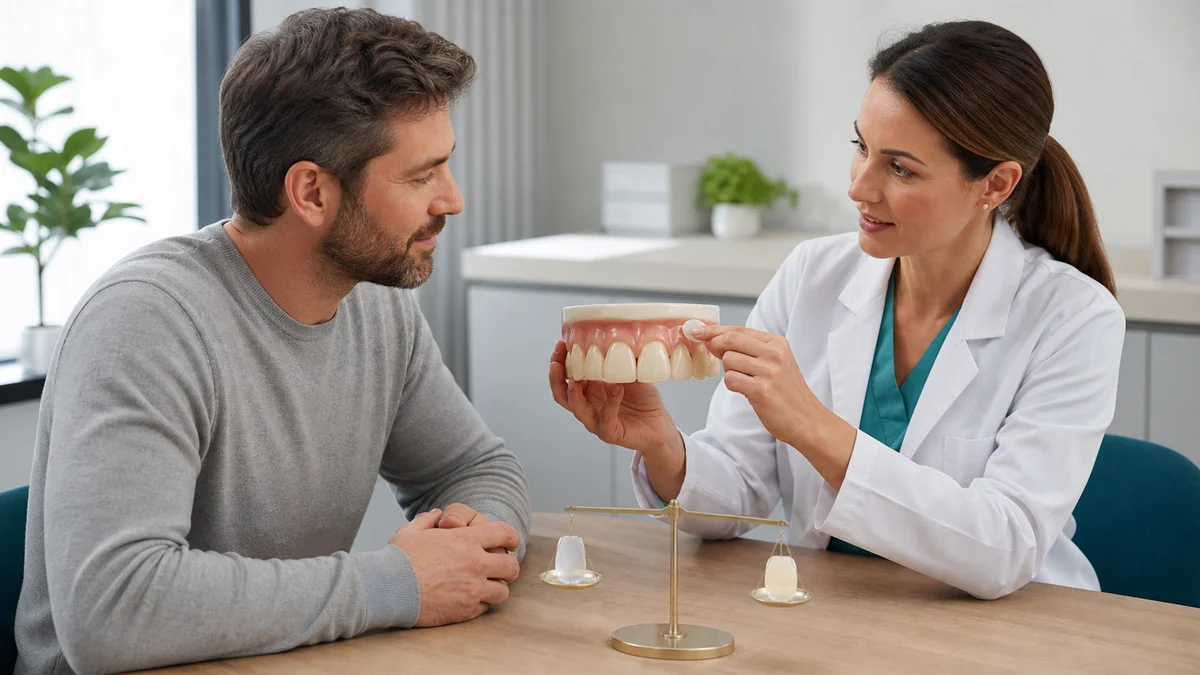
Quick answer: The most useful review of porcelain veneers pros and cons pairs every benefit with its clinical condition. Ceramic can provide controlled shape, colour and a smooth surface, but treatment may remove irreplaceable enamel, can fracture or debond, and usually begins a long-term restoration cycle. Suitability depends on tooth health, enamel, bite, expectations and maintenance.
Lists of porcelain veneers pros and cons often place “natural appearance” in one column and “cost” in another. That format is easy to scan but clinically incomplete. A benefit exists only when the tooth, design, bonding surface and bite allow it. A disadvantage may be modest in one plan and decisive in another. The real task is to identify which conditions make each trade-off acceptable for a particular tooth.
A porcelain veneer is a thin, custom-made ceramic facing bonded to the visible surface of a tooth. The patient-facing word “porcelain” may cover more than one dental ceramic, and different ceramic families have different optical and mechanical properties. The restoration is also only one part of the system: remaining enamel or dentine, adhesive steps, cement, preparation design, margins and bite contacts all influence performance.
This guide is educational and cannot determine whether veneers are appropriate for you. Active decay, gum disease, unexplained pain, cracks, heavily restored teeth or an unfavourable bite may change or postpone the plan. A licensed dentist must examine the teeth and discuss reasonable alternatives before elective preparation.
How to Read porcelain veneers pros and cons Safely
Do not score each benefit and drawback as if all items carried equal weight. Irreversible enamel reduction is different from needing an extra appointment. A colour preference is different from active disease. A chip that can be repaired is different from a crack that compromises the tooth. The consequence, probability and ability to recover all matter.
A safer method pairs each claimed advantage with four questions: What clinical condition is required? What tissue change makes the result possible? What could go wrong? What is the recovery route? If a consultation describes only appearance and not these conditions, the consent discussion is unfinished.
- Diagnosis: Which exact concern is the veneer intended to address?
- Condition: What must be true about enamel, gums, pulp and bite for the benefit to apply?
- Intervention: What tooth structure may be changed and can it be replaced biologically?
- Failure route: Could a problem be polished, repaired, re-bonded or would replacement be needed?
- Alternative: Could whitening, orthodontics, local composite, monitoring or another restoration meet the goal with less irreversible change?
- Maintenance: What home care, review, protective measures and future costs remain?
The American Dental Association’s veneer guidance describes porcelain veneers as custom front-surface shells and notes that veneer treatment is not reversible because enamel is removed. It also advises treating decay or gum disease first and warns that veneers can chip, crack, wear or loosen. Those points are not a rejection of treatment; they are the baseline for balanced consent.
Trade-Off 1: Natural-Looking Light Behaviour vs Masking Limits
Potential benefit: Dental ceramics can be layered, stained, textured and polished to reproduce many features of natural enamel. Translucency can allow light to enter and reflect in a way that avoids a flat, opaque appearance. Laboratory control can help harmonise shape and colour across several planned teeth.
Counterweight: Translucency also allows the underlying tooth to influence the result. A deeply discoloured tooth, dark core, metal post or mismatched foundation may not be concealed by a very thin translucent veneer. Increasing opacity or thickness can change the appearance and may influence preparation. The “most translucent” material is therefore not automatically the most natural for every substrate.
Shade selection is a system rather than a single colour code. The tooth beneath, ceramic, thickness, surface texture, resin cement, neighbouring teeth and lighting all interact. A filtered screen image cannot represent these variables faithfully. The porcelain veneers pros and cons discussion should define what can be masked, what may remain visible and whether pretreatment could reduce the need for aggressive masking.
Whitening may be considered when the main concern is general tooth shade, although it does not lighten existing fillings or ceramic. Internal discolouration may need a different assessment. A mock-up or try-in can support communication, but neither guarantees the final optical response.
Trade-Off 2: Controlled Shape vs the Risk of Overbuilding
Potential benefit: A veneer can change the visible width, length, edge form, surface texture and apparent symmetry of a tooth. It may close a modest space, replace lost contour or make a slightly misshapen tooth look more balanced within the smile.
Counterweight: Material has physical volume. If a prominent, rotated or crowded tooth is covered additively without enough spatial analysis, the result may look bulky, create a ledge near the gum or interfere with cleaning and bite. If the design instead removes substantial tooth tissue to create room, the visual correction may carry a biological cost that orthodontic movement could have reduced.
Veneers change the visible shell; they do not move the root or correct every bite relationship. A front photograph may make apparent alignment look simple while hiding side profile, palatal position and functional contacts. Diagnostic design should be evaluated from several views and in movement.
This paired trade-off is why “no-prep” and “minimal-prep” cannot be universal promises. An additive approach may be suitable when space and contour allow it. In another anatomy, it may create an overcontoured restoration. The proposed preparation should be mapped tooth by tooth rather than inferred from a package name.
Trade-Off 3: Less Coverage Than a Crown vs Irreversible Enamel Change
Potential benefit: A veneer covers primarily the front surface and selected edges, while a crown surrounds much more of the tooth. For a suitable tooth and goal, a bonded veneer may preserve more structure than full coverage. This is an important advantage when a crown is not structurally indicated.
Counterweight: More conservative than a crown does not mean reversible. The ADA explains that a small amount of enamel is commonly removed from the front and sides for porcelain veneer placement. Removed enamel does not regrow. Even limited preparation can commit the tooth to a restoration and its future repair or replacement cycle.
The amount of enamel available varies. Erosion, previous veneers, large fillings, fractures or earlier preparation can leave a mixed bonding surface. A plan that works predictably on intact enamel may not transfer directly to a tooth dominated by dentine or restorative material. The dentist should explain the expected substrate and whether another restorative design is more appropriate.
A responsible review of porcelain veneers pros and cons therefore compares the veneer not only with a crown but also with no irreversible treatment, whitening, orthodontics and local composite bonding. “Less invasive” has meaning only relative to an alternative that could realistically solve the same diagnosed problem.
Trade-Off 4: A Smooth, Colour-Stable Surface vs Brittleness
Potential benefit: Properly finished ceramic can provide a smooth, lustrous surface with strong resistance to many forms of surface staining and wear. This may support a stable appearance when the restoration, margins and surrounding teeth are maintained.
Counterweight: Ceramic is not flexible like natural tissue or direct resin. It can chip or fracture under unfavourable loading, impact, inadequate support or a design problem. A surface that resists wear does not mean the veneer is unbreakable. Hard ceramic can also affect opposing surfaces if roughness or contact is not managed appropriately.
The ADA’s current indirect restorative materials overview explains that ceramics vary in composition, properties, processing and clinical indication. It identifies aesthetics and wear resistance among ceramic advantages while also discussing brittleness, fracture and technique sensitivity. “Premium porcelain” is not a sufficient technical description.
A patient can ask for the actual ceramic family, fabrication method and laboratory record. The reason for the choice matters more than a familiar product name. A material selected for translucency, masking or strength should be compatible with the planned thickness, bonding approach and tooth position.
Trade-Off 5: Strong Enamel Bonding vs Technique Sensitivity
Potential benefit: Adhesive procedures can create an integrated restoration-tooth system when preparation, enamel support, ceramic treatment, cementation and isolation are appropriate. Keeping margins and bonding surfaces in suitable enamel can be an important part of conservative planning.
Counterweight: Bonding is technique-sensitive. Contamination, moisture, an unsuitable substrate, poor surface treatment, stress concentration or inadequate fit can compromise the system. The restoration may debond even when the ceramic itself remains intact. A veneer is not made reliable by material strength alone.
Existing fillings need specific assessment. Bonding to restorative materials may require a different protocol and does not simply reproduce bonding to fresh enamel. A heavily restored or cracked tooth may need another design based on structure rather than appearance. The patient should know whether the proposed margin and bonding surface are expected to lie mainly in enamel.
The 2024 literature review indexed by the U.S. National Library of Medicine surveyed laminate veneer outcomes across porcelain, glass-ceramic, composite and other materials. Its scope itself is a useful reminder: “success” is affected by material, substrate, preparation, bonding and clinical selection. Group evidence cannot guarantee an individual outcome.
Trade-Off 6: Laboratory Precision vs a Multi-Stage Process
Potential benefit: Indirect fabrication allows a dentist and dental technician to work with scans or impressions, diagnostic designs, shade information and surface character. The veneer can be checked for fit, contour and appearance before final bonding. This collaborative process can be valuable for complex optical or multi-tooth planning.
Counterweight: More stages create more coordination points. Preparation, scanning or impressions, temporary veneers when needed, laboratory production, try-in and bonding must align. Temporary restorations may feel or look different from the final ceramics and can loosen or fracture. Schedule changes and remakes may extend the pathway.
Digital design can improve communication but should not be mistaken for a guaranteed result. A simulation can alter tooth shape without showing enamel thickness, underlying colour, gum response or functional load. A physical mock-up may be more informative but still uses a different material and cannot reproduce every biological variable.
When discussing porcelain veneers pros and cons, ask who is responsible for design, laboratory communication, temporary care, shade approval, fit adjustments and aftercare. A seamless marketing label can conceal several separate clinical and technical responsibilities.
Trade-Off 7: Multi-Tooth Uniformity vs Overtreatment Risk
Potential benefit: Planning several visible teeth together can coordinate width, length, shade and surface texture. When multiple teeth genuinely need restoration, a unified design may avoid isolated mismatches and can create a coherent result.
Counterweight: Uniformity can become a reason to include healthy teeth that do not need irreversible treatment. Treating more teeth increases the number of margins, bonded interfaces and restorations that may require future care. Perfect bilateral sameness may also look less natural than controlled variation.
Each tooth should earn its place in the plan. The record should state the concern, health status, proposed change and alternative for every tooth. A sound tooth should not be prepared solely because it sits beside a tooth that needs restoration unless the patient understands the proportional benefit and long-term consequence.
Staged treatment may sometimes help. Whitening, orthodontic movement or local bonding can be completed first, then the residual need for ceramic reassessed. Staging is not always the right route, but it prevents the initial number of veneers from becoming an unquestioned target.
Trade-Off 8: Immediate Visible Change vs No Root Movement or Disease Treatment
Potential benefit: Once fabricated and bonded, veneers can create an immediate visible change in contour and colour. Unlike orthodontics, they do not require months of tooth movement. This may be attractive when the concern is restorative or surface-based.
Counterweight: Speed does not broaden the indication. A veneer cannot move a root, rebuild lost periodontal support, remove decay without treatment or make active gum disease disappear. It may mask the appearance of a problem while the underlying biology remains.
The ADA advises that decay and gum disease be treated before veneers. The World Health Organization also identifies dental caries and periodontal disease as major preventable oral conditions and emphasises fluoride toothpaste, plaque control and prevention. Cosmetic coverage does not replace these measures, and teeth can still decay around or beneath veneer margins.
If the main issue is tooth position, orthodontic assessment can reveal whether movement would reduce preparation or improve bite. If the main issue is shade, whitening may be considered before restorations are matched. If the issue is a local chip, a partial composite repair may preserve more structure. The fastest visible change is not automatically the safest first intervention.
Trade-Off 9: A Planned Result vs Lifelong Maintenance
Potential benefit: Diagnostic records, mock-ups, laboratory fabrication and controlled bonding can make the intended result easier to communicate than an improvised cosmetic change. The patient can review shape and shade goals before definitive placement and receive records of the materials used.
Counterweight: Definitive does not mean permanent or maintenance-free. A veneer can chip, crack, debond, roughen at a damaged area or need replacement. Gum recession may reveal a margin. The surrounding tooth can develop decay. The bite and neighbouring natural teeth may change over time.
A small problem may be polished or repaired in some circumstances; another may require replacing the veneer. Repair options depend on defect, ceramic, location, bite, underlying tooth and available bonding surface. Replacement may require additional intervention, so the future pathway belongs in the original consent discussion.
This is the long view of porcelain veneers pros and cons: the initial aesthetic gain is paired with home care, review, possible protective measures and an eventual repair or replacement decision. No responsible clinician can promise that a veneer will last for a fixed period in every mouth.
Decision Table: When Does Each Trade-Off Become Decisive?
| Claim or concern | Potential advantage | Condition required | Counterweight to discuss | Possible alternative |
|---|---|---|---|---|
| “I want a natural shade” | Ceramic can provide nuanced translucency and texture | Underlying colour and space suit the optical plan | Dark foundations may need opacity, thickness or pretreatment | Whitening or selective restoration |
| “I want straighter-looking teeth” | Visible contour can be redesigned | Change does not require excessive reduction or bulk | Roots and bite are not moved | Orthodontic movement |
| “I want a durable surface” | Finished ceramic can resist surface stain and wear | Support, bonding and bite are favourable | Ceramic can chip or fracture and may need replacement | Direct composite where repairability is prioritised |
| “I want minimal treatment” | A veneer usually covers less than a crown | The tooth and goal suit a bonded facing | Enamel removal is irreversible | No treatment, local bonding or whitening |
| “I want every tooth identical” | Multi-tooth design can coordinate the smile | Every included tooth has a proportionate indication | Healthy teeth may be treated unnecessarily | Selective treatment and acceptance of natural variation |
| “I want a quick result” | Appearance changes at definitive bonding | Health and bite are stable first | Speed does not treat disease or move roots | Staged health, whitening or orthodontic care |
| “I want a permanent result” | Indirect ceramic is intended as definitive restoration | Maintenance and risk are accepted | No restoration has a guaranteed lifetime | Monitoring or more repairable interim care |
The table does not select treatment. It identifies when an attractive feature is conditional and when a drawback changes the recommendation. A consultation should adapt the table to each tooth rather than give one answer for an entire smile.
Who May Be a Reasonable Candidate, and Who Should Pause?
Porcelain veneers may be considered when the cosmetic or restorative concern is well defined, tooth and gum health are stable, enough suitable bonding substrate is present, the bite can be managed and the patient accepts irreversible treatment and maintenance. This description is intentionally conditional; appearance alone is not an indication.
Assessment may need to pause or redirect when there is active decay, uncontrolled gum inflammation, unexplained pain, significant structural weakness, inadequate enamel, large existing restorations, a severe bite concern, active grinding, unrealistic expectations or pressure to treat many healthy teeth. Some of these factors can be managed; others may favour a different restoration or no elective treatment.
- Decay, leaking fillings and gum disease are stabilised before cosmetic coverage.
- The reason for treating each tooth is documented, including teeth that need no treatment.
- The likely preparation and bonding surface are explained tooth by tooth.
- Bite contacts, clenching, grinding and damaging habits are assessed.
- The desired shade and shape are tested against the underlying colour and available space.
- Whitening, orthodontics, local composite, monitoring and other reasonable options are discussed.
- The patient understands that repair or replacement may be needed later.
The ADA also warns against veneer services performed by unlicensed individuals, noting risks such as infection, nerve damage and placement over unhealthy teeth. Provider licensure and a proper dental examination are safety requirements, not administrative details.
What the Appointment Path Should Clarify
The process begins with the concern and health assessment, not preparation. Clinical examination may be supported by photographs, radiographs when justified, scans or impressions and bite records. Existing restorations, enamel distribution, gum levels, cracks and sensitivity should be evaluated.
Diagnostic design can then explore shape, edge position and tooth selection. A mock-up may help preview changes before preparation. The patient should be shown what the preview can and cannot predict. If the design reveals excessive bulk or reduction, alternatives should be reconsidered before enamel is removed.
After preparation, the dentist records the teeth and communicates shade, material and design with the laboratory. Temporary veneers may be needed. At try-in, fit, colour, contour and the patient’s informed preferences are reviewed before bonding. After bonding, bite contacts, margins and cleaning access require checking.
The NHS dental treatments overview describes veneers as front-surface facings and notes that some of the front of the tooth is reduced for a conventional porcelain veneer. This public-health description reinforces why the sequence and irreversible point should be clear before treatment starts.
Compare Quotes Without Turning Treatment Into a Commodity
A quote should identify which teeth are included, why each is treated, ceramic type, preparation concept, diagnostic design, temporary care, laboratory, try-in, bonding, review and repair policy. A single line for “porcelain veneers” does not show whether two proposals have the same clinical endpoint.
Cost can change with tooth number, material, laboratory process, complexity, pretreatment and aftercare. A fixed public number cannot account for disease, substrate or design. The important comparison is scope: what is included, what is conditional and what happens if findings change the plan.
The General Dental Council’s consent guidance says relevant options, risks, benefits and possible costs should be discussed and that changes to agreed treatment or estimated cost require consent. While rules differ by jurisdiction, documenting changes before proceeding is a sound patient-safety principle.
- Exact teeth and clinical reason for each veneer
- Named ceramic family and fabrication route
- Expected preparation, margins and bonding substrate
- Mock-up, scan or impression and temporary-veneer scope
- Laboratory, shade communication and try-in process
- Included reviews, bite adjustments and hygiene instruction
- Repair, remake, guarantee exclusions and future replacement responsibility
- Written procedure for changes in plan or estimated cost
For an individual evaluation, Redent Klinik can review the concern, oral health and available records before discussing suitable restorative and non-restorative options. Photographs may support preliminary communication but cannot confirm enamel, cracks, decay, gums or bite. Appointment questions can be sent through the English contact page.
Maintenance and Warning Signs After Placement
Veneers require ordinary disease prevention: brushing with fluoride toothpaste, cleaning between teeth, a diet that limits frequent sugar exposure and professional review based on individual risk. The ADA notes that cavities can still occur under or around veneers. Cleaning should reach the margin without damaging the gums.
Avoid using veneered teeth as tools and discuss sports protection where relevant. If grinding or clenching is identified, the clinician may discuss habit management or a protective appliance. An appliance reduces some risk in selected situations but cannot guarantee against ceramic fracture or make an unsuitable bite suitable.
Contact a dentist for a veneer that feels mobile, a new rough edge, pain on biting, persistent sensitivity, gum swelling, an altered bite or visible damage. Facial swelling, spreading infection signs, trauma or severe pain may need prompt assessment. Do not glue a loose veneer at home.
Maintenance is part of the porcelain veneers pros and cons decision, not a footnote. The plan should state who will review the restoration, what records the patient receives and how care can continue if the original clinic is not accessible.
Frequently Asked Questions About porcelain veneers pros and cons
What is the biggest advantage of porcelain veneers?
For a suitable tooth, ceramic can provide controlled colour, translucency, surface texture and contour in a thin bonded restoration. The advantage depends on the underlying tooth, available space, enamel support, laboratory work and bite. Appearance alone does not establish suitability.
What is the biggest disadvantage of porcelain veneers?
The central disadvantage is that treatment is usually irreversible because enamel may be removed, beginning a future maintenance and replacement pathway. The weight of that disadvantage depends on how much healthy tissue changes and whether less irreversible options could meet the same goal.
Do porcelain veneers stain?
A well-finished ceramic surface is relatively resistant to many surface stains, but the tooth, cement line, margins and neighbouring teeth can still change in appearance. Roughness, gum recession or external deposits can affect the result. “Stain resistant” does not mean the whole smile remains one shade without care.
Can porcelain veneers chip or fall off?
Yes. Ceramic can chip or fracture, and a veneer can debond. Risk is influenced by support, preparation, bonding, contamination, bite, habits and trauma. Depending on the problem, polishing, repair, re-bonding or replacement may be considered after clinical assessment.
Are porcelain veneers better than composite?
Neither material is universally better. Ceramic may offer a stable polished surface and complex optical control; direct composite is often easier to add to, polish or repair and may permit a more local intervention. The correct comparison depends on the tooth, goal, bite, enamel and future repair priorities.
Are no-prep porcelain veneers reversible?
That should not be promised automatically. A no-prep plan may still involve surface conditioning, selective modification and a bonded contour that affects cleaning or bite. Removing the restoration later may require intervention. The exact tooth-by-tooth plan matters more than the label.
Can porcelain veneers fix crooked teeth?
They can change visible contour and create an appearance of alignment, but they do not move roots or correct every bite. If the visual correction requires excessive reduction or bulky additions, orthodontic movement may preserve more tissue and improve the underlying position.
How long do porcelain veneers last?
No fixed lifespan applies to every tooth. Material, enamel support, preparation, bonding, bite, habits, disease control and maintenance all influence performance. Study averages describe selected groups and definitions; they are not an individual guarantee. Future repair and replacement should be anticipated.
Can veneers be placed over decay or gum disease?
Active disease should be diagnosed and treated first. Covering an unhealthy tooth does not cure decay, and inflamed or unstable gums can compromise margins, cleaning and appearance. Health must be stable enough for an elective restorative plan.
Is getting more veneers better for symmetry?
Not necessarily. Treating more teeth may coordinate shape and shade, but it also increases the number of healthy surfaces altered and restorations maintained. Each tooth should have a proportionate reason for treatment. Natural variation or selective care may be safer than complete uniformity.
Can an online consultation confirm porcelain veneers?
No. Photographs and records can support preliminary discussion, but they cannot fully show decay, cracks, enamel distribution, gum stability, pulp status or bite contacts. A final recommendation requires clinical examination and any justified diagnostic records.
Conclusion: Pair Every Benefit With Its Condition
The honest way to assess porcelain veneers pros and cons is to resist universal claims. Natural-looking optics depend on the substrate and design. Conservative coverage is still usually irreversible. A smooth ceramic surface is also brittle. Laboratory precision requires coordinated stages. Immediate appearance does not move roots or treat disease.
A sound plan shows why each tooth is included, how much enamel may change, which ceramic is proposed, what alternatives remain and how failure would be managed. The best outcome is not the whitest or most uniform image; it is a proportionate, maintainable result chosen with valid consent and room for the future.
Authoritative Sources
- American Dental Association and MouthHealthy: Veneers
- American Dental Association: Materials for indirect restorations
- PubMed: Clinical performance of laminate veneers, 2024 review
- NHS: Dental treatments and veneers
- General Dental Council: Obtain valid consent
- World Health Organization oral health fact sheet