
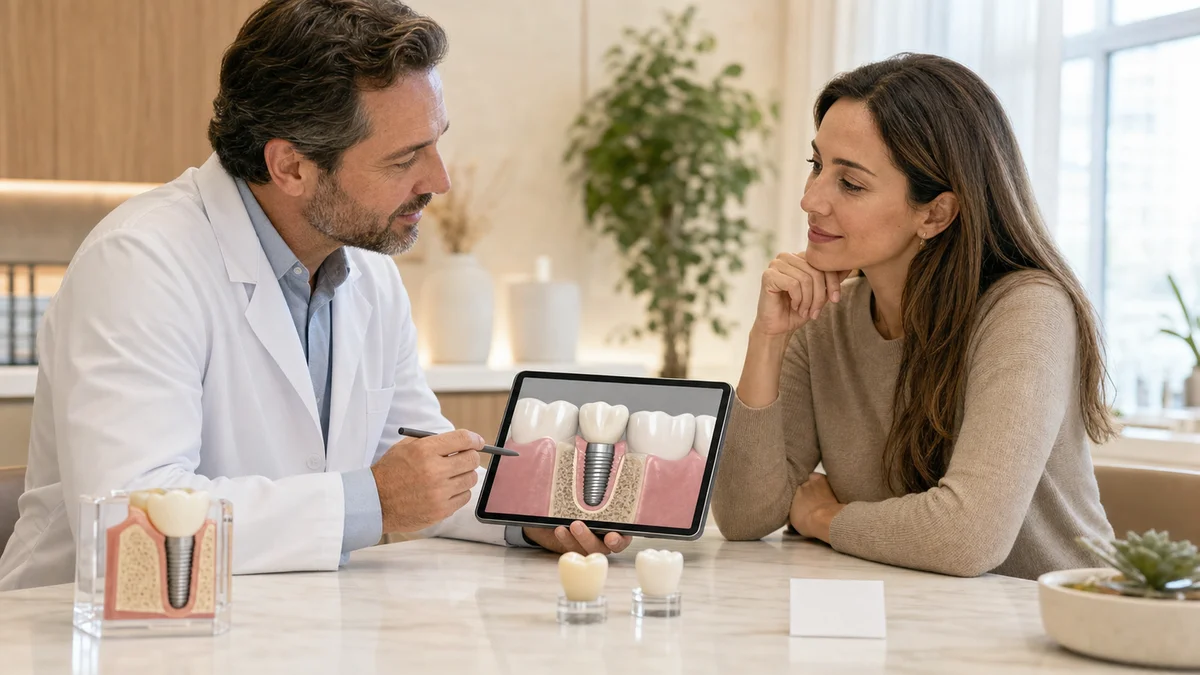
Quick answer: a dental implant in one day may mean placing an implant on the extraction day, attaching a carefully protected temporary tooth, or both. It rarely means biological healing and the definitive crown are complete that day. Suitability depends on diagnosis, bone, infection control, implant stability, bite, health and hygiene. A staged alternative must be planned in advance.
The phrase dental implant in one day sounds like a single appointment replaces every stage of care. In reality, several different protocols are marketed under that label. An implant may be placed immediately after a tooth is removed. A temporary crown may be attached on the day of placement. A full-arch temporary bridge may be fitted to several implants. None of these descriptions automatically means that healing is finished or that the definitive restoration has been delivered.
Dental implants are medical devices placed in jawbone to support crowns, bridges or dentures. The US Food and Drug Administration explains that the system includes an implant body and abutment and may include a fixation screw. The FDA also notes that healing may take several months or longer. Therefore, the safest way to understand a dental implant in one day is to separate the surgical day, temporary tooth and final prosthetic stage.
This guide does not diagnose candidacy or guarantee a same-day tooth. It explains terms, decision factors, quote items, risks and fallback plans so a patient can discuss the option with a qualified treating team. Content is written for evidence-based review by Dentist Esma Çevrük Çakır.
1. dental implant in one day can describe four different events
The first step is to ask the provider to define “one day.” Immediate implant placement usually means the implant body is inserted into the extraction socket during the same surgical visit. Immediate provisionalisation means a temporary tooth is connected soon after implant placement. Immediate loading means the restoration transmits some functional force under a controlled protocol. Same-day full-arch treatment involves another design in which several implants may support a connected temporary bridge.
These terms are not interchangeable. A patient may receive an implant on extraction day but use a removable temporary tooth instead of a crown connected to the implant. Another patient may receive an attached temporary crown that is deliberately kept out of heavy contact. The final ceramic crown normally follows clinical reassessment after healing.
Ask for the treatment endpoint to be written beside dental implant in one day: implant only, implant plus healing cap, implant plus non-functional temporary crown, or implant plus temporary full-arch bridge. This single clarification prevents many cost and expectation mismatches.
Use that exact endpoint whenever requesting a dental implant in one day quote so each provider prices the same temporary and final stages.
2. Why healing cannot be compressed into one appointment
After placement, bone and soft tissue respond biologically. Initial mechanical stability comes from the implant engaging bone; longer-term support depends on healing and integration. A temporary tooth may improve appearance and selected function, but it does not prove that integration is complete. Excessive early movement can be a concern, so loading and dietary instructions matter.
The FDA states that overall health influences candidacy and healing and that the implant body may need several months or longer to heal. The American Academy of Periodontology likewise describes a period in which implants and bone bond before definitive teeth in many full-mouth pathways. Marketing a dental implant in one day should never erase this biological interval.
A consent form for dental implant in one day should therefore distinguish delivery of a provisional tooth from completion of bone and soft-tissue healing.
Temporary is not a lower-quality final crown
A temporary restoration is designed for the healing phase. Its contour may guide soft tissue and support appearance while allowing adjustments. Its material, contacts and expected service period differ from the definitive crown. Ask how the temporary will be protected, cleaned, repaired and replaced by the final restoration.
3. Candidacy begins with a full assessment
A reliable dental implant in one day decision requires medical and dental history, examination and appropriate imaging. The clinician evaluates the reason for tooth loss, infection, remaining tooth structure, bone walls, soft tissue, adjacent teeth, smile position, nerve or sinus location, bite and parafunctional habits. Medication, smoking, diabetes control and other health factors may influence risk and timing.
Photographs or a remote video can support an initial discussion but cannot confirm socket anatomy, bone quality or primary stability. Even with detailed three-dimensional planning, the final decision to connect a temporary tooth may depend on findings during surgery. Consent should state that the same-day restoration can be changed to a healing cap or removable temporary option.
Records that may support planning
- medical history, medication list and allergy information;
- clinical examination of tooth, gums and bite;
- periodontal assessment and oral hygiene review;
- appropriate two- or three-dimensional imaging;
- digital scan or impression of the teeth;
- photographs for tooth position and smile references;
- analysis of available restorative space;
- discussion of temporary and staged alternatives.
If a clinic gives a final promise before these records, treat it as a marketing estimate rather than confirmed eligibility. A safe dental implant in one day pathway has both a preferred plan and a fallback plan.
The assessment fee and records required for dental implant in one day should be visible in the quote rather than hidden inside an unexplained package.
4. Bone and socket conditions influence immediate placement
After extraction, the socket must be assessed for intact walls, available bone beyond or around the socket, infection management and the ability to position the implant prosthetically. A socket can look suitable on an image yet present an unexpected defect during surgery. The implant must be positioned for the final crown, not simply placed wherever bone is easiest to engage.
A bone graft or contour augmentation may be considered to manage a gap or tissue profile. This does not automatically prevent immediate placement, but it can change stability, loading, healing, cost and consent. Every graft should have a documented clinical reason and alternatives.
For a dental implant in one day, ask what minimum intraoperative conditions must be met before a temporary crown is attached. Avoid relying on a universal insertion value or implant count advertised for everyone; the treating clinician must interpret stability within the complete case.
If those conditions are not achieved, the dental implant in one day plan should change without pressure to attach a restoration that the clinician considers unsuitable.
5. Infection does not have a one-word answer
A tooth may need extraction because of infection, fracture, decay or failed previous treatment. The presence, location and control of infection must be clinically evaluated. Treatment may involve debridement, drainage, extraction, endodontic care or a staged implant plan. Antibiotics are not a substitute for diagnosis and source control, and they are not automatically required for every implant procedure.
The question is not simply whether “infection” exists but whether the site can be adequately managed and whether immediate placement is appropriate in that patient. A responsible dental implant in one day plan explains why immediate or delayed placement is recommended and what evidence could change the decision.
6. Compare the main timing pathways
The table below is a decision aid, not a recommendation. The correct timing depends on the individual site, health, restoration and professional assessment.
| Pathway | Surgical timing | Tooth during healing | Questions to verify |
|---|---|---|---|
| Immediate placement with attached temporary crown | Extraction and implant placement occur in one visit. | A protected provisional crown is connected if required conditions are met. | Stability threshold, bite protection, diet, grafting and fallback option. |
| Immediate placement with removable temporary | Implant is placed on extraction day. | A removable tooth or other solution avoids direct implant loading. | Pressure relief, cleaning, review and when the final crown begins. |
| Early placement after soft-tissue healing | Extraction occurs first; implant follows after an initial healing interval. | Removable, bonded or no temporary tooth depending on the site. | Reason for waiting, tissue goals, imaging and total visits. |
| Delayed placement after fuller healing | Implant follows a longer extraction-site healing period. | A separate temporary option is used if needed. | Bone preservation, graft need, timeline and provisional replacement. |
| Non-implant replacement | No implant surgery. | Bridge, removable denture or monitored space as appropriate. | Adjacent teeth, cleaning, repairability, function and patient preference. |
When comparing a dental implant in one day with staged care, compare the complete journey to a definitive tooth. Same-day placement may reduce one waiting interval but can require detailed pre-surgical records, a custom provisional and close early reviews.
7. Bite control is central to a same-day temporary
A temporary implant crown may be designed to minimise direct contact during biting and side movements, particularly for a single implant. In a full-arch restoration, forces are distributed across a connected design under a specific protocol. These are different biomechanical situations.
Clenching, grinding, a deep bite, limited restorative space or inability to follow a modified diet may affect suitability. The clinician should explain which foods and habits to avoid and how long restrictions apply. A dental implant in one day does not mean the temporary tooth should immediately be used like a fully healed natural tooth.
Written bite restrictions are part of safe dental implant in one day care and should be reviewed again when the final crown is fitted.
Ask how the bite will be reviewed
The plan should include bite checks at insertion and early follow-up, plus an instruction to report looseness, a change in contact or fracture. A protective appliance may be considered later for selected patients, but its timing and indication are individual.
8. Front teeth and back teeth present different demands
A front tooth often creates urgent aesthetic concerns, while a back tooth may experience higher chewing forces and be less visible. Bone anatomy, tooth-root shape and available space also differ. The same protocol should not be assumed across all sites.
For an anterior dental implant in one day, soft-tissue contour, implant position and provisional crown shape are important. For a posterior site, load and anatomy may lead to a different temporary plan. Ask the clinician to explain the site-specific benefits and risks rather than relying on a generic package.
9. Full-arch “teeth in a day” is not a single-tooth procedure
Full-arch treatment may involve removal of several teeth, placement of multiple implants and attachment of a connected temporary bridge. It requires restorative design, surgical planning, laboratory coordination, occlusal management and a maintenance strategy. Implant number and position cannot be selected from an advertisement alone.
The American Academy of Periodontology describes implant, abutment and prosthetic components and notes that temporary teeth may be possible in some full-mouth cases; otherwise healing caps may be used. Final bridges or dentures follow the appropriate healing and restorative stages. Therefore, a full-arch dental implant in one day normally describes the temporary transition, not completed biological healing.
10. The 16 items to see in a written quote
A transparent dental implant in one day quote should label the following items as included, conditional or excluded:
- Consultation and examination: history, diagnosis and alternatives.
- Imaging and records: scans, radiographs, photographs and bite data as indicated.
- Restorative-led planning: final tooth position and implant plan.
- Extraction: simple or surgical removal and management of the socket.
- Implant body: manufacturer, model and traceability record.
- Implant placement: surgical professional fee and routine early care.
- Guide: design and manufacturing if a surgical guide is used.
- Bone or soft-tissue procedure: professional work, membrane and biomaterial.
- Anaesthesia or sedation: method, provider and monitoring where relevant.
- Temporary restoration: attached or removable, material and repair policy.
- Temporary abutment and components: parts used during healing.
- Postoperative reviews: number, timing and emergency route.
- Final records: scan or impression after healing.
- Definitive abutment and crown: material category and laboratory stages.
- Adjustment and maintenance: bite, hygiene and professional reviews.
- Fallback and complication costs: what happens if immediate loading is not possible.
Without these definitions, a one-day headline may quote the implant and temporary tooth while excluding the final abutment and crown. The useful price is the complete pathway, not the surgery-day subtotal.
Mark every line in the dental implant in one day proposal as included, conditional or excluded; do not assume a blank item is covered.
11. The fallback plan should be agreed before surgery
Even a carefully selected patient may not meet the planned stability or tissue conditions during surgery. The consent should describe what happens next: healing cap, cover screw, removable temporary tooth, bonded temporary solution or modified full-arch prosthesis. The patient should know whether that change alters the fee.
A high-quality dental implant in one day pathway treats this fallback as prudent risk management, not failure. Pressure to deliver an attached tooth regardless of intraoperative findings can conflict with patient safety.
The fallback cost should remain visible in a dental implant in one day quote, including any removable temporary or later provisional visit.
12. Risks and complications do not disappear with speed
Possible implant complications include infection, damage to adjacent teeth or tissues, sinus involvement, bone injury, altered sensation from nerve injury, inadequate integration, implant movement, screw loosening, prosthetic fracture and difficulty cleaning. Risks can occur soon after placement or later.
The FDA lists surgical and prosthetic risks and advises patients to report a loose or painful implant promptly. Smoking may impair healing, and untreated periodontal disease can increase concern. A dental implant in one day advertisement should provide balanced risk information rather than guarantee success.
Symptoms that need prompt assessment
Contact the treating team for increasing severe pain, significant swelling, fever, persistent bleeding, progressive numbness, a loose temporary tooth or a change in the bite. Difficulty breathing or swallowing is an emergency and requires urgent local services. Do not wait for a scheduled review when symptoms are escalating.
13. Travel can complicate same-day treatment
Patients sometimes combine immediate implant treatment with international travel. A short trip must still allow assessment, surgery, early review and contingency time. Flying home immediately may make adjustment, swelling review or temporary repair harder. Discuss travel timing with the treating clinician and obtain individual medical travel advice when appropriate.
Travel planning for a dental implant in one day should reserve time for an early clinical review and an unexpected adjustment before departure.
The true budget for a travel-based dental implant in one day includes flights, accommodation, extra nights, companion costs, time away from work and potential return visits. Ask who provides urgent care after return and whether a local dentist can access compatible components.
14. Final teeth require a later restorative phase
After healing, the implant and tissues are reassessed. New records may be taken for the definitive abutment and crown or bridge. The final restoration considers tissue contour, contact with adjacent teeth, colour, material, screw or cement pathway, cleanability and bite. Aesthetic adjustments to a temporary do not automatically transfer perfectly to the final crown.
The final laboratory stage is part of the full dental implant in one day cost even when it occurs months after the surgical visit.
For a dental implant in one day, ask when the final phase is expected, what clinical criteria trigger it, how many try-ins are included and whether the final restoration is already in the quote. Do not assume the temporary crown is converted into a permanent one.
15. Long-term care remains essential
Implants do not develop tooth decay, but the surrounding gums and bone can become inflamed or diseased. Daily plaque control, suitable interdental cleaning, professional review and maintenance are necessary. The crown, screws or attachments may also need adjustment or repair.
The FDA recommends careful oral hygiene, regular dental visits and keeping the implant brand and model in personal records. Include maintenance, professional cleaning and possible component service when calculating the long-term cost of a dental implant in one day.
Keep the implant record
Request the implant manufacturer, model, dimensions, lot information, placement date and site, plus temporary and final component details. These records support continuity if another professional needs to assess or repair the restoration.
16. Compare one-day and staged quotes fairly
Place both proposals side by side and make them reach the same definitive endpoint. Match the extraction, implant, graft assumption, temporary tooth, final abutment, final crown, reviews and maintenance. Separate confirmed procedures from contingencies.
- Define immediate placement, provisionalisation and loading separately.
- Confirm single tooth versus full arch.
- Match diagnostic records and surgical planning.
- Identify the temporary tooth and its restrictions.
- Check graft, membrane and soft-tissue assumptions.
- Include the definitive abutment and restoration.
- Compare routine reviews and emergency access.
- Read fallback, repair and cancellation terms.
- Include travel and return visits where relevant.
- Compare clinical reasoning, not only speed.
This method makes a dental implant in one day comparable with staged treatment without assuming one is universally better. The safest protocol is the one justified by the individual diagnosis and delivered with an alternative if conditions change.
A fair comparison of dental implant in one day and staged care uses the same definitive crown, review period and maintenance endpoint.
17. Warning signs in a one-day implant advertisement
Be cautious if a provider guarantees an attached final tooth before assessment, uses the same protocol for every patient, hides the distinction between temporary and final, or claims healing is complete in a day. Other warning signs include no named licensed clinician, no implant records, no emergency plan, pressure to pay immediately and unclear final-crown costs.
A responsible dental implant in one day discussion acknowledges uncertainty. It explains when the attached temporary may be withheld, what diet and hygiene are required, how healing is monitored and when the definitive restoration is considered.
Any online dental implant in one day promise remains provisional until the treating clinician confirms the site and patient conditions.
18. Preparing a Redent Klinik consultation
You can review general English-language information on the Redent Klinik English website and use the Redent Klinik contact page to ask how records should be transferred securely. Do not send sensitive health data through an unsecured channel without guidance.
Prepare your medical history, medications, allergies, smoking history, previous dental records and treatment goals. After examination, the team can explain whether immediate placement, an attached provisional or staged care is appropriate and provide an itemised dental implant in one day plan.
The personalised dental implant in one day plan should end with a named definitive restoration and maintenance pathway, not just surgery-day delivery.
Frequently asked questions about dental implant in one day
Does one day mean I receive the final crown?
Usually the same-day tooth is temporary. The definitive crown or bridge commonly follows healing and reassessment. Ask the quote to name the temporary and final restorations separately.
Can everyone have an implant immediately after extraction?
No. Socket anatomy, available bone, infection management, soft tissue, implant position, health, habits and the final restoration all affect suitability. The final decision may depend on surgical findings.
Can a temporary crown be attached even if the implant is not healed?
In selected cases a protected temporary can be attached under a planned protocol. It does not mean integration is complete. Bite control, diet and follow-up instructions are essential.
What happens if stability is lower than planned?
The clinician may use a healing cap or cover screw and provide a removable or bonded temporary alternative. This fallback should be explained before surgery, including any fee change.
Is a dental implant in one day more expensive?
It may include extra planning, a custom temporary and close reviews, but costs vary. Compare the complete path through the final crown. A surgery-only price cannot answer the question.
Can infection be treated with a same-day implant?
Some sites may be considered after appropriate management, while others are better staged. “Infection” covers different conditions. Only a treating clinician with examination and imaging can advise.
Can I chew normally on the temporary tooth?
Do not assume so. The temporary may be kept out of direct contact or require a modified diet. Follow the specific written instructions and report a change in bite or looseness promptly.
Are full-arch teeth in a day the same as a single implant?
No. A full-arch temporary bridge connects several implants and uses a different biomechanical and restorative plan. Implant number and suitability are individual.
How long does healing take?
There is no universal duration. The FDA notes that implant healing may take several months or longer. Site, health, grafting, stability and restoration can influence the timeline.
What records should I receive?
Keep the treatment plan, consent, images, implant brand and model, lot details, placement site and date, temporary and final component records, laboratory information, maintenance instructions and invoices.
Official sources and clinical reference points
- US Food and Drug Administration — Dental Implants: What You Should Know
- American Academy of Periodontology — Full Mouth Dental Implants
- American Dental Association
- World Health Organization — Oral health fact sheet
Sources were reviewed for implant components, healing, temporary restorations, risks and oral-health context. They do not determine individual eligibility, timing, fee or outcome.