
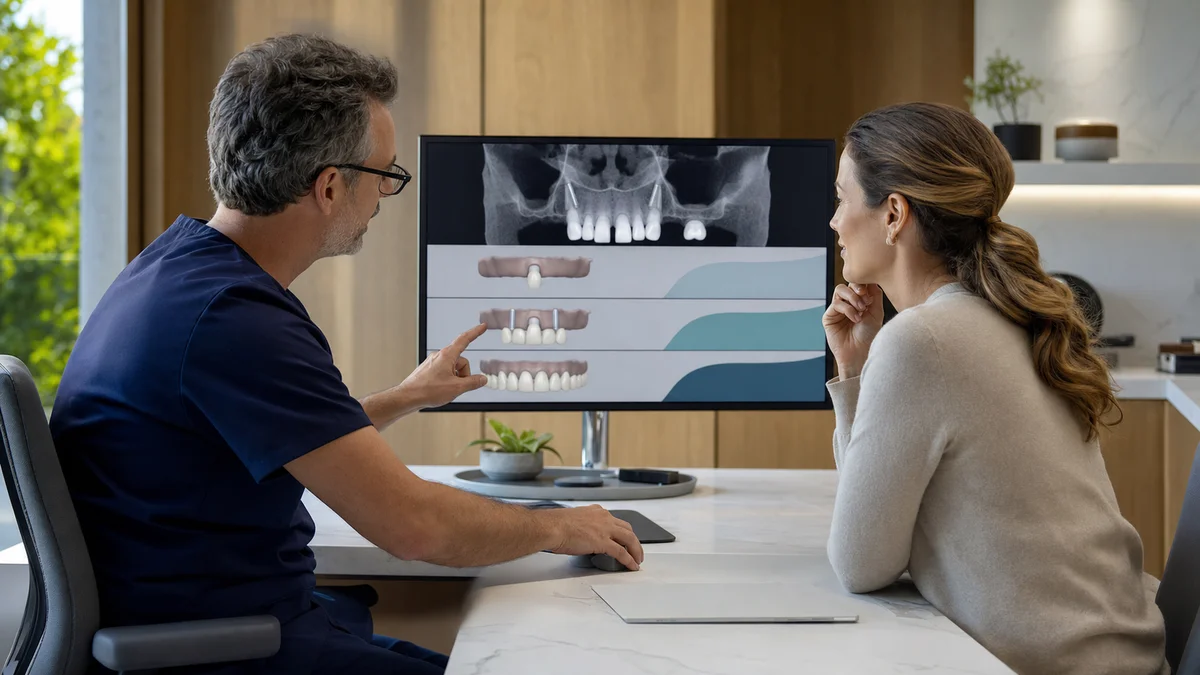
There is no clinically honest universal average for what is the average cost for upper dental implants because “upper implants” may mean one tooth, a bridge or a full arch. Total cost can include imaging, extractions, grafting or sinus treatment, implant bodies, abutments, provisional teeth, the final prosthesis, anaesthesia and maintenance. Compare complete itemised plans after examination.
People who ask what is the average cost for upper dental implants are often comparing numbers that describe entirely different treatments. One quote may cover a single implant body only. Another may include an abutment and crown. A third may describe a fixed full-arch prosthesis, while a fourth may be a removable overdenture. Even when two plans use the same number of implants, the diagnostic work, bone management, temporary teeth, final materials and follow-up may differ. The fairest comparison therefore starts with scope, not a headline number.
This guide is educational and cannot diagnose whether an implant, graft or sinus procedure is appropriate for you. A dentist needs to assess your remaining teeth, gums, bite, medical history and imaging. The aim is to help you ask safer questions, recognise missing line items and understand why what is the average cost for upper dental implants cannot be separated from an upper-jaw plan. It does not promise suitability, a timeline or a result, and it deliberately avoids a fixed price that could be misleading across patients, providers, locations and currencies.
1. Why “average” is the wrong starting point
The phrase what is the average cost for upper dental implants looks like one question, but it contains at least four unanswered questions: how many teeth are missing, whether the planned teeth are fixed or removable, how many implant sites are proposed, and whether preparatory care is required. An average that blends one crown with an entire arch has little value for an individual decision. It is similar to averaging the cost of replacing one window with rebuilding a roof.
Geography also changes the number without changing the biology. Professional fees, laboratory work, facility standards, regulation, taxes, exchange rates and the services bundled into a package vary. That is why what is the average cost for upper dental implants changes across markets. A lower number is not automatically a lower total, and a higher number is not automatically a more appropriate plan. The useful benchmark is a like-for-like, written, clinically justified scope.
- Define whether the quote is for one tooth, several teeth or the complete upper arch.
- Confirm whether the restoration is fixed, removable, provisional or final.
- Separate implant bodies, abutments and replacement teeth rather than treating them as one object.
- Ask which diagnostic, surgical, restorative and maintenance visits are included.
- Record important exclusions and the circumstances that could change the plan.
2. First define what “upper dental implants” means
Before researching what is the average cost for upper dental implants, write down the outcome you are actually discussing. The US Food and Drug Administration explains that an implant system includes an implant body placed in bone and an abutment that supports an artificial tooth. The visible replacement may be a crown, bridge or denture. These components have different clinical and laboratory steps, so “implant” should not be assumed to mean the completed tooth.
A single missing upper tooth may involve one implant body, one abutment and one crown, but even that simple description is not a diagnosis. Several missing teeth might be restored by an implant-supported bridge rather than one implant for every missing tooth. A complete upper arch might use a removable implant overdenture or a fixed bridge. These are different endpoints within what is the average cost for upper dental implants. The appropriate design and implant distribution depend on anatomy, bite, cleansability and the planned prosthesis; no universal implant count should be promised from a web page.
3. Single upper tooth: the smallest common scope
For a single tooth, what is the average cost for upper dental implants should be reframed as “what is included in the complete single-tooth pathway?” The quote may need to cover assessment, two-dimensional imaging or clinically justified three-dimensional imaging, extraction if the tooth remains, possible socket or site grafting, the implant body, healing components, an abutment, a temporary tooth if indicated, the final crown and review visits.
Location matters when answering what is the average cost for upper dental implants. An upper front tooth can demand careful planning of gum shape, implant position, temporary restoration and crown character because the area is visible. A posterior tooth may be nearer the maxillary sinus. Neither location automatically requires a graft. The examination and imaging show the available bone and soft-tissue conditions, while the restorative plan determines where the replacement tooth needs support.
4. Implant-supported bridge: count teeth and supports separately
When several adjacent teeth are missing, what is the average cost for upper dental implants cannot be answered by multiplying a “per implant” figure by the number of missing teeth. A bridge can replace more teeth than the number of implant bodies supporting it. Its design depends on the span, available sites, load, opposing teeth, hygiene access and material. The quote should name both the number of planned implant bodies and the number of teeth in the bridge.
Ask whether provisional teeth are included, how the bridge will be retained, what happens if healing changes the restorative plan, and who manufactures the final prosthesis. A laboratory-made bridge is not merely a collection of crowns. Its framework, passive fit, contours, emergence, cleaning spaces and bite need planning and verification. A quote that lists only implant units can hide a substantial restorative phase.
5. Full upper arch: fixed and removable are not equivalent
For a person missing all or nearly all upper teeth, what is the average cost for upper dental implants must distinguish a removable implant overdenture from a fixed full-arch bridge. An overdenture is removed for cleaning and may use attachments that wear and require replacement. A fixed restoration is removed only by a clinician and has different framework, material, hygiene and repair considerations. Both can be legitimate; they are not interchangeable products.
A full-arch plan may also include extraction of remaining teeth, management of infection or periodontal disease, bone reshaping, grafting, immediate provisional teeth, a healing period and a later final prosthesis. These phases are central to what is the average cost for upper dental implants. “Teeth in a day” language may refer to provisional teeth placed under selected conditions. It should not be interpreted as a promise of a final prosthesis, immediate loading for everyone or guaranteed integration.
6. Why the upper jaw can change the plan
The clinical answer to what is the average cost for upper dental implants may differ from a lower-jaw estimate because the upper jaw has its own anatomy. The maxillary sinuses are air-filled spaces above the upper premolar and molar regions. After tooth loss, the height and form of available bone may not suit the initially imagined implant position. At the front, tooth position, lip support, gum display and soft-tissue shape can be especially important to appearance.
These differences do not mean that every upper implant is difficult or that every posterior site needs sinus augmentation. They mean what is the average cost for upper dental implants should follow a prosthetic goal planned first and matched to safe anatomy. A panoramic radiograph may answer some questions; a cone beam CT may be requested when three-dimensional information is clinically justified. Imaging should support a decision rather than serve as a universal add-on.
7. Sinus lift: possible line item, not an automatic charge
Patients asking what is the average cost for upper dental implants often encounter “sinus lift” in estimates for back teeth. Cambridge University Hospitals explains that the procedure creates sufficient bone under the maxillary sinus for implant placement and may be performed before or at the same time as the implant, depending on existing bone and the selected approach. It is elective and has benefits, risks and alternatives that require consent.
If a sinus procedure is proposed, ask what finding makes it necessary, which approach is planned, whether the implant would be placed simultaneously or later, what graft material is proposed, and how it changes what is the average cost for upper dental implants. Alternatives may include a different implant position, a shorter implant in suitable bone, fewer implants placed farther forward, a bridge, a denture or accepting a gap. Each alternative has trade-offs; none should be selected from price alone.
8. Bone grafting and site development
Another reason what is the average cost for upper dental implants produces inconsistent answers is that “grafting” covers different procedures. A small defect may be managed at implant placement; a larger deficiency may be treated in a separate stage. A site preserved when a tooth is extracted is not necessarily the same procedure as rebuilding a deficient ridge months or years later. Materials and membranes may come from different sources, which should be disclosed.
Not everyone needs bone grafting. Guy’s and St Thomas’ lists it as one possible stage and explicitly notes that it is not required for every patient. If it is proposed, request the purpose, material, timing, alternatives, risks and its effect on what is the average cost for upper dental implants. The plan should also identify whether later imaging or another surgical visit is included.
9. The complete cost stack to request in writing
A practical response to what is the average cost for upper dental implants is an itemised cost stack. Requesting it does not imply that every line is necessary. It ensures the parties are comparing the same expected pathway and can identify conditional items before consent.
- Diagnosis: consultation, periodontal assessment, records, photographs, models, conventional radiographs and any clinically justified CBCT.
- Preparation: treatment of active disease, extractions, site preservation, bone grafting, sinus augmentation or soft-tissue management when indicated.
- Surgery: implant bodies, healing components, surgical guide if used, local anaesthesia, sedation or facility fee where applicable.
- Provisional phase: temporary removable or fixed teeth, adjustments and whether an immediate provisional is conditional on stability.
- Restorative phase: abutments, scans or impressions, verification, laboratory work, final crown, bridge, overdenture or full-arch prosthesis.
- Aftercare: surgical reviews, hygiene instruction, maintenance visits, radiographic monitoring and management of wear or complications.
10. A decision table for like-for-like quotes
Use this table when deciding what is the average cost for upper dental implants means for your situation. It is a comparison framework, not a treatment recommendation.
| Scenario | Scope that must be explicit | Question that prevents a false comparison |
|---|---|---|
| One missing upper tooth | Implant body, abutment, provisional if needed and final crown | Does the quote end with the completed crown? |
| Short upper bridge | Number of implant supports and number of replacement teeth | Is the bridge laboratory phase included? |
| Removable upper overdenture | Implants, attachments, denture and future attachment maintenance | Which parts are removable and likely to wear? |
| Fixed full upper arch | Extractions, implant distribution, provisional and final bridge | Is the advertised tooth set provisional or final? |
| Posterior site near the sinus | Imaging, sinus assessment and conditional augmentation | What anatomical finding supports the sinus procedure? |
| Extraction and immediate plan | Extraction, implant, graft if indicated and contingency prosthesis | What happens if immediate placement or loading is not safe? |
| Staged graft | Graft stage, healing checks, later implant and restoration | Are both operations and repeat imaging included? |
| Self-pay plan | Complete fees, payment timing and conditional charges | Which foreseeable costs are excluded? |
| International treatment | Travel, visit count, records, local aftercare and contingency plan | Who provides urgent and long-term care after travel? |
11. Imaging and records: pay for information that changes a decision
When researching what is the average cost for upper dental implants, confirm what the diagnostic fee covers. A detailed examination should review oral health, remaining teeth, periodontal condition, bite, smile and the proposed prosthesis. Imaging can assess bone and relevant anatomy. Leeds Teaching Hospitals notes that CBCT can show structures such as adjacent roots, nerves, the nasal cavity and sinuses, as well as bone at the proposed site.
That does not mean every person needs every scan. Ask what decision the scan is intended to support and whether its interpretation and report are included in what is the average cost for upper dental implants. Obtain copies of relevant images, the written plan and implant system information for continuity of care. The FDA advises patients to ask for the brand and model of the implant system and retain that information.
12. Provisional teeth versus the final prosthesis
A low answer to what is the average cost for upper dental implants can result from quoting a surgical or provisional stage only. A temporary crown, bridge or denture helps during healing and may test tooth position, appearance, speech and hygiene. It is not necessarily made from the same material or to the same design as the final prosthesis.
Ask the quote to label “provisional” and “final” separately. Clarify how many temporary repairs or adjustments are included, when the final prosthesis is made, and which clinical milestones must be met first. If immediate fixed teeth are proposed, ask for the backup option if primary stability or another safety condition is not achieved. A responsible contingency plan is more valuable than an unconditional same-day promise.
13. Final material is only one part of value
People comparing what is the average cost for upper dental implants may focus on material labels such as zirconia, ceramic, metal-acrylic or composite. Material affects laboratory workflow, thickness, repair strategy, appearance and wear, but a premium-sounding word cannot establish suitability. Framework design, implant position, passive fit, occlusion, hygiene access and maintenance remain important.
Request the material of the implant body, abutment, framework and visible teeth separately. Ask whether components are original or compatible parts, how repairs are handled, and whether removal for professional maintenance is expected. The best selection depends on the specific prosthesis and clinical conditions, not a ranking copied from advertising.
14. Anaesthesia, sedation and facility fees
Any answer to what is the average cost for upper dental implants should state the planned method of pain control. Many implant procedures are performed with local anaesthesia. Sedation or general anaesthesia may be considered in selected situations, adding assessment, monitoring, escort and facility requirements. The most expensive option is not automatically the safest or most comfortable for every person.
Ask whether local anaesthesia is included, whether sedation is optional or clinically recommended, who provides it, where it occurs and which recovery instructions apply. Report medicines, allergies, medical conditions, pregnancy status and previous anaesthesia experiences accurately. Never stop prescribed medicines merely to fit a dental package; medication changes belong with the relevant prescriber and dental team.
15. Insurance: verify the benefit, not the marketing phrase
In the United States, what is the average cost for upper dental implants is not the same as “what will I pay after insurance?” Medicare states that, in most cases, it does not cover routine dental services or items such as dentures and implants. Limited dental services may be covered when directly linked to certain covered medical treatment. HealthCare.gov states that adult dental coverage is not an essential Marketplace benefit, health plans do not have to include it, and stand-alone plans can have waiting periods.
A private dental plan may apply an annual maximum, deductible, coinsurance, network rule, prior authorisation, waiting period, missing-tooth clause, replacement-frequency rule or alternative-benefit provision. Benefits can change, so obtain a current written estimate from the insurer. “Covered” rarely means every line is paid, and a pre-treatment estimate is not always a guarantee of payment.
- Request the procedure codes and written plan before contacting the insurer.
- Ask whether diagnostics, extraction, grafting, implant placement and the prosthesis are separate benefits.
- Confirm annual maximum, deductible, coinsurance, network status and remaining benefit.
- Ask about waiting periods, missing-tooth clauses, replacement frequency and alternative benefits.
- Clarify who handles appeals if the clinical plan differs from the insurer’s allowance.
16. Risks and maintenance belong in the cost conversation
A trustworthy discussion of what is the average cost for upper dental implants includes long-term responsibilities. The FDA lists possible complications including damage to nearby teeth or tissues, sinus perforation, infection, delayed healing, implant failure, screw loosening, bite problems and numbness from nerve injury. Components may loosen, chip or wear. Inflammation around an implant can threaten supporting tissues.
Maintenance is therefore not a cosmetic extra. It includes home cleaning adapted to the prosthesis, professional reviews, hygiene care, monitoring of gum and bone health, and timely management of looseness or wear. Smoking can impair healing, and overall health affects candidacy and recovery. No implant or prosthesis should be sold as maintenance-free or guaranteed for life.
17. Alternatives can be safer, simpler or more appropriate
The question what is the average cost for upper dental implants should not crowd out the option of keeping a restorable tooth. When preservation is reasonable, compare its prognosis, burden and maintenance with extraction and replacement. If a tooth is missing, alternatives may include a tooth-supported bridge, resin-bonded bridge, removable partial or complete denture, or no replacement in a selected functional situation.
Guy’s and St Thomas’ lists no treatment, preparing other teeth for a bridge and different denture designs among alternatives. Cambridge University Hospitals lists bridges, dentures and no replacement among alternatives to sinus augmentation. Each choice shifts the trade-offs among surgery, effects on adjacent teeth, removability, hygiene, function, appearance, repair and future change.
18. International treatment: compare the entire pathway
For travel, what is the average cost for upper dental implants must include more than the clinic invoice. Add flights, accommodation, transfers, time away from work, companion expenses, return visits and local emergency care. Healing biology does not accelerate because travel dates are short. A staged plan may require multiple trips, especially when grafting or sinus treatment is needed.
Ask for remote record review to be described as preliminary, with the final plan confirmed after examination and necessary imaging. Obtain the clinician’s name and credentials, implant system details, laboratory and prosthesis description, informed-consent documents, medication plan, records in a language you understand, and written aftercare contacts. Clarify what can be managed by a local dentist and what would require returning.
Redent Klinik is located in Istanbul and serves international patients, but it is not a US insurer or a substitute for a local emergency service. You can review the clinic’s approach on the Redent Klinik English website and send existing records through the Redent Klinik contact page. Any remote discussion remains provisional until a clinical assessment confirms the options.
19. Fifteen questions to put beside every quote
Instead of asking only what is the average cost for upper dental implants, use these questions to expose differences that a headline hides.
- What exact teeth and final function does this plan aim to replace?
- Is the final restoration a crown, bridge, removable overdenture or fixed full arch?
- How many implant bodies, abutments and replacement teeth are included?
- Which examination, photographs, radiographs, models or CBCT are included?
- Which current dental disease must be treated first?
- Are extractions, site preservation, bone grafting or sinus treatment included or conditional?
- What clinical finding justifies each preparatory procedure?
- Is a surgical guide planned, and is it included?
- What type of anaesthesia or sedation is included?
- Are temporary teeth included, and are they fixed or removable?
- Does “same day” refer to a provisional or final prosthesis?
- Which materials and implant system will be used?
- How many expected reviews, adjustments and hygiene visits are included?
- What foreseeable exclusions, repairs or remakes could add cost?
- Who provides urgent, routine and long-term care after completion?
20. How to build your personal planning range
A safer personal answer to what is the average cost for upper dental implants is a range with three columns: expected, conditional and long-term. Put the agreed diagnostic, surgical and restorative scope in “expected.” Put grafting, sinus treatment, additional provisional work or alternative loading in “conditional,” each tied to the finding that would trigger it. Put professional maintenance, hygiene, attachment replacement and possible repairs in “long-term.”
Then compare two or more written plans line by line. If the diagnoses differ, ask each clinician to explain the evidence and alternatives. Do not force two plans into equivalence by deleting important steps. The purpose of a second opinion is to understand the choices, not to turn health care into an auction.
Frequently asked questions about what is the average cost for upper dental implants
1. Can a dentist quote the final total without seeing me?
A remote team can explain typical components, but what is the average cost for upper dental implants cannot become a reliable final total until the dentist assesses your mouth, medical history, bite, desired prosthesis and appropriate imaging. Existing records may help with preliminary planning. Any answer to what is the average cost for upper dental implants should identify assumptions and remain subject to clinical confirmation.
2. Is an upper implant always more expensive than a lower implant?
No. When considering what is the average cost for upper dental implants, upper anatomy can add planning or site-development steps, particularly near the sinus, but it does not automatically do so. A straightforward upper site may require fewer steps than a complex lower site. Compare the diagnosed conditions and complete restoration, not the jaw label alone.
3. Does every upper back implant need a sinus lift?
No. The answer to what is the average cost for upper dental implants should not contain an automatic sinus charge. Available bone, sinus position, planned implant and prosthetic design must be assessed. If augmentation is proposed, ask for the anatomical reason, approach, timing, risks and alternatives. Cambridge University Hospitals describes sinus lift as elective and outlines non-sinus alternatives.
4. Does one missing tooth always require one implant?
A single missing tooth is often discussed as one implant-supported crown, but what is the average cost for upper dental implants still depends on neighbouring teeth, site condition, space, bite and alternatives. Several missing teeth do not necessarily require one implant per tooth because an implant-supported bridge may use fewer supports than replacement teeth.
5. How many implants are needed for a full upper arch?
There is no universal number that a general article should prescribe. For what is the average cost for upper dental implants, the clinician must match implant position and distribution to anatomy, bone, bite, opposing teeth, hygiene access and whether the prosthesis is fixed or removable. Treat a one-number promise without diagnostic context as incomplete marketing, not a personalised plan.
6. Are “same-day teeth” the final teeth?
Not necessarily. In many discussions of what is the average cost for upper dental implants, same-day teeth are a provisional restoration used during healing. Immediate placement or loading requires suitable conditions and needs a contingency if those conditions are not met. Ask the quote to distinguish implant placement, provisional teeth and the later final prosthesis.
7. Will Medicare pay for upper dental implants?
Medicare says it does not cover implants in most cases. Limited dental services may be covered when directly related to specified covered medical treatment. Therefore, what is the average cost for upper dental implants and your personal Medicare liability are different questions. Verify the current service, setting and medical connection with Medicare and the treating providers before care.
8. What can make the estimate change after treatment begins?
When estimating what is the average cost for upper dental implants, changes can follow new diagnostic findings, extraction conditions, inadequate stability for immediate loading, unexpected graft needs, healing events, prosthetic design changes or additional maintenance. A good estimate identifies foreseeable conditional items and how approval will be obtained rather than presenting every variation as a surprise.
9. What warning signs need prompt contact after surgery?
Contact the treating team promptly for uncontrolled bleeding, rapidly worsening swelling, fever, spreading redness, difficulty breathing or swallowing, severe pain not controlled as instructed, persistent vomiting, an allergic reaction, a loose implant or prosthesis, or concerning sinus symptoms after upper-jaw surgery. Emergency symptoms require local emergency services. This safety advice matters more than refining what is the average cost for upper dental implants.
10. What is the single best way to compare two plans?
Convert both plans into the same endpoint: diagnosed sites, implant bodies, abutments, provisional teeth, final prosthesis, preparatory procedures, anaesthesia, reviews, maintenance and exclusions. Then what is the average cost for upper dental implants becomes a structured decision instead of a misleading headline. If endpoints differ, ask why before comparing totals.
Final perspective
The honest answer to what is the average cost for upper dental implants is that there is no single clinically meaningful average across a crown, an implant bridge, a removable overdenture and a fixed full upper arch. The upper jaw may introduce aesthetic, bone or sinus considerations, but none should be assumed without assessment. A complete quote names the intended endpoint and separates diagnostic, preparatory, surgical, provisional, final and maintenance phases.
Use the fifteen questions above, verify insurance directly, keep your records and insist on alternatives and contingencies. A price becomes useful only after the scope is clear. The safest plan is not necessarily the cheapest or the most elaborate; it is the one that is clinically justified, understandable, maintainable and agreed through informed consent.
Evidence and official patient resources
- US Food and Drug Administration — Dental Implants: What You Should Know
- American Dental Association
- National Institute of Dental and Craniofacial Research — Health Information
- NIDCR — Finding Dental Care
- Medicare.gov — Dental Services Coverage
- HealthCare.gov — Dental Coverage in the Marketplace
- Guy’s and St Thomas’ NHS Foundation Trust — Dental Implants
- Cambridge University Hospitals — Sinus Lift Procedures
- Cambridge University Hospitals — Insertion of Dental Implants
- Leeds Teaching Hospitals — Dental Implants
- World Health Organization — Oral Health