
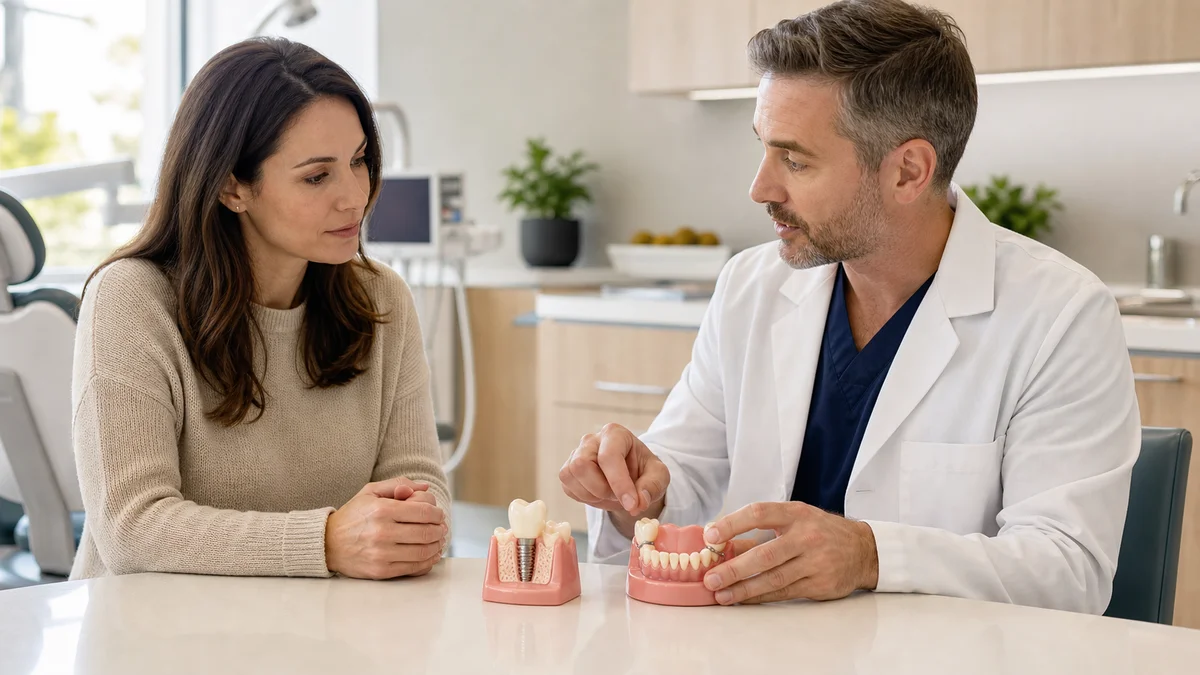
Comparing dental implants vs partials is not simply a contest between a modern treatment and an old one. Both can replace missing teeth, but they do so through different biological and mechanical designs. A dental implant is a device placed surgically in the jaw and used to support a crown, bridge or denture. A removable partial denture replaces one or more missing teeth and can be taken out and reinserted by the patient.
The US Food and Drug Administration advises patients considering implants to discuss candidacy, benefits, risks, healing and the exact implant system with their dental provider. The American Dental Association and NHS guidance emphasise that partial dentures require daily cleaning, periodic professional review and care of the remaining teeth. A safe dental implants vs partials decision therefore starts with examination, imaging when indicated and a realistic plan for maintenance.
This article provides education, not a diagnosis, fixed price or treatment guarantee. It does not rank brands or clinics. Your dentist must assess the mouth, medical history, expectations and local treatment options before recommending a plan.
Dental implants vs partials: the basic difference
In a typical implant restoration, an implant body is placed in jawbone, an abutment connects to it and a crown or other prosthesis restores the visible tooth. Healing may take months, and a temporary solution may be used. The FDA notes that general health affects candidacy, healing and how long an implant may remain in place. Implant treatment can involve more than one professional and several stages.
A removable partial denture usually has replacement teeth attached to an acrylic or metal-based framework and rests on oral tissues and/or remaining teeth according to its design. Clasps or other components may help retention. The patient removes it for cleaning. In dental implants vs partials, this removability avoids implant surgery but introduces different demands for adaptation, hygiene, handling and periodic adjustment.
There are hybrid options. Implants can retain or support removable dentures, and a case may combine implants with other prosthetic designs. The phrase dental implants vs partials can therefore oversimplify a spectrum. Ask whether the proposed “partial” is conventional, immediate, temporary or implant-assisted and whether the implant proposal means a single crown, bridge or removable overdenture.
Who may be suited to each option?
Suitability depends on the whole patient, not age alone. For implants, clinicians assess bone volume and anatomy, gum health, healing capacity, oral hygiene, smoking, diabetes control, medications, prior radiation, infection risk and ability to undergo surgery. Additional investigations or coordination with a physician may be needed. A person can be medically well yet have an implant site that requires a different plan.
Partials require usable space, a design that works with the bite and oral tissues, and remaining teeth that can tolerate the planned support and retention. Manual dexterity, memory, gag reflex, dry mouth, sensitivity to bulk and ability to remove and clean the appliance matter. When weighing dental implants vs partials, a less invasive option is not automatically easier if the patient cannot manage it safely.
Some people are candidates for both and can choose based on priorities. Others have only one reasonable option at a particular time. Disease control, extractions or healing may change the choices later. In dental implants vs partials, a reversible interim partial can sometimes preserve time for a future decision, but it still needs a clear design and review plan.
Decision table for dental implants vs partials
Use this table to organise questions, not to self-select treatment. The answer to dental implants vs partials can differ by site within the same mouth.
| Factor | Implant-based replacement | Removable partial denture | What the dentist must assess |
|---|---|---|---|
| Invasiveness | Requires surgery to place the implant body | Usually avoids implant surgery | Medical risk, anatomy, healing and patient preference |
| Removability | A single crown or fixed bridge is not removed by the patient | Removed by the patient for cleaning and usually overnight | Dexterity, cleaning access and lifestyle |
| Support | Uses an implant anchored in jawbone | May use teeth and oral tissues according to design | Bone, gum, remaining teeth and bite |
| Timing | May require staged healing and multiple visits | Can often be made without surgical integration time | Extraction healing, urgency and provisional needs |
| Maintenance | Needs daily cleaning and professional implant review | Needs removal, appliance cleaning and care of remaining teeth | Long-term ability and access to follow-up |
| Future change | Components or restoration may need repair or replacement | May need adjustment, reline, repair or replacement as the mouth changes | Prognosis of all teeth and likely future tooth loss |
| Cost pattern | Often more stages and surgical/restorative components | Often lower initial complexity but ongoing maintenance remains | Complete written scope, insurance and lifetime maintenance |
Surgery and healing: the clearest contrast
Implants require an operation to place a device in bone. The FDA lists potential complications such as injury to nearby teeth or tissues, sinus perforation, jaw fracture, altered bite, screw loosening, infection, implant loosening, cleaning difficulty and nerve-related numbness. These are possible risks, not predictions for every patient. The consent discussion should address likelihood and management for the individual site.
Smoking can impair healing, and uncontrolled diabetes may raise certain risks. Bone grafting or other site development can add surgery, healing time and cost. In the dental implants vs partials comparison, ask whether the implant plan depends on grafting, how many surgical stages are expected and what temporary tooth replacement will be used.
In the surgical dimension of dental implants vs partials, a conventional partial does not require implant placement, but extractions or other treatment may still be needed. Immediate dentures placed around the time of extraction may require adjustment or replacement as tissues change during healing. “No implant surgery” should not be mistaken for “no treatment risk.” Sore areas, poor fit, plaque retention, damage to supporting teeth or difficulty eating can require attention.
Comfort, chewing and speech
When discussing comfort in dental implants vs partials, many patients value fixed implant-supported teeth because they do not remove a single crown or fixed bridge for routine cleaning. The FDA identifies restored chewing and appearance among potential benefits of implant systems. However, sensation does not become identical to a natural tooth, and a restoration can feel high, loose or uncomfortable if complications occur.
Partials occupy space and can initially affect speech, chewing and salivary awareness. NHS guidance notes that it can take weeks to become accustomed to dentures. Design, fit, extension, clasp placement, bite and patient adaptation influence comfort. In dental implants vs partials, try-in stages and adjustment access may be as important as the first impression.
Ask how each option will handle the foods you commonly eat and whether there are realistic limitations. A stable partial can function well, while a poorly designed or poorly maintained one may move or create sore spots. An implant crown can feel stable, but it can still have ceramic, screw, gum or bone complications. Neither option permits a universal promise of natural-tooth function.
Effect on bone, gums and remaining teeth
FDA patient information states that implants can help maintain surrounding bone and gum health and keep adjacent teeth stable. That potential benefit depends on appropriate placement and continued health. Implants do not make a patient immune to inflammatory disease; plaque around implants can contribute to peri-implant mucositis or peri-implantitis, and bone can be lost.
A partial denture may distribute forces through teeth and tissues according to the design. Clasps, rests and denture bases need sufficient space and should be planned around the prognosis of remaining teeth. Plaque can collect around components. ADA and NHS resources stress daily denture cleaning and continued care of natural teeth. The dental implants vs partials decision should include decay and gum risk, not appearance alone.
Missing teeth can be associated with shifting, altered chewing and bone changes, but treatment should be proportionate. Replacing every gap is not mandatory in every mouth. For dental implants vs partials, a shortened dental arch, bridge, another restoration or monitoring may also be reasonable in selected circumstances. Ask what problem treatment is meant to solve.
Cleaning dental implants vs partials
Implant-supported restorations require daily plaque removal around the crown, abutment and gumline with tools that fit the design. A professional should show technique and choose recall intervals based on risk. The FDA advises regular cleaning and dental visits and says a loose or painful implant should be reported promptly.
Removable partial dentures should be taken out and cleaned as instructed, while remaining teeth, gums and tongue also need care. The ADA advises that dentures should not be placed in hot or boiling water because they may warp, and denture cleansers must be used according to directions. NHS guidance generally advises removal at night unless the dentist gives different instructions.
- Ask for a demonstration with the exact restoration or appliance.
- Use only brushes, floss aids or cleansers recommended for its materials.
- Clean remaining natural teeth with fluoride toothpaste as advised.
- Remove a partial over a protected sink or soft towel to reduce breakage risk.
- Do not adjust clasps, grind the appliance or tighten implant components yourself.
- Report persistent bleeding, swelling, ulcers, mobility, pain or bad taste.
- Keep scheduled maintenance even when the replacement feels comfortable.
When patients compare dental implants vs partials, they sometimes assume the fixed choice requires less care. In reality, both demand lifelong hygiene; the techniques and failure modes differ.
Treatment time and number of appointments
An implant pathway can include consultation, records, extraction, grafting if indicated, implant placement, healing, exposure or abutment steps, impressions or scans, provisional care and final restoration. Some steps may be combined, but timing depends on stability, tissue health and treatment design. The FDA notes that implant healing may take several months or longer.
A partial denture commonly requires records, design, impressions or scans, jaw relation, try-in, fitting and adjustments. An immediate partial can be prepared before extraction, but tissues change as they heal. It may need relining or replacement. In dental implants vs partials, a faster start does not necessarily mean fewer lifetime visits.
Ask for a realistic range rather than a promised date when comparing dental implants vs partials. Illness, healing, laboratory steps, complexity and availability can alter schedules. If appearance during treatment matters, make sure the provisional plan is explicit and included in the quote.
Cost and insurance without misleading price claims
The total for implants may include surgery, implant body, abutment, grafting, imaging, provisional treatment and the final crown or bridge. A partial quote may include examinations, extractions, framework, teeth, fittings and adjustments. Comparing only “per tooth” fees makes dental implants vs partials look simpler than it is.
Fees vary by country, clinician, material, anatomy, number of teeth and additional procedures. Insurance varies by plan, network, deductible, annual maximum, waiting period, frequency rule and prior approval. Request itemised written plans with codes where applicable. A pre-treatment estimate can clarify likely benefits but may not guarantee final payment.
Traditional Medicare generally excludes routine dental care and replacement of teeth, subject to limited exceptions for dental services closely linked to certain covered medical care. CMS notes that some Medicare Advantage plans may offer routine dental benefits. Verify the exact plan rather than assuming either side of dental implants vs partials is covered.
- Initial consultation, records and imaging
- Extractions, disease control and site preparation
- Surgical, restorative and laboratory components
- Temporary teeth during treatment
- Travel, accommodation and time away from work
- Adjustments, relines, repairs and component replacement
- Professional maintenance and hygiene tools
- Insurance exclusions and patient responsibility
Appearance and design choices
For appearance in dental implants vs partials, an implant crown can emerge through the gum and may offer a tooth-by-tooth result, but final aesthetics depend on bone, gum shape, implant position, material and neighbouring teeth. Front-tooth cases can be especially demanding. Tissue changes or metal visibility can occur, and a highly aesthetic result cannot be guaranteed.
A partial may replace not only teeth but also missing gum volume. Its framework, base, clasps and tooth arrangement affect visibility. Some clasps may show, while other designs use different retention. The least visible design is not automatically safest or easiest to repair. For dental implants vs partials, request an explanation of what will show during smiling and speaking.
Photographs, scans and trial arrangements can support communication, but they are planning tools. Ask whether a mock-up or try-in is possible and what changes can still be made at each stage. Understand how shade changes in remaining teeth would affect future matching.
Repairs, replacement and future flexibility
Implant treatment includes several components. A crown can chip, an abutment or screw can loosen, or biological complications can develop around the implant. The implant body itself may fail to integrate or may later lose support. Repair can range from adjustment to replacement of a component or additional surgery.
Partials can lose fit as gums and bone change. Teeth or acrylic may wear or break, clasps may deform, and supporting teeth can change. Some designs can be relined, repaired or modified, but not every change is simple. ADA guidance recommends professional evaluation when dentures become unstable, damaged, chronically irritating or difficult to wear.
Future tooth loss should be discussed before choosing dental implants vs partials. A partial might be designed with potential changes in mind; an implant position might support a broader future restoration. Neither pathway should be assumed to adapt automatically. Ask what happens if another tooth fails.
Medical conditions, medications and smoking
Before choosing dental implants vs partials, provide a complete medical history, medication list, allergies and smoking or vaping information. Conditions or drugs affecting healing, immunity, bleeding or bone metabolism may change implant planning or require medical coordination. Do not stop anticoagulants, antiplatelets or other prescribed medicines on the basis of a website.
Smoking is associated with impaired implant healing, and the FDA specifically warns that it may reduce long-term success. Diabetes control, active gum disease and oral hygiene also matter. For a partial, dry mouth, reduced dexterity, neuromuscular conditions, cognitive impairment or high decay risk can influence safe handling and maintenance.
The best dental implants vs partials answer may change if health changes. A clinician should distinguish a temporary contraindication, a modifiable risk and a reason to choose a different plan. Absolute statements such as “too old for implants” or “partials always work” are not adequate assessments.
Second opinions and complex cases
A second opinion about dental implants vs partials can be useful when plans involve multiple implants, extensive grafting, removal of restorable teeth, uncertain prognosis or substantially different recommendations. Bring existing imaging and records to avoid unnecessary repetition while allowing the second clinician to decide what is diagnostically adequate.
Compare the same clinical objective. One proposal may replace three spaces with individual implants; another may use an implant bridge; a third may offer a removable partial. These are not equivalent line items. The dental implants vs partials discussion should state which teeth are being replaced, which are kept and how each design is maintained.
For complex cases, ask whether a prosthodontist, periodontist, oral surgeon or another clinician will be involved. Know who coordinates the final plan and who manages complications. More clinicians can add expertise, but roles and records must be clear.
Comparing local and international treatment
Some patients compare dental implants vs partials while considering treatment abroad. The comparison must include diagnostic visits, extractions, grafts, provisional teeth, healing intervals, final restoration, travel, accommodation, time away and long-term review. A remote quote cannot confirm bone anatomy, gum health, bite or the prognosis of remaining teeth.
If Redent Klinik is one of the options under review, the English Redent Klinik website offers clinical context, and the English contact page can be used to request an individual assessment and itemised proposal. Contact does not guarantee candidacy, timing, price or result; examination remains necessary.
Verify professional registration, implant system records, consent language, laboratory details, follow-up arrangements and emergency contacts in the treating country. Ask who will maintain the work after you return. If local clinicians are expected to provide follow-up, discuss this before travelling rather than after a complication.
Red flags when comparing dental implants vs partials
Price or convenience alone is not a red flag. Concern arises when a provider recommends irreversible treatment without adequate diagnosis, dismisses medical history or refuses to discuss alternatives. A legitimate dental implants vs partials consultation acknowledges uncertainty and explains why one option fits the individual case.
- Implant surgery is promised before examination or appropriate imaging.
- A healthy or treatable tooth is proposed for removal without a clear reason.
- Bone grafting, temporaries or final prosthetic components are omitted from the quote.
- A partial is described as maintenance-free or suitable without checking supporting teeth.
- Insurance coverage or treatment success is guaranteed.
- The implant brand, model or responsible clinician is not disclosed.
- There is no plan for cleaning, repair, adjustment or complications.
- Countdown offers or fear are used to force immediate consent.
Frequently asked questions
Which is better: dental implants vs partials?
The answer to dental implants vs partials is not universal. Implants may offer a fixed, bone-anchored replacement but require surgery and suitable healing conditions. Partials avoid implant surgery and can replace several teeth in one appliance, but they are removable and need careful handling. The better option is the safest maintainable fit for your findings and priorities.
Are implants more comfortable than a partial denture?
A well-functioning fixed implant restoration may feel less bulky because there is no removable base. Yet implant complications can cause discomfort. A well-designed partial can be comfortable after adaptation, while poor fit can create movement or sore areas. Comfort cannot be promised before assessment and adjustment.
Can a partial denture damage remaining teeth?
A poorly fitting, poorly designed or inadequately cleaned partial can contribute to plaque retention, decay, gum problems or harmful forces. Proper design, hygiene and review reduce risk. The remaining teeth must be assessed before treatment and monitored after fitting.
Do dental implants prevent bone loss?
Implants can help preserve surrounding jawbone by transmitting load, and the FDA lists bone preservation as a potential benefit. They do not prevent every future bone change. Infection, overload, poor hygiene or other factors can still lead to loss of supporting bone.
How long do dental implants and partials last?
No exact lifespan can be guaranteed. Implant components, bone and gums require maintenance and may develop complications. Partials can wear, break or lose fit as tissues and teeth change. Personal risk, design, use, hygiene and professional follow-up influence replacement needs.
Is a partial faster than implant treatment?
It often avoids the biological integration period required after implant placement, but manufacture still requires records, design, fitting and adjustments. Immediate partials may need later modification as extraction sites heal. A faster initial delivery does not always mean fewer total appointments.
Can I sleep with a removable partial?
NHS and ADA guidance generally supports removing dentures at night unless a dentist gives different instructions for a specific situation. Removal allows cleaning and tissue rest. Follow the directions for your exact material and store the appliance safely as advised.
Does insurance cover dental implants vs partials differently?
Often yes, but rules vary widely. Plans can use different codes, exclusions, deductibles, annual limits, waiting periods or alternative-benefit clauses. Ask for written treatment plans and verify current benefits. A pre-treatment estimate may still be subject to final eligibility and claim review.
Can I switch from a partial to implants later?
Sometimes, but future candidacy depends on bone, gums, remaining teeth, health and available space at that time. Wearing a partial does not reserve a future implant outcome. If conversion is a goal, ask the dentist to plan extractions, bone preservation and appliance design with that possibility in mind.
What records should I keep after implant treatment?
Keep the implant brand, model, dimensions, placement date, clinician, site, restoration information, imaging and maintenance notes. The FDA specifically advises asking for the brand and model. These records can help another provider identify components if repair or follow-up is needed.
Final checklist before deciding
Before choosing dental implants vs partials, confirm that both options were compared against the same clinical goal. A good plan connects diagnosis, treatment stages, risks, maintenance and cost rather than selling a device.
- The health and prognosis of remaining teeth are documented.
- Bone, gums, bite and restorative space have been assessed.
- Medical conditions, medications and smoking were reviewed.
- Reasonable alternatives, including no immediate treatment, were discussed.
- Surgical risks and any grafting need are explained for implants.
- The partial design, support, retention and visible components are explained.
- Temporary teeth and treatment timing are included in the plan.
- Itemised costs and insurance assumptions are written.
- Daily cleaning and professional maintenance are realistic for you.
- Repair, adjustment, replacement and emergency routes are clear.
The most reliable dental implants vs partials decision is individual, documented and revisable when health or findings change. Implants can provide fixed support and partials can restore several spaces without implant surgery, but both have risks and ongoing responsibilities. Choose the option you can safely receive, clean, maintain and finance with accountable professional follow-up.
Authoritative sources
- American Dental Association
- American Dental Association — Denture care and maintenance
- ADA MouthHealthy — Removable partial dentures
- US Food and Drug Administration — Dental implants: what patients should know
- NHS — Dentures, partials and care
- Guy’s and St Thomas’ NHS Foundation Trust — Dental implant options and risks
- Centers for Medicare & Medicaid Services — Medicare dental coverage, updated 2026
- World Health Organization — Oral health fact sheet