
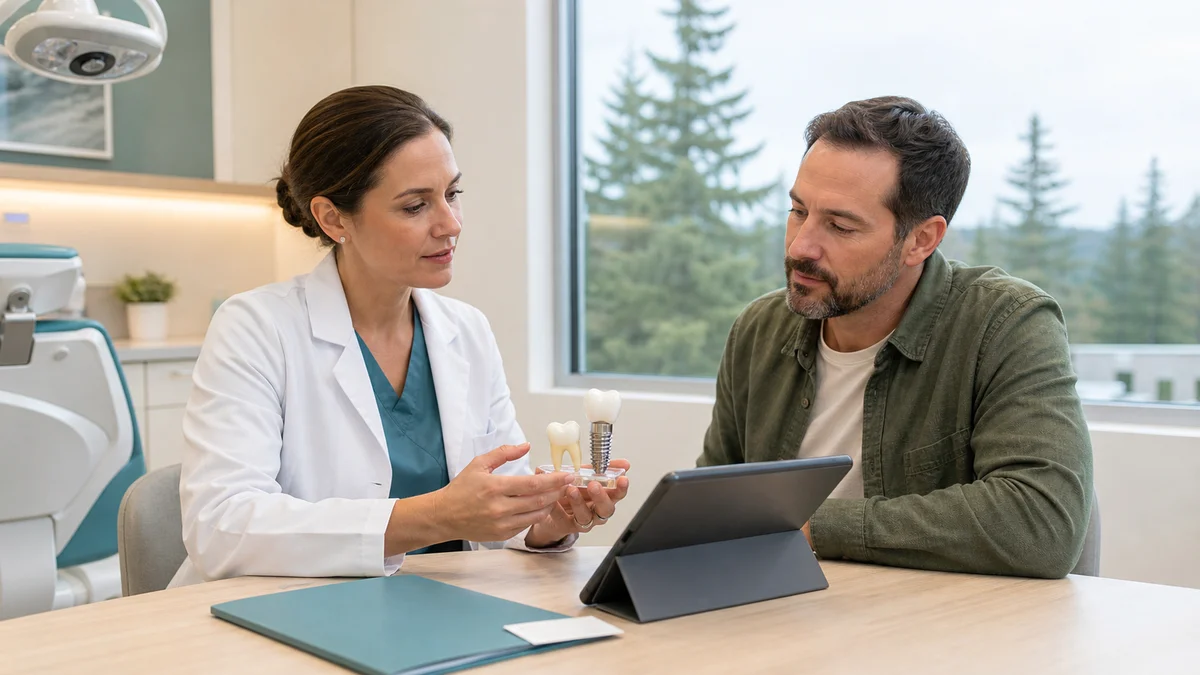
Quick answer: For most adults, the answer to does OHP cover dental implants is usually no for routine implant treatment because implants are not listed among standard OHP adult dental benefits. Coverage can differ by age, eligibility category, clinical need, plan, and written authorization. Ask your CCO or Open Card program for a service-specific decision before treatment.
If you are asking does OHP cover dental implants, you probably need more than a one-word answer. The Oregon Health Plan is Oregon’s Medicaid program, but “OHP” can involve different benefit packages, coordinated care organizations (CCOs), dental networks, and fee-for-service arrangements. A dentist may consider an implant clinically reasonable while the benefit administrator decides that a removable denture, bridge, or another covered service meets the funded need. Those are separate judgments.
The safest summary is that dental implants are not shown on the Oregon Health Authority’s current list of routine dental benefits for all members. That list includes examinations, X-rays, cleanings, fluoride varnish, fillings, extractions, stainless steel crowns on back teeth, full dentures at stated intervals, partial dentures at stated intervals, specialist care, and urgent or emergency care. Therefore, an adult searching does OHP cover dental implants should not assume payment merely because a dentist recommends an implant or sends a prior-authorization request.
There can still be important individual questions. Members under age 21 have federal Early and Periodic Screening, Diagnostic and Treatment (EPSDT) protections. Oregon also describes expanded benefits for qualifying Young Adults with Special Health Care Needs (YSHCN), generally ages 19–25. A traumatic injury, congenital condition, complex functional problem, or other medical context may require a case-specific review. This guide explains how to obtain that review without promising coverage, diagnosis, or a particular result.
Does OHP Cover Dental Implants for Most Adults?
For a typical adult member, does OHP cover dental implants is best answered as “generally not as a routine dental benefit.” The official OHP dental benefits page does not list implant placement, implant abutments, or implant-supported crowns among the standard services for all members. It does list conventional full and partial dentures, subject to frequency rules. That difference matters because a benefit program may fund restoration of chewing function while choosing a less costly covered method.
This is not the same as saying an implant is never clinically useful. The U.S. Food and Drug Administration explains that dental implants are surgically placed medical devices that may support a crown, bridge, or denture and can restore chewing. Clinical usefulness does not automatically establish Medicaid coverage. When a member asks does OHP cover dental implants, the plan must look at the member’s active package, age, delivery system, diagnosis, requested procedure codes, documentation, and applicable rules on the intended date of service.
In other words, does OHP cover dental implants is both a benefit question and a case-documentation question. Neither an advertisement nor another member’s outcome can replace the current written decision for your own record.
What the public benefit list establishes
The Oregon Health Authority’s member page is an authoritative starting point, not a personalized authorization. It establishes that OHP dental coverage exists and identifies common covered services. It also directs CCO members to their CCO and gives contact routes for members whose dental benefit is fee-for-service. If does OHP cover dental implants is your question, the page supports requesting a plan-specific answer rather than relying on an online estimate, office conversation, or verbal statement from someone who has not reviewed your eligibility.
Why “medically necessary” does not automatically mean paid
Oregon’s rules use standards such as medical necessity, dental appropriateness, favorable prognosis, practicality, and whether a less costly procedure can achieve the same ultimate result when prior authorization applies. A provider can document that replacing a tooth would improve function, but the payer may still determine that a covered removable prosthesis is an adequate alternative. So does OHP cover dental implants cannot be settled by the phrase “medically necessary” alone. The relevant service must also fit the member’s benefit and review criteria.
How OHP Dental Coverage Decisions Actually Work
A reliable answer to does OHP cover dental implants starts with identifying who administers your dental benefit. Most members receive care through a CCO, but some have Open Card, also called fee-for-service. A coverage letter shows the benefit package and which organization handles medical, dental, and behavioral health services. Two people who both say they have OHP may therefore need to call different organizations.
- Check active eligibility: confirm that your coverage is active on the planned date of each stage, not only on the consultation date.
- Identify the dental payer: read the coverage letter or call OHP Client Services to learn whether a CCO, dental plan, or OHA fee-for-service program decides the claim.
- Use an enrolled provider: ask whether the dentist, oral surgeon, restorative dentist, laboratory, and facility participate in the relevant network.
- Request exact codes: implant treatment may involve separate codes for imaging, extraction, grafting, implant body, abutment, crown, anesthesia, and follow-up.
- Obtain a written determination: a phone estimate is not the same as prior authorization, a claim decision, or a notice of denial.
CCO coverage versus Open Card
If your CCO covers dental care, its member services team and dental network are the first contacts for does OHP cover dental implants. If your dental care is Open Card, OHA’s fee-for-service rules and provider processes apply. Do not send the same question randomly to several dental networks. First confirm the organization listed for dental care on your coverage letter, then ask that organization for its current criteria and provider directory.
Prior authorization is not a payment guarantee
Oregon Administrative Rule 410-123-1160 expressly says that prior-authorization approval does not guarantee eligibility or reimbursement and that eligibility must be checked on each date of service. This is crucial because implant therapy can extend over months. Even if a reviewer approves one component, does OHP cover dental implants may still have a different answer for an abutment, final crown, bone graft, sedation, or a later service performed after eligibility changes.
Age and Eligibility Can Change the Answer
The member’s age and eligibility category deserve careful attention. Federal Medicaid rules require comprehensive dental services for most Medicaid-enrolled children and adolescents under 21 through EPSDT when services are medically necessary to correct or improve an identified condition. Oregon’s public materials also describe additional dental benefits for children ages 0–20 and qualifying YSHCN members ages 19–25. That does not make every implant payable, but it means does OHP cover dental implants should receive an individualized, clinically documented review rather than an adult-benefit assumption.
Members under age 21 and EPSDT
CMS states that EPSDT dental services must include relief of pain and infection, restoration of teeth, and maintenance of dental health, and that medically necessary coverable services may be required even if they are not in a state’s routine benefit list. Growth, jaw development, timing, long-term maintenance, and alternatives are especially relevant to implant decisions in younger patients. A treating team should decide clinical timing; an online answer to does OHP cover dental implants cannot substitute for pediatric or specialist assessment.
YSHCN, pregnancy, Veteran Dental, and COFA Dental
Qualifying YSHCN members may have expanded medically necessary and medically appropriate benefits. Pregnancy adds certain dental services, but the official OHP list does not turn pregnancy into automatic implant coverage. Veteran Dental and COFA Dental members receive the standard dental benefits for all members plus specified supports. In each category, ask does OHP cover dental implants with your exact enrollment type and service codes. Category membership alone is not authorization.
Dental Implant Coverage Decision Table
The following table is a decision aid, not a benefit determination. It shows why does OHP cover dental implants can lead to different next steps even when the desired restoration sounds similar.
| Situation | Likely coverage starting point | Best next action | Do not assume |
|---|---|---|---|
| Adult seeking a routine single-tooth implant | Implants are not listed as a standard adult OHP dental benefit | Ask the dental payer about exact codes and covered alternatives | That a dentist’s recommendation guarantees payment |
| Member under 21 with documented functional need | EPSDT requires individualized medical-necessity review | Have the treating provider submit complete clinical records | That age alone guarantees an implant |
| Qualifying YSHCN member ages 19–25 | Expanded benefits may affect review | Confirm YSHCN status and request a service-specific decision | That every expanded benefit includes every implant component |
| Tooth loss after trauma, disease, or congenital condition | Clinical context may justify specialist review | Document function, diagnosis, prognosis, alternatives, and codes | That a serious history overrides benefit rules automatically |
| Implant planned by an out-of-network or overseas clinic | OHP generally requires covered care in the United States from accepting providers | Get written payer guidance before paying or traveling | That reimbursement is available after self-payment |
| Prior request denied | Member notice and appeal rights may apply | Read the deadline, reason, criteria, and evidence instructions | That a verbal “no” is the final formal decision |
What Documentation Supports a Coverage Review?
Good documentation cannot create a benefit that does not exist, but it can help the reviewer apply the correct rule. If a provider submits only “implant needed,” the plan may lack information about function, alternatives, prognosis, and component codes. A strong submission addressing does OHP cover dental implants usually separates diagnosis from the requested treatment and explains why the proposal is practical and appropriate.
- Current examination findings, periodontal assessment, relevant medical history, and the cause and date of tooth loss.
- Diagnostic-quality radiographs or other imaging that the provider considers necessary.
- The functional problem, such as impaired chewing, instability of an existing prosthesis, pain, infection history, or a structural defect.
- Tooth numbers, jaw location, and every requested CDT or medical code, with units and expected dates.
- Prognosis for the proposed restoration and the condition of adjacent teeth, bone, and gums.
- Alternatives considered, including conventional denture, partial denture, fixed bridge, no immediate replacement, or staged care.
- A reason a lower-cost covered option would not achieve the same functional result, if that is the clinician’s evidence-based opinion.
- Separate estimates for surgery, implant component, abutment, restoration, grafting, anesthesia, imaging, maintenance, and potential revisions.
Ask the provider to keep the language factual. Statements such as “the only possible treatment” or “guaranteed to last” are rarely appropriate without robust evidence. The most defensible way to ask does OHP cover dental implants is to present the clinical record, alternatives, requested codes, and benefit criteria transparently.
Covered Alternatives When an Implant Is Not Funded
If the answer to does OHP cover dental implants is no for your case, that does not mean all restorative care is unavailable. OHP’s public benefit page identifies full dentures and partial dentures at specified intervals, along with fillings, certain crowns, extractions, specialist care, and urgent treatment. Exact eligibility and authorization still need confirmation, but a dentist can discuss which covered options are clinically suitable.
- Removable partial denture: may replace one or several missing teeth and can sometimes avoid surgery.
- Complete denture: may restore an edentulous arch when clinically appropriate and frequency requirements are met.
- Fixed bridge: may be considered in selected cases, although coverage, tooth condition, and preparation of adjacent teeth must be reviewed.
- Preserve a restorable tooth: periodontal, restorative, or endodontic treatment may sometimes avoid extraction, depending on prognosis.
- Staged disease control: treat infection, decay, or gum disease first, then reassess the definitive replacement plan.
No alternative is universally best. A removable denture involves adaptation and maintenance; a bridge may affect adjacent teeth; an implant requires surgery, healing, hygiene, and long-term monitoring. A patient asking does OHP cover dental implants should compare function, invasiveness, longevity uncertainty, repairability, and total personal cost—not only the initial appearance.
Get a Written Answer Before Treatment Begins
Coverage questions become harder after an extraction, graft, or implant is completed. Before consenting, ask the dental office for a written treatment plan with codes and ask the correct payer for a written benefit determination. If the office says “OHP should cover it,” request the authorization number, approved codes, service dates, provider names, and any conditions. For does OHP cover dental implants, “we checked benefits” is less useful than a document tied to your member record and proposed services.
- Read your current OHP coverage letter and record your benefit package and dental administrator.
- Ask your dentist for the diagnosis, proposed sequence, alternatives, exact codes, and itemized estimate.
- Call the number on your member card and ask whether each code is excluded, covered, or subject to prior authorization.
- Ask whether the surgeon, restorative dentist, facility, laboratory, and pharmacy are participating providers.
- Request the current clinical criteria and a written decision; keep dates, names, reference numbers, and copies.
- Do not schedule a non-urgent self-pay procedure until you understand financial responsibility.
Questions to ask member services
Use precise language: “For my active benefit package, does OHP cover dental implants under codes X, Y, and Z at this provider?” Then ask whether grafting, imaging, sedation, provisional teeth, abutments, crowns, and maintenance are separate decisions. Confirm whether a denial is based on exclusion, lack of medical necessity, missing documentation, network status, or another covered alternative. Each reason calls for a different response.
Questions to ask the dental team
Ask who is responsible for the surgical and restorative stages, what happens if integration is delayed, how smoking or uncontrolled diabetes may affect healing, what hygiene is required, and which components may need replacement. The FDA recommends keeping the implant brand and model information. These questions remain important even when does OHP cover dental implants receives a favorable preliminary answer because coverage and clinical outcome are not the same thing.
What to Do if OHP Denies the Request
OHP members have the right to a Notice of Adverse Benefit Determination when a service is denied or a level of service changes, plus information and help with appeals and hearings. Read the notice immediately. It should identify the decision, reason, effective date, and review route. Deadlines matter. A search for does OHP cover dental implants cannot tell you which deadline appears on your notice.
When reviewing that notice, repeat the exact question does OHP cover dental implants for the specific codes submitted, because a denial of one component does not necessarily describe every related service.
First, compare the denial with the actual request. Was the code wrong? Was documentation missing? Was the provider out of network? Did the reviewer find a covered alternative? Was eligibility inactive? Your provider may be able to submit records or correct a request, while you retain member rights. Do not alter clinical facts or exaggerate symptoms. A successful review, if any, should rest on accurate records and the applicable benefit standard.
Appeal versus a new or corrected request
An appeal challenges a decision; a corrected request addresses an error or missing information. Sometimes both possibilities deserve discussion with the plan and provider. When does OHP cover dental implants was denied because the benefit excludes the service for an adult, more clinical detail may not change the exclusion. When the denial says documentation was insufficient, targeted records may matter. Follow the notice and obtain qualified help rather than guessing.
Clinical Suitability Still Comes Before Financing
Coverage is only one part of informed consent. FDA guidance says overall health influences candidacy, healing time, and implant longevity. Smoking can impair healing. Uncontrolled diabetes, active local infection, untreated periodontal disease, inadequate hygiene, insufficient bone, and certain bite forces may change the plan or risk profile. Therefore, does OHP cover dental implants should never replace the question “Is this treatment safe and appropriate for me?”
A complete consultation keeps does OHP cover dental implants separate from the dentist’s clinical recommendation, so financial and health decisions can each be evaluated on their own evidence.
Implant treatment commonly includes assessment, disease control, possible extraction, healing, implant placement, integration, abutment, restoration, and maintenance. Not everyone needs every stage, and timing varies. Complications can include injury to nearby teeth or tissues, sinus or nerve involvement, infection, impaired cleaning, screw loosening, implant mobility, fracture, or the need for additional surgery. No ethical clinic should guarantee integration, longevity, or a complication-free result.
One “implant price” may hide several services
A quote may refer only to the fixture placed in bone, or it may include an abutment and crown. Imaging, extraction, grafting, temporary restoration, anesthesia, laboratory work, and follow-up can be separate. The coverage answer to does OHP cover dental implants may differ for each line. Request a component-by-component estimate and match it to the payer’s written response before comparing options.
Self-Pay, Travel, and Second-Opinion Considerations
OHA states that OHP generally covers services when they are in the member’s benefit package, medically necessary, supplied in the United States, and provided by professionals who accept the Oregon Health ID card. If you choose an out-of-network or overseas clinic, assume that OHP reimbursement is unavailable unless your payer confirms otherwise in writing. Asking does OHP cover dental implants after paying a deposit creates avoidable financial risk.
For an independent treatment discussion, you may review Redent Klinik’s English patient information and use the Redent Klinik contact page to request an individualized consultation. These links are not an OHP authorization route, and Redent Klinik cannot decide Oregon Medicaid benefits. Any international plan should include records transfer, implant system details, realistic healing time, emergency arrangements, and local long-term maintenance.
If a self-pay option is considered, compare the complete episode rather than a promotional starting figure. Include diagnostic visits, all surgical and restorative components, travel, accommodation, time away from work, medication, follow-up, repairs, and the possibility of additional care. The question does OHP cover dental implants should be resolved before financial commitments, but a “no” should not push anyone into rushed treatment or unsafe debt.
Warning Signs in Coverage and Implant Marketing
- A seller promises OHP payment without checking your current benefit package, codes, provider status, and written authorization.
- The quote calls everything “the implant” and does not separate fixture, abutment, crown, graft, imaging, anesthesia, and maintenance.
- A clinic guarantees success, permanence, painless treatment, or a fixed result before examination.
- You are pressured to pay a nonrefundable deposit before records, alternatives, risks, and responsibilities are clear.
- The provider discourages a second opinion or refuses to identify the implant brand and model.
- Financing is emphasized more than infection control, periodontal health, smoking, diabetes, hygiene, or follow-up.
- A verbal answer to does OHP cover dental implants is presented as if it were a formal benefit determination.
Frequently Asked Questions
Does OHP cover dental implants if my dentist says they are necessary?
A dentist’s recommendation is important clinical evidence but is not a payment decision. The plan may review whether the service belongs to your benefit, whether it is medically necessary and dentally appropriate, whether the prognosis is favorable, and whether a lower-cost covered option can achieve the required result. Ask the dental payer for a written, code-specific determination.
Does OHP cover dental implants after an accident?
Trauma can make the clinical need more complex, but it does not automatically create coverage. Document the accident, diagnosis, lost teeth, functional problem, prognosis, alternatives, and requested components. Age and eligibility category may matter. The plan must apply the current benefit rules to the individual request.
Does OHP cover dental implants for members under 21?
EPSDT provides broader protections for most Medicaid members under 21 and requires medically necessary coverable services to correct or improve identified conditions. That means individualized review is essential; it does not mean every implant request is approved. Growth, timing, alternatives, specialist evidence, and Oregon’s medical-necessity decision remain relevant.
Does OHP cover dental implants for YSHCN members?
Qualifying Young Adults with Special Health Care Needs may receive expanded medically necessary and medically appropriate services. Confirm that your YSHCN eligibility is active, then ask the responsible dental administrator about each proposed code. Do not infer implant coverage from YSHCN status alone.
Will prior authorization make the implant free?
No guarantee follows from a request, and Oregon’s rule says even an approval does not guarantee eligibility or reimbursement. Verify active eligibility, provider participation, approved codes, dates, limitations, and any member responsibility at every stage. Implant surgery and the final tooth may have separate decisions.
Can I pay first and ask OHP to reimburse me later?
That is risky. OHP generally uses participating providers and defined authorization and billing processes. Self-payment, out-of-network care, or care outside the United States may not be reimbursable. Obtain written guidance before paying, and never rely on a clinic’s informal assurance of later repayment.
What if OHP covers a denture but I prefer an implant?
You can discuss all clinically appropriate options and decide whether to pursue self-pay treatment, but first understand why the covered alternative was selected and the complete risks and costs of your preferred option. A personal preference does not necessarily require Medicaid to fund the more expensive treatment.
Who should I call for the definitive coverage answer?
Call the dental administrator shown in your current coverage letter or on your member card. CCO members should contact their CCO; Open Card members can use OHP Client Services or Care Coordination contacts listed by OHA. Provide exact procedure codes and provider information, and request the answer in writing.
Can a clinic guarantee my implant will last?
No responsible clinician can guarantee a biological or device outcome. Healing, hygiene, smoking, health conditions, bone and gum status, bite forces, maintenance, and unexpected complications all affect longevity. Ask about realistic benefits, risks, alternatives, product records, and the plan for managing complications.
Practical Bottom Line
For most adult members, does OHP cover dental implants is usually answered “not as a routine covered benefit.” The conclusion should remain conditional because the correct decision depends on the member’s age, eligibility group, active package, dental administrator, provider network, diagnosis, exact codes, documentation, and current rules. Members under 21 and qualifying YSHCN members deserve particular attention to broader protections.
Start with your coverage letter, an OHP-enrolled dentist, an itemized treatment plan, and a written benefit response. Compare covered alternatives without dismissing their advantages or limitations. If denied, read the notice and act within its deadlines. If you self-pay, separate every component and plan long-term maintenance. The safest answer to does OHP cover dental implants is the one documented for your own member record—not a promise from a webpage.
Recheck does OHP cover dental implants whenever eligibility, provider, codes, or treatment dates change.
Keep the written answer to does OHP cover dental implants with your treatment records.
Sources and Current Rules
- Oregon Health Authority: OHP Dental Benefits
- Oregon Health Authority: OHP Benefits and Coverage Conditions
- Oregon Secretary of State: Current Dental and Denturist Services Rules
- Oregon Health Authority: Understanding the OHP Coverage Letter
- Oregon Health Authority: Coordinated Care Organizations
- Oregon Health Authority: OHP Member Rights
- Oregon Health Authority: Appeals and Hearings
- Centers for Medicare & Medicaid Services: Dental Care
- Centers for Medicare & Medicaid Services: EPSDT
- U.S. Food and Drug Administration: Dental Implants—What You Should Know
- American Dental Association
- World Health Organization: Oral Health Fact Sheet