
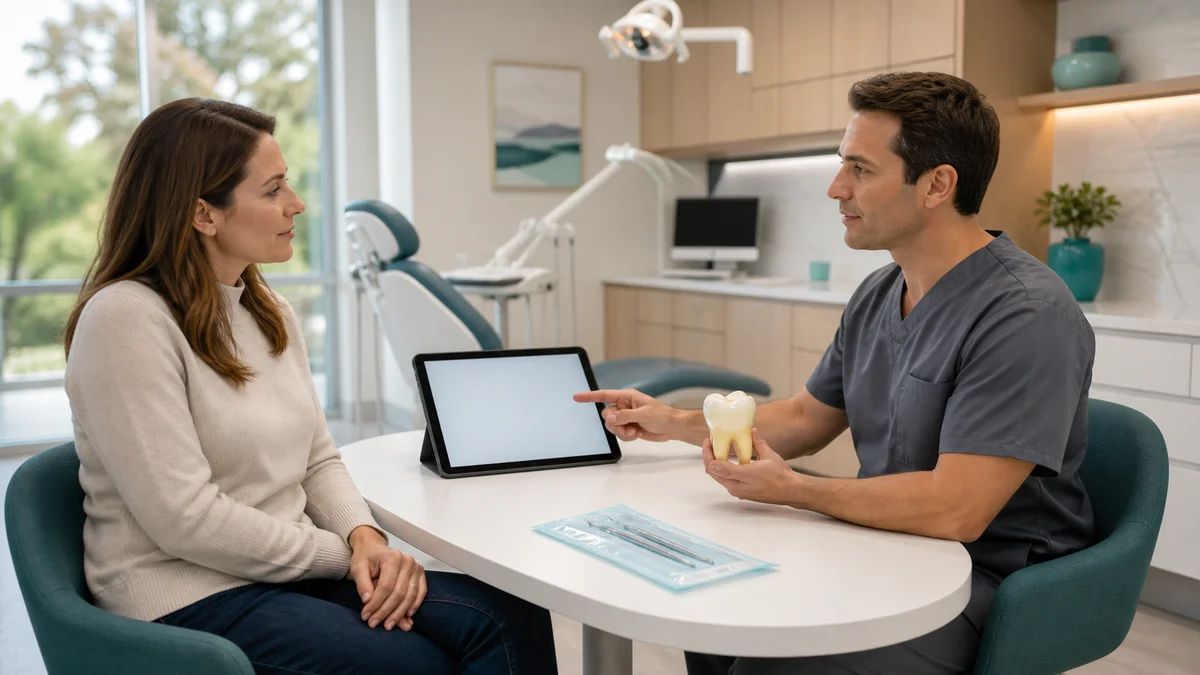
Quick answer: Choose a dentist in arlington tx by confirming an active Texas license, matching the office to your clinical needs, and requesting a written, itemized care plan. Ask about infection prevention, urgent-care access, records, sedation permits, and insurance estimates. Treat reviews as context—not proof of clinical quality—and seek prompt care for warning signs.
Searching for a dentist in arlington tx can feel simple until dozens of practices, insurance labels, promotional offers, and review scores appear. The safest choice is rarely the office with the loudest claim. It is the practice that can explain who will examine you, how findings are supported, which alternatives exist, what the likely costs are, and what happens if your symptoms change. This guide offers a practical framework for comparing local providers without diagnosing you or ranking individual clinicians.
Dental needs also differ. A routine cleaning, a broken tooth, persistent pain, implant planning, care for a child, and treatment under sedation require different questions. A suitable dentist in arlington tx for preventive care may appropriately refer a complex surgical or medical case. A referral is not a failure; it can be evidence that the clinician recognizes the limits of the setting and puts safety first.
This information is educational and cannot replace an examination. If you have trouble breathing or swallowing, rapidly increasing facial or neck swelling, uncontrolled bleeding, severe trauma, confusion, or another potentially life-threatening problem, call 911 or seek emergency medical care. Do not delay urgent help while comparing websites, prices, or appointment slots.
1. Define what you need from a dentist in arlington tx
Start by describing the reason for your visit in plain language. “Checkup” is different from “a tooth broke yesterday,” “my gums bleed,” or “I want to discuss replacing several missing teeth.” The person scheduling you should understand whether the request is preventive, urgent, restorative, cosmetic, surgical, or related to a previous treatment. They may not diagnose you by phone, but they should be able to explain the practice’s scope and the appropriate appointment type.
When you call a dentist in arlington tx, a concise description of your goal helps the team reserve enough time and route urgent symptoms appropriately.
Consider practical needs as well. Do you need step-free access, interpretation, early or late appointments, a quiet environment, help transferring to the chair, or coordination with a physician? Ask before booking. A good dentist in arlington tx should welcome relevant medical information and be clear about accessibility rather than leaving you to discover barriers on arrival.
- Routine prevention: examination, risk-based radiographs when indicated, cleaning, gum assessment, and a recall plan.
- New symptoms: focused examination of pain, swelling, sensitivity, trauma, bleeding, or a broken restoration.
- Complex treatment: additional records, specialist input, phased planning, and time to consider alternatives.
- Sedation or special health needs: medication review, appropriate permits, emergency preparation, and individualized instructions.
- Second opinion: copies of existing images and plans so the consultation adds information instead of repeating tests without reason.
2. Know when the search for a dentist in arlington tx should become urgent
Dental pain can be intense without being life-threatening, but certain combinations of symptoms need prompt assessment. Call a dental office and describe the onset, location, swelling, fever, trauma, bleeding, and any difficulty eating, drinking, breathing, or swallowing. Do not place aspirin or caustic substances against the gums, and do not take someone else’s antibiotics. Medication and treatment choices depend on your health, allergies, examination, and diagnosis.
A dentist in arlington tx should have a clear process for urgent calls during business hours and explain what established patients should do after hours. Ask whether the office reserves emergency time, which hospital or specialist network it uses when escalation is needed, and how post-treatment concerns are triaged. “Emergency appointment” may mean an assessment and stabilization rather than completion of all definitive treatment on the same day.
For a knocked-out permanent tooth, serious facial injury, uncontrolled bleeding, or rapidly progressing swelling, time can matter. Call an appropriate dental or medical service immediately for instructions. A primary tooth should not be replanted by a parent. Because circumstances vary, direct professional guidance is safer than a generic online remedy.
Save the after-hours instructions from your dentist in arlington tx before an urgent problem occurs, especially when treatment is already underway.
3. Verify the Texas license of a dentist in arlington tx
Before relying on a biography or directory badge, use the Texas State Board of Dental Examiners online license search. Search the clinician’s legal name and check the profession, license number, current status, and available public information. The Board says its licensee database is updated daily and may include disciplinary action and certain sedation-related permit information. A similar name is not enough; match the record to the practitioner and office you intend to visit.
Confirm which dentist in arlington tx will actually perform the examination or procedure. A practice brand may include several clinicians, and the provider who appears on the homepage may not be the person scheduled. Ask for the treating dentist’s full name in advance. If a hygienist, dental assistant, laboratory, or visiting specialist will participate, the office should be able to explain each person’s role and supervision.
Licensure is a necessary baseline, not a promise of a particular outcome. Training, communication, case selection, current competence, facilities, and follow-up also matter. Conversely, a public complaint alone does not automatically establish wrongdoing. Use official records carefully and ask neutral questions when you need context.
Recheck the record if your dentist in arlington tx changes between consultation and procedure, because each treating clinician has a separate license history.
4. Match the clinician’s scope to the proposed care
General dentists provide a broad range of preventive and restorative services, but no office must perform every procedure. For complex root canal therapy, gum disease, oral surgery, orthodontics, pediatric care, oral medicine, or prosthetic rehabilitation, ask whether the dentist routinely manages similar needs and when the practice refers. Marketing phrases such as “expert,” “implant center,” or “smile specialist” should not substitute for a clear description of qualifications and scope.
A thoughtful dentist in arlington tx should be comfortable explaining whether another clinician’s opinion could help. Ask who will handle complications, whether an outside specialist reviews images, and how records move between offices. If the plan involves several disciplines, identify who coordinates sequencing. The right order can affect healing, temporary restorations, gum stability, bite, and the ability to maintain the result.
Also distinguish a consultation from consent to treatment. The American Dental Association’s practice guidance notes that a signed treatment plan can document understanding without obligating a patient to proceed. You should have the opportunity to ask about the diagnosis, expected benefits, material risks, reasonable alternatives, and the consequences of delaying or declining care.
Ask the dentist in arlington tx whether referral would change the diagnosis, technique, setting, or management of risk in your particular case.
5. Ask a dentist in arlington tx how the first examination works
A comprehensive first visit normally begins with medical and dental histories. Share medications, allergies, pregnancy, tobacco or nicotine use, bleeding conditions, diabetes, immune problems, heart conditions, prior reactions to anesthesia, sleep apnea, and relevant surgeries. Do not stop prescribed medicine because of a website. The dentist may need to consult the prescriber or modify the appointment, but changes should be individualized.
The examination should connect observations to recommendations. Depending on your needs, it may include the teeth, existing restorations, gums, bite, jaw function, soft tissues, oral cancer screening, and symptoms. Radiographs are not automatically identical for every patient. Their selection should reflect age, history, findings, disease risk, prior images, and the clinical question. Ask why an image is recommended and whether usable recent records can be transferred.
When a dentist in arlington tx presents a diagnosis, ask to see the relevant image, photograph, charting, or examination finding when practical. Evidence should be explained in language you understand. Some conditions can be monitored; others are more time-sensitive. A good discussion separates what is known, what remains uncertain, and what additional test or referral could change the plan.
Your dentist in arlington tx should also explain how your medical history changes the examination, prevention plan, or need to coordinate with another clinician.
6. Compare treatment plans, not promotional labels
Two appropriate plans can differ because clinicians weigh preservation, predictability, invasiveness, timing, maintenance, and patient priorities differently. Ask each dentist in arlington tx to identify the immediate problem, long-term risk, alternatives, and staging. If one plan is dramatically larger than another, a second opinion can clarify whether the difference reflects diagnosis, philosophy, incomplete records, or a different goal.
An itemized written plan should identify the teeth or areas involved, procedures, sequence, estimated number of visits, expected healing or laboratory time, and likely need for temporary work. It should also state what is not included when that matters—for example, specialist fees, future maintenance, imaging, grafting, anesthesia, or replacement of a temporary restoration. A plan is an estimate based on current information; findings during care can require revision, but changes should be discussed before proceeding whenever circumstances permit.
Keep the dated plan from each dentist in arlington tx so that a second-opinion comparison uses the same teeth, goals, and treatment stage.
- What finding supports each recommended procedure?
- What are the reasonable alternatives, including monitoring or referral?
- Which part is urgent, and which part can be phased?
- What benefits and important risks should I understand?
- Who performs each stage, and who provides follow-up?
- What home care and maintenance will the result require?
- What could change the estimate or the treatment sequence?
7. Evaluate infection prevention at a dentist in arlington tx
The Centers for Disease Control and Prevention describes Standard Precautions as the minimum infection-prevention practices for all patient care in dental settings. These include hand hygiene, appropriate personal protective equipment, respiratory hygiene, sharps safety, safe injection practices, sterile instruments and devices, and cleaned or disinfected environmental surfaces. You do not need to inspect an autoclave, but you can ask how the office processes instruments and monitors sterilization.
Look for consistent behavior rather than staged perfection. Team members should perform hand hygiene at appropriate times, change gloves between patients, and avoid touching clean drawers, phones, or charts with contaminated gloves. Reusable instruments that enter tissue or contact bone require appropriate sterilization. Treatment surfaces should be protected with barriers or cleaned and disinfected between patients according to their use and the product instructions.
A credible dentist in arlington tx should answer infection-control questions without dismissing them. Ask who coordinates the program, how new staff are trained, how sterilization cycles are monitored, and how the practice responds to a failed indicator or exposure. A sealed pouch is not by itself proof that every step was followed, but an organized, explainable system is a positive sign.
Tell the dentist in arlington tx promptly if you notice a barrier breach or have a concern; the team should pause, replace contaminated items, and explain the response.
8. Check sedation permits and emergency preparation
“Sedation dentistry” is not one uniform service. Minimal sedation, nitrous oxide, oral medication, moderate sedation, deep sedation, and general anesthesia have different effects, monitoring needs, and regulatory requirements. Ask the proposed level, who administers it, who monitors you, and what permit or privilege applies. Verify available permit information through the Texas dental regulator rather than relying only on an advertising page.
Before sedation, a dentist in arlington tx should review health history, current medicines, allergies, prior anesthesia problems, sleep apnea, pregnancy status where relevant, and transportation arrangements. Follow individualized fasting and medication instructions exactly. Never assume that instructions for one procedure or person apply to another. If you do not understand whether to take a prescribed medicine, ask both the dental team and the prescriber as directed.
Ask about monitoring, oxygen and emergency equipment, staff training, discharge criteria, written home instructions, and the responsible adult escort required for the planned technique. Texas dental rules include requirements related to emergency policies and procedures. A prepared office cannot eliminate all risk, but it should be able to describe how it recognizes deterioration, stabilizes a patient, activates emergency medical services, and documents follow-up.
Do not book sedation with a dentist in arlington tx until the planned level, permit pathway, health review, monitoring, and ride-home rules are clear.
9. Make costs and insurance estimates understandable
Insurance participation and clinical need are separate questions. A plan may limit frequency, apply waiting periods, exclude a material, use an alternate-benefit provision, or pay only up to an annual maximum. “Covered” rarely means “free.” Ask the practice and your insurer to explain the network status of the specific treating dentist, deductible, coinsurance, remaining annual maximum, frequency rules, missing-tooth clauses if applicable, and whether a pretreatment estimate is useful.
Request an itemized estimate from the dentist in arlington tx before non-urgent treatment. It should separate expected insurer payment, patient portion, and services that may not be covered. Treat it as an estimate rather than a guarantee; the insurer makes the final benefit determination under the plan, and clinical findings may change. Ask how credits, refunds, financing, deposits, cancellations, laboratory charges, and plan revisions are handled.
Discuss finances in a private, unhurried setting rather than while reclined for treatment. Do not let an expiring promotion replace informed consent. A lower initial price may omit diagnostics, anesthesia, temporary work, laboratory fees, maintenance, or management of complications. A higher estimate is not automatically better either. Compare the same scope, materials, provider, follow-up, and contingency plan.
Ask the dentist in arlington tx to revise the written estimate when the scope changes, then reconfirm benefits and your expected portion before non-urgent work continues.
10. Use this dentist in arlington tx decision table
| Situation | First question | Evidence to request | Reasonable next step |
|---|---|---|---|
| Routine preventive visit | How are examination, gum assessment, images, and cleaning tailored to risk? | Written recall plan and reason for any radiographs | Book when scope, access, and estimate are clear |
| Pain, swelling, or broken tooth | How quickly can the office assess urgency? | Focused findings, diagnosis, stabilization and definitive options | Seek prompt assessment; escalate emergency warning signs |
| Several restorations or smile changes | Which problems are disease control and which are elective? | Itemized phased plan, alternatives, photographs or records | Consider a second opinion before irreversible care |
| Surgery or sedation | Who performs and monitors the procedure? | License, applicable permit, written instructions, emergency plan | Proceed only after individualized health review and consent |
| Child or special health-care needs | What accommodations and behavior-support options are available? | Care setting, referral thresholds, caregiver instructions | Select the setting that can meet medical and communication needs |
The table is a conversation aid, not a scorecard. A dentist in arlington tx may reasonably recommend a different pathway after examining you. The key is whether the recommendation is supported, understandable, proportionate to the problem, and accompanied by an appropriate follow-up plan.
Use the table consistently for every dentist in arlington tx you consult so that convenience or price does not hide a difference in clinical scope.
11. Test communication and informed consent
Good communication is clinical safety. You should know what will happen before treatment begins and have a chance to ask questions. If you need an interpreter, accessible format, support person, sensory accommodation, or extra time, ask how the office handles it. Children and adults with limited decision-making capacity still deserve age- and ability-appropriate explanations while the legally authorized person participates in consent.
A dentist in arlington tx should distinguish routine consent forms from a real conversation. Forms cannot predict every possibility, but the clinician should discuss the nature of the proposed procedure, expected benefits, important risks, alternatives, and what may happen without treatment. You can ask for time to decide when the situation is not urgent. You can also withdraw consent, although stopping in the middle of a procedure may require safe stabilization.
Notice how the team responds to uncertainty. “I need to examine you first,” “I want another image,” or “this is better managed by a specialist” can be responsible answers. Be cautious when a clinician guarantees a result, minimizes every risk, attacks another provider without adequate records, or pressures you to accept irreversible treatment immediately.
A dentist in arlington tx who checks your understanding and documents your preferences is creating a safer foundation for shared decisions.
12. Plan records, referrals, and continuity of care
Dental records support continuity when you change offices or see a specialist. Texas rules describe records broadly, including histories, examinations, radiographs, periodontal charting, diagnoses, treatment plans, consent, anesthesia records, laboratory reports, progress notes, materials, referrals, post-treatment recommendations, and billing information where applicable. Ask how to request copies, where they are sent securely, and whether any administrative fee applies.
When transferring to a new dentist in arlington tx, request records early. Images may need compatible file formats, and a new provider must decide whether existing records answer the current clinical question. Old or incomplete images may not eliminate the need for new ones. Still, sharing usable material can reduce duplication and help the clinician understand earlier findings, treatment, and complications.
If care spans several offices, clarify ownership of follow-up. Who checks healing after surgery? Who adjusts a restoration? Who responds if a temporary breaks? Who monitors implants, periodontal health, orthodontic retention, or recurrent decay long term? A handoff should include records, a clear question for the receiving clinician, and a route for both offices to communicate.
13. Read reviews of a dentist in arlington tx cautiously
Reviews can reveal patterns in scheduling, courtesy, billing communication, accessibility, and how a practice handles concerns. They cannot verify a diagnosis, sterilization process, technical quality, or whether another person’s treatment was appropriate. Extreme praise and extreme criticism both lack the clinical context, medical history, records, and consent discussion required for a fair judgment.
Look for repeated operational themes across time and platforms, then verify important claims directly. A dentist in arlington tx should not disclose private patient details to win an online argument. A restrained response that invites the reviewer to contact the office may reflect privacy obligations, not indifference. Similarly, before-and-after photos show selected outcomes and should never be treated as a promise that your anatomy or response will match.
Use official sources for licensure and public regulatory information. Use the consultation to judge whether the dentist listens, explains evidence, respects questions, and avoids pressure. The strongest signal is a coherent process that remains professional even when the answer is “no,” “not yet,” or “we should refer.”
14. Recognize practical and clinical warning signs
No single inconvenience proves unsafe care, but several unresolved concerns should slow the decision. Ask for clarification and consider another opinion before irreversible treatment. For urgent symptoms, do not let concerns about one office prevent you from seeking timely help elsewhere.
- The treating dentist’s identity or active Texas license cannot be confirmed.
- The office guarantees a cure, lifetime result, painless experience, or insurance payment.
- A large plan is presented before an adequate history, examination, or explanation of findings.
- Alternatives, meaningful risks, referral, or time to consider are dismissed.
- Sedation level, administrator, monitoring, permit, escort, or emergency process is vague.
- Team members cannot explain basic instrument processing or standard infection precautions.
- Fees are bundled so tightly that you cannot tell what is included or excluded.
- Requests for usable records or communication with another clinician are obstructed without a clear lawful reason.
- After-hours and post-procedure instructions do not explain whom to contact or when to escalate.
If you believe care by a dentist in arlington tx raises a professional or safety issue, first seek any urgent clinical help you need. Then preserve records, estimates, messages, and dates. The Texas State Board of Dental Examiners accepts complaints within its jurisdiction, including concerns about quality of care, sanitation, professional conduct, patient abandonment, and unlicensed practice. The Board states that it does not resolve ordinary fee disputes, and its complaint process is not anonymous. Insurance and billing concerns may have separate routes.
15. Prepare a new-patient checklist
Bring a current medication list, allergy information, relevant diagnoses, physician contacts when needed, insurance details, photo identification, and the names of previous dental offices. Write down symptoms, when they began, what makes them better or worse, and any prior treatment. If anxiety makes it hard to remember information, bring questions or ask whether a support person may attend.
Confirm the address, parking or transit route, and check-in time with the dentist in arlington tx. Tell the dentist in arlington tx about communication or mobility accommodations before arrival.
Before leaving the first visit with a dentist in arlington tx, make sure you understand the findings, immediate priorities, alternatives, next appointment, home-care instructions, and estimated fees. Ask how to reach the office if pain, swelling, bleeding, a reaction, or a temporary problem occurs. Obtain written instructions after procedures, especially when sedation, extraction, surgery, or medication is involved.
After the visit, consider whether the explanations matched the records and whether you felt able to ask questions. Comfort matters, but a pleasant environment cannot replace sound assessment. Equally, a conservative recommendation or referral may be more valuable than an impressive same-day sales presentation.
16. Comparing Arlington care with treatment elsewhere
This guide is about selecting a local dentist in arlington tx; Redent Clinic does not present itself here as an Arlington provider. Some readers also compare treatment in another city or country. That decision requires extra planning for travel, medical fitness, records, regulatory jurisdiction, staged procedures, laboratory timing, and management of complications after returning home.
If you are independently researching international dental care, you may review the Redent Clinic English information pages and use the English contact page to ask who would perform care, what an individualized assessment requires, and how follow-up would be coordinated. These links are not a substitute for verifying a local Texas clinician, and no travel decision should be based on a generic online estimate or outcome promise.
Wherever treatment occurs, request a written diagnosis, itemized plan, provider credentials, material information, images, consent documentation, medication instructions, and a record-transfer process. Ask who manages an emergency at each stage. Complex care is safer when local and remote clinicians can communicate rather than when the patient must translate an incomplete plan between them.
17. Frequently asked questions about a dentist in arlington tx
How do I verify a dentist in arlington tx?
Use the Texas State Board of Dental Examiners online license search and match the clinician’s full legal name to the profession, license number, status, and office information. Confirm the name of the person who will treat you, not only the practice brand. Review available public actions in context and ask the office for clarification when necessary.
Does “in network” mean a dentist in arlington tx is the best clinical match?
No. Network participation affects contracted fees and benefit calculations, not whether a particular clinician or setting fits your diagnosis, health, communication needs, or procedure. Confirm the network status of the specific provider, then evaluate scope, evidence, informed consent, safety systems, and follow-up separately.
Should every new patient receive the same X-rays?
No universal set suits every patient. Image selection should reflect age, symptoms, examination, disease risk, previous care, and the availability and quality of recent images. Ask what clinical question each image will answer. A dentist must still decide whether transferred records are current and adequate for your situation.
Can a dentist in arlington tx guarantee an implant, crown, or cosmetic result?
Responsible clinicians can discuss expected benefits, limitations, maintenance, and factors that influence prognosis, but they should not promise a biological or cosmetic outcome. Healing, disease risk, habits, anatomy, materials, bite forces, home care, and future events vary. Ask how complications are detected and managed rather than accepting a guarantee.
When is a second opinion useful?
Consider one before extensive, irreversible, elective, or unexpectedly costly care; when plans differ substantially; or when the diagnosis and alternatives remain unclear. Bring records and ask the second clinician to identify points of agreement, uncertainty, and evidence. Do not delay urgent assessment for infection, trauma, or dangerous swelling.
What should I ask before dental sedation?
Ask the exact sedation level, administrator, applicable permit, monitoring, health-screening process, fasting and medication instructions, escort requirements, emergency equipment, discharge criteria, and after-hours contact. Verify available Texas permit information. Instructions must be personalized; never copy another patient’s medication or fasting plan.
What if I cannot afford the entire treatment plan?
Ask which care is urgent, which can be phased, and whether less costly clinically reasonable alternatives exist. Request an itemized estimate and check benefits directly with the insurer. Discuss financing terms, deposits, and refund policies carefully. Delaying care can change options, so ask the dentist to explain the likely consequences of each timeline.
Where can I report a serious concern about a dentist in arlington tx?
First obtain urgent medical or dental help if safety is at risk. For professional concerns within its jurisdiction, review the Texas State Board of Dental Examiners complaint process and preserve relevant records. The Board states that it addresses issues such as care quality, sanitation, conduct, abandonment, and unlicensed practice, but not ordinary fee disputes.
18. Final choice: favor verifiable process over promises
The best dentist in arlington tx for you is not determined by one rating, one discount, or one piece of equipment. Look for an active license, a scope that matches your needs, an evidence-based examination, understandable consent, an itemized plan, transparent estimates, dependable infection prevention, appropriate sedation safeguards, accessible records, and a workable emergency pathway.
You do not need perfect certainty before a first visit. You need enough information to choose a credible setting, describe your needs accurately, and ask useful questions. After the examination, the clinician should earn confidence through evidence, proportional recommendations, respect for your priorities, and willingness to coordinate or refer. That process is far more informative than any promise of a fast, painless, permanent, or universally affordable result.
Keep this checklist when comparing a dentist in arlington tx, and update it when your symptoms, insurance, medicines, or treatment goals change.
Authoritative sources
- Texas State Board of Dental Examiners — license search and regulatory resources
- Texas State Board of Dental Examiners — licensee data and available permit information
- Texas State Board of Dental Examiners — complaint jurisdiction and process
- Texas State Board of Dental Examiners — recent rule adoptions
- U.S. Centers for Disease Control and Prevention — Standard Precautions in dental settings
- American Dental Association — treatment-plan communication and acceptance
- American Dental Association — dental benefit plans and treatment planning
- World Health Organization — oral health fact sheet