
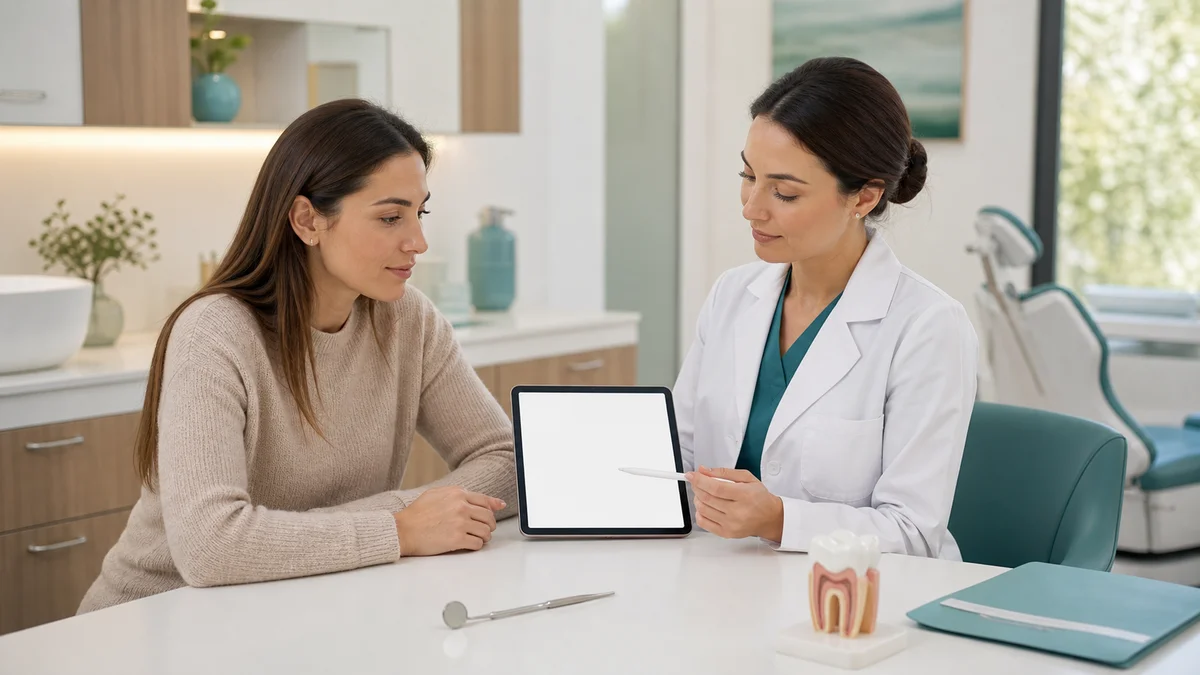
Quick answer: Choose a local dental clinic by verifying the treating dentist, first-visit scope, urgent-care route, accessibility, written fees, consent process, records and follow-up—not by map position alone. For rapidly increasing facial swelling, breathing or swallowing difficulty, major injury or uncontrolled bleeding, seek urgent medical or dental help instead of comparing routine appointments.
Searching clinic dentist near me can produce a convenient list in seconds, but a map result cannot decide whether a clinic fits your health needs. Distance, opening hours and reviews are useful screening details. They do not confirm who will examine you, whether that person is registered, what the first appointment includes, how the clinic handles an unexpected finding or whether you can obtain your records later.
This guide turns a broad local search into a patient-safety decision. It is educational, not a diagnosis or a personal treatment recommendation. Toothache, swelling, sensitivity, bleeding gums and jaw discomfort can have different causes; a clinician needs a history and examination to distinguish them. No checklist can guarantee an outcome, but careful questions can reveal whether a clinic communicates clearly, works within an appropriate scope and supports continuity.
The World Health Organization describes major oral conditions as largely preventable and often treatable in their early stages. That makes a dependable “dental home”—a practice you can return to for prevention, assessment and coordination—more valuable than a one-off promotional offer. Use the following 17 checks for a routine first appointment, a new symptom, a family member or a planned procedure.
1. Define what you need from a clinic dentist near me
Before ranking clinics, write one sentence describing why you need care. “New-patient examination with no current symptoms,” “persistent pain in a lower tooth,” “second opinion about a crown,” “child’s first visit” and “assessment for an implant” require different appointment lengths, clinicians and equipment. A receptionist can only book the right pathway if the concern is described honestly.
A clinic dentist near me should ask when symptoms began, whether they are worsening, whether swelling, fever, injury or bleeding is present and what previous treatment or imaging exists. The team should not promise a diagnosis or specific procedure from a call, photograph or chat message. It can explain whether the clinic normally manages that type of concern, who would assess it and how quickly it should be seen.
Separate your non-negotiables from preferences. Wheelchair access, an interpreter, allergy precautions or a clinician experienced with a particular medical condition may be essential. Evening hours, parking and a quiet waiting area may be preferences. This distinction prevents a high review score from outweighing a need that affects safe attendance.
2. Know when clinic dentist near me should become urgent
Do not spend hours comparing ordinary listings when symptoms suggest urgent care. The NHS advises urgent dental assessment for severe or persistent tooth or mouth pain, a knocked-out tooth or other dental injury, worsening swelling or a persistent lump or patch, significant symptoms after an extraction, and broken or loose restorations. Local pathways and response times vary, so use the urgent service for your location.
A clinic dentist near me is not a substitute for emergency medical care. Serious facial or jaw injury, heavy bleeding that will not stop, loss of consciousness, or severe swelling affecting breathing, swallowing, the throat, neck or eyes warrants emergency assessment. Call the appropriate emergency number where you are rather than driving yourself if you are unwell.
When calling, describe severity and progression—not only “I have toothache.” Mention fever, recent procedures, pregnancy, allergies, medicines, immune suppression, diabetes or anticoagulants when relevant. Do not take leftover antibiotics or another person’s medicine. Pain relief, antibiotics and definitive dental treatment serve different purposes, and a qualified professional should decide what is appropriate.
3. Verify the people behind a clinic dentist near me
Record the full professional name of the dentist expected to examine you. Check that person in the official dental register or licensing board for the jurisdiction where treatment will occur. Confirm current status and, when a specialty is advertised, whether the register recognises that specialty. A clinic biography, influencer profile or booking-platform badge is not an independent credential check.
Ask a clinic dentist near me who will take the history, conduct the examination, make the diagnosis and perform any later procedure. Dentists, hygienists, therapists, assistants and specialists have different training and legally defined scopes that vary by country. A well-run clinic identifies those roles without implying that every team member is a dentist.
The American Dental Association’s patient guidance suggests using professional directories, local dental societies and trusted healthcare professionals to build a shortlist. A directory is a starting point, not a guarantee of suitability. Verify the person and facility independently, especially if the clinic has several branches or visiting clinicians.
4. Confirm the exact location of a clinic dentist near me
Similar clinic names, duplicate map pins and multiple branches can cause mistakes. Match the official practice name, address, telephone number and website. Confirm that the appointment is at the facility you researched and ask whether diagnostic records can be viewed at another branch if care moves between sites.
For a clinic dentist near me, practical access matters because good care often requires more than one visit. Test the actual journey at the appointment time. Consider public transport, parking, stairs, lifts, wheelchair routes, restroom access, weather, work commitments and the ability to return after a procedure if you should not drive.
Convenience is clinically useful when it improves attendance and follow-up. It is not proof of clinical quality. A slightly farther clinic with verified personnel, appropriate access and reliable follow-up may be a better fit than the closest door. Conversely, a distant premium facility may be impractical for maintenance that must occur repeatedly.
5. Ask what the first clinic dentist near me visit includes
A new-patient visit commonly begins with medical and dental histories, current medicines, allergies, previous care, symptoms and goals. The clinical examination may include teeth, gums, bite, soft tissues, jaw and oral-cancer screening, depending on the appointment and patient. The ADA’s patient resource explains that radiographs are considered according to the treatment plan and findings; they are not identical for every person.
Before attending a clinic dentist near me, ask whether the booking is a full examination, problem-focused urgent visit, consultation or hygiene appointment. Those labels are not interchangeable. An urgent appointment may focus on pain and immediate risk, while a comprehensive visit may require more time and records. Confirm whether treatment is normally performed the same day or discussed after assessment.
Bring a current medicine list and relevant medical details. Arrange transfer of recent radiographs if the receiving dentist wants them; the dentist must decide whether their date, quality and coverage answer the current question. Expect an explanation when new imaging is recommended. “It is our standard package” is less informative than a reason linked to your history and examination.
6. Judge communication at a clinic dentist near me
Good communication is part of safe care. The clinician should explain findings in plain language, distinguish observation from diagnosis and acknowledge uncertainty. You should be able to ask what happens if you wait, what alternatives exist and what would change the recommendation. A professional answer can be cautious without being vague.
During a clinic dentist near me consultation, notice whether the team listens before presenting a solution. The ADA describes patients and dentists as partners in oral health. Partnership means your medical history, preferences, anxiety, budget and long-term ability to maintain a result are considered—not that the patient chooses a procedure without clinical guidance.
If you use another language, ask for a competent interpreter and translated written information where available. A friend may offer emotional support but may not accurately translate risks or technical terms. Accessibility also includes hearing, vision, cognitive, sensory and communication needs. Tell the clinic in advance so adequate time and support can be arranged.
7. Compare services at a clinic dentist near me without package bias
A general dental clinic may provide prevention, restorations, gum care, root-canal treatment, extractions, prosthetic care and cosmetic services, but no clinic must provide everything. Complex care may require an endodontist, periodontist, oral surgeon, orthodontist, pediatric dentist or medical colleague. Referral can be a sign of appropriate boundaries.
Ask whether the clinic dentist near me routinely assesses your concern, what it manages in-house and where it refers beyond its scope. If several clinicians participate, ask who owns the overall plan, who reviews healing and who receives urgent calls. A long menu of technologies is less useful than a clear care pathway.
Be cautious when a clinic promises a single branded technique, “permanent” result or universal same-day solution before examination. Treatment suitability depends on diagnosis, anatomy, oral hygiene, disease activity, medicines, medical risk, patient preferences and maintainability. Equipment can support care; it does not replace judgement or informed consent.
8. Use this clinic dentist near me decision table
Apply the same questions to two or three candidates. The table is a comparison aid, not a clinical rating or guarantee. A missing detail is a prompt to clarify, while repeated resistance to basic questions is a reason to pause.
| Decision point | Reassuring information | Clarify or pause |
|---|---|---|
| Identity | Full clinician name, role and verifiable registration | Only a brand name or unnamed “expert” |
| First visit | Appointment type, history and examination scope explained | Procedure promised from a message or photograph |
| Diagnostics | Images or tests selected for a stated clinical reason | Mandatory premium diagnostics for every patient |
| Options | Benefits, material risks, alternatives and delay discussed | Only the highest-cost package presented |
| Fees | Itemised estimate, inclusions and change process | Pressure to prepay before assessment |
| Urgent access | Clear triage and out-of-hours instructions | No route if symptoms worsen |
| Records | Copies available in a usable format | Unexplained refusal to release records |
| Continuity | Named follow-up responsibility and recall process | No plan after the procedure |
A clinic dentist near me does not need to offer every convenience to score well. It should be transparent about who provides care, how decisions are made and what happens next. Weight each row according to your need; urgent access may matter most during pain, while accessibility and continuity may dominate long-term prevention.
9. Call a clinic dentist near me with these questions
A five-minute call can prevent a mismatched visit. State the main concern, symptom duration, urgency, age of the patient and whether a referral or recent images exist. Use the clinic’s approved secure channel for health information rather than a public comment or unverified social-media account.
- Who will examine me, and what is that clinician’s professional role?
- Is this a comprehensive, problem-focused, consultation or hygiene appointment?
- What records, medicine information or images should I bring?
- How much time is reserved, and what may be assessed?
- Will I receive findings, options and an itemised written estimate?
- How are referrals and after-hours dental problems handled?
- What accessibility, interpreter or anxiety support can be arranged?
- How can I request my notes, images and treatment summary?
The clinic dentist near me may appropriately decline to predict treatment or price before examination. It should still explain the appointment, published consultation fees where applicable, payment process, cancellation terms, accessibility and urgent-contact route. Distinguish reasonable clinical uncertainty from evasiveness about basic administration.
10. Review fees and insurance for a clinic dentist near me
Dental fees vary with location, clinician, appointment type, diagnostic needs, materials, laboratory work, complexity and follow-up. Insurance networks, exclusions, deductibles, annual limits, waiting periods and authorisation rules can change. A website price or benefit summary is not a personal coverage determination.
Ask a clinic dentist near me for an itemised estimate after the diagnosis. It should distinguish examination, imaging, treatment, laboratory items, sedation if relevant, temporary care, review and maintenance. Ask what is included, what could change after new findings and how your approval will be obtained. Claim submission by a clinic does not guarantee payment by an insurer.
Confirm network status directly with both clinic and insurer using the exact dentist and facility, not only the brand. If cost is a barrier, ask about staged care, clinically acceptable alternatives, payment schedules and public, community or dental-school resources. Financial discussion should support informed planning, not manufacture urgency.
11. Observe infection prevention at a clinic dentist near me
A tidy reception is reassuring but cannot prove clinical decontamination. The clinic should follow the infection-prevention laws and professional standards in its jurisdiction. Appropriate hand hygiene, personal protective equipment, sterilisation of reusable instruments, safe handling of single-use items and proper clinical-waste management are baseline systems.
You may ask a clinic dentist near me how instruments are processed, treatment-room surfaces are prepared and waterlines are maintained. The team should answer respectfully or direct you to the responsible person. Patients do not need to audit a sterilisation room, but secrecy or visibly unsafe practice warrants caution.
Tell the clinic before arrival if you have a current infectious illness, recent exposure or immune vulnerability so staff can advise on timing and precautions. Share allergies, implanted devices and relevant medical conditions honestly. Safe planning depends on accurate information from both sides.
12. Expect consent, records and privacy from a clinic dentist near me
Consent should cover the proposed care, expected benefits, material risks, reasonable alternatives and likely consequences of deferring treatment. It must allow questions and voluntary choice. A signature records part of that process; it does not replace conversation, and consent can be revisited when the plan changes.
A clinic dentist near me should document the history, findings, diagnosis or working diagnosis, recommendations, consent discussion and care provided. You should know how to request notes, radiographs, photographs, prescriptions, laboratory information and a treatment summary according to local rules. Copies support a second opinion, referral or move.
Ask how the clinic protects digital records and who can access photographs. Clinical images should not be used for marketing merely because they were taken during care; separate valid permission may be required. Do not send identity documents or medical details to an account whose ownership you cannot verify.
13. Plan for anxiety and sedation at a clinic dentist near me
Tell the team about fear, a strong gag reflex, sensory triggers, previous trauma or difficulty becoming numb when you book. Useful supports may include a longer appointment, step-by-step explanations, an agreed stop signal, quieter scheduling, topical or local anaesthesia and breaks. The right approach depends on the person and procedure.
If a clinic dentist near me offers sedation, ask which level is proposed, why, who administers and monitors it, what credentials and emergency equipment apply, whether fasting or an escort is required and what recovery restrictions follow. The ADA notes that the procedure, overall health, allergies and anxiety level are among factors considered when choosing pain or anxiety control.
Sedation can help appropriate patients but does not replace diagnosis, local pain control, consent or aftercare. Disclose medicines, alcohol or substance use, sleep apnoea, pregnancy and medical conditions. Never assume that “light sedation” means you can drive, work or make important decisions immediately afterwards; follow the clinic’s written instructions.
14. Choose a clinic dentist near me for children or support needs
For a child, ask whether the clinician routinely treats that age group, how first visits are structured and when pediatric referral is recommended. A child-friendly website is not evidence of clinical experience. The team should communicate at an age-appropriate level, involve the parent or guardian correctly and avoid using fear or shame.
For disability or complex support needs, give a clinic dentist near me practical information before booking: mobility transfer needs, communication method, sensory triggers, decision-making support, caregiver role and medical equipment. Ask whether the facility can safely provide the required adjustments and how much time is reserved.
If the clinic cannot meet a need, it should help identify a suitable referral where possible. This is safer than accepting an appointment in an inaccessible environment. Bring a concise health summary and care plan if one exists, while allowing the dentist to obtain consent and history through the proper process.
15. Verify a clinic dentist near me when travelling
“Near me” may mean near a hotel rather than home. For cross-border care, verify the clinician and facility with official authorities in the destination, not only a travel coordinator. Check who is legally responsible for diagnosis, treatment, records, complications and aftercare. Allow enough time for assessment and healing; a travel itinerary should not dictate an unsafe schedule.
For patients considering a clinic dentist near me in Türkiye, the Ministry of Health publishes information on healthcare providers authorised for international health tourism. Match the current official facility name and address. Authorisation is a regulatory baseline, not an endorsement of a specific procedure or outcome.
Ask for a written plan in a language you understand, the exact clinician, implant or laboratory identifiers where relevant, medicine instructions and a complete record to take home. Clarify who pays for an extra visit, altered travel or local follow-up if healing is delayed. Travel insurance and dental-benefit coverage should be confirmed directly with the relevant providers.
16. Look for continuity from a clinic dentist near me
Oral health is not completed by one procedure. The CDC advises adults to have regular professional dental care while recognising that individual needs vary; the ADA likewise notes there is no single visit interval for everyone. Recall should be based on risks, findings, treatment history and home care rather than a universal promise.
Ask the clinic dentist near me who will review treatment, what symptoms should trigger earlier contact and how preventive care will be coordinated. If care involves several clinicians, obtain a shared sequence and named responsibility. A restoration, implant, periodontal therapy or orthodontic result still needs monitoring and daily maintenance.
Continuity also means portability. If the treating dentist leaves or you move, the clinic should have a lawful process for records and ongoing needs. Choose a practice willing to explain long-term maintenance before you agree to an irreversible procedure.
17. Recognise red flags in a clinic dentist near me result
One imperfect review or delayed reply does not prove unsafe care. Look for patterns in the clinic’s own conduct: hidden clinician identity, diagnosis from a photograph, guaranteed results, pressure to pay immediately, unexplained refusal to provide records, no discussion of risks or alternatives, or marketing that dismisses all conventional care.
Pause if a clinic dentist near me uses a dramatic discount countdown for health decisions, claims one device is suitable for everyone or asks you to conceal medical information. Before-and-after images cannot show examination findings, consent, follow-up or complications and should not be treated as outcome probabilities.
- Verify the clinician and facility independently.
- Do not accept a definitive diagnosis without an appropriate assessment.
- Request written findings, options and an itemised estimate.
- Expect time for questions before irreversible care.
- Confirm urgent contact, records and follow-up responsibility.
- Seek a second opinion for stable, extensive or unclear proposals.
If the situation is stable, another opinion can clarify different defensible approaches. Provide the same records and ask each dentist to explain diagnosis, uncertainty, alternatives and maintenance. Do not delay genuinely urgent treatment merely to collect many opinions.
Frequently asked questions about clinic dentist near me
How do I find a reputable clinic dentist near me?
Start with an official professional directory, licensing board, local dental society or referral from a trusted healthcare professional. Build a shortlist, then verify the treating dentist, facility address, appointment scope, urgent route, accessibility, fees, records and follow-up. Reviews can reveal service themes but cannot establish competence or predict your experience.
Should I choose the highest-rated clinic dentist near me?
No single rating should decide. Reviews may reflect parking, waiting time or friendliness rather than diagnostic quality, and they can be unrepresentative. Read recent patterns cautiously, confirm credentials independently and use a consultation to judge whether the dentist listens, examines appropriately and explains options without pressure.
Can a clinic dentist near me quote treatment before I visit?
A clinic can usually explain consultation fees, common price ranges or published charges, but a reliable personal estimate often requires history, examination and sometimes imaging. Ask for an itemised written estimate after assessment, including what may change. A fixed package given before diagnosis can omit clinically necessary differences.
What should I bring to a clinic dentist near me?
Bring identification and benefit details if applicable, a current medicine and allergy list, relevant medical information, referral documents and recent dental records requested by the clinic. Note symptoms, onset and questions. If you need interpretation, mobility help or a support person, arrange this before the appointment.
Will a clinic dentist near me take X-rays at every first visit?
Not necessarily. The dentist should decide whether radiographs are indicated by your history, examination, age, symptoms, risk and existing images. Ask what question each image is intended to answer. Recent records may help, but only the treating clinician can determine whether they are adequate for the current concern.
How often should I return to a clinic dentist near me?
There is no universal interval. Your dentist should recommend recall according to disease risk, current findings, treatment, medicines, medical conditions and ability to maintain oral health. Some people need more frequent professional care than others. Ask what factors set your interval and when it will be reviewed.
Can a clinic dentist near me handle an emergency?
Ask before you need help. A clinic should explain in-hours triage, after-hours arrangements and where it refers problems beyond its scope. For severe swelling affecting breathing or swallowing, uncontrolled bleeding, major facial injury or other medical emergency signs, use the appropriate emergency service rather than waiting for a routine clinic response.
Is a second opinion from another clinic dentist near me reasonable?
Yes, particularly for stable extensive, irreversible or unclear proposals. Request your records and give the second dentist the same information. Different plans may both be defensible, so ask each clinician to explain evidence, uncertainty, benefits, risks, alternatives and maintenance. Urgent problems should not be delayed solely to gather opinions.
Make your clinic dentist near me shortlist actionable
Choose two or three candidates, verify their clinicians, then record the same facts for each: appointment type, access, expected assessment, fee process, urgent route, record policy and continuity. Book the option that best matches your actual need. The closest clinic can be the right choice—but only after proximity is combined with transparent, appropriately scoped care.
For general and restorative dental questions, explore Redent Klinik’s English patient information. If you want to ask about appointment scope, accessibility, records or international-patient coordination, use the Redent Klinik contact page. Online information cannot determine whether you personally need a procedure; an examination remains the safe next step.
Sources and further reading
- American Dental Association — professional and patient oral-health resources.
- ADA MouthHealthy: How to choose a dentist — access, communication, benefits, emergencies and records.
- ADA MouthHealthy: Questions about dental visits — first checks, personalised recall and continuity.
- US Centers for Disease Control and Prevention: Oral health tips for adults — prevention and professional care.
- NHS: Urgent and emergency dental appointments — symptom-based routes and emergency warning signs.
- World Health Organization: Oral health fact sheet — current global overview and prevention context.
- Republic of Türkiye Ministry of Health: Authorised international health-tourism providers.