
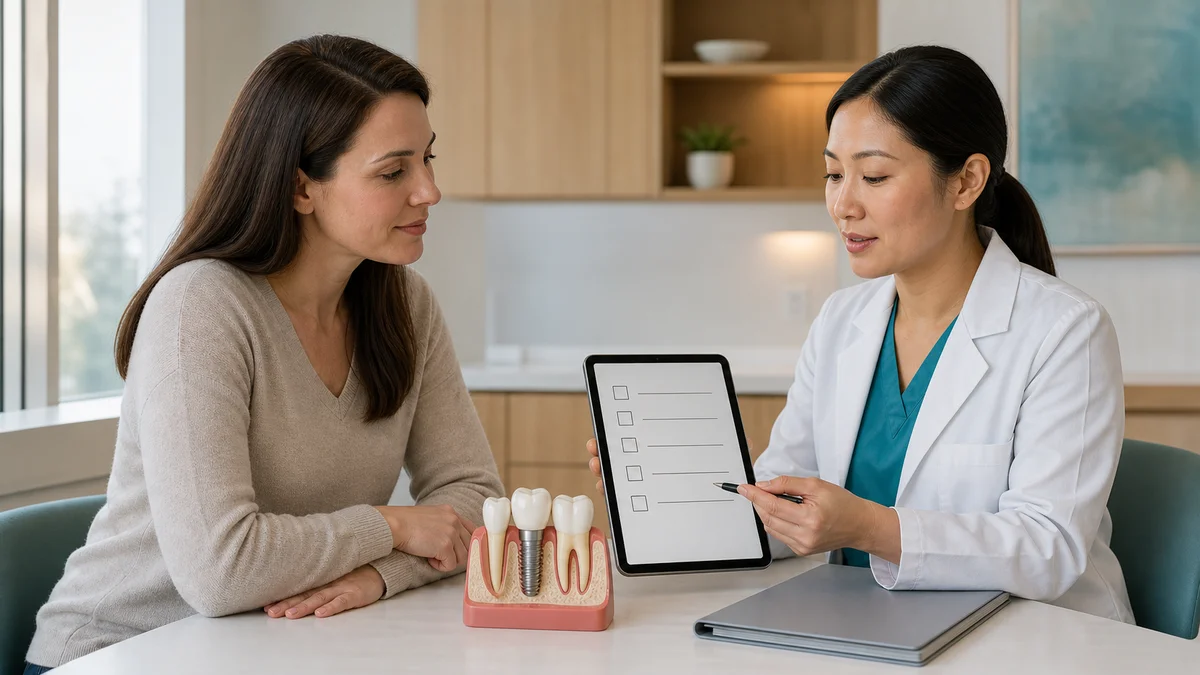
Quick answer: Current 2026 Keystone First Pennsylvania Medicaid materials do not list dental implants among standard covered dental benefits, and an earlier official plan notice explicitly listed implants as non-covered. Do not assume a Benefit Limit Exception applies. Ask a network dentist to verify exact procedure codes and obtain a written plan decision from Keystone First before treatment, because age and eligibility can affect review.
Does Keystone First cover dental implants when a dentist says an implant is the preferred replacement for a missing tooth? For the Keystone First Pennsylvania Medicaid plan, current 2026 member and provider documents do not include implants in their standard dental-benefit lists. An earlier official Keystone First provider communication expressly identified dental implants as services not covered. That combination points to “generally no” for routine implant treatment—not to an automatic benefit.
However, an internet summary cannot decide an individual claim. Coverage can depend on the precise plan, the member’s age and eligibility category, service date, provider network status, procedure codes, prior-authorization rules and a written determination. Members under age 21 have broader medically necessary dental protections through EPSDT, but that does not make every implant request payable. The safe next step is benefits verification before surgery or payment.
This article was checked against Keystone First’s current 2026 Member Handbook, July 2026 Dental Provider Supplement, provider resource pages and Pennsylvania Department of Human Services information. It explains how to verify coverage; it is not legal advice, a guarantee of payment or a personal dental recommendation.
1. Does Keystone First cover dental implants in 2026?
The shortest evidence-based answer to does Keystone First cover dental implants is: implants are not shown as a standard covered benefit in the current 2026 materials reviewed. The adult list includes exams, cleanings, emergencies, X-rays, fillings, extractions, pulpotomies for pain relief, recementing crowns, dentures, dental surgical procedures and certain sedation or anesthesia when medically necessary. It does not name implant placement, implant abutments or implant-supported crowns.
The July 2026 provider supplement likewise lists adult dental benefits and services that may be available through authorization or a Benefit Limit Exception. It names periodontal treatment, root canals, crowns, dentures, surgery, emergencies, imaging, extractions and fillings. Implant services are not listed. Silence in a summary is not always a formal exclusion, which is why a current code-specific decision remains important.
An official Keystone First provider newsletter published in 2021 explicitly placed “dental implants” in a non-covered-services list. Because benefit documents can change, that older notice should not be the only evidence used today. The current handbook, provider supplement and Member Services should control your present verification.
2. Does Keystone First cover dental implants under your exact plan?
Keystone First, Keystone First Community HealthChoices, Pennsylvania CHIP and unrelated commercial products are not interchangeable. A search result or dental office may use “Keystone” loosely. Check the exact plan name on your current member card and confirm that eligibility is active for the expected service date.
Before asking does Keystone First cover dental implants, provide Member Services with your member identification and plan name, but do not post those details publicly. Ask whether dental benefits are administered directly or through a dental administrator for your plan. Keystone First’s current provider materials refer dental providers to DentaQuest tools for eligibility and authorization processes.
Benefits can change when a person moves, changes eligibility category, turns 21, enters or leaves a facility-based category, or switches managed-care plans. A benefit check performed months before treatment may no longer be reliable. The provider should verify eligibility again close to each major stage.
3. Does Keystone First cover dental implants differently by age?
Age is central to the question does Keystone First cover dental implants. Keystone First’s provider supplement states that members under 21 are eligible for all medically necessary dental services and lists covered categories “including, but not limited to” several treatments. It also says that authorization is required for specified services and medical necessity must be demonstrated. The document does not promise implant approval.
For adults age 21 and older, the published benefit list is more limited. Several categories require prior authorization, and some are available only through a Benefit Limit Exception. Implants are not among the adult services named in the current handbook or supplement. Adult exceptions for residence in certain long-term-care or intermediate-care facilities affect the BLE process, but current prior-authorization rules still apply.
For a member under 21, the dentist should submit the exact implant-related codes, diagnosis, clinical findings, alternatives and why the service is medically necessary under EPSDT. Do not interpret “all medically necessary dental services” as permission to begin treatment without authorization. Only the plan’s written response resolves the particular request.
4. Does Keystone First cover dental implants through a BLE?
Some adults see the handbook’s Benefit Limit Exception section and ask again: does Keystone First cover dental implants through a BLE? The current examples identify crowns and related services, root canals and other endodontic services, periodontal treatment, additional cleanings or exams, and certain additional or replacement denture services. They do not identify implants as a routine BLE category.
The handbook says a BLE may be approved when defined criteria are met, including serious or chronic health circumstances, avoiding substantial worsening, avoiding more expensive treatment, or compliance with federal law. These criteria do not prove that an otherwise excluded implant becomes covered. A provider must submit the request, and Keystone First makes the determination.
Ask the dental office which benefit category and codes it believes support the request. If staff say “we will just file an exception,” request a written explanation and do not treat that statement as approval. A BLE for a crown, periodontal procedure or denture is not necessarily an authorization for an implant fixture or implant-supported restoration.
5. Does Keystone First cover dental implants as one bundled item?
The phrase “dental implant” can refer to the implant body placed in bone, the abutment, the crown or bridge attached to it, and related diagnostic or surgical work. A plan may evaluate each component separately. Therefore, asking only does Keystone First cover dental implants can produce an incomplete phone answer.
- Consultation, examination and diagnostic imaging
- Extraction or management of the existing tooth or root
- Bone or soft-tissue grafting when clinically indicated
- Surgical placement of the implant body
- Healing components and second-stage procedures
- Prefabricated or custom abutment
- Implant-supported crown, bridge or removable prosthesis
- Sedation, medication, follow-up and complication management
Request a tooth-specific treatment plan with the CDT procedure codes the provider intends to submit. Ask which parts are expected to be covered, denied or self-pay and which need authorization. A covered extraction or denture does not imply coverage of the later implant, and a covered diagnostic image does not authorize surgery.
6. Does Keystone First cover dental implants after prior authorization?
Prior authorization is the plan’s advance review of a requested service; it is not the same as a general benefits call. The provider may need to submit radiographs, a narrative, periodontal findings, missing-tooth information, medical history, prognosis and alternative-treatment analysis. Keystone First’s provider supplement directs participating providers to authorization tools and requires medical necessity for specified dental services.
When considering does Keystone First cover dental implants, ask whether the implant body, abutment and prosthetic restoration each require a separate determination. Also ask whether authorization has an expiration date and whether treatment must be delivered by the requesting network provider. A treatment plan can change after surgery; additional codes may require another review.
Authorization is not always a guarantee of payment. Eligibility, provider status, accurate coding and compliance with conditions still matter on the service date. Conversely, a receptionist saying “implants are not usually covered” is not a formal denial. Obtain the plan’s written response to the submitted request.
7. Decision table: does Keystone First cover dental implants for this case?
Use this table to organise verification. It does not predict approval; it identifies the document or person who can answer each part.
| Question | Best evidence | Unsafe assumption |
|---|---|---|
| Is the member eligible? | Eligibility check for the planned service date | A current card guarantees future eligibility |
| Is the dentist in network? | Current Keystone First provider directory and plan confirmation | The office accepts “Medicaid” generally |
| Which implant components are planned? | Written tooth chart and CDT code list | One “implant package” represents every stage |
| Is the service a standard benefit? | Current handbook plus code-specific benefits verification | A web article or old benefits sheet controls |
| Does an exception apply? | Submitted BLE request and written determination | Any medical need creates implant coverage |
| Is prior authorization approved? | Authorization notice with codes, provider and dates | A phone reference number is surgical clearance |
| What remains self-pay? | Plan decision plus itemised provider estimate | Approval of one component covers the full restoration |
| Can the decision be challenged? | Denial notice and current complaint, grievance or hearing instructions | A verbal “no” has no review route |
8. Does Keystone First cover dental implants? Use this 2-call script
First call Keystone First Member Services at the number printed on your card. The 2026 handbook lists 1-800-521-6860 and TTY 1-800-684-5505 and states that Member Services can answer benefit questions. Ask the representative to verify your exact plan, age category, dental administrator and network requirements.
Use the exact question does Keystone First cover dental implants, then make it code-specific: “My dentist is considering these CDT codes for tooth number __. Are they excluded, covered, subject to prior authorization or potentially reviewable under EPSDT or another exception?” Ask for the source document, effective date and a call reference number. Do not request or share clinical details beyond what is needed in an unsecured setting.
Second, call a participating dental provider. Ask whether the office has verified eligibility, who will submit authorization, which documents are missing and whether it will wait for a written decision before treatment. A provider quote and a plan decision serve different purposes; keep both.
- Exact plan name and current eligibility status
- Member age category on each expected service date
- Network status for surgeon and restorative dentist
- CDT codes for implant, abutment, prosthesis and related services
- Prior-authorization or exception submission requirements
- Written approval or denial and the effective dates
- Member responsibility for non-covered stages
- Complaint, grievance or fair-hearing deadlines if denied
9. Does Keystone First cover dental implants out of network?
The 2026 Member Handbook says adult dental benefits are delivered through dentists in the Keystone First network. The plan’s online directory can identify participating dental providers, and Member Services can help locate one. An office saying it accepts Medicaid does not necessarily mean it participates with Keystone First at that address.
For the question does Keystone First cover dental implants from a non-network, out-of-state or overseas clinic, do not assume reimbursement. Obtain written plan confirmation before care. Emergency rules are different from planned implant surgery, and a self-pay treatment abroad generally cannot be converted into a network authorization after the fact.
If you are comparing care in Türkiye, treat Keystone First coverage verification and the clinical travel decision as separate workstreams. Ask the overseas provider for a diagnosis, alternatives, exact implant system, records and aftercare plan. If you contact Redent Klinik, request a provisional itemised clinical plan; do not present it as proof of insurance coverage.
10. Ask does Keystone First cover dental implants before comparing alternatives
A plan may consider a removable partial denture, complete denture, tooth-supported bridge or no immediate replacement as alternatives, depending on the mouth and benefit structure. The current Keystone First adult list includes dentures under defined limits and possible authorization or exception rules. That does not make a denture clinically equivalent to an implant for every person.
When asking does Keystone First cover dental implants, also ask your dentist what each alternative would involve. Consider remaining teeth, bone, gums, cleaning ability, function, future treatment, surgery, maintenance and personal priorities. The dentist should not recommend extraction merely because a prosthetic benefit is easier to obtain.
A coverage decision answers what the plan may pay; it does not choose the safest treatment. If an implant is non-covered, you may discuss staged self-pay care or another clinically acceptable option. Avoid high-pressure financing until diagnosis and benefit status are clear.
11. Does Keystone First cover dental implants when medically necessary?
Clinicians use “medically necessary” to explain why a treatment is appropriate for health or function. Insurers apply contractual and regulatory definitions to decide whether a service meets coverage criteria. A dentist can reasonably prefer an implant while the plan still excludes that service or requires an alternative.
This distinction matters whenever someone asks does Keystone First cover dental implants. A narrative should describe diagnosis, function, bone and soft-tissue conditions, failed or unsuitable alternatives, prognosis and relevant medical factors. More detail can support review, but it cannot create a benefit that the governing plan excludes.
For members under 21, EPSDT review may involve whether the requested service is necessary to correct or ameliorate a condition. The provider should follow current submission rules. Families should wait for the written decision and use the notice’s review rights if they disagree.
12. What if “does Keystone First cover dental implants” is denied?
A denial notice should identify what was requested, the reason, the authority or criterion used and available review steps. Keystone First’s 2026 handbook describes complaints, grievances and Department of Human Services Fair Hearings. The correct route and deadline depend on the type and stage of decision, so read the notice rather than relying on a generic timeline.
If the denial answers does Keystone First cover dental implants with “not a covered service,” ask whether the request was coded accurately and whether all components were considered separately. If the reason is lack of medical necessity or missing documentation, the dentist may be able to submit clinical evidence or a corrected request. Do not alter facts to fit a criterion.
Keep the treatment plan, radiographs, clinical narrative, authorization request, denial, call references and delivery dates. You may ask for help from Member Services, a member advocate, the treating provider or an authorised representative. If the notice offers continuation rights for an existing service, follow its instructions promptly.
13. If does Keystone First cover dental implants is answered “no”
Do not pay a non-refundable deposit solely because an office says insurance will “probably” reimburse you. Ask for a written self-pay estimate showing implant body, abutment, crown or prosthesis, grafting, imaging, sedation, temporary tooth, follow-up and possible additional procedures. Clarify refund terms if the diagnosis or plan changes.
A negative answer to does Keystone First cover dental implants does not justify rushing. Compare the implant with reasonable alternatives and, for extensive treatment, consider a second opinion. Ask who performs surgery and restoration, which implant system is used, how components will be available later and who manages complications.
If any related service might be covered, make sure the provider distinguishes covered work from self-pay work in writing. Members generally should not be billed improperly for covered services, while a valid agreement may be required before non-covered care. Ask Keystone First how its member-billing protections apply to the proposed arrangement.
14. Clinical safety before asking does Keystone First cover dental implants
Dental implants require a diagnosis and assessment of the whole mouth. The dentist may evaluate gums, remaining teeth, bite, bone, medical history, medicines, tobacco use, diabetes control and ability to maintain hygiene. Imaging should be selected according to clinical need. No insurer approval can replace informed consent or make an unsuitable implant appropriate.
Likewise, the question does Keystone First cover dental implants should not delay urgent care for pain, infection, swelling, trauma or uncontrolled bleeding. The plan’s current materials include dental emergencies among adult benefits, but the exact setting and service still matter. Seek prompt professional guidance for worsening symptoms and emergency help for breathing or swallowing difficulty or rapidly spreading swelling.
An implant is usually an elective, staged treatment after urgent disease is stabilised. Antibiotics alone do not replace drainage or dental treatment when those are required. Never use leftover medication or postpone infection care while waiting for an implant-benefit decision.
15. Does Keystone First cover dental implants and later maintenance?
Coverage, self-payment and successful placement are not the end of care. Implants require hygiene, professional monitoring and management of mechanical or biological complications. Keep the implant manufacturer, model, dimensions, placement date, batch information when available, abutment details, restorative materials, radiographs and operative notes.
Whether the answer to does Keystone First cover dental implants is no, partial or case-specific, ask which future examinations, imaging, maintenance, repairs or complication services are covered. Coverage for treating gum inflammation or removing a failing implant is a separate question from initial implant placement. Obtain code-specific verification when new care is proposed.
Patients treated away from home should arrange continuity with a local dentist before travelling. Use the Redent Klinik contact page to request clinical and record-transfer information if considering treatment there. Insurance eligibility and reimbursement must still be verified directly with Keystone First.
Frequently asked questions: does Keystone First cover dental implants?
Does Keystone First cover dental implants for adults over 21?
Current 2026 adult benefit lists do not name implants as covered services, and an earlier official Keystone First notice explicitly listed dental implants as non-covered. The prudent answer is generally no for routine implant care. Verify exact procedure codes and obtain a current written determination before treatment because eligibility and plan documents can change.
Does Keystone First cover dental implants for members under 21?
Members under 21 have broader coverage for medically necessary dental services under EPSDT, but this is not an automatic implant benefit. A participating provider should submit the exact codes, diagnosis, documentation, alternatives and medical-necessity rationale for review. Wait for the plan’s written authorization or denial.
Does Keystone First cover dental implants through a Benefit Limit Exception?
The current BLE examples include crowns, endodontic care, periodontal services, additional exams or cleanings and certain denture services—not dental implants. Do not assume a BLE converts an excluded implant into a benefit. Ask the provider and Keystone First which rule, if any, permits a code-specific request.
Does Keystone First cover the crown on an implant?
An implant crown is coded differently from a crown on a natural tooth, so a general crown benefit does not establish implant-crown coverage. Ask the restorative dentist for the exact CDT code and request a written determination. Approval of an extraction, image or other component also does not authorize the implant restoration.
Does Keystone First cover bone grafting before an implant?
Grafting is a separate service with its own diagnosis, code and authorization status. Do not assume it is covered because a dentist says it is needed for a self-pay implant. The provider should verify the graft code independently and explain what happens if the implant itself remains non-covered.
Can I use an out-of-network implant dentist?
Current adult dental benefits are described as available through dentists in the Keystone First network. Planned out-of-network or overseas implant care should not be assumed reimbursable. Confirm provider status in the current directory and obtain written plan approval before treatment if an exception is claimed.
Who should submit the authorization request?
The participating dental provider ordinarily submits clinical records, codes and the medical-necessity narrative through the plan’s dental authorization process. The member should confirm submission, keep the reference and wait for a written response. Ask Member Services what to do if a provider will not submit a potentially reviewable request.
What number should I call about dental implant benefits?
Use the number on your current member card. The 2026 Keystone First handbook lists Member Services at 1-800-521-6860 and TTY 1-800-684-5505, available 24 hours a day, seven days a week. Ask for a code-specific benefit check, the source document and a call reference.
What if I disagree with the denial?
Read the notice for the reason, review route and deadline. The handbook describes complaints, grievances and Pennsylvania DHS Fair Hearings, but the correct process depends on the decision. Ask the provider whether coding or documentation needs correction, keep all records and submit any challenge within the notice’s time limit.
Conclusion: does Keystone First cover dental implants by exact code?
Based on the current documents reviewed, the practical answer to does Keystone First cover dental implants is that implants are not a standard listed benefit and should generally be expected to be non-covered unless Keystone First issues a case-specific written decision under an applicable rule. Neither a dental office’s assurance nor a broad “medical necessity” statement guarantees payment.
Confirm the exact plan and age category, use a network provider, separate every implant stage by code, wait for authorization and keep the decision. If denied, review the notice and deadlines before paying privately. Insurance verification protects finances; a complete examination, informed consent and long-term maintenance protect health.
Official sources for “does Keystone First cover dental implants”
- Keystone First Member Handbooks — page stating that the online handbook is the most current version.
- Keystone First 2026 Member Handbook — current dental benefits, BLE criteria, Member Services and review rights.
- Keystone First Dental Program — current provider resources and July 2026 supplement.
- Keystone First July 2026 Dental Provider Supplement — age-based benefits, authorization and BLE process.
- Keystone First provider finder — current network search and Member Services information.
- Pennsylvania Department of Human Services: Medicaid dental services — age, eligibility, MCO and provider information.
- Pennsylvania DHS dental provider information — adult service categories and BLE context.
- American Dental Association — professional oral-health and procedure information.
- World Health Organization: Oral health — oral-disease and access-to-care context.