
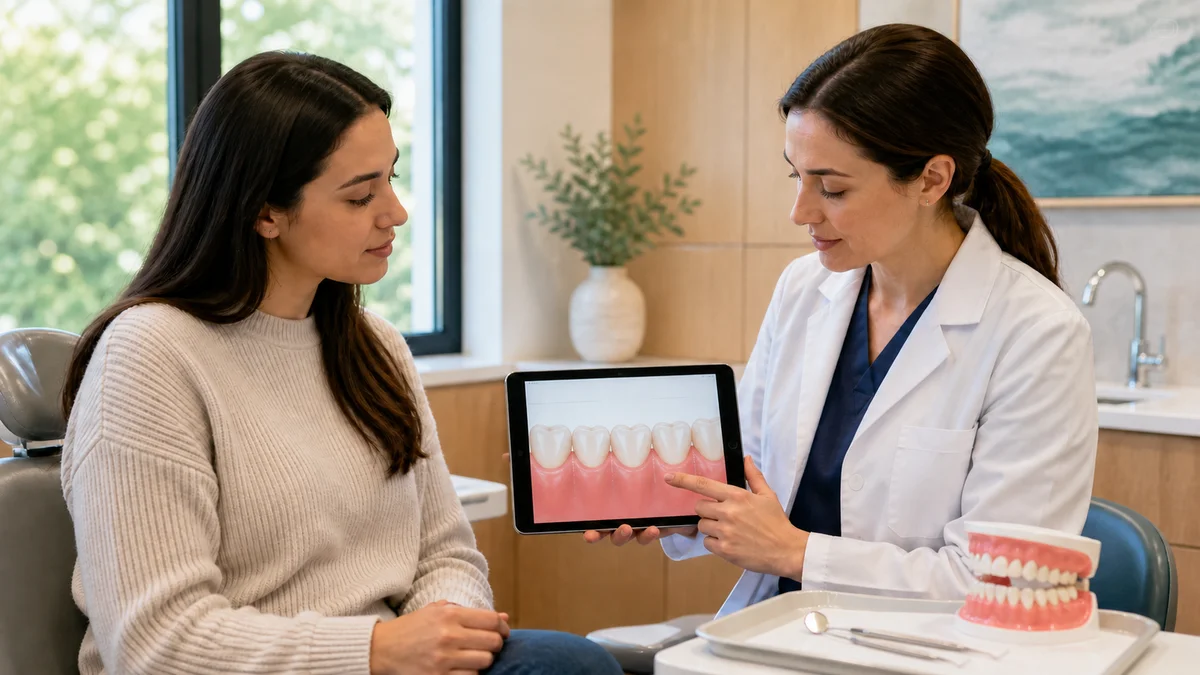
Quick answer: Choose a periodontal office by more than distance. Confirm the clinician’s credentials, the scope of the first gum assessment, access to appropriate imaging, written diagnosis, treatment alternatives, urgent-contact route, fees, records and maintenance plan. Bleeding, recession or loose teeth deserve professional assessment; rapidly increasing swelling or breathing or swallowing difficulty needs urgent care.
Typing periodontal office near me into a search box is often the first step after noticing bleeding gums, recession, persistent bad breath, a loose tooth or a referral from a general dentist. Search results can show what is geographically close, but proximity does not establish who will examine you, which services are available, whether the office can manage your level of complexity or how follow-up will work.
This guide turns that local search into a patient-safety checklist. It is educational and cannot diagnose gum disease or recommend a procedure for you. Gingivitis, periodontitis, an abscess, trauma, tooth decay and other problems can share symptoms, so an in-person examination matters. The best office is not automatically the first map result, the most expensive clinic or the practice with the most dramatic before-and-after photographs.
1. What a periodontal office near me search can—and cannot—tell you
A periodontal office near me result can help estimate travel time, opening hours, accessibility and whether a practice describes periodontal services. It cannot confirm the clinician’s registration, specialist status, diagnostic quality or treatment suitability. Sponsored placement and review volume are marketing signals, not clinical evidence. Treat the results page as a shortlist, then verify each option through independent sources.
Start by deciding what kind of access you need. A routine second opinion can tolerate a longer journey; repeated maintenance visits may make reliable transport more important. A person with new swelling, severe pain or a rapidly changing problem needs timely triage rather than a lengthy comparison exercise. The office should tell you whether it can assess the concern, offer an earlier appointment or direct you to an appropriate urgent service.
Save the official practice name, clinical address, telephone number and clinician’s full name. Similar names and multiple branches can create confusion. Confirm that your appointment is at the facility you researched and that the treating professional is the one whose credentials you checked.
2. Who works in a periodontal office near me?
A periodontist is a dentist with advanced training focused on the prevention, diagnosis and treatment of periodontal disease and on dental implants. The American Academy of Periodontology explains that periodontists commonly manage more challenging gum and implant cases. General dentists also identify and treat many gum problems and may refer when the diagnosis, severity, surgery or implant-related issue requires specialist expertise.
When calling a periodontal office near me, ask who will perform the examination, who will make the diagnosis and who would provide each proposed treatment. A dental hygienist may deliver important preventive and therapeutic care within the scope permitted by local rules, but the practice should clearly identify professional roles and supervision. The office name alone does not prove specialist status.
A referral is not a sign that your dentist has failed. It can create a coordinated team in which the periodontist manages complex periodontal needs while the general dentist continues restorative and preventive care. Ask how the two practices exchange records and decide who is responsible for each stage.
3. Symptoms that justify a periodontal office near me appointment
The CDC lists red, swollen or tender gums, bleeding, gum recession, loose or sensitive teeth, painful chewing and a change in the bite among possible signs of periodontal disease. Gum disease can become advanced before a person notices obvious symptoms. One symptom does not establish a diagnosis, and a lack of pain does not confirm health.
Arrange an assessment if bleeding persists, the gum line appears to move, food repeatedly packs between teeth, teeth feel mobile, your bite changes, an implant area bleeds or a dentist recommends specialist review. A periodontal office near me should ask enough triage questions to determine the appropriate appointment type rather than promising treatment over the phone.
- Bleeding during brushing, interdental cleaning or eating
- Redness, swelling, tenderness or recurring gum discomfort
- Gums that appear to have receded or teeth that look longer
- Persistent bad taste or breath despite routine hygiene
- Mobility, drifting teeth or a new change in the bite
- Discomfort when chewing or sensitivity near exposed root surfaces
- Bleeding, tenderness or bone-loss concerns around an implant
Photographs can help a receptionist understand what you describe, but they do not measure periodontal pockets, attachment or bone levels. Do not scrape, press or repeatedly test a painful area while waiting for professional advice.
4. When a periodontal office near me search becomes urgent
Routine gum bleeding should be assessed, but some symptoms need faster care. The NHS advises seeking an urgent dental appointment for very sore, swollen gums, teeth becoming loose or falling out, ulcers or red patches, or a lump in the mouth or on the lip. Rapidly increasing facial or mouth swelling, difficulty breathing or swallowing, severe systemic illness or uncontrolled bleeding may require emergency medical care.
Do not wait for the highest-rated periodontal office near me if a local urgent dental or emergency service can see you sooner. Call ahead, describe the onset and progression, and mention fever, medicines, allergies, pregnancy, immune suppression, diabetes or recent procedures when relevant. Follow the triage instructions for your location.
Antibiotics are not a substitute for drainage, diagnosis or definitive dental treatment when those are needed. Never use leftover or another person’s prescription. A qualified clinician should decide whether a medicine is indicated after considering the problem and your medical history.
5. What a periodontal office near me should assess
The American Academy of Periodontology describes a comprehensive periodontal evaluation as an assessment of teeth, plaque, gums, bite, bone structure and risk factors. At a first visit, the clinician may review medical and dental histories, medicines, tobacco or nicotine exposure, diabetes control, pregnancy and previous periodontal treatment. The examination can include recession, tooth mobility, bite relationships and periodontal pocket measurements.
A suitable periodontal office near me should explain why photographs, radiographs or other imaging are proposed. Imaging should be selected according to clinical need, not ordered automatically as a premium add-on. Existing recent images may be useful if they are diagnostic and can be transferred, although the clinician must decide whether they answer the current question.
Ask for the findings in plain language. A written diagnosis should distinguish gingival inflammation from periodontitis and describe distribution and severity when possible. If an implant is involved, ask whether the assessment concerns soft tissue inflammation, supporting bone, implant position, restoration design or another factor. The examination should lead to options, not an automatic sales package.
6. Verify the clinician behind a periodontal office near me
Search the dentist or specialist in the official professional register for the jurisdiction where treatment will occur. In the United States, this generally means the relevant state dental board; in the United Kingdom, the General Dental Council register; elsewhere, use the national or regional regulator. Check name, registration status and any officially listed specialty information. A social-media biography is not a substitute.
The AAP provides a member periodontist finder, but it notes that not all members opt into the directory. Therefore, an absent listing does not by itself prove that a clinician is unqualified. Use a directory to locate candidates, then confirm licensure independently. A periodontal office near me should readily provide the treating clinician’s full professional name.
If you are arranging care in Türkiye as an international patient, the Ministry of Health publishes current lists of healthcare providers authorised for international health tourism. Match the facility name and address to the official list. Authorisation is an important regulatory baseline, not a guarantee of an individual result.
7. Does a periodontal office near me match your clinical need?
Periodontal care ranges from diagnosis, prevention and non-surgical treatment to gum grafting, pocket-reduction procedures, regenerative approaches, crown-lengthening, implant placement and management of peri-implant disease. Not every practice provides every service, and offering a service does not prove that it is appropriate for you.
Tell the periodontal office near me whether you are seeking a first diagnosis, a second opinion, care after referral, an implant assessment or ongoing maintenance. Ask if the practice routinely manages your type of concern and whether it coordinates with your general dentist, physician or other specialist when needed. For a complex medical history, confirm what records the office needs before the visit.
A good answer is specific but cautious: the office can describe its scope and appointment pathway without declaring the treatment before examination. Be wary of promises that everyone with bleeding gums needs the same deep cleaning, laser, surgery or implant solution.
8. Decision table for choosing a periodontal office near me
Use one comparison sheet for every candidate. The following table is not a clinical score and cannot guarantee quality. It helps reveal whether the information needed for informed choice is available before you commit.
| Decision point | Reassuring information | Reason to clarify or pause |
|---|---|---|
| Clinician | Full name, role and verifiable registration | Only a practice brand or unnamed “specialist” |
| First visit | History, examination, periodontal measurements and justified imaging | Treatment promised from a photograph |
| Diagnosis | Findings explained and documented before a plan | A generic package for every gum complaint |
| Options | Benefits, risks, alternatives and no-treatment consequences discussed | Only the highest-cost procedure presented |
| Fees | Written estimate, inclusions, insurance process and change policy | Pressure to prepay before questions are answered |
| Urgent access | Clear triage route during and outside opening hours | No instructions for worsening symptoms |
| Records | Copies available and communication with referring dentist | Refusal to share your clinical documents |
| Maintenance | Individual recall plan with responsibilities defined | Treatment described as a one-time permanent cure |
9. Questions to ask a periodontal office near me before booking
A brief call can prevent a mismatched appointment. Provide the main symptom, how long it has been present, whether it is changing, any referral information and whether you have recent radiographs. Do not send sensitive health information through an unsecured social-media account. Use the practice’s approved communication channel.
- Who will examine me, and what is that clinician’s professional role?
- Is this visit a consultation, complete periodontal evaluation or urgent assessment?
- What records and images should my general dentist transfer?
- How long is reserved, and are measurements or imaging usually performed?
- Will I receive a written diagnosis, options and itemised estimate?
- How do you coordinate treatment and maintenance with my regular dentist?
- What accessibility, interpretation or anxiety-support arrangements are available?
- Whom do I contact if symptoms worsen before or after the appointment?
The periodontal office near me may not be able to answer treatment-specific questions before examination, and that restraint is appropriate. It should still be able to explain its process, professional roles, fee structure and urgent-contact pathway.
10. Treatment pathways at a periodontal office near me
Periodontal treatment depends on diagnosis, disease extent, risk factors, tooth and implant condition, medical history and patient preferences. The ADA notes that care can be non-surgical or surgical and that the optimal approach is based on patient, site and systemic factors. Scaling and root planing may be an initial non-surgical treatment for periodontitis, but it is not automatically appropriate for every person with bleeding gums.
A trustworthy periodontal office near me should link each recommendation to documented findings. Initial care may include oral-hygiene instruction and professional removal of plaque and calculus. Some cases need re-evaluation after tissue response; others may require surgical access, regenerative treatment, grafting, extraction or coordination with restorative care. The sequence should be explained before irreversible steps.
Be cautious with claims that a particular device, laser or branded technique is universally superior. Ask what evidence supports its use in your case, whether it replaces or supplements standard treatment, what alternatives exist and how outcomes will be assessed. Patient preference matters, but it must be informed by realistic benefits, limitations and risks.
11. Fees and insurance at a periodontal office near me
Fees vary with examination type, imaging, number of sites treated, procedure complexity, clinician and local market. Insurance coverage, referral rules, waiting periods, annual limits and pre-authorisation differ by plan and can change. Obtain information directly from the practice and insurer rather than relying on a general online estimate.
Ask the periodontal office near me for an itemised written estimate that distinguishes consultation, diagnostics, treatment, sedation if relevant, medicines, review and maintenance. Confirm which amount is an estimate, which services could be added after diagnosis and how you will approve a change. If the practice will submit a claim, remember that submission is not a promise that the insurer will pay.
If cost is a barrier, say so before treatment. Ask about staged care, clinically acceptable alternatives, payment schedules and public, university or community resources in your location. Financial pressure should not be used to rush consent, and delaying a proposed intervention should be discussed with a clinician so you understand the health implications.
12. Distance, accessibility and continuity matter
Proximity becomes clinically useful when it supports attendance. Periodontal therapy can involve several appointments followed by long-term supportive care. Check public transport, parking, stairs or lifts, wheelchair access, appointment times and the practical journey during bad weather or work hours. A slightly farther practice with reliable access may be more sustainable than a close office with limited availability.
When evaluating a periodontal office near me, ask who provides maintenance and how often the interval will be reassessed. The ADA explains that a person treated for periodontitis remains susceptible and may require lifelong supportive care; maintenance timing is individualized. Avoid an office that markets active treatment without discussing what keeps the condition stable afterwards.
Also consider continuity if the clinician changes or the practice closes. You should be able to obtain records, radiographs and a summary for another provider. A care plan belongs to you, not to one building or booking platform.
13. Records and consent at a periodontal office near me
Before treatment, the clinician should explain the diagnosis, purpose, expected benefits, material risks, reasonable alternatives and likely consequences of deferring care. You should have time to ask questions and use interpretation support when necessary. Consent is an ongoing conversation, not only a form signed after the chair is reclined.
A well-organised periodontal office near me records pocket measurements, recession, mobility, bleeding, furcation involvement, imaging findings, risk factors and the treatment or maintenance plan as relevant. Not every item applies to every visit, but the record should support the diagnosis and future comparison. Ask for a copy of your chart and images in a usable format.
Share a current medicine list and relevant diagnoses. Smoking or vaping, diabetes control, pregnancy, allergies, bleeding disorders and medicines affecting immunity, bone or clotting can influence planning. Do not stop a prescribed medicine without advice from the clinician who manages it.
14. Infection prevention and a safe clinical environment
Clean appearance alone does not establish infection prevention, but the office should follow applicable professional and public-health standards. Team members should perform hand hygiene, use appropriate personal protective equipment and process reusable instruments correctly. Single-use items should not be reused. Sharps and clinical waste should be managed safely.
You can ask a periodontal office near me how instruments are sterilised and how waterlines, surfaces and surgical areas are managed. A professional practice should answer without defensiveness. You do not need to inspect every process personally; the goal is transparency and adherence to local regulation.
If you have an infectious illness, recent exposure or immune vulnerability, call before attending so the team can advise appropriately. Do not conceal a health condition out of fear that the appointment will be delayed. Safe scheduling protects you, staff and other patients.
15. Maintenance with a periodontal office near me
Periodontitis-related attachment and bone loss are not simply erased by treatment. The CDC describes periodontitis as a condition that can be slowed and managed with professional treatment. Ongoing plaque control, professional maintenance and management of modifiable risk factors help reduce recurrence, but no clinic can promise that a tooth or implant will last for life.
Ask the periodontal office near me to define success measures: reduced inflammation and bleeding, improved pocket conditions, stable attachment or bone, better home care and a maintainable environment. A review may lead to additional therapy, continued maintenance or referral. Changes should be shown with comparable records rather than impression alone.
Home care should be tailored to dexterity, spaces between teeth, restorations and implants. Follow the professional’s technique advice and report pain, bleeding or device-related injury. Tobacco cessation and diabetes management may be important parts of risk control, coordinated with the appropriate healthcare professionals.
16. A second opinion from a periodontal office near me
A second opinion can be useful when the diagnosis is unclear, the proposal is extensive, extraction or surgery is recommended, implant prognosis is uncertain or options have not been explained. It is also reasonable when a plan changes unexpectedly or you feel pressured. Seeking another view does not require accusing the first clinician of poor care.
Give the second periodontal office near me the same records and describe your objectives without hiding the first recommendation. Different plans can both be clinically defensible because they weigh prognosis, invasiveness, cost, maintenance and patient preference differently. Ask each clinician to explain the evidence and uncertainty.
Do not delay urgent care to collect multiple opinions. For a stable, elective decision, take enough time to compare diagnoses and understand what would trigger a change in plan. The aim is informed agreement, not shopping for the answer you hoped to hear.
17. A practical shortlist for a periodontal office near me
Choose two or three candidates from independent sources, verify clinician registration, then call with the same questions. Record appointment type, lead time, fee information, accessibility, urgent route and whether records can be coordinated. Remove an option if the clinician’s identity or practice location cannot be verified.
For readers considering care with Redent Klinik, the same checklist applies: request the treating professional’s identity, an evidence-based assessment and a written plan before deciding. International patients should also verify the facility through the current Turkish Ministry of Health list and plan local continuity after returning home.
A periodontal office near me earns a place on the shortlist through clear professional roles, thorough assessment, reasonable access and long-term planning—not promises or luxury imagery. If you need to ask about consultation scope and available records, use the Redent Klinik contact page. A contact request is not a diagnosis or a commitment to treatment.
Frequently asked questions about periodontal office near me
Do I need a referral to a periodontal office near me?
Rules differ by healthcare system, insurer and practice. Some periodontists accept self-referrals, while an insurance plan may require a general dentist’s referral for benefits. Calling first can clarify the process. Even without a formal referral, sharing recent examinations and radiographs can improve continuity and reduce unnecessary duplication.
What happens at my first periodontal appointment?
The clinician commonly reviews medical and dental history, symptoms, medicines and risk factors, then assesses teeth, gums, bite, mobility and periodontal measurements. Appropriate imaging may be reviewed or taken when justified. You should receive an explanation of findings, diagnosis, options and next steps rather than an automatic procedure.
Is a “deep cleaning” always the first treatment?
No. Scaling and root planing can be an evidence-based initial non-surgical treatment for periodontitis, but bleeding gums have different possible causes and disease severity varies. Diagnosis comes first. Ask which sites need treatment, how response will be re-evaluated and what alternatives or adjuncts are appropriate.
How quickly should a periodontal office near me see bleeding gums?
Persistent bleeding warrants a dental assessment, even without pain, but the timing depends on the whole clinical picture. Call and describe duration, progression, swelling, pain, mobility and medical factors. Very sore swollen gums, loose teeth, a lump or rapidly worsening symptoms may require urgent assessment. Breathing or swallowing difficulty requires emergency help.
Can online reviews identify the best periodontist?
Reviews can describe scheduling or communication experiences, but they rarely verify diagnosis, infection control, long-term stability or specialist registration. Use them as one practical signal. Confirm credentials through an official register, ask about the examination and maintenance process, and judge whether explanations are clear and respectful.
Should a periodontal office take X-rays at every visit?
Imaging should be based on clinical need, previous records and the diagnostic question rather than a universal schedule. Periodontal bone levels may require radiographic assessment, but the type and timing vary. Ask why an image is recommended, what it may change and whether recent transferable images are adequate.
Will treatment cure periodontitis permanently?
Periodontitis can be treated and managed, but susceptibility and recurrence risk remain. Supportive periodontal care, effective home plaque control and risk-factor management are important. No ethical practice should guarantee lifelong stability. Ask how the office will measure response and adjust the maintenance interval over time.
What should I bring to a periodontal office near me?
Bring identification and insurance information when relevant, a current medicine and allergy list, medical conditions, referral letter, recent dental records and radiographs, and your questions. Note symptom timing and previous gum or implant treatment. Tell the office beforehand if you need language, mobility or anxiety support.
Conclusion: choose a periodontal office near me for continuity
A useful periodontal office near me search ends with verified credentials, an appropriate appointment, a comprehensive assessment and a plan you understand. Distance matters when it helps you attend, but it should be balanced with professional scope, urgent access, records, transparent fees, collaboration and maintenance.
Book sooner when symptoms are persistent or progressing, and use urgent services when triage indicates. For stable decisions, compare offices with the same checklist and seek a second opinion if the diagnosis or extent of treatment remains unclear. Patient-safe periodontal care is built around diagnosis and long-term support, not a map ranking.
Evidence for choosing a periodontal office near me
- American Dental Association — professional and patient oral-health information.
- American Dental Association: Periodontitis — classification, treatment principles and supportive care.
- ADA nonsurgical periodontitis treatment guideline — evidence and recommendations for scaling and root planing and adjuncts.
- American Academy of Periodontology: What is a periodontist? — training, first-visit expectations and referral context.
- American Academy of Periodontology: Comprehensive Periodontal Evaluation — teeth, plaque, gums, bite, bone and risk-factor assessment.
- American Academy of Periodontology member finder — local and international directory with opt-in limitations.
- US Centers for Disease Control and Prevention: Gum disease — symptoms, risk factors, prevention and treatment overview.
- NHS: Gum disease — symptoms and urgent dental advice.
- Republic of Türkiye Ministry of Health: authorised international health-tourism providers — current official provider lists.
- World Health Organization: Oral health — periodontal disease, risk factors and access to care.