
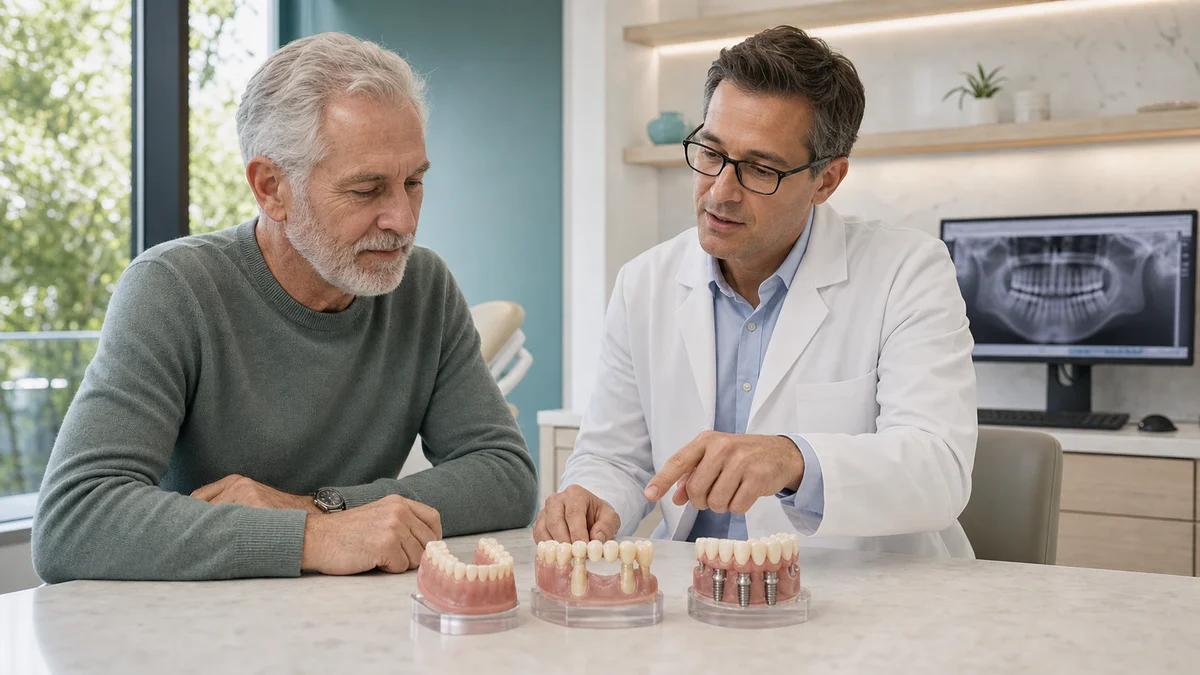
dentures alternatives include tooth-supported bridges, resin-bonded bridges, implant crowns, implant bridges, fixed full-arch restorations, implant overdentures, tooth-supported overdentures, orthodontic space closure and, in selected cases, monitored non-replacement. The right choice depends on how many teeth are missing, the health of remaining teeth and bone, medical factors, hygiene ability, surgical tolerance, maintenance needs, budget and personal priorities.
People searching for dentures alternatives are often trying to solve more than one problem. A removable denture may feel loose, affect taste or speech, create sore areas, or simply not fit the life a patient wants. Someone who has just lost a tooth may wish to avoid a removable appliance altogether. Yet “fixed” does not automatically mean safer, permanent or maintenance-free. Each option transfers forces differently and places different demands on teeth, gums, bone and daily cleaning.
This guide compares the full treatment pathway rather than selling one device. It explains examination, bridges, implants, overdentures, fixed full-arch teeth, space closure, non-replacement, risks, aftercare and costs. It cannot diagnose your mouth or promise a result. Pain, swelling, pus, a suddenly loose tooth, a denture-related ulcer that does not settle, unexplained bleeding or difficulty swallowing needs prompt professional assessment. You can review the clinic’s general approach on the Redent Clinic English homepage.
Dentures Alternatives Begin with the Problem You Want to Solve
A conventional complete denture replaces all teeth in an arch and rests mainly on the gums and underlying ridge. A partial denture replaces some teeth and may use remaining teeth for support or retention. These appliances can restore appearance, speech and chewing for many people, but their performance varies with anatomy, fit, saliva, muscle control and adaptation. A lower complete denture is often more difficult to stabilize than an upper denture because the tongue and floor of the mouth move around it.
Before comparing dentures alternatives, define the concern. Is the appliance painful because it no longer fits, or because infection, dry mouth, a sharp ridge or another condition is present? Is the priority stronger chewing, less movement, no palate coverage, fewer visible clasps, easier speech, avoiding surgery or preserving healthy adjacent teeth? A useful dentures alternatives discussion separates a correctable denture problem from a true need for a different design. A reline, adjustment or well-designed new denture may solve a fit problem without a more invasive reconstruction. Conversely, adhesive should not conceal a persistently poor fit or untreated disease.
Why a Full Examination Comes Before Dentures Alternatives
The treatment plan starts with medical and dental history. Relevant factors can include diabetes control, smoking or vaping, medications, blood-thinning treatment, previous radiotherapy, osteoporosis therapies, dry mouth, allergies, healing problems, dental anxiety and the ability to attend reviews. The clinician examines the oral lining, gums, remaining teeth, bite, jaw movement, ridge shape and available restorative space. Existing dentures are assessed for fit, wear, cleanliness, tooth position and fracture.
Appropriate photographs, impressions or digital scans help document anatomy. Imaging is selected to answer a clinical question, not ordered automatically. For implant planning, the clinician may need to assess bone dimensions and nearby nerves or sinuses; three-dimensional imaging is used only when justified. For a bridge, the roots, restorability and gum support of potential supporting teeth matter. Therefore, the phrase dentures alternatives describes a group of possible treatments, not a diagnosis obtainable from a photograph or online questionnaire.
Decision Table: Comparing Dentures Alternatives
The table is a conversation aid, not a personal recommendation. It shows why the most appropriate dentures alternatives differ between a single gap, several missing teeth and a fully toothless jaw.
| Option | Usually considered for | Main trade-off | Long-term care question |
|---|---|---|---|
| Resin-bonded bridge | Selected single-tooth gaps with a suitable adjacent tooth | Conservative preparation, but it may detach and is not suitable for every bite | Can the wing and gumline be cleaned and reviewed? |
| Conventional fixed bridge | One or more missing teeth with strong abutment teeth | Fixed replacement, but supporting teeth often need preparation | How will the false tooth and connectors be cleaned? |
| Single implant crown | A single missing tooth with suitable bone and health | Avoids preparing neighboring teeth, but requires surgery and maintenance | Can tissues around the implant be cleaned and monitored? |
| Implant-supported bridge | Several missing teeth | Can reduce the number of implants, but design and cleaning access are critical | What components may need repair or replacement? |
| Fixed full-arch restoration | A toothless or soon-to-be toothless arch in selected patients | Fixed teeth, but surgery, complex hygiene and mechanical upkeep | Who removes, services and professionally cleans it? |
| Implant overdenture | A complete denture needing more retention | Improved stability while remaining removable for cleaning | How often will clips, inserts or attachments be serviced? |
| Orthodontic space closure | Selected gaps where moving teeth is biologically and functionally appropriate | No artificial tooth in the closed space, but treatment takes time and needs retention | Will tooth shape or bite need further adjustment? |
| Monitored non-replacement | Selected spaces with adequate function and acceptable risk | Avoids treatment, but changes in teeth, bite or bone may occur | What findings would trigger reconsideration? |
Dentures Alternatives for One Missing Tooth
A single missing tooth can sometimes be replaced with a resin-bonded bridge, a conventional bridge or an implant crown. In other situations, orthodontic movement may close the gap, or the space may be monitored. The choice depends on location, bite, neighboring teeth, bone, gum appearance, age and priorities. A back-tooth gap that does not affect function may be approached differently from a visible front-tooth gap.
When evaluating dentures alternatives for one tooth, ask what must be changed to support the replacement. An implant avoids cutting down healthy adjacent teeth but adds surgery and healing. A conventional bridge can be sensible when neighboring teeth already need crowns, yet preparing untouched teeth is a meaningful cost. A resin-bonded bridge is more conservative, but its suitability depends on the enamel surface, bite and design.
Resin-Bonded Bridges as Conservative Dentures Alternatives
A resin-bonded bridge uses a metal or ceramic wing bonded to the back of a supporting tooth. It often requires little or no drilling compared with a full-coverage bridge. This can be valuable for a suitable single missing tooth, particularly when the adjacent tooth is healthy. The design must provide sufficient bonding area while avoiding harmful bite contacts.
The bridge can debond, fracture or become unaesthetic, and not every gap has a suitable support tooth. A detached bridge needs assessment rather than repeated home gluing. Among dentures alternatives, a resin-bonded bridge may be relatively conservative, but “minimal preparation” does not mean no maintenance. A complete dentures alternatives comparison also includes the likelihood and consequences of rebonding. Gum health, cleaning around the false tooth and the condition of the supporting tooth remain important.
Conventional Fixed Bridges: Benefits and Limits
A conventional bridge uses crowns or other retainers on supporting teeth to carry one or more false teeth. It does not come out for routine cleaning and can feel secure. It may be especially reasonable when the intended abutment teeth have large restorations or need crowns independently. The number, span and position of missing teeth, root support, periodontal health and bite determine whether the foundation is appropriate.
Preparing an abutment tooth removes tooth structure and can sometimes lead to sensitivity, loss of vitality, decay at the margin or future root-canal treatment. If one support fails, the whole bridge may be affected. When comparing dentures alternatives, ask whether each abutment is healthy enough, how much preparation is planned and how you will clean beneath the false tooth. A fixed bridge is not immune to decay or gum disease.
Implant Crowns Among Dentures Alternatives
A dental implant is a device placed surgically in the jawbone to support a crown, bridge or denture. A single implant crown can replace one missing tooth without relying on adjacent teeth. Suitability depends on bone, soft tissue, spacing, bite, oral hygiene, general health and healing factors. Age alone is less informative than growth status and health; an implant is not placed in a jaw that is still growing.
The FDA advises patients to discuss candidacy, benefits, risks and the implant system with their provider. Possible complications include damage to nearby teeth or tissues, sinus or nerve injury, infection, poor healing, bone loss, component loosening, altered bite and implant failure. Smoking and uncontrolled disease can worsen healing. For these reasons, dentures alternatives involving implants require surgical consent, restorative planning and lifelong professional maintenance.
Implant-Supported Bridges for Several Missing Teeth
Several adjacent missing teeth do not necessarily require one implant per tooth. A carefully designed implant-supported bridge can use a smaller number of implants to support multiple units. This may avoid preparing natural teeth and can provide a fixed replacement. However, implant number and position must be selected from anatomy and force distribution, not a universal marketing formula.
Cleaning access beneath an implant bridge is essential. Floss threaders, interdental brushes, water irrigation or other aids may be recommended according to the design. Screws, veneering materials or other components can wear, loosen or fracture, while biological inflammation can develop around implants. Among dentures alternatives, an implant bridge should be judged by both initial stability and whether the patient can maintain it over many years.
Fixed Full-Arch Dentures Alternatives
A fixed full-arch restoration replaces a complete row of teeth and is attached to several implants. Patients cannot remove it for daily cleaning, although a clinician may be able to remove a screw-retained design for service. It can provide greater stability than a conventional complete denture and may reduce palate coverage. It is still a prosthesis, not a new set of natural teeth.
Planning must address existing teeth, bone volume, smile line, lip support, speech, restorative space, implant positions, bite forces and hygiene access. Some patients need bone or soft-tissue procedures; others may be better served by a removable design that supports the lips and is easier to clean. When dentures alternatives are advertised with a fixed implant count or instant result, request a diagnosis-specific explanation rather than assuming the same configuration suits every jaw. Responsible dentures alternatives planning explains why the proposed implant distribution suits that anatomy.
Immediate temporary teeth may be possible in selected circumstances, but they are not the same as a guaranteed final restoration. The implants still need biological healing, and loading conditions must be controlled. The definitive bridge may be made later after tissues stabilize. Surgery, provisional repairs, final teeth and long-term servicing should appear in the written plan.
Implant Overdentures: Stable but Still Removable
An implant overdenture attaches to implants through studs, a bar or another retention system. The patient removes it for cleaning. For a lower complete denture, implant retention can reduce movement and improve confidence, while a removable design allows access around the implants. The upper jaw has different anatomy and biomechanical requirements, so the same implant number or attachment choice cannot simply be copied.
This option sits between conventional dentures and fully fixed teeth. It still rests partly on tissues in many designs, and removable teeth may be needed for lip support. Clips, nylon inserts, housings, bars and denture bases can wear and need servicing. If your main concern is looseness rather than removal itself, implant overdentures may be important dentures alternatives to discuss.
Tooth-Supported Overdentures and Preserving Useful Teeth
Sometimes selected roots or teeth can be retained beneath an overdenture after appropriate treatment and shaping. They may contribute support, sensation and preservation of local bone. This is not possible when the teeth are unrestorable, infected or have inadequate periodontal support. Retained roots require meticulous hygiene, fluoride protection and review because decay or gum problems can occur around them.
Before extracting the last remaining teeth, ask whether any have a defensible long-term role. At the same time, keeping a tooth with a poor prognosis simply to avoid a complete denture can create repeated infection and cost. Among dentures alternatives, tooth-supported overdentures depend on a careful prognosis for each retained structure and a realistic maintenance plan.
Orthodontic Space Closure as a Dentures Alternative
In selected cases, braces or aligners can move teeth to close a missing-tooth space. This may be considered for congenitally absent teeth or particular extraction spaces, especially when tooth positions and facial growth make closure favorable. It avoids placing an artificial tooth in the closed space, but it can require substantial time and retention. Tooth reshaping, bonding or bite adjustment may also be needed.
Space closure is not suitable for every missing tooth, every age or every bite. Moving teeth in the wrong direction could worsen function or appearance. The plural search term dentures alternatives should therefore include an orthodontic opinion when gap closure could plausibly reduce the need for prosthetic treatment. The orthodontic and restorative endpoints should be planned together.
When No Replacement May Be a Reasonable Option
Not every gap must automatically receive a prosthesis. If enough functional teeth remain, the space is stable, appearance is acceptable and the risk of unwanted movement or overloading is low, monitored non-replacement may be reasonable. This can avoid surgery, preparation and ongoing device maintenance. The decision is more cautious when the gap affects chewing, speech, tooth stability or future restorative options.
Choosing no treatment is still a clinical choice that needs documentation and review. Ask what could change in the bite, opposing tooth, neighboring teeth and local bone, and whether delaying replacement might make a later option more difficult. In a balanced discussion of dentures alternatives, observation should neither be dismissed nor presented as risk-free.
Can a Better New Denture Be the Best Alternative?
Sometimes the most proportionate solution is not to abandon dentures but to remake or redesign them. A worn bite, unstable tooth position, poor border extension, fractured base, inadequate support or major ridge change can make an old denture perform badly. A reline may improve the tissue surface when tooth position and bite remain acceptable; other problems require a new appliance.
Partial dentures can use acrylic, metal frameworks, precision attachments or selected flexible materials, each with different support, repair and hygiene implications. A high-quality removable option may provide lip support and cleanability that a fixed restoration cannot reproduce easily. When reviewing dentures alternatives, compare a clinically appropriate new denture—not only the failing old one—with the fixed or implant-assisted plan.
Speech, Taste and Eating with Dentures Alternatives
Any new prosthesis can temporarily alter speech and chewing. A fixed bridge may feel tooth-like but still has a false tooth contour. A full-arch fixed bridge changes tongue space and airflow. An upper overdenture or complete denture may cover part of the palate. Adaptation depends on design, anatomy and practice, and a digital image cannot predict the exact sensory experience.
Chewing improvement is a legitimate goal, yet no artificial replacement duplicates natural teeth perfectly. Start with the foods and functions that matter to you and ask how each design handles them. A patient with reduced hand dexterity may value removable access for cleaning, while another may prioritize maximum retention. These everyday details often determine whether dentures alternatives are genuinely better for a particular person.
Risks Shared by Most Dentures Alternatives
All replacement teeth require a healthy foundation and maintenance. Natural abutment teeth can decay, fracture, lose gum support or need root-canal treatment. Implants can develop peri-implant inflammation, lose supporting bone, loosen or fail. Prosthetic teeth, bases, connectors, screws and veneering materials can wear or break. Gum and bone anatomy may change, affecting fit and appearance. These shared risks belong in every dentures alternatives consent discussion.
No honest plan can guarantee lifetime survival. The relevant question is how risks are reduced, detected and managed. For dentures alternatives, request a written explanation of biological and mechanical complications, what follow-up is included, what is considered normal wear, and who pays for repairs. A result that depends on inaccessible cleaning is not a durable result for someone who cannot use the required aids.
Oral Hygiene and Maintenance Decide Long-Term Value
Fixed does not mean self-cleaning. Bridges need cleaning under the false tooth and around margins. Implant crowns and bridges need plaque removal at the gumline and regular checks for inflammation or looseness. Full-arch restorations may require special brushes, threaders or irrigators. Removable overdentures need cleaning both of the prosthesis and the implants, roots or gums beneath it. In practice, dentures alternatives are only as sustainable as their cleaning access.
Conventional dentures are generally removed at night unless a dentist gives a specific reason otherwise. The NHS notes that overnight wear can increase risks such as gum infection and decay around remaining teeth. Clean the mouth as well as the appliance, and do not use boiling water or abrasive methods that can damage materials. When comparing dentures alternatives, include the daily cleaning routine and professional maintenance schedule in the decision.
- Ask the clinician to demonstrate cleaning on the actual proposed design.
- Check whether hand strength, eyesight or a caregiver affects the routine.
- Keep regular examinations even when no natural teeth remain.
- Report bleeding, swelling, pain, looseness, a bad taste or broken components promptly.
- Maintain records of implant brand, model and components when implants are used.
Bone Grafting and Surgery Are Not Automatic
Implant treatment sometimes needs additional bone or soft tissue, but the need and extent vary. Grafting adds healing, risk, cost and time. Alternatives can include a different implant position or design, a shorter span, an overdenture, a tooth-supported bridge, a removable denture or acceptance of the space. More complex implant approaches may avoid one graft while introducing different surgical and restorative risks.
For implant-based dentures alternatives, ask what anatomy is deficient, what the graft is meant to achieve and how the plan changes without it. Discuss bleeding, infection, swelling, donor-site effects, nerve or sinus proximity, graft failure and the possibility that the final plan may change. A decision should be based on benefit and risk, not on the assumption that more surgery is necessarily more advanced.
Dentures Alternatives for People with Medical Conditions
Medical conditions do not automatically exclude fixed or implant-supported treatment, but they can change healing and risk. The dentist may coordinate with a physician when diabetes control, immune suppression, bleeding risk, previous cancer treatment or medications affecting bone metabolism are relevant. Smoking can delay healing and increase implant complications. Dry mouth raises decay and comfort concerns for natural teeth and removable appliances.
A medication should never be stopped solely for dental treatment without instructions from the prescribing clinician. Bring an accurate medication and allergy list. When considering dentures alternatives, a simpler, cleanable and repairable design may provide more benefit than a technically complex one for a patient with frailty, limited mobility or changing health. Treatment should fit future care needs, not only today’s anatomy.
Cost Comparison: Look Beyond the First Procedure
There is no responsible universal price for bridges or implant reconstructions. Fees depend on diagnosis, number and type of units, materials, surgery, laboratory work, provisional teeth, grafting, sedation, reviews and local systems. A written treatment and cost plan should state what is included and which events could create additional charges. Financing changes payment timing, not the biological risk of treatment.
Compare dentures alternatives over their likely care cycle:
| Cost area | Questions to ask before consent |
|---|---|
| Diagnosis and planning | Are examinations, scans, imaging and specialist opinions included? |
| Preparation or surgery | Does the plan include extractions, grafting, temporary teeth and anesthesia? |
| Definitive restoration | Which materials, implant components and laboratory stages are specified? |
| Routine reviews | How often are clinical and hygiene visits expected? |
| Wear and repair | Who pays for relines, clips, screws, fractures, chipping or a lost bridge? |
| Biological complications | How are decay, gum disease, peri-implant disease or failure managed? |
| Future replacement | What parts are expected to be replaced, and is the system serviceable? |
The cheapest first step is not automatically the least expensive pathway. Neither is the most costly reconstruction automatically the best. Value depends on achievable function, invasiveness, maintainability, expected repairs and how well the plan matches the patient’s priorities.
Second Opinions and Treatment Abroad
A second opinion is particularly useful when the proposal involves removing multiple teeth, major grafting or a full-arch reconstruction. Bring existing images, periodontal records, the proposed tooth plan, implant details and itemized costs. A second dentures alternatives assessment should compare the same goals and starting records. Ask both clinicians to separate the prognosis of each remaining tooth from the convenience of a particular prosthetic design.
Travel can reduce or rearrange costs but also adds coordination. For dentures alternatives delivered away from home, clarify who manages healing, urgent visits, hygiene care, component identification, warranty terms and later repairs. A remote review can organize information, but the definitive plan remains provisional until a personal clinical examination. Allow enough time for biological healing and do not treat a return flight as a medical deadline.
Red Flags While Choosing Dentures Alternatives
Be cautious when a provider recommends extracting restorable teeth without explaining their individual prognosis, guarantees that implants will last for life, quotes a complete plan without examination, or says maintenance is unnecessary. Fixed teeth marketed by implant count alone ignore anatomy, restorative space, force distribution and cleanability. High-pressure discounts and finance agreements should not replace informed consent.
During treatment, rapidly increasing swelling, fever, uncontrolled bleeding, breathing or swallowing difficulty, persistent numbness, severe worsening pain or a loose implant-supported restoration needs urgent assessment. A sore area caused by a removable appliance should be adjusted, and an ulcer that does not heal needs examination. Safe dentures alternatives include a clear route for urgent and long-term care.
Questions to Ask Before You Decide
Use this list to turn the broad search dentures alternatives into a personal, evidence-based discussion:
- Which teeth can predictably be kept, and what evidence supports each prognosis?
- What problem will the proposed option solve, and what limitations will remain?
- What happens to healthy neighboring teeth, gums, bone and bite?
- Is surgery necessary, and what non-surgical designs are realistic?
- How will temporary teeth, healing and the final restoration be sequenced?
- Can I clean the proposed design with my current dexterity and support?
- What biological and mechanical complications are most relevant to me?
- Which reviews, repairs and replacement components are likely over time?
- What does the written fee include, and what may be charged separately?
- What is the plan if an implant, abutment tooth or prosthetic component fails?
Frequently Asked Questions About Dentures Alternatives
What Are the Best Dentures Alternatives for One Tooth?
A resin-bonded bridge, conventional bridge, implant crown, orthodontic closure or monitored space may be considered. The best option depends on the gap, adjacent teeth, bite, bone, gum appearance, age and treatment goals. An implant avoids preparing neighboring teeth but requires surgery; a bridge avoids implant surgery but uses a dental foundation that must be suitable.
Are Implants Always Better Than Dentures?
No. Implants can improve support and stability, but they require suitable anatomy, health, surgery, healing, daily cleaning and long-term reviews. A removable design may offer better lip support, easier cleaning or lower surgical burden for some patients. The choice should compare function, risk, maintenance and patient priorities rather than treating “fixed” as automatically superior.
Can I Get Fixed Teeth with Significant Bone Loss?
Possibly, but the answer requires imaging and restorative planning. Options may involve grafting, a different implant distribution, an overdenture, a bridge, a conventional denture or no replacement. Avoiding a graft can introduce different risks. The clinician should explain what bone is available, where vital structures lie and how each design can be cleaned.
Are Bridges Good Dentures Alternatives?
They can be. A bridge is fixed and can replace one or more teeth when supporting teeth or implants provide a sound foundation. Conventional bridges often require preparation of abutment teeth; resin-bonded designs may be more conservative but can detach. Decay, gum disease or failure of a support can affect the whole bridge, so hygiene and review are essential.
Can Existing Dentures Be Converted to Implant Overdentures?
Sometimes an existing denture can be modified during treatment, but it must have suitable fit, strength, tooth position, bite and space for attachment components. Other dentures need a reline, reinforcement or complete remake. Do not assume conversion is included. The treatment plan should identify the temporary and definitive appliance separately.
How Many Implants Do I Need Instead of Dentures?
There is no universal number. The answer depends on the jaw, bone, implant positions, opposing teeth, bite forces, whether the result is fixed or removable, restorative materials and hygiene access. The lower and upper jaws behave differently. A marketing label based only on implant count is not a substitute for an individualized prosthetic plan.
Can Denture Adhesive Replace a Reline or New Denture?
Adhesive may improve confidence with an otherwise appropriate appliance, but it should not conceal a major loss of fit, fracture, pain or disease. A denture that repeatedly moves or causes sores needs assessment. The dentist may recommend adjustment, reline, remake, implant retention or another option according to the cause.
What If I Cannot Clean Under a Fixed Bridge?
Tell the clinician before treatment. The design may need more cleaning space, different contours or an alternative that can be removed. Ask for a hands-on demonstration with recommended brushes, threaders or irrigators. A fixed restoration that cannot be cleaned predictably has a higher biological risk and may not be the right design for that patient.
Is It Safe to Leave a Missing Tooth Unreplaced?
It can be reasonable in selected cases with adequate function, stable neighboring and opposing teeth, acceptable appearance and a review plan. Other gaps may allow drifting, over-eruption, food trapping or functional change. The dentist should explain the expected risks and whether delaying replacement could complicate later treatment.
How Long Do Dentures Alternatives Last?
No option has a guaranteed lifespan. Teeth, implants and prosthetic components face biological and mechanical changes. Longevity depends on diagnosis, design, materials, bite, hygiene, smoking, health, accidents and maintenance. Ask which parts are repairable or replaceable and what reviews are needed, rather than relying on a single survival promise.
Conclusion: Choose Dentures Alternatives for the Whole Care Pathway
dentures alternatives can provide fixed teeth, better retention, preservation of healthy adjacent teeth or a simpler non-surgical pathway, but every advantage has a trade-off. The safest plan begins by treating disease, assessing every remaining tooth and defining the function the replacement must deliver. It then compares surgery, tooth preparation, cleanability, repair, long-term review and total cost.
Ask for a written diagnosis, option comparison, staged treatment plan and maintenance schedule before consenting to irreversible work. If you would like to organize an individual examination and review of records, use the Redent Clinic English contact page. This article is prepared for review by Dentist Esma Çevrük Çakır and does not replace a personal dental assessment.
Official Sources and Patient Information
- NHS — Dentures, care and alternatives
- NHS — Bridges, dental implants and dentures
- US Food and Drug Administration — Dental implant benefits, risks and patient questions
- American Dental Association MouthHealthy — Missing-teeth replacement options
- American Dental Association MouthHealthy — Dental bridges
- Cambridge University Hospitals NHS Foundation Trust — Dental implants in restorative dentistry
- American Dental Association — Professional and patient resources
- World Health Organization — Oral health fact sheet