
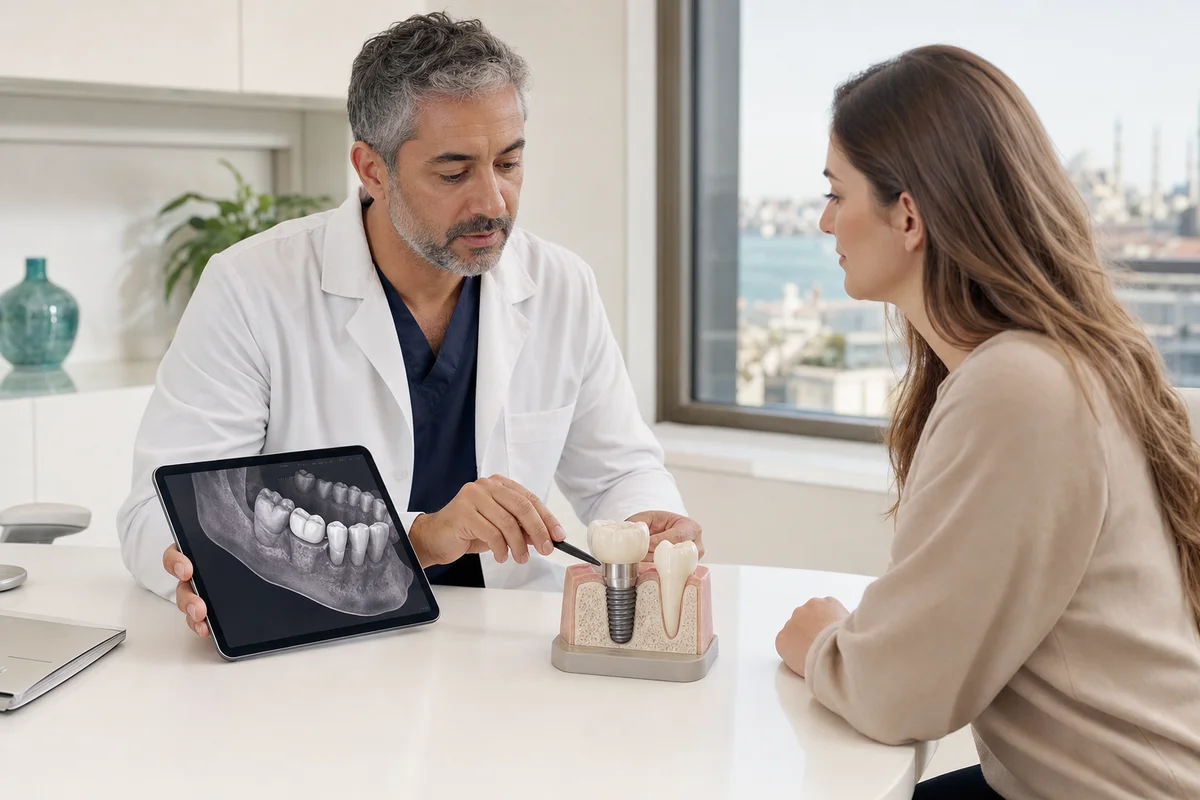
Quick answer: The average cost for molar implant treatment cannot be judged safely from one advertised figure. A complete comparison should identify the implant fixture, abutment, molar crown, imaging, surgical care, temporary restoration, possible grafting, follow-up and complication policy. Only a dentist who has examined your mouth and reviewed appropriate imaging can define which of those items are clinically necessary.
Searching for the average cost for molar implant treatment often produces numbers that look comparable but describe different things. One quote may cover only the implant body placed in the jaw. Another may include the abutment and final crown. A third may add three-dimensional imaging, extraction, bone grafting, sedation, provisional care and reviews. Those offers are not equivalent, even if every one of them is labelled “molar implant.”
A molar also has a demanding job. It absorbs substantial chewing forces, sits in a region where access and cleaning can be more difficult, and may be close to the maxillary sinus or an important lower-jaw nerve. The correct plan therefore begins with diagnosis, not a price list. This guide explains how to turn the average cost for molar implant search into a clinically sensible, like-for-like comparison without presenting a fixed fee, a remote diagnosis or a treatment guarantee.
What does the average cost for molar implant actually include?
The first useful question is not “What is the number?” but “What is included in the number?” The US Food and Drug Administration describes a dental implant system as an implant body placed in the jaw and an abutment that supports an artificial tooth. For a single missing molar, that artificial tooth is usually a crown. In everyday advertising, however, the word implant may refer to only one of these components or to the whole course of care.
Any average cost for molar implant figure should therefore be read as a scope statement. If the scope does not say whether a fixture, connector and definitive restoration are included, the figure cannot answer what a functioning replacement will require.
A meaningful average cost for molar implant comparison normally separates at least three core parts:
- Implant body or fixture: the device surgically placed in the jawbone.
- Abutment: the connector between the implant and the restoration; it may be standard or customised.
- Final molar crown: the visible chewing surface designed to fit the bite and adjacent teeth.
Those components are only the centre of the plan. Assessment, radiographs or cone-beam CT when clinically indicated, anaesthesia, sterile surgical materials, sutures, healing components, scans or impressions, laboratory work and scheduled reviews may be billed separately. An unusually low starting figure may be accurate for a limited item while still being misleading as a prediction of total treatment.
Ask the clinic to write down the brand and model of the implant system as well. The FDA specifically advises patients to ask for this information and keep it in their records. Brand alone does not decide quality or suitability, but documented components make future maintenance and repair easier to organise.
For that reason, the average cost for molar implant is more useful when paired with component traceability and a maintenance plan than when it is presented as a stand-alone promotional number.
Why a molar site can change the treatment scope
The average cost for molar implant treatment is influenced by anatomy and function more than by the label “molar.” Upper and lower molars present different planning questions, and two people missing the same tooth number may need different procedures.
Upper molars and the maxillary sinus
The roots of upper back teeth may sit near the floor of the maxillary sinus. After tooth loss, the available bone height can be limited. A dentist may need sectional imaging to evaluate the relationship and decide whether standard placement is possible, whether a staged approach is safer or whether sinus augmentation should be discussed. A sinus procedure is not automatically required for every upper molar; including it before imaging would be speculation. This is one reason the average cost for molar implant cannot be personalised before anatomical assessment.
When it is genuinely necessary, sinus-related treatment changes the average cost for molar implant because it introduces additional materials, surgical time, healing and reviews. A written proposal should state whether the procedure is definite, conditional on imaging or only a possible contingency.
Lower molars and the mandibular nerve
Lower molar planning considers the location of the inferior alveolar nerve canal as well as bone width, tooth position and bite. The FDA lists post-surgical numbness from nerve impingement or damage among recognised implant risks. That does not mean nerve injury is expected; it means safe planning should identify relevant anatomy and explain material risks before consent.
If a quote for the average cost for molar implant omits diagnostic planning entirely, ask how the clinician will assess implant dimensions and distance from anatomical structures. More imaging is not always better, but the imaging selected should be justified by the clinical question.
Chewing load, crown shape and bite
A molar crown must work within the patient’s bite. Crown material, available space, opposing teeth, tooth grinding, jaw relationship and whether neighbouring teeth are stable can affect design. A night guard may be discussed when there is evidence of bruxism, but it should not be added automatically to every plan. A responsible average cost for molar implant estimate separates required crown design from optional protective care.
Laboratory design is therefore part of the average cost for molar implant, not a cosmetic afterthought. Ask whether the quoted crown is the definitive restoration, what material is proposed, how the fit and bite will be checked, and what the clinic’s adjustment or remake policy covers.
Clinical items that can move the total above or below an online average
Online estimates cannot reveal whether the tooth is still present, whether infection is active, whether bone volume is adequate or whether gum disease is controlled. These findings may alter the sequence, number of visits and materials. They also explain why the average cost for molar implant is not a diagnosis.
- Consultation, medical history, periodontal assessment and bite evaluation.
- Two-dimensional radiographs or cone-beam CT when clinically indicated.
- Extraction of a remaining molar, including management of a difficult or fractured root.
- Socket preservation, local bone grafting or sinus augmentation if required.
- Immediate, early or delayed implant placement based on site conditions.
- Local anaesthesia and any separately justified sedation or facility charge.
- Healing abutment, temporary tooth solution and soft-tissue management.
- Digital scan or impression, abutment and definitive molar crown.
- Reviews, radiographs, bite adjustment and maintenance instructions.
Not every patient needs every item. For example, an intact healed site with adequate bone may have a more straightforward scope than a freshly extracted infected molar with a defect. Conversely, a package that includes procedures you do not need is not automatically better value. The most useful estimate is personalised and itemised.
That itemisation turns the average cost for molar implant from an internet benchmark into a decision aid: confirmed care is separated from possible additions, and the patient can see what clinical finding would activate each contingency.
Average cost for molar implant: a like-for-like decision table
Use the table below to compare scope rather than headline price. Put each clinic’s answer in writing. If a field is marked “if needed,” ask who decides, when that decision is made and how the extra fee is authorised. In this format, the average cost for molar implant is evaluated against a defined clinical endpoint.
| Quote item | What to confirm | Why it changes comparability |
|---|---|---|
| Diagnosis and imaging | Examination, radiographs, CBCT indication and reporting | A device price without anatomical planning is not a complete care estimate |
| Implant system | Fixture, brand/model, cover screw or healing component | Some advertised figures cover only the surgically placed component |
| Abutment | Standard or custom, material and laboratory charge | The connector may be omitted from an entry price |
| Definitive crown | Material, laboratory, scan/impression, fit and bite checks | A complete molar replacement requires the restoration, not just the fixture |
| Site preparation | Extraction, graft, membrane or sinus procedure and whether each is conditional | Anatomy can add stages, materials and healing time |
| Aftercare | Scheduled reviews, suture removal, urgent contact and adjustment policy | Low initial quotes may shift routine follow-up to separate charges |
| Contingencies | What happens if integration is delayed or an alternative plan becomes necessary | A guarantee is inappropriate, but responsibilities and exclusions should be clear |
A fair average cost for molar implant comparison uses the same clinical endpoint in every column: a functioning, maintainable single molar restoration, with necessary diagnostics and follow-up identified. Comparing a fixture-only promotion with a full implant-abutment-crown plan will produce a false saving.
How to request a complete written quote
The NHS advises that a treatment plan should state proposed treatment and costs, distinguish NHS and private options, and be updated when findings change. Although those rules belong to the UK system, the patient-safety principle travels well: proposed care and financial scope should be documented before irreversible treatment. The same discipline makes an average cost for molar implant comparison auditable.
For an average cost for molar implant enquiry, send records only through a clinic’s secure process and expect any remote indication to remain provisional. A final plan normally requires clinical examination and appropriate diagnostic records.
- Name the clinical endpoint. Ask for a single molar implant, abutment and definitive crown, not simply “an implant.”
- Request included and excluded items. Separate diagnosis, surgery, prosthetic work, laboratory, medication and reviews.
- Mark conditional procedures. Grafting or sinus treatment should be labelled as confirmed, possible or not currently indicated.
- Ask for timing. Identify which appointments are surgical, which are restorative and what healing milestones determine the next stage.
- Clarify revisions. Ask how new findings, plan changes or additional treatment are approved and priced.
- Keep device records. Request implant brand, model and component information for future maintenance.
When comparing Redent Klinik with another provider, use the same checklist for both. The clinic’s dental implant overview can help you frame questions, while the contact page provides the appropriate route for an individual assessment. These links do not replace examination and do not promise that implant treatment is suitable.
Insurance, Medicare and financing questions
Insurance wording can change what a patient actually pays, even when the clinical proposal is identical. “Dental implant benefit” may refer to the surgical fixture, the crown, a percentage subject to an annual maximum, or no routine benefit at all. Verify the implant, abutment, crown, extraction, graft and imaging separately with the payer. The average cost for molar implant and the patient’s eventual out-of-pocket amount are therefore different questions.
For US patients, the Centers for Medicare & Medicaid Services states that Medicare generally excludes services connected with the care, treatment or replacement of teeth, while allowing limited coverage when dental care is inextricably linked to the clinical success of specified Medicare-covered services. Medicare Advantage plans may offer additional dental benefits. This is why the average cost for molar implant should never be described as “covered” or “not covered” without checking the person’s plan and clinical circumstances.
Ask the clinic for procedure descriptions or codes if your payer requires them, but do not assume a pre-authorisation is a guarantee of payment. Confirm deductibles, waiting periods, annual limits, missing-tooth clauses, network rules, laboratory benefits and whether reimbursement is paid to the clinic or patient. For financing, compare the total repayable amount, term, fees and late-payment consequences rather than only the monthly instalment.
Local care and treatment abroad: compare the whole pathway
Geography can influence fees, but it also changes travel, continuity and the practical response to a problem. A lower average cost for molar implant in another country is relevant only when the quoted clinical scope, clinician qualifications, device documentation, laboratory restoration and follow-up pathway are comparable.
A molar implant usually involves more than one phase. The FDA notes that healing of the implant body may take several months or longer. The precise schedule varies with the site, stability, grafting, general health and restorative plan. Travel attached to an average cost for molar implant offer should be planned around clinical milestones, not an assumed healing date.
- Who performs the examination, surgery and final restoration?
- How many trips and appointments are expected, and which dates remain provisional?
- What records, scan files and implant labels will you receive?
- Who provides urgent assessment after you return home?
- Which follow-up visits are included, and which require travel?
- How are plan changes, remakes or complications documented and charged?
Add flights, accommodation, local transport, time away from work, an accompanying person if needed and possible return travel to the comparison. These are not dental fees, but they affect the real-world budget. A responsible clinic should allow enough time for assessment and informed consent rather than compressing treatment to fit a holiday itinerary.
Safety and suitability should come before the average
The FDA advises patients to discuss benefits, risks and candidacy with a dental provider. Overall health affects suitability and healing; smoking can impair healing; and recognised risks include injury to nearby teeth or tissues, infection, implant or screw loosening, inadequate function, difficulty cleaning and nerve-related numbness. Listing these possibilities does not predict an individual outcome. It supports informed consent and keeps the average cost for molar implant secondary to suitability.
Before interpreting the average cost for molar implant, tell the clinician about medicines, allergies, smoking or nicotine use, diabetes, previous radiotherapy, osteoporosis medicines, immune conditions and relevant operations. Do not stop prescribed medication on the basis of an online article. Medication changes require coordination with the prescriber and treating dentist.
Gums and neighbouring teeth also matter. The National Institute of Dental and Craniofacial Research recommends daily plaque removal and regular dental care as foundations of oral health. An implant crown does not decay like a natural tooth, but plaque-related inflammation can affect the surrounding tissues. Maintenance time and professional reviews belong in long-term planning.
Red flags in an average cost for molar implant advertisement
A promotional price is not automatically unsafe. The concern is whether the message prevents informed comparison or substitutes marketing for assessment. Pause and request clarification when the average cost for molar implant offer shows any of the following:
- No distinction between implant fixture, abutment and final crown.
- A “guaranteed” result, lifetime outcome or universal treatment time.
- A fixed total before examination or review of suitable imaging.
- Bone grafting presented as mandatory for everyone or never necessary for anyone.
- No named clinician, professional registration route or treatment location.
- No written explanation of aftercare, emergencies or plan changes.
- Pressure to pay immediately before questions or alternatives are discussed.
- Testimonials used as proof that your anatomy will have the same result.
Patient photographs and individual stories cannot establish your prognosis. Ask instead about diagnosis, alternatives, expected limitations, material risks and what happens if the original plan is no longer appropriate. A professional answer can include uncertainty without being evasive.
Questions to ask at the implant consultation
Take the written quote and this list to the appointment. The goal is not to challenge the clinician; it is to understand the plan well enough to consent. The answers will make an average cost for molar implant comparison more informative than a collection of internet prices.
- Why is an implant preferred over a bridge, removable option or monitored space in my case?
- What findings show that the site is ready, and what imaging is clinically justified?
- Is extraction needed, and can placement be immediate or should it be staged?
- Is grafting confirmed, conditional or unlikely based on the current evidence?
- Which implant system, abutment type and crown material are proposed?
- How will the molar bite and cleaning access be checked?
- What healing milestones must be met before the definitive crown?
- Which appointments, records, adjustments and urgent reviews are included?
- What alternatives remain available if implant treatment is unsuitable?
Frequently asked questions
Is the average cost for molar implant the same as the price of one implant?
Not necessarily. “One implant” may mean only the fixture in the jaw, while complete single-molar treatment usually also involves an abutment and crown. Assessment, imaging, surgery, healing components, laboratory work and follow-up may be included or separate. Ask for an itemised endpoint rather than relying on the label.
Why can the average cost for molar implant be higher for an upper molar?
Some upper molar sites have limited bone beneath the maxillary sinus, so additional assessment or augmentation may be considered. Many upper molars do not need a sinus procedure. Only examination and appropriate imaging can establish the anatomy and whether an added stage is justified.
Does the quote normally include the abutment and crown?
There is no universal advertising convention. Some quotes include the whole implant-abutment-crown pathway; others quote the fixture first. The FDA’s component description is a useful reminder to ask about all parts. Get the proposed crown material, laboratory work and bite adjustments in writing.
Does a bone graft always increase the average cost for molar implant?
If grafting is clinically required, it can add materials, surgical care and follow-up, but not every molar site needs it. Ask whether grafting is confirmed or conditional, what defect it is intended to address, whether alternatives exist and how the fee changes if it is not performed.
Can a dentist confirm my total from a photograph?
A photograph may help an initial conversation, but it cannot show bone dimensions, infection, nerve or sinus relationships, periodontal condition or the complete bite. A remote estimate should remain provisional until the treating clinician examines you and reviews the records needed for a diagnosis.
Does Medicare pay the average cost for molar implant treatment?
Routine replacement of teeth is generally excluded from Original Medicare, according to CMS, although defined dental services may be covered when inextricably linked to specified covered medical care. Medicare Advantage benefits vary. Check the exact plan and obtain payer confirmation; do not assume that an implant package is covered.
Is the cheapest molar implant quote the best value?
It may be appropriate, incomplete or unsuitable; the number alone cannot tell you which. Compare the same diagnostic, surgical, restorative and aftercare scope. Consider clinician accountability, records, component traceability, travel and contingency arrangements as well as the initial fee.
How long does molar implant treatment take?
The sequence depends on extraction status, infection, bone, grafting, implant stability, health and the restorative plan. The FDA notes that implant-body healing may take several months or longer. Your dentist should describe milestones and uncertainty rather than guarantee one universal completion date.
What should I receive after molar implant treatment?
Ask for the treatment summary, relevant radiographs or scan access, implant brand and model, component or batch information when supplied, crown details, maintenance instructions and emergency contact route. Keep these records because another dentist may need them for future review or repair.
What is the safest next step after researching the average cost for molar implant?
Arrange an assessment with a suitably qualified dental professional, bring your medical and medication history, and ask for an itemised written plan with alternatives. Compare only equivalent scopes. Seek prompt dental advice for swelling, fever, uncontrolled bleeding, spreading infection, new persistent numbness or severe worsening pain.
A practical conclusion
The average cost for molar implant is useful as a search starting point, not as a treatment prescription. The safest comparison defines the same endpoint, records which steps are necessary, distinguishes confirmed and conditional procedures, and explains aftercare. A transparent quote should make it easy to see the fixture, abutment, crown, diagnostics, possible site preparation, reviews and exclusions.
Once those details are aligned, price becomes meaningful. Until then, a low number and a high number may simply describe different care. Choose the plan that is clinically justified for your anatomy, clearly documented, maintainable and supported by a realistic follow-up route.
Sources
- US Food and Drug Administration — Dental Implants: What You Should Know
- Centers for Medicare & Medicaid Services — Medicare Dental Coverage
- NHS — Dental services available on the NHS
- American Dental Association MouthHealthy — Dental Implants
- American Dental Association — Professional and public oral-health resources
- National Institute of Dental and Craniofacial Research — Oral Hygiene
- World Health Organization — Oral Health