
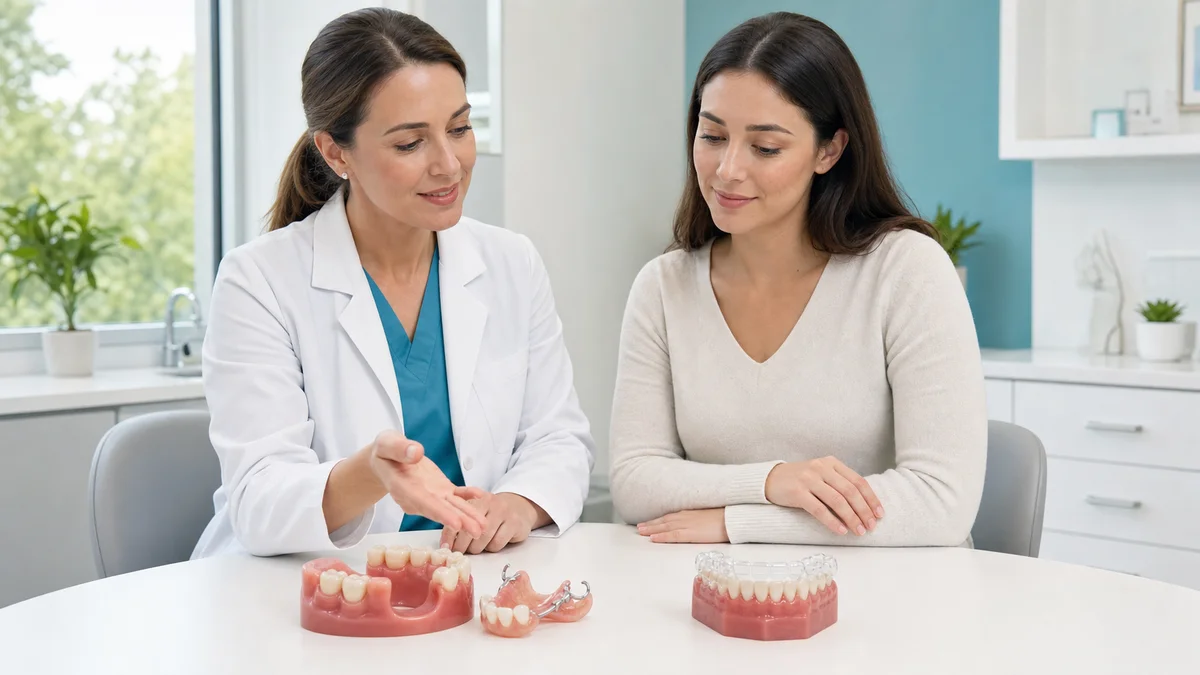
When people ask dentures or clear aligners which is better, they are often comparing two removable objects that look superficially similar. Clinically, however, they perform different jobs. A denture carries artificial teeth and replaces teeth that are absent. A clear aligner fits over natural teeth and applies planned force to move them. The useful first question is therefore not “Which appliance do I prefer?” but “Which teeth are present, which can be maintained, and what should happen to each space?”
This distinction immediately separates three very different situations. A person with a full natural dentition and crowding may need orthodontic assessment but has no missing teeth for a denture to replace. A person with no natural teeth in an arch cannot use clear aligners to move teeth that are not there. A person with some missing teeth and some maintainable teeth may need a coordinated plan in which teeth are moved, spaces are opened or closed, and a partial denture is made or revised after the final tooth positions are known.
The NHS defines complete dentures as replacements for all upper or lower teeth and partial dentures as replacements for one or more missing teeth. The British Orthodontic Society describes clear aligners as a series of close-fitting appliances that move teeth incrementally after comprehensive assessment, diagnosis and treatment planning. Those definitions show why these treatments are not substitutes. One replaces a part of the dentition; the other changes the position of the natural dentition.
This article cannot decide whether a particular tooth is maintainable or whether a missing tooth should be replaced. Examination may include periodontal measurements, caries and restoration assessment, mobility, vitality testing, bite analysis, suitable radiographs, medical and social history, and evaluation of any existing denture or implant. A digital scan alone cannot reveal every condition that changes prognosis.
Why dentures or clear aligners which is better Starts With an Arch Inventory
An “arch inventory” records what is actually present in the upper and lower jaws. The inventory should distinguish healthy natural teeth, restored teeth, crowned teeth, root-treated teeth, retained roots, missing spaces, dental implants, bridge units, complete dentures, partial dentures and overdentures. It should also record whether the tissues are healthy enough to support movement or a removable prosthesis.
The number of teeth alone is not enough. Two people may each have eight remaining teeth, yet need completely different plans. In one mouth, the teeth may be strategically distributed, comfortable and periodontally stable. In another, they may be clustered on one side, mobile, decayed or unable to support a predictable partial denture. A prognosis must consider position, support, restorability, cleansability, function and the patient’s ability to maintain care.
This inventory prevents a common category error: using a replacement treatment to solve a positioning problem or using a movement appliance to solve tooth loss. It also identifies when the real decision is not dentures versus aligners, but retention versus extraction, space closure versus space preservation, or temporary versus definitive tooth replacement.
What Dentures Can and Cannot Do
Dentures are removable prostheses. A complete denture replaces all teeth in an arch. A partial denture replaces selected missing teeth and may use remaining teeth and oral tissues for support, stability and retention. An overdenture fits over retained teeth, roots or implant components. The design, materials and suitability depend on the clinical situation.
Dentures can restore visible tooth form, help fill missing-tooth spaces and assist speech and chewing. They can also replace some lost gum contour. An immediate denture may be inserted around the time teeth are removed, but the NHS explains that healing changes the shape of the mouth and immediate dentures often require adjustment or replacement. A “same-day” appliance is therefore not necessarily the final fit.
- Dentures may provide: removable replacement of one, several or all missing teeth; support for appearance and speech; and a reversible, adaptable option in selected changing mouths.
- Dentures do not provide: biological movement of natural teeth, treatment of active decay or gum disease, regeneration of lost bone, correction of a jaw discrepancy or a guaranteed return to natural-tooth chewing.
- Dentures still require: daily cleaning, care of remaining teeth and oral tissues, review of fit and bite, and professional assessment when they become loose, sore, damaged or difficult to use.
The American College of Prosthodontists states that complete and partial dentures are medical devices with limited lifespans rather than permanent restorations. Oral tissues and ridges can change while the denture base does not change in the same way. Components can wear or fracture. A serviceable denture may be relined, rebased, modified or remade depending on fit, support, stability, bite, appearance, speech and patient experience.
What Clear Aligners Can and Cannot Do
Clear aligners are custom appliances that fit closely over natural teeth. Each stage is intended to move selected teeth a small distance toward planned positions. Attachments, elastics, interproximal reduction, refinements or additional appliances may be needed. Some orthodontic problems are suitable for aligners; others are more predictably treated with fixed appliances, combined mechanics or no treatment.
Aligners may improve selected crowding, spacing, rotations and bite relationships. In a mouth with missing teeth, orthodontics may close a space or create and preserve an appropriate space for later replacement. The American Association of Orthodontists notes that clinicians may move neighboring teeth together or hold open space for a bridge or implant. The same space-planning principle can inform a future partial denture, but the prosthetic design must be coordinated with the orthodontic result.
- Aligners may provide: planned movement of suitable natural teeth and roots, redistribution of missing-tooth spaces and improvement of selected bite relationships.
- Aligners do not provide: artificial teeth that function as a denture, movement of dental implants, cure of active oral disease or guaranteed correction of every orthodontic problem.
- Aligners still require: proper diagnosis, a named responsible clinician, monitoring, good hygiene, adherence to instructions and retention after active movement.
The British Orthodontic Society says aligners are commonly used for mild to moderate problems and that severe crowding, extraction treatment, complex movement or jaw discrepancy may require additional techniques. Missing teeth can make biomechanics and appliance fit more complex. Fewer teeth do not automatically make treatment simpler.
Decision Table: Identify the Arch Before Choosing the Path
This table is a consultation aid, not a diagnosis. The same person may have different conditions in the upper and lower arches.
| Arch situation | Role of dentures | Role of clear aligners | Priority question |
|---|---|---|---|
| All natural teeth present, with crowding or spacing | No missing teeth to replace; a denture is not a straightening appliance | May move suitable teeth after orthodontic diagnosis | Is treatment needed, and are aligners the right appliance for the movement? |
| One or a few missing teeth with stable neighboring teeth | A partial denture may replace selected spaces if clinically appropriate | May close a space or create a better space for replacement | Should each space be closed, preserved or redistributed? |
| Several missing teeth and tilted remaining teeth | A partial denture may restore the final spaces | May upright or reposition suitable abutment teeth before the final prosthesis | Can movement improve the path of insertion, support and cleansability of the denture? |
| Existing partial denture with teeth planned for movement | May need temporary modification, relining or replacement | May alter the tooth surfaces and spaces on which the denture depends | How will appearance and function be managed while the old denture no longer fits the changing arch? |
| Complete tooth loss in an arch | A complete denture or another prosthetic option may replace the missing dentition | No natural teeth exist for aligners to move | What prosthetic design, tissue condition and adaptation plan are appropriate? |
| Implant-retained overdenture | Uses implants for retention or support | Cannot move integrated implants; may only move suitable remaining natural teeth if any | Does the fixed implant position constrain the final tooth and denture arrangement? |
| Active decay, periodontitis, infection or painful denture trauma | Definitive design may be unreliable until disease and tissue injury are managed | Movement may be unsafe or inappropriate until oral health is stable | What must be stabilized before elective movement or final impressions? |
| Questionable remaining teeth and possible future tooth loss | An adaptable interim partial denture may help during reassessment in selected cases | Movement should not be planned around teeth without an agreed prognosis | Which teeth are maintainable, and when should prognosis be reevaluated? |
Complete Tooth Loss: Why Clear Aligners Are Not an Alternative
A complete denture is used when all natural teeth in an upper or lower arch are absent. Clear aligners move natural teeth through their supporting tissues. If an arch has no natural teeth, there are no crowns and roots for an aligner to move. A transparent tray made for a toothless ridge would not become orthodontic treatment merely because it looks like an aligner.
The clinical questions in complete tooth loss concern the condition of the oral tissues, ridge anatomy, jaw relationship, available restorative space, saliva, muscle control, expectations and the design of the replacement. Options may include a conventional complete denture or, for selected patients, an implant-assisted prosthesis. Each has different procedures, risks, maintenance and cost.
A complete denture can arrange artificial teeth to support appearance, speech and an intended bite, but it does not move jaw bones or recreate the sensory behavior of natural teeth. Fit may change over time as tissues and ridges change. Pain, persistent ulceration, looseness or inability to function should lead to assessment rather than repeated self-adjustment or indefinite adhesive use.
Partial Tooth Loss: Where the Two Pathways Can Meet
A partially dentate arch contains both natural teeth and missing spaces. This is where orthodontics and removable prosthodontics can become parts of one plan. The remaining teeth may be upright and well distributed, or they may have drifted, tilted or rotated into the spaces. The spaces may be too wide, too narrow or poorly distributed for a stable and cleansable replacement.
Orthodontic movement can sometimes improve the location of the remaining teeth before a partial denture is designed. British Orthodontic Society guidance for dentists notes that orthodontics may upright teeth to improve the path of insertion for fixed or removable prostheses and may reduce the need to remove healthy tooth tissue. That does not mean every partial-denture patient needs orthodontics. It means tooth position should be assessed before the definitive prosthesis locks in the current arrangement.
The final partial denture must fit the final arch, not the starting scan. If orthodontics changes spaces, contacts, undercuts or the inclination of teeth used for support or retention, an old partial denture may cease to fit properly. A new design, modification or transitional appliance may be needed. This is a foreseeable planning issue rather than a surprise to manage after movement begins.
Do Not Extract Maintainable Teeth Merely to Simplify the Choice
A request for dentures can sometimes reflect frustration with repeated treatment, appearance, pain, cost or fear rather than a clinical conclusion that all remaining teeth are non-maintainable. Removing a natural tooth is irreversible. A complete denture may be valuable when an arch is terminal, but it should not be presented as a universal shortcut for crowding or a way to avoid orthodontic diagnosis.
The American Association of Orthodontists cautions against having teeth removed simply to obtain dentures in young or middle-aged adults and emphasizes that orthodontics can be part of a comprehensive plan to keep teeth. That statement does not mean every tooth can or should be saved. Teeth with unfavorable fractures, severe structural loss, uncontrolled infection or inadequate support may have a poor prognosis. The point is that each tooth should earn its retention or extraction decision through assessment.
A balanced plan can be mixed. Some teeth may be retained, some treated, some removed, and missing areas restored with a partial denture. Initial disease control and reevaluation may change the prognosis. The newest NHS England care-pathway guidance emphasizes personalized plans based on risk and disease profiles, adaptability during active disease management and reassessment rather than premature definitive treatment.
A 9-Step Sequence for Missing Teeth and Misalignment
When both replacement and movement may be needed, the sequence should be written before custom devices are ordered.
- Map both arches. Record every natural tooth, restoration, missing space, implant, bridge, retained root and removable prosthesis. A full-mouth problem cannot be planned from one smiling photograph.
- Diagnose active disease and tissue injury. Address pain, infection, decay, periodontal inflammation, poorly fitting denture trauma and urgent structural problems. Elective alignment and definitive impressions should not hide active disease.
- Assign a tooth-by-tooth prognosis. Separate maintainable teeth, teeth needing treatment, uncertain teeth requiring reassessment and teeth that are unlikely to support the intended plan.
- Choose a goal for every space. Decide whether a space should close, remain, open to a specific size or be redistributed. The decision should consider roots, bite, appearance, hygiene and the future replacement.
- Select the movement method. Determine whether clear aligners can deliver the required movements or whether fixed appliances, sectional mechanics, auxiliaries or no movement are more appropriate.
- Plan transitional tooth replacement. If visible or functional teeth are missing during movement, agree how those spaces will be managed without obstructing the orthodontic appliance. Do not assume an existing partial denture and aligner can occupy the same surfaces.
- Reevaluate before final prosthodontics. Confirm oral health, tooth positions, stable spaces, bite and the prognosis of potential supporting teeth before definitive denture records.
- Coordinate denture and retainer design. A partial denture and orthodontic retainer may contact the same teeth. Their insertion paths, clasps, coverage and wear schedules must be compatible.
- Define maintenance and contingency care. Record who reviews the denture, who monitors retention, what happens if another tooth is lost and how urgent problems will be managed after travel.
Can an Existing Partial Denture Be Worn During Aligner Treatment?
Sometimes an existing denture can be modified or used at selected times, but compatibility should never be assumed. A partial denture may clasp teeth, use undercuts, cover tissue and depend on a precise path of insertion. An aligner covers tooth surfaces and may include attachments. If both appliances need the same surfaces or space, they may interfere, fail to seat or place unintended pressure.
The solution is case-specific. A clinician may modify a temporary denture, provide an alternative transitional replacement, incorporate an artificial tooth appearance into an orthodontic appliance in selected circumstances, or accept a planned period without the old prosthesis. The choice depends on function, appearance, the number and location of spaces, movement mechanics and safety. A patient should not trim either device at home to force them together.
As tooth positions change, the existing denture may become tight, loose or unstable. Pressure on moving teeth or oral tissues requires review. A denture that clicks, slips, causes pain or no longer fits should be assessed, consistent with NHS patient guidance. “Making it fit” with more adhesive does not correct a changed design relationship.
Immediate Dentures and Aligners Follow Different Timelines
An immediate denture is made before extraction and inserted around the time teeth are removed. It can provide prompt appearance and some function, but the tissues change during healing. The NHS notes that immediate dentures often need adjustment or replacement because the mouth changes shape. Final prosthetic decisions should account for that biological change.
Clear aligners, by contrast, are manufactured for a planned sequence of tooth shapes and positions. Extracting teeth, changing restorations or altering a denture-supporting contour after the aligner scan can make the trays inaccurate. When extractions and orthodontics are both planned, the responsible clinicians must agree which records are taken before and after each stage and how the extraction spaces will be managed.
A person should not be promised that an immediate denture is the permanent endpoint or that a pre-extraction aligner series will automatically remain valid after unplanned dental changes. Healing, fit and tooth movement all need review. Timelines are estimates, not guarantees.
Space Closure Versus Space Opening for Replacement
A missing-tooth space does not always have to be filled with an artificial tooth. In some patterns, orthodontics can close the space and reshape the bite. In others, the space should be opened or redistributed so a denture, bridge or implant can have appropriate dimensions. Hospital hypodontia services describe this collaborative choice between closing gaps and creating the correct amount of space for replacement.
The decision involves more than the visible width of a gap. Root positions, gum contours, midlines, opposing teeth, smile display, chewing contacts and future cleansability matter. Closing one space may shift another problem. Opening a space without stabilizing roots may leave an unsuitable site for the intended replacement.
If a partial denture is selected, the prosthodontic design should influence the orthodontic endpoint. Uprighting a tilted tooth can improve insertion and reduce overcontouring, but excessive or unnecessary movement adds time and risk. The team should identify the smallest movement that produces a meaningful restorative benefit.
Implants and Implant-Retained Dentures: A Fixed Constraint
Dental implants can support crowns, bridges or some dentures. They are integrated with bone and cannot be moved by conventional orthodontic forces, as the American Association of Orthodontists states. An implant-retained overdenture may be removable, but the implant positions beneath it are fixed.
If natural teeth remain, selected teeth may still be moved around the implant positions. This can be useful or limiting. An implant placed before space and bite planning may restrict the final arrangement. Attachments for an overdenture and the intended denture base also occupy restorative space, so orthodontic movements should not be planned in isolation.
A complete implant-retained denture does not create a reason for clear aligners in a fully edentulous arch. A partially dentate mouth with implants may require complex coordination among orthodontic, restorative and surgical clinicians. The patient should know which components are fixed, which are removable and which natural teeth, if any, are actually intended to move.
Disease Control Comes Before Either Elective Pathway
Orthodontic movement and denture construction both depend on a healthy, maintainable environment. The NHS states that orthodontic treatment should not begin without a good standard of oral hygiene because treatment can increase the risk of decay and gum problems. A partial denture also creates surfaces and spaces that need careful cleaning around remaining teeth and gums.
Active decay, uncontrolled periodontitis, fungal infection, painful ulceration and unstable teeth can invalidate a definitive plan. A denture may need adjustment while tissues heal. A tooth thought suitable for orthodontic support may have a worse prognosis after full assessment. Treatment should be phased when the diagnosis is uncertain, with interim solutions that can be adapted.
Smoking, diabetes control, dry mouth, medications, dexterity and the ability to clean appliances can influence risk and maintenance. These factors do not produce one automatic answer, but they belong in consent and design decisions. A treatment package that skips them is incomplete.
Retention and the Final Partial Denture Must Work Together
After orthodontic movement, teeth can change position again. The British Orthodontic Society says retainers are required after aligner treatment. A partial denture may also help resist some drifting by occupying spaces, but it is not automatically a substitute for a prescribed orthodontic retainer.
The two devices must be designed as a system. A removable retainer may cover surfaces needed by denture clasps. A fixed retainer may affect cleaning or the path of insertion. A denture flange or connector may interfere with retainer coverage. Coordinating digital or physical records can avoid making two individually accurate devices that cannot be worn as intended.
If another tooth is later lost, an acrylic partial denture may sometimes be adapted, while other designs may be less modifiable. Any change can affect retention and bite. The NHS England care-pathway guidance highlights adaptability in patients whose disease profile and future needs are changing. The long-term plan should include what happens if the arch inventory changes.
Daily Life and Maintenance Are Different, Not Easier Versus Harder
Clear aligners are removed for eating and cleaned as directed, while natural teeth require thorough brushing and interdental care. Wearing trays over plaque or frequent sugar exposure can increase risk. Patients must follow the responsible clinician’s wear and review instructions and report trays that no longer seat, persistent pain or damaged teeth.
Dentures are removed and cleaned, and the gums, tongue and remaining teeth also need care. NHS advice includes removing dentures at night unless a dentist advises otherwise and avoiding abrasive toothpaste on the prosthesis. Dentures can break if dropped, and worn or loose appliances need professional review. Patients should not self-repair a fractured base or bend clasps.
Neither pathway ends when the device is delivered. Aligners lead to retention; dentures lead to adaptation, review and periodic reassessment of fit. A person with both treatments may have two maintenance routines. Choosing on the basis of which device looks simpler in an advertisement can underestimate the actual responsibilities.
Cost, Time and Insurance: Compare the Complete Sequence
A denture fee and an aligner fee describe different scopes. Denture care may include extractions, healing reviews, immediate or transitional appliances, impressions or scans, jaw records, try-ins, fitting, adjustments, relining or later remake. Orthodontic care may include records, attachments, active appliances, monitoring, refinements and retainers. Combined care may include both, plus coordination and replacement of an old partial denture.
Costs vary with the number and prognosis of teeth, materials, design, complexity, imaging, laboratory work, clinician expertise, treatment location and aftercare. Insurance coverage depends on policy wording, clinical criteria, networks, waiting periods and exclusions. A clinic cannot guarantee reimbursement on behalf of an insurer.
Time also depends on biology and sequence. Disease stabilization, extraction healing, orthodontic movement, refinement and denture fabrication can each alter the schedule. A promised universal finish date is not reliable. Ask for milestones, dependencies and a contingency budget rather than one unexplained package total.
Coordinating Treatment With Redent Klinik in Turkey
Patients considering care in Turkey can use a consultation to establish the arch inventory, tooth prognosis and intended sequence before travel. The Redent Klinik English website introduces the clinic, and the Redent Klinik contact page can be used to request an assessment. Remote records can support preparation, but an in-person examination may be essential before extraction, orthodontic movement or definitive denture impressions.
For combined care, request a written plan that identifies who is responsible for disease control, movement, transitional replacement, the final denture and retention. Ask how many in-person stages are expected and how an aligner, denture or sore area will be managed after returning home. Long-term maintenance should be possible where the patient lives.
A responsible plan does not guarantee that every tooth can be saved, that an aligner will deliver every movement or that a denture will feel like natural teeth. It explains uncertainty, alternatives and follow-up before consent.
Consultation Questions and Red Flags
Useful questions turn the comparison into a clinical roadmap:
- Which teeth are healthy, treatable, uncertain or unlikely to remain?
- For each missing space, is the goal closure, preservation, enlargement or redistribution?
- Would tooth movement materially improve the denture design, bite or cleansability?
- Are clear aligners capable of the required movement, or are other orthodontic mechanics more suitable?
- Can the current partial denture be used safely during movement, and when would it need modification?
- How will visible missing teeth be managed during treatment?
- When will definitive denture impressions or scans be taken?
- How will the final denture and orthodontic retainer fit and function together?
- What maintenance, replacement and emergency arrangements are included?
Red flags include recommending extraction of maintainable teeth simply to avoid orthodontic planning; offering aligners for a completely toothless arch; taking final denture records before planned movement without explaining why; ignoring active gum disease or denture trauma; assuming implants can move; providing no transitional replacement strategy; claiming permanent denture fit; guaranteeing a finish date or outcome; or offering remote movement without a named clinician and access to in-person care.
Frequently Asked Questions
dentures or clear aligners which is better if I have all my natural teeth?
If all teeth are present and the concern is crowding, spacing or bite, there are no missing teeth for a denture to replace. Orthodontic assessment can determine whether treatment is needed and whether aligners, fixed appliances or another approach is suitable. Healthy teeth should not be extracted merely to simplify a cosmetic plan.
Can clear aligners work if I have a partial denture?
Possibly, if suitable natural teeth remain and the movement is appropriate. The existing denture may interfere with aligner coverage or attachments and may stop fitting as teeth move. A coordinated transitional and final prosthetic plan is needed before treatment starts.
Can a complete denture straighten my bite?
A complete denture can arrange artificial teeth to create an intended prosthetic bite, but it does not move natural roots or correct the underlying jaw bones. Fit, jaw relationship and muscle control require clinical assessment. Significant skeletal problems may need different specialist advice.
Can aligners replace a missing tooth?
No. Aligners move existing teeth; they do not create a functional replacement tooth. In selected treatment, an appliance may carry a temporary cosmetic tooth shape in a space, but definitive replacement or planned space closure is a separate clinical decision.
Should orthodontics be completed before a new partial denture?
Often the definitive partial denture is designed after planned tooth movement because spaces, inclinations and contacts may change. However, urgent function or appearance may require an interim solution, and not every case needs orthodontics. The sequence depends on prognosis, movement goals and prosthetic design.
Will my old partial denture fit after clear aligners?
It may not. Orthodontics can change the positions and undercuts on which the denture depends. The old appliance may need modification, relining or replacement. It should never be forced into place or adjusted at home.
Can clear aligners move implants under an overdenture?
No. Integrated dental implants cannot be moved by conventional orthodontic forces. Suitable remaining natural teeth may sometimes be moved around fixed implant positions, but the implants and overdenture attachments become constraints in the plan.
Do missing teeth always need a denture?
Not always. A space may be accepted, closed orthodontically or restored with a denture, bridge or implant depending on location, function, appearance, bite, health and preference. The consequences of leaving or changing the space should be explained before choosing.
Can I wear my denture and aligners at the same time?
Do not assume so. Both devices may need the same tooth surfaces or space, and forcing them together can prevent full seating or create pressure. The dental team must design a compatible schedule or transitional appliance for the individual case.
Which treatment lasts longer?
The comparison is misleading because the treatments have different endpoints. Orthodontic movement requires ongoing retention, while dentures need review and may require adjustment, relining, repair or replacement as the mouth and device change. Neither has a guaranteed lifetime.
Conclusion: Choose the Arch Plan Before the Appliance
The answer to dentures or clear aligners which is better begins with the arch inventory. Dentures replace teeth that are missing. Clear aligners move suitable natural teeth. A completely toothless arch needs prosthetic planning, not aligner treatment. A partially dentate arch may benefit from disease control, selective movement, space planning, transitional replacement and a definitive denture designed for the final positions.
Protect maintainable teeth, identify fixed implant constraints, decide the purpose of every space and coordinate the final denture with retention. The right sequence is more important than the superficial similarity of two removable devices.
Official Sources and Clinical References
- NHS: Dentures
- NHS: Orthodontics
- NHS England: Dentistry care pathways guidance, including prosthodontic provision
- British Orthodontic Society: Clear aligners
- British Orthodontic Society: Orthodontics before fixed or removable prostheses
- American Association of Orthodontists: Missing teeth and comprehensive orthodontic planning
- American Association of Orthodontists: Dental implants and orthodontic movement
- American College of Prosthodontists: Frequency of denture replacement position statement
- Leeds Teaching Hospitals NHS Trust: Removable partial dentures
- University College London Hospitals: Orthodontic and restorative planning for missing teeth
- American Dental Association: Oral health professional resources
- World Health Organization: Oral health fact sheet