
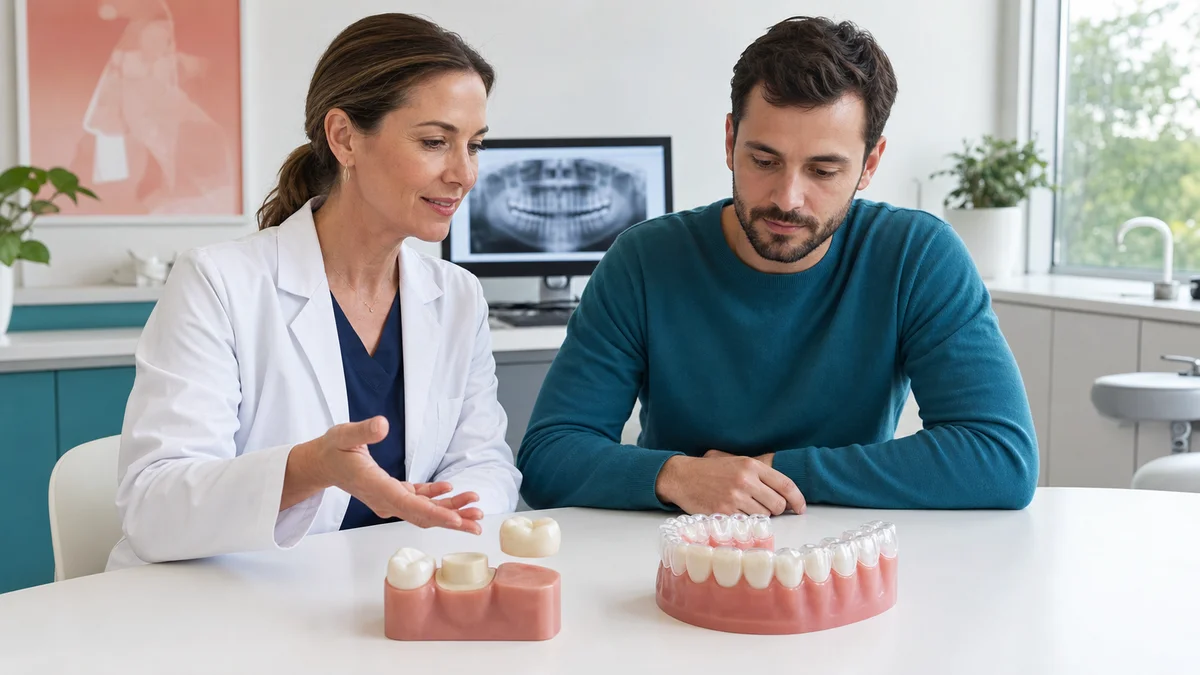
Asking zirconia crowns or clear aligners which is better sounds like a comparison between two products, but it is really a choice between two different biological goals. A crown changes the outer form of a tooth and replaces lost or weakened structure. An aligner applies controlled forces so a tooth and its root can move through supporting tissues. One restores; the other repositions. The safest decision starts by identifying which problem is present rather than choosing the treatment that appears faster or more cosmetic.
This distinction becomes especially important when a smile has both damage and misalignment. A tooth may be cracked and crowded. An old crown may no longer match the planned final bite. A crown on a natural tooth may be movable, whereas an implant-supported crown is attached to an implant that conventional orthodontic forces cannot move. A bridge may connect several units and limit how independently they can be repositioned. These are treatment-order questions, not simple material preferences.
The British Orthodontic Society explains that clear aligner treatment should follow a comprehensive assessment, diagnosis and treatment plan. The NHS describes a crown as a cap that fully covers a real tooth and notes that the tooth must be shaped for the restoration. Taken together, these points show why diagnosis matters: crown preparation changes tooth structure, while orthodontic movement changes tooth position and bite. Neither should be prescribed from photographs, a digital smile simulation or a price list alone.
This guide is educational and cannot determine whether a specific tooth needs coverage, movement, both treatments or neither. That decision may require examination, periodontal assessment, bite analysis, vitality testing, suitable radiographs, evaluation of existing restorations, and a discussion of alternatives. The aim here is to help patients recognize the sequence questions that should be answered before irreversible work or custom aligners begin.
Why zirconia crowns or clear aligners which is better Is Not a Product Contest
Zirconia is a family of ceramic materials used for indirect restorations. It may be selected for a crown when a tooth needs substantial restoration and the clinical design, available space, appearance, bite and laboratory plan support that choice. “Zirconia” does not itself diagnose a tooth, and it is not automatically the best crown material for every location. A clinician must still decide whether a crown is indicated and then whether zirconia is appropriate.
Clear aligners are a series of custom appliances designed to move teeth incrementally. They can address selected alignment and bite problems, but suitability varies. Some movements are less predictable with aligners alone, and complex crowding, extraction patterns, significant jaw discrepancies or difficult root movements may require attachments, auxiliaries, fixed appliances or a different plan. The appliance should follow the orthodontic diagnosis.
Because the goals differ, “better” must be completed with a purpose: better for protecting a structurally weak tooth, better for moving a healthy tooth, better for managing an implant in the arch, or better for establishing the bite before final restorations. A crown can sometimes make one tooth look straighter by changing its visible contour, but it does not move the root or correct the relationship among the jaws. An aligner can move a suitable tooth, but it cannot replace missing enamel, seal a crack, remove decay or rebuild a failing restoration.
What a Zirconia Crown Can and Cannot Change
A crown is a full-coverage restoration. It may be considered when a tooth has extensive structural loss, a large failing restoration, fracture, severe wear, or another condition that makes a direct filling unsuitable. The exact indication is tooth-specific. Root canal treatment alone does not make every tooth identical, and a cosmetic concern alone does not prove that full coverage is justified.
To receive a conventional crown, the tooth is prepared so the restoration has sufficient space and an appropriate shape. The NHS and NHS restorative services describe filing or shaping the tooth before impressions or other records are made. That removal cannot be undone. A crown may improve the visible shape, shade and proportions of the prepared tooth, but the underlying root remains where it was unless orthodontic forces move it.
- A crown may do: restore form, cover weakened structure, recreate contacts, contribute to bite stability and improve the appearance of an indicated restoration.
- A crown cannot do: biologically align roots, correct crowding across an arch, change a skeletal jaw relationship, treat active gum disease or guarantee that a tooth will never fracture or decay.
- Zirconia does not remove planning variables: tooth preparation, margin design, thickness, surface finish, cementation or bonding, opposing teeth, grinding, laboratory accuracy and daily hygiene still matter.
The American Dental Association notes that zirconia offers high strength and developing translucency options, while also identifying concerns such as chipping or fracture, loss of retention and wear of opposing teeth. The clinical message is not that zirconia is good or bad. It is that material selection and execution must fit the indication, and long-term outcomes cannot be guaranteed from the material name.
What Clear Aligners Can and Cannot Change
Clear aligners fit over the teeth and are changed in a planned sequence to apply pressure in selected directions. They can move natural teeth when the supporting tissues are healthy enough and the planned movements are clinically achievable. Treatment may involve attachments bonded to teeth, elastics, refinement aligners or other aids. Wear instructions and review intervals should come from the responsible clinician because they depend on the system and individual plan.
Aligners act on position; they do not rebuild damaged tissue. If a tooth has active decay, an unstable fracture, untreated infection or a restoration that cannot safely withstand treatment, those problems need assessment before movement. Similarly, alignment does not automatically correct tooth color, unusual shape or lost structure. A patient may still need conservative cosmetic or restorative care after orthodontics, but the final need can sometimes be smaller once the teeth are in more favorable positions.
- Aligners may do: improve selected crowding, spacing, rotations and bite relationships while allowing removal for eating and cleaning.
- Aligners cannot promise: treatment of every malocclusion, movement without attachments, a fixed finish date, permanent stability without retention or identical results for different patients.
- Supervision still matters: the British Orthodontic Society states that clear aligner care is a medical procedure requiring a named dentist or orthodontist, appropriate diagnosis, ongoing monitoring and access to face-to-face care when needed.
After active movement, retainers help maintain the new positions. Teeth can relapse, and retention is a long-term responsibility. The future shape of a crown also matters because an old retainer may not fit after a restoration is replaced. Orthodontic and restorative teams therefore need to coordinate the final scan, crown contour and retention plan.
Decision Table: Match the Main Problem to the Correct Sequence
The following table is a discussion guide, not a diagnosis. More than one row may apply to the same mouth, and urgent disease control always takes priority over elective appearance goals.
| Clinical situation | What a zirconia crown may contribute | What clear aligners may contribute | Key order question |
|---|---|---|---|
| Healthy teeth with crowding or spacing | Usually not a first-line method merely to make intact teeth appear straight | May move suitable teeth after full orthodontic diagnosis | Can alignment preserve sound tooth structure and reduce later restorative need? |
| One damaged tooth in an acceptable position | May restore and protect the tooth if full coverage is indicated | May be unnecessary if there is no orthodontic problem | Is the tooth restorable, and is zirconia the right material rather than simply the requested material? |
| A damaged tooth that is also misaligned | May be needed provisionally or definitively for structural safety | May reposition the tooth and improve space, contacts or bite | Can a stable provisional restoration protect the tooth until movement is complete? |
| An existing crown on a natural tooth | May remain, need adjustment or need replacement after movement | The crowned natural tooth may sometimes move with its root | Is the crown sound, can an attachment be managed, and will final contacts change? |
| A crown on a dental implant | Restores the implant but does not make the implant movable | May move neighboring natural teeth around the fixed implant position | Can the implant serve as a fixed reference, or does its position restrict the orthodontic goal? |
| A bridge joining multiple teeth | Replaces or restores connected units | Independent movement may be limited by the joined restoration | Must the bridge be sectioned, removed, replaced or designed around the movement plan? |
| Active decay, gum inflammation or infection | Definitive crown work may be unreliable until disease is controlled | Movement may be delayed or modified until oral health is stable | What must be treated before either elective pathway begins? |
| Combined orthodontic and smile-restoration plan | Can provide final form where teeth genuinely need restoration | Can establish position, space and bite before definitive contours | Which records, provisional stages and retention steps keep both plans compatible? |
A 9-Step Diagnostic Path Before Choosing or Sequencing Treatment
A coordinated plan is more useful than a list of isolated procedures. The following sequence shows the questions that commonly change the decision.
- Define the primary problem. Separate structural damage, decay, color, shape, crowding, spacing, bite and jaw concerns. A photograph may show appearance but not root position, decay depth or periodontal support.
- Stabilize urgent and active disease. Pain, swelling, infection, unstable fractures, decay and uncontrolled gum inflammation require assessment. Elective alignment or final cosmetic work should not distract from disease control.
- Assess every tooth and restoration. Record which teeth are intact, restored, crowned, root-treated, missing, bridged or implant-supported. Check margins, contacts, mobility, cracks and symptoms.
- Complete orthodontic records. Clinical examination, photographs, digital scans and appropriate imaging help evaluate roots, bone, available space and bite. Records should support a diagnosis rather than only generate a visual simulation.
- Decide whether the damaged tooth can wait. A stable tooth may be managed with a provisional or conservative interim restoration during movement. A vulnerable tooth may need definitive protection before aligners. This cannot be standardized online.
- Plan attachment and appliance fit. Existing crowns, bridges and unusual tooth shapes may affect aligner retention or attachment bonding. The clinician must know which surfaces are natural enamel and which are restorative materials.
- Model the final restorative space. Orthodontic movement should create usable space, root alignment, contacts and bite for any planned crown. Moving only the visible edges without considering the root can compromise restorative options.
- Coordinate final crown and retainer records. If a definitive crown will be placed after movement, its final contour should be reflected in the retention appliance. A crown made after the retainer scan can alter fit.
- Set maintenance and review responsibilities. Identify who monitors movement, who manages the restoration, how emergencies are handled and when gum, bite, crown and retainer reviews occur.
Healthy but Crooked Teeth: Start With Tooth Preservation
When teeth are healthy but appear crowded, rotated or spaced, placing full crowns solely to create the appearance of instant alignment deserves careful scrutiny. Crown preparation removes tooth structure and changes a healthy tooth into a restored tooth that will need monitoring for the rest of its service. The speed of a cosmetic change does not make that biological cost disappear.
Orthodontics may preserve more natural tooth structure because it moves the teeth rather than covering them. However, that does not make aligners automatically suitable. The bite, gum health, roots, space requirements and movement complexity still need assessment. Some people are better treated with fixed appliances or a combination of techniques; others may not need treatment at all if the concern is minor and the bite is healthy.
Conservative alternatives can also be discussed after alignment. Small shape discrepancies may sometimes be managed with limited contouring or additive bonding rather than full crowns, although these options have their own indications and maintenance needs. The useful question is not which treatment creates the quickest photograph. It is which plan meets the goal with a proportionate and maintainable intervention.
When a Damaged and Misaligned Tooth May Need Both Treatments
A tooth can need structural protection and still benefit from movement. For example, a heavily restored tooth may be tilted into a space, or a fractured tooth may sit in a crowded segment. Simply crowning it in the wrong position can create an overcontoured restoration, difficult cleaning, poor contacts or an unfavorable bite. Moving it without protecting a vulnerable structure can also be unsafe.
The solution may involve an interim restoration. A clinician may stabilize the tooth, establish a shape that an aligner can grip, complete orthodontic movement and then place the definitive crown after position and bite are settled. In another case, the tooth may require a durable final restoration before aligners can be made. The aligner scan must then capture that final shape. Neither order is universally correct.
Endodontic, periodontal and restorative findings can change the sequence. A root-treated natural tooth may sometimes move orthodontically if the tooth and supporting tissues are suitable, but the integrity of the tooth and restoration must be evaluated. A tooth with an unfavorable fracture, unresolved infection or inadequate periodontal support may not be a reliable anchor for an elaborate combined plan. Prognosis comes before cosmetic sequencing.
Existing Zirconia Crown on a Natural Tooth: Can It Move?
A crown on a natural tooth is not the same as a dental implant. The crown covers the tooth, while the natural root remains connected to the periodontal ligament and surrounding bone. The American Association of Orthodontists explains that teeth with crowns can be moved and that orthodontic treatment can be possible after root canal treatment. Suitability still depends on individual health, restoration quality and the intended movement.
The surface material matters during appliance design. If an attachment is needed on zirconia, the clinician may use a material-specific surface and bonding protocol rather than treating it like enamel. Existing crown contours can also affect aligner grip, and the crown margin should be checked before movement. A loose, leaking, fractured or poorly fitting crown should not be ignored simply because it is hidden under an aligner.
Movement can change contacts and bite. A crown that fit acceptably before treatment may not have the ideal shape after neighboring teeth move. It may be retained, adjusted or replaced depending on condition and final requirements. Replacement should be a clinical decision, not an automatic package add-on.
Implant-Supported Zirconia Crown: The Critical Exception
A dental implant is integrated with bone and does not have the periodontal ligament that enables a natural tooth to move under conventional orthodontic force. The American Association of Orthodontists therefore states that dental implants cannot be moved by conventional orthodontic forces. A zirconia crown attached to an implant remains in the implant’s fixed position.
Neighboring natural teeth may still be moved around that fixed point. This can be useful when the implant is well positioned, but restrictive when it is not. If an implant was placed before orthodontic space and root positions were established, its location may limit how the final bite and contacts can be corrected. The implant crown may need redesign after adjacent teeth move, even though the implant itself stays put.
This is why “I already have a zirconia crown” is incomplete information. The clinician needs to know whether it is tooth-supported or implant-supported. Patients should also identify bridges or splinted implant crowns because connected restorations behave differently from individual natural teeth.
Bridges and Connected Crowns Require Multidisciplinary Planning
A bridge joins units together, often using crowned teeth to support a replacement tooth. Those connections can prevent the involved teeth from moving independently. Applying a digital aligner plan without accounting for the bridge can produce unrealistic movement instructions or poor appliance fit.
Depending on the goal, a bridge may remain in place while other teeth move, be modified, be sectioned, or be replaced at another stage. Removing or altering a serviceable bridge is not a trivial step, and keeping an unsuitable bridge can block the desired result. The restorative and orthodontic clinicians should agree on the planned final spaces and contacts before custom appliances are ordered.
Missing-tooth spaces need particular care. Orthodontics may close a space, redistribute it or preserve it for a future restoration. Roots must be positioned appropriately, not merely the visible crowns. If an implant is planned, orthodontic records should guide the space before implant placement because the future implant will not be movable.
Crown Before Aligners or After? Four Common Sequences
Treatment order should be documented, including what would cause the plan to change. Four broad pathways illustrate the choices:
- Align first, restore later. This may suit a stable tooth when movement will substantially change its position, contacts or bite. A conservative interim restoration may be used if needed. The definitive crown is designed after alignment.
- Restore first, then align. This may be necessary when a damaged tooth cannot safely function or support an appliance without definitive restoration. The final crown shape must be established before the aligner scan.
- Provisional crown during alignment. A provisional can protect the tooth and provide a controlled shape while allowing the definitive material and contours to follow the final position. Provisional durability and fit need monitoring.
- Orthodontics around an existing sound crown. A serviceable natural-tooth crown may remain during movement. At the end, the team reassesses margins, shade, contacts, bite and whether the retainer fits the final contour.
The phrase zirconia crowns or clear aligners which is better becomes more useful when reframed as “which sequence protects the tooth while creating a stable final position?” A sequence is not a guarantee. Teeth may respond differently than predicted, a restoration may fail, or an additional finding may alter the plan. Patients should know how refinements, repairs and revised records will be handled.
Do Not Choose Zirconia Before Confirming That a Crown Is Needed
Even after a crown is indicated, zirconia is one material category among several. The choice may be influenced by tooth location, remaining structure, required thickness, available occlusal space, substrate color, translucency needs, margin position, cementation strategy, grinding, the opposing dentition and the laboratory’s design. Monolithic and layered zirconia also have different aesthetic and technical tradeoffs.
A patient may reasonably ask why zirconia is proposed instead of another ceramic, metal-ceramic restoration, a direct restoration, an onlay or no immediate replacement. The answer should connect material properties to the specific tooth. “Strongest” is not enough, because a restoration must also fit, be cleansable, preserve appropriate structure, work with the bite and be repairable or replaceable if necessary.
If orthodontics will change the available space or bite, selecting the final crown too early can lock the plan into avoidable compromises. Conversely, if a crown is essential before movement, the orthodontic team should know its definitive contours. The material decision and movement plan should be parts of one case, not two unrelated purchases.
Risks and Limitations to Discuss for Both Paths
Crown preparation can cause sensitivity and introduces lifelong restorative maintenance. Potential complications include loss of retention, ceramic damage, recurrent decay at a margin, gum irritation, bite problems, wear of opposing teeth, pulpal symptoms and eventual repair or replacement. A technically sound crown still depends on oral hygiene, the condition of the supporting tooth and regular review.
Orthodontic treatment may cause temporary soreness and can be associated with gum irritation, enamel demineralization or decay when hygiene is poor, root shortening, unwanted movement, incomplete correction and relapse. The British Orthodontic Society’s patient information emphasizes that the desired result may not always be reached and that retainers are needed after treatment. Risk varies with the patient and plan.
Combined care adds interfaces where errors can occur. A crown contour may not match the aligner plan, an attachment may debond, the bite may change after restoration, or a retainer may stop fitting. Coordination reduces these risks but cannot eliminate uncertainty. The consent discussion should distinguish expected adaptation from symptoms that need prompt assessment.
Monitoring, Hygiene and Retention Are Part of Treatment
Aligners cover tooth and restoration surfaces for much of the day, so plaque and trapped sugars can create problems if teeth and appliances are not cleaned appropriately. Patients should follow individualized hygiene advice, avoid placing aligners over unclean teeth after sugary or acidic intake, and report sharp edges, loose crowns, persistent pain or aligners that no longer seat as directed.
Remote monitoring may support care but should not remove clinical responsibility. British Orthodontic Society guidance says there should be direct involvement from a trained registered dentist or orthodontist, a named clinician, ongoing supervision and access to face-to-face appointments when required. Mail-order movement without adequate diagnosis and clinical oversight can miss gum disease, decay, root problems or harmful bite changes.
At completion, the retainer plan must account for final restorations. If a zirconia crown is placed after active aligners, a new scan or retainer may be required. If the crown changes shape later, the patient should not force an old retainer over it. Retention, crown review and routine preventive care continue after the photographs are taken.
Cost, Time and Insurance Without a False Cheapest Option
A unit price does not compare these pathways fairly. One crown treats one tooth; orthodontic care may involve records, appliances, attachments, reviews, refinements and retention across an arch. Combined care can include provisional restorations, a definitive crown, additional scans and coordination between clinicians. The relevant comparison is the complete diagnosed pathway.
Costs vary with tooth condition, number of restorations, movement complexity, imaging, laboratory work, treatment location, clinician expertise, material design and aftercare. Insurance rules vary by policy and jurisdiction, and a plan may distinguish medically necessary restoration from adult orthodontic or cosmetic services. Coverage should be confirmed directly with the insurer rather than assumed from a clinic package.
Time estimates should also be conditional. A crown pathway may be shorter than orthodontic movement, but urgent disease control, root treatment, gum healing or laboratory stages can extend it. Aligner treatment depends on biological response, complexity, wear, appointments and whether refinements are required. A promised universal finish date or guaranteed result is a warning sign.
Planning Combined Care With Redent Klinik in Turkey
Patients considering treatment in Turkey can use a consultation to separate restorative need from orthodontic goals and document the intended order. The Redent Klinik English website provides an overview of the clinic, while the Redent Klinik contact page can be used to request an assessment. A remote exchange can collect history and records, but it cannot replace an in-person examination when diagnosis depends on the condition of teeth, roots, gums and bite.
For combined treatment, ask for a written sequence that identifies urgent care, provisional stages, orthodontic responsibility, the planned final crown, retention and review. Patients traveling should also understand how unscheduled problems will be managed after they return home, who can adjust an aligner or provisional restoration, and how records will be shared with a local clinician if needed.
No clinic should promise that zirconia, aligners or treatment abroad will produce a guaranteed appearance or lifetime result. A patient-safe plan explains alternatives, uncertainty and maintenance in language the patient understands before consent.
Consultation Checklist and Red Flags
Bring a list of previous root canal treatments, crowns, implants, bridges, gum treatment, grinding symptoms and any current pain. If available, include previous scans or radiographs, but expect the treating clinician to decide whether updated records are needed.
- Ask which teeth are healthy, restorable, crowned, implant-supported or connected by a bridge.
- Ask whether the main goal is structural repair, tooth movement, appearance or a combination.
- Ask what natural tooth structure each restorative option removes and whether a more conservative option is appropriate.
- Ask whether the proposed movements are suitable for aligners alone and which alternatives were considered.
- Ask whether the crown should be provisional or definitive during movement.
- Ask who monitors treatment, where in-person care is available and what happens if an aligner stops fitting.
- Ask when the final crown and retainer scans occur and whether a new retainer is included after contour changes.
- Ask for a complete estimate that separates disease control, orthodontics, restoration, retention and maintenance.
Red flags include recommending multiple full crowns on apparently healthy teeth without discussing orthodontic or conservative alternatives; starting remote aligners without a responsible clinician and adequate examination; assuming an implant can move; preparing teeth before the combined plan is agreed; promising a fixed result or lifetime restoration; or providing no retention, maintenance or complication pathway.
Frequently Asked Questions
zirconia crowns or clear aligners which is better for crooked but healthy teeth?
If teeth are structurally healthy and the problem is their position, orthodontic assessment is generally the logical starting point because aligners or another appliance can move teeth without covering them. Aligners are not suitable for every case, and no treatment may also be reasonable. Full crowns solely to mask alignment require irreversible preparation and should be weighed against more conservative options.
Can clear aligners move a natural tooth that already has a zirconia crown?
They may be able to. The natural root and its supporting tissues remain capable of orthodontic movement when clinically suitable. The crown’s condition, contours and surface affect appliance planning, and a material-specific approach may be needed for attachments. The crown should be checked before, during and after movement.
Can clear aligners move an implant with a zirconia crown?
No. A dental implant is integrated with bone and cannot be moved by conventional orthodontic forces. Natural teeth around it may be moved, but the implant position becomes a fixed planning constraint. The implant crown may need redesign if neighboring contacts or the bite change.
Should a damaged tooth be crowned before clear aligners?
Sometimes, but not always. A tooth that cannot safely wait may need definitive protection before the aligner scan. A stable tooth may be protected with an interim restoration and receive its definitive crown after movement. The decision depends on structural, pulpal, periodontal and orthodontic findings.
Will I need a new retainer after a zirconia crown?
A new or adjusted retainer may be required if the crown changes the tooth’s external shape or contacts. Do not force an old retainer over a new crown. Ideally, the restorative and orthodontic teams coordinate the final crown contour and retention records.
Can zirconia crowns fix an overbite or crowded roots?
A crown can change the visible contour of a prepared tooth but cannot move its root or correct a jaw relationship. It therefore cannot biologically correct crowding or an overbite. Orthodontic assessment is needed to determine whether tooth movement, jaw-related treatment or another approach is appropriate.
Are clear aligners always more conservative than crowns?
They usually avoid full-coverage tooth preparation, but “conservative” also includes appropriateness and risk. Unnecessary or poorly supervised movement can harm teeth and supporting tissues. Aligners require diagnosis, monitoring, hygiene and retention. A tooth that genuinely needs structural coverage is not made safer by postponing necessary restoration merely to avoid a crown.
Does a root canal prevent orthodontic movement?
Not automatically. The American Association of Orthodontists notes that successful orthodontic treatment can be possible with root canal-treated teeth. The tooth’s structural condition, restoration, root, surrounding bone and intended movement still require individual assessment.
What happens if an attachment is needed on a zirconia crown?
The clinician must identify the material and use an appropriate surface and bonding protocol. Attachment retention on a restoration is not managed exactly like bonding to natural enamel. If the attachment repeatedly fails, the treatment mechanics or crown plan may need revision.
Is zirconia always the strongest and best crown material after aligners?
No material is universally best. Zirconia may offer useful strength, but translucency, available space, tooth position, opposing surfaces, cementation, bite, grinding, repairability and the laboratory design all matter. The material should be selected after the final restorative indication and bite are known.
Conclusion: Diagnose the Problem, Then Coordinate the Order
The answer to zirconia crowns or clear aligners which is better is rarely one treatment for every concern. Zirconia crowns can restore appropriately selected damaged teeth. Clear aligners can move appropriately selected natural teeth. A natural tooth under a crown may be movable; an implant under a crown is not. Bridges, provisional restorations, final contacts and retainers add further sequencing decisions.
A patient-safe plan protects urgent and vulnerable teeth, preserves sound structure where possible, establishes a realistic orthodontic goal, and coordinates the final crown with the bite and retainer. Choose the diagnosis and sequence before choosing the material or appliance.
Official Sources and Clinical References
- British Orthodontic Society: Clear aligners
- British Orthodontic Society: Patient information leaflet for aligner treatment
- British Orthodontic Society: Teledentistry and remote interactions guidance
- American Association of Orthodontists: Orthodontics with crowns and root canal treatment
- American Association of Orthodontists: Orthodontic glossary, including dental implants
- NHS: Dental treatments, including crowns and orthodontics
- American Dental Association: Materials for indirect restorations
- World Health Organization: Oral health fact sheet