
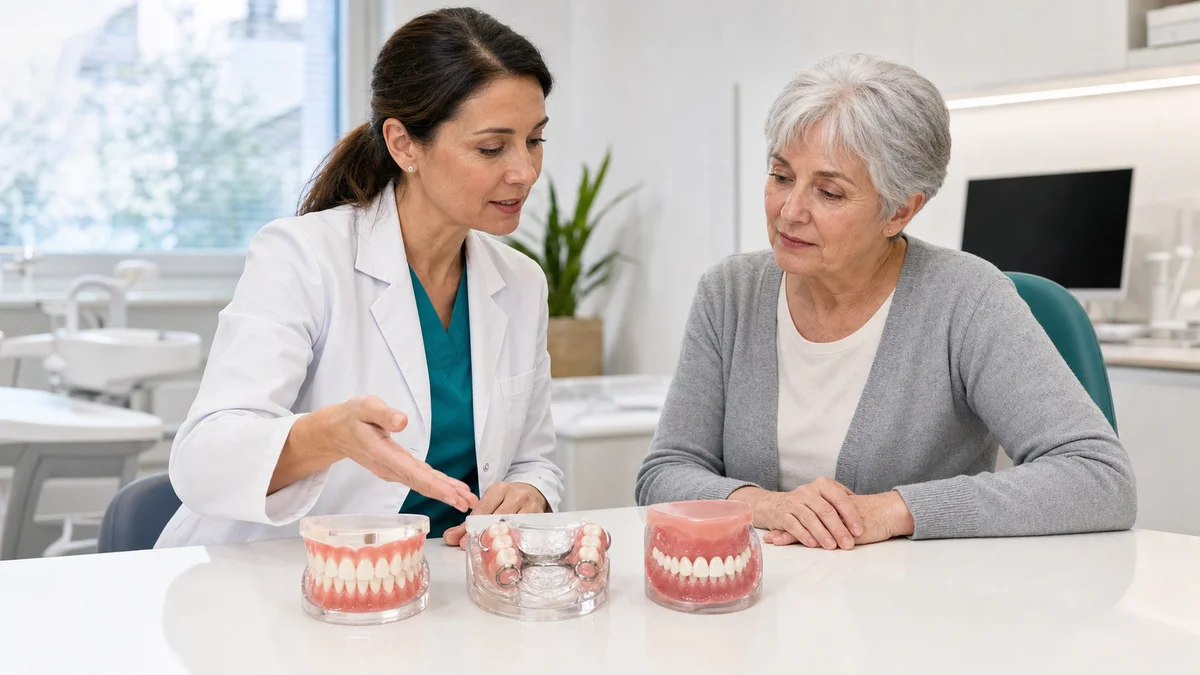
When someone asks gum disease treatment or dentures which is better, the most important word is often missing: better for which teeth? Gum treatment and dentures solve different problems. Periodontal therapy aims to control inflammation and infection around natural teeth, reduce modifiable risks and make the mouth maintainable. A denture restores some appearance and function after teeth have been lost or removed. It does not cure active periodontitis around teeth that remain.
This distinction matters because advanced gum disease rarely makes every tooth identical. One tooth may have adequate support and a favorable response to cleaning, another may need specialist treatment, and a third may be so mobile, fractured or strategically unhelpful that extraction is reasonable. A responsible plan can therefore combine periodontal care, selected extraction and a partial denture instead of forcing an all-or-nothing decision.
The National Institute of Dental and Craniofacial Research describes gum disease as an infection of the tissues that hold teeth in place. It also explains that treatment varies with the extent of disease and that controlling infection is the goal. The European Federation of Periodontology, or EFP, uses stepwise evidence-based pathways for stages I to III and multidisciplinary planning for stage IV periodontitis, where tooth loss and impaired chewing may already be present.
This article is educational and cannot diagnose whether a particular tooth should be retained. That decision requires direct periodontal charting, mobility and bite assessment, appropriate radiographs, the condition of each tooth, medical and smoking history, the patient’s ability to clean, and a discussion of alternatives. It should not be made from a photograph, a promotional package or a price comparison alone.
Why gum disease treatment or dentures which is better Is the Wrong First Question
The first question should be: which teeth are healthy, which are treatable, which have an uncertain prognosis and which are unlikely to remain comfortable and functional? Only then is it useful to compare treatment and replacement. Choosing dentures before that assessment can sacrifice maintainable teeth. Choosing indefinite periodontal treatment for teeth with a very poor prognosis can prolong discomfort, expense or instability without creating a usable result.
“Save every tooth” and “remove everything” are both overly simple rules. Natural teeth can provide efficient sensation and function when they are healthy enough to maintain. Dentures can be valuable when missing teeth compromise chewing, speech or appearance, or when remaining teeth cannot support a stable plan. Neither path is automatically easier. Both require daily care, professional review and adaptation over time.
The EFP Stage IV guideline emphasizes a multidisciplinary assessment: the amount of lost support, chewing and speech, teeth already lost, which remaining teeth can be retained, the anatomical conditions for rehabilitation, and the risk of progression or recurrence. This is why a periodontist and a restorative dentist or prosthodontist may plan together in complex cases. The replacement design should follow the diagnosis, not precede it.
What Periodontal Treatment Can and Cannot Do
Gingivitis and periodontitis are not the same condition. Gingivitis affects the gums without the attachment and bone loss that defines periodontitis, and it may improve with professional cleaning and effective plaque control. Periodontitis damages the supporting tissues. It can be managed, but treatment cannot simply recreate every structure already lost or guarantee that every affected tooth will survive.
Depending on the diagnosis, periodontal care may include oral-hygiene coaching, professional removal of deposits above and below the gumline, root-surface instrumentation, management of contributing factors, and reevaluation. Selected sites may need periodontal surgery or regenerative procedures. Teeth with severe structural damage, uncontrolled infection, unfavorable fractures or inadequate support may still need extraction even when other teeth respond well.
The aim is a mouth the patient and dental team can maintain. Clinical improvement is judged by more than whether bleeding stops for a few days. The clinician considers inflammation, pocket depths, suppuration, mobility, attachment, radiographic support, comfort, function and the patient’s ability to clean. Periodontal maintenance then continues at an interval matched to risk.
- What treatment may achieve: reduced inflammation, better access for cleaning, control of active disease and a more reliable basis for restorative planning.
- What it cannot promise: saving every tooth, eliminating future recurrence, replacing missing teeth or removing the need for home care and professional maintenance.
- What changes the outlook: disease severity, tooth anatomy, smoking, diabetes control, plaque control, attendance, restorative condition and response to initial therapy.
What Dentures Can and Cannot Do
Dentures are removable appliances that replace missing teeth and nearby tissues. A partial denture uses remaining teeth and/or soft tissues for support, retention and stability. A complete denture replaces all teeth in an arch. An immediate denture may be inserted around the time teeth are extracted, while a definitive appliance may be made or revised after tissues change.
A denture can help restore appearance, speech and chewing, but it is not identical to natural teeth. Fit, stability, bite, saliva, muscle control, ridge anatomy and patient adaptation all matter. New dentures commonly need adjustments. The gums and jaw continue to change after tooth loss, so an appliance that once fit may later become loose or sore and may need professional assessment, relining or replacement.
Crucially, a partial denture does not treat periodontitis around remaining teeth. If active disease, plaque-retentive contours or poor cleansability are ignored, supporting teeth may deteriorate. A complete denture removes the risk of periodontitis around natural teeth only because those teeth are no longer present; it introduces different responsibilities involving the oral lining, denture hygiene, fit, nutrition and monitoring of the mouth.
The NHS advises cleaning dentures and the mouth daily, removing dentures at night unless a dental professional gives different instructions, and attending regular checks. Poorly fitting or unclean dentures can contribute to soreness, infection and difficulty eating or speaking. Extraction should therefore never be presented as a way to avoid future dental care.
Diagnosis Before the Retain-or-Replace Decision
A useful consultation records the periodontal condition and the restorative condition separately, then combines them. A deep pocket does not by itself determine extraction, and a tooth that looks intact above the gumline may have limited support. Conversely, substantial radiographic bone loss does not automatically mean a tooth is hopeless. Pattern, stability, anatomy, function and response to treatment all matter.
Assessment commonly includes a medical and dental history, periodontal probing, bleeding and suppuration, recession, mobility, furcation involvement, tooth vitality where relevant, decay, fractures, previous root-canal treatment, crown and bridge condition, and appropriate radiographs. The bite, tooth migration, missing spaces, chewing ability and aesthetic priorities are also considered. A clinician should document both an overall prognosis and an individual prognosis for important teeth.
Patient factors belong in the diagnosis rather than in a footnote. Smoking is associated with poorer periodontal outcomes and can mask obvious bleeding. Diabetes and glycaemic control may influence disease risk and healing. Dry mouth, dexterity, memory, medication, nutrition, anxiety, travel and access to maintenance can affect whether a sophisticated plan is genuinely maintainable.
- Ask which findings show active disease and which reflect historical damage.
- Ask for the prognosis of each strategic tooth, not only the name of a full-mouth package.
- Ask what will be reassessed after initial periodontal therapy.
- Ask how a proposed partial denture will be cleaned around remaining teeth.
- Ask what happens if one uncertain tooth fails later.
- Ask for reasonable alternatives, including the consequences of no treatment.
Decision Table: Match the Condition to the Treatment Goal
The table below is a conversation guide, not a diagnostic rule. It shows why gum disease treatment or dentures which is better usually becomes a sequence of decisions rather than one universal answer.
| Clinical pattern | Primary goal | Likely direction to discuss | Reassessment question |
|---|---|---|---|
| Gingival inflammation without attachment or bone loss | Reverse inflammation and improve plaque control | Professional preventive care and home-care support; dentures are irrelevant unless teeth are already missing | Has inflammation resolved and can the patient maintain the result? |
| Periodontitis with several maintainable teeth | Control infection and retain useful natural teeth | Stepwise periodontal therapy, reevaluation and supportive care | Which sites remain active, deep, bleeding or difficult to clean? |
| Mixed prognosis with missing teeth | Retain strategic teeth while restoring function | Periodontal care, selected extractions and a cleansable partial denture or another staged prosthetic option | Will retained teeth support the design, and can failure be managed without remaking everything? |
| A small number of non-maintainable teeth | Remove persistent sources of pain or instability while preserving the rest | Targeted extraction plus periodontal treatment for remaining teeth; temporary or definitive replacement as needed | Is disease controlled before the final appliance is made? |
| Terminal dentition with severe functional compromise | Create a safe transition to full-arch rehabilitation | Multidisciplinary discussion of extraction timing, provisional care, complete dentures and other appropriate options | Are expectations, healing, maintenance, medical risk and contingency plans realistic? |
| Complete tooth loss | Restore function and monitor oral tissues | Complete dentures or other clinically suitable rehabilitation; periodontal treatment is no longer directed at absent teeth | Is the appliance stable, comfortable, hygienic and compatible with nutrition and speech? |
A Stepwise Periodontal Path Before Final Prosthetic Work
The EFP guideline for stages I to III describes an incremental pathway. The foundation includes patient education, plaque control, professional removal of deposits above the gumline and risk-factor support. Subgingival instrumentation follows where periodontitis is present. Healing is then evaluated before additional site-specific treatment is chosen. Supportive periodontal care continues after active treatment.
This order protects the patient from committing to a final denture design while inflammation, tooth prognosis and tissue contours are still changing. It also gives the dental team information that no initial scan can provide: how the gums respond, whether home care is sustainable, which teeth become less mobile and which sites remain problematic.
Temporary replacement may still be appropriate during treatment. The important distinction is that a provisional appliance is designed for a changing mouth. It may need adjustment, addition of teeth, relining or replacement. A final prosthesis should not be marketed as permanently predictable before the biological foundation has been reassessed.
- Confirm diagnosis, urgency, risk factors and patient priorities.
- Control plaque and inflammation and complete indicated nonsurgical therapy.
- Reevaluate periodontal findings and update tooth-by-tooth prognosis.
- Use additional periodontal treatment or selected extraction where justified.
- Confirm stability and cleansability before definitive rehabilitation.
- Enter supportive periodontal and prosthetic maintenance.
Why Reevaluation Can Change the Denture Plan
Initial mobility may partly reflect inflammation and traumatic bite forces, while persistent mobility after treatment may signal a different prognosis. Pocket depths and bleeding can improve, remain unchanged or reveal sites that need further care. A tooth tentatively assigned as a partial-denture support may become more favorable, or it may remain too difficult to clean or too structurally compromised.
Reevaluation is not indecision. It is the planned point at which a provisional hypothesis becomes a better-informed plan. The 2026 EFP quality standards call for ongoing assessment after each treatment step and for a final report that includes prognosis and future supportive therapy. Patients should know in advance which measurements can alter the next phase.
A clear plan might say: “Retain these teeth if inflammation and mobility improve; remove this tooth because of an unfavorable fracture; defer the final partial denture until healing; and use a design that can accept an additional tooth if an uncertain abutment later fails.” That is more honest and resilient than a blanket guarantee.
When Retaining Natural Teeth May Be the Better Direction
Retention deserves serious consideration when teeth can be made comfortable, functional and cleanable with a reasonable treatment burden. Useful support, acceptable restorative condition, favorable response to initial therapy and reliable maintenance strengthen the case. Strategic teeth may preserve sensation, contribute to chewing and help avoid or simplify a removable appliance.
Age alone should not decide. An older adult with good plaque control, manageable disease and realistic follow-up may benefit from retaining teeth. A younger person with aggressive disease, heavy smoking, poorly controlled diabetes or repeated nonattendance may have a more guarded outlook. The decision concerns biology and maintainability, not a birthday.
Retention also does not mean repeated intervention at any cost. The clinician should explain expected treatment phases, uncertainty, likely maintenance, the consequence of later failure and how the prosthetic plan can adapt. A tooth may be technically treatable yet strategically unhelpful if it prevents a stable, hygienic rehabilitation. Patient values and treatment burden matter alongside clinical possibility.
When Extraction and a Denture May Be Reasonable
Extraction may be discussed for teeth that are non-restorable, repeatedly infected, severely mobile and uncomfortable, or unable to contribute to a maintainable plan. It may also be appropriate when the remaining dentition cannot provide stable function and the burden of attempting to retain it is disproportionate. These judgments should be tied to documented findings, not to convenience or an expiring discount.
Guy’s and St Thomas’ NHS Foundation Trust lists continued periodontal care, selected extraction and no treatment among alternatives considered in periodontal planning. It notes that natural teeth can offer functional advantages in some situations, while extraction may suit loose teeth that cannot be maintained. The point is not that extraction is better; it is that a clinically honest plan must include it when retention is not reasonable.
Before consenting to removal of multiple teeth, ask what is irreversible, whether urgent and elective extractions can be distinguished, whether specialist review is appropriate, and what the patient will wear during healing. The plan should address pain control, medication, nutrition, cleaning, adjustment visits and how the definitive prosthesis will be timed. Once a tooth is removed, the decision cannot be reversed.
Partial Dentures: The Often-Missed Middle Path
A partial denture can replace missing or selected extracted teeth while maintainable teeth remain. This is often the most relevant answer to gum disease treatment or dentures which is better: the patient may need both, in a deliberately staged order. Periodontal therapy protects the remaining foundation; prosthetic design restores spaces and distributes forces as safely as possible.
The design should minimize plaque traps and allow effective cleaning around supporting teeth, clasps, rests and the gumline. The dentist must evaluate whether candidate support teeth have adequate periodontal and restorative prognosis. A framework or acrylic design may be considered depending on anatomy, expected changes, cost, reparability and the role of the appliance. No material is automatically best for every mouth.
Adaptability is especially valuable when prognosis is mixed. NHS England’s 2026 dental care pathways guidance highlights retrievability and adaptability when disease risk or future change matters and states that fixed prosthodontic work should be postponed during active disease. A removable design may allow additions or modification, although it still needs careful planning and review.
Patients should receive practical instruction for insertion, removal, cleaning and nighttime storage. They should know which soreness is expected during adaptation and which symptoms require adjustment. Filing or bending a denture at home can damage the appliance and tissues. Remaining teeth still need brushing, interdental cleaning and periodontal maintenance.
Complete Dentures After a Terminal Dentition
A complete denture may be appropriate when an arch has no teeth or when all remaining teeth have been carefully judged non-maintainable. The transition is clinically and emotionally significant. A patient is not merely buying teeth; they are moving from a dentate mouth to an appliance supported largely by tissues and muscle control.
Immediate dentures can avoid a period without visible teeth, but they are fitted to a mouth that will change after extraction. They often need adjustments and may later need relining or replacement. A conventional denture made after more healing may fit a more settled ridge, but it requires a different temporary plan. Neither pathway guarantees comfort or stability.
Lower complete dentures can be especially challenging because the supporting area, tongue and mobile tissues influence stability. Adhesive may help some patients when used as directed, but it should not hide a poor fit or persistent soreness. Nutrition, speech, confidence and manual dexterity should be discussed before treatment, along with a realistic adaptation plan.
Full extraction also changes future options. Bone and soft tissues remodel after teeth are removed. Implant-assisted rehabilitation may or may not be suitable later, depending on health, anatomy, disease control, hygiene capacity and finances. Removing teeth simply to “prepare for implants” is not a neutral decision and should not be presented as one.
Implants Do Not Remove the Need for Disease Control
Some patients compare periodontal treatment with implant-supported dentures rather than conventional dentures. Implants can improve retention in suitable cases, but they are not immune to biological complications. A history of periodontitis, smoking, poor plaque control and inadequate maintenance can affect risk. The EFP has a separate guideline for prevention and treatment of peri-implant diseases because implants require lifelong monitoring.
Active oral disease should be addressed before elective implant rehabilitation. The team must assess whether the patient can clean around attachments or a fixed prosthesis, attend maintenance and manage component wear. More complex hardware can improve function while also increasing cleaning and repair demands. “Fixed” does not mean maintenance-free or permanent.
Implant suitability needs appropriate imaging and medical review. Bone grafting, number and position of implants, loading protocol and provisional design cannot be determined from an online package. A second opinion is reasonable before full-arch extraction or extensive implant treatment, particularly when some teeth may be maintainable.
Function, Speech and Appearance: Compare the Real Tradeoffs
Natural teeth, partial dentures and complete dentures provide different sensory and mechanical experiences. A successful periodontal result may preserve natural contact and chewing efficiency, but mobile or painful teeth may not function well. A partial denture can restore missing spaces while relying on remaining structures. A complete denture restores an arch but depends more on fit, anatomy and patient control.
Appearance should be planned with facial support, tooth display, smile line, speech and patient preference in mind. A very white, uniform arrangement is not automatically natural or healthy. Trial stages can help evaluate shape and bite, but immediate dentures may allow less preview because they are made before extraction.
Speech and chewing usually require adaptation after a new removable appliance. The clinician may recommend starting with manageable foods and practicing speech, but persistent clicking, gagging, ulceration, instability or inability to eat deserves review. A patient should not be told to tolerate ongoing injury as the price of dentures.
Maintenance Burden: Teeth and Dentures Both Need Care
Periodontal treatment is followed by supportive care. The interval is individualized according to disease history, residual pockets, inflammation, smoking, diabetes, plaque control and other risks. Home care may include brushing and cleaning between teeth with tools selected for the spaces and dexterity. Maintenance is part of treatment, not an optional warranty visit.
Partial dentures are removed for cleaning, and supporting teeth need special attention where components contact them. Complete dentures require mechanical cleaning with suitable products, daily oral-tissue care and professional checks. They are usually removed at night unless a clinician advises otherwise. Hot water, abrasive products or household repairs can distort or damage them.
A useful comparison therefore asks which daily routine the patient can sustain. Someone with reduced dexterity may need enlarged handles, powered brushes, caregiver support or a simpler prosthetic design. A technically elegant option that cannot be cleaned is not a patient-safe option.
Smoking, Diabetes and General Health Change the Plan
Smoking increases periodontal risk and can reduce healing. A clinician should offer cessation support without using shame. Stopping tobacco can improve the environment for periodontal therapy and any future surgery. Vaping and other nicotine use should also be disclosed so the team can give individualized advice based on current evidence and local resources.
Diabetes does not automatically prevent periodontal or prosthetic care, but glycaemic control, medication, meal timing and healing may influence sequencing. Patients should share their current medical history and coordinate with their medical clinician when needed. Anticoagulants, osteoporosis medication, immune conditions, previous radiotherapy and allergies can also affect extraction or surgical planning.
Never stop prescribed medication on dental advice found online. The treating clinicians should assess bleeding, infection and healing risks and provide a documented plan. In medically complex cases, a simpler, staged and adjustable solution can be safer than compressing multiple irreversible procedures into a short trip.
Cost and Insurance Without a False Cheapest Option
There is no responsible fixed price for this comparison. Periodontal cost depends on diagnosis, number and distribution of sites, imaging, nonsurgical therapy, surgery, extractions and maintenance. Denture cost depends on whether it is partial, complete or immediate; materials and design; required preparation; provisional care; adjustments; relines and future replacement. Implant-assisted options add surgical and component variables.
Compare complete care pathways rather than headline procedures. A lower initial denture quote may exclude extractions, temporary appliances, adjustments or relines. A periodontal quote may exclude reevaluation, surgery or maintenance. Insurance coverage, annual limits, waiting periods and medical necessity rules vary by plan and country. A pre-treatment estimate is useful but is not a guarantee of payment.
Ask for an itemized plan with definite and conditional stages. The estimate should explain what happens if teeth respond better or worse than expected and how unused procedures are credited. A sound consent process separates clinical recommendation from payment pressure and gives the patient time to consider irreversible treatment.
Planning Periodontal and Denture Care in Turkey
Travel can change fees and scheduling, but it does not remove the biology of inflammation, extraction healing or adaptation. A compressed itinerary should not force definitive prosthetic decisions before the mouth is stable. International patients should ask which parts can safely occur during one visit, which require healing, and who will provide maintenance or urgent care after they return home.
Redent Klinik’s English dental care page provides an overview for patients considering care in Turkey. Records and questions can be sent through the English contact page. Remote review can help organize a consultation, but it cannot replace direct periodontal measurements, appropriate imaging or physical assessment of denture-supporting tissues.
Request copies of radiographs, periodontal charts, treatment notes, prosthesis details and maintenance instructions in a form a local dentist can use. Confirm the process for adjustments, repairs and complications after travel. A premium experience is measured by diagnosis, informed consent and continuity, not by how many procedures fit into a holiday.
Questions to Take to a Periodontal-Prosthetic Consultation
- What is my diagnosis, stage and current disease activity?
- Which teeth are favorable, questionable or non-maintainable, and why?
- Can initial treatment provide useful information before irreversible extraction?
- Which teeth are important for a partial denture, and are they cleanable?
- What temporary replacement will I have during healing?
- How might tissue change affect an immediate denture?
- What are the alternatives to the proposed plan, including selected extraction or no treatment?
- How will smoking, diabetes, medication or dexterity affect the recommendation?
- What maintenance and repair should I budget for?
- How will the plan adapt if an uncertain tooth fails later?
Good answers should connect each recommendation to findings and patient priorities. Be cautious when every patient is offered the same full-mouth solution, when a price expires before diagnostic records are reviewed, or when the clinician dismisses maintenance. It is reasonable to seek a periodontal or prosthodontic second opinion before removing multiple teeth.
Symptoms That Need Prompt or Urgent Assessment
Bleeding gums, persistent bad breath, gum recession, loose teeth, pus, new spaces or changes in the bite warrant dental assessment. Gum disease may progress with little pain, so the absence of pain does not confirm stability. A broken denture, persistent ulcer, unexplained oral lesion or appliance that suddenly becomes loose also needs professional review.
Facial swelling, fever with dental symptoms, severe uncontrolled pain, rapidly spreading infection, difficulty swallowing or breathing, or significant bleeding can require urgent dental or medical care. Do not wait for an overseas appointment or routine denture consultation when these signs are present. Local emergency services should be used when breathing or swallowing is affected.
Frequently Asked Questions
gum disease treatment or dentures which is better if teeth are loose?
Looseness alone cannot answer the question. Inflammation, bone support, bite forces, fractures and tooth position all matter. Some mobility improves after infection control; some teeth remain non-maintainable. A periodontal examination, radiographs and reassessment after initial therapy are often needed before deciding which teeth to retain or replace.
Can dentures cure gum disease?
No. A denture replaces missing teeth. A partial denture does not treat periodontitis around the teeth that remain, so active disease still needs management. Complete extraction removes natural teeth but does not eliminate the need to clean and monitor the gums, oral lining and prosthesis.
Can I keep some teeth and have a partial denture?
Often, yes, if the retained teeth have a reasonable periodontal and restorative prognosis and the design can be kept clean. Periodontal treatment usually comes first, followed by reevaluation and prosthetic planning. The denture may be designed to allow future modification when prognosis is uncertain.
Should all teeth be removed because one area has severe bone loss?
Not automatically. Periodontitis can affect teeth unevenly. Each tooth’s support, structure, symptoms, function and maintainability should be assessed. Selected extraction may be appropriate while other teeth are treated and retained. Multiple extraction is irreversible, so documented reasoning and a second opinion may be valuable.
Is a complete denture easier than periodontal maintenance?
Not necessarily. A complete denture removes the need to clean natural teeth in that arch, but it requires daily appliance and tissue care, nighttime removal in most cases, adjustment, review and adaptation. Fit can change as the ridge remodels. Extraction should not be chosen simply to avoid check-ups.
How long should I wait before the final denture?
There is no universal interval. Timing depends on the number and type of extractions, healing, tissue change, temporary appliance and treatment design. Immediate dentures are inserted around extraction but commonly need adjustment and later revision. The treating dentist should explain milestones rather than promise one fixed date.
Are implants always better than dentures after gum disease?
No. Implants may improve support in suitable patients, but they require adequate anatomy, disease control, hygiene and maintenance and can develop peri-implant disease. Medical factors, smoking, dexterity, cost and restorative complexity influence suitability. They are not a maintenance-free substitute for natural teeth.
Can gum disease return after treatment?
Periodontitis can recur or progress, particularly when inflammation, smoking, diabetes, plaque control or maintenance are unfavorable. Treatment aims to control disease, not provide immunity. Supportive periodontal care and home cleaning are therefore essential even when the mouth feels comfortable.
Does insurance decide whether treatment or dentures are better?
No. Coverage affects affordability, but the clinical recommendation should come from diagnosis, prognosis, patient goals and reasonable alternatives. Plans may limit benefits or favor one category without making it biologically appropriate. Obtain an itemized estimate and verify current benefits in writing.
When should I get a second opinion?
Consider one before removing many teeth, accepting extensive surgery, or committing to a full-arch plan, especially when the prognosis explanation is unclear. A second opinion should review the same records and examine you directly. Urgent infection still needs timely care while elective decisions are considered.
Conclusion: Choose a Maintainable Mouth, Not a Slogan
The honest answer to gum disease treatment or dentures which is better is that periodontal treatment preserves and stabilizes teeth that can reasonably be maintained, while dentures restore spaces when teeth are missing or cannot be retained. The two options are not opponents, and many safe plans use both.
Begin with a documented diagnosis and tooth-by-tooth prognosis. Control active disease, reassess the response, and make irreversible decisions only with clear alternatives and realistic expectations. A partial denture may preserve useful teeth; a complete denture may be appropriate for a carefully assessed terminal dentition. In every case, daily care, professional maintenance and an adaptable long-term plan matter more than a universal promise.
Official Sources and Clinical References
- National Institute of Dental and Craniofacial Research: Gum Disease.
- European Federation of Periodontology: Guideline on Treatment of Stage I-III Periodontitis.
- European Federation of Periodontology: Guideline on Treatment of Stage IV Periodontitis.
- European Federation of Periodontology: Quality Standards for Postgraduate Education in Periodontology, 2026.
- NHS: Gum Disease.
- NHS: Dentures.
- Guy’s and St Thomas’ NHS Foundation Trust: Periodontal Gum Surgery and Alternatives.
- NHS England: Dentistry Care Pathways Guidance.
- American Dental Association.
- World Health Organization: Oral Health Fact Sheet.
Primary and official clinical sources reviewed July 18, 2026. Guidance supports individualized diagnosis and shared decision-making; it does not determine the prognosis of a specific tooth without examination.