
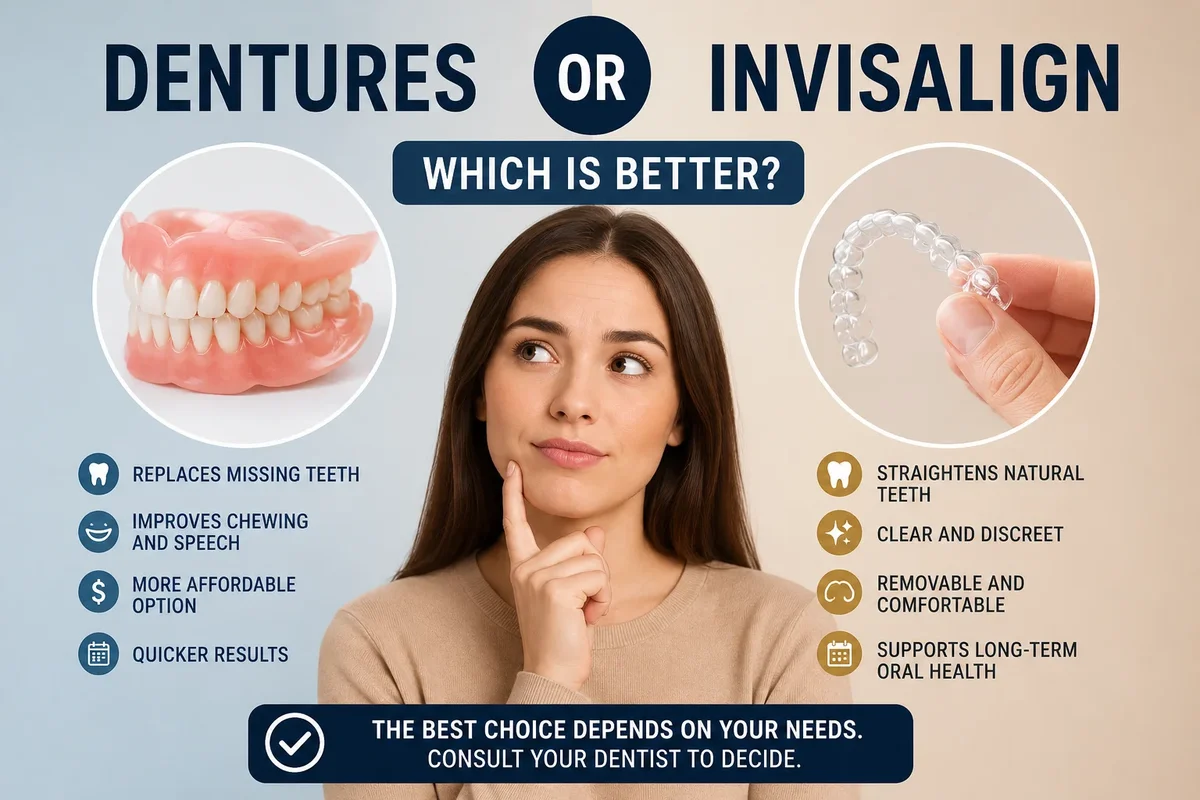
If you are asking dentures or invisalign which is better, the answer depends on one important factor: whether you need to replace missing teeth or straighten existing teeth. Although these treatments are often compared online, they solve very different dental problems. Understanding this distinction can save you time, help you set realistic expectations, and make your consultation more productive.
In simple terms, Invisalign is designed to move natural teeth into healthier positions using a series of clear removable aligners. Dentures, on the other hand, replace teeth that have already been lost. Because of this difference, there is no universal winner when people ask dentures or invisalign which is better. The right choice depends on your oral health, the condition of your teeth and gums, your long-term goals, and the recommendations made after a professional examination.
For someone with healthy natural teeth that are crowded, spaced, or mildly to moderately misaligned, Invisalign may help improve the bite and appearance without replacing any teeth. However, if several teeth are missing or all teeth in an arch have been lost, dentures may be the more appropriate restorative option. This is why the question dentures or invisalign which is better should always begin with an evaluation of your current dental condition rather than focusing only on appearance or cost.
Understanding the Main Difference
Many people mistakenly believe dentures and Invisalign are competing treatments. In reality, they belong to different areas of dentistry.
- Invisalign: Straightens existing natural teeth.
- Dentures: Replace missing teeth.
This distinction is essential when deciding dentures or invisalign which is better. If your teeth are present but crooked, replacing them with dentures would usually not be the first option. Likewise, Invisalign cannot replace teeth that are already missing.
Which Option May Fit Different Patients?
You May Benefit More from Invisalign If:
- You still have most or all of your natural teeth.
- Your main concern is crooked, crowded, or spaced teeth.
- You want a removable and discreet orthodontic solution.
- Your gums and supporting bone are generally healthy.
You May Benefit More from Dentures If:
- You have lost multiple teeth.
- You have difficulty chewing because of missing teeth.
- You need to restore facial support after significant tooth loss.
- Your dentist determines that replacing missing teeth is the priority.
These examples demonstrate why there is no single answer to dentures or invisalign which is better. Different clinical situations require different treatment approaches.
What Does This Mean for Your Situation?
If you are comparing treatments because you dislike your smile, the first question should not simply be dentures or invisalign which is better. Instead, ask yourself why you are unhappy with your smile.
- Are your teeth crooked?
- Have you already lost several teeth?
- Do you struggle with chewing?
- Are you mainly concerned about appearance?
- Have previous dental problems caused tooth loss?
Your answers help identify which treatment category may deserve further evaluation. Some patients even require both restorative and orthodontic care at different stages of treatment planning. For example, a dentist may recommend correcting tooth positions before replacing missing teeth, while in other cases replacing missing teeth becomes the immediate priority.
Factors Beyond Appearance
When evaluating dentures or invisalign which is better, appearance is only one consideration. Your dentist will also evaluate:
- Overall oral health.
- Bone support.
- Gum condition.
- Remaining natural teeth.
- Bite alignment.
- Jaw function.
- Long-term maintenance.
These factors often influence treatment recommendations far more than cosmetic preferences alone.
Why a Professional Examination Matters
Online comparisons provide useful background information, but they cannot determine which treatment is appropriate for an individual patient. Clinical photographs, digital X-rays, bite analysis, periodontal evaluation, and a complete examination allow the dental team to identify problems that may not be obvious from symptoms alone.
If you continue asking dentures or invisalign which is better after reading general information, it usually means your specific clinical situation needs professional assessment rather than more internet comparisons.
Organizations such as the American Dental Association also emphasize the importance of individualized diagnosis and treatment planning instead of choosing treatments based solely on online information.
A Personalized Treatment Plan Can Make a Difference
Every smile is unique. Two people with similar-looking teeth may receive completely different recommendations because of differences in bone support, gum health, previous dental work, bite relationships, or missing teeth.
For this reason, asking dentures or invisalign which is better should always lead to a personalized discussion rather than assuming one treatment is automatically superior. A comprehensive consultation allows the dentist to explain suitable options, expected treatment stages, possible limitations, maintenance requirements, and realistic outcomes without making guarantees.
At Redent Klinik, treatment planning focuses on understanding each patient’s oral condition, functional needs, and aesthetic goals before discussing available options. This individualized approach helps patients understand why one solution may be more appropriate than another in their specific case.
Quick Takeaway
The simplest answer to dentures or invisalign which is better is this:
- If you need to straighten healthy natural teeth, Invisalign may be appropriate.
- If you need to replace missing teeth, dentures may be appropriate.
- Some patients may require additional restorative or orthodontic treatments depending on their oral health.
Final treatment recommendations should always be based on a comprehensive dental examination rather than assumptions about appearance, convenience, or general online advice.
Your Next Step
If you are still uncertain about dentures or invisalign which is better, schedule a comprehensive dental consultation before making any treatment decision. During the appointment, ask about your remaining natural teeth, gum health, bite condition, expected treatment timeline, maintenance requirements, and possible alternatives. If you would like a personalized assessment or have questions about your treatment options, you can contact the dental team through the Redent Klinik Contact Page. A tailored evaluation can help you understand which approach best matches your oral health needs and long-term goals.
Quick Answer: Dentures or Invisalign Which Is Better for Your Situation?
When people search dentures or invisalign which is better, they are usually hoping for one simple answer. In reality, the better option depends on your dental condition rather than which treatment is more popular. The first question a dentist asks is not “Which treatment do you want?” but “What problem needs to be solved?” Understanding that difference can help you make a more informed decision and avoid pursuing a treatment that is not designed for your needs.
If your natural teeth are healthy but crooked, crowded, or have gaps, Invisalign is generally intended to improve alignment without replacing teeth. If several teeth are missing or all teeth in an arch have been lost, dentures are designed to restore missing teeth and improve chewing ability. Because these treatments have different purposes, the answer to dentures or invisalign which is better almost always depends on your oral health, the number of remaining teeth, your gum condition, and your long-term treatment goals.
The Fastest Way to Understand the Difference
A useful way to think about the comparison is to ask yourself one simple question:
- Do I want to straighten teeth that I still have?
- Or do I need to replace teeth that are already missing?
If your answer is the first option, Invisalign may deserve further evaluation. If your answer is the second, dentures may be the more appropriate solution. This is why dentures or invisalign which is better cannot be answered by looking at photos or prices alone.
When Invisalign May Be the Better Choice
Suitable Situations
Invisalign may be appropriate when:
- Your teeth are generally healthy.
- You have mild to moderate crowding.
- You have gaps between teeth.
- Your bite requires orthodontic correction.
- You want removable clear aligners instead of traditional braces.
In these situations, asking dentures or invisalign which is better usually leads toward Invisalign because the objective is preserving and improving your natural teeth rather than replacing them.
Possible Advantages
- Nearly invisible appearance.
- Removable during meals.
- Easier brushing and flossing than fixed braces.
- Gradual tooth movement planned digitally.
However, successful treatment depends on wearing the aligners as instructed. Compliance is an important part of achieving the planned tooth movement.
When Dentures May Be the Better Choice
Suitable Situations
Dentures are commonly considered when:
- Multiple teeth are missing.
- Complete tooth loss has occurred.
- Chewing has become difficult.
- Speech or facial support has been affected by tooth loss.
For these patients, the answer to dentures or invisalign which is better is often more straightforward because Invisalign cannot replace teeth that no longer exist.
Potential Benefits
- Replacement of missing teeth.
- Improved ability to chew certain foods.
- Support for facial appearance after tooth loss.
- Non-surgical treatment option for many patients.
Some people eventually consider implant-supported alternatives depending on their bone condition and treatment goals, but dentures remain an important restorative option for many individuals.
Cost Should Never Be the Only Decision Factor
Many patients begin their research by comparing prices and asking dentures or invisalign which is better from a financial perspective. While budgeting is important, treatment selection should begin with clinical suitability rather than cost alone.
The final investment depends on numerous factors, including:
- Number of teeth involved.
- Complexity of treatment.
- Diagnostic imaging.
- Preparatory dental procedures.
- Materials selected.
- Length of treatment.
- Individual treatment planning.
Because every patient is different, a dentist can only provide an accurate estimate after a clinical examination and personalized treatment plan.
Can Someone Need Both Treatments?
Yes. One reason dentures or invisalign which is better is not always an either-or decision is that some patients benefit from a combination of treatments completed in stages.
Examples include:
- Straightening remaining teeth before replacing missing teeth.
- Orthodontic treatment to improve spacing for future restorations.
- Partial dentures after orthodontic correction.
The treatment sequence depends entirely on the patient’s oral condition and should be planned individually.
Questions Worth Asking During Your Consultation
Instead of only asking dentures or invisalign which is better, consider discussing questions such as:
- Which treatment addresses my actual dental problem?
- How healthy are my gums?
- Can my natural teeth be preserved?
- Will additional procedures be necessary?
- How long is the expected treatment process?
- What maintenance will be required?
- What realistic improvements can I expect?
These questions usually provide more valuable guidance than comparing treatments based only on internet articles.
Why Personalized Treatment Planning Matters
No article can determine which option is appropriate for every individual. Even two patients with similar-looking smiles may receive different recommendations because of differences in bone support, bite alignment, periodontal health, previous restorations, or overall oral health.
At Redent Klinik, treatment recommendations are based on a comprehensive examination and discussion of each patient’s goals rather than assuming one solution fits everyone. This individualized approach helps patients understand why one treatment may be more suitable than another without making unrealistic promises.
Practical Next Step
If you are still wondering dentures or invisalign which is better, begin by identifying whether your primary concern is missing teeth or misaligned natural teeth. Then arrange a comprehensive dental assessment where your dentist can evaluate your remaining teeth, gum health, bite, jaw function, and overall oral condition. Before making any decision, ask about treatment suitability, expected maintenance, possible alternatives, and whether any preparatory procedures are recommended. Seeking professional advice is particularly important if you have multiple missing teeth, loose teeth, gum disease, difficulty chewing, or are unsure which treatment category best matches your needs.
Cost Comparison: Dentures or Invisalign Which Is Better for Long-Term Value?
One of the first questions many people ask after searching dentures or invisalign which is better is how much each treatment costs. While cost is an important consideration, choosing between dentures and Invisalign based only on the initial price can lead to unrealistic expectations. These treatments have different purposes, different treatment timelines, and different maintenance requirements. The better long-term value comes from selecting the treatment that correctly addresses your dental needs rather than simply choosing the option with the lower upfront cost.
If your goal is to replace missing teeth, comparing the cost of Invisalign with dentures is often not meaningful because Invisalign cannot replace lost teeth. Likewise, if your goal is to straighten healthy natural teeth, dentures are generally not intended to solve orthodontic problems. Therefore, before comparing fees, the first step in answering dentures or invisalign which is better is confirming which treatment is clinically appropriate for your situation.
Why Treatment Costs Differ
The overall investment for dental treatment depends on much more than the appliance itself. A personalized treatment plan may include diagnostic examinations, digital scans, X-rays, impressions, follow-up appointments, adjustments, and any additional procedures needed before treatment begins.
When evaluating dentures or invisalign which is better, remember that treatment plans are individualized. Two patients receiving the same type of treatment may receive different cost estimates because their oral health conditions are not identical.
Factors that commonly influence treatment costs include:
- The complexity of your dental condition.
- The number of teeth involved.
- The type of denture or aligner system recommended.
- Preparatory dental procedures.
- Gum health and bone condition.
- Length of treatment.
- Follow-up visits and adjustments.
Because of these variables, no responsible dental clinic can provide guaranteed pricing without first completing an examination and discussing your treatment goals.
Understanding the Value of Invisalign
What You Are Investing In
For patients with healthy natural teeth that require alignment, Invisalign focuses on gradually moving teeth into more favorable positions. The value comes from improving function, bite, and appearance while preserving natural teeth whenever possible.
If your dentist confirms that orthodontic treatment is appropriate, the answer to dentures or invisalign which is better may favor Invisalign because it addresses the underlying alignment issue rather than replacing healthy teeth.
Patients often appreciate Invisalign because it offers:
- Clear removable aligners.
- Digital treatment planning.
- The ability to remove aligners for eating and brushing.
- A discreet appearance during treatment.
However, wearing the aligners consistently is an important part of achieving the planned tooth movement. Following your dentist’s instructions plays a significant role in the overall success of treatment.
Understanding the Value of Dentures
What You Are Investing In
Dentures are intended to replace missing teeth and help restore functions such as chewing, speaking, and supporting facial appearance. Their value is measured differently because they solve a different clinical problem.
If you have experienced significant tooth loss, asking dentures or invisalign which is better often becomes easier because replacing missing teeth usually becomes the immediate priority. Invisalign cannot substitute for teeth that have already been lost.
Depending on the patient’s needs, dentures may help:
- Restore chewing ability.
- Support facial tissues.
- Improve speech in some situations.
- Replace several or all missing teeth.
Your dentist may also discuss alternative restorative options depending on your oral health, remaining teeth, and bone support.
Think Beyond the Initial Cost
Many patients naturally compare initial treatment fees, but long-term value should also include maintenance, expected lifespan, future adjustments, and your overall oral health goals.
When deciding dentures or invisalign which is better, consider questions such as:
- Will this treatment solve my primary dental problem?
- How much maintenance will it require?
- Will future adjustments be expected?
- How will this affect my daily routine?
- Am I preserving healthy natural teeth whenever possible?
These practical questions often provide more useful guidance than comparing numbers alone.
Could Additional Treatment Affect the Overall Budget?
Yes. Some patients require additional dental care before either dentures or Invisalign can begin. Depending on your oral health, treatment planning may include procedures such as periodontal care, fillings, tooth extractions, or other restorative treatments.
This is another reason why dentures or invisalign which is better cannot be answered solely by searching for average prices online. A personalized examination provides a much clearer understanding of the complete treatment process and the factors that influence the final treatment plan.
Balancing Cost with Long-Term Goals
Choosing the lowest-cost option is not always the most beneficial long-term decision. The best value usually comes from selecting the treatment that addresses your clinical needs while supporting your oral health over time.
At Redent Klinik, treatment planning focuses on understanding each patient’s oral condition, expectations, and long-term objectives before discussing suitable treatment options. This individualized approach helps patients compare potential benefits, limitations, maintenance requirements, and expected treatment stages without relying on generalized assumptions or guaranteed pricing.
Questions to Ask Before Comparing Prices
During your consultation, consider asking:
- Which treatment is appropriate for my dental condition?
- Are there alternative options available?
- Will I need preparatory dental treatment?
- How long is the expected treatment process?
- How often are follow-up appointments needed?
- What maintenance should I expect after treatment?
- How will this treatment support my long-term oral health?
These discussions help place financial considerations within the context of your overall treatment goals instead of focusing only on the initial estimate.
What to Check Before Making Your Decision
If you are still asking dentures or invisalign which is better, avoid choosing based only on advertised prices or online averages. Instead, ask your dentist to evaluate your remaining natural teeth, gum health, bite, bone support, and long-term expectations. Request a personalized treatment plan that explains the recommended option, any necessary preparatory procedures, expected maintenance, and realistic treatment stages. Professional advice is especially important if you have missing teeth, difficulty chewing, loose teeth, advanced tooth wear, or are uncertain whether orthodontic treatment or tooth replacement is the more appropriate solution for your situation.
Who Is the Best Candidate? Dentures or Invisalign Which Is Better Based on Oral Health?
When deciding dentures or invisalign which is better, one of the most important considerations is whether you are actually a suitable candidate for either treatment. Many people compare these options as if they are interchangeable, but they are designed for different dental situations. Your oral health, the number of remaining natural teeth, gum condition, jawbone support, and long-term goals all influence which treatment may be recommended.
The most helpful way to answer dentures or invisalign which is better is to start with a professional examination rather than focusing on appearance or online reviews. During a consultation, your dentist will determine whether your priority should be preserving natural teeth, correcting tooth alignment, replacing missing teeth, or combining multiple treatments in a carefully planned sequence.
Candidates Who May Benefit from Invisalign
You Still Have Most of Your Natural Teeth
Invisalign is generally intended for patients whose natural teeth are present but require orthodontic correction. If your teeth are healthy enough to be moved safely, clear aligners may help improve their position over time.
Patients who often ask dentures or invisalign which is better may be good Invisalign candidates when they have:
- Mild or moderate crowding.
- Spacing between teeth.
- Minor bite irregularities.
- Healthy gums.
- Adequate bone support around the teeth.
In these situations, replacing healthy teeth with dentures would usually not be the preferred approach because preserving natural teeth is often an important goal whenever clinically appropriate.
Commitment Is Part of Suitability
Being a suitable Invisalign candidate also depends on your willingness to follow treatment instructions. Since the aligners are removable, patients are typically expected to wear them for the recommended number of hours each day and attend regular follow-up appointments.
For this reason, answering dentures or invisalign which is better also involves considering your lifestyle, daily routine, and ability to remain consistent throughout treatment.
Candidates Who May Benefit from Dentures
Missing Teeth Are the Primary Concern
Dentures are generally recommended when replacing missing teeth becomes the main treatment objective. Tooth loss may affect chewing, speech, facial support, and overall oral function, making restoration an important part of treatment planning.
If several teeth are already missing, the answer to dentures or invisalign which is better often shifts toward dentures because Invisalign cannot replace teeth that no longer exist.
Dentures may be appropriate for people who:
- Have lost multiple teeth.
- Have complete tooth loss in one or both arches.
- Need improved chewing function.
- Want a removable tooth replacement solution.
Whether partial or complete dentures are appropriate depends on the number of remaining healthy teeth and the overall treatment plan.
When Neither Treatment Alone Is Enough
Combination Treatment Plans
Sometimes the question dentures or invisalign which is better has a surprising answer: both may play a role at different stages of treatment.
For example:
- Remaining teeth may first be aligned before replacing missing teeth.
- Orthodontic treatment may create better spacing for future restorations.
- Some patients receive partial dentures after orthodontic correction.
Because every smile is unique, dentists often design treatment in phases rather than relying on a single procedure.
Health Conditions That May Influence Your Options
Your dentist evaluates much more than the appearance of your teeth. Several health-related factors can influence which treatment is suitable.
Important Clinical Considerations
- Periodontal (gum) health.
- Bone support around existing teeth.
- Tooth mobility.
- Untreated decay.
- Bite alignment.
- Jaw joint function.
- Previous dental restorations.
- Overall oral hygiene.
These findings often determine the answer to dentures or invisalign which is better far more accurately than age or cosmetic preferences.
Lifestyle Can Also Affect the Decision
Your everyday routine should also be discussed during treatment planning.
Questions your dentist may ask include:
- Can you maintain excellent oral hygiene?
- Will you remember to wear removable aligners consistently?
- Do you frequently travel?
- Do you have any habits such as teeth grinding?
- Are you looking for a removable or fixed solution?
These practical considerations help determine whether the recommended treatment fits your daily life as well as your clinical needs.
Why Age Is Not the Main Factor
Many people believe younger patients automatically need Invisalign while older adults automatically need dentures. In reality, age alone rarely determines the answer to dentures or invisalign which is better.
A younger adult who has experienced significant tooth loss may require dentures or another restorative option, while an older adult with healthy natural teeth may still be an excellent Invisalign candidate. Oral health status is usually much more important than chronological age.
The Importance of Individualized Assessment
Two people with similar smiles may receive completely different recommendations because their underlying dental conditions differ. Digital scans, photographs, X-rays, bite analysis, and a clinical examination provide valuable information that cannot be obtained from online comparisons alone.
At Redent Klinik, treatment planning is based on each patient’s oral health, functional needs, and aesthetic goals. Instead of assuming one treatment is universally better, the dental team evaluates which option is most appropriate for the individual’s condition and discusses realistic expectations, maintenance requirements, and possible alternatives.
What You Should Check Before Choosing
If you are still wondering dentures or invisalign which is better, begin by identifying whether your primary concern is tooth alignment or tooth replacement. During your consultation, ask your dentist to assess your gum health, remaining natural teeth, bone support, bite relationship, and overall oral condition. You should also discuss whether preserving natural teeth is possible, whether additional treatment is needed before starting, and whether a staged treatment plan would provide better long-term results. Professional advice is particularly important if you have loose teeth, advanced gum disease, multiple missing teeth, or uncertainty about which treatment best matches your current oral health.
Treatment Process Explained: Dentures or Invisalign Which Is Better for Comfort and Daily Life?
For many patients, the question dentures or invisalign which is better is not only about appearance or cost—it is also about what daily life will look like during and after treatment. Comfort, eating habits, oral hygiene, adjustment periods, and the amount of time required for treatment all influence the decision. Understanding the treatment process before you begin can help you choose the option that best matches your lifestyle and expectations.
It is important to remember that dentures and Invisalign are designed to achieve different goals. Invisalign gradually moves natural teeth into improved positions, while dentures replace teeth that have already been lost. Because the objectives are different, the treatment experience is also very different. This is why answering dentures or invisalign which is better requires looking beyond the final result and considering the entire journey.
What to Expect with Invisalign Treatment
Step 1: Consultation and Digital Assessment
The Invisalign process typically begins with a comprehensive examination. Your dentist evaluates your teeth, gums, bite, and jaw function before determining whether clear aligners are suitable.
The assessment may include:
- Clinical examination.
- Digital scans or impressions.
- Photographs.
- X-rays when necessary.
- Bite analysis.
Only after reviewing these findings can your dentist explain whether Invisalign is appropriate for your situation.
Step 2: Wearing the Aligners
If treatment proceeds, you receive a series of custom-made aligners that gradually move your teeth according to the planned sequence.
Most patients appreciate that the aligners are removable, allowing them to:
- Eat without fixed brackets.
- Brush and floss normally.
- Remove the aligners for short periods when instructed.
However, because the aligners are removable, consistent wear is essential. Following your dentist’s instructions is an important part of achieving the planned tooth movement.
Step 3: Regular Progress Reviews
Throughout treatment, scheduled appointments allow your dentist to monitor tooth movement, evaluate progress, and make adjustments if needed.
For patients whose primary concern is crooked natural teeth, the answer to dentures or invisalign which is better may favor Invisalign because it preserves natural teeth while improving alignment.
What to Expect with Dentures
Initial Assessment
Denture treatment also begins with a detailed examination, but the focus is different. Instead of moving teeth, your dentist evaluates the areas where teeth are missing, the health of the gums, jawbone support, and the remaining teeth if partial dentures are being considered.
The planning process may involve:
- Oral examination.
- Impressions or digital scans.
- Bite registration.
- Assessment of remaining teeth.
- Evaluation of chewing function.
Fabrication and Fitting
Once the treatment plan is finalized, the dentures are fabricated to match your oral anatomy. Depending on the type of denture, several appointments may be necessary for impressions, try-ins, adjustments, and the final delivery.
Patients often require a short adaptation period while becoming accustomed to speaking, eating, and chewing with their new dentures.
Adjustment Period
Unlike Invisalign, dentures replace missing teeth rather than moving existing ones. During the first weeks, your dentist may recommend follow-up visits to improve comfort and evaluate how the dentures fit.
This is another reason why dentures or invisalign which is better depends on your treatment goals rather than convenience alone.
Daily Life Comparison
Eating
With Invisalign, patients typically remove the aligners before meals and replace them afterward according to professional instructions.
With dentures, eating habits may gradually improve as patients become accustomed to the appliance, although certain foods may require additional care depending on the individual’s adaptation and the type of denture.
Cleaning
Both treatments require consistent oral hygiene.
For Invisalign:
- Brush teeth before replacing aligners.
- Clean aligners as instructed.
- Maintain regular oral hygiene.
For dentures:
- Clean the dentures daily.
- Maintain healthy gums.
- Care for remaining natural teeth if present.
- Attend routine dental reviews.
Proper maintenance helps support long-term oral health regardless of which treatment you receive.
Which Treatment Fits Your Lifestyle?
When deciding dentures or invisalign which is better, lifestyle considerations are often just as important as clinical findings.
You may prefer Invisalign if you:
- Want to preserve natural teeth.
- Can commit to wearing aligners consistently.
- Prefer a discreet orthodontic solution.
- Have healthy teeth suitable for movement.
You may lean toward dentures if you:
- Need to replace missing teeth.
- Want to restore chewing ability.
- Require replacement of several or all missing teeth.
- Need a removable restorative solution.
Your dentist can explain how each option fits your specific oral condition and daily routine.
Can the Treatment Plan Change?
Sometimes the answer to dentures or invisalign which is better changes after the initial examination. Additional findings such as untreated decay, gum disease, or bite issues may require treatment before dentures or Invisalign can begin.
Similarly, some patients benefit from staged treatment plans that include orthodontic and restorative procedures performed in a logical sequence. Personalized planning helps ensure that each stage supports the next.
Why Professional Guidance Matters
Although online comparisons can provide general information, they cannot evaluate your oral health. Clinical findings such as bone support, periodontal health, tooth stability, and bite function often determine which treatment is appropriate.
At Redent Klinik, each treatment plan is tailored to the patient’s clinical condition, expectations, and long-term oral health goals. Rather than recommending one solution for everyone, the dental team explains the expected treatment process, maintenance requirements, possible alternatives, and realistic outcomes so patients can make informed decisions.
What to Review Before Starting Treatment
If you are still asking dentures or invisalign which is better, take time to discuss the complete treatment process during your consultation. Ask how long treatment is expected to take, what daily care will be required, how often follow-up visits are recommended, whether any preparatory procedures are necessary, and what level of maintenance will be expected after treatment. You should also request an evaluation of your gums, remaining natural teeth, bite, and jaw function before making a final decision. Professional advice is especially valuable if you have multiple missing teeth, bite problems, gum disease, or uncertainty about whether tooth alignment or tooth replacement should be your primary treatment priority.
Benefits, Limitations, and Risks: Dentures or Invisalign Which Is Better in Different Cases?
When patients compare treatment options, they often focus on the advantages of each solution while overlooking the possible limitations. If you are asking dentures or invisalign which is better, understanding both the benefits and the challenges is essential for making an informed decision. Neither treatment is universally better than the other because they are intended to solve different dental problems. The right choice depends on your oral health, the condition of your remaining teeth, your expectations, and the goals established during a professional consultation.
Every dental treatment involves benefits, compromises, and ongoing responsibilities. Learning about these factors before starting treatment can help you prepare for the process and reduce unrealistic expectations. Rather than searching for a universal winner, the better approach is to determine which treatment best addresses your specific clinical needs.
The Benefits of Invisalign
Preserving Natural Teeth
One of the primary advantages of Invisalign is that it focuses on improving the position of your existing natural teeth instead of replacing them. Whenever healthy natural teeth can be preserved, many dentists consider this an important long-term goal.
For patients whose main concern is alignment rather than tooth loss, the answer to dentures or invisalign which is better may favor Invisalign because it corrects orthodontic issues while maintaining natural tooth structure.
Comfort and Appearance
Many patients appreciate Invisalign because the aligners are:
- Clear and discreet.
- Custom-made for the individual.
- Removable during meals.
- Easy to remove for brushing and flossing.
These features often make Invisalign attractive for adults and older teenagers who prefer a less noticeable orthodontic option.
Potential Functional Improvements
Depending on the individual’s condition, properly aligned teeth may contribute to:
- Improved oral hygiene access.
- Better bite relationships.
- Reduced crowding.
- Improved smile aesthetics.
The expected outcome always depends on the patient’s diagnosis and treatment plan.
The Limitations of Invisalign
Not Designed for Missing Teeth
One of the biggest misconceptions surrounding dentures or invisalign which is better is believing Invisalign can replace teeth. It cannot. If multiple teeth are already missing, another restorative solution is generally required.
Patient Commitment Is Essential
Because Invisalign aligners are removable, treatment success depends heavily on following professional instructions. Patients who frequently forget to wear their aligners may experience slower or less predictable progress.
Regular follow-up appointments are also important to monitor tooth movement and evaluate treatment progress.
The Benefits of Dentures
Replacing Missing Teeth
Dentures are specifically designed to replace missing teeth and help restore oral function. For patients experiencing significant tooth loss, dentures may improve daily activities such as chewing and speaking while also supporting facial appearance.
If tooth replacement is your primary need, the answer to dentures or invisalign which is better often becomes much clearer because Invisalign cannot restore missing teeth.
Non-Surgical Option for Many Patients
Depending on the treatment plan, conventional removable dentures may provide a non-surgical approach to replacing missing teeth. Whether this is appropriate depends on your oral health, remaining teeth, and overall treatment objectives.
The Limitations of Dentures
Adjustment Period
Most patients need time to adapt to new dentures. Eating, speaking, and wearing the appliance comfortably often improve gradually as patients become familiar with the restoration.
Follow-up appointments may be recommended so the dentist can evaluate fit and make adjustments when appropriate.
Ongoing Maintenance
Dentures require regular care and maintenance. Patients should:
- Clean dentures daily.
- Maintain healthy gums.
- Attend routine dental examinations.
- Monitor the condition of any remaining natural teeth.
Good maintenance supports comfort and long-term oral health regardless of the treatment selected.
Understanding Possible Risks
Every dental treatment has potential limitations and considerations. Discussing these before treatment begins helps patients make realistic decisions.
With Invisalign
Potential considerations may include:
- Temporary pressure when changing aligners.
- The need for consistent wear.
- Regular monitoring appointments.
- Suitability depending on case complexity.
With Dentures
Potential considerations may include:
- An adaptation period.
- Periodic adjustments.
- Daily cleaning requirements.
- Changes in fit over time depending on individual circumstances.
These possibilities do not occur equally for every patient, which is why individualized treatment planning is essential.
Alternative Treatments Worth Discussing
Sometimes the answer to dentures or invisalign which is better is neither option alone. Depending on your oral health, your dentist may also discuss alternatives such as:
- Dental implants.
- Implant-supported dentures.
- Dental bridges.
- Orthodontic treatment followed by restorative procedures.
- A staged combination of treatments.
The most appropriate alternative depends on your oral condition, treatment objectives, and the findings of your clinical examination.
Making a Balanced Decision
Choosing treatment should involve more than comparing convenience or appearance. A balanced decision considers:
- Your current oral health.
- The condition of your gums.
- The number of remaining natural teeth.
- Your ability to maintain treatment.
- Your long-term oral health goals.
- The recommendations of your dental team.
Patients who carefully consider these factors usually make more confident decisions than those relying solely on online comparisons.
Why Individual Assessment Is Essential
At Redent Klinik, every treatment recommendation begins with a comprehensive clinical evaluation. Instead of assuming one option is universally superior, the dental team assesses your oral health, functional needs, and aesthetic goals before discussing suitable treatment options. This individualized approach allows patients to understand the expected benefits, possible limitations, maintenance requirements, and realistic outcomes without making exaggerated claims or guarantees.
What to Check Before You Decide
If you are still wondering dentures or invisalign which is better, ask your dentist to evaluate whether your priority should be preserving natural teeth or replacing missing teeth. Discuss the expected benefits, possible limitations, maintenance responsibilities, treatment timeline, and any alternative options that may be suitable for your situation. Professional advice should be sought if you have significant tooth loss, loose teeth, advanced gum disease, difficulty chewing, or uncertainty about whether orthodontic treatment or restorative treatment is the most appropriate first step for your long-term oral health.
Alternative Treatments to Consider Before Choosing Dentures or Invisalign
If you are researching dentures or invisalign which is better, you may assume that one of these two treatments must be the right solution. However, depending on your oral health, there may be alternative treatments that better address your specific needs. Dentistry offers a wide range of restorative and orthodontic options, and in many situations, a dentist may recommend a completely different treatment or a combination of procedures instead of choosing dentures or Invisalign alone.
The purpose of exploring alternatives is not to make the decision more complicated, but to ensure that your treatment plan is based on your clinical condition rather than on a limited comparison. Every patient has unique oral health needs, and what works well for one person may not be suitable for another. This is why the question dentures or invisalign which is better should always be part of a broader discussion about all available treatment options.
Dental Implants
When They May Be Considered
If your primary concern is replacing one or more missing teeth, dental implants may be discussed as an alternative to removable dentures. Implants are designed to replace missing tooth roots and support restorations such as crowns, bridges, or implant-supported dentures.
For patients with missing teeth, asking dentures or invisalign which is better may eventually lead to a discussion about implants because Invisalign cannot replace teeth, while conventional dentures are only one of several restorative solutions.
Your dentist will evaluate factors such as:
- Bone quantity and quality.
- Overall oral health.
- Gum condition.
- Medical history.
- Treatment expectations.
Not every patient is immediately suitable for implants, making professional evaluation an essential step.
Implant-Supported Dentures
A Combination of Stability and Tooth Replacement
Some patients who are considering dentures may also be candidates for implant-supported dentures. These restorations combine the function of dentures with the additional support provided by dental implants.
If your comparison begins with dentures or invisalign which is better, but your primary challenge is extensive tooth loss, your dentist may explain whether implant-supported options are appropriate based on your bone support and treatment goals.
Potential advantages may include:
- Improved stability.
- Reduced movement during chewing.
- Support for oral function.
- Greater confidence for some patients.
The exact treatment approach depends on individual clinical findings.
Dental Bridges
Replacing One or Several Missing Teeth
When only one or a few teeth are missing, a dental bridge may be another restorative option. Bridges are designed to replace missing teeth by using adjacent supporting teeth or implants, depending on the treatment plan.
Patients comparing dentures or invisalign which is better sometimes discover that a bridge may more closely match their needs, particularly when tooth loss is limited and surrounding teeth are suitable for supporting a restoration.
Your dentist will evaluate:
- The health of neighboring teeth.
- Bite relationships.
- Periodontal health.
- Long-term restorative goals.
Traditional Orthodontic Braces
An Alternative to Invisalign
If your goal is correcting tooth alignment rather than replacing missing teeth, traditional braces may be discussed alongside Invisalign.
While many patients search dentures or invisalign which is better, the more appropriate orthodontic comparison may actually be Invisalign versus fixed braces.
Depending on the complexity of tooth movement, your dentist or orthodontist may explain:
- Whether Invisalign is appropriate.
- Whether fixed braces offer advantages.
- The expected treatment sequence.
- The anticipated level of patient cooperation required.
Preserving Natural Teeth Whenever Possible
Conservative Dentistry
In some situations, neither dentures nor Invisalign represents the first step. Before recommending tooth replacement or orthodontic treatment, your dentist may determine that preserving your natural teeth is the priority.
Treatment may include:
- Fillings.
- Root canal treatment.
- Crowns.
- Periodontal therapy.
- Professional cleaning.
For many patients asking dentures or invisalign which is better, improving the health of existing teeth allows more treatment options to remain available in the future.
Combination Treatment Plans
Sometimes More Than One Treatment Is Needed
Modern dentistry often combines different procedures into one carefully planned treatment sequence.
Examples include:
- Periodontal treatment before orthodontics.
- Orthodontic alignment before restorative work.
- Dental implants after tooth movement.
- Partial dentures following restorative treatment.
Because every patient’s oral condition is unique, the answer to dentures or invisalign which is better may involve several treatment stages rather than a single procedure.
How Dentists Decide Between Options
Rather than selecting treatment based on appearance or convenience, dentists evaluate a wide range of clinical factors.
Key Evaluation Criteria
- Number of missing teeth.
- Remaining healthy tooth structure.
- Bone support.
- Periodontal health.
- Bite function.
- Jaw relationships.
- General oral hygiene.
- Patient expectations.
These findings provide a much more reliable basis for treatment recommendations than online comparisons alone.
Why Personalized Advice Matters
At Redent Klinik, treatment planning focuses on identifying the underlying cause of the patient’s concerns before discussing possible solutions. Instead of assuming that dentures or Invisalign are the only options, the dental team evaluates your complete oral health, explains suitable alternatives, and develops an individualized treatment plan based on clinical findings and your long-term goals. This patient-centered approach helps ensure that recommendations are tailored to your specific situation rather than based on generalized comparisons.
What You Should Review Before Choosing a Treatment
If you are still asking dentures or invisalign which is better, discuss all reasonable alternatives during your consultation before making a final decision. Ask your dentist whether your natural teeth can be preserved, whether implants or bridges may be suitable, whether orthodontic treatment is appropriate, and whether a staged treatment plan would provide better long-term results. You should also request an evaluation of your gum health, bone support, bite function, and remaining teeth. Professional advice is especially important if you have multiple missing teeth, advanced periodontal disease, complex bite problems, or are uncertain which treatment best supports your long-term oral health and functional needs.
Financing and Payment Considerations for Dentures and Invisalign
For many people, deciding dentures or invisalign which is better involves more than comparing treatment goals or clinical suitability. Financial planning is also an important part of the decision-making process. Even when a dentist recommends the most appropriate treatment, patients often want to understand how to prepare financially, what factors influence the overall investment, and how payment options may affect their treatment timeline.
Although financial considerations matter, they should never replace a proper clinical evaluation. Choosing a treatment simply because it appears less expensive may not address your dental needs. Instead, the best approach is to first determine which treatment is suitable for your oral health and then discuss payment options that make the recommended treatment more manageable.
When asking dentures or invisalign which is better, it is helpful to separate two questions:
- Which treatment is clinically appropriate?
- How can I comfortably plan for the cost of that treatment?
Answering these questions in the correct order often leads to a better long-term decision.
Why Treatment Costs Can Vary
Every Patient Has Different Clinical Needs
No two treatment plans are exactly alike. Even patients receiving the same type of denture or Invisalign treatment may receive different cost estimates because their oral conditions, treatment complexity, and required procedures differ.
When comparing dentures or invisalign which is better, remember that overall treatment costs may be influenced by factors such as:
- The number of teeth involved.
- The complexity of your case.
- Digital scans and diagnostic records.
- Preparatory dental procedures.
- Materials selected.
- Follow-up appointments.
- Treatment duration.
For this reason, responsible dental clinics provide individualized treatment estimates after a comprehensive examination rather than offering guaranteed pricing online.
Looking Beyond the Initial Cost
Think About Long-Term Value
Patients sometimes compare only the initial financial commitment, but long-term value often depends on choosing the treatment that best solves the underlying problem.
If your concern is missing teeth, selecting Invisalign simply because it appears less expensive would not solve the actual issue. Likewise, replacing healthy teeth with dentures would rarely be the preferred solution for someone whose primary concern is tooth alignment.
This is why the question dentures or invisalign which is better should always focus on clinical suitability before financial comparisons.
Long-term value may include:
- Preserving natural teeth whenever possible.
- Restoring comfortable chewing.
- Supporting long-term oral health.
- Meeting your functional and aesthetic goals.
Preparing a Treatment Budget
Ask for a Personalized Treatment Plan
Once your dentist determines which treatment is appropriate, request a written treatment plan explaining each stage of care. This allows you to understand not only the recommended procedure but also any additional treatments that may be needed before dentures or Invisalign can begin.
Patients researching dentures or invisalign which is better often discover that the complete treatment process may include:
- Initial examination.
- Diagnostic imaging.
- Professional cleaning if necessary.
- Restorative treatment before orthodontics.
- Periodic review appointments.
- Maintenance after treatment.
Understanding the complete sequence helps prevent unexpected surprises during treatment.
Questions About Payment Options
What You Can Discuss with the Clinic
Different clinics may offer different payment arrangements depending on local regulations, treatment type, and administrative policies. Rather than assuming every clinic follows the same approach, ask directly during your consultation.
Useful questions include:
- Can treatment be completed in stages?
- Are payment plans available?
- When are payments typically scheduled?
- What services are included in the treatment plan?
- Will follow-up appointments be explained in advance?
These discussions often provide much greater clarity than relying on online estimates.
Insurance and Dental Benefits
Coverage May Differ
Depending on your country, insurance provider, or dental benefits program, coverage for dentures and orthodontic treatment may vary significantly.
When considering dentures or invisalign which is better, it is worthwhile to contact your insurance provider and ask:
- Which treatments are eligible for coverage?
- Are there annual benefit limits?
- Are waiting periods applicable?
- Which documentation is required?
Your dental clinic may also help provide treatment documentation if required by your insurer, although coverage decisions are generally determined by the insurance provider.
Why the Lowest Price Is Not Always the Best Choice
While everyone appreciates affordable treatment, selecting the lowest advertised price without understanding what is included may lead to confusion. Treatment quality, diagnostic planning, follow-up care, and individualized assessment all contribute to the overall patient experience.
Instead of asking only dentures or invisalign which is better, consider asking:
- Which treatment solves my actual problem?
- What is included in the treatment plan?
- How will my oral health be monitored?
- What maintenance will be required afterward?
These questions usually provide a stronger foundation for decision-making than price alone.
Planning for Long-Term Oral Health
Financial planning should support your overall treatment goals rather than determine them completely. Choosing the most appropriate treatment based on a thorough examination may help you achieve a solution that aligns with your oral health needs, lifestyle, and long-term expectations.
At Redent Klinik, every treatment recommendation begins with an individualized assessment. After evaluating your oral condition, the dental team explains the recommended treatment, expected stages, possible alternatives, and the factors that influence the overall treatment plan. This allows patients to make informed financial decisions without relying on generalized pricing or unrealistic expectations.
What to Review Before Making Your Financial Decision
If you are still comparing dentures or invisalign which is better, begin by confirming which treatment is clinically appropriate before discussing costs. During your consultation, ask for a personalized treatment plan, an explanation of each treatment stage, information about possible payment arrangements, and clarification regarding maintenance or follow-up appointments. You should also check whether your insurance or dental benefits provide any coverage and ask whether additional procedures are recommended before treatment begins. Professional advice is especially valuable if you are balancing financial considerations with complex dental needs, multiple missing teeth, or uncertainty about the most appropriate long-term treatment option.
Frequently Asked Questions About Dentures or Invisalign Which Is Better
People searching dentures or invisalign which is better often have similar concerns, even though every patient’s dental condition is unique. Questions about comfort, appearance, cost, treatment time, maintenance, and long-term oral health are common during consultations. While general information can help you understand the differences, the final recommendation should always be based on a professional dental examination.
The following frequently asked questions address some of the most common topics patients discuss before deciding between dentures and Invisalign. These answers are intended to provide practical guidance while emphasizing the importance of individualized treatment planning.
Can Invisalign Replace Missing Teeth?
Short Answer
No. Invisalign is designed to move existing natural teeth into improved positions. It does not replace teeth that have already been lost.
If your primary concern involves several missing teeth, asking dentures or invisalign which is better usually leads to restorative treatment options because Invisalign cannot restore missing teeth. Depending on your oral condition, your dentist may discuss dentures, dental implants, bridges, or a combination of treatments.
Are Dentures Better Than Invisalign?
It Depends on Your Dental Condition
There is no universal answer to dentures or invisalign which is better. Each treatment serves a different purpose.
- Invisalign helps straighten natural teeth.
- Dentures replace missing teeth.
If your natural teeth are healthy but misaligned, Invisalign may be the more appropriate option. If multiple teeth are missing, dentures or another restorative treatment may be recommended instead.
Can Someone Need Both Treatments?
Yes, in Certain Situations
Some patients benefit from more than one type of dental treatment.
Examples include:
- Orthodontic treatment before replacing missing teeth.
- Aligning teeth before placing a bridge.
- Partial dentures after orthodontic correction.
- A staged treatment plan involving several procedures.
This is one reason why dentures or invisalign which is better cannot always be answered with a simple either-or choice.
Which Treatment Usually Takes Longer?
Treatment Time Varies
The expected timeline depends on the complexity of your case.
For Invisalign, treatment duration depends on factors such as:
- The amount of tooth movement required.
- Your individual treatment plan.
- Consistent aligner wear.
For dentures, treatment time depends on:
- The type of denture.
- Whether teeth need to be removed beforehand.
- The number of appointments required.
- Adjustment visits after delivery.
Your dentist can provide a more personalized estimate after completing a clinical examination.
Which Option Is Easier to Maintain?
Both Require Daily Care
Maintenance is an important consideration when comparing dentures or invisalign which is better.
With Invisalign:
- Aligners should be cleaned regularly.
- Good oral hygiene remains essential.
- Follow-up appointments are important.
With dentures:
- Dentures require daily cleaning.
- Remaining natural teeth should continue to receive proper care.
- Routine dental examinations remain important.
Neither treatment eliminates the need for ongoing oral hygiene and professional dental care.
Can Older Adults Use Invisalign?
Age Alone Is Not the Deciding Factor
Many adults wonder whether they are too old for orthodontic treatment.
When asking dentures or invisalign which is better, remember that dentists usually evaluate:
- Gum health.
- Bone support.
- Remaining natural teeth.
- Overall oral health.
A healthy older adult with natural teeth may still be a suitable Invisalign candidate, while a younger patient with extensive tooth loss may require restorative treatment instead.
Should I Choose Based on Cost?
Cost Is Only One Part of the Decision
Budget is naturally important, but treatment suitability should come first.
The overall treatment plan may depend on:
- Your diagnosis.
- The number of missing teeth.
- Additional dental procedures.
- Diagnostic records.
- Follow-up care.
Because these factors differ from one patient to another, a personalized examination is necessary before discussing treatment costs in detail.
How Do I Know Which Treatment Is Right for Me?
Professional Evaluation Is Essential
If you continue asking dentures or invisalign which is better, the most reliable next step is a comprehensive dental consultation.
Your dentist may evaluate:
- Remaining natural teeth.
- Gum condition.
- Bone support.
- Bite function.
- Medical and dental history.
- Your treatment goals.
These findings allow your dental team to explain which options are suitable and whether alternative treatments should also be considered.
Why Personalized Advice Is More Valuable Than General Comparisons
Every patient has different priorities. Some want to improve chewing ability, while others are focused on correcting crooked teeth or preserving healthy natural teeth. For this reason, online articles can provide general education but cannot replace an individualized clinical assessment.
At Redent Klinik, treatment planning begins with understanding each patient’s oral health, functional needs, and aesthetic goals. After a comprehensive examination, the dental team discusses appropriate treatment options, explains realistic expectations, reviews possible alternatives, and answers patient questions so that every decision is based on clinical findings rather than assumptions.
What to Check Before Requesting Professional Advice
If you are still researching dentures or invisalign which is better, prepare a list of questions before your consultation. Ask whether your natural teeth can be preserved, whether your gums and bone support are healthy enough for the proposed treatment, what maintenance will be required, whether additional procedures are recommended, and if any alternative treatments may better suit your needs. Professional advice is particularly important if you have multiple missing teeth, difficulty chewing, advanced gum disease, loose teeth, or uncertainty about whether tooth alignment or tooth replacement should be your primary treatment objective.
Final Decision Guide: When to Schedule a Professional Dental Consultation
After reading about treatment options, many patients still ask the same question: dentures or invisalign which is better? By this stage, you have probably realized that there is no universal answer because dentures and Invisalign are intended to solve different dental problems. The best decision is not based on which treatment is more advanced or more popular—it is based on which option best addresses your current oral health needs while supporting your long-term goals.
A professional consultation brings together all the information discussed throughout this guide. Instead of relying on general comparisons, your dentist evaluates your teeth, gums, jawbone, bite, and overall oral health before recommending an individualized treatment plan. This final section explains how to prepare for that appointment, what questions to ask, and how to use the information you receive to make a confident, well-informed decision.
Step 1: Identify Your Primary Concern
Ask Yourself the Right Questions
Before scheduling your consultation, take a few minutes to think about what is bothering you most. This helps your dental team understand your priorities.
Ask yourself:
- Am I missing one or more teeth?
- Are my natural teeth crooked or crowded?
- Do I have difficulty chewing?
- Am I mainly concerned about appearance?
- Do I experience discomfort when biting?
- Have my teeth shifted over time?
Your answers provide valuable information that supports the discussion about dentures or invisalign which is better. They also help your dentist explain why one treatment may be more appropriate than another.
Step 2: Understand What the Examination Includes
A Comprehensive Assessment Provides Better Answers
A dental consultation involves much more than looking at your smile. A thorough evaluation helps identify underlying conditions that may influence treatment recommendations.
Your examination may include:
- Clinical assessment of your teeth and gums.
- Digital photographs.
- Digital scans or impressions.
- X-rays when appropriate.
- Bite evaluation.
- Assessment of jaw function.
- Review of your dental and medical history.
These findings allow your dentist to answer dentures or invisalign which is better based on evidence from your own oral health rather than general information found online.
Step 3: Discuss Every Suitable Option
Do Not Limit the Conversation
Even if you arrive expecting dentures or Invisalign, your dentist may identify additional treatment possibilities that better match your needs.
Depending on your situation, the discussion may include:
- Invisalign.
- Partial or complete dentures.
- Dental implants.
- Implant-supported dentures.
- Dental bridges.
- Periodontal treatment.
- Combination treatment plans.
This broader discussion ensures that the decision is based on all appropriate options rather than only two treatments.
Step 4: Ask Practical Questions
Questions That Support Better Decisions
During your consultation, consider asking questions such as:
- Why is this treatment recommended for my condition?
- Can my natural teeth be preserved?
- Will additional procedures be necessary?
- What maintenance should I expect?
- How long is the anticipated treatment process?
- Are there reasonable alternatives?
- How will this treatment support my long-term oral health?
These discussions often provide much greater value than focusing only on appearance or estimated costs.
Step 5: Consider Long-Term Oral Health
Think Beyond Today’s Problem
Choosing between treatments should not focus solely on immediate concerns. Long-term oral health should remain an important part of the decision.
When comparing dentures or invisalign which is better, think about:
- Protecting healthy natural teeth whenever possible.
- Maintaining healthy gums.
- Improving chewing efficiency.
- Supporting bite function.
- Maintaining good oral hygiene.
- Attending routine dental reviews.
A treatment that supports these goals may provide greater long-term value than one chosen only because it appears faster or less expensive.
When You Should Arrange a Consultation Soon
Do Not Delay Assessment If You Notice:
- Multiple missing teeth.
- Loose teeth.
- Persistent chewing difficulties.
- Noticeable changes in your bite.
- Progressive tooth movement.
- Signs of gum disease.
- Difficulty cleaning crowded teeth.
Early professional assessment may provide more treatment options than waiting until oral health problems become more advanced.
Making an Informed Decision with Professional Guidance
At Redent Klinik, every treatment recommendation begins with a personalized evaluation rather than a one-size-fits-all approach. The dental team carefully assesses your oral health, discusses your concerns, explains appropriate treatment options, and helps you understand the potential benefits, limitations, maintenance requirements, and realistic expectations for each solution. This collaborative process allows patients to make confident decisions based on clinical findings instead of assumptions or online comparisons.
If you would like to arrange an individualized assessment or discuss your treatment options in more detail, you can contact the clinic through the Redent Klinik Contact Page. A consultation provides the opportunity to receive recommendations tailored to your specific dental condition and long-term goals.
Final Checklist Before Choosing Your Treatment
If you are still asking dentures or invisalign which is better, use this checklist before making your decision:
- Confirm whether your primary concern is tooth alignment or tooth replacement.
- Ask for a comprehensive examination rather than relying on online comparisons.
- Request an explanation of all suitable treatment options and alternatives.
- Discuss expected maintenance, treatment stages, and follow-up care.
- Understand that final treatment recommendations and costs depend on your individual examination and treatment plan.
- Consider your long-term oral health goals, not only your immediate concerns.
Professional advice should always be requested if you have multiple missing teeth, significant tooth movement, loose teeth, advanced gum disease, difficulty chewing, or uncertainty about which treatment best matches your oral health. An individualized consultation provides the most reliable way to determine whether dentures, Invisalign, or another treatment approach is the most appropriate choice for your unique situation.
Disclosure: this page may contain affiliate links. We may earn a commission if you use them, at no extra cost to you.