
If you are comparing veneers vs invisalign, the short answer is that neither treatment is universally better. The right choice depends on why you want to improve your smile. Some people mainly want straighter teeth, while others are more concerned about tooth shape, color, chips, or gaps. Understanding the difference between veneers vs invisalign can help you avoid investing time and money in a treatment that does not address your primary concern. A professional dental examination is the best way to determine which option aligns with your oral health, cosmetic goals, and long-term expectations.
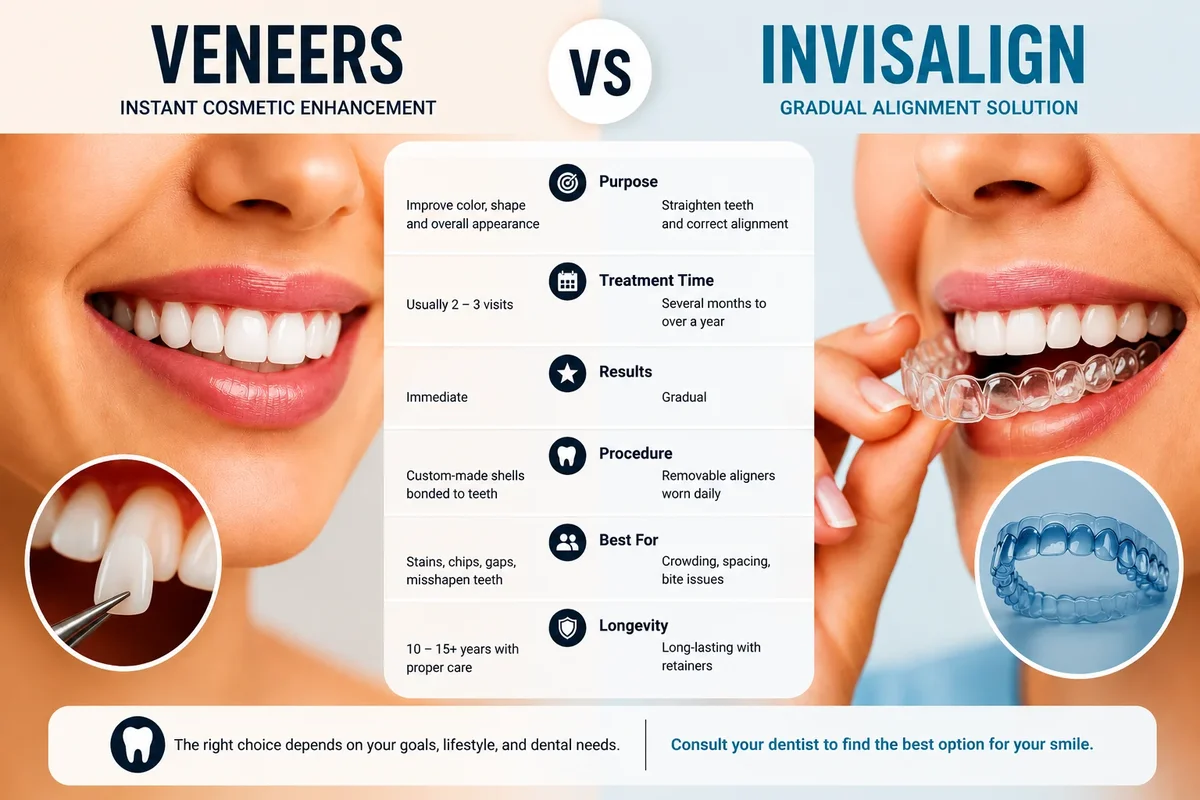
In many situations, veneers vs invisalign is not really a competition because they solve different problems. Invisalign is designed to gradually move teeth into healthier positions using a series of clear removable aligners. Veneers, on the other hand, are thin porcelain or composite shells bonded to the front surface of teeth to improve their appearance. They do not physically move teeth. Instead, they create the visual appearance of a more balanced smile by changing the color, size, shape, and sometimes the perceived alignment of teeth.
When deciding between veneers vs invisalign, start by asking yourself one simple question: Do I want to move my teeth, or do I mainly want to change how they look? If crooked or crowded teeth are your biggest concern, orthodontic treatment may provide a more suitable solution. If your teeth are already reasonably aligned but have discoloration, worn edges, uneven shapes, or small gaps, veneers may better match your expectations. Some patients even benefit from combining both treatments, completing orthodontic alignment first and then placing veneers on selected teeth for cosmetic refinement.
Another important factor when comparing veneers vs invisalign is your commitment during treatment. Invisalign requires wearing aligners for approximately 20 to 22 hours each day. Success depends heavily on patient compliance. Skipping aligners regularly can slow progress and affect the final outcome. Veneers generally require fewer appointments after planning, but they involve altering the tooth surface in many cases. Because these treatments work differently, your lifestyle, daily routine, and willingness to follow treatment instructions should all be considered before making a decision.
Oral health also plays a major role in the veneers vs invisalign decision. Healthy gums, stable teeth, and good oral hygiene support successful outcomes for either option. Existing tooth decay, untreated gum disease, severe bite problems, or significant tooth wear may need to be addressed before cosmetic treatment begins. This is why a comprehensive examination, photographs, digital scans, and sometimes dental X-rays are commonly recommended before any treatment plan is finalized.
Many people researching veneers vs invisalign are surprised to learn that cosmetic improvements and functional improvements are not always the same thing. Straighter teeth can make brushing and flossing easier for some patients and may contribute to improved oral hygiene. Veneers can dramatically enhance smile aesthetics, but they are not intended to correct significant orthodontic problems. Choosing based only on photographs found online may lead to unrealistic expectations because every patient’s teeth, bite, enamel quality, and facial proportions are unique.
Cost is another reason people compare veneers vs invisalign. While treatment fees are an important consideration, the final cost depends on many factors, including the complexity of your case, the number of teeth involved, the materials selected, additional procedures that may be needed, and the dentist’s treatment plan. Rather than looking for a single advertised price, it is usually more helpful to understand exactly what is included in your personalized treatment proposal after an examination.
If your goal is a natural-looking smile that supports both appearance and oral health, the discussion about veneers vs invisalign should focus on long-term suitability rather than finding a universal winner. Some patients prioritize preserving natural tooth structure whenever possible, while others value achieving a specific cosmetic result. Your age, bite relationship, enamel condition, previous dental work, and future maintenance requirements can all influence which approach may be more appropriate.
During your consultation, your dentist may use digital smile analysis to demonstrate possible outcomes before treatment begins. This allows you to better understand how veneers vs invisalign could affect your smile and whether one option—or a combination of both—better matches your expectations. Asking questions about treatment duration, maintenance, longevity, oral hygiene requirements, and expected limitations can help you make a more informed decision.
At Redent Klinik, treatment recommendations are based on individual clinical findings rather than a one-size-fits-all approach. Every smile has different functional and cosmetic priorities, so a personalized assessment is essential before deciding between treatment options. If you would like professional guidance based on your own oral condition, you can visit the
Redent Klinik Contact Page
to request an evaluation. You can also find general oral health information through the
American Dental Association.
Next step: Before choosing between veneers vs invisalign, prepare a list of your smile goals, note any concerns such as crooked teeth, discoloration, worn edges, or gaps, and schedule a comprehensive dental consultation. A personalized examination is the most reliable way to determine which treatment—or combination of treatments—is appropriate for your specific situation without relying on assumptions or generalized advice.
Quick Answer: Veneers vs Invisalign for Different Smile Goals
The most important point when comparing veneers vs invisalign is understanding that these treatments are designed to solve different problems. Many people search for a single winner, but the better option depends entirely on your smile goals, the condition of your teeth, and your long-term expectations. If your primary concern is crooked or crowded teeth, Invisalign is often considered because it gradually repositions teeth. If your concern is cosmetic issues such as discoloration, chipped enamel, uneven shapes, or small gaps, veneers may provide a more suitable solution. In many cases, the discussion about veneers vs invisalign is not about choosing the “best” treatment but identifying which treatment addresses the problem you actually have.
What Is Your Main Goal?
Before making a decision about veneers vs invisalign, ask yourself what you hope to change when you smile. People often have several concerns at once, but one issue is usually the highest priority. For example, someone may dislike crooked front teeth, while another person may have straight teeth but be unhappy with stains that whitening cannot remove. These situations require different treatment approaches.
Invisalign focuses primarily on tooth movement. Clear aligners apply controlled pressure over time to reposition teeth into improved alignment. Veneers do not move teeth. Instead, they improve the visible appearance of teeth by covering the front surface with carefully designed restorations. Understanding this distinction makes the veneers vs invisalign decision much easier because the treatments are intended for different clinical situations.
When Invisalign May Be More Suitable
During a veneers vs invisalign comparison, Invisalign may be considered if your main concerns include mild to moderate crowding, spacing, minor bite irregularities, or teeth that have shifted over time. Since the treatment gradually moves natural teeth, many patients appreciate that no visible brackets or wires are required.
Invisalign also appeals to adults who want orthodontic treatment with minimal impact on daily appearance. However, treatment success depends heavily on wearing the aligners consistently according to professional instructions. Patients who frequently remove aligners or forget to wear them may experience longer treatment times or less predictable progress.
Common Reasons Patients Consider Invisalign
- Mild or moderate crowding
- Small gaps between teeth
- Relapse after previous orthodontic treatment
- Desire to preserve natural tooth structure while improving alignment
- Preference for removable orthodontic appliances
When Veneers May Be More Suitable
Looking at veneers vs invisalign, veneers are commonly considered when cosmetic improvements are the primary objective. Teeth that are discolored, worn, chipped, irregularly shaped, or slightly uneven can often be improved visually with veneers. Instead of moving teeth, veneers reshape the visible surface to create a more balanced smile.
Patients sometimes expect veneers to solve severe alignment problems. While veneers may improve the appearance of slight irregularities, they are generally not intended to replace orthodontic treatment for significant crowding or bite correction. A comprehensive examination helps determine whether veneers alone are appropriate or whether orthodontic treatment should be considered first.
Common Reasons Patients Consider Veneers
- Permanent tooth discoloration
- Chipped or worn enamel
- Small cosmetic gaps
- Uneven tooth size or shape
- Smile makeover focused on aesthetics
Can Both Treatments Be Combined?
One aspect often overlooked during a veneers vs invisalign comparison is that some patients benefit from both treatments. Orthodontic alignment may be completed first to place teeth into healthier positions, followed by veneers on selected teeth to refine color, symmetry, or shape. This approach can sometimes preserve more natural tooth structure while achieving cosmetic goals.
Whether combination treatment is appropriate depends on factors such as bite alignment, enamel quality, existing restorations, gum health, and the patient’s desired outcome. A dentist evaluates these factors before recommending a sequence of treatment.
Important Factors Beyond Appearance
Although aesthetics often drive the veneers vs invisalign discussion, practical considerations deserve equal attention. Daily oral hygiene, treatment duration, maintenance requirements, future repairs, and lifestyle all influence which option may better fit your needs.
For example, patients who frequently snack throughout the day may find aligner wear more demanding because aligners should generally be removed before eating and replaced afterward once teeth are cleaned. Meanwhile, veneer patients should understand that restorations require ongoing care and routine dental examinations to monitor their condition.
Avoid Choosing Based Only on Photos
Online before-and-after photographs can be inspiring, but they should not determine your veneers vs invisalign decision. Every smile differs in tooth anatomy, jaw position, gum contours, facial proportions, and functional bite. What works well for one patient may not be the most suitable option for another.
A personalized consultation allows digital scans, photographs, bite analysis, and a clinical examination to identify which treatment is more appropriate for your individual circumstances. At Redent Klinik, treatment planning focuses on each patient’s oral health, smile objectives, and long-term maintenance rather than recommending the same solution for everyone.
What to check before making your decision: Review your primary smile concern, assess whether you want to correct tooth position or tooth appearance, consider your willingness to follow treatment instructions, and discuss realistic expectations with a qualified dentist. Request professional advice if you have significant crowding, bite problems, gum disease, damaged teeth, existing dental restorations, or if you are unsure whether veneers, Invisalign, or a combination approach would better support your long-term oral health and cosmetic goals.
Cost Comparison: What Affects Veneers vs Invisalign Pricing?
For many people researching veneers vs invisalign, cost is one of the biggest deciding factors. While it is natural to compare prices before choosing a treatment, focusing only on the initial fee can sometimes lead to the wrong decision. The true value of veneers vs invisalign depends on whether the chosen treatment addresses your actual dental concerns and supports your long-term oral health goals. A treatment that appears less expensive initially may require additional procedures later if it does not solve the underlying issue, while a higher initial investment may provide a more appropriate solution for your specific smile goals.
It is also important to understand that there is no universal price for veneers vs invisalign. Treatment costs vary depending on individual clinical findings, geographic location, the experience of the dental team, the materials selected, laboratory work, digital planning technology, and the complexity of treatment. For this reason, responsible dental clinics avoid guaranteeing exact prices before a comprehensive examination.
Why Treatment Costs Vary
One of the most common misconceptions about veneers vs invisalign is that each treatment has a standard price. In reality, every patient presents a unique combination of oral health conditions and cosmetic goals. Two patients seeking similar smile improvements may receive very different treatment plans because one has healthy teeth while the other requires additional dental care before cosmetic treatment can safely begin.
Before comparing financial estimates, dentists usually evaluate gum health, tooth structure, bite alignment, previous restorations, enamel quality, and overall oral hygiene. These factors help determine whether Invisalign, veneers, or another treatment option is more appropriate.
Factors That Influence Invisalign Costs
When discussing veneers vs invisalign, Invisalign pricing is influenced largely by the complexity of tooth movement. Minor corrections generally require fewer aligners than comprehensive orthodontic treatment involving multiple stages of movement. Digital treatment planning, monitoring appointments, refinement aligners, and retention after treatment may also influence the overall investment.
Common Cost Factors for Invisalign
- Severity of crowding or spacing
- Length of treatment
- Number of aligners required
- Digital scanning and treatment planning
- Need for refinement aligners
- Retention appliances after treatment
Because Invisalign treatment is customized, patients with relatively simple orthodontic needs may require fewer resources than those with more complex bite corrections. A professional examination is therefore necessary before discussing realistic treatment expectations.
Factors That Influence Veneer Costs
In a veneers vs invisalign comparison, veneer pricing is affected by several different variables. The material selected, such as porcelain or composite, influences treatment planning. The number of veneers required also plays a significant role. Some patients need only one or two veneers, while others pursue a complete smile makeover involving multiple front teeth.
Common Cost Factors for Veneers
- Number of teeth receiving veneers
- Choice of restorative material
- Complexity of smile design
- Laboratory fabrication methods
- Need for preliminary dental treatment
- Existing restorations or tooth damage
Since veneers are individually designed, every restoration is planned according to the patient’s facial proportions, smile line, bite relationship, and aesthetic objectives. This personalized planning contributes to differences in overall treatment cost.
Think Beyond the Initial Price
Comparing veneers vs invisalign based only on price can overlook important long-term considerations. For example, Invisalign primarily changes tooth position, while veneers primarily change tooth appearance. Selecting a treatment that does not address your main concern could result in additional procedures later.
Long-term maintenance should also be considered. Both treatments require ongoing oral hygiene, regular dental examinations, and appropriate aftercare. Future maintenance requirements differ between individuals, making personalized treatment planning more valuable than comparing advertised fees alone.
Questions Worth Asking During Your Consultation
Instead of requesting only a single price when discussing veneers vs invisalign, consider asking questions that help you understand the complete treatment plan.
- What treatment is recommended based on my dental condition?
- Why is this option more suitable than the alternative?
- What examinations are included before treatment?
- Will additional procedures be necessary?
- How long is the estimated treatment process?
- What maintenance should I expect after treatment?
These questions often provide more useful information than comparing numbers alone because they clarify exactly what your personalized treatment involves.
Planning for Value Rather Than Price Alone
The discussion around veneers vs invisalign should ultimately focus on achieving an outcome that supports both appearance and oral health. Some patients benefit more from orthodontic correction, while others primarily need cosmetic enhancement. Choosing the treatment that best fits your clinical needs can provide greater long-term satisfaction than selecting the option with the lowest advertised cost.
At Redent Klinik, treatment planning begins with a comprehensive assessment rather than a standard pricing model. Digital scans, photographs, bite evaluation, and an oral examination help determine which treatment is appropriate for your specific situation. Because every smile is unique, any discussion about costs should follow a personalized evaluation instead of relying on generalized estimates.
What to check before making your decision: Compare the complete treatment plan instead of only the quoted price. Ask what is included, whether additional procedures may be necessary, how long treatment is expected to take, and what future maintenance may involve. Request professional advice if you have significant crowding, damaged teeth, previous dental restorations, bite concerns, or if you are uncertain whether veneers vs invisalign is more appropriate for your smile goals. A comprehensive examination provides the most reliable basis for understanding treatment suitability and the factors that influence your individual investment.
Who Is the Best Candidate for Veneers vs Invisalign?
Choosing between veneers vs invisalign becomes much easier when you understand which treatment is designed for your specific dental condition. While both options can improve the appearance of a smile, they are intended for different clinical situations. Instead of asking which treatment is universally better, a more useful question is: Which treatment matches my oral health needs and cosmetic goals? A personalized evaluation allows your dentist to determine whether your priority should be moving teeth into healthier positions, improving the appearance of existing teeth, or combining both approaches. Understanding candidacy is one of the most important steps in making an informed veneers vs invisalign decision.
Ideal Candidates for Invisalign
When comparing veneers vs invisalign, Invisalign is generally considered for patients whose primary concern involves the position of their teeth. Clear aligners gradually move teeth using controlled orthodontic forces, making them suitable for many mild to moderate alignment issues. Patients often choose Invisalign because it offers a discreet alternative to traditional braces while allowing them to remove the aligners for eating and oral hygiene.
Good candidates usually have healthy teeth and gums, realistic expectations, and the motivation to wear aligners consistently for the recommended number of hours each day. Since treatment success depends on patient cooperation, commitment is just as important as the clinical diagnosis.
Invisalign May Be Suitable If You Have:
- Mild or moderate crowding
- Small spaces between teeth
- Minor bite irregularities
- Relapse after previous orthodontic treatment
- A desire to preserve natural tooth structure while improving alignment
During a consultation, digital scans and bite analysis help determine whether Invisalign can predictably address your orthodontic concerns. Some complex bite problems may require different orthodontic approaches, which is why professional assessment remains essential before deciding on veneers vs invisalign.
Ideal Candidates for Veneers
In the discussion of veneers vs invisalign, veneers are usually recommended when cosmetic enhancement is the primary objective rather than tooth movement. Veneers improve the visible surface of teeth by changing their color, shape, size, and overall symmetry. They are commonly considered by patients whose teeth are already reasonably aligned but who remain dissatisfied with the appearance of their smile.
Candidates should have sufficient healthy tooth structure to support veneers and maintain good oral hygiene. Existing gum disease or untreated decay generally needs to be managed before cosmetic treatment begins.
Veneers May Be Suitable If You Have:
- Permanent discoloration that does not respond to whitening
- Chipped or worn front teeth
- Uneven tooth size or shape
- Minor cosmetic gaps
- A desire for a smile makeover focused on aesthetics
While veneers can improve the appearance of slightly misaligned teeth, they are not designed to correct significant orthodontic problems. This distinction is one of the most important differences in the veneers vs invisalign comparison.
When Combination Treatment May Be the Better Choice
A common misconception is that choosing veneers vs invisalign always means selecting one treatment instead of the other. In reality, some patients achieve their preferred results through a staged treatment plan. Invisalign may first reposition the teeth into a healthier alignment, after which veneers are placed on selected teeth to enhance shape, color, or symmetry.
This combined approach can sometimes reduce the amount of tooth preparation required for veneers while creating a more balanced final result. Whether combination treatment is appropriate depends on individual clinical findings rather than cosmetic preferences alone.
Health Factors That Influence Suitability
Beyond appearance, several oral health factors influence candidacy in a veneers vs invisalign evaluation. Healthy gums provide a stable foundation for both treatments. Untreated periodontal disease, extensive tooth decay, active infections, or severe tooth wear should usually be addressed before cosmetic or orthodontic treatment begins.
Dentists also evaluate enamel quality, previous restorations, jaw relationships, bite function, and habits such as teeth grinding. These factors help determine not only which treatment is appropriate but also how long-lasting and predictable the results are likely to be.
Lifestyle Considerations
Your daily routine also influences the veneers vs invisalign decision. Invisalign requires discipline because aligners should generally be worn for most of the day and removed only when eating, drinking anything other than water, or cleaning the teeth. Patients who travel frequently, snack often, or struggle with consistent routines should discuss these factors honestly during consultation.
Veneers require different considerations. Maintaining excellent oral hygiene, attending regular dental check-ups, and avoiding habits that may damage restorations—such as biting hard objects—can help support long-term success. Choosing between these treatments therefore involves both clinical suitability and lifestyle compatibility.
Why a Personalized Assessment Matters
Online articles, smile galleries, and social media posts may provide inspiration, but they cannot determine whether veneers vs invisalign is the right choice for your unique situation. Every patient has different tooth anatomy, gum contours, facial proportions, bite relationships, and cosmetic expectations. What appears ideal for one individual may not be the most suitable treatment for another.
At Redent Klinik, treatment planning begins with a comprehensive examination that may include digital scans, photographs, bite analysis, and a review of your oral health history. Rather than recommending the same solution for every patient, the goal is to identify the treatment that aligns with your functional needs, aesthetic preferences, and long-term oral health.
What to check before making your decision: Consider whether your primary concern is tooth alignment or tooth appearance, evaluate your commitment to treatment and aftercare, and ensure your teeth and gums are healthy enough for cosmetic or orthodontic procedures. Request professional advice if you have significant crowding, bite issues, worn teeth, gum disease, previous dental restorations, or if you are unsure whether veneers vs invisalign or a combination of both treatments would best support your smile goals.
Treatment Process: How Veneers vs Invisalign Work Step by Step
Understanding the treatment process is one of the most effective ways to decide between veneers vs invisalign. While both options aim to improve your smile, they follow very different clinical pathways. Invisalign focuses on gradually moving natural teeth into improved positions over time, whereas veneers concentrate on enhancing the visible appearance of existing teeth. Knowing what happens at each stage of veneers vs invisalign allows you to set realistic expectations regarding appointments, treatment duration, daily responsibilities, and follow-up care. Instead of choosing based solely on appearance or cost, understanding the complete process helps you determine which option better matches your lifestyle and smile objectives.
Step 1: Comprehensive Consultation and Examination
Every successful veneers vs invisalign treatment begins with a detailed dental examination. Before recommending either option, your dentist evaluates your teeth, gums, bite, jaw relationship, existing restorations, and overall oral health. Digital photographs, intraoral scans, and, when appropriate, dental X-rays help create an accurate picture of your current condition.
During this appointment, you should discuss your expectations openly. Some patients primarily want straighter teeth, while others hope to improve tooth color or shape. Identifying your priorities early helps the dental team recommend the treatment that is most appropriate rather than simply the one that appears most popular.
Information Commonly Collected During the Consultation
- Medical and dental history
- Digital photographs
- 3D intraoral scans or impressions
- Bite analysis
- Evaluation of gum health
- Assessment of enamel and existing restorations
Step 2: Personalized Treatment Planning
The planning stage is where the differences between veneers vs invisalign become more apparent. Invisalign uses digital software to simulate tooth movement throughout treatment. This allows your dentist to map out each stage of alignment before the first aligner is even worn.
Veneer planning focuses on smile design rather than orthodontic movement. Factors such as tooth proportions, facial symmetry, gum contours, lip position, and smile line are carefully evaluated. In some cases, temporary mock-ups or digital smile simulations help patients visualize possible cosmetic outcomes before treatment begins.
Step 3: Beginning Active Treatment
During a veneers vs invisalign comparison, this is the point where the clinical experience differs significantly.
How Invisalign Treatment Begins
Once aligners are manufactured, patients receive their first series and instructions on proper wear. Aligners are generally worn for approximately 20 to 22 hours per day and replaced according to the dentist’s treatment schedule. Regular follow-up appointments monitor progress and ensure tooth movement is occurring as planned.
How Veneer Treatment Begins
Veneer treatment usually involves preparing the teeth when clinically indicated, taking highly accurate impressions or digital scans, and fabricating custom restorations in a dental laboratory. Temporary restorations may be used in some situations before the final veneers are bonded. Once completed, the dentist carefully evaluates fit, color, bite, and overall aesthetics before final placement.
Step 4: Daily Responsibilities During Treatment
One important consideration in the veneers vs invisalign decision is the level of patient participation required.
Invisalign treatment depends heavily on consistency. Aligners should generally be removed only for eating, drinking beverages other than water, brushing, and flossing. Patients who frequently forget to wear their aligners or remove them for extended periods may experience slower progress or require adjustments to the treatment plan.
Veneers involve fewer daily treatment responsibilities after placement, but maintaining excellent oral hygiene remains essential. Brushing, flossing, routine dental examinations, and avoiding habits that may damage restorations all contribute to long-term maintenance.
Step 5: Completion and Long-Term Maintenance
Completing veneers vs invisalign treatment does not mean dental care ends. Invisalign patients commonly receive retainers to help maintain the new tooth positions. Wearing retainers according to professional instructions is important because teeth naturally have a tendency to shift over time.
Veneers also require ongoing maintenance. Although they are designed to improve aesthetics, regular dental visits allow the dentist to evaluate the health of surrounding teeth and gums while monitoring the condition of the restorations. Proper home care supports long-term function and appearance.
Can the Treatment Plan Change?
During veneers vs invisalign treatment, adjustments are sometimes necessary. Invisalign patients may require refinement aligners if additional tooth movement is needed after the initial series. Veneer treatment plans may also evolve if new findings emerge during preparation or if underlying dental conditions require attention before cosmetic procedures continue.
This flexibility highlights the importance of individualized care. Every patient’s response to treatment is different, so planning should remain adaptable rather than relying on fixed expectations.
Choosing the Process That Fits Your Lifestyle
The best choice in the veneers vs invisalign comparison is often the one that aligns with your daily routine as well as your clinical needs. Patients who are comfortable wearing aligners consistently and want to preserve natural tooth structure may prefer orthodontic treatment. Others who seek cosmetic enhancement of tooth shape, color, or minor imperfections may find veneers more aligned with their expectations.
At Redent Klinik, treatment planning focuses on understanding each patient’s oral health, aesthetic priorities, and lifestyle before recommending any procedure. Digital technology, careful examination, and personalized consultation help determine whether Invisalign, veneers, or a staged combination of both treatments is the most appropriate pathway.
What to check before making your decision: Ask your dentist how long treatment is expected to take, what daily responsibilities are involved, whether additional procedures may be necessary, and what long-term maintenance will include. Request professional advice if you have bite problems, gum disease, worn teeth, previous restorations, or if you are unsure whether the treatment process for veneers vs invisalign fits your oral health needs and lifestyle. A personalized examination remains the most reliable way to choose the treatment pathway that best supports your smile goals.
Risks, Limitations, and Long-Term Considerations of Veneers vs Invisalign
Every dental treatment offers potential benefits, but every procedure also has limitations that should be understood before making a decision. When comparing veneers vs invisalign, many patients focus on the expected cosmetic outcome while overlooking the practical responsibilities and long-term considerations associated with each option. Understanding these factors allows you to make a balanced decision based on your individual dental condition rather than expectations created by advertisements or social media. The goal of evaluating veneers vs invisalign is not to identify a treatment with no disadvantages, but to determine which option provides the most appropriate balance of benefits and limitations for your specific situation.
Understanding the Limitations of Invisalign
Invisalign has become a popular orthodontic treatment because it uses clear removable aligners instead of conventional brackets and wires. However, success depends heavily on patient cooperation. Unlike fixed orthodontic appliances, Invisalign only works effectively when aligners are worn consistently according to professional instructions. Patients who frequently remove aligners or fail to wear them for the recommended number of hours each day may experience slower tooth movement or reduced treatment effectiveness.
Another important point in the veneers vs invisalign discussion is that not every orthodontic problem can be treated with clear aligners alone. Some complex bite discrepancies or severe alignment problems may require alternative orthodontic techniques or additional procedures. A detailed clinical examination helps determine whether Invisalign is an appropriate treatment option for your individual case.
Potential Limitations of Invisalign
- Requires consistent daily wear for successful treatment.
- May not be suitable for every complex orthodontic condition.
- Regular follow-up appointments are necessary to monitor progress.
- Retainers are typically recommended after treatment to help maintain alignment.
- Daily discipline is essential for predictable progress.
Understanding the Limitations of Veneers
During a veneers vs invisalign comparison, veneers provide cosmetic improvements rather than orthodontic correction. While they can transform the appearance of teeth, they do not physically move teeth into different positions. Patients with significant crowding, bite problems, or functional orthodontic concerns may still require tooth movement before cosmetic restorations are considered.
Depending on the clinical situation, veneer placement may involve modifying a small amount of the natural tooth surface. The extent of preparation varies according to treatment goals and the condition of the teeth. Because every patient presents unique anatomy, the amount of preparation should only be determined after a comprehensive dental examination.
Potential Limitations of Veneers
- Primarily improve appearance rather than tooth position.
- May require tooth preparation depending on the treatment plan.
- Not intended to correct significant orthodontic problems.
- Require good oral hygiene and regular professional monitoring.
- Future maintenance or replacement may become necessary over time.
Long-Term Maintenance Matters
Long-term care is often overlooked when researching veneers vs invisalign. Completing treatment is only the beginning of maintaining a healthy and attractive smile. Both options require commitment after the active treatment phase, although the responsibilities differ.
Invisalign patients are commonly advised to wear retainers after orthodontic treatment. Teeth naturally tend to shift throughout life, so retention helps preserve the alignment achieved during treatment. Skipping retainer use may increase the likelihood of gradual tooth movement over time.
Veneer patients should maintain excellent oral hygiene, attend routine dental examinations, and avoid habits that may place excessive stress on restorations, such as biting hard objects or using teeth as tools. These preventive habits support long-term function regardless of the type of restoration used.
Managing Expectations
One of the most important aspects of deciding between veneers vs invisalign is setting realistic expectations before treatment begins. Invisalign gradually changes tooth position, meaning improvements occur progressively rather than immediately. Veneers may produce faster cosmetic changes once treatment is completed, but they are not intended to resolve functional orthodontic issues.
Patients who understand the strengths and limitations of each option are generally better prepared for the treatment process and long-term maintenance. Open communication with the dental team helps ensure that treatment goals remain realistic and appropriate for the patient’s oral condition.
Could Delaying Treatment Create Additional Challenges?
Another consideration in the veneers vs invisalign decision is timing. Delaying treatment does not necessarily cause problems in every case, but untreated crowding, bite irregularities, worn teeth, or damaged restorations may gradually become more complicated if underlying issues are not addressed. Early assessment allows your dentist to identify whether immediate treatment is advisable or whether monitoring is sufficient.
Likewise, cosmetic concerns sometimes mask functional issues. A patient requesting veneers for aesthetic reasons may actually benefit from orthodontic correction first. This is why treatment planning should never rely solely on photographs or online comparisons.
When Combination Treatment May Reduce Limitations
In some situations, the discussion about veneers vs invisalign does not end with choosing one option. Orthodontic alignment followed by carefully planned veneers may provide a more conservative and balanced result for selected patients. Aligning teeth first can sometimes reduce the amount of tooth preparation needed for veneers while improving overall smile symmetry.
Whether this staged approach is appropriate depends on factors such as bite alignment, enamel condition, gum health, facial proportions, and aesthetic objectives. A comprehensive examination is essential before recommending combined treatment.
Making a Balanced Decision
At Redent Klinik, treatment recommendations are based on individual clinical findings rather than promoting one cosmetic solution for every patient. Digital scans, photographs, bite evaluation, and a detailed oral examination help identify the advantages, limitations, and long-term considerations associated with each treatment option. Rather than asking which procedure is universally better, patients are encouraged to focus on which option best supports their oral health, smile goals, and lifestyle.
What to check before making your decision: Consider whether your primary goal is improving tooth alignment or cosmetic appearance, evaluate your willingness to follow long-term maintenance requirements, and discuss any existing dental conditions with your dentist. Request professional advice if you have significant crowding, bite concerns, teeth grinding habits, damaged restorations, gum disease, or if you are uncertain whether veneers vs invisalign is the more appropriate treatment for your individual needs. A personalized clinical assessment provides the most reliable foundation for making an informed and confident decision.
Alternatives to Veneers vs Invisalign for Improving Your Smile
Although many people compare veneers vs invisalign, these are not the only treatment options available for creating a healthier and more attractive smile. In some situations, another dental procedure—or a combination of treatments—may provide a better solution depending on your oral health, cosmetic expectations, and functional needs. Understanding the available alternatives helps you make a more informed decision rather than assuming your only choices are veneers vs invisalign. A comprehensive dental examination is the best way to determine whether an alternative treatment could achieve your goals more conservatively or more effectively.
Before selecting any cosmetic procedure, your dentist evaluates the condition of your teeth, gums, bite, enamel, previous restorations, and overall oral health. This assessment may reveal that another treatment should be completed before cosmetic work begins, or that a less invasive option can address your concerns.
Professional Teeth Whitening
Some patients researching veneers vs invisalign are primarily unhappy with tooth color rather than alignment or tooth shape. If discoloration is the main concern and the teeth are otherwise healthy, professional whitening may be an appropriate first step. Whitening can improve the brightness of natural teeth without changing their position or structure.
However, whitening is not suitable for every type of stain, and it does not change the color of existing crowns, veneers, or other restorations. A dental examination helps determine whether whitening is likely to improve your smile or whether another treatment would better address your concerns.
Whitening May Be Appropriate If You Have:
- Healthy natural teeth
- Surface discoloration or age-related staining
- No significant alignment concerns
- Realistic expectations regarding color improvement
Dental Bonding
Another alternative worth considering alongside veneers vs invisalign is dental bonding. Composite resin can sometimes repair small chips, close minor gaps, or improve slight shape irregularities without requiring laboratory-fabricated veneers. Bonding is generally more conservative than veneers because less tooth preparation may be required.
The suitability of bonding depends on factors such as bite forces, the size of the defect being corrected, oral hygiene habits, and the location of the tooth. While bonding can be an excellent option for selected patients, it may not provide the same indications as orthodontic treatment or porcelain veneers.
Orthodontic Braces
When comparing veneers vs invisalign, it is also important to remember that traditional braces remain an effective orthodontic solution for many patients. Fixed braces may be recommended for more complex tooth movements or bite corrections that require additional control beyond removable aligners.
The decision between braces and Invisalign depends on individual orthodontic needs rather than appearance alone. Your dentist or orthodontist evaluates the complexity of tooth movement before recommending the most appropriate treatment approach.
Traditional Braces May Be Considered For:
- More complex bite discrepancies
- Severe crowding
- Significant tooth rotation
- Cases requiring extensive orthodontic movement
Dental Crowns
Some people exploring veneers vs invisalign actually have teeth that are structurally weakened by large fillings, fractures, or extensive wear. In these situations, dental crowns may provide greater protection than cosmetic veneers because crowns cover the entire visible portion of the tooth rather than only the front surface.
Whether a tooth requires a crown or a veneer depends on the amount of remaining healthy tooth structure. Preserving natural teeth whenever clinically appropriate is generally an important consideration during treatment planning.
Combination Treatment Approaches
In many situations, the most effective solution is not choosing exclusively between veneers vs invisalign. Instead, several procedures may be combined to create a balanced result. For example, orthodontic treatment may first improve alignment, followed by whitening and then selective veneers on a few teeth to refine color or symmetry.
Another patient may begin with periodontal treatment to improve gum health before considering any cosmetic procedure. Every smile has different functional and aesthetic priorities, making individualized treatment planning essential.
How Dentists Choose the Right Alternative
Selecting the most appropriate option beyond veneers vs invisalign requires more than looking at photographs or reading online comparisons. During consultation, dentists evaluate multiple clinical factors that influence treatment recommendations.
Common Factors Considered During Treatment Planning
- Overall oral health
- Gum condition
- Enamel thickness
- Bite relationship
- Existing restorations
- Age and long-term maintenance expectations
- Personal smile goals
- Daily lifestyle and oral hygiene habits
These findings help determine whether orthodontic treatment, cosmetic restorations, whitening, bonding, crowns, or a combination of procedures is most appropriate for your unique circumstances.
Avoid Choosing Based on One Factor Alone
Many patients researching veneers vs invisalign initially focus only on appearance or cost. While both are important considerations, treatment decisions should also account for long-term oral health, maintenance, expected longevity, and functional stability. Choosing a procedure that addresses only cosmetic concerns without considering underlying dental conditions may not provide the most appropriate long-term solution.
At Redent Klinik, treatment recommendations are developed after a detailed clinical evaluation rather than applying the same cosmetic approach to every patient. Digital imaging, intraoral scans, bite assessment, and discussion of your personal goals allow the dental team to recommend the treatment—or combination of treatments—that best supports both function and aesthetics.
What to check before making your decision: Identify whether your main concern is tooth color, alignment, shape, structural damage, or overall smile harmony. Ask your dentist whether conservative alternatives such as whitening or bonding could meet your goals before considering more extensive procedures. Request professional advice if you have worn teeth, previous restorations, bite problems, gum disease, significant crowding, or if you are uncertain whether veneers vs invisalign or another treatment option would be the most appropriate choice for your long-term oral health and smile expectations.
Financing and Payment Considerations for Veneers vs Invisalign
Financial planning is an important part of deciding between veneers vs invisalign. While clinical suitability should always come first, understanding how treatment costs are structured and what payment options may be available can make the decision easier. Many patients initially compare only the advertised price, but the overall financial picture often includes consultation fees, diagnostic imaging, treatment planning, follow-up visits, retainers, temporary restorations, or future maintenance. Rather than searching for the lowest number, it is more helpful to understand what is included in your personalized treatment plan and whether it fits both your dental needs and your budget. When evaluating veneers vs invisalign, remember that every smile is unique, so financial planning should be based on an individual examination rather than generalized online estimates.
Why There Is No Standard Price
One of the first things patients discover when researching veneers vs invisalign is that treatment fees vary considerably. This variation does not necessarily mean one clinic is better than another. Instead, differences usually reflect the complexity of the case, the number of teeth involved, the technology used for diagnosis and planning, laboratory work, and the treatment approach recommended by the dental team.
For example, a patient requiring only minor orthodontic correction may have a different treatment plan from someone with more complex bite issues. Similarly, one person may need veneers on only two front teeth, while another may choose a more comprehensive cosmetic smile enhancement. These individual differences explain why responsible dental providers avoid quoting guaranteed prices before a complete examination.
Understanding What May Be Included
Before comparing quotes for veneers vs invisalign, ask what services are included in the proposed treatment plan. Two treatment estimates that appear similar may actually cover different services, making direct comparisons difficult.
Items That May Be Included in a Treatment Plan
- Initial consultation and clinical examination
- Digital scans or impressions
- Photographs and smile analysis
- Treatment planning appointments
- Follow-up visits during treatment
- Retention appliances after orthodontic treatment, when appropriate
- Temporary restorations, if clinically indicated
- Post-treatment reviews and maintenance recommendations
Asking for a detailed explanation of the proposed treatment helps you understand the complete investment instead of focusing only on the headline figure.
Monthly Payment Options
Many clinics recognize that cosmetic and orthodontic treatments represent a significant financial commitment. As a result, some practices may offer staged payment plans or financing solutions that allow eligible patients to spread treatment costs over time. Availability, eligibility requirements, repayment periods, and financial terms vary between providers and countries.
During your veneers vs invisalign consultation, it is reasonable to ask whether flexible payment arrangements are available. Rather than assuming every clinic provides financing, request a clear explanation of the available options and review all terms carefully before making any financial commitment.
Insurance Considerations
Insurance coverage is another factor that often influences the veneers vs invisalign decision. Coverage policies vary widely depending on your insurance provider, your specific plan, your country of residence, and whether treatment is considered cosmetic, orthodontic, restorative, or medically necessary.
Because policies differ significantly, patients should contact their insurance provider directly to confirm current benefits, exclusions, annual limits, waiting periods, and documentation requirements. Your dental clinic may also assist by providing treatment plans or supporting documentation when appropriate.
Looking Beyond the Initial Investment
When evaluating veneers vs invisalign, it is helpful to consider long-term value rather than focusing only on the immediate expense. Both treatments require ongoing oral hygiene, regular dental examinations, and professional maintenance. Invisalign patients may require retainers after treatment, while veneer patients should plan for routine monitoring of their restorations and overall oral health.
Understanding these continuing responsibilities helps you prepare financially and practically for maintaining your smile after treatment is complete.
Questions to Ask During Your Financial Consultation
Before choosing between veneers vs invisalign, ask questions that provide a complete understanding of your treatment proposal rather than simply requesting the final cost.
Helpful Questions to Discuss
- What services are included in the treatment estimate?
- Are digital scans, photographs, and reviews included?
- Could additional procedures become necessary after examination?
- What payment options are available?
- How are follow-up appointments handled?
- What long-term maintenance should I expect?
- Will future retainers or restoration maintenance involve additional costs?
These questions often provide a much clearer understanding of the overall investment than comparing advertised prices alone.
Balancing Budget and Clinical Needs
Choosing between veneers vs invisalign should never be based solely on financial considerations. A treatment that appears less expensive may not address your primary concern, while another option may better support both function and aesthetics over the long term. The most cost-effective treatment is often the one that appropriately addresses your individual dental needs without unnecessary procedures.
At Redent Klinik, financial discussions follow a comprehensive clinical assessment so that recommendations are based on your oral health, smile goals, and treatment priorities rather than generalized pricing. Digital examinations, smile analysis, and personalized treatment planning allow patients to understand both the clinical recommendations and the factors influencing the overall investment before making a decision.
What to check before making your decision: Ask for a written treatment plan explaining what is included, discuss available payment or financing options if needed, and confirm whether future maintenance requirements should be considered as part of your budget. Request professional advice if you are uncertain whether veneers vs invisalign is the more appropriate investment for your oral health, cosmetic expectations, and long-term treatment goals. A personalized consultation provides the clearest understanding of both clinical suitability and financial planning.
Frequently Asked Questions About Veneers vs Invisalign
Patients researching veneers vs invisalign often ask similar questions before scheduling a consultation. While online information can provide a helpful introduction, the most reliable answers always depend on an individual clinical examination. Factors such as tooth position, enamel quality, gum health, bite relationship, previous dental work, and cosmetic goals all influence which treatment may be more appropriate. The following frequently asked questions explain common concerns about veneers vs invisalign while helping you understand when professional advice is recommended.
Which Treatment Looks More Natural?
A common question about veneers vs invisalign is which treatment creates the most natural-looking smile. The answer depends on what you are trying to improve. Invisalign gradually moves your own natural teeth, so the final appearance comes from improved alignment rather than artificial restorations. Veneers enhance the visible surface of teeth by modifying color, shape, and symmetry. When carefully planned, both treatments can produce natural-looking results, but they achieve those results in different ways.
Which Option Usually Takes Longer?
Treatment duration is another frequent topic in the veneers vs invisalign comparison. Invisalign generally requires a period of gradual tooth movement that varies according to the complexity of the orthodontic correction. Veneers often involve fewer clinical stages once planning has been completed, although laboratory fabrication and preparation appointments are part of the process.
Rather than comparing treatment length alone, patients should consider whether the chosen procedure addresses their primary concern. A shorter treatment that does not solve the underlying problem may not be the most appropriate choice.
Can Veneers Straighten Crooked Teeth?
This is one of the most misunderstood aspects of veneers vs invisalign. Veneers can improve the appearance of slightly uneven teeth by changing their visible shape, but they do not physically move teeth into new positions. If significant crowding, spacing, or bite correction is required, orthodontic treatment may be recommended before cosmetic procedures are considered.
A comprehensive examination allows the dentist to determine whether veneers alone are appropriate or whether orthodontic alignment would better support long-term oral health.
Can Invisalign Improve Tooth Color?
During discussions about veneers vs invisalign, some patients expect Invisalign to improve discoloration. Invisalign aligns teeth but does not change the natural shade of enamel. If color is your primary concern, professional whitening, veneers, or other cosmetic procedures may be more suitable depending on the cause of the discoloration.
Your dentist can identify whether stains are likely to respond to whitening or whether restorative treatment should be considered.
Can I Have Both Treatments?
Yes, some patients benefit from combining veneers vs invisalign rather than choosing only one. Orthodontic treatment may first improve tooth alignment, after which veneers can be placed on selected teeth to enhance shape, symmetry, or color. This staged approach is individualized and depends on clinical findings rather than cosmetic preference alone.
Combining treatments is not necessary for every patient, but it may offer advantages in selected situations where both function and aesthetics require improvement.
Will Either Treatment Last Forever?
Another common question regarding veneers vs invisalign concerns longevity. No dental treatment can be guaranteed to last indefinitely because outcomes depend on oral hygiene, regular dental care, lifestyle habits, bite forces, and many individual factors.
Invisalign patients are generally advised to wear retainers after treatment to help maintain tooth position. Veneers also require regular professional monitoring, excellent oral hygiene, and avoidance of habits that may damage restorations.
Which Treatment Is Better for Adults?
Adults frequently compare veneers vs invisalign because they want to improve their smile without disrupting professional or social activities. Both treatments are commonly performed in adults, but the most suitable option depends on the patient’s oral condition rather than age alone.
Some adults prioritize correcting alignment, while others seek cosmetic improvements in tooth color or shape. A personalized assessment helps determine which treatment best matches these goals.
How Do Dentists Decide Which Treatment to Recommend?
During a consultation about veneers vs invisalign, dentists evaluate multiple clinical factors before making recommendations. These may include:
Common Assessment Factors
- Overall oral health
- Gum condition
- Tooth alignment
- Bite relationship
- Enamel quality
- Existing restorations
- Smile goals
- Long-term maintenance expectations
Because every patient presents a unique combination of these factors, treatment planning should always be individualized rather than based solely on online comparisons.
What Should You Bring to Your Consultation?
Preparing for a consultation about veneers vs invisalign can help you receive more personalized recommendations. Consider writing down your smile concerns, previous dental treatments, questions about maintenance, expected treatment timelines, and any financial considerations you would like to discuss.
Bringing photographs of smiles you like may also help communicate your aesthetic preferences, although these images should be used only as references rather than expectations for identical results.
Making an Informed Decision
At Redent Klinik, consultations are designed to provide individualized guidance rather than encouraging one treatment for every patient. Digital scans, photographs, bite evaluation, and a comprehensive oral examination help identify whether Invisalign, veneers, another treatment, or a combination approach best supports your smile goals and oral health. By understanding the differences between veneers vs invisalign, patients are better equipped to make decisions based on clinical suitability instead of assumptions.
What to check before making your decision: Review your main concerns, determine whether you want to improve tooth alignment or appearance, ask about long-term maintenance, and discuss realistic treatment expectations with your dentist. Request professional advice if you have bite problems, significant crowding, damaged teeth, existing restorations, gum disease, or if you remain uncertain whether veneers vs invisalign is the most appropriate treatment for your individual smile goals. A personalized clinical assessment is the most reliable way to receive recommendations tailored to your oral health.
Final Decision: Choosing Between Veneers vs Invisalign and Your Next Step
Reaching the end of your research on veneers vs invisalign does not necessarily mean you have reached the final answer. Instead, it means you should now have a clearer understanding of what each treatment is designed to achieve. The most important takeaway is that there is no universal winner in the veneers vs invisalign comparison. The right treatment depends on your oral health, your smile goals, your lifestyle, and the clinical findings identified during a professional dental examination. Rather than asking which treatment is more popular, focus on which option solves the problem you actually have.
Throughout this guide, you have seen that Invisalign primarily improves tooth position through controlled orthodontic movement, while veneers improve the visible appearance of teeth by changing their color, shape, and proportions. These different purposes explain why dentists rarely recommend one treatment simply because a patient requests it. Instead, recommendations are based on clinical evidence gathered during consultation and diagnostic assessment.
Start With Your Main Smile Goal
The easiest way to approach the veneers vs invisalign decision is to identify your highest priority. Every patient has different expectations, and defining your main objective helps narrow the treatment options considerably.
If Your Priority Is Tooth Alignment
- Mild or moderate crowding
- Spacing between teeth
- Teeth that shifted after previous orthodontic treatment
- Improving bite relationships in appropriate cases
- Preserving natural tooth structure while correcting alignment
Patients with these concerns often discuss orthodontic solutions during a veneers vs invisalign consultation because moving the natural teeth addresses the underlying issue rather than masking its appearance.
If Your Priority Is Cosmetic Appearance
- Permanent discoloration
- Small chips or worn edges
- Uneven tooth shape
- Minor cosmetic gaps
- Smile symmetry
These situations frequently lead patients to explore veneers as a cosmetic solution. However, whether veneers are appropriate still depends on enamel quality, gum health, bite function, and the condition of the supporting teeth.
Remember That Combination Treatment Is Sometimes Best
One of the biggest misconceptions about veneers vs invisalign is that you must always choose one treatment instead of the other. In reality, some patients achieve the most balanced outcome by combining both approaches. Orthodontic treatment may first improve alignment, followed by carefully planned veneers on selected teeth to refine shape or color.
This staged approach is not appropriate for everyone, but it illustrates why individualized treatment planning is far more valuable than trying to identify a universal “best” treatment from online comparisons.
Questions to Ask Yourself Before Deciding
Before making your final veneers vs invisalign decision, take time to consider your personal priorities rather than focusing only on cost or appearance.
Helpful Self-Assessment Questions
- Am I trying to improve alignment, appearance, or both?
- Am I prepared to follow daily treatment instructions?
- Do I understand the maintenance required after treatment?
- Have I discussed all available alternatives with my dentist?
- Do I have realistic expectations about the outcome?
- Have any underlying dental problems been identified and treated?
Honest answers to these questions can help guide a more confident conversation with your dental team.
The Importance of a Comprehensive Examination
Although articles like this provide valuable background information, they cannot replace a clinical evaluation. Every veneers vs invisalign recommendation should be based on a detailed assessment of your oral health rather than assumptions. Dentists commonly evaluate gum condition, tooth structure, enamel thickness, bite relationships, existing restorations, facial proportions, and smile goals before recommending treatment.
Digital scans, clinical photographs, and bite analysis often reveal important details that cannot be identified from photographs alone. These findings help create a personalized treatment plan designed around your specific needs.
Planning for Long-Term Success
The decision about veneers vs invisalign should not end once treatment begins. Long-term success depends on maintaining good oral hygiene, attending routine dental examinations, and following professional advice after treatment is completed. Invisalign patients are commonly advised to wear retainers as instructed, while veneer patients should continue regular preventive care and avoid habits that may place excessive stress on restorations.
Thinking beyond the immediate cosmetic improvement allows you to choose a treatment that supports your smile for years to come rather than focusing only on the initial transformation.
Your Next Step
If you are still uncertain about veneers vs invisalign, the next step is not choosing a treatment independently—it is arranging a comprehensive consultation with a qualified dental professional. A personalized assessment allows your dentist to explain which option best matches your oral health, cosmetic expectations, and long-term treatment goals.
At Redent Klinik, treatment planning begins with careful diagnosis rather than assumptions. Digital imaging, clinical examination, and discussion of your priorities help determine whether Invisalign, veneers, another treatment option, or a combination approach is the most appropriate solution. The objective is to recommend treatment based on your individual needs while helping you understand every stage of the process before making a decision.
Final Checklist Before Scheduling Treatment
Review These Points
- Clearly identify your primary smile concern.
- Understand whether your goal involves alignment, appearance, or both.
- Review the expected treatment process and maintenance requirements.
- Discuss alternative options before committing to treatment.
- Ask how your oral health influences the recommended approach.
- Request a personalized treatment plan based on a complete examination.
When to request professional advice: Schedule a comprehensive dental consultation if you have crowded teeth, bite concerns, worn or chipped teeth, discoloration, previous restorations, gum disease, or if you remain unsure whether veneers vs invisalign is the most suitable option for your smile. A personalized examination provides the information needed to make a confident, evidence-based decision while considering your oral health, cosmetic goals, lifestyle, and long-term expectations.
Disclosure: this page may contain affiliate links. We may earn a commission if you use them, at no extra cost to you.