
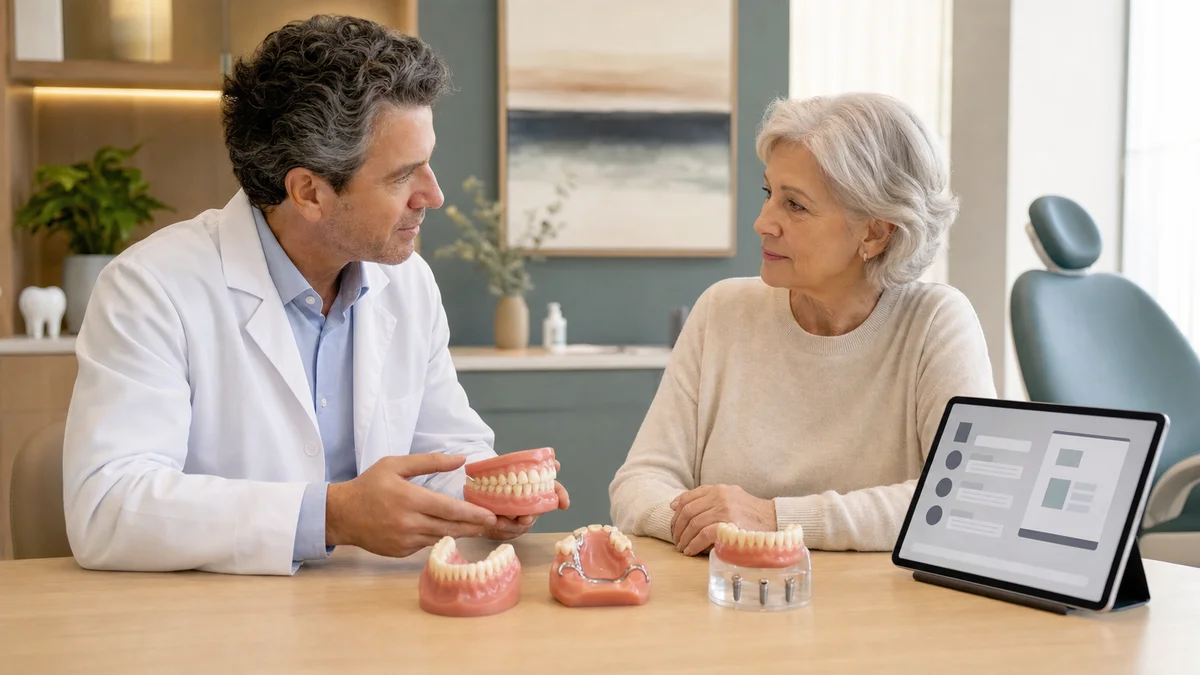
Quick answer: Treat dentures reviews as personal experience, not proof that one design will suit you. Compare the reviewer’s denture type, starting oral condition, treatment stage, adjustment visits, cleaning routine and follow-up. A clinical examination remains essential because fit, comfort, speech, chewing and maintenance depend on anatomy, health, expectations and ongoing care.
People search dentures reviews because they want a candid picture of everyday life: Will the appliance feel secure? How long might speech and eating take to adapt? Are follow-up appointments normal? Which compromises are reasonable? Those are valid questions. The difficulty is that reviews often collapse very different treatments into the single word “dentures.” An upper complete denture, a lower removable partial denture, an immediate denture fitted after extractions and an implant-retained overdenture do not share the same mechanics, maintenance or adaptation pathway.
This guide offers a safer way to read dentures reviews without turning individual stories into a diagnosis. It does not rank brands, repeat anonymous claims or promise an outcome. Instead, it helps you identify the clinical context behind a review, compare like with like and prepare questions for a qualified dentist. You can also explore Redent Klinik’s English patient information and use the contact page to request an individual assessment. A clinician must examine your mouth, remaining teeth, gums, jaw relationship and relevant health history before recommending treatment.
Why Dentures Reviews Can Be Helpful but Cannot Diagnose You
Useful dentures reviews describe what happened, when it happened and what kind of appliance was involved. They may reveal practical issues worth discussing, such as early pressure spots, time needed to practise speech, the value of adjustment visits or difficulty cleaning around attachments. They can also show which questions a clinic explained clearly. What they cannot establish is whether the reviewer had a similar ridge shape, saliva flow, muscle control, bite, medical history, dexterity or set of remaining teeth.
Every removable prosthesis works in a biological environment that changes. Gums and the underlying ridge can alter after tooth loss, especially during healing after extractions. Saliva, tongue movement, cheek control and the shape of the upper palate affect how an appliance behaves. A strong review from someone with an upper full denture cannot predict the experience of someone considering a lower full denture. A negative review written two days after delivery cannot be compared fairly with one written after several adjustments and months of use.
- Use reviews to collect questions: note recurring themes about assessment, consent, adjustment and maintenance.
- Do not use reviews to self-select treatment: suitability requires an examination and sometimes imaging or additional records.
- Separate service from biology: clear communication is assessable in a review, but healing and adaptation vary.
- Look for time stamps: immediate impressions, early adaptation and long-term function are different stages.
- Prefer specific context: “lower immediate complete denture after extractions” is more informative than “new teeth.”
A balanced reading of dentures reviews therefore asks two questions at once: “What does this story tell me about the care process?” and “Which parts depend on circumstances that may not apply to me?” That distinction protects you from both unrealistic optimism and unnecessary fear.
Identify the Exact Treatment Behind Dentures Reviews
Before accepting any claim, identify what the reviewer actually received. The American Dental Association explains that dentures may be complete or partial and may be non-implant-retained or implant-retained. Materials and support can differ as well. These categories influence retention, cleaning access, repair options, surgical requirements and overall treatment stages. If dentures reviews do not name the appliance, they provide limited evidence for your decision.
Conventional complete dentures
A conventional complete denture replaces all teeth in an arch after the tissues have healed sufficiently for the planned fabrication process. It is removable by the patient. An upper appliance may gain support and retention from a broad palatal area and border seal, while a lower appliance has less surface area and must coexist with the tongue and mobile floor of the mouth. Good dentures reviews say whether the experience concerns the upper arch, lower arch or both.
Immediate dentures
An immediate denture is inserted around the time teeth are removed, so the patient is not necessarily without teeth during early healing. It has an important trade-off: the mouth changes as extraction sites heal, so fit can change and adjustments, temporary linings or later refabrication may be considered. Early dentures reviews about an immediate appliance should not be treated as a final judgment on a healed conventional denture.
Removable partial dentures
A removable partial denture replaces some teeth and uses the remaining oral structures for support and retention. Designs may use metal frameworks, resin bases, clasps or other components depending on the case. The health and position of supporting teeth matter. When reading dentures reviews, check whether the reviewer discusses hygiene around remaining teeth, not only the appearance of the replacement teeth.
Implant-retained removable overdentures
An implant-retained overdenture is still removable by the patient but connects to implants or an implant-supported bar through attachments. It introduces surgical assessment, healing, attachment maintenance and cleaning around implant components. It may provide different retention from a conventional appliance, but it does not remove the need for hygiene, professional review or component maintenance. Dentures reviews should specify the number and location of implants only when known; do not assume another person’s configuration is suitable for you.
Fixed full-arch implant prostheses
Some posts use “permanent dentures” for a full-arch prosthesis that the patient does not remove. That is not the same daily-care experience as a removable denture, and eligibility depends on clinical assessment and restorative planning. If dentures reviews mix removable overdentures with fixed full-arch restorations, separate them before comparing comfort, cleaning, repairs or treatment stages.
Dentures Reviews Decision Table: Compare Like With Like
The table below is a discussion aid, not a treatment recommendation. It highlights context that should appear in meaningful dentures reviews. Individual plans can combine or modify features after examination.
| Option | What supports or retains it | Daily removal | Review details that matter | Clinical questions to ask |
|---|---|---|---|---|
| Conventional complete denture | Oral tissues, border form, saliva and neuromuscular control | Usually yes | Upper or lower arch, ridge condition, adjustment history, speech and eating stage | Expected retention, adaptation plan, relining, review schedule and hygiene |
| Immediate complete denture | Healing tissues after planned extractions | According to the clinician’s early instructions, then usually yes | Time since extraction, swelling changes, temporary lining and later remake discussion | Healing reviews, adjustment access, interim fit changes and definitive plan |
| Removable partial denture | Remaining teeth and oral tissues, according to design | Yes | Framework or base type, clasp visibility, support teeth and cleaning routine | Health of supporting teeth, decay and gum risk, design, repair and future tooth loss |
| Implant-retained overdenture | Implant attachments plus tissues, depending on design | Yes | Arch, attachment upkeep, implant cleaning, maintenance events and healing stage | Implant suitability, surgical risks, maintenance, cleaning access and contingency planning |
| Fixed full-arch implant prosthesis | Implants; removed professionally when indicated | No patient removal | Whether the review truly concerns a fixed design, hygiene access and component service | Surgical and restorative assessment, cleaning method, repair pathway and long-term reviews |
If you cannot complete the first three columns from a post, the story is probably too vague to guide a clinical comparison. Save it as a communication example rather than treating it as evidence that one option is universally best.
15 Checks for Reading Dentures Reviews Safely
A structured checklist reduces the emotional swing between a glowing testimonial and a frightening complaint. Apply the same questions to positive and negative dentures reviews.
- Which arch? Upper, lower or both can produce different functional experiences.
- Which type? Complete, partial, immediate, implant-retained removable or fixed full-arch must be distinguished.
- Which starting condition? Remaining teeth, gum health, ridge form, dry mouth and previous denture experience affect context.
- When was it written? Day two, week six and year two do not describe the same treatment stage.
- Were extractions recent? Healing changes can affect an immediate appliance and its fit.
- Were adjustment visits available? A delivery appointment is not always the end of care.
- Is soreness described precisely? Location, duration and professional assessment are more useful than a generic comfort score.
- Are speech and eating separated? These skills may adapt at different rates and depend on the appliance.
- Is adhesive use explained? Product, amount, frequency and fit assessment matter more than “works” or “does not work.”
- Is cleaning realistic? Reviews should account for removing plaque and adhesive, cleaning oral tissues and caring for remaining teeth or implants.
- Are maintenance events disclosed? Relines, repairs, attachment replacement and professional cleaning change the long-term story.
- Are claims absolute? “No adjustments ever” and “fits everyone” are warning signs, not clinical standards.
- Could it be promotional? Discounts, gifted treatment, affiliate relationships or clinic-selected testimonials may influence presentation.
- Does the clinic explain alternatives? Informed consent includes options, limitations, risks and what happens if the plan changes.
- Is there individual assessment? A recommendation made without examining the mouth lacks the information needed for safe prosthetic planning.
The best dentures reviews do not need to be long. They need to be specific. A concise account that identifies the appliance, arch, timeline and aftercare can be more useful than a dramatic story with no clinical context.
Fit, Soreness and Adjustments in Dentures Reviews
New removable appliances can feel unfamiliar. The tongue has less room, food behaves differently and the muscles around the mouth are learning a new surface. That adaptation does not mean persistent pain should be ignored. The NHS advises dental review when dentures cause pain, slip, click, appear worn or damaged, or no longer fit properly. Therefore, dentures reviews that celebrate “pushing through” ongoing ulcers without assessment should not be copied as a care strategy.
A pressure spot can require targeted adjustment. Randomly filing or heating an appliance at home risks damaging the fit and the prosthesis. A dentist needs to examine both the sore tissue and the denture surface. The pattern can reflect a local pressure point, unstable movement, a bite problem, poor hygiene, infection, dry mouth or another condition. Online dentures reviews cannot distinguish these causes.
- Contact the dental team when pain persists, an ulcer develops, the appliance repeatedly dislodges or eating becomes progressively harder.
- Bring the denture and describe when the problem occurs; follow the clinic’s instructions about whether to wear it before an adjustment appointment.
- Do not use household glue, boiling water, craft tools or self-curing repair materials.
- Seek urgent medical or dental help for breathing or swallowing difficulty, rapidly increasing facial swelling, uncontrolled bleeding or a suspected severe allergic reaction.
- Arrange professional assessment for any persistent unexplained mouth change rather than assuming the denture is the only cause.
When comparing dentures reviews, distinguish an appropriate adjustment process from repeated unplanned visits with no explanation. Good care should include a pathway for reporting discomfort, examining its cause, modifying the appliance when indicated and reviewing healing or function. The number of visits alone is not a quality score; complex starting conditions may require more care.
Speech and Eating Claims in Dentures Reviews
Speech and chewing are skills, not merely properties of acrylic or metal. A new contour can temporarily change how the tongue contacts surfaces for certain sounds. Practising slowly, reading aloud and following personalised advice may help, but a persistent whistle, click or major difficulty warrants review. Meaningful dentures reviews state how long the appliance had been worn and whether a clinician assessed the fit and bite.
Eating experiences also require context. A common adaptation approach is to begin with manageable textures, cut food into smaller pieces and distribute chewing more evenly, then progress according to comfort and professional guidance. Very sticky or hard foods may destabilise some removable designs or increase fracture risk. This does not mean everyone follows an identical menu. Medical conditions, swallowing problems, nutritional needs and oral anatomy can change advice.
Be sceptical when dentures reviews promise that a particular appliance will reproduce natural teeth in every respect. Prostheses can restore important appearance and function, but they have different sensory feedback and mechanics. A responsible consultation discusses both goals and limitations. If a reviewer reports sudden deterioration after a previously stable period, the useful lesson is to seek assessment, not to switch products based only on a comment.
Cleaning and Overnight Wear: What Dentures Reviews Should Mention
Hygiene is central to comfort and tissue health. The ADA notes that removable dentures can accumulate plaque, stains and calculus and recommends daily cleaning with appropriate nonabrasive methods. The NHS advises removing dentures at night unless a dentist recommends otherwise, cleaning the denture and also brushing the gums, tongue and any remaining teeth. Dentures reviews that omit cleaning habits leave out a major influence on odour, staining and oral irritation.
Specific products and materials require their own instructions. In general, very hot or boiling water can distort many dentures. Ordinary toothpaste may be too abrasive for some denture surfaces. Cleansers designed for a removable appliance should be used as directed and not while the denture is in the mouth. After cleaning, rinse the appliance as instructed. Store it in a way that preserves its material and shape, following advice for that specific denture.
- Handle the appliance over a folded towel or a basin containing water to reduce breakage risk if it is dropped.
- Remove loose debris and residual adhesive gently; clean all accessible surfaces with the recommended brush and cleanser.
- Clean the gums, tongue, palate and any natural teeth; a denture does not replace oral hygiene.
- For partial dentures, pay particular attention to supporting teeth and clasp areas.
- For implant-retained designs, clean around attachments or bars using the demonstrated technique.
- Keep professional examinations even if no natural teeth remain, because the oral tissues still need review.
Use dentures reviews to discover practical cleaning questions, but confirm every method with the treating team and the appliance manufacturer’s instructions. A cleanser that is compatible with one material or metal component may not be appropriate for another.
Adhesive Claims in Dentures Reviews Need Extra Context
Denture adhesive can improve retention for some properly assessed wearers, but it should not be presented as a cure for a poorly fitting appliance. The FDA states that a large amount of adhesive does not necessarily solve ill fit and advises consumers to follow product directions, avoid using more than recommended and ask a dental professional when instructions are unclear. Good dentures reviews explain whether a dentist checked the fit before adhesive became part of the routine.
Some adhesives contain zinc. The FDA advises moderation according to the label and notes that chronic overuse of zinc-containing products can contribute to harmful effects. Symptoms such as numbness or tingling in the extremities warrant stopping the adhesive and consulting a physician. This is not a reason to diagnose toxicity from a review. It is a reason to avoid copying another person’s quantity and to track your own use according to instructions.
A sudden need for more adhesive, product oozing into the mouth or dependence on repeated applications may indicate that fit should be reassessed. The ridge and gums can change, and a denture may need adjustment, relining, repair or replacement. Dentures reviews that focus only on adhesive strength miss this clinical question. Never combine products or exceed a label because a reviewer recommends it.
How to Judge a Clinic Through Dentures Reviews
Reviews are stronger at describing observable service processes than predicting biological outcomes. Look for consistent evidence that a clinic listens, explains choices, obtains health information, examines the mouth, discusses limitations and provides a follow-up route. In dentures reviews, a promise of instant perfection is less reassuring than a transparent explanation of adaptation and maintenance.
Before treatment
- A full dental and medical history relevant to healing, function, medications and oral health.
- Examination of soft tissues, jaw relationships, remaining teeth and existing dentures.
- Discussion of removable and, when clinically relevant, implant-related alternatives.
- Clear consent covering expected stages, material limitations, maintenance and foreseeable changes.
- A personalised written plan without guaranteeing fit, comfort, lifespan or appearance.
During fabrication and delivery
Good documentation should show how impressions or scans, bite records, tooth position, try-in stages and patient feedback fit the plan. Not every technique suits every patient, and not every case uses the same appointment sequence. Useful dentures reviews describe whether concerns were heard and whether the clinician explained compromises before final acceptance.
After delivery
The clinic should explain insertion and removal, cleaning, overnight management, eating progression, speech practice, warning signs and how to request an adjustment. Immediate dentures require healing-related instructions. Implant-retained designs need maintenance and hygiene teaching for their components. When dentures reviews praise “no follow-up needed,” consider whether that reflects an uncomplicated experience or an absent safety net.
Costs in Dentures Reviews: Compare Scope, Not a Headline Number
A price mentioned in dentures reviews can be misleading without its date, country, currency, arch, material, clinical scope and maintenance assumptions. A quote for a single conventional denture is not comparable with a plan that includes extractions, temporary appliances, implants, sedation, bone procedures, attachments or a fixed full-arch restoration. Even two apparently similar partial dentures may differ in framework, supporting teeth and preparatory care.
Ask for an itemised plan showing what is included and what may be charged separately. Relevant questions include whether diagnostic records, extractions, temporary linings, adjustment visits, laboratory remakes, repairs, relines, replacement attachments, protective devices and ongoing examinations are included. Financing is a payment method, not a measure of clinical suitability. Do not let a promotional deadline replace time for informed consent.
Insurance rules, reimbursements and consumer protections vary by location and may change. Verify current terms with the insurer, provider and relevant authority. A clinic cannot promise that another organisation will approve or reimburse care. For this reason, dentures reviews should be treated as historical personal accounts, not binding estimates.
Red Flags When Dentures Reviews Sound Too Certain
Absolute language is particularly risky in health decisions. A reviewer may genuinely love or dislike an appliance, but a marketer should not convert that story into a universal claim. Pause when dentures reviews or the surrounding sales page use statements such as:
- “Guaranteed perfect fit” or “works for everyone.”
- “No examination, imaging or adjustment will ever be needed.”
- “Exactly the same as natural teeth” without discussing limitations.
- “Permanent” without distinguishing removable and fixed prostheses or maintenance.
- “Adhesive solves any loose denture” or advice to exceed the label.
- “Pain is always normal” or pressure to ignore persistent sores.
- “One-day treatment” without identifying preparation, healing and review stages.
- “Lifetime solution” without conditions, servicing, biological change or repair pathways.
- Anonymous before-and-after claims with no indication of consent, timing or treatment type.
Another warning sign is a direct-to-consumer pathway that asks a person to diagnose themselves or make irreversible changes without dentist oversight. The ADA discourages direct-to-consumer dental laboratory services because prosthetic care requires professional responsibility. Remote communication can support parts of care, but it cannot replace every hands-on examination, impression, fit check or tissue assessment. Read dentures reviews with this distinction in mind.
Questions to Bring From Dentures Reviews to Your Consultation
Turning online research into a focused conversation is more productive than asking a dentist to reproduce someone else’s result. Bring the appliance names, concerns and claims you encountered. Ask how each point applies to your examination.
- Which denture category and design are you considering for me, and why?
- What findings in my mouth support this plan, and what alternatives are reasonable?
- How may an upper and lower appliance differ in retention and adaptation?
- If extractions are planned, what is the immediate, healing and definitive sequence?
- Which stages let me comment on appearance, tooth position, speech and bite?
- What degree of movement or food entry is realistic for this design?
- How do I clean the denture, oral tissues, remaining teeth and any implant components?
- When should it be removed overnight, and are there case-specific exceptions?
- What symptoms require an adjustment, routine review or urgent care?
- Could adhesive be appropriate, and how should the labelled amount be monitored?
- What maintenance, relining, repair or replacement might be needed over time?
- Who manages complications or laboratory issues if I live or travel elsewhere?
These questions make dentures reviews useful without letting them control the diagnosis. Write down the clinician’s answers and ask for clarification when terms such as “implant-supported,” “implant-retained,” “fixed,” “removable,” “immediate” or “definitive” are used.
Dentures Reviews FAQ
Are online dentures reviews reliable?
They can reliably describe one person’s perception of communication, convenience, comfort and service at a particular time. They do not reliably establish which appliance you need or predict your fit. The most useful dentures reviews identify the denture type, arch, treatment stage, starting condition, adjustment process and length of follow-up. Verify health claims with qualified clinicians and authoritative guidance.
How long should new dentures hurt?
There is no safe universal number that applies to every person or appliance. A short period of unfamiliarity can occur, but persistent pain, sores, slipping, clicking, worsening function or damaged material should be assessed by a dentist. Do not copy advice in dentures reviews to file the appliance yourself or continue wearing it through significant pain. The cause must be examined.
Do dentures always need adhesive?
No. The FDA notes that properly fitted and maintained dentures generally should not require adhesive, although an appropriate product may help some wearers when used as directed. Increasing quantity cannot reliably correct poor fit. If dentures reviews recommend frequent or excessive use, discuss fit with a dentist, follow the label and never copy another person’s dose.
Are implant-retained dentures always better?
“Better” depends on the goal, anatomy, health, surgical suitability, hygiene ability, maintenance acceptance and other clinical findings. Implant retention changes treatment stages and introduces implant and attachment care. Positive dentures reviews cannot establish candidacy. Ask about removable versus fixed designs, surgical risks, hygiene access, component servicing and alternatives before deciding.
Can I sleep in my dentures?
The NHS advises removing dentures every night unless a dentist recommends otherwise. Case-specific instructions may differ temporarily, particularly around immediate post-extraction care, so follow the treating clinician’s plan. Do not adopt overnight wear solely because dentures reviews describe it. Cleaning the appliance and oral tissues and storing the denture correctly are part of safe care.
How often should dentures be replaced?
There is no calendar date that guarantees replacement is necessary or unnecessary. Fit, stability, tissue health, wear, damage, appearance, supporting teeth and function all matter. The ADA summarises professional warning signs such as chronic irritation, poor stability, damage and changed supporting teeth. Use dentures reviews to notice maintenance themes, then arrange an individual assessment.
Are flexible partial dentures the best-looking option?
Appearance is one factor among support, retention, tissue response, repairability, hygiene, remaining teeth and future changes. “Flexible” can refer to material characteristics, not a universal indication. A photo or review cannot show all design requirements. When dentures reviews praise one material, ask a dentist how that material would function and be maintained in your specific mouth.
Can I order dentures online without seeing a dentist?
A remote purchase cannot by itself examine suspicious tissues, tooth or gum disease, bite relationships, ridge form or the cause of pain. The ADA discourages direct-to-consumer dental laboratory services because unsupervised prosthetic care can cause harm. Use online information for education, but do not let dentures reviews replace an examination and a responsible delivery and follow-up pathway.
A Patient-Safe Bottom Line on Dentures Reviews
The right lesson from dentures reviews is rarely “buy the same appliance.” It is “ask better questions.” Identify the exact prosthesis, arch, timeline and starting condition. Separate early healing from long-term function. Look for adjustment access, honest limitations, hygiene teaching and a maintenance plan. Treat guarantees, missing clinical context and instructions to ignore pain as warning signs.
A well-made prosthesis still exists in a changing mouth. Periodic professional review matters even when the wearer has no natural teeth. If comfort, fit or function changes, seek assessment rather than relying on more adhesive or a home modification. A dentist can evaluate whether the issue involves the denture, oral tissues, remaining teeth, implants, bite, dry mouth or another factor.
At Redent Klinik, treatment decisions are made after individual assessment and informed discussion; no review can promise a personal outcome. Bring the claims that concern you, along with your health history, current appliances and priorities. Used this way, dentures reviews become a preparation tool rather than a substitute for evidence-based care.
Sources
- American Dental Association — professional oral-health resources and standards.
- American Dental Association: Denture Care and Maintenance — denture categories, daily cleaning, adhesives and professional replacement indicators.
- NHS: Dentures — cleaning, overnight removal, fit changes and signs that need dental review.
- U.S. Food and Drug Administration: Denture Adhesives — labelled use, zinc considerations and why adhesive does not correct poor fit.
- National Institute of Dental and Craniofacial Research: Older Adults and Oral Health — maintaining oral health throughout later life.
- World Health Organization: Oral Health — global overview of oral disease prevention and access to care.
Sources were checked on 1 August 2026. This educational article supports, but does not replace, an individual dental examination or urgent medical care.