
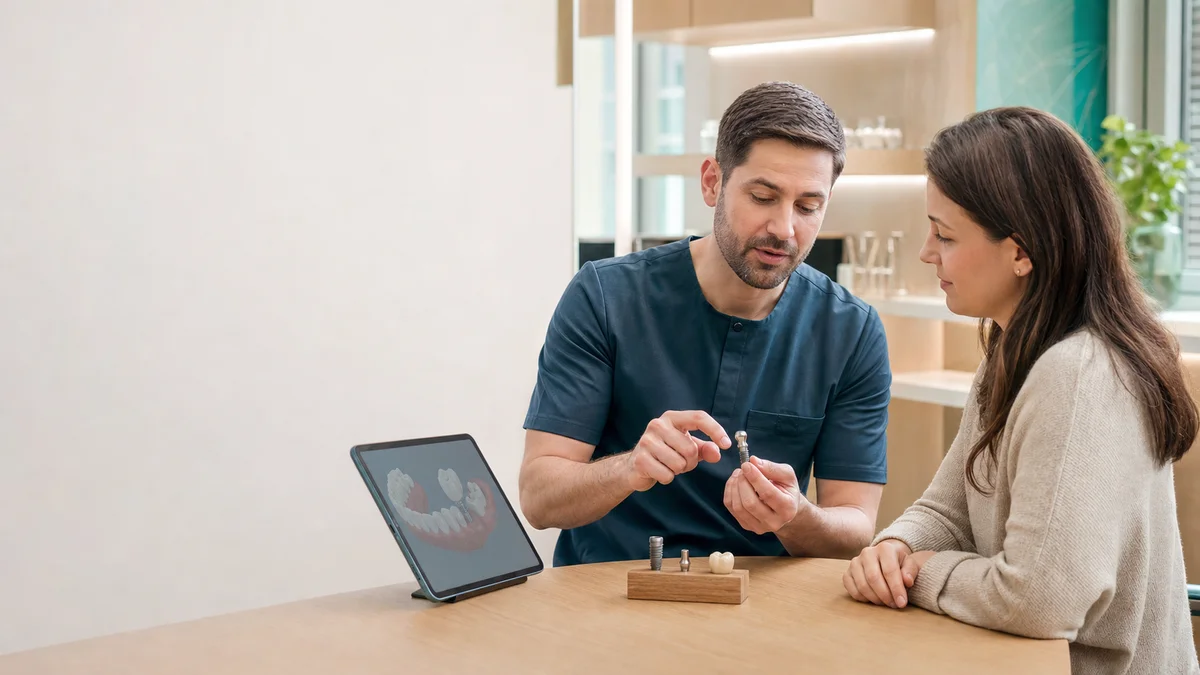
Quick answer: Tooth abutment cost is not a universal single fee. It can reflect the connector itself, customization, material, implant-system compatibility, digital or laboratory work, and placement. The crown, implant surgery, imaging, temporary parts, and follow-up may be separate. Compare written, itemized plans rather than headline prices, and ask what happens if the design changes after scanning.
People comparing tooth abutment cost often discover that two apparently similar implant quotes contain different things. One estimate may list the definitive abutment, its retaining screw, a custom design, and laboratory work. Another may name only the implant crown, leaving the connector as a separate line. Neither format automatically indicates better care or better value; the useful question is whether every required stage, component, professional service, and possible adjustment is explained before consent.
This guide focuses mainly on the abutment used with a dental implant: the small component that connects the implant body in the jaw with the visible restoration. In traditional bridge language, a dentist may also call a prepared natural tooth an “abutment tooth.” That is a different clinical situation and a different fee structure. If a treatment plan is unclear, confirm which meaning applies before comparing tooth abutment cost.
The information below is educational and cannot determine which component is suitable for an individual mouth. Implant position, gum and bone condition, bite forces, health history, restoration design, and the precise implant system all matter. A clinical examination and appropriate records are needed. A reliable tooth abutment cost comparison therefore begins with equivalent clinical plans. The aim is to help you ask safer questions, identify omitted items, and understand why the lowest advertised figure may not equal the lowest complete treatment cost.
What Tooth Abutment Cost Actually Refers To
A dental implant restoration is a small system rather than one solid replacement tooth. The US Food and Drug Administration describes an implant system as an implant body and an abutment, often with an abutment fixation screw. The implant body is placed in the jaw. The abutment connects that body to the artificial tooth or other prosthesis. The crown is the visible restoration. These parts are related, but they are not interchangeable words or necessarily a single invoice item. That component map is essential when reviewing tooth abutment cost.
Accordingly, tooth abutment cost may mean one of several things: the manufactured component alone; a component plus a new fixation screw; a custom-designed connector made from a scan; the dentist’s placement service; or a bundled restorative stage including the crown. The exact definition should appear in writing. A useful quote names the part, material, design route, laboratory involvement, restoration type, and services included.
- Implant body: the device placed in bone during the surgical phase.
- Healing component: a temporary part used in some workflows while soft tissue heals; it is not necessarily the definitive abutment.
- Definitive abutment: the connector selected or designed for the final restoration.
- Fixation screw: a small system-specific screw that may secure the abutment to the implant body.
- Crown or prosthesis: the visible tooth, bridge, or denture supported by the system.
A current 2026 professional fee guide published by the Turkish Dental Association offers a useful example of item separation: its entry for an implant-supported ceramic veneer crown explicitly excludes the abutment fee. That document is jurisdiction-specific and is not a worldwide price list, but the wording illustrates why patients should not assume “implant crown” automatically includes tooth abutment cost.
Why Tooth Abutment Cost Varies Between Treatment Plans
There is no safe, universal market price for an abutment. The final amount can change with the component family, whether the connector is prefabricated or patient-specific, the restorative material, the emergence profile through the gum, the implant angle, and the laboratory or digital workflow. Geographic overhead, professional fees, taxes, guarantees offered by a provider, and the number of visits can also alter an estimate without changing the basic name of the part. For that reason, tooth abutment cost is meaningful only with its scope.
Clinicians must also work within a compatible implant system. A generic-looking connector is not automatically appropriate for every implant body. The correct platform, connection geometry, screw, dimensions, and approved restorative pathway matter for fit and traceability. When a clinic has to identify an older implant or source a less common compatible part, tooth abutment cost can include time and procurement that are absent from a straightforward new restoration.
- Stock or custom design and the amount of digital planning required
- Titanium, zirconia, or a hybrid restorative configuration
- Standard, angled, multi-unit, or other prosthetic purpose
- Implant brand, connection, platform size, and component availability
- Single crown, bridge, or removable/full-arch prosthesis
- Chairside scan, conventional impression, scan body, model, and laboratory stages
- New screw, temporary part, removal of an old component, or repair work
- Placement, verification imaging when clinically indicated, adjustments, and reviews
These variables do not mean that the most complex option is always the best. They mean that tooth abutment cost should be evaluated alongside the clinical purpose. A standard component may be entirely appropriate when implant position, tissue contour, space, and restorative plan permit it. A custom component may be recommended when contours, angulation, hygiene access, or esthetic transition need more control. The dentist should explain the reason, alternatives, limitations, and expected maintenance without promising a particular lifespan.
Stock and Custom Abutments: The Main Design Difference
A prefabricated or “stock” abutment is manufactured in standardized shapes and sizes for a defined implant system. The clinician selects the closest appropriate configuration and the restoration is made around it. Fewer custom design steps can make the process more direct. This can influence tooth abutment cost. Yet a stock part is not automatically a budget compromise; when it fits the clinical plan, it may be a sensible and well-documented choice.
A custom abutment is designed for the patient’s implant position and restorative space, commonly from an intraoral scan or a conventional impression that is digitized by a laboratory. The design may control height, angle, finish line, emergence contour, and support for the crown. That extra design, manufacturing, verification, and laboratory responsibility can increase tooth abutment cost. The benefit being sought should be specific rather than described with vague premium language.
Ask whether “custom” refers to the definitive abutment itself or only to a custom crown over a stock connector. Also ask who designs and manufactures the part, how implant-system compatibility is confirmed, whether a new screw is included, and whether the final restoration will be screw-retained, cement-retained, or use another plan. Retention choice affects clinical steps and maintenance; it should not be reduced to price alone.
Material Choice and Tooth Abutment Cost
Titanium is widely used for implant components because of its established role in implant dentistry and its mechanical properties. Zirconia-containing options may be considered in selected esthetic or material-planning situations. Some designs combine a zirconia suprastructure with a titanium base rather than using a single material throughout. These are different constructions, so the same material label can conceal different component and laboratory work within tooth abutment cost.
Material can affect tooth abutment cost, but it should not be chosen from color or marketing claims alone. Available restorative space, implant connection, tissue thickness, loading, restoration design, retrievability, and the manufacturer’s instructions all matter. No material eliminates the need for good fit, hygiene, maintenance, and review. A clinician may reasonably favor different solutions for front and back regions or for different prostheses.
Patients with a documented allergy or previous device reaction should share that history before treatment. Internet lists cannot diagnose material sensitivity or select a device. Ask for the proposed material and manufacturer in writing, and keep the implant and component records. The FDA advises patients to ask for the brand and model of the implant system and to retain this information for their records.
Front Tooth, Back Tooth, and Full-Arch Planning
An anterior single tooth may require careful control of the transition from implant to crown, particularly where gum display is visible. A posterior tooth may place different demands on strength, occlusion, and access. A bridge or full-arch restoration distributes support across multiple implants and may use multi-unit components to create a common restorative path. These are not directly comparable products even when every estimate uses the word “abutment.”
Position also influences whether an angled solution is being considered. Angled or multi-unit components can add parts and restorative planning, which can affect tooth abutment cost. They are not universal upgrades and do not correct every implant-position problem. The clinician should describe the intended purpose, connection, retention approach, hygiene implications, and maintenance plan.
For a front tooth, ask how the provisional phase, soft-tissue contour, shade, and final abutment are billed. For a back tooth, ask how crown material, screw access, bite adjustment, and protective advice are handled. For a full-arch case, ask whether the quote is per component or for the whole restorative assembly and how future individual part replacement is priced. These questions make tooth abutment cost comparisons fairer.
What an Itemized Quote Should Include and Exclude
A complete written plan should distinguish the surgical phase from the restorative phase. Implant placement, grafting, sedation, diagnostic imaging, extraction, and management of disease are not the abutment itself. They may be necessary in an individual’s overall plan, but adding them under a broad package can make tooth abutment cost impossible to evaluate. Equally, an abutment-only headline can appear inexpensive because it excludes the crown and professional work.
Request a line-by-line estimate and ask which amounts are firm, which are estimates, and what finding could change them. This is the clearest way to place tooth abutment cost in context. The UK Competition and Markets Authority’s current 2026 guidance—while written for UK care—reinforces a broadly useful consumer principle: patients can ask what treatment options exist, what they are likely to pay, and give consent before treatment starts. Local payment rules differ, so confirm the rules that apply where care is provided.
- Consultation, examination, scans, radiographs, and treatment planning
- Implant surgery and implant body, if not already completed
- Healing component, removal or exchange, and temporary restoration
- Definitive abutment, material, design type, manufacturer, and fixation screw
- Digital scan or impression components and laboratory design/manufacture
- Final crown or prosthesis, retention type, material, shade, and placement
- Adjustments, follow-up visits, maintenance, and management of complications
- Taxes, currency, payment schedule, cancellation terms, and remake policy
If a quote uses “all inclusive,” ask for the same details anyway. Confirm whether a temporary crown, custom abutment, screw, scan body, laboratory fee, delivery visit, and post-delivery review are included. Ask how a change from stock to custom design would be approved and priced. A transparent answer is more meaningful than a single low number.
Insurance and Financing Questions to Ask
Insurance treatment of tooth abutment cost depends on the plan, jurisdiction, network, clinical coding, annual limits, exclusions, and the relationship between the abutment and the completed prosthesis. Do not assume that coverage for an implant automatically covers every restorative component. Conversely, a denial under one benefit category does not explain how every plan will respond. Obtain plan-specific information in writing.
In the United States Marketplace, HealthCare.gov states that adult dental coverage is not an essential health benefit and health plans do not have to offer it. Marketplace dental coverage may be embedded in a health plan or offered through a separate dental plan, and stand-alone plans can have adult waiting periods. This does not determine whether a particular tooth abutment cost is covered; it shows why the policy document and insurer response matter more than general assumptions.
- Is the definitive abutment a separate covered service from the crown?
- Are custom and stock components treated differently under this policy?
- Does the plan require prior authorization, a pre-treatment estimate, or specific records?
- What deductible, coinsurance, waiting period, annual maximum, frequency rule, or network rule applies?
- How will laboratory and replacement-component charges be classified?
- Is the insurer’s estimate a guarantee of payment? If not, what can change the final benefit?
A pre-treatment estimate can clarify anticipated benefits but is commonly not a guarantee of final payment. Ask the clinic to provide procedure descriptions and supporting records requested by the plan, then compare the insurer’s written response with the clinic’s itemized plan. For financing, distinguish the total treatment price from monthly payment size, and review interest, fees, missed-payment terms, and refund rules before signing.
Decision Table for Comparing Abutment Options
The table below is a discussion aid, not a prescription. The correct pathway requires examination, restoration planning, and verified compatibility. Its purpose is to connect tooth abutment cost with the service being purchased.
| Possible pathway | Why the quote may differ | Question to ask | Important limitation |
|---|---|---|---|
| Prefabricated stock abutment | Standard component with fewer custom design steps | Why does this shape suit my implant position and crown? | Not every standardized contour suits every site |
| Custom titanium abutment | Scan, design, manufacture, and verification may be added | Which contour or angle is being customized, and who manufactures it? | Custom does not remove biological or maintenance risks |
| Zirconia-containing custom option | Material and construction may require a different laboratory workflow | Is this one-piece, or zirconia on a titanium base, and why is it proposed? | Suitability depends on design, space, loading, and system instructions |
| Angled or multi-unit component | Additional parts and prosthetic planning may be needed | What restorative problem is this component intended to address? | It is not a universal upgrade or a substitute for diagnosis |
| Replacement of an existing abutment | Identification, removal, new screw, crown work, and unavailable parts may add cost | Can the current crown be safely reused, and is the implant system documented? | The answer may change after clinical and radiographic assessment |
Compatibility, Traceability, and Patient Safety
Price should not override compatibility. The FDA classifies endosseous dental implant abutments as medical devices used with implant fixtures for prosthetic rehabilitation. A restorative team should know the implant system, connection, platform, planned component, and relevant manufacturer instructions. A lower tooth abutment cost does not answer those safety questions. Ask whether original-system or third-party compatible parts are proposed and what evidence, documentation, and support apply. A brand label alone cannot establish individual suitability.
Keep a copy of the implant brand, model, size, placement date, and component details. This record can shorten identification work if the crown or screw needs attention years later. It may also reduce uncertainty in future tooth abutment cost because the replacement team does not have to identify the connection from limited clues. If records are unavailable, identification may require examination, images, prior-clinic contact, or specialist input.
The FDA lists potential implant complications including infection, loosening, device failure, cleaning difficulty, and injury to nearby structures. These are not predictions for an individual, and tooth abutment cost cannot remove them. Follow the clinician’s hygiene and review instructions. Contact a dental professional promptly about new movement, persistent pain, swelling, discharge, an altered bite, or a loose restoration. Breathing or swallowing difficulty warrants urgent medical care.
Replacement, Repair, and Long-Term Value
An existing abutment may need evaluation because a screw is loose, the crown is damaged, the restoration is difficult to clean, tissue has changed, or a new prosthetic plan is required. The visible symptom does not reveal the cause, and replacement tooth abutment cost cannot be confirmed from a photograph alone. Tightening a screw without evaluating fit, damage, bite, implant condition, and manufacturer guidance may delay appropriate care. Do not attempt home repair or use household adhesives.
Replacement tooth abutment cost can differ from the initial restorative fee. The clinician may need to remove a crown, retrieve a screw, identify an implant, obtain new records, take a new scan, redesign the abutment, remake the crown, or manage damaged threads. Sometimes a crown can be reused; sometimes its retention or fit makes reuse inappropriate. That decision cannot be guaranteed before assessment.
Long-term value includes cleanability, access for review, component traceability, availability of replacement parts, and a clear maintenance plan. These factors belong beside the initial tooth abutment cost. Ask who to contact if the restoration feels loose, what routine reviews are recommended for your clinical situation, whether professional cleaning needs special instruments, and how future repairs are billed. A more transparent initial plan can reduce surprise even though it cannot guarantee a complication-free result.
How to Compare Two Quotes Fairly
Start by confirming that both plans describe the same missing tooth, implant system, restorative design, component material, and crown. Next, align the stages: diagnostics, surgery, provisional treatment, definitive abutment, definitive crown, delivery, and follow-up. Mark anything described as optional, provisional, estimated, or excluded. Only then compare tooth abutment cost.
Ask both providers what clinical finding could change the plan and how that change would be authorized. If care involves travel, include the practical cost and time of review visits, temporary problems, component delivery delays, and management after returning home; these may sit outside the quoted tooth abutment cost. Confirm which provider is responsible for each stage and how records will be transferred. Remote photographs and price messages are not substitutes for an examination.
- Same implant site and same type of final restoration?
- Same stock or custom abutment category and material?
- Same manufacturer/compatibility pathway and new fixation screw?
- Same scan, laboratory, crown, placement, adjustment, and review services?
- Same taxes, currency, payment schedule, remake policy, and exclusions?
- Clear clinician responsibility if the plan changes or a problem develops?
You may send existing implant records and images to contact Redent Clinic for a planning conversation, but a final recommendation may require an in-person examination and additional diagnostics. You can also review the clinic’s broader patient information on the Redent Clinic English website. No online estimate should be treated as a diagnosis or outcome promise.
Questions to Ask Before Giving Consent
Bring the written quote to the appointment and ask the clinician to point to each relevant part on a diagram or model. Confirm whether the proposed abutment is temporary or definitive, stock or custom, titanium or another construction, and specific to which implant connection. Those details define tooth abutment cost. Ask why it suits the planned crown and whether another reasonable option exists.
Then ask what the quoted tooth abutment cost includes: design, component, screw, laboratory, placement, crown, scans, adjustments, and review. Request the likely total for the defined plan, not only the connector price. Ask what is excluded and what circumstance could require a new component or crown. Ensure you understand benefits, material alternatives, relevant risks, maintenance, timing, and who handles unexpected symptoms.
Take time to consider the information unless urgent care is clinically necessary. Consent is a process, not merely a signature. It should reflect a voluntary choice based on a comprehensible plan. If terminology or fees remain unclear, ask for clarification or an independent second opinion. A careful pause is reasonable when a quote combines many stages or when the implant system cannot yet be identified.
Tooth Abutment Cost FAQs
Is the abutment included in the implant price?
Sometimes, but not always. An “implant price” may refer only to surgical placement and the implant body, while another package includes the abutment and crown. Ask for the implant body, healing part, definitive abutment, fixation screw, crown, laboratory work, and placement services as separate lines. That is the only reliable way to interpret tooth abutment cost.
Is a healing abutment the same as the final abutment?
Not necessarily. A healing component may temporarily shape or protect the tissue during healing, while a definitive abutment supports the final restoration. Workflows vary, and some components have different roles. Ask which part is present now, which part is planned, and whether both are included in the estimate.
Does a custom abutment always produce a better result?
No. Custom design can offer control over contour, height, or angle, but it is not automatically superior in every site. A stock part may be appropriate when it fits the implant position and restorative objectives. The clinician should explain the specific reason for customization and its limits rather than relying on the word “custom.”
Why can the crown and tooth abutment cost be separate?
They are separate components with different manufacturing and clinical steps. The abutment connects the implant body to the restoration; the crown is the visible replacement tooth. The laboratory may design them together but invoice them separately. A quote should also explain whether the retaining screw and placement service are separate.
Does insurance cover an implant abutment?
Coverage varies by policy, location, coding, network, and benefit limits. Ask the insurer whether tooth abutment cost is treated separately from the crown and whether prior review is required. A pre-treatment estimate can be helpful but may not guarantee payment. Obtain the answer in writing and compare it with the clinic’s itemized plan.
Can I buy a cheaper abutment online and bring it to the dentist?
Do not assume an online part is compatible, traceable, sterile where relevant, or suitable for your restoration. Connection geometry, platform, screw, material, and manufacturer instructions matter. A clinic may decline to use a component it cannot verify or support. Discuss cost concerns before purchasing any medical device.
Why might the estimate change after a digital scan?
The scan can reveal restorative space, implant angle, tissue contour, and design constraints that were not clear from an initial discussion. The team may then recommend a different component or laboratory step, changing tooth abutment cost. Ask in advance how a change will be explained, approved, and billed before manufacture begins.
Can an old crown be reused on a new abutment?
Sometimes reuse may be considered, but it depends on retention, fit, material, condition, access, occlusion, and the reason for replacement. Removal itself can alter or damage a crown. The clinician may not be able to promise reuse before examination or removal. Request a primary plan and a contingency price.
What records should I receive after treatment?
Ask for the implant brand, model or system, connection or platform information when available, component details, placement dates, and relevant clinical records. Keep these with your health documents. Traceability may simplify future maintenance, reduce uncertainty in future tooth abutment cost, and help another clinician identify appropriate instruments and components.
Is zirconia always more expensive than titanium?
Not in every clinic or design. The price reflects the entire construction and workflow, not only a raw material. A zirconia-containing option may use a titanium base, and custom titanium also involves design and manufacture. Compare the exact design, purpose, laboratory work, and services rather than assuming a material hierarchy.
What symptoms should prompt a dental review?
Contact a dental professional about movement, a loose crown, persistent pain, swelling, discharge, a new bad taste, difficulty cleaning, or a bite that feels different. These signs have several possible causes and cannot be diagnosed online. Do not tighten components or apply glue yourself. Seek urgent medical help for breathing or swallowing difficulty.
What is the safest way to lower tooth abutment cost?
Ask whether a clinically appropriate stock option exists, compare complete itemized plans, verify insurance requirements before treatment, keep system records, and follow maintenance advice. Avoid unverified parts or delaying assessment of a loose restoration. The lowest connector price can become more expensive if it excludes essential services or creates compatibility problems.
Evidence Sources and Further Reading
- US Food and Drug Administration: Dental Implants—What You Should Know — implant-system components, patient questions, benefits, risks, and follow-up.
- FDA Product Classification: Endosseous Dental Implant Abutment — intended device role and regulatory classification.
- HealthCare.gov: Dental Coverage in the Health Insurance Marketplace — adult dental benefit status, plan formats, and waiting-period guidance.
- UK Competition and Markets Authority: Choosing and Paying for Dental Care (2026) — questions about options, likely costs, and consent; rules are UK-specific.
- Turkish Dental Association: 2026 Oral and Dental Health Fee Guide — jurisdiction-specific example showing an implant-supported crown line that excludes the abutment fee.
- World Health Organization: Oral Health Fact Sheet — broader oral-health context and prevention.
- American Dental Association — professional oral-health resources and patient education pathways.
Patient-safety note: This article will be reviewed by Dentist Esma Çevrük Çakır. It provides general education and does not replace an examination, diagnosis, individualized treatment plan, insurer decision, or emergency care. Prices, device availability, coverage, local rules, and tooth abutment cost change; request current written information from the treating clinic and applicable payer.