
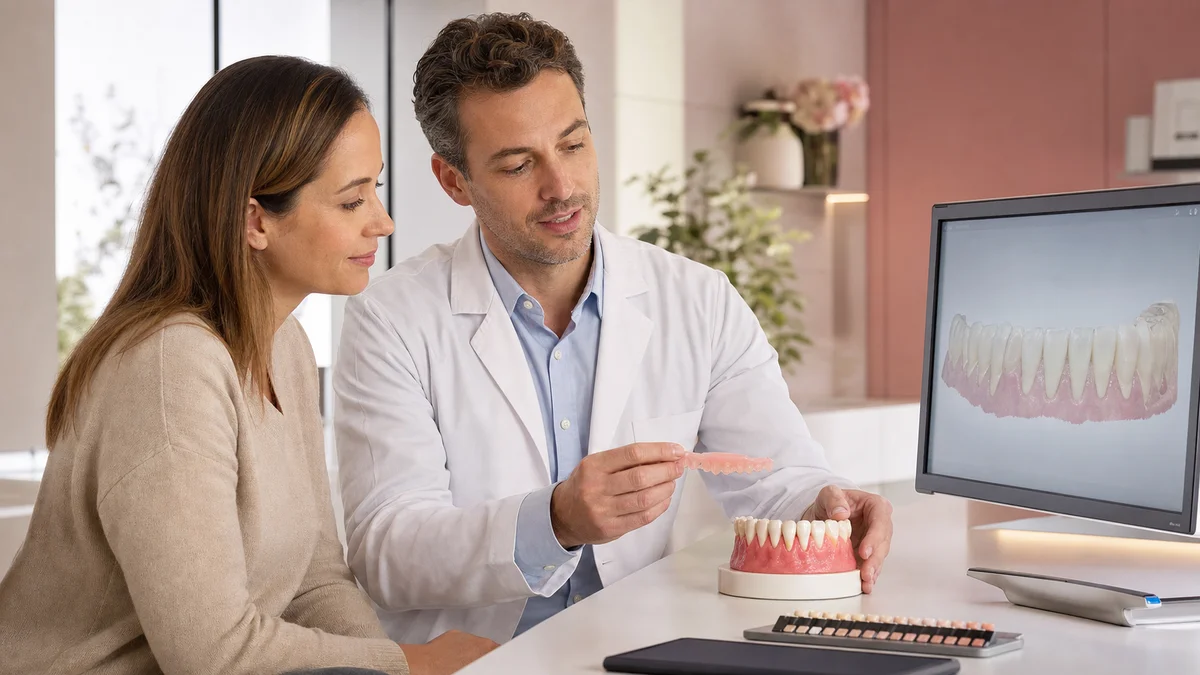
Searching gingival veneer cost can be confusing because “gingival veneer” does not usually mean the tooth-coloured shell commonly called a dental veneer. It generally describes a custom prosthesis—also called a gingival mask or gingival prosthesis—that imitates missing pink gum tissue. A removable version can conceal recession, long-looking teeth or open “black triangle” spaces in selected cases. Fixed pink components may also be incorporated into another restoration, but that is a different clinical and financial proposition.
A headline amount is therefore incomplete unless it identifies the device, material, area covered and clinical problem. One quote may describe a small removable acrylic mask; another may include a flexible silicone appliance extending across several teeth, multiple shade trials and laboratory work. A third may actually concern pink ceramic or composite within a fixed implant or bridge reconstruction. These options should not be compared as if one gingival veneer cost described identical care.
This guide explains gingival veneer cost without publishing a fixed clinic fee or promising an outcome. It covers assessment, periodontal stability, material, design, fabrication, insurance, cleaning, adjustments and eventual replacement. Individual suitability requires an examination and relevant records. The content is evidence-informed, prioritizes patient safety and is prepared for review by Dentist Esma Çevrük Çakır.
What a gingival veneer is—and is not
The American Dental Association glossary includes gingival prostheses within the broad definition of dental prostheses that replace missing teeth and, when required, associated structures. Clinical literature uses several names: gingival veneer, gingival mask, gingival slip or gingival prosthesis. A removable appliance is usually a thin pink structure fitted over the facial side of teeth or restorations to reproduce lost gum contours. It does not regrow tissue or cure gum disease.
This distinction matters to gingival veneer cost. A tooth veneer covers part of a tooth with tooth-coloured material. A gingival veneer replaces the appearance and volume of missing soft tissue with gum-coloured material. Some complex fixed restorations use pink ceramic or composite, but they may involve crowns, bridges or implants and cannot be priced like a small removable mask.
A removable gingival veneer may be considered when tissue loss affects appearance, creates open embrasures that trap food, changes certain speech sounds or exposes sensitive roots. It may be an interim or longer-term prosthetic choice for a suitable patient, with a gingival veneer cost that reflects its intended use. The appliance should fit passively, remain stable in ordinary use and be removable for cleaning. It should not be used to hide untreated inflammation or active disease.
gingival veneer cost starts with periodontal diagnosis
A responsible gingival veneer cost discussion begins by identifying why tissue is missing. Gingival recession can relate to periodontal disease, tooth position, thin tissues, trauma, previous surgery, extraction, bone loss, implant contours or several interacting factors. The dentist may assess medical and dental history, plaque control, bleeding, pocket depths, tooth mobility, decay, exposed roots, bite, existing restorations and implant health. Clinically indicated photographs, radiographs, scans or impressions may also be needed.
Active periodontal inflammation usually needs management before a definitive appliance is planned. The American Dental Association describes periodontitis as an inflammatory disease associated with attachment and bone loss; clinical signs can include bleeding, recession and mobility. A mask can change appearance, but it cannot replace disease control, appropriate periodontal care or maintenance. Fabricating over unstable tissues can also compromise fit as contours change.
The initial gingival veneer cost quote should say whether examination, periodontal measurements, imaging and disease-control visits are included. Remote photographs may support an early conversation, but they cannot show every surface, pocket, tissue response or radiographic finding. Treat an online amount as provisional until an in-person assessment confirms the device can be worn and cleaned safely.
Removable, fixed and surgical options are different
Removable gingival masks can replace a relatively large visible volume without surgically rebuilding it. They can often be taken out for cleaning and adjusted or remade if tissues or restorations change. Retention may come from close adaptation, extensions into spaces between teeth, saliva and lip pressure. These design demands influence gingival veneer cost. The device must avoid unwanted compression and should be evaluated during speech and facial movement.
Fixed pink porcelain, ceramic or composite may be integrated into crowns, bridges or implant prostheses. This can avoid daily insertion, but hygiene access, repair, retrievability and the condition of supporting teeth or implants become central. The gingival veneer cost for a fixed reconstruction may include much more than the pink material and should list every supporting restoration.
Periodontal plastic surgery or gum grafting is another category. The American Academy of Periodontology explains that gum graft surgery may cover exposed roots and can help reduce sensitivity or further recession in selected cases. Surgery and a prosthetic mask have different aims, burdens and limitations. Some patients may not be candidates for predictable surgical root coverage, while others may prefer a tissue-based approach. A second opinion from a periodontist or prosthodontist can help when the defect is extensive or the trade-offs are unclear.
13 factors that can change gingival veneer cost
An itemised gingival veneer cost estimate should separate the following components when they apply:
- Diagnostic assessment: the cause, stability and extent of tissue loss;
- Disease control: periodontal, restorative or implant care needed first;
- Coverage area: one local space versus several front teeth or a broader arch segment;
- Design type: removable mask, interim device or pink component within a fixed reconstruction;
- Material: rigid acrylic, flexible silicone, thermoplastic or another documented option;
- Records: photographs, impression, digital scan, model and clinically indicated imaging;
- Shade and characterization: matching natural tissue in different lighting;
- Laboratory work: model preparation, wax design, processing, finishing and quality checks;
- Retention complexity: available spaces, tooth shape, implants, bridges and lip movement;
- Trial stages: try-ins used to assess outline, comfort, speech and appearance;
- Delivery: insertion teaching, pressure checks, edge finishing and written care instructions;
- Follow-up: planned reviews and adjustment appointments;
- Future care: cleaning supplies, repairs, colour changes, fit changes and eventual remake.
Not every patient needs every stage, and a longer list does not prove better care. Its purpose is to reveal whether quotes describe the same clinical scope. If one gingival veneer cost figure excludes periodontal treatment, diagnostic records or review, it should not be compared directly with a comprehensive estimate.
How material choice affects the quote
Acrylic materials can be rigid, polishable and colour stable in some applications, but a thin appliance may be more vulnerable to fracture and rigid edges may be harder to negotiate around undercuts. Flexible silicone can improve comfort and resistance to fracture in selected designs, yet porosity, staining, plaque retention and changes in physical properties can be concerns. Material selection therefore changes gingival veneer cost. Thermoplastic and other resin systems have their own handling and maintenance requirements.
Case reports describe gingival prostheses made from acrylics, composite resins, porcelain, thermoplastic acrylics and silicone-based materials. These reports illustrate possible techniques; they do not establish that one material is best for every patient or predict an individual lifespan. A dentist and laboratory must select a documented material compatible with the design, tissues, retention, cleaning ability and expectations.
Ask the gingival veneer cost provider to name the material and explain why it was selected. Also ask how to clean and store it, which products could damage it, how colour may change and whether repair is feasible. “Medical grade” or “premium” is not a complete specification. The written record should identify enough information to support future care or a remake.
A decision table for comparing plans
Use this table to examine a gingival veneer cost offer. It does not diagnose you or rank providers; it shows which questions remain unanswered.
| Plan pattern | What may be included | Main uncertainty | Safer next step |
|---|---|---|---|
| Small removable acrylic mask | Impression, laboratory acrylic device and one fitting | Rigidity, retention, pressure points, repair and follow-up | Confirm material, trial process and adjustment policy |
| Flexible silicone mask | Custom shade, processing and removable appliance | Cleaning, staining, fit changes and remake timing | Request written care instructions and future-cost terms |
| Pink material within a fixed restoration | Gingival-coloured component with crowns, bridge or implant work | Full restorative scope, hygiene access, retrievability and repair | Obtain a tooth- or implant-by-implant plan |
| Instant impression-free online offer | A marketing starting amount | Periodontal stability, contours, undercuts, shade, speech and retention | Treat it only as provisional until clinical assessment |
| Surgical proposal | Periodontal procedure and follow-up | Whether root coverage is predictable and how it compares with prosthetic masking | Discuss benefits, risks, alternatives and maintenance separately |
A lower amount is not automatically unsafe, and a higher amount does not guarantee fit or appearance. The useful comparison is between plans that cover the same area, use a clearly identified material and include comparable assessment and support. When the gingival veneer cost differs substantially, ask which design, laboratory or follow-up assumptions explain the difference.
The custom fabrication and fitting process
After periodontal stability is assessed, the clinician records the tissue defect and adjacent teeth or restorations. This may involve an impression, digital scan or both, depending on the technique and material. Those records form part of gingival veneer cost. The laboratory or clinician designs the visible gum contour, borders and extensions. A tissue shade is selected, recognizing that natural gingiva is not a single flat pink colour.
A try-in may allow the dentist and patient to review length, bulk, smile-line transition, speech, lip movement and retention. The device should not create painful pressure, interfere with cleaning or move unpredictably. Final finishing aims for smooth, cleanable surfaces and appropriate edges. Some designs require more than one trial or adjustment, which can affect gingival veneer cost.
At delivery, the patient should practice insertion and removal without forcing the appliance. Instructions should address cleaning, storage, wearing schedule and what to do if the mask feels loose, causes a sore area or changes colour. A review appointment is valuable because comfort during a short fitting does not always predict function over several days.
Retention, speech and comfort considerations
Retention depends on anatomy. Spaces between teeth can provide mechanical engagement, while saliva and lip pressure may contribute. The device must be secure enough for its intended use yet removable without damaging tissues or restorations. A broad defect, shallow spaces, tooth mobility, an implant bridge or unusual lip movement can make design more complex.
A gingival mask may influence pronunciation or air escape, particularly when it fills open spaces near front teeth. Some patients adapt quickly; others need contour adjustment. Bulky or overextended borders may feel unnatural. A clinician should evaluate speech and movement rather than relying on appearance in a still photograph.
Retention and comfort work can change gingival veneer cost because additional impressions, trials or laboratory modifications may be required. Ask whether routine adjustments are included, how many visits the estimate assumes and what happens if a secure passive fit cannot be achieved.
Cleaning and tissue health are non-negotiable
A removable appliance creates surfaces where plaque and food can collect. Daily cleaning of the mask, teeth, interdental spaces and exposed roots is essential. The exact method depends on material; abrasive toothpaste, hot water, bleach or an unsuitable cleaner may roughen, distort or discolour some devices. Cleaning supplies and reviews belong in gingival veneer cost. Follow instructions provided for the actual material rather than copying generic denture advice.
Many removable prostheses are taken out at night unless the treating clinician advises otherwise. The NHS denture guidance explains that overnight removal and proper cleaning can reduce trapped food and risks to oral tissues, while also emphasizing material-appropriate care. A gingival mask is not necessarily a denture, but the same principle—do not improvise the wearing schedule—applies.
Good hygiene is part of the real gingival veneer cost. Budget for appropriate brushes or cleaners, periodontal maintenance and future reviews. If the appliance makes cleaning impossible, smells persistently, causes bleeding or creates soreness, stop assuming it is merely an adaptation issue and arrange an examination.
Durability, staining, repair and replacement
No universal replacement interval can be promised. The material, thickness, design, insertion technique, cleaning, smoking, beverages, oral changes and daily use influence performance. Silicone may stain or lose flexibility; acrylic can wear, fracture or change fit. Future remakes can alter the lifetime gingival veneer cost. Tissues and teeth can also move or change after periodontal treatment, extraction, implant work or aging.
Published case reports often have limited follow-up and cannot establish a personalized lifespan. Statements that a gingival veneer will last a precise number of years should be treated as general marketing unless supported by the specific device, patient and maintenance record. Ask which signs indicate repair or replacement and whether the laboratory can reproduce the shade from stored records.
A complete gingival veneer cost budget separates the first appliance from possible adjustment, repair and remake fees. Ask whether loss, accidental damage, staining, tissue change or an altered dental restoration is covered. A written “warranty” should be read for exclusions and cannot guarantee biological stability.
Insurance and benefit estimates
Dental insurance treatment varies by country, plan and clinical purpose. A removable gingival prosthesis may have no dedicated benefit category, may be treated as a prosthetic service or may be excluded when considered cosmetic. Coverage should never be assumed from the word “prosthesis.” Ask the practice for the proposed procedure description and applicable billing codes, then contact the insurer directly before accepting the gingival veneer cost.
The American Dental Association explains that predetermination can show eligibility, covered services, deductibles, copayments and maximum limitations, but it is not a guarantee of payment. Eligibility can change, annual benefits can be used elsewhere and the final service can differ from the estimate. The gingival veneer cost decision should therefore remain clinically appropriate even if the expected benefit changes.
Ask the insurer and practice:
- which procedure description and code will be submitted;
- whether the service is covered for your documented clinical purpose;
- the allowed amount, benefit and your estimated out-of-pocket share;
- whether deductibles, waiting periods, annual maximums or frequency limits apply;
- whether the clinician or laboratory must be in network;
- whether assessment, periodontal care, appliance, adjustments and remake are separate;
- what happens if the design changes after examination;
- why a predetermination may differ from the final claim.
Do not let benefit design choose a clinically unsuitable appliance. A plan may pay for the least expensive alternative or exclude a desired option, but informed consent still requires discussion of appropriate alternatives. Confirm the written gingival veneer cost and insurer estimate before fabrication begins.
Red flags in gingival veneer cost advertising
Pause and request more information if you encounter:
- a claim that a mask cures periodontal disease or makes hygiene unnecessary;
- a final quote or appliance made without assessing gum health and tissue contours;
- no distinction between a gingival mask, tooth veneer and fixed pink restoration;
- no named material, laboratory pathway or shade process;
- no instructions for insertion, removal, cleaning, storage or overnight wear;
- a guarantee that the device cannot stain, break, loosen or require replacement;
- no plan for sore spots, pressure, movement, speech difficulty or fit changes;
- pressure to pay immediately before alternatives and limitations are discussed;
- an insurance promise made without checking your current policy;
- treatment provided by an unlicensed person or in a non-clinical setting.
The ADA has warned that irreversible dental procedures involving teeth, gums or jaws should be performed by licensed, trained dentists. A removable mask may appear simple, but diagnosis, impressions, fit and tissue monitoring are dental care. A low gingival veneer cost does not replace these safeguards. Verify the practitioner with the appropriate regulator in your jurisdiction.
A safer 9-step comparison process
- Define the concern. Identify appearance, food trapping, speech, sensitivity or another goal.
- Assess disease first. Obtain periodontal and restorative evaluation before masking tissue loss.
- Name the device. Confirm removable mask, interim appliance or fixed pink component.
- Compare alternatives. Discuss periodontal surgery, restorative changes, orthodontics, monitoring and no treatment where relevant.
- Specify the material. Record acrylic, silicone, thermoplastic or another documented system.
- Itemise the quote. Separate records, laboratory, trials, delivery, adjustments and reviews.
- Test practical use. Discuss retention, speech, cleaning access, storage and wearing schedule.
- Verify benefits yourself. Treat insurer predetermination as an estimate, not a promise.
- Plan future care. Budget for maintenance, repair, shade change and eventual remake.
You can learn about Redent Klinik’s general treatment-planning approach on its English clinic homepage. To request an individual examination pathway and an itemised written plan, use the Redent Klinik contact page. A message or image cannot confirm periodontal stability, device design or final gingival veneer cost.
Frequently asked questions about gingival veneer cost
Is a gingival veneer the same as a porcelain tooth veneer?
No. A gingival veneer usually means a gum-coloured prosthesis that replaces the appearance of missing soft tissue. A conventional tooth veneer is a tooth-coloured restoration bonded to the tooth surface. If a quote uses only “veneer,” ask the provider to identify exactly what is being made.
Is there one standard gingival veneer cost?
No. The total depends on assessment, extent, design, material, records, shade work, laboratory stages, trials, retention and follow-up. A small removable mask and a pink component within an implant bridge are not comparable. Obtain a written plan after clinical assessment.
Can a gingival mask treat gum disease?
No. It can reproduce missing tissue visually and may address selected functional concerns, but it does not remove bacterial deposits, restore attachment or regenerate bone. Active periodontal or peri-implant disease requires diagnosis and appropriate care. The mask should remain cleanable and should not conceal worsening inflammation.
Which is better, acrylic or silicone?
Neither is universally better. Acrylic can be rigid and polishable; silicone can be flexible and comfortable in suitable designs. Staining, plaque retention, thickness, fracture, fit, cleaning and repair differ. Selection should follow anatomy, intended use and the patient’s ability to maintain the appliance.
Will insurance cover gingival veneer cost?
Coverage depends on the plan, code and documented purpose. Some plans may exclude cosmetic care or lack a category for the device. Ask for a procedure description, request predetermination and confirm deductibles and limits. Remember that a benefit estimate is not a payment guarantee.
How often does a gingival veneer need replacement?
There is no reliable universal interval. Material changes, staining, cleaning, use, tissue remodeling and new dental work can alter fit or appearance. Ask how the appliance will be reviewed and what signs indicate adjustment, repair or remake. Avoid precise lifetime promises.
Can I sleep or eat while wearing it?
Do not assume. Wearing instructions depend on retention, material, design and choking or tissue concerns. Many removable oral prostheses are removed overnight, and some masks may be intended mainly for social use. Follow individualized instructions and ask specifically about meals, sleep and storage.
When should I stop wearing the appliance and seek care?
Remove it and arrange assessment if it causes persistent pain, ulceration, bleeding, swelling, a bad taste or odor, unexpected mobility, difficulty cleaning or a sudden change in fit. Seek urgent help for rapidly increasing swelling, fever, uncontrolled bleeding, difficulty swallowing or breathing, or a loose device that creates a choking risk.
Conclusion: compare the complete prosthetic plan
The most useful answer to gingival veneer cost is not a universal number. It is a plan that identifies the diagnosis, disease stability, device type, area, material, records, laboratory stages, retention strategy, fitting, maintenance and future replacement. It also explains what is excluded and when the estimate may change.
Confirm that gum health is managed, compare removable, fixed and surgical alternatives, verify the practitioner and obtain insurance information yourself. A custom mask can be a conservative visual solution for selected tissue defects, but it needs careful design and hygiene. Clear documentation cannot guarantee success, yet it makes consent and long-term planning safer.
Sources and further reading
- American Dental Association — Glossary of Dental Terms
- American Dental Association — Periodontitis
- American Academy of Periodontology — Surgical Procedures
- PubMed Central — Silicone gingival prosthesis clinical report
- PubMed Central — Gingival veneer clinical report
- American Dental Association — Introduction to Dental Benefits
- American Dental Association — Oral-health resources
- World Health Organization — Oral health fact sheet