
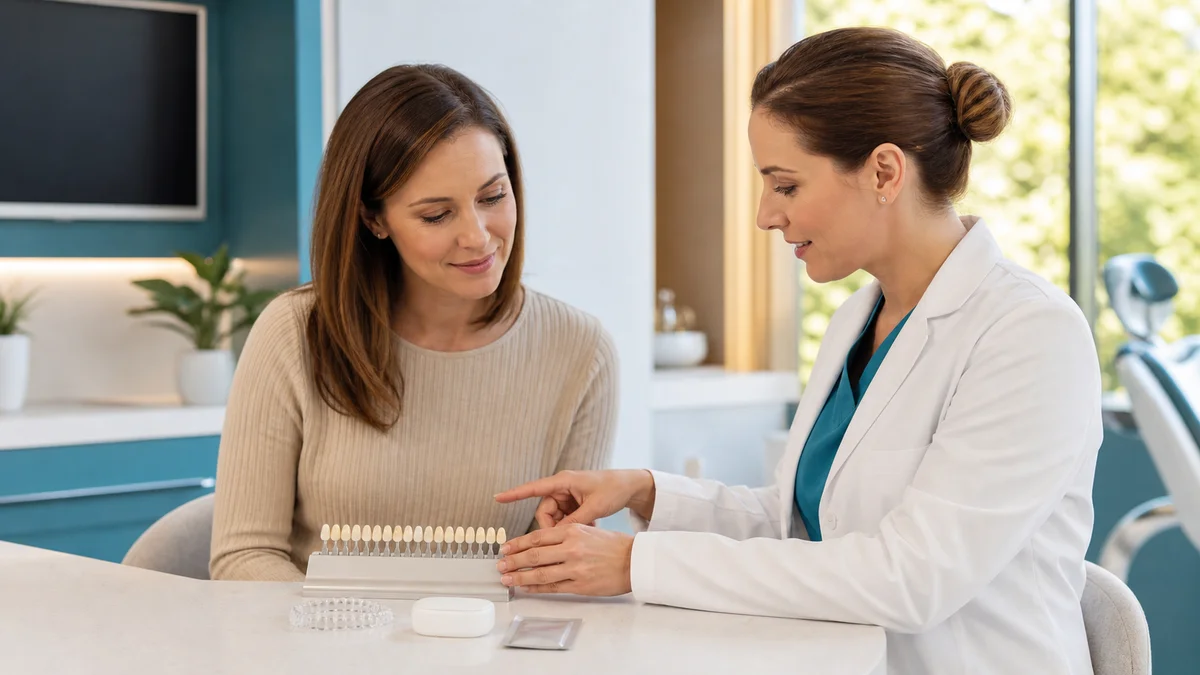
Quick answer: For a teeth whitening best at home decision, start with healthy teeth and gums, understand whether stains are surface or internal, and choose a labeled product used exactly as directed. ADA-Accepted toothpaste may remove surface stains; peroxide strips or dentist-supervised trays may change natural tooth shade. Stop if irritation or significant sensitivity develops and ask a dentist about persistent symptoms.
The search phrase teeth whitening best at home sounds as if one product should win for everyone. It does not work that way. Whitening toothpaste, peroxide strips, over-the-counter trays, and dentist-supervised custom trays do different jobs. The right option depends on the cause of discoloration, the condition of your enamel and gums, existing fillings or crowns, previous sensitivity, the result you expect, and how reliably you can follow instructions.
This patient-safe guide does not name a universal “best” brand, diagnose discoloration, or promise a shade change. Instead, it translates the teeth whitening best at home query into a practical decision: first check whether self-care is reasonable, then distinguish stain removal from bleaching, compare product formats, follow the label, and know when a dental examination should come before cosmetic treatment.
Healthy teeth naturally vary in color, and a brighter shade is not the same as better oral health. A teeth whitening best at home course is elective. It should never delay evaluation of pain, swelling, a broken tooth, bleeding gums, a new dark area, or a color change affecting one tooth. If facial swelling interferes with breathing or swallowing, or you have severe trauma or uncontrolled bleeding, seek urgent medical help rather than starting any whitening product.
What “teeth whitening best at home” Really Means
A sensible teeth whitening best at home choice balances four things: what the product can realistically change, evidence for the specific claim, compatibility with your mouth, and the effort required to use it correctly. A toothpaste that removes surface stain may be a good low-intensity option but cannot be expected to act like a peroxide bleach. A whitening strip may change the shade of natural teeth, but it may not contact crooked or rotated surfaces evenly. A custom tray can improve fit and professional oversight, yet it still requires careful home use.
Before comparing products, define the outcome in neutral terms. Do you want to remove coffee or tobacco staining from tooth surfaces, or do you want the natural tooth structure to look lighter? Do visible fillings, crowns, veneers, bonding, dentures, or implants sit in the smile zone? Restorative materials generally do not bleach like natural teeth, so a color mismatch can become more noticeable after whitening. That is one reason the teeth whitening best at home answer may begin with an examination rather than a shopping cart.
- Goal: surface-stain removal, a modest shade change, or preparation for planned restorative work.
- Starting condition: gum health, decay risk, cracks, sensitivity, exposed roots, and existing restorations.
- Product evidence: a clear label, ingredient disclosure, realistic claim, and independent evaluation such as the ADA Seal when available.
- Fit and control: whether gel stays on teeth and away from soft tissues, and whether the format reaches the intended surfaces.
- Adherence: your ability to follow duration, frequency, storage, and stop-use instructions without adding extra treatment.
- Follow-up: what you will do if color is uneven, sensitivity persists, or your gums become irritated.
The American Dental Association’s patient page on teeth whitening distinguishes whitening toothpaste, in-office bleaching, dentist-provided home bleaching, and over-the-counter bleaching. This distinction is essential to an evidence-aware teeth whitening best at home comparison.
Check Why the Teeth Look Darker Before Whitening
Discoloration is not a single condition, so a teeth whitening best at home search needs context. Surface staining can accumulate from tobacco, coffee, tea, red wine, strongly colored foods, or plaque and calculus. Internal color can relate to aging, tooth development, previous injury, disease, or medicines. A single tooth that has changed color needs different thinking from a generally darker smile. Whitening does not treat decay, gum disease, a leaking restoration, or a damaged tooth.
For that reason, the teeth whitening best at home path should pause if there is untreated pain, a cavity, cracked enamel, gum inflammation, exposed roots, unexplained spots, or a recent change in one tooth. Peroxide or abrasive products may aggravate sensitivity or irritate tissues, while a cosmetic change could make an underlying concern less obvious to you without resolving it.
A professional cleaning can remove plaque, calculus, and some external stain, but it is not the same as bleaching. Ask a dentist or hygienist what appears to be on the surface and what seems to be within the tooth before a teeth whitening best at home course. If you are planning a crown, veneer, implant crown, or visible filling, discuss color sequencing before treatment because restoration shades are selected rather than bleached later.
Photographs taken under the same natural lighting can help you observe change more fairly. Avoid judging results immediately after treatment when teeth may be temporarily dehydrated and appear different. A responsible teeth whitening best at home plan sets a modest goal and recognizes that natural teeth are not uniformly paper-white.
Compare Home Whitening Formats by What They Can Do
The table organizes common options for a teeth whitening best at home decision. It is not a prescription, and individual products vary. Always follow the label or dentist’s instructions for the exact product you use.
| Option | Main action | Potential advantage | Important limitation or safety check |
|---|---|---|---|
| ADA-Accepted whitening toothpaste | Primarily removes surface stains through cleaning and polishing agents | Fits a routine brushing habit and may improve external staining gradually | Does not bleach natural tooth color like peroxide; aggressive scrubbing can irritate tissues |
| Over-the-counter peroxide strips | Bleaches contacted natural tooth surfaces | Pre-measured format and relatively simple application | Contact may be uneven; gel can irritate gums; restorations do not whiten the same way |
| Over-the-counter gel tray | Holds bleaching gel against natural teeth | May cover more surfaces than a strip | Poor fit can increase soft-tissue contact or uneven delivery; use only the supplied amount |
| Dentist-supervised custom tray | Uses a fitted tray and dentist-selected bleaching plan at home | Professional screening, tailored fit, instructions, and follow-up | Still can cause sensitivity or irritation; requires adherence and is not suitable for every mouth |
| Whitening rinse, pen, light, or novelty device | Varies by product and claim | May be convenient for a limited purpose | Evidence and contact time vary; a light or gadget does not make an unsafe gel safe |
| Kitchen acids, charcoal, harsh powders, or mixed DIY chemicals | May abrade or chemically affect surfaces rather than provide controlled bleaching | No reliable safety advantage | Avoid: acids and excessive abrasion can damage or roughen tooth surfaces and irritate tissues |
Look for the exact claim a teeth whitening best at home product is evaluated to make. The ADA explains that a whitening toothpaste accepted for stain removal has evidence for that purpose, while accepted home bleaching products are evaluated for whitening claims. A seal on one product does not automatically transfer to every product from the same company. This product-specific reading improves a teeth whitening best at home comparison.
Use the ADA Seal and Label as Product-Specific Evidence
In the United States, many home whitening items are marketed as cosmetics. The ADA Seal of Acceptance can add product-specific evidence because manufacturers must submit supporting safety and effectiveness information for the claim under review. The ADA’s current Seal of Acceptance program should be checked directly rather than inferred from packaging colors or online seller language.
The 2026 ADA category requirements for home-use tooth-bleaching products describe testing, labeling, and safety documentation expected for that category. That does not mean an accepted product is appropriate for every person or that more use produces a better outcome. It means the exact accepted product and its accepted claim have been evaluated within a defined process. In a teeth whitening best at home review, verification matters more than influencer testimonials.
- Confirm the product name and formulation in the current ADA Seal directory when a seller claims acceptance.
- Read active ingredient, warnings, age restrictions, frequency, duration, and storage instructions.
- Check that seals and packaging are intact and that the seller and product source are credible.
- Do not buy a product with missing ingredients, unclear concentration, altered instructions, or no responsible manufacturer information.
- Do not combine kits, refill a tray with an unrelated gel, or use a professional-strength material without professional supervision.
- Keep whitening agents away from children and pets and follow disposal directions.
If a product causes an unexpected adverse event, stop using it, follow the label’s safety instructions, and seek appropriate professional advice. In the United States, consumers and clinicians can report serious product problems through FDA MedWatch. Reporting is not a substitute for urgent clinical care.
Know Who Should Ask a Dentist Before Starting
A pre-whitening examination is especially valuable when the cause of color is unclear, one tooth differs from the others, or you have dental restorations in visible areas. It is also prudent if you have active decay, gum disease, cracks, erosion, exposed roots, recurring sensitivity, recent dental treatment, or a history of strong reactions to oral-care products. These factors can change whether and how whitening should be attempted.
Children and adolescents should not use adult whitening products casually; age limits and professional advice matter. People who are pregnant or breastfeeding often choose to postpone elective whitening because safety information for cosmetic bleaching in these periods is limited. Anyone with allergies, significant oral disease, complex medical care, or medicines that affect the mouth should discuss the teeth whitening best at home plan with the relevant dental or medical professional.
Existing crowns, veneers, bonding, tooth-colored fillings, dentures, and implant crowns generally will not respond like natural enamel and dentin. If these are visible, a teeth whitening best at home product may create a mismatch. A dentist can help sequence whitening and any planned restoration, but no professional can guarantee an exact shade or permanent match.
Do not whiten to mask a darkening tooth after trauma, pain on biting, a persistent sore, bleeding, swelling, or other unexplained change. A teeth whitening best at home decision is cosmetic; those signs deserve assessment for health reasons first.
Follow a Safer At-Home Whitening Sequence
Once a suitable product has been selected, the safest teeth whitening best at home routine is usually the least creative one: follow the instructions. Do not increase the amount, frequency, concentration, or contact time. More exposure can increase sensitivity or soft-tissue irritation without producing a proportional benefit.
- Read first: review the entire label, contraindications, preparation, use, storage, stop-use directions, and manufacturer contact.
- Start with a healthy mouth: postpone use if you have pain, open sores, active gum inflammation, a broken tooth, or an unresolved dental concern.
- Use only the supplied system: do not transfer gel to a different tray or mix it with household ingredients.
- Apply the stated amount: excess gel is not a shortcut and may contact gums or be swallowed.
- Time accurately: remove the product when instructed; never sleep in a product unless its official directions and your dentist specifically support that use.
- Watch the tissues: check for gum blanching, burning, sores, or increasing tooth sensitivity.
- Stop at the course limit: do not immediately repeat a full course because the result looks subtle.
- Record and reassess: compare photographs under similar light and ask a dentist about patchy or disappointing change rather than escalating on your own.
Keep normal oral hygiene gentle during a teeth whitening best at home course. Whitening does not replace brushing with fluoride toothpaste, cleaning between teeth, tobacco avoidance, a balanced diet, or dental care based on individual need. The World Health Organization oral health fact sheet emphasizes prevention and the shared risk factors between oral and other noncommunicable diseases. Cosmetic color should not displace that broader health perspective.
Manage Sensitivity Without Improvising
Temporary tooth sensitivity and gum irritation are among the most commonly reported whitening effects. Peroxide can move through enamel and dentin and stimulate the tooth’s nerve, while gel contacting gums can irritate soft tissue. The exact experience varies with product, concentration, exposure, fit, and personal susceptibility.
If sensitivity begins during a teeth whitening best at home course, follow the product’s instructions. That may mean pausing, reducing frequency only when the label or dentist advises it, or discontinuing. Do not neutralize gel with acids, alkalis, essential oils, or another online remedy. A dentist may recommend a different schedule or desensitizing approach after considering your mouth, but this should be individualized.
Seek dental advice if pain is severe, spontaneous, localized to one tooth, lasts after stopping, wakes you, or occurs with swelling, fever, a crack, or biting pain. Persistent gum burns, ulcers, rash, breathing difficulty, or suspected ingestion also need appropriate advice; emergency symptoms require urgent help. The teeth whitening best at home goal is never worth pushing through significant symptoms.
Be cautious about applying numbing agents simply to continue a teeth whitening best at home course. Reduced sensation could hide worsening irritation, and some products have their own risks. The appropriate response to a warning sign is to stop and understand it, not to silence it so exposure can continue.
Avoid “Natural” and Viral DIY Whitening Hacks
“Natural” does not mean enamel-safe. Lemon juice, apple cider vinegar, and other acids can lower surface pH and contribute to erosion. Coarse baking-soda mixtures, salt, charcoal, and abrasive powders can wear or roughen surfaces when used aggressively. Oil pulling and turmeric do not have reliable evidence as bleaching treatments. The ADA’s natural whitening fact-versus-fiction guidance advises against relying on acidic, abrasive, or unsupported kitchen approaches.
Do not mix hydrogen peroxide from a household bottle with other substances or invent a concentration for teeth whitening best at home. Do not apply pool chemicals, cleaning products, hair bleach, or professional dental materials bought through an unauthorized marketplace. Products designed for different tissues or uses can cause chemical injury, poisoning, or permanent damage.
Charcoal can make a tooth look temporarily different by removing or masking surface stain, but appearance is not proof of safe whitening. Abrasion may remove tooth structure and can expose darker dentin over time. For a teeth whitening best at home decision, controlled evidence and a clear label are more valuable than a dramatic short video.
Set Realistic Expectations for Shade and Longevity
No teeth whitening best at home method makes every tooth uniformly white. The starting shade, stain type, tooth structure, age, and contact pattern affect response. Canines may remain slightly darker than front teeth, and the color near the gumline may differ from the edge. Internal developmental or medication-related discoloration can respond differently from surface stains.
A teeth whitening best at home result is not permanent. Coffee, tea, red wine, tobacco, and other exposures can contribute to new staining. However, avoiding every colored food is neither realistic nor a substitute for evidence-based oral care. Rinse with water after staining drinks when practical, avoid tobacco, maintain good hygiene, and follow personalized dental advice. Do not repeat treatment continuously to chase a fixed “perfect” shade.
A sound teeth whitening best at home goal is a healthy-looking, natural improvement within the product’s evidence and your mouth’s tolerance. Before-and-after photos from sellers are selected examples and may use different lighting, camera settings, dehydration, or editing. They cannot predict your result.
If whitening does not address the appearance concern, ask a dentist to identify why before considering bonding, veneers, or crowns. Those are restorative procedures with maintenance needs and, in some cases, irreversible tooth preparation. They should not be presented as automatic next steps after an unsatisfying teeth whitening best at home attempt.
When Dentist-Supervised Home Whitening May Be Better
Dentist-supervised teeth whitening best at home treatment still happens primarily at home, but it adds examination, custom tray fit, product selection, instructions, and follow-up. It may be useful when an over-the-counter strip fits poorly, visible restorations complicate shade planning, sensitivity needs closer management, or the cause of discoloration needs clarification.
The dentist should examine teeth and gums, discuss alternatives, explain likely limitations, and document a teeth whitening best at home plan. Ask what gel is used, how much to place, how long and how often to wear the trays, how to clean and store them, what side effects to expect, when to stop, and how follow-up works. A custom tray can improve control but cannot eliminate every risk or guarantee even whitening.
For many people, the teeth whitening best at home answer is not “strongest product.” It is the lowest reasonable exposure that can address the actual stain while protecting comfort and tissues. Professional supervision may provide more useful control than escalating among unverified online products.
The UK National Health Service’s current teeth-whitening guidance likewise emphasizes an oral-health check and identifies dentist-supplied home kits as a safer route within its regulatory context. Product rules differ by country, so use local dental and regulatory guidance where you live.
How to Compare Products Without Ranking Brands
A brand leaderboard becomes outdated quickly and may not match your mouth. Instead, use a product-level teeth whitening best at home checklist. Verify the exact product, active ingredient, accepted claim, directions, warnings, source, and condition of the package. Then compare whether the format can contact the intended surfaces without excessive gum exposure.
- Evidence: Is there current independent evaluation for the exact claim, such as an ADA Seal listing?
- Transparency: Are ingredients, responsible manufacturer, lot information, warnings, and instructions clear?
- Suitability: Does the label address your age, dental condition, restorations, pregnancy status, allergies, and sensitivity concerns?
- Delivery: Will the strip or tray fit your tooth arrangement and minimize soft-tissue contact?
- Adherence: Can you follow the full schedule without exceeding it?
- Support: Is there a credible contact for product questions or adverse events?
- Exit plan: Do you know when to stop and whom to call?
Price, influencer promotion, light color, bubbling, tingling, or the strongest stated concentration does not prove superior teeth whitening best at home value. The teeth whitening best at home option is the one that fits the correct purpose and can be used safely—not the one that feels most dramatic.
Frequently Asked Questions About Home Teeth Whitening
Are whitening toothpaste and bleaching strips the same?
No. Whitening toothpaste primarily helps remove external stains through cleaning or polishing; it usually does not change intrinsic natural tooth color like peroxide bleach. Strips typically deliver a peroxide agent that can lighten contacted natural tooth surfaces. Check the exact accepted claim, directions, and limitations when making a teeth whitening best at home comparison.
Can fillings, crowns, veneers, or implant crowns be whitened?
These materials generally do not bleach like natural teeth. Whitening surrounding teeth can expose a shade mismatch. Ask a dentist to review visible restorations and plan the sequence before you start. Replacing a sound restoration solely for color has cost, maintenance, and biological implications that deserve informed discussion.
Is tooth sensitivity after whitening normal?
Temporary sensitivity is commonly reported, but severity and duration matter. Follow the product’s stop or pause instructions and do not extend exposure. Seek dental advice for severe, persistent, spontaneous, or one-tooth pain, or when symptoms occur with swelling, fever, trauma, cracks, or biting pain.
Can I leave whitening strips or trays on longer for a faster result?
No. Longer or more frequent use can increase sensitivity and gum irritation and may damage tissues without a proportional cosmetic benefit. Follow the exact label or dentist’s instructions. A safe teeth whitening best at home course does not improvise dose, concentration, or contact time.
Are charcoal, lemon, vinegar, or baking-soda mixtures safe whiteners?
Do not assume so. Acids can contribute to erosion, while coarse or repeated abrasives can wear surfaces. Charcoal and kitchen remedies lack the controlled product evidence needed for bleaching claims. Use a properly labeled oral-care product for its evaluated purpose and ask a dentist before trying a viral DIY method.
Should I whiten before or after a crown or filling?
Discuss sequencing before restorative treatment. Natural teeth may change shade with bleaching, while restorative materials do not respond the same way. A dentist can allow color to stabilize and then select a restoration shade when appropriate. Timing depends on clinical needs; never delay necessary treatment solely for whitening.
How white can my teeth safely become?
There is no universal safe endpoint or guaranteed shade. Natural color, stain type, enamel, dentin, restorations, and response vary. Aim for a modest natural improvement, stop at the product’s course limit, and avoid continuous repeat treatment. A dentist can help explain why some areas respond differently.
When should I skip home whitening and book an examination?
Book first for pain, swelling, bleeding gums, decay, cracks, exposed roots, strong sensitivity, mouth sores, a recent change in one tooth, unexplained patches, or visible restorations that complicate shade. Also ask before use for children, adolescents, pregnancy, breastfeeding, allergies, or complex medical and dental histories.
Make the teeth whitening best at home Decision Safely
The safest answer to teeth whitening best at home is a process, not a product name. Identify the type of discoloration, confirm that teeth and gums are healthy enough for elective whitening, choose a product with a transparent label and evidence for its exact claim, and follow directions without increasing exposure. Treat persistent pain, irritation, or uneven change as a reason to stop and ask—not a reason to apply more.
For general information about dental assessment and treatment planning at Redent Klinik, visit the Redent Klinik English website. This article does not establish that whitening is suitable for you, and online information cannot replace an examination. Redent Klinik does not rank consumer whitening brands or guarantee a shade outcome.
If you want to ask Redent Klinik what records or photographs are useful before a consultation, use the Redent Klinik contact page. Product choice, timing, and sensitivity management must reflect individual findings. That patient-specific approach is more reliable than any universal teeth whitening best at home claim.
Sources and Evidence Used
- American Dental Association — professional and patient oral-health resources.
- ADA MouthHealthy: Teeth Whitening — formats, effects, and side effects.
- ADA MouthHealthy: Natural Teeth Whitening — evidence and DIY risks.
- ADA 2026 home-use tooth-bleaching acceptance requirements.
- U.S. FDA MedWatch — adverse-event and product-problem reporting.
- NHS: Teeth Whitening — patient guidance within the UK regulatory setting.
- World Health Organization oral health fact sheet.