
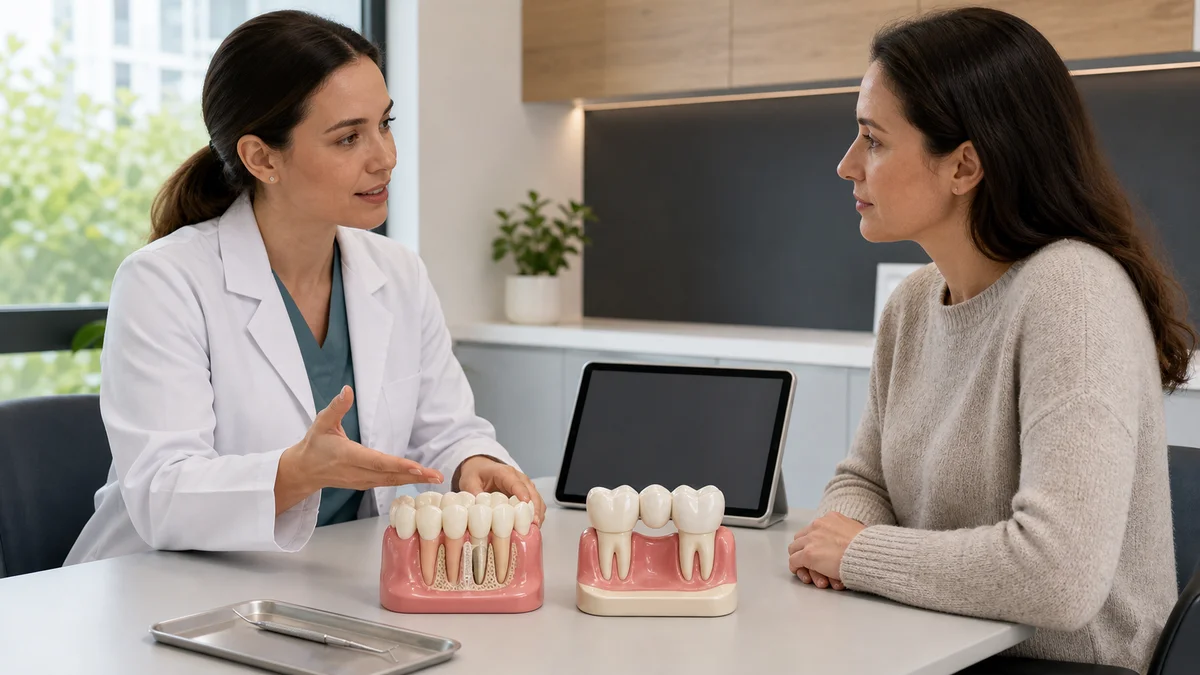
Quick answer: gum disease treatment vs dental bridge is usually not an either-or choice. Periodontal care controls infection around teeth that are still present; a bridge replaces one or more teeth that are already missing or must be removed. Active disease generally needs assessment and stabilisation before a definitive bridge is planned, because the gums, bone and supporting teeth form its foundation.
Searching for these two options often means that a person has a loose, painful or badly damaged tooth and wants to know whether it can be saved or should be replaced. The clinically useful question is not “Which procedure wins?” It is “What condition is present, is the tooth maintainable, and is the mouth stable enough to support a restoration?” Those questions require an examination. Bleeding gums alone do not prove that a tooth needs extraction, and a missing tooth does not mean that every type of bridge is suitable.
Periodontal disease affects the tissues that hold teeth in place. Its severity can range from reversible gum inflammation to loss of attachment and supporting bone. A dental bridge, by contrast, is a fixed prosthesis that places an artificial tooth in a gap and obtains support from adjacent teeth, dental implants or a combination selected for the case. A bridge does not disinfect periodontal pockets, regenerate all lost support or stop active inflammation by itself.
This guide explains the sequence a dental team may use, what each stage can and cannot do, how supporting teeth are assessed, and what to ask before consenting. It is educational rather than a diagnosis. Individual recommendations may differ according to clinical findings, imaging, medical history, smoking or nicotine exposure, diabetes control, bite forces, the location of the gap and the patient’s ability to maintain daily plaque control.
1. Why gum disease treatment vs dental bridge is a false either-or choice
The two interventions solve different problems. Gum disease treatment aims to control infection and inflammation around natural teeth. A bridge aims to restore a space after a tooth has been lost or removed. Sometimes only periodontal care is needed because the tooth remains functional and maintainable. Sometimes disease control is followed by extraction and later replacement because the tooth cannot predictably meet the agreed goals. In other cases, a gap is accepted or managed with a removable prosthesis or implant-based option instead of a tooth-supported bridge.
The distinction matters because starting with the replacement can hide the underlying decision. If active periodontal disease affects the proposed abutment teeth, preparing them for a conventional bridge may add restorative demands to an unstable foundation. If a patient already has a bridge, bleeding around it may indicate plaque retention, inflammation, decay or another problem that needs diagnosis; replacing the bridge without addressing the cause may not produce a durable result.
- Natural tooth present: diagnose the cause of mobility, bleeding, pain or bone loss and assess whether the tooth can be maintained.
- Tooth missing: evaluate the gap, neighbouring teeth, gum health, bone, bite and replacement goals.
- Tooth planned for removal: agree on the reason, stabilise disease elsewhere and plan healing, temporary appearance and definitive replacement.
- Existing bridge present: examine the supporting teeth and cleanability before assuming that the bridge itself is the only problem.
2. What periodontal treatment is designed to achieve
The National Institute of Dental and Craniofacial Research describes the main goal of periodontal treatment as controlling infection. The exact method depends on disease extent. Early care may centre on personalised brushing and interdental cleaning instruction plus professional removal of plaque-retentive deposits. More advanced disease may require subgingival instrumentation, often described as deep cleaning, and review of healing. Selected cases may need specialist assessment, periodontal surgery or removal of teeth that cannot be maintained.
Treatment is a process rather than a one-off cleaning. The clinician needs a baseline, an active phase and a review. At review, bleeding, pocket depths, plaque control, mobility, symptoms and other findings can be compared with the baseline. This reassessment helps determine whether inflammation is controlled, whether more care is needed and whether restorative planning can proceed.
Home care is not an optional extra. Bacterial deposits re-form, and areas between teeth or under a bridge require access every day. Smoking can make periodontal treatment less successful and may mask bleeding. Diabetes and some medicines or medical conditions can change risk and healing. A safe plan records these factors rather than treating the gums as isolated from the rest of the patient.
3. What a dental bridge can and cannot do
The American Dental Association’s patient resource defines a bridge, also called a fixed partial denture, as a restoration that replaces one or more missing teeth with artificial teeth. A conventional tooth-supported bridge commonly uses crowns on one or both adjacent teeth. A resin-retained or adhesive bridge uses a bonded wing and may require little tooth preparation in selected situations. An implant-supported bridge obtains support from implants rather than natural abutment teeth.
A bridge may restore appearance, provide a chewing surface, support speech in certain locations and help manage a gap within an overall bite plan. It cannot cure active gum disease. It also cannot make a poor abutment tooth strong simply by covering it. The restoration transfers loads to its supports, so those supports and their surrounding tissues must be assessed carefully.
Different bridge designs involve different trade-offs. A conventional bridge may be reasonable when adjacent teeth already need substantial crowns, but it usually requires preparation of tooth structure. An adhesive bridge may preserve more enamel but is not appropriate for every bite or span. Implant support avoids preparing neighbouring natural teeth, yet it introduces surgery, healing requirements and peri-implant maintenance. “Fixed” describes how the restoration is retained; it does not mean maintenance-free or permanent for life.
4. The four diagnostic questions that determine sequence
Is there active periodontal inflammation?
Bleeding on probing, plaque, calculus, pocketing, suppuration and radiographic bone patterns contribute to the periodontal assessment. One sign alone is not the entire diagnosis. The distribution matters: disease may be localised or generalised, and a bridge site cannot be separated from the health of the rest of the mouth.
Is the tooth present and strategically useful?
A tooth can be mobile yet still have treatment possibilities, while another tooth may look relatively intact above the gum but have an unfavourable fracture or insufficient remaining support. The team considers restorability, root and bone support, endodontic status, crown-to-root relationship, position, bite, symptoms and whether the patient can clean it.
Can the proposed abutment teeth carry and maintain a bridge?
Abutment assessment includes periodontal support, decay risk, existing restorations, cracks, vitality or root-canal status, alignment, available enamel, span length and occlusal forces. A strong-looking crown on a weak or inflamed foundation is not enough. Cleanable contours and access under the replacement tooth are part of the design decision.
What outcome does the patient value?
Appearance, function, treatment time, tolerance for surgery, preservation of adjacent teeth, maintenance ability and budget all matter. These preferences should be discussed after clinically reasonable options are identified. A quoted price should state whether it includes disease control, extraction, temporary restoration, laboratory work, definitive bridge and follow-up; otherwise two estimates may not describe the same care.
5. Decision table: disease control, tooth retention and replacement
| Clinical situation | Likely first priority | When bridge planning may enter | Key caution |
|---|---|---|---|
| Bleeding gums, tooth present and maintainable | Periodontal diagnosis, plaque control and indicated professional care | Only if a separate missing-tooth space needs restoration | A bridge does not treat the inflammation |
| Advanced support loss, prognosis uncertain | Stabilise the mouth and reassess the tooth after active therapy where appropriate | After prognosis and extraction need are agreed | Do not promise that treatment will save every tooth |
| Tooth cannot be restored or maintained | Plan safe removal, disease control and temporary needs | After the site and remaining supports are suitable | Healing and tissue change can affect timing |
| Gap present, gums stable, adjacent teeth suitable | Compare bridge, implant, removable option, orthodontic space management or no replacement | Once benefits, preparation, cleanability and alternatives are understood | Not every gap must be restored in the same way |
| Existing bridge with bleeding or odour | Examine margins, abutments, cleaning access, decay and periodontal status | Replacement only if diagnosis shows it is indicated | Symptoms can arise from several causes |
This table is a conversation aid, not a remote treatment plan. The same visible gap can involve very different root anatomy, periodontal support and bite forces. A clinician may also coordinate periodontal, endodontic, orthodontic, surgical and restorative input for complex cases.
6. The usual sequence when gum disease and a missing tooth coexist
A staged sequence protects information. If a definitive bridge is made before the tissues respond to treatment, later recession or swelling reduction may change the appearance, cleansability or margin relationship. Stabilisation first allows the team to plan against a more reliable tissue condition. The sequence can vary, but it often includes:
- Comprehensive dental and medical history, including medicines, allergies, smoking or nicotine use, diabetes and previous periodontal care.
- Clinical examination of all teeth, gums, existing restorations and the bite, not just the painful or missing site.
- Appropriate imaging and periodontal measurements when clinically justified.
- Urgent management of pain, swelling, trauma or acute infection when present.
- Personalised home-care instruction and professional periodontal treatment according to diagnosis.
- Review after an appropriate healing interval to assess response and revise prognosis.
- Discussion of retention, extraction or referral for teeth with uncertain prognosis.
- Restorative options for a stable gap, including bridge design, alternatives, maintenance and expected limitations.
- Temporary replacement when appearance or function requires it and the clinical situation permits.
- Definitive treatment followed by periodontal maintenance and restoration review.
7. Can gum disease treatment save a loose tooth?
Sometimes mobility improves when inflammation is controlled and biting forces are managed, but no responsible clinician can guarantee that every loose tooth will be saved. Mobility may reflect reduced bone support, active inflammation, bite trauma, root fracture, endodontic problems or combinations of these. The amount and pattern of remaining support, the tooth’s position and function, response to treatment and ability to maintain the area influence prognosis.
Splinting a mobile tooth or connecting it to a prosthesis is not a substitute for diagnosis. In selected cases it can improve comfort or distribute forces, but it can also make cleaning more demanding. If a proposed bridge would depend on a periodontally compromised tooth, the team should explain why that support is considered acceptable, what uncertainty remains and what failure would mean for the whole restoration.
8. When extraction may be discussed
Extraction may be considered when a tooth cannot be restored, has an unfavourable fracture, has inadequate support for the intended function, repeatedly develops infection, or cannot be maintained within the overall plan. The decision should be based on findings and alternatives rather than fear or a single online image. A second opinion can be reasonable when the decision is complex and not urgent.
Removing a tooth eliminates that tooth, not the patient’s general susceptibility to periodontal disease. Remaining teeth and any future bridge still need plaque control and maintenance. Extraction can also change gum and bone contours during healing. If a front tooth is involved, temporary appearance should be planned before removal rather than improvised afterwards.
9. How periodontal stability affects bridge design
Healthy-looking gums on one day do not alone establish stability. The team considers the treatment response, residual pocketing, bleeding pattern, plaque control and risk factors. A bridge should provide access for cleaning under the artificial tooth and around each retainer. Bulky contours, inaccessible margins or an unrealistic span can make daily care harder.
For a conventional bridge, the biological cost of preparing adjacent teeth must be balanced against its restorative benefit. Teeth with large existing restorations may have different trade-offs from untouched healthy teeth. For an adhesive bridge, enamel quantity, bite and the location of the gap influence retention. For an implant-supported option, periodontal history remains relevant because implants also require healthy tissues and ongoing monitoring.
10. Gum disease treatment vs dental bridge: risks to compare honestly
Gum disease treatment vs dental bridge should be compared by purpose and risk, not by a promise of a permanent fix. Periodontal instrumentation may cause temporary tenderness, sensitivity or changes in how the gums look as swelling resolves. Advanced therapy has its own indications and risks, which should be explained for the planned procedure. The main limitation is that disease can recur or progress if risk factors and plaque control are not managed.
A bridge can loosen, chip, wear or require replacement. Supporting teeth can develop decay, pulpal problems, fracture or periodontal deterioration. Cleaning under the artificial tooth requires a suitable floss threader, interdental brush, water flosser or another device selected for the space. No fixed restoration makes its supports immune to disease.
11. Cleaning under a bridge after periodontal treatment
Ordinary floss cannot always pass down between connected bridge units. The dental team should demonstrate a method that reaches under the pontic and along the abutment margins. The best device depends on space and dexterity. Forcing an oversized brush can injure tissues or damage a restoration; using a device that is too small may leave deposits behind.
- Brush twice daily with fluoride toothpaste and follow the clinician’s advice on brush type and technique.
- Clean beneath the pontic and beside every abutment every day with the demonstrated device.
- Do not rely on mouthwash to replace mechanical plaque removal.
- Attend review and maintenance at the interval based on personal risk, not a generic calendar promise.
- Report persistent bleeding, swelling, bad taste, mobility, pain, a loose bridge or difficulty cleaning.
The aim is consistent, atraumatic cleaning. A premium material cannot compensate for inaccessible design or absent maintenance. Before bridge placement, ask the clinician to show where the cleaning aid will pass on the model or provisional restoration.
12. Medical and behavioural factors that change the plan
Smoking is a major periodontal risk factor and can reduce treatment success. Nicotine exposure should be discussed honestly, including vaping or smokeless products where relevant. Diabetes can affect periodontal risk and healing, particularly when blood glucose is poorly controlled. The dentist may need communication with the patient’s physician for complex medical conditions, but dental care should not be delayed or altered based on assumptions alone.
Anticoagulants, antiresorptive medicines, immune-modifying drugs, allergies, pregnancy and previous reactions to dental treatment can influence planning. Patients should not stop prescribed medicine on their own. A complete medicines list, including supplements, helps the dental team assess bleeding, healing and interaction risks.
13. Warning signs that need prompt assessment
Routine bleeding deserves a dental appointment because gum disease can progress without dramatic pain. Prompt or urgent assessment is particularly important for rapidly increasing swelling, severe pain affecting sleep or daily activity, pus or a persistent bad taste, fever with facial swelling, difficulty swallowing or breathing, uncontrolled bleeding, dental trauma, or a tooth or bridge that suddenly becomes very mobile.
Difficulty breathing or swallowing and spreading swelling can be medical emergencies. Seek local emergency services rather than waiting for an elective bridge consultation. Online advice cannot determine whether swelling is dental, periodontal or from another cause.
14. How to compare treatment proposals without comparing unlike plans
One proposal may include periodontal charting, active therapy, reassessment, extraction, a temporary tooth, definitive bridge, laboratory stages and maintenance. Another may quote only the bridge. The lower headline number may therefore represent less scope, not better value. Ask for written clinical stages rather than a single package label.
- What diagnosis explains the bleeding, bone loss, mobility or missing tooth?
- Which tooth is being retained, removed or used as an abutment, and why?
- What evidence will show that periodontal treatment has stabilised the tissues?
- What bridge design is proposed, and how much natural tooth preparation does it require?
- Are temporary treatment, laboratory work, follow-up and maintenance included?
- How will the patient clean under the bridge, and can this be demonstrated?
- What alternatives are clinically reasonable, including no immediate replacement?
- What could make the plan change after active therapy or extraction?
For a coordinated assessment, patients can review the clinical approach at Redent Klinik and use the contact page to share relevant records before a visit. Remote records can help preparation, but definitive suitability still depends on an in-person examination and any justified imaging.
15. Frequently asked questions about gum disease treatment vs dental bridge
Can a dental bridge cure gum disease?
No. A bridge replaces missing tooth structure or a missing tooth; it does not control infection in periodontal pockets. Active disease needs diagnosis and appropriate care. A bridge may be considered later if the mouth and its proposed supports are suitable.
Must every loose tooth be removed before a bridge?
No. Mobility has several possible causes and degrees. The dentist evaluates periodontal support, inflammation, fractures, bite and restorability. Some teeth can be maintained; others have a poor prognosis. The decision cannot be made safely from looseness alone.
Can a bridge be placed while my gums are bleeding?
Persistent bleeding should be assessed first. Inflamed tissue can impair impression or scan accuracy, margin evaluation and cleaning, and it may change as swelling resolves. Urgent temporary care may still be possible, but definitive sequencing is individual.
How long after gum treatment can a bridge be made?
There is no universal waiting period. Timing depends on disease severity, the treatment performed, tissue response, whether extraction occurred, site location and the planned design. The key milestone is clinical reassessment, not a fixed number of days.
Does deep cleaning rebuild all lost bone?
No. Periodontal treatment aims to control infection and create maintainable conditions. Some specialised regenerative procedures may be considered for selected defects, but complete restoration of lost support cannot be promised. Follow-up measurements are needed to judge response.
Can a bridge use a tooth with previous gum disease?
Possibly, if the tooth has adequate support, the disease is controlled, the design is appropriate and the area can be maintained. A history of disease increases the importance of prognosis, cleanability and continuing periodontal maintenance.
Is an implant always safer than a tooth-supported bridge after gum disease?
No. Implants avoid preparation of adjacent teeth but involve surgery and also require healthy, maintainable tissues. Periodontal history, smoking, diabetes, bone, space, anatomy and hygiene affect suitability. The alternatives should be compared for the individual mouth.
What if only one tooth is missing and the adjacent teeth are healthy?
An adhesive bridge, implant, orthodontic space management, removable option or accepting the gap may be discussed, depending on location and bite. A conventional bridge may require more preparation of healthy adjacent teeth, so its benefit and biological cost should be clear.
Will a bridge stop neighbouring teeth from developing gum disease?
No. Abutment teeth remain susceptible to plaque-related inflammation and decay. Bridge contours can create extra cleaning challenges. Daily cleaning, risk-factor management and professional review remain necessary.
What happens if gum disease develops under an existing bridge?
The dentist examines pocketing, margins, abutment teeth, decay, fit, mobility and cleaning access. Treatment may range from hygiene changes and periodontal care to repair or bridge removal and replacement. Symptoms alone do not identify the required intervention.
Which specialist may be involved?
A general dentist may coordinate care. A periodontist focuses on gum and supporting-tissue disease; a prosthodontist focuses on complex tooth replacement. Endodontic, orthodontic or surgical input may also be useful. Referral reflects complexity, not necessarily a worse outcome.
16. A safer way to make the decision
The safest reading of gum disease treatment vs dental bridge is a sequence: diagnose first, control active disease, reassess what can be maintained, and only then design a replacement if a gap exists and replacement serves the patient’s goals. This sequence does not guarantee that every tooth will be saved or that every bridge will last indefinitely. It does make the reasons, trade-offs and maintenance duties more visible.
Ask for the periodontal findings, prognosis of each proposed support, bridge design, alternatives and cleaning method in writing. Seek prompt care for swelling, severe pain or rapidly increasing mobility. For elective decisions, allow enough time to understand the plan before irreversible tooth preparation or extraction.
Sources
- U.S. National Institute of Dental and Craniofacial Research: Periodontal (Gum) Disease
- NHS: Gum disease, symptoms, treatment and urgent signs
- American Dental Association MouthHealthy: Bridges
- American Dental Association: Professional and public oral-health resources
- Healthdirect Australia: Dental bridge
- NHS: Dental treatments and fixed bridges
- University College London Hospitals NHS Foundation Trust: Prosthodontic services
- American Academy of Periodontology: What is a periodontist?
- World Health Organization: Oral health fact sheet