
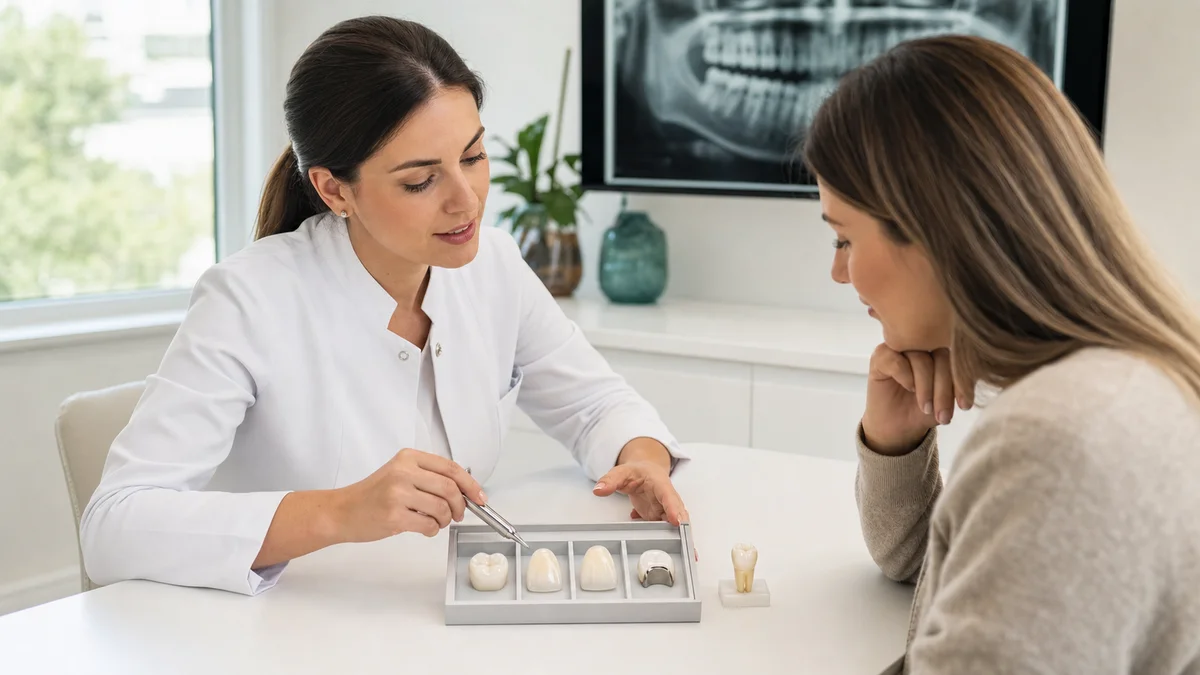
A patient asking for a zirconia crowns comparison is often shown a simple contest: zirconia is described as strongest, lithium disilicate as prettiest, and metal-ceramic as old-fashioned. Those labels are too broad to support informed consent. Dental zirconia includes different formulations and designs. A polished monolithic molar crown, a translucent gradient anterior crown and a zirconia framework layered with porcelain can behave differently even though all are called zirconia.
The comparison also changes with the clinical problem. A dark post under a front crown creates a different optical task from a vital molar with limited clearance. A short preparation needing adhesive retention creates a different bonding task from a retentive preparation that can accept conventional cementation. An implant crown creates different connection and retrieval questions from a crown on a natural tooth.
This guide does not select a material for an individual tooth, prescribe a brand, promise a lifespan or guarantee a result. It shows how to compare complete restoration specifications after a dentist has assessed decay, cracks, pulp and root condition, remaining tissue, gums, bite, opposing teeth, appearance goals and ability to maintain the crown.
1. First Decide Whether the Tooth Needs a Full Crown
A full crown covers most of the visible part of a prepared tooth. Material selection comes after the coverage decision. A limited defect may be managed with a direct restoration, repair, inlay, onlay or overlay in selected cases. A structurally healthy tooth with a colour or position concern may need whitening, bonding, orthodontics, a veneer or no treatment rather than circumferential preparation.
The FDI World Dental Federation’s minimal-intervention approach supports preserving sound and remineralisable tissue where clinically reasonable. That does not mean every damaged tooth should receive a small restoration. A cracked cusp, extensive structural loss, a large failing restoration or another finding may justify broader protection. It means the dentist should explain which surfaces and cusps need coverage before discussing the crown material.
- What diagnosis makes full coverage proportionate?
- How much sound enamel and dentin remain after disease and old material are removed?
- Which walls or cusps are cracked, thin or unsupported?
- Is the pulp healthy, previously treated or still under investigation?
- Can a partial restoration meet the same structural objective?
- What changes if treatment is repaired, monitored or delayed?
If these questions are unanswered, a detailed material debate is premature. The strongest crown cannot rescue a non-restorable root, and the most translucent ceramic cannot compensate for an unhealthy foundation.
2. Decode “Zirconia” Before Comparing It
Zirconia is a polycrystalline ceramic whose composition and microstructure can be adjusted to balance optical and mechanical properties. The American Dental Association’s current overview explains that adding stabilising material and changing phase composition can affect translucency, strength and fracture behaviour. More translucent formulations can trade some mechanical properties for improved light transmission; the exact product and approved indication matter.
A monolithic crown is milled mainly as one zirconia body. Colour gradients, stains, glaze or limited characterisation may be added, but there is no extensive outer porcelain layer. A layered crown uses a zirconia framework with veneering porcelain on part or all of the visible surface. A micro-layered design uses a smaller aesthetic layer in selected areas. A multilayer or gradient blank may vary colour and sometimes material properties through its height.
These labels are not interchangeable. “High translucency” is not a complete specification, and an yttria number alone does not determine clinical performance. Thickness, connector or crown design, sintering, milling, adjustment, surface treatment and the manufacturer’s instructions still matter. Ask the clinic to document the exact product family and design rather than writing only “zirconium crown.”
3. zirconia crowns comparison Decision Table
This table compares common full-crown families. It is a consultation map, not a remote prescription. A product can differ from the general characteristics of its category, and a dentist may choose another option after examination.
| Crown family or design | Potential reason to consider it | Main trade-off to assess | What the written plan should name |
|---|---|---|---|
| High-strength monolithic zirconia | Functional demand, posterior use or selected limited-space designs | Opacity, exact formulation, adjustment and removal | Product, indication, minimum thickness and polishing protocol |
| Translucent or gradient monolithic zirconia | Balance of tooth colour and useful strength in a suitable site | Greater translucency can accompany different mechanical properties | Material zones, orientation, thickness and substrate shade |
| Porcelain-layered zirconia | Laboratory control of surface texture, colour depth and character | Veneering porcelain adds a chipping interface | Framework support, layered areas and repair plan |
| Lithium disilicate glass ceramic | Translucency and adhesive options for selected anterior or posterior crowns | Different strength, thickness and fracture behaviour from zirconia | Exact ceramic, preparation, bonding and masking strategy |
| Porcelain fused to metal | Metal framework with established crown and bridge uses | Opaque core, possible visible margin and veneering porcelain chipping | Alloy, framework, porcelain, margin and sensitivity history |
| Full cast metal | Selected posterior situations where function and conservative thickness may matter | Visible metal, alloy composition and patient preference | Alloy certificate, design, margin and expected appearance |
| Indirect resin-matrix crown | Selected definitive or longer-term provisional pathways and repairability | Wear, colour change and lower load tolerance for some materials | Definitive versus provisional intent, product and replacement plan |
| No full crown | Repair, direct restoration or partial coverage may preserve more tissue | Must still protect every structurally compromised area | Defect map, covered cusps, bonding conditions and review trigger |
Do not compare a full zirconia crown with a partial glass-ceramic onlay as though material were the only variable. Coverage, preparation and objective are different. First normalize the design, then compare material performance within that design.
4. Factor One: Strength Must Match the Site, Not the Slogan
Many zirconias have high fracture resistance, which can be valuable for suitable posterior crowns and other demanding designs. The ADA notes that zirconia is generally stronger and tougher than glass ceramics, while more translucent zirconia formulations can have different mechanical profiles from traditional framework zirconia. A laboratory should follow the product’s indication and minimum dimensions rather than applying one generic value.
Lithium disilicate is a glass ceramic with different optical and adhesive properties. Metal-ceramic crowns use a metal substructure and veneering porcelain. Full metal crowns use an alloy without an aesthetic porcelain layer. Each can provide useful service when the tooth, preparation, laboratory design and bite fit the material.
Strength numbers measured in a laboratory do not equal an individual crown’s lifespan. Sharp internal angles, thin areas, grinding damage, processing defects, unsupported layering, poor fit, heavy contacts, decay and root fracture can defeat a nominally strong material. A material choice should never replace an assessment of restorability.
A five-year randomized clinical trial published in 2025 compared translucent monolithic zirconia with metal-ceramic posterior crowns in a digital workflow and supported zirconia as a viable option in the studied setting. That result does not prove that every zirconia product, every preparation or every patient will perform identically.
5. Factor Two: Translucency and Masking Pull in Opposite Directions
Natural-looking crowns need the right balance of translucency, brightness, opacity, surface texture and fluorescence for the site. A highly translucent restoration can transmit the colour of a healthy underlying tooth and create depth. It can also reveal a dark core, metal post, discoloured tooth or implant component. A more opaque zirconia can mask that substrate but may look high in value or flat beside natural enamel.
Lithium disilicate generally offers greater translucency than zirconia, but the exact ingot or block, thickness and opacity influence the result. Layered zirconia gives the technician more freedom to create internal colour and texture, while adding a porcelain interface. Modern gradient zirconias attempt to combine stronger and more translucent zones, but blank orientation and crown design become part of the prescription.
A small 2025 randomized trial compared one gradient zirconia system with one lithium-disilicate system for anterior crowns. Both groups achieved satisfactory aesthetic outcomes within the study, and the tested zirconia showed favourable shade replication. The sample was small, follow-up was limited and products were specific, so the study should not be converted into “zirconia always looks better.”
- Record the shade and material of the prepared tooth, core or abutment.
- Identify how much masking is required and where.
- Compare the crown under neutral and natural lighting.
- Consider adjacent teeth, smile line and expected gum changes.
- Document whether characterisation is monolithic, micro-layered or fully layered.
6. Factor Three: Available Thickness and Tooth Preservation
A stronger material may be approved for thinner sections in selected designs, but preparation is not determined by strength alone. The crown needs space for contour, contacts, occlusion, material processing, masking and cleaning. Using a thin crown without creating appropriate space can produce an over-contoured restoration that traps plaque or looks bulky.
Tooth position matters. A prominent or tilted tooth may require more reduction to bring the final crown into alignment. A dark tooth may need additional optical space. A short tooth may need retention planning. Existing fillings, cracks and prior preparation may remove the option of an ideal textbook design.
Ask for a reduction map rather than a generic “minimal preparation” claim. It should show the planned occlusal or incisal clearance, axial space, margin design and areas where colour or alignment requires more room. Compare that map with a partial-coverage option before deciding that a full crown is necessary.
7. Factor Four: Monolithic and Layered Crowns Fail Differently
A monolithic zirconia crown removes most of the conventional veneering porcelain and therefore reduces one well-known chipping pathway. It can still fracture, lose retention, wear, develop margin disease or require replacement. A layered zirconia crown can offer greater aesthetic control, but the outer ceramic can chip while the framework remains intact.
A systematic review and meta-analysis of tooth-supported restorations found more chipping and technical complications in porcelain-veneered zirconia than in monolithic zirconia across the included evidence. The studies varied in restoration type, cement, follow-up and design. The practical lesson is to ask where porcelain is layered, how it is supported and what can be repaired, not to claim that monolithic crowns are unbreakable.
Metal-ceramic crowns also have a veneering porcelain layer that can chip. Lithium-disilicate crowns are usually monolithic or characterised differently and have another fracture pattern. Full metal removes ceramic chipping but introduces visible metal and alloy considerations. The relevant comparison is the likely failure pathway and its manageability for the site.
8. Factor Five: Opposing-Tooth Wear Depends on Surface Finish
The word “hard” does not predict antagonist wear by itself. Surface roughness, polish, glaze, contact, bite, product and patient habits all matter. A zirconia surface that is adjusted in the mouth should be restored to a smooth, product-appropriate finish. Glaze may wear, so the quality of the underlying polished surface remains important.
A 2024 umbrella review reported favourable antagonist-wear findings for polished monolithic zirconia compared with several ceramic surfaces and highlighted polishing over glazing. Another systematic review of controlled trials found ceramic crowns can produce more antagonist wear than natural enamel and reported variation by material. Different methods and comparators explain why absolute marketing claims are unsafe.
Ask whether the crown required occlusal adjustment, which polishing sequence was used and how contacts were reviewed. Patients with significant wear, grinding or a history of fractured restorations need individual functional planning. A night appliance may be discussed for selected patients but cannot guarantee protection.
9. Factor Six: Bonding and Cementation Are Material-Specific
Some retentive zirconia crowns may be conventionally cemented when product instructions and preparation geometry permit. A short, over-tapered or otherwise less retentive preparation may require an adhesive strategy. Zirconia does not use the same surface-conditioning pathway as silica-based glass ceramics such as lithium disilicate.
Try-in contamination, internal cleaning, controlled air abrasion where indicated, suitable primers or resin cements, moisture control and curing can affect retention. The exact sequence should follow the crown material, preparation and cement manufacturers’ instructions. A patient article cannot safely prescribe one brand-neutral chairside protocol.
Glass ceramics can be etched and bonded through a different chemical pathway. This can be useful in selected adhesive designs, but reliable isolation and adequate tooth substrate are still required. “Bonded” does not automatically mean stronger in every mouth, and “self-adhesive” does not mean technique-free.
10. Factor Seven: Gum Health Depends on Contour and Margin
Zirconia is widely used as a tooth-coloured ceramic, but the material label does not guarantee healthy gums. Plaque, over-contour, deep margins, residual cement, open contacts, roughness and poor fit can inflame tissues around any crown. Existing gum disease should be stabilised before definitive records and placement.
A more opaque crown can sometimes hide a dark substrate without placing the margin too deep. In another case, a visible transition, recession or thin gum tissue may complicate the aesthetic plan. Metal-ceramic crowns can show a darker underlying edge if tissue recedes, while all-ceramic crowns can still reveal a colour mismatch or margin.
Ask where the margin will sit, why that location is needed and how you will clean it. The crown should have an emergence profile that supports tissue and interdental access rather than merely looking symmetrical on a screen. WHO identifies caries and periodontal disease among major oral diseases; crown material cannot replace prevention and maintenance.
11. Factor Eight: Repair, Removal and Retrieval Matter
A small chip in layered porcelain may sometimes be polished or repaired. A rough contact can sometimes be adjusted and repolished. Loss of retention may be managed when the crown and tooth remain suitable. Extensive fracture, recurrent decay, poor fit, a major colour problem or structural damage may require replacement.
Zirconia’s strength can make crown removal time-consuming. The clinician may need to section the restoration while protecting the underlying tooth. Lithium disilicate, metal-ceramic and full metal crowns have different removal and repair characteristics. Ease of removal is not the same as durability, but it matters when future root canal access or replacement is possible.
For implant crowns, retrieval can be central to the design. Ask whether the crown is screw-retained or cement-retained, whether a titanium base or separate abutment is used, where the access channel is located and how components will be identified later. A tooth-supported crown and an implant crown should not share one generic maintenance plan.
12. Front-Tooth zirconia crowns comparison
For a visible front tooth, the comparison often centres on substrate masking, translucency, neighbouring enamel, gum line, available thickness and laboratory artistry. A dark post or core may favour controlled opacity. A healthy light substrate may allow a more translucent ceramic. A single central incisor is a demanding match because its neighbour provides an immediate reference.
Gradient zirconia, micro-layered zirconia, conventional layered zirconia and lithium disilicate can all be discussed for selected anterior cases. The choice depends on the exact product and design. A material sample outside the mouth cannot reproduce cement shade, thickness, stump colour, hydration and surrounding light.
Request a neutral-light shade record and a try-in plan. Ask whether a laboratory technician is involved in complex matching and what can still be changed before definitive cementation. A digital simulation can guide proportion, but it is not a guarantee of optical integration.
13. Posterior-Tooth zirconia crowns comparison
Posterior crowns place greater emphasis on functional clearance, contacts, material thickness, crack pattern, opposing teeth and access for cleaning. Monolithic zirconia is commonly considered because of its mechanical profile and reduced veneering-porcelain chipping. Metal-ceramic, full metal, lithium disilicate and selected resin-matrix materials remain possible in appropriate designs.
A molar with limited clearance may appear to favour a strong thin material, but the preparation still needs sufficient space for the approved design and smooth contour. A cracked tooth may need a coverage pattern that protects vulnerable cusps. A root-treated tooth may need a core and ferrule assessment before the crown is selected.
Ask the dentist to show centric and movement contacts, not only a scan of the preparation. If chairside adjustment is expected, confirm how the surface will be polished. The strongest material does not justify leaving a high bite or a rough contact.
14. Root-Treated Teeth Need a Foundation Audit
Root canal treatment manages the pulp space; it does not determine the crown material. The crown decision depends on remaining walls, cracks, ferrule, core, post if any, gum level, root condition and bite. A post can retain a core in selected cases but does not make every root stronger.
A dark core or metal post can influence optical planning. Opaque zirconia may mask it more readily than a highly translucent ceramic, but adequate thickness and a natural value still need laboratory control. Replacing a serviceable post solely to improve crown colour may create additional risk and should be justified.
Ask whether future endodontic access through the crown is plausible and how the access could be repaired. If the tooth has an uncertain prognosis, retrievability and the cost of remaking the crown belong in the consent discussion.
15. Implant-Supported Crowns Are a Separate Comparison
An implant-supported crown replaces a missing tooth on an implant and abutment. It does not have enamel, pulp or a natural root. Implant position, soft tissue, abutment material, screw access, connection, crown thickness and retrieval therefore shape the material choice.
A zirconia implant crown may be monolithic, layered or bonded to a titanium base, depending on the system. A highly translucent crown can reveal an underlying abutment, while an opaque crown can affect natural depth. Ceramic chipping, screw loosening, access repair and cleaning beneath the contour are distinct maintenance questions.
A 2026 randomized trial compared three monolithic crown materials on zirconia implants over one year. Its sample and follow-up were limited, so it informs a narrow question rather than proving a lifetime hierarchy. Ask how evidence for the proposed product relates to the specific implant system and design.
16. Turn the Comparison Into a Written Laboratory Prescription
The most useful result of a zirconia crowns comparison is not a material nickname; it is a complete prescription. The dentist and laboratory need shared information about preparation, shade, substrate, thickness, margin, contacts, occlusion, finish and intended cementation. The patient should be able to receive the final material details for future care.
- Natural tooth or implant support and exact tooth position
- Material manufacturer, product family and shade or blank
- Monolithic, gradient, micro-layered or fully layered design
- Prepared-tooth, core or abutment shade and masking target
- Minimum and planned thickness by surface
- Margin design and emergence profile
- Contact and occlusal scheme, including movement contacts
- Areas adjusted and final polishing protocol
- Internal surface treatment and cementation category
- Repair, access, removal and replacement pathway
Brand secrecy is not a quality signal. Product traceability does not guarantee success, but it helps another clinician understand what was used. Keep the invoice, material record, relevant radiographs and final treatment notes.
17. Read Clinical Evidence Without Turning It Into a Promise
Clinical trials answer narrow questions about specified products, sites, preparations, clinicians and follow-up periods. A posterior trial cannot automatically settle an anterior shade question. A single-crown trial cannot prove a long bridge design. An implant-crown study cannot be applied directly to natural teeth.
Systematic reviews combine studies but can inherit variation in materials, definitions and methods. Zirconia evolves quickly; a paper on an older opaque framework may not describe a current gradient product. Conversely, a new highly translucent product may have less long-term clinical evidence than an established design.
Ask what evidence supports the exact indication and what remains uncertain. “Clinically studied” should identify the product or material family, restoration type and duration. No ethical consent process turns group data into an individual guarantee.
18. Compare Quotes by Scope, Not by “Zirconia Upgrade”
A crown quote may include examination, radiographs when indicated, removal of decay and old material, core build-up, post or root treatment, gum care, preparation, provisional crown, laboratory work, final cementation and follow-up. Another quote may list only the final crown. Normalize the clinical scope before comparing the material fee.
Ask whether the quoted zirconia is monolithic or layered, whether complex shade work is included, what happens if the plan changes after decay removal and which early adjustments are covered. Insurance may use material allowances or alternate benefits, but coverage does not determine biological suitability. Verify current plan terms directly and treat predetermination as an estimate rather than guaranteed payment.
For international care, include travel, accommodation, laboratory timing, provisional care, records, possible return visits and local maintenance. Redent Klinik is in Turkey. Patients can review the Redent Klinik English information hub and use the English contact page to ask which records support a preliminary review.
A remote proposal remains provisional. Photographs cannot confirm decay depth, cracks, pulp status, ferrule, margin position, clearance or bite. Clinical findings, not the flight schedule, should determine the final crown and any additional treatment.
19. Red Flags in a zirconia crowns comparison
- Every product is called the same “premium zirconia.”
- Strength is described as proof that the crown cannot break.
- Translucent zirconia is promised to match every front tooth automatically.
- A full crown is recommended without explaining why partial coverage is insufficient.
- Material thickness and tooth reduction cannot be shown.
- Adjusted zirconia is left rough or polishing cannot be explained.
- Zirconia and lithium disilicate are said to use the same bonding protocol.
- Layered areas, chipping and repair are not disclosed.
- The implant connection or abutment is omitted from the crown discussion.
- The laboratory, alloy or ceramic product will not be documented.
- A small study is presented as a lifetime guarantee.
- Payment or travel pressure limits time for questions and consent.
A red flag is a reason to pause and request clarification; it does not by itself prove unsafe care. A strong recommendation can explain the chosen material, design, evidence, limitations and alternatives for that exact tooth.
Frequently Asked Questions About Zirconia Crown Materials
Is monolithic zirconia better than layered zirconia?
Not universally. Monolithic design removes most veneering porcelain and can reduce chipping of that layer. Layered zirconia offers more laboratory control of colour and texture but adds an interface. Site, substrate, thickness, bite and aesthetic demand determine the trade-off.
Is translucent zirconia weaker than traditional zirconia?
Many more-translucent formulations have a different phase composition and mechanical profile from traditional high-strength zirconia. The exact product, thickness and indication matter. Do not infer suitability from “high translucency” or an yttria label alone.
Is zirconia better than lithium disilicate for front teeth?
Either may be suitable in selected cases. Zirconia can provide useful strength and masking; lithium disilicate can provide high translucency and a different adhesive pathway. Substrate shade, available space, neighbouring teeth, bite and the exact material determine the choice.
Is zirconia better than porcelain fused to metal?
Both are established crown categories with different designs. Zirconia avoids a metal framework, while metal-ceramic uses metal support beneath porcelain. Compare opacity, margin appearance, chipping pathway, alloy considerations, thickness, evidence and repair rather than treating one as automatically superior.
Does zirconia wear the opposing tooth?
It can contribute to wear, particularly when rough or poorly adjusted. Polished monolithic zirconia has shown favourable wear behaviour in reviews, but outcomes vary with surface, contacts, product, bite and comparator. Zero wear should not be guaranteed.
Can zirconia crowns be bonded?
Yes, when an adhesive strategy is indicated and the product-compatible surface treatment, primer or resin cement and isolation are used. Zirconia is not etched through the same pathway as lithium-disilicate glass ceramic. The exact protocol is clinical and product-specific.
Which crown masks a dark tooth best?
A more opaque material or layer can help mask a dark substrate, but excessive opacity can look unnatural. The dentist and laboratory must balance stump shade, crown thickness, cement, neighbouring teeth and desired value. No material name alone answers the question.
Can a chipped layered zirconia crown be repaired?
Some small chips can be polished or repaired depending on their location, cause and framework exposure. Extensive chipping, poor fit, recurrent disease or structural fracture may require replacement. A repair may not reproduce the strength or optics of an intact laboratory crown.
Is zirconia the best material for people who grind?
Its mechanical properties can be useful, but grinding still affects contacts, antagonist wear, retention, the underlying tooth and other restorations. Material choice cannot control the habit. The dentist should assess function and discuss a protective strategy where appropriate.
What should appear on my crown material record?
Ask for the product or material family, monolithic or layered design, shade, laboratory, cementation category and relevant implant component details. Keep this with treatment records. Traceability supports future repair, access, removal and replacement decisions.
Conclusion: Compare Specifications, Not Material Nicknames
The safest zirconia crowns comparison begins after the tooth is judged restorable and full coverage is justified. It then compares exact crown designs through eight factors: strength, optics, thickness, fracture pathway, antagonist wear, cementation, gum response and future service. No single factor should decide the material.
Ask which zirconia or alternative is proposed, how it fits the substrate and bite, where it is layered, how adjusted surfaces are polished, how it is retained and what happens if repair or removal is needed. Convert those answers into a written laboratory and clinical specification. That is more useful than choosing “zirconia” from a price list and more honest than declaring one ceramic best for every tooth.
Official Sources and Evidence Notes
- American Dental Association: Materials for Indirect Restorations
- American Dental Association
- American Dental Association MouthHealthy: Crowns
- U.S. Food and Drug Administration: Dental Ceramics Performance Guidance
- FDI World Dental Federation: Minimal Intervention Dentistry
- World Health Organization: Oral Health Fact Sheet
- Five-Year Randomized Trial: Translucent Zirconia and Metal-Ceramic Posterior Crowns
- 2025 Randomized Trial: Gradient Zirconia and Lithium Disilicate Anterior Crowns
- Systematic Review: Monolithic and Porcelain-Veneered Zirconia
- 2024 Umbrella Review: Antagonist Enamel Wear and Zirconia Crowns
- Systematic Review: Antagonist Wear From Ceramic Crowns
- 2026 Randomized Trial: Monolithic Crowns on Zirconia Implants
Sources reviewed July 18, 2026. This article provides general education and does not diagnose a tooth, prescribe a material or guarantee an outcome. Product instructions and clinical evidence change; final selection requires examination and informed consent with a licensed dentist.