
Using a health savings account dental implants strategy has become one of the most effective ways for patients in the United States to afford long-term tooth replacement without overwhelming upfront costs. In this detailed guide, you’ll learn exactly how an HSA works, why it is considered a tax-advantaged powerhouse for dental implant treatment, and how thousands of patients use it every year to lower their total expenses 😊. Because dental implants are an investment in both oral health and confidence, understanding the financial tools available to you is essential.
A Health Savings Account (HSA) is a special type of savings account designed to help individuals pay for qualified medical and dental expenses using pre-tax income. That means the money you put into the account isn’t taxed, the growth inside the account isn’t taxed, and the withdrawals for eligible treatments—such as health savings account dental implants procedures—aren’t taxed either. This triple tax advantage makes HSAs one of the most powerful financing tools available for healthcare. In fact, many experts refer to HSAs as a “medical emergency fund” or “health investment account” because of how flexible and value-packed they are.
Dental implants are considered medically necessary in most cases because they restore chewing function, prevent bone loss, and maintain facial structure. This is why they qualify as an acceptable expense under IRS Publication 502, which governs medical deductions and HSA-eligible procedures. While cosmetic dental work is not eligible, implants rarely fall into that category because they directly affect eating, speech, jawbone density, and oral health stability. This makes the pairing of health savings account dental implants not only legal but also financially smart 👍.
Let’s walk through how this practically benefits you. Imagine that you earn $60,000 per year and decide to allocate $3,000 of pre-tax income into your HSA. If your marginal tax rate is approximately 22%, that decision alone saves you about $660 in taxes. You now have $3,000 available that can be used toward diagnostic imaging, implant surgery, abutments, and the final crown. For patients undergoing full-mouth restoration or All-on-4 procedures, using an HSA can create thousands of dollars in tax savings over time.
In addition to affordability, an HSA gives you complete control over your funds. Unlike an FSA, unused HSA money rolls over every year. Even better, your contributions can be invested, allowing your savings to grow for future treatments. For example, if you maintain your account for several years before pursuing implants, your balance may increase significantly depending on the investment options offered by your HSA provider. This is why many patients choose to plan their health savings account dental implants treatment timeline strategically, giving themselves extra time to save and grow their funds 📈.
Another major advantage is flexibility. You can use your HSA to pay not only the implant itself but also supporting components such as bone grafts, sinus lifts, CT scans, and anesthesia fees. These additional treatments are often necessary for long-lasting results, and the ability to pay for them tax-free is a tremendous benefit. If you are unsure whether a specific step of the procedure qualifies, your provider can offer written documentation to present to your HSA administrator.
To further support your decision-making, professional organizations like the American Dental Association provide educational resources about dental implants, helping you better understand the clinical process and long-term success rates. When selecting a clinic or specialist, always choose experienced implant professionals who prioritize bone health, digital imaging accuracy, and long-term prosthetic stability.
If you are considering implants at Redent Klinik, you can easily request a personalized treatment plan or ask financial questions through the Redent Klinik Contact Page. A dedicated specialist can explain how your HSA can be used, help estimate costs, and guide you through treatment preparation. Whether you require a single implant, multiple implants, or hybrid full-arch solutions, proper planning ensures you maximize your tax savings while receiving the highest standard of care 🦷✨.
In summary, combining a health savings account dental implants approach allows patients to enjoy tax-free savings, flexible spending power, long-term planning, and a significant reduction in the financial burden associated with implant treatment. Because implants are not only functional but crucial for oral health, having access to a tax-advantaged payment method helps make them more accessible and sustainable for everyday individuals. This strategic financial planning—paired with modern implant technology—creates a pathway to durable, attractive, and confidently restored smiles.
How an HSA Works for Dental Implant Treatment
Understanding how a Health Savings Account functions is essential when planning to use a health savings account dental implants strategy to reduce overall treatment expenses. HSAs are unique, tax-advantaged accounts designed specifically to help individuals pay for eligible medical and dental procedures using pre-tax income. This means every dollar you contribute goes further and costs you less than if you paid out of pocket with post-tax dollars. For dental implants—often one of the most valuable long-term treatments in modern dentistry—this can significantly improve affordability and access 😊.
To use an HSA, you must be enrolled in a High Deductible Health Plan (HDHP). Once enrolled, you can begin contributing funds to your HSA up to the annual IRS limit. These contributions are 100% tax-deductible, making them one of the most effective methods for budgeting healthcare costs. When you withdraw the funds for qualified procedures such as health savings account dental implants treatments, the withdrawals are also tax-free. This creates a powerful financial advantage that no other medical savings tool offers.
Why Dental Implants Qualify as an HSA-Eligible Expense
Many patients wonder whether implants are considered cosmetic or medically necessary. The IRS clearly recognizes dental implants as eligible because they restore normal oral function, prevent bone loss, and support overall dental health. Procedures that address these functional needs qualify under HSA rules. This includes:
- Single-tooth implants
- Multiple implants
- All-on-4 or full-arch implant restorations
- Bone grafts and sinus lifts
- 3D imaging, CBCT scans, and surgical guides
- Implant abutments and crowns
This wide range of eligible services makes the combination of health savings account dental implants an especially practical solution for both simple and complex implant cases.
The Triple Tax Advantage Explained
HSAs are often described as “triple tax-advantaged” because they provide three separate financial benefits:
- Pre-tax contributions: Money added to your HSA is removed from your taxable income.
- Tax-free growth: Funds in the account can be invested, growing without being taxed.
- Tax-free withdrawals: As long as you use the funds for eligible expenses, including health savings account dental implants, no tax is applied.
This triple advantage is what makes HSAs superior to standard savings accounts or credit-based financing options. You pay less, save more, and avoid interest payments typically associated with dental loans.
How to Use Your HSA for Implant Treatment
The process of using an HSA to pay for dental implants is straightforward, but understanding the steps ensures no complications occur. Once your dentist provides a full treatment plan, you can present the itemized documentation to your HSA provider. Most HSA accounts offer three payment options:
- Using an HSA debit card
- Requesting reimbursement after payment
- Paying the provider directly through your HSA portal
Your dental clinic will typically provide invoices that clearly outline the components of the implant procedure, ensuring compliance with IRS rules. If you are undergoing treatment at Redent Klinik, specialists can guide you through this process and help you determine which portions of the treatment plan qualify. You can always reach out through the Redent Klinik Contact Page for personalized assistance.
HSA Contribution Limits and Planning Ahead
Every year, the IRS sets a maximum amount that individuals or families can contribute to an HSA. Planning ahead is crucial, especially when considering costly but transformative procedures such as implants. By contributing regularly and allowing your funds to accumulate, you can cover a significant percentage of your total implant expenses using tax-free dollars.
For example, imagine you contribute $3,500 annually for two years. With modest investment growth, you could accumulate more than $7,200 tax-free. This alone can cover diagnostics, the implant fixture, and part of the restoration. The strategic use of health savings account dental implants planning can easily save hundreds to thousands of dollars over time.
Investment Growth Inside Your HSA
Many people overlook the fact that HSAs allow for investment growth similar to retirement accounts. If you do not need the funds immediately, you can invest your contributions in mutual funds, ETFs, or other IRS-approved assets. This gives your savings time to grow before your dental implant treatment. The longer you wait, the more financial flexibility you gain 📈.
What Happens if Your HSA Balance Is Not Enough?
If your current balance does not fully cover your implant treatment, you can combine payment methods. Many clinics allow:
- HSA payments supplemented by cash or credit
- Payment plans
- Phased treatment to spread costs over 12–24 months
This flexibility ensures that a lack of total funds does not prevent you from undergoing health savings account dental implants procedures when you need them.
Professional Guidance for Maximum Savings
The American Dental Association provides guidelines and educational materials that help patients make informed decisions about oral health treatments. When you combine this information with strategic HSA planning, the long-term benefits compound. You save money, preserve your oral health, and ensure a stable, functional bite for years to come.
Overall, understanding how an HSA works gives you clarity and financial power. Whether you need a single implant or a full-mouth restoration, pairing modern dentistry with smart financial planning makes treatment more predictable, affordable, and stress-free. This is why so many patients rely on health savings account dental implants systems when preparing for life-changing treatment 🦷✨.
Eligible Dental Implant Expenses You Can Pay with an HSA
One of the biggest advantages of using a health savings account dental implants strategy is the wide range of treatment-related expenses that qualify for tax-free payment. The IRS clearly defines which procedures and components are medically necessary, and dental implants fall under this category because they restore function, prevent bone loss, and improve long-term oral health. This section explains every eligible expense in detail so you can confidently plan your implant journey without worrying about surprises 😊.
Dental implant treatment is not a single procedure—it is a series of carefully coordinated steps. Each step contributes to the final result, and fortunately, nearly all components are eligible for HSA spending. Whether you are undergoing a simple single-tooth implant or a full-arch restoration, knowing which costs qualify can help you maximize your savings and use your HSA efficiently.
HSA-Eligible Diagnostic and Preparatory Procedures
Before implant surgery begins, your dental specialist must evaluate bone structure, gum health, and overall oral condition. These pre-surgical steps are essential and fully qualified for HSA usage under IRS medical guidelines. This includes:
- Comprehensive consultation and oral examination: Required for treatment planning and evaluation.
- 3D CBCT scans: Cone Beam CT imaging is medically necessary to assess jawbone density and nerve pathways.
- Intraoral X-rays: Used to evaluate bone condition and whether extraction is required.
- Digital impressions or surgical guides: Crucial for precision placement of implants.
All these assessments contribute directly to your implant success. When combined with a health savings account dental implants strategy, these required diagnostic steps become significantly more affordable.
Surgical Procedures Fully Covered by HSA Funds
Dental implant placement is a surgical procedure, which is why it qualifies as a medical expense rather than a cosmetic one. HSAs cover multiple surgical components involved in implant dentistry:
- Tooth extractions: If a damaged or decayed tooth must be removed before placing the implant.
- Implant fixture placement: The titanium or zirconia post that serves as the artificial tooth root.
- Bone graft surgery: Needed when the jawbone requires strengthening to support the implant.
- Sinus lift procedures: Helps create enough bone height in the upper jaw for implant stability.
- Soft tissue grafts: Improves gum health and aesthetic integration around the implant.
- Anesthesia and sedation fees: Includes local anesthesia, IV sedation, or general sedation depending on case complexity.
Because these procedures are functionally necessary, they are fully compatible with health savings account dental implants coverage. If your clinic provides itemized documentation—which reputable clinics like Redent Klinik always do—your HSA administrator will easily approve these expenses.
Restorative Components Covered by HSAs
Implant treatment extends beyond surgery. The artificial tooth that attaches to the implant also qualifies as a legitimate medical expense. Your HSA can be used to pay for:
- Abutments: The connector piece that links the implant post to the crown.
- Implant crowns: The visible portion of the tooth, custom-designed for aesthetics and function.
- Temporary prosthetics: Used during healing to preserve appearance and function.
- Full-arch implant prostheses: Including All-on-4, All-on-6, and hybrid denture restorations.
Restorative work is essential to your ability to chew, speak, and maintain a healthy oral structure, which is why it falls squarely within HSA eligibility guidelines. When combined with strategic health savings account dental implants planning, these components become significantly more manageable financially.
Medications and Post-Operative Care Eligible for HSA Payment
After implant surgery, your dentist may recommend medications or follow-up treatments. These also qualify for HSA reimbursement, including:
- Prescription pain relievers
- Antibiotics
- Mouth rinses used specifically for healing
- Follow-up visits and suture removal
- Additional imaging to verify healing progress
Because these medications and services directly support post-surgical healing, the IRS considers them valid medical expenses. When you structure your care under a health savings account dental implants plan, even these smaller costs add up to meaningful savings over time.
Expenses That Do Not Qualify for HSA Use
While most implant-related procedures are eligible, a few exceptions exist. The IRS does not allow HSA funds to cover procedures that are purely cosmetic. These include:
- Teeth whitening
- Cosmetic veneers
- Non-medically necessary gum contouring
However, these exclusions rarely affect implant patients because implants almost always serve a functional medical purpose. If you are unsure whether a particular step of your treatment is eligible, your clinic can provide documentation. If you are working with Redent Klinik, you can request clarification through the Redent Klinik Contact Page.
Why This Eligibility Matters for Implant Patients
Dentists and financial advisors frequently highlight the importance of understanding HSA-covered expenses. Dental implants are among the most effective, natural-looking tooth replacements available, but they also require specialized materials, surgical expertise, and long-term planning. Knowing which expenses you can confidently pay with your HSA helps reduce financial stress and improves treatment accessibility. For example, if your total implant treatment cost is $3,000–$4,500 for a single tooth, paying these expenses through a health savings account dental implants approach can reduce your effective cost by hundreds or even thousands of dollars depending on your tax bracket.
The American Dental Association emphasizes that dental implants contribute to long-term oral function, bone preservation, and facial stability. Because of this medically necessary role, HSA eligibility is both appropriate and extremely beneficial.
In summary, nearly every step of the implant process—from diagnostics to surgery to final restoration—is eligible for HSA spending. This makes the combination of health savings account dental implants not only accessible but financially optimized. When you understand the full scope of eligible expenses, you gain the power to plan confidently, save strategically, and achieve a long-lasting smile without unnecessary financial strain 🦷✨.
Comparing HSA vs. FSA for Implant Procedures
When patients look for the most cost-effective way to pay for dental implants, they often compare two major tax-advantaged tools: Health Savings Accounts (HSA) and Flexible Spending Accounts (FSA). Understanding the differences between these options is crucial because choosing the right one directly affects your savings, long-term budgeting, and overall treatment affordability. In this section, we will examine every meaningful difference so you can make the most informed decision when paying for health savings account dental implants and determine whether an HSA or FSA better suits your needs 😊.
Both accounts help reduce out-of-pocket healthcare expenses, but they operate differently in terms of ownership, rollover rules, contribution limits, withdrawals, and investment opportunities. Because dental implants can cost several thousand dollars per tooth, or even tens of thousands for full-arch restoration, selecting the optimal account can save you a substantial amount of money. Let’s break these differences down in a clear and actionable way.
Key Differences Between HSAs and FSAs
Although both HSAs and FSAs offer tax advantages, they are built for different types of healthcare and financial situations. Here’s an overview of the most important distinctions:
- HSAs require enrollment in a High Deductible Health Plan (HDHP), while FSAs do not.
- HSA funds roll over indefinitely, but FSAs often operate under a “use it or lose it” rule.
- HSA contributions belong to you permanently, whereas FSA funds are employer-controlled.
- HSAs allow investment growth, but FSAs do not.
- HSAs have higher contribution limits compared to FSAs.
Because of these differences, HSAs are generally considered the stronger financial tool for long-term planning, especially for procedures as valuable and comprehensive as health savings account dental implants treatment.
HSA Flexibility vs. FSA Restrictions
Flexibility is one of the biggest advantages of an HSA. Not only do your contributions stay with you forever, but you can also change how much you contribute throughout the year (depending on your employer’s rules). FSAs, however, require you to choose your contribution amount at the beginning of the year and you cannot adjust it later unless you have a qualifying life event.
Another important difference is ownership. Your HSA belongs to you even if you switch jobs, retire, or lose your insurance. The money stays with you for life. In contrast, FSA funds often stay with the employer, and if you change jobs mid-year, you may lose access to any unspent dollars.
This makes HSAs a much stronger choice for ongoing savings and for planning larger, staged dental implant treatments. Many patients preparing for health savings account dental implants continue contributing for several years to accumulate enough funds to cover full-arch procedures or multiple implants.
Rollover Rules: A Critical Factor for Implant Patients
How HSA Rollover Benefits You
HSAs allow unlimited rollover from year to year. This is incredibly valuable because implant treatment often happens in phases over a 6–18 month period. With an HSA, you can accumulate funds over time, letting your balance grow until the surgical phase or final restoration.
The Risk of Losing FSA Funds
FSAs, on the other hand, typically come with strict “use it or lose it” policies. Some employers offer a grace period or allow a small rollover amount (often $500–$610), but the majority of unused funds disappear at the end of the plan year. For implant patients, this creates unnecessary financial pressure and limits the ability to save gradually for treatment.
If your goal is to responsibly plan for health savings account dental implants over several years, an HSA is almost always the wiser option.
Contribution Limits: HSAs Offer More Avenues for Savings
IRS regulations allow significantly higher contributions to HSAs compared to FSAs. Because implants can be expensive—single implants often ranging from $2,800 to $4,500 and full-mouth treatments costing more—having higher contribution limits helps you build a meaningful savings cushion.
Here’s the general comparison as of recent IRS guidelines:
- HSA Individual Contribution Limit: Substantially higher than FSA limits.
- HSA Family Contribution Limit: Even more generous, allowing joint savings.
- FSA Contribution Limit: Considerably lower, making it insufficient for larger procedures.
The difference in savings potential is significant. With an HSA, many patients can save enough to cover most or even all implant-related expenses tax-free, whereas an FSA may only cover part of the procedure in a single year.
Investment Growth: The Hidden Advantage of HSAs
One of the most overlooked benefits of an HSA is its ability to grow through investments. You can invest your balance in mutual funds, stocks, or ETFs—allowing your savings to compound over time. FSAs have no investment options at all.
If you are planning full-mouth rehabilitation or a multi-step treatment over several years, this investment aspect becomes incredibly valuable. Many patients strategically invest their contributions and use the gains to cover a portion of their health savings account dental implants treatment at no additional cost 📈.
Eligibility for Implant-Related Expenses
Both HSAs and FSAs typically cover the medically necessary components of implant treatment, such as:
- Surgical implant placement
- Bone grafts and sinus lifts
- Implant crowns and abutments
- CT scans and diagnostic imaging
- Post-operative medications
However, because FSA funds expire annually, they are less practical for multi-stage implant treatments that require long healing periods. An HSA gives you the flexibility to spread your treatment over time without losing access to your savings.
If you want personalized treatment planning or financial guidance, you can always contact specialists through the Redent Klinik Contact Page. They can help you understand which expenses qualify and how to maximize your tax-free savings.
Which One Is Better for Implant Patients?
For most patients, the HSA is the superior choice, especially when planning health savings account dental implants treatments. The combination of rollover protection, higher contribution limits, investment growth, and lifelong ownership makes HSAs the financially safer and more strategic option. FSAs are still useful for short-term medical needs, but they lack the long-term structure required for implant financing.
Professional organizations such as the American Dental Association emphasize that dental implants are a long-term investment in oral health. Because of this, pairing implant treatment with a long-term financial tool like an HSA aligns perfectly with both medical and financial goals.
In summary, while both accounts offer benefits, an HSA provides unmatched flexibility and savings potential. If you are planning a life-changing implant procedure, choosing a health savings account dental implants approach will help you reduce costs, lower your tax burden, and improve your financial strategy for many years ahead 🦷✨.
Tax Advantages of Using an HSA for Dental Implants
One of the most compelling reasons patients choose a health savings account dental implants strategy is the exceptional tax savings it provides. HSAs are widely regarded as the most powerful tax-advantaged tool available for healthcare expenses in the United States. Unlike traditional payment methods or financing plans, an HSA allows you to reduce your taxable income, grow your funds tax-free, and use the money for dental implant procedures without paying taxes on withdrawals. These combined benefits dramatically decrease the real cost of treatment, especially for high-value procedures like dental implants 😊.
Because dental implants are considered medically necessary for oral function and long-term bone health, the IRS allows you to pay for nearly every aspect of implant treatment with HSA funds. This means that the money you set aside—money that is never taxed—goes directly toward restoring your smile. Over time, these savings can amount to thousands of dollars, particularly for full-mouth implant solutions or multi-tooth restorations.
The Triple Tax Benefit: Why HSAs Are So Powerful
The “triple tax advantage” is the foundation of HSA financial power. It is the reason financial advisors, dental professionals, and tax experts strongly recommend using HSAs for high-cost medical procedures. This advantage includes:
- Tax-free contributions
- Tax-free investment growth
- Tax-free withdrawals for eligible expenses
No other healthcare financial tool offers all three. FSAs offer only one or two, and standard savings accounts or credit-based options offer none. When applied to health savings account dental implants, this triple advantage makes implants far more affordable and accessible.
1. Pre-Tax Contributions Reduce Your Taxable Income
Every dollar you contribute to an HSA is deducted from your taxable income. This means you pay less income tax and save more immediately. For many patients, this reduces the actual cost of dental implant treatment by 20–30% depending on their tax bracket.
For example, if you contribute $3,000 toward implant treatment with an HSA and are in the 24% tax bracket, you save $720 instantly. That is money you keep simply by using the right account.
In many cases, patients preparing for health savings account dental implants plan their contributions over one or two tax years to maximize these benefits. Families with high deductible health plans can save even more since they are allowed higher annual contribution limits.
2. Tax-Free Growth Allows Your Savings to Multiply
HSAs are not just savings accounts—they can also act as investment vehicles. Patients can choose to invest their funds in:
- Mutual funds
- ETFs
- Stocks
- Index funds
All investment earnings inside an HSA are tax-free. Over several years, this allows your account to grow significantly, giving you even more purchasing power when it’s time for implant treatment. This is especially useful for patients planning full-mouth rehabilitation over 12–36 months.
Investment growth is one of the hidden strengths of health savings account dental implants planning. With even moderate investment returns, your HSA balance can grow far beyond your contributions—essentially giving you free money for essential dental care 📈.
3. Tax-Free Withdrawals for Qualified Implant Expenses
When you use your HSA funds to pay for dental implants, you don’t pay a single cent in taxes on those withdrawals. This includes:
- Implant surgery
- 3D imaging, scans, and digital planning
- Bone grafts and sinus lifts
- Abutments and dental crowns
- Post-operative care and medications
This is possible because implants are considered medically necessary—they restore chewing ability, preserve bone health, and support proper jaw function. The IRS categorizes them as eligible medical expenses under HSA rules, allowing them to be paid entirely with tax-free funds. For patients undergoing multiple implants or All-on-4 treatment, this tax-free withdrawal feature can generate thousands of dollars in long-term savings.
HSA vs. Traditional Payment: Real Cost Comparison
Most patients are surprised at how much tax savings impact the real cost of treatment. Here is a simplified comparison for a $4,000 implant:
Without HSA
- Income taxed at 22%
- Effective cost: $4,000
With HSA
- Income is not taxed
- Effective cost: $4,000 – $880 (tax savings) = $3,120
This is a straightforward scenario. If you also invest your HSA contributions, your savings can be even greater. Strategic planning around health savings account dental implants consistently proves to be one of the most financially intelligent approaches to dental care.
Long-Term Tax Benefits for Multi-Stage Treatments
Dental implants often involve multiple phases—extraction, bone grafting, implant placement, healing, and final restoration. These phases typically span 6–18 months. This timeline allows patients to:
- Contribute HSA funds over multiple tax years
- Invest money while waiting for the next phase
- Plan cost distribution strategically
This long-term structure pairs perfectly with an HSA, which is why so many patients prefer health savings account dental implants planning over financing or traditional savings accounts.
IRS Compliance and Documentation
To ensure compliance, your dental clinic will provide itemized documentation for each stage of implant treatment. This is important because the IRS requires proof that HSA funds were used for qualifying expenses. Reputable providers—including Redent Klinik—make this process easy by offering detailed invoices and treatment breakdowns.
If you ever need clarification, you can contact specialists directly through the Redent Klinik Contact Page for guidance about eligible expenses, documentation, or payment structure.
Professional Guidelines and Support
The American Dental Association supports and recognizes dental implants as medically significant procedures that restore function and oral health. This professional acknowledgment reinforces their status as HSA-eligible expenses and gives patients confidence when allocating tax-advantaged funds toward treatment.
In summary, using an HSA for implant treatment allows you to reduce your taxable income, grow your savings tax-free, and withdraw funds without paying taxes when undergoing eligible dental procedures. When effectively managed, a health savings account dental implants strategy can reduce the total cost of treatment, making dental implants more accessible, affordable, and financially sustainable for patients seeking long-term oral health solutions 🦷✨.
Step-by-Step Guide to Paying for Implants with an HSA
Using a health savings account dental implants strategy is one of the smartest and most financially efficient ways to manage the cost of dental implant treatment. But many patients are unsure how to practically apply their HSA to cover diagnostics, surgery, and restorative procedures. In this comprehensive step-by-step guide, you will learn exactly how to prepare, contribute, document, and pay for dental implant treatment using your Health Savings Account—ensuring full IRS compliance and maximum tax savings 😊.
Whether you are planning a single implant or a complete full-arch restoration, understanding these steps helps you avoid mistakes, optimize your contributions, and streamline your payment process from start to finish.
Step 1: Confirm That You Have an Eligible HDHP Plan
To open and use an HSA, you must be enrolled in a High Deductible Health Plan (HDHP). This is a requirement set by the IRS. Once enrolled, your HSA becomes active and you can begin contributing pre-tax dollars that will later be used for your health savings account dental implants expenses.
- Check your insurance provider’s documentation
- Verify that your plan meets IRS HDHP minimums
- Ensure the plan has no disqualifying supplemental coverage
If you do not currently have an HDHP, you can switch during your employer’s open enrollment period or during a qualifying life event.
Step 2: Open or Activate Your HSA Account
Once your HDHP eligibility is confirmed, the next step is opening an HSA account. This can be done through:
- Your employer’s preferred HSA provider
- Banks and credit unions
- Online HSA financial institutions
Most providers offer two options: a standard savings-style account and an investment-enabled account. If you plan your health savings account dental implants treatment over several years, choosing an HSA that allows investment growth may be highly beneficial.
Step 3: Start Making Pre-Tax Contributions
HSA contributions reduce your taxable income, so it is important to contribute as consistently as possible. Contributions can be made through:
- Payroll deductions
- Direct bank transfers
- One-time deposits
The IRS sets annual contribution limits, and maximizing these contributions increases your long-term tax savings. Patients preparing for multi-stage dental implant procedures often contribute across two or more years to accumulate sufficient funds.
Planning Ahead for Multi-Phase Implant Treatment
Because implant treatment typically occurs in phases—extractions, bone grafts, implant placement, and crown restoration—you can plan contributions to align with each stage. This ensures you have enough tax-free funds available when needed.
Step 4: Schedule a Comprehensive Implant Consultation
Before you can use your HSA funds, your dental implant specialist needs to complete a thorough evaluation. This consultation typically includes:
- Oral examination
- 3D CBCT scan
- Digital treatment planning
- Bone density assessment
- Implant eligibility review
These diagnostic procedures are all eligible for HSA payment because they are medically necessary and directly related to implant treatment. At Redent Klinik, you can schedule a consultation or request clarification through the Redent Klinik Contact Page.
Step 5: Request an Itemized Treatment Plan
Once your consultation is complete, your dental clinic will provide a detailed treatment plan outlining:
- The number of implants required
- Surgical procedures needed (e.g., bone grafts)
- Restorative components (abutments, crowns)
- Total estimated cost
- The sequence and timing of each stage
This document is essential for IRS compliance when using health savings account dental implants funds. Your plan will serve as proof that the expenses qualify as medically necessary procedures.
Step 6: Use Your HSA Debit Card or Request Reimbursement
You can pay for your dental implant procedures using your HSA in one of two ways:
Option A: Use Your HSA Debit Card
Most HSA providers issue a debit card directly connected to your account. This is the fastest method and allows you to pay your dental office upfront.
Option B: Request Reimbursement After Paying Out-of-Pocket
If your provider does not accept HSA cards, you can pay normally and then submit receipts to your HSA administrator. Once approved, the funds are transferred back to your personal bank account tax-free.
Both methods are fully recognized by the IRS and work seamlessly for health savings account dental implants care.
Step 7: Maintain Detailed Documentation
Record-keeping is essential for IRS compliance. Make sure to store:
- Invoices
- Itemized receipts
- Treatment plans
- Prescription documentation
- Post-operative instructions
These documents confirm that your HSA withdrawals were used for qualified medical expenses. Reputable providers—including Redent Klinik—automatically supply patients with clear and compliant paperwork.
Step 8: Track Your HSA Balance Throughout Treatment
Implant treatment can span several months, so it’s important to monitor your HSA balance as you progress through each stage. This helps you:
- Avoid insufficient funds during the surgical phase
- Plan future contributions
- Allocate money for crown placement and follow-up visits
Patients undergoing multi-step health savings account dental implants treatment often contribute gradually while completing each phase of care.
Step 9: Use Remaining HSA Funds for Maintenance and Aftercare
Even after your implant is placed and restored, your HSA can still support oral health maintenance. Eligible expenses include:
- Prescription mouth rinses
- Follow-up imaging
- Professional cleanings (if required for implant health)
- Treatment of peri-implant inflammation
This ensures your investment in implant treatment is protected long-term.
Professional Guidance to Maximize Your HSA Benefits
If at any point in the process you need clear guidance or assistance, you can always reach out through the Redent Klinik Contact Page. Additionally, trusted organizations like the American Dental Association offer extensive resources to help patients make informed decisions about implant care.
In summary, following a structured step-by-step approach makes using a health savings account dental implants method simple, efficient, and highly cost-effective. With proper planning, documentation, and communication with your provider, you can complete implant treatment using tax-free dollars—making it one of the smartest financial decisions for long-term oral health 🦷✨.
How to Maximize Your HSA Savings Before Implant Surgery
Planning dental implant treatment using a health savings account dental implants strategy is one of the most efficient ways to reduce costs, eliminate tax burdens, and stay financially organized throughout your treatment. But to fully benefit from your HSA, you must understand how to strategically grow, allocate, and manage your funds before surgery. This section provides a complete, actionable roadmap to help you maximize every dollar and optimize your savings—all while preparing for a long-lasting, functional, and aesthetically pleasing dental implant solution 😊.
Because dental implants are typically completed over several months, you have an opportunity to accumulate tax-free funds, invest strategically, and time your contributions to minimize personal expenses. These strategies are especially valuable for patients planning either multi-implant procedures or full-arch reconstruction, which often involve higher treatment costs.
Start with a Clear Treatment Timeline
Maximizing your HSA begins with understanding your expected treatment timeline. Dental implants generally proceed through stages such as extraction, bone graft (if needed), implant placement, healing, and final restoration. This multi-phase process gives you several months—and sometimes over a year—to continue contributing to your HSA.
Why a Detailed Timeline Matters
A structured plan allows you to:
- Align HSA contributions with upcoming treatment stages
- Distribute costs across multiple tax years
- Estimate how much tax-free money you’ll need at each step
- Use waiting periods (e.g., healing phases) to build up your account
Patients who map out their implant journey with their provider often save significantly more, especially when focusing on health savings account dental implants planning well in advance.
Maximize Your Annual HSA Contributions
The IRS sets annual contribution limits for HSAs, and reaching these limits is one of the best ways to grow tax-free funds. Whether you have an individual or family plan, maximizing contributions helps accelerate your savings for upcoming implant treatments.
You can contribute through:
- Automatic payroll deductions
- Direct transfers from your bank
- One-time contributions before tax filing deadlines
Many patients preparing for complex implant procedures increase their contributions during the 6–18 month implant timeline. This ensures tax-free dollars are ready when the surgical or restorative phases begin.
Take Advantage of Employer Contributions
If your employer contributes to your HSA—even a small amount—those contributions are essentially free money. Employer deposits count toward your total annual HSA limit, but they significantly boost your ability to pay for implant treatment without dipping into personal funds.
Before your procedure, check whether your employer:
- Offers monthly or quarterly contributions
- Matches a percentage of your contributions
- Provides incentives for wellness or preventive visits
Even modest employer contributions can meaningfully offset the cost of health savings account dental implants over time.
Invest Your HSA Funds for Additional Growth
One of the biggest advantages of an HSA over traditional savings is the ability to invest your balance. While not all providers require a minimum threshold to begin investing, many allow you to grow your funds through investment vehicles such as:
- Index funds
- Mutual funds
- ETFs
- Stocks (depending on the provider)
If your implant treatment is scheduled several months out, your contributions have time to grow tax-free. Even modest gains give you additional purchasing power for surgical or restorative stages.
Investment Example
Let’s say you contribute $3,500 to your HSA and invest it moderately. If your investments grow by 6–9% over the year, that gain is also tax-free—and can be used directly toward health savings account dental implants treatment.
Investment growth is one of the most powerful tools for patients preparing for high-value dental procedures, especially if they start early.
Spread Your Treatment Across Two Tax Years
Because dental implants involve several phases, you can often schedule treatment across two calendar years to maximize contribution opportunities. This strategy gives you double the HSA limit to use for treatment.
How This Works
For example:
- Consultation, imaging, and grafting may happen in December
- Implant placement may occur early the following year
- Final crowns can be placed months later
By dividing treatment across two tax periods, patients often double the total tax-free funds available for health savings account dental implants, reducing the personal cost substantially.
Use Your Grace Period Wisely if You Have One
Some HSA-compatible plans offer short grace periods that allow contributions until the tax filing deadline. These extra weeks can be strategically used to increase your balance just before a major implant procedure.
This strategy is especially helpful if you:
- Need to cover unexpected additional costs
- Require a bone graft or sinus lift not initially planned
- Are preparing for full-arch reconstruction
Coordinate With Your Dental Provider for Accurate Cost Planning
Working closely with your dental specialist ensures your financial strategy aligns perfectly with your clinical timeline. Your clinic can provide:
- Itemized invoices for IRS compliance
- Staged treatment plans to align with contribution windows
- Guidance on eligible expenses
If you are receiving care at Redent Klinik, their specialists can walk you through all financial planning details via the Redent Klinik Contact Page.
Leverage Authoritative Resources for Smart Planning
Organizations like the American Dental Association publish up-to-date guidelines about dental implant standards, treatment protocols, and clinical best practices. These resources help patients fully understand the value of implant therapy—making financial planning around health savings account dental implants an even smarter choice.
In summary, maximizing your HSA savings before implant surgery involves strategic contributions, early planning, investment growth, accurate cost estimation, and coordination with your dental provider. By following these steps, you can dramatically reduce the out-of-pocket expense of dental implants while taking full advantage of the tax-free benefits that HSAs offer 🦷✨.
Common Mistakes Patients Make When Using an HSA for Implants
Using a health savings account dental implants strategy can significantly reduce the cost of treatment, but only when used correctly. Many patients unintentionally make mistakes that limit their tax savings, slow down the payment process, or even risk IRS penalties. The good news is that these pitfalls are completely avoidable when you understand the rules, documentation requirements, and best practices for using an HSA to pay for dental implant procedures 😊.
This section outlines the most common errors patients encounter—and more importantly, how to avoid them—so you can confidently manage your HSA funds and maximize your financial benefit during implant treatment.
Not Understanding Which Implant Expenses Are HSA-Eligible
The biggest mistake many patients make is assuming that only the implant itself is eligible for HSA payment. In reality, nearly all medically necessary components of implant therapy qualify. Patients who overlook this end up paying out-of-pocket for expenses that could have been covered with tax-free dollars.
What Patients Often Miss
- 3D CBCT scans
- Bone grafts and sinus lifts
- Surgical guides
- Anesthesia and sedation
- Healing abutments
- Medications after surgery
These steps are essential for successful implant outcomes and fall fully under health savings account dental implants eligibility. Always request a detailed treatment plan from your dentist to confirm all HSA-eligible items.
Failing to Request an Itemized Invoice
The IRS requires proof that HSA withdrawals were used for qualified medical expenses. Many patients accidentally submit incomplete documentation or generic receipts, leading to delays or potential tax complications.
A proper invoice should include:
- Provider name and address
- Date of service
- Detailed breakdown of procedures
- Cost per item or phase
- Verification that services were medically necessary
Reputable clinics like Redent Klinik automatically provide itemized invoices. If you need assistance, their specialists can help via the Redent Klinik Contact Page.
Using HSA Funds for Ineligible Cosmetic Procedures
While most implant-related treatments qualify under IRS regulations, certain cosmetic procedures do not. Patients sometimes mistakenly use HSA funds for non-medical cosmetic options, such as whitening or elective veneer upgrades. This can result in penalties during an IRS audit.
Common Ineligible Expenses
- Teeth whitening
- Non-essential cosmetic veneers
- Aesthetic-only gum contouring
To stay compliant, verify whether each procedure relates directly to functional health and aligns with health savings account dental implants guidelines. When in doubt, ask your provider for written medical necessity confirmation.
Not Timing Contributions Strategically
Dental implant treatment often spans 6–18 months, which provides a strategic window for contributions. A common mistake is failing to time HSA deposits in a way that maximizes pre-tax savings.
Timing Errors Include:
- Contributing too late into the treatment timeline
- Not utilizing two tax years for multi-stage procedures
- Missing contribution deadlines before surgery
To maximize savings, plan your treatment timeline with your specialist. This helps ensure you have adequate HSA funds available for all health savings account dental implants expenses.
Paying With Personal Funds Instead of the HSA
A surprising number of patients pay for implant procedures with cash, debit, or credit cards—even when they have funds available in their HSA. This mistake leads to unnecessary tax loss. Using after-tax dollars instead of pre-tax HSA funds increases the actual cost of treatment, especially for high-value procedures.
How to Avoid This Error
- Always use your HSA debit card when possible
- If the clinic doesn’t accept HSA cards, submit for reimbursement immediately
- Save receipts and invoices digitally and physically
Remember: Paying with tax-free funds is one of the biggest advantages of health savings account dental implants planning.
Assuming Your HSA Provider Automatically Covers Everything
Not all HSA administrators interpret IRS guidelines the same way. Some may ask for additional documentation, particularly for procedures involving grafts or combination treatments.
Best Practices
- Call your HSA provider before major procedures
- Verify coverage details for bone grafts or sinus lifts
- Request written confirmation if needed
Doing this prevents unexpected denials or delays in reimbursement.
Not Tracking HSA Fund Balances During Multi-Phase Treatment
Implant procedures often involve several payments made months apart. Patients sometimes lose track of their remaining HSA balance, leading to insufficient funds when they reach the next stage of treatment.
Tips for Staying on Track
- Check your balance regularly
- Schedule contributions around each treatment step
- Keep a digital log of expenses and withdrawals
Patients undergoing health savings account dental implants treatment tend to save the most when they manage their contributions proactively.
Not Coordinating With the Dental Clinic
Your dental provider plays a major role in simplifying the HSA process. One common mistake is not communicating your financial strategy to the clinic. When your team knows you’re using HSA funds, they can help you:
- Split payments across phases
- Prepare proper documentation
- Time procedures around contribution schedules
For personalized support, Redent Klinik’s team is available through the Redent Klinik Contact Page.
Ignoring Professional Guidelines and Resources
The American Dental Association provides reliable information about implant safety, success rates, and best practices. Patients who skip these resources may misunderstand the medical value of implants and the reasoning behind HSA eligibility. Staying informed helps you use your HSA confidently and compliantly.
In summary, avoiding these common mistakes ensures you maximize your savings, stay compliant with IRS rules, and enjoy the full financial advantages of your health savings account dental implants plan. When used correctly, your HSA becomes a powerful tool that transforms dental implant treatment into a more affordable, predictable, and stress-free experience 🦷✨.
Realistic Cost Expectations for Dental Implant Procedures
Understanding the true cost of dental implants is essential when planning treatment, especially if you intend to use a health savings account dental implants strategy to minimize your financial burden. Dental implants vary widely in price based on the number of implants, the complexity of your oral condition, the need for bone grafts, and the type of restoration you choose. This section provides a detailed and accurate breakdown of the costs you can expect—helping you prepare your HSA contributions wisely while maintaining full clarity about each stage of treatment 😊.
The goal is to help you understand what influences implant pricing, what is included in the overall cost, and how to create a realistic savings plan that aligns with your treatment timeline and your HSA’s contribution limits.
Average National Cost Ranges for Implant Treatment
The price of dental implants can vary depending on your location, your provider’s expertise, and the materials used. Although these numbers are general estimates, they reflect the most commonly reported fees in the United States:
Single-Tooth Implant (Typical Range)
- Implant fixture: $1,200–$2,000
- Abutment: $400–$600
- Crown: $1,000–$1,800
Total average: $2,800–$4,500 per tooth
Full-Arch Implant (All-on-4 or Hybrid Prosthesis)
- Full-arch surgical placement: $10,000–$16,000
- Prosthetic hybrid arch: $12,000–$18,000
Total average: $22,000–$34,000 per arch
Additional Surgical Needs (If Applicable)
- Bone graft: $300–$1,200
- Sinus lift: $1,200–$2,500
- Tooth extraction: $150–$400 per tooth
These numbers represent typical market pricing and may vary by region. By using a health savings account dental implants approach, you can significantly reduce your effective cost—often by 20–30% depending on your tax bracket.
Why Implant Costs Are Higher Than Traditional Restorations
While dental implants cost more than bridges or dentures, they are also the most durable, functional, and natural-looking solution. Their higher cost is due to:
- Advanced biocompatible materials (titanium or zirconia)
- Surgical expertise and operating equipment
- 3D imaging and digital planning technology
- Precision laboratory craftsmanship
- Multi-stage treatment protocols
This investment ensures a long-lasting result—often 20+ years or even a lifetime with proper care. By pairing your treatment with health savings account dental implants planning, you can enjoy these long-term benefits while reducing your immediate financial burden.
How Diagnostic Procedures Affect the Total Cost
The diagnostic phase plays a major role in planning your treatment cost accurately. High-resolution CBCT imaging, digital scans, and oral evaluations determine whether you need bone grafts, how many implants are required, and whether advanced surgical techniques are necessary.
Typical Diagnostic Fees
- Comprehensive exam: $80–$200
- CBCT scan: $150–$450
- Impressions or digital scans: $75–$250
These fees are fully eligible under health savings account dental implants guidelines and help you predict your total treatment cost with accuracy.
Factors That Influence Total Implant Cost
Several variables determine the final cost of your treatment. Understanding these variables helps you plan your HSA contributions effectively:
- Number of implants: One implant vs. multiple implants dramatically affects cost.
- Bite alignment: Complex cases require customized treatment plans.
- Bone quality: Patients with low bone density may need grafting.
- Implant type: Titanium and zirconia implants differ in cost.
- Location: Implants placed in esthetic zones may require advanced techniques.
Patients should always seek an itemized treatment plan from their specialist. Clinics like Redent Klinik provide detailed cost breakdowns and can help you plan your HSA usage through the Redent Klinik Contact Page.
Using Your HSA to Reduce Your Effective Costs
Even though the listed prices may seem high, using an HSA significantly reduces your actual expenses. For example, if your marginal tax rate is 24% and you use your HSA for a $4,000 implant, your effective cost becomes:
- Original cost: $4,000
- Tax savings (24%): $960
Adjusted effective cost: $3,040
This demonstrates why strategic planning around health savings account dental implants is so valuable.
Financing Options Combined With HSA Savings
Some patients choose to combine HSA funds with financing or phased treatment options. This is especially helpful when the full cost exceeds your current HSA balance.
Common Strategies Include:
- Using HSA for surgical phases only
- Financing the prosthetic portion
- Spreading treatment across 12–18 months for more HSA contributions
- Mixing cash payments and HSA reimbursements
Unlike FSAs, your HSA funds never expire—giving you long-term flexibility.
Comparing Implant Costs With Alternative Treatments
Many patients want to know how implants compare to traditional restorations such as dentures or bridges.
Dentures
- Cost: $800–$2,500 per arch
- Lifespan: 5–7 years
- Bone loss: High risk
Dental Bridges
- Cost: $1,500–$3,500 per bridge
- Lifespan: 7–10 years
- Requires grinding healthy teeth
Dental Implants
- Cost: $2,800–$4,500 per implant
- Lifespan: Often 20+ years
- Preserves bone and oral structure
Because implants preserve long-term function and bone health, the American Dental Association considers them one of the most reliable treatments available.
In summary, understanding the full cost structure of implants allows you to plan your HSA contributions strategically. With proper financial preparation and a well-organized health savings account dental implants approach, you can significantly reduce your total expenses while ensuring you receive the highest-quality restorative treatment available 🦷✨.
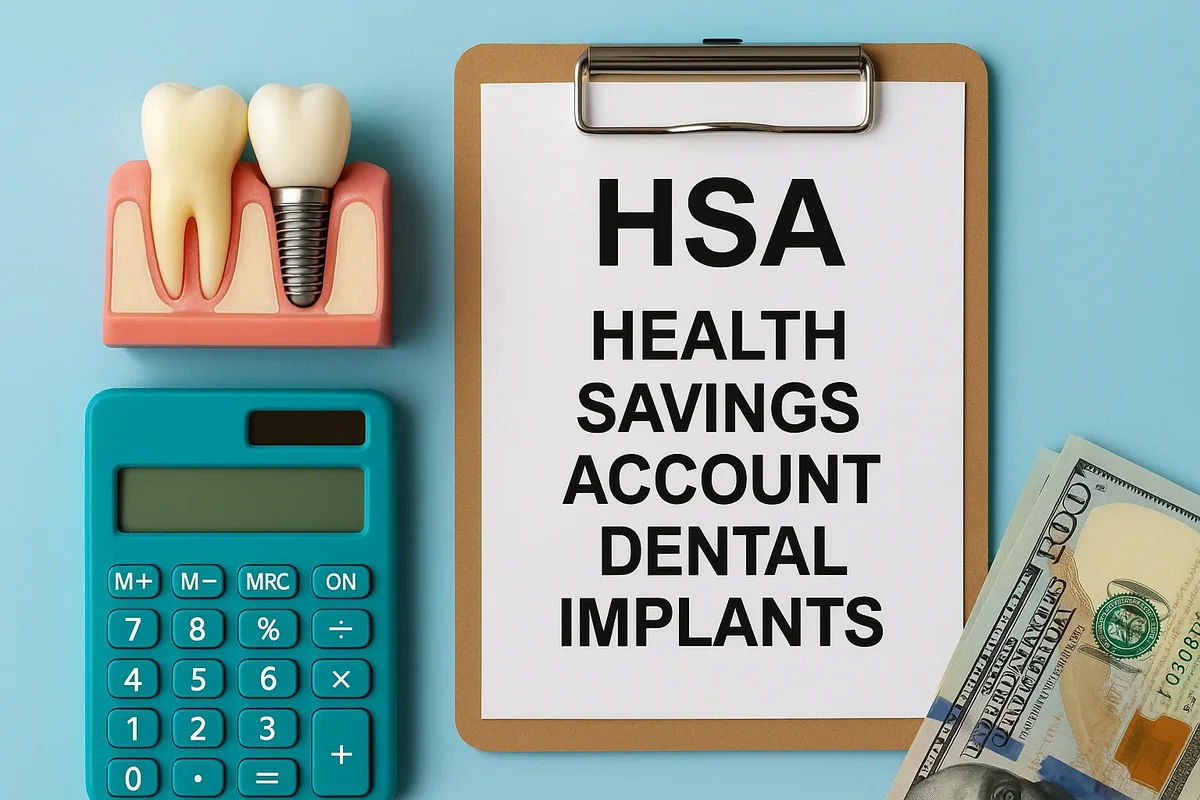
Why Using an HSA Improves Long-Term Oral Health Outcomes
Choosing a health savings account dental implants strategy does more than just lower your upfront costs—it also directly supports long-term oral health, treatment consistency, and overall wellness. When patients have structured, tax-free funds allocated for medically necessary dental care, they are far more likely to complete all phases of implant treatment, follow proper maintenance routines, and address issues before they escalate. This section explains in detail how using an HSA leads to superior oral health outcomes before, during, and long after implant placement 😊.
Dental implants are one of the most durable and health-supporting solutions in modern dentistry. They prevent bone loss, help maintain proper chewing force, preserve facial structure, and improve overall function. When you combine these medical benefits with the cost-saving structure of an HSA, you create a long-term financial and health strategy that leads to stronger, more predictable outcomes.
HSAs Encourage Early Treatment Intervention
One of the leading contributors to poor oral health outcomes is delayed treatment. Many patients postpone getting implants because of cost concerns, which often results in:
- Greater bone loss
- More complicated surgical needs
- Longer healing time
- Higher overall expenses
However, when patients use a health savings account dental implants plan, they are more financially prepared. Having dedicated tax-free funds ready encourages patients to move forward earlier—when treatment is simpler, more predictable, and more successful.
The Importance of Treating Tooth Loss Early
Bone resorption begins within months after a tooth is lost. If implants are delayed for years, the bone structure may become too weak or too thin to support implants without grafting. Using an HSA helps avoid such complications by removing financial hesitation.
HSAs Support Complete and Proper Treatment Planning
A major advantage of HSAs is that they allow patients to afford every medically necessary stage of implant treatment—not just the implant post itself. Because dental implants require precise planning, diagnostic imaging, and proper restorations, patients who have sufficient financial resources complete their treatment more thoroughly.
Better Access to High-Quality Diagnostics
- 3D CBCT scanning
- Digital impressions
- Surgical guides
All of these steps contribute to implant accuracy and long-term success. Because they fall under health savings account dental implants eligibility, patients are more likely to receive premium diagnostics that improve both aesthetics and implant longevity.
HSAs Allow Patients to Choose Higher-Quality Materials
Dental implants come in many varieties, including titanium, zirconia, and premium custom-designed crowns. Patients with financial strain may be forced to choose less durable or less natural-looking materials. HSAs eliminate that pressure by providing:
- Tax-free funds for top-quality implant fixtures
- Supportive restorations such as ceramic or zirconia crowns
- Stronger, more biocompatible abutments
These choices significantly influence long-term oral health and aesthetics. A well-funded health savings account dental implants plan gives patients the freedom to select the best available materials without sacrificing quality.
HSAs Reduce Stress and Improve Post-Surgical Recovery
Financial stress is known to impact the body’s ability to heal. Research shows that stress elevates cortisol, slows tissue regeneration, and increases inflammation. By having an HSA in place, patients reduce financial pressure, which contributes to smoother healing and better surgical outcomes.
Post-operative care improvements include:
- Better adherence to follow-up appointments
- Ability to afford recommended medications
- Greater commitment to proper oral hygiene
Patients who use a health savings account dental implants approach routinely follow post-op recommendations more consistently because the financial burden is minimized.
HSAs Promote Long-Term Implant Maintenance
Implants require regular maintenance to remain healthy, stable, and fully functional for decades. This includes routine check-ups, professional cleanings, X-rays, and, in rare cases, treatment for peri-implant inflammation.
HSAs can be used to pay for:
- Implant-specific cleanings
- Annual or biennial radiographs
- Follow-up examinations
- Prescription mouth rinses
Having tax-free funds available makes it far more likely that patients will maintain proper care. This is one of the reasons why health savings account dental implants strategies are associated with higher long-term implant survival rates.
HSAs Improve Outcomes for Full-Arch and Multi-Implant Cases
Patients undergoing full-mouth rehabilitation or multi-implant restorations often need staged procedures that span several months or even years. An HSA supports this timeline because funds can be saved, rolled over, and invested tax-free across multiple years.
Advantages for multi-phase treatment include:
- Better financial preparation for grafting
- Support for simultaneous and sequential surgery
- Longer-term budgeting for premium full-arch prosthetics
These multi-step cases often achieve better clinical outcomes when patients can afford the recommended procedures at the right time.
Greater Patient Compliance Leads to Better Clinical Results
The American Dental Association emphasizes that patient compliance is one of the strongest predictors of implant success. Because HSAs reduce cost barriers, patients are more likely to:
- Follow their treatment plan exactly as recommended
- Attend all follow-up visits
- Invest in proper oral hygiene tools
This creates ideal conditions for long-term success, ensuring the implant integrates correctly with the jawbone and remains stable for years.
HSAs Foster Better Communication With Your Dental Clinic
Patients managing their implant care with HSA funds tend to be more engaged and communicative. This leads to clearer expectations, improved appointment scheduling, and better monitoring of healing progress. Clinics like Redent Klinik actively support this communication through the Redent Klinik Contact Page, ensuring patients feel informed and prepared every step of the way.
In conclusion, using a health savings account dental implants approach significantly enhances long-term oral health outcomes. It reduces financial stress, promotes complete treatment planning, enables the use of premium materials, supports maintenance care, and encourages patient compliance. When combined with high-quality implant dentistry, an HSA becomes one of the most powerful tools for achieving stable, functional, and beautifully restored smiles that last a lifetime 🦷✨.