
One of the most common questions aspiring dental professionals ask is: how long does take to become a dentist? If you are considering a career in oral healthcare, understanding the full educational pathway is essential. Dentistry is a respected, stable, and rewarding profession, but it requires years of structured education, clinical training, and licensing before you can practice independently. 🦷✨
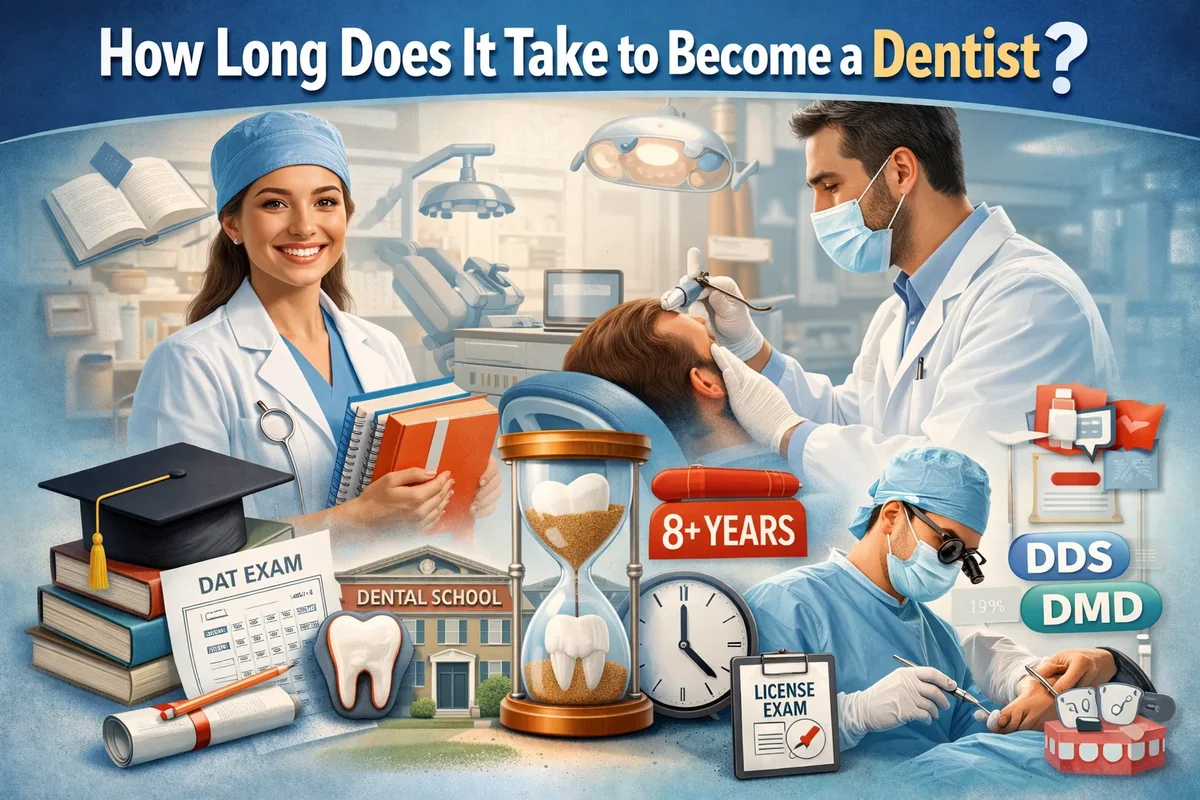
To clearly answer how long does take to become a dentist, the standard timeline in most countries, including the United States, ranges from 8 to 12 years after high school. This includes undergraduate education, dental school, and potentially additional specialization or residency training. The exact duration depends on your academic path, the country where you study, and whether you pursue advanced specialties such as orthodontics or oral surgery.
Let’s break down how long does take to become a dentist step by step. First, students typically complete a 4-year bachelor’s degree. While there is no mandatory major, most students choose biology, chemistry, or other science-related fields to fulfill dental school prerequisites. After completing undergraduate education, candidates must take entrance exams such as the DAT (Dental Admission Test) in the United States.
Next comes dental school, which usually lasts another 4 years. During this time, students earn either a DDS (Doctor of Dental Surgery) or DMD (Doctor of Dental Medicine) degree. The curriculum includes classroom instruction in anatomy, physiology, microbiology, and pathology, followed by hands-on clinical training with real patients under supervision. When evaluating how long does take to become a dentist, these eight years (4 + 4) form the foundation of general dental qualification.
However, the journey does not always end there. Many dentists choose to specialize. Specializations such as orthodontics, pediatric dentistry, endodontics, prosthodontics, or oral and maxillofacial surgery can add 2 to 6 additional years of training. Therefore, for specialists, the answer to how long does take to become a dentist may extend beyond a decade.
Another important factor in determining how long does take to become a dentist is the licensing process. After graduating from dental school, candidates must pass national and regional licensing exams. In the United States, licensing requirements are overseen by state dental boards and guided by organizations like the American Dental Association. Without passing these exams, even a graduate cannot legally practice dentistry.
Some countries offer accelerated or direct-entry dental programs that combine undergraduate and dental education into a 5- or 6-year program. In these systems, the timeline for how long does take to become a dentist may be shorter compared to the traditional U.S. pathway. However, the academic intensity remains high, and clinical competency standards are strict worldwide.
When people search for how long does take to become a dentist, they are often not only asking about years but also about commitment. Dentistry requires dedication, strong academic performance, excellent hand skills, and outstanding communication abilities. It is both a scientific and artistic profession, combining medical knowledge with precision-based procedures.
Financial investment is also part of the timeline consideration. The process of becoming a dentist involves tuition costs, exam fees, and living expenses during years of study. However, dentistry remains one of the most financially stable healthcare careers. Many graduates begin practicing immediately after obtaining their license, while others continue into residencies for career advancement.
In summary, if you are wondering how long does take to become a dentist, the realistic answer is approximately 8 years for general dentistry and up to 12 or more years for specialized fields. The timeline may seem long, but it reflects the responsibility dentists carry in protecting patients’ oral and overall health. 🏥
Understanding the full pathway helps you prepare mentally, academically, and financially. The question how long does take to become a dentist is not just about counting years—it’s about planning a long-term professional journey that leads to a respected and impactful healthcare career.
1. Understanding How Long Does Take to Become a Dentist
Before starting the journey toward a dental career, it is essential to fully understand how long does take to become a dentist and what each phase involves. Many students assume the process is straightforward, but in reality, it is a carefully structured pathway that combines academic study, laboratory training, clinical experience, and licensing examinations. If you are serious about entering the dental profession, having clarity about how long does take to become a dentist will help you set realistic expectations and long-term goals. 🦷
The Standard Educational Timeline
When analyzing how long does take to become a dentist, the most common pathway in the United States includes four years of undergraduate education followed by four years of dental school. This means a minimum of eight years after high school. During undergraduate studies, students complete prerequisite courses such as biology, chemistry, physics, and mathematics. These foundational sciences prepare them for the rigorous dental school curriculum.
Dental school itself is intensive. The first two years typically focus on biomedical sciences, dental anatomy, pathology, pharmacology, and preclinical laboratory training. The final two years shift toward hands-on clinical work with real patients under supervision. Understanding this breakdown is crucial when evaluating how long does take to become a dentist, because each academic phase builds upon the previous one.
Licensing and Examination Requirements
Another critical factor in determining how long does take to become a dentist is the licensing process. Graduation from dental school does not automatically allow someone to practice. Dentists must pass national written exams and regional clinical examinations. In the United States, professional standards are supported by organizations such as the American Dental Association. State boards require proof of competency before granting a license.
This examination phase can take several months depending on preparation time and scheduling availability. Therefore, when calculating how long does take to become a dentist, students must consider not only classroom years but also exam preparation and application processing periods.
Does Location Affect How Long It Takes?
The answer to how long does take to become a dentist may vary depending on the country. In some European and Asian countries, dentistry is offered as a direct-entry program after high school, lasting five or six years total. In these systems, students do not complete a separate bachelor’s degree before entering dental education.
However, even in countries with shorter integrated programs, academic standards remain high. Clinical competency, patient safety, and ethical responsibility are universal expectations. So while the structure may differ, the dedication required does not change. 🌍
Accelerated and Combined Programs
Some universities offer accelerated BS/DDS or BS/DMD programs that combine undergraduate and dental education into six or seven years. These programs are highly competitive and require exceptional academic performance in high school. For students accepted into these pathways, the timeline for how long does take to become a dentist may be slightly reduced, but the workload is more concentrated.
What About Specialization?
Many people asking how long does take to become a dentist are also curious about specialization. After earning a DDS or DMD degree, dentists may choose advanced fields such as orthodontics, oral surgery, endodontics, pediatric dentistry, or prosthodontics. Specialization programs typically require an additional two to six years of residency training.
For example:
- Orthodontics: 2–3 additional years
- Pediatric Dentistry: 2 years
- Oral and Maxillofacial Surgery: 4–6 years
This means that for specialists, the answer to how long does take to become a dentist can extend to 10–12 years or more. The extended training ensures expertise in complex procedures and advanced patient care.
The Commitment Beyond the Timeline
Understanding how long does take to become a dentist is not just about counting years. It is about recognizing the depth of responsibility involved. Dentists diagnose oral diseases, perform surgical procedures, restore teeth, manage pain, and improve patients’ overall health. This level of responsibility demands comprehensive education.
Additionally, dentistry requires lifelong learning. Even after completing formal education and licensing, dentists must participate in continuing education courses to maintain their credentials. Therefore, while the formal answer to how long does take to become a dentist may be eight years minimum, professional development continues throughout a dentist’s career.
Financial and Personal Planning
Another reason to carefully evaluate how long does take to become a dentist is financial planning. Dental education can be a significant investment. Tuition for dental school in the United States can range from $40,000 to $90,000 per year depending on whether the institution is public or private. Including living expenses, the total cost may exceed $300,000 over four years.
Despite the investment, dentistry offers strong earning potential and job stability. Many graduates begin practicing shortly after licensure, while others continue into residency for advanced opportunities.
In conclusion, when fully analyzing how long does take to become a dentist, the most accurate answer is approximately eight years for general practice and up to twelve or more years for specialization. The timeline reflects the complexity, skill, and dedication required to safely care for patients. By understanding each stage clearly, aspiring dentists can confidently plan their academic and professional journey. 🏥✨
2. High School Preparation for a Future in Dentistry
If you are already wondering how long does take to become a dentist while still in high school, you are thinking ahead in the right way. Although the official professional timeline begins after graduation, the preparation truly starts much earlier. High school years play a foundational role in shaping academic readiness, building discipline, and developing the scientific mindset required for dentistry. Understanding early preparation helps clarify how long does take to become a dentist and how you can position yourself for success from the very beginning. 🎓🦷
Choosing the Right High School Courses
Students interested in dentistry should focus heavily on science and mathematics. Biology, chemistry, and physics are particularly important because they form the backbone of pre-dental education. When evaluating how long does take to become a dentist, it is essential to understand that undergraduate dental prerequisites are science-intensive. A strong high school science background makes the transition smoother.
Advanced Placement (AP) or International Baccalaureate (IB) science courses can provide an advantage. These classes not only strengthen academic foundations but may also allow students to earn college credits. While this does not drastically shorten how long does take to become a dentist, it can reduce undergraduate workload and improve GPA flexibility.
Recommended High School Subjects
- Biology (especially human anatomy if available)
- Chemistry
- Physics
- Algebra and Advanced Mathematics
- English Composition and Communication
Communication skills are often overlooked, yet dentists must explain procedures clearly to patients. Therefore, public speaking and writing courses indirectly support the long journey of how long does take to become a dentist.
Developing Manual Dexterity Skills
Dentistry is not only academic—it is highly practical. Fine motor skills and hand-eye coordination are essential. Activities such as drawing, sculpting, playing musical instruments, or participating in crafts can strengthen precision skills. When people research how long does take to become a dentist, they often focus only on years of education, but manual competence is equally important for long-term success.
Dental schools evaluate applicants not just by grades, but also by their ability to perform delicate procedures. Early development of dexterity can improve performance during laboratory simulations and clinical training later in the journey of how long does take to become a dentist.
Volunteering and Shadowing Dentists
One of the best ways to understand how long does take to become a dentist is by observing practicing professionals. Many dental schools require shadowing hours as part of the application process. High school students can begin by volunteering at local clinics or asking to observe a dentist for a few days.
Shadowing provides insight into patient interaction, infection control protocols, dental equipment usage, and the daily responsibilities of a dental professional. It also helps students confirm whether they truly want to commit to the demanding pathway of how long does take to become a dentist.
Building a Competitive College Application
Because dentistry requires strong undergraduate performance, gaining admission to a reputable university is important. High GPA, strong SAT/ACT scores (where applicable), extracurricular involvement, and leadership activities all matter. While these steps do not directly change how long does take to become a dentist, they significantly influence the quality of education and future opportunities.
Understanding the Long-Term Commitment
Many high school students underestimate the dedication required when asking how long does take to become a dentist. The minimum eight-year academic path requires discipline, resilience, and financial planning. Dental education can cost between $40,000 and $90,000 per year in tuition alone in the United States, excluding living expenses.
Organizations such as the American Dental Association provide resources for aspiring dental professionals, including guidance on education standards and career planning. Reviewing these materials early can help students better understand the structure behind how long does take to become a dentist.
Academic Excellence and GPA Awareness
Dental schools are highly competitive. Maintaining strong academic performance in high school builds study habits that will be critical during college and dental school. When evaluating how long does take to become a dentist, remember that poor academic performance can delay admission, potentially extending the overall timeline.
Consistent academic excellence reduces the risk of repeating courses or needing gap years, which could lengthen how long does take to become a dentist. Early discipline often translates into smoother transitions through each educational phase.
Setting Clear Career Goals Early
Finally, high school is the ideal time to ask yourself why you want to pursue dentistry. Is it the scientific challenge? The opportunity to help patients? The financial stability? The artistic aspect of smile design? Having clarity strengthens motivation throughout the long academic journey of how long does take to become a dentist.
In summary, although high school does not officially count toward the professional training years, it lays the essential groundwork. By choosing the right courses, developing manual skills, volunteering in dental settings, and maintaining academic excellence, students prepare themselves effectively for the demanding yet rewarding pathway of how long does take to become a dentist. Early preparation does not shorten the timeline dramatically, but it makes the journey more efficient, focused, and successful. 🌟
3. Bachelor’s Degree Requirements and Timeline
After completing high school preparation, the next major milestone in understanding how long does take to become a dentist is earning a bachelor’s degree. In countries like the United States and Canada, undergraduate education is a mandatory step before entering dental school. This stage typically lasts four years and forms half of the standard eight-year pathway. When calculating how long does take to become a dentist, these undergraduate years are essential and cannot be skipped in traditional systems.
Choosing the Right Major for Dental School
Interestingly, dental schools do not require a specific major. However, most pre-dental students choose science-focused fields such as biology, chemistry, biochemistry, or biomedical sciences. These majors align closely with dental school prerequisites and make it easier to meet admission requirements. Understanding this alignment is crucial when evaluating how long does take to become a dentist, because selecting the right major can prevent delays caused by missing required coursework.
Dental schools typically require courses in:
- General Biology with laboratory
- General Chemistry with laboratory
- Organic Chemistry
- Physics
- Biochemistry
- English Composition
If students fail to complete these prerequisites on time, they may need additional semesters, which can extend how long does take to become a dentist beyond the typical eight years.
The Importance of GPA and Academic Performance
Dental school admissions are highly competitive. Maintaining a strong GPA during undergraduate studies is critical. A competitive GPA often ranges between 3.5 and 3.8 on a 4.0 scale. When students ask how long does take to become a dentist, they must also consider the possibility of gap years if their academic performance is not competitive enough for immediate admission.
Strong academic performance can prevent delays in dental school acceptance, helping keep how long does take to become a dentist within the standard timeline. On the other hand, retaking courses or postponing applications can add one or more years.
Dental Admission Test (DAT)
Another key component of the undergraduate phase is preparing for and taking the Dental Admission Test (DAT). This standardized exam evaluates academic knowledge, perceptual ability, reading comprehension, and quantitative reasoning. Preparing for the DAT often requires several months of dedicated study.
Because exam preparation takes time, it plays an indirect role in how long does take to become a dentist. Students who prepare strategically and take the exam at the right time during their junior or senior year can apply to dental school without delaying their timeline.
When Should You Take the DAT?
Most students take the DAT during the summer after their junior year of college. This timing allows them to apply to dental school at the beginning of their senior year. Proper timing ensures that how long does take to become a dentist remains aligned with the traditional progression.
Extracurricular Activities and Clinical Experience
Undergraduate years are not only about academic performance. Dental schools expect applicants to demonstrate commitment to the profession through shadowing, volunteering, and leadership activities. These experiences strengthen applications and reduce the risk of rejection, which could lengthen how long does take to become a dentist.
Shadowing licensed dentists provides firsthand exposure to patient care, clinical procedures, and ethical standards. Organizations such as the American Dental Association offer guidance on professional expectations and educational standards that aspiring dentists should understand early in their journey.
Financial Considerations During Undergraduate Study
When assessing how long does take to become a dentist, financial planning is equally important. Undergraduate tuition varies significantly depending on whether the institution is public or private. In the United States, annual tuition may range from $10,000 to $30,000 for public universities (in-state) and $30,000 to $60,000 for private institutions.
While undergraduate costs are generally lower than dental school tuition, they still represent a substantial investment. Students should consider scholarships, grants, and financial aid to minimize debt before entering dental school, where tuition can be significantly higher.
Can You Shorten the Undergraduate Timeline?
Some highly motivated students attempt to graduate in three years instead of four by taking heavier course loads or attending summer sessions. While this can technically reduce how long does take to become a dentist, it requires careful academic planning and exceptional performance. Overloading coursework can negatively affect GPA, which may ultimately delay dental school admission.
Combined BS/DDS Programs
Another option that may shorten how long does take to become a dentist is enrollment in combined BS/DDS or BS/DMD programs. These accelerated programs integrate undergraduate and dental education into six or seven years. Admission is highly competitive, often requiring outstanding high school performance. For accepted students, this pathway can reduce the overall time commitment.
Transitioning to Dental School
By the end of undergraduate education, students should have completed all prerequisites, taken the DAT, gained shadowing experience, and submitted dental school applications. Acceptance into dental school marks the halfway point in the traditional answer to how long does take to become a dentist.
In summary, the bachelor’s degree phase typically lasts four years and represents a critical foundation in the professional journey. Although it may seem lengthy, these years prepare students academically, clinically, and personally for the demanding environment of dental school. Proper planning, academic excellence, and strategic decision-making can ensure that how long does take to become a dentist stays within the expected timeline and does not extend unnecessarily. 🎓🦷
4. Dental School: Curriculum and Clinical Training
Once a student completes a bachelor’s degree, the next major stage in understanding how long does take to become a dentist is dental school itself. This phase typically lasts four years and represents the core professional training period. For most aspiring dentists, these four years are the most intensive and transformative part of the journey. When calculating how long does take to become a dentist, dental school accounts for half of the standard eight-year pathway.
Structure of the First Two Years: Foundational Sciences
The first two years of dental school focus primarily on biomedical sciences and preclinical laboratory training. Students study subjects such as anatomy, physiology, microbiology, pathology, pharmacology, dental materials, and oral biology. These courses build upon undergraduate science knowledge but go much deeper into oral and craniofacial systems.
Understanding this academic intensity is essential when evaluating how long does take to become a dentist, because dental school is not simply an extension of college—it is professional medical education. Students must master detailed knowledge of head and neck anatomy, disease processes, infection control, and patient safety protocols.
Preclinical Simulation Labs
In addition to classroom learning, students spend many hours in simulation laboratories. Here, they practice drilling, filling, crown preparation, and impression techniques on mannequins before treating real patients. These simulation exercises ensure students develop precision and confidence before entering clinical environments.
This structured progression is one reason how long does take to become a dentist cannot be shortened easily. Clinical competence requires repetition, supervision, and evaluation over time.
The Final Two Years: Clinical Patient Care
The third and fourth years of dental school shift toward hands-on patient care. Under faculty supervision, students diagnose oral diseases, perform restorations, extract teeth, conduct root canal treatments, and provide preventive care. Clinical training is rigorous because students are responsible for real patients under controlled settings.
Many individuals asking how long does take to become a dentist are surprised by the volume of clinical hours required. Dental schools mandate hundreds of completed procedures to ensure competency. These experiences are carefully tracked and evaluated before graduation is granted.
Interdisciplinary Training
Modern dental education also includes interdisciplinary exposure. Students may rotate through departments such as oral surgery, pediatric dentistry, prosthodontics, and periodontics. This comprehensive exposure ensures that graduates are prepared for general practice.
Because patient safety is the highest priority, educational standards remain strict. This explains why how long does take to become a dentist remains consistent across accredited institutions.
Degrees Awarded: DDS vs. DMD
Upon completion of dental school, graduates receive either a Doctor of Dental Surgery (DDS) or Doctor of Dental Medicine (DMD) degree. There is no difference in curriculum quality between the two; the distinction is historical and institutional. Both degrees qualify graduates to pursue licensure.
Therefore, when evaluating how long does take to become a dentist, the degree title does not affect the timeline—both pathways require four years of dental school education.
Academic Demands and Workload
Dental school schedules are demanding. Students often attend lectures during the morning and spend afternoons in clinics or laboratories. Study hours extend into evenings and weekends. Exams are frequent, and practical evaluations require high levels of accuracy.
This demanding schedule explains why how long does take to become a dentist cannot realistically be compressed into fewer years without compromising educational quality. Dentistry combines medical knowledge with technical skill, and both require time to develop.
Tuition and Financial Investment
When analyzing how long does take to become a dentist, financial considerations are equally important. Dental school tuition in the United States typically ranges between $40,000 and $90,000 per year depending on whether the institution is public or private. Including living expenses, equipment, and exam fees, total costs may exceed $300,000 to $400,000 over four years.
Although this represents a significant investment, dentistry remains one of the most stable and financially rewarding healthcare professions. Careful financial planning ensures that the timeline of how long does take to become a dentist remains financially manageable.
Preparation for Licensure
During the final year of dental school, students prepare for national board examinations and regional clinical licensing exams. Professional standards are guided by organizations such as the American Dental Association. Passing these exams is mandatory before practicing independently.
This licensing preparation phase is the final step in the formal educational answer to how long does take to become a dentist. After successful graduation and licensure, a dentist can begin practicing general dentistry.
The Emotional and Professional Growth
Beyond academics and clinical skills, dental school fosters professional maturity. Students learn ethical decision-making, patient communication, pain management, and treatment planning. These skills are critical because dentists carry significant responsibility for patient health.
In summary, dental school represents the professional heart of the journey in understanding how long does take to become a dentist. The four-year program combines science, clinical training, patient management, and licensing preparation. While demanding, this stage transforms students into competent healthcare professionals ready to serve their communities. 🏥🦷
5. Licensing Exams and Certification Process
After completing dental school, the next critical step in understanding how long does take to become a dentist is the licensing and certification process. Many students assume graduation automatically allows them to begin practicing, but this is not the case. Licensure ensures that every dentist meets national and regional standards of competency, safety, and ethical responsibility. When calculating how long does take to become a dentist, it is essential to include the time required for examinations, applications, and board approvals. 📝🦷
National Board Dental Examinations
In the United States, dental graduates must pass the Integrated National Board Dental Examination (INBDE). This written exam evaluates clinical knowledge, diagnostic ability, treatment planning skills, and understanding of patient management. Preparing for this examination often requires several months of dedicated study.
Because exam preparation occurs during the final year of dental school or shortly after graduation, it directly affects how long does take to become a dentist. Students who plan efficiently can complete this phase without delaying their entry into practice. However, if a candidate needs to retake the exam, the timeline of how long does take to become a dentist may extend.
What Does the Written Exam Cover?
- Oral pathology and radiology
- Pharmacology and anesthesia
- Periodontology and prosthodontics
- Endodontics and restorative dentistry
- Patient safety and infection control
The comprehensive nature of this exam reflects why how long does take to become a dentist includes years of preparation—dentists must demonstrate mastery across multiple disciplines.
Regional or Clinical Licensing Exams
In addition to national written examinations, candidates must pass a regional or state clinical licensing exam. These practical exams test hands-on skills in procedures such as restorations, extractions, periodontal scaling, and treatment planning.
The scheduling of these exams can vary by region, and waiting periods may affect how long does take to become a dentist. Some states accept alternative assessment pathways, such as portfolio-based evaluations or residency completion instead of traditional live-patient exams.
State-Specific Requirements
Each state in the U.S. sets its own licensing criteria. While national standards are guided by organizations such as the American Dental Association, state dental boards finalize licensure approvals. Some states may require additional jurisprudence exams covering dental laws and regulations.
Therefore, when evaluating how long does take to become a dentist, applicants must review their intended practice location’s requirements carefully to avoid unexpected delays.
Application Processing and Background Checks
Beyond examinations, candidates must submit official transcripts, proof of graduation, exam scores, and background checks. Processing times vary, often ranging from several weeks to a few months. Although this administrative phase may seem minor, it contributes to the overall answer to how long does take to become a dentist.
Applicants who submit incomplete documentation may face delays, potentially extending how long does take to become a dentist beyond the standard timeline.
Optional Residency vs. Immediate Practice
Some states require completion of a one-year residency program (often called a General Practice Residency or Advanced Education in General Dentistry) before granting full licensure. In such cases, the minimum answer to how long does take to become a dentist increases by at least one additional year.
Even in states where residency is optional, many graduates choose this path to gain additional clinical confidence. This decision does not change the core eight-year academic pathway but can extend the practical answer to how long does take to become a dentist to nine years.
International Licensing Considerations
For internationally trained dentists seeking to practice in another country, the licensing process can significantly extend how long does take to become a dentist. Many countries require foreign-trained professionals to complete advanced standing programs, equivalency exams, or additional years of accredited dental education.
For example, in the United States, internationally trained dentists may need to complete a two- or three-year advanced standing DDS/DMD program before qualifying for licensure exams. This requirement can substantially increase how long does take to become a dentist for international applicants.
Maintaining Licensure Through Continuing Education
Even after obtaining a license, dentists must complete continuing education (CE) courses to maintain their credentials. While this does not directly change how long does take to become a dentist, it highlights that professional development continues throughout a dentist’s career.
Why Continuing Education Matters
Dental technology evolves rapidly. Advances in digital dentistry, implantology, cosmetic procedures, and infection control protocols require ongoing training. Continuous learning ensures dentists remain competent and compliant with evolving regulations.
Therefore, although the formal educational pathway answers how long does take to become a dentist with approximately eight years (excluding specialization), professional education truly lasts a lifetime.
Final Timeline Overview
To summarize, the licensing and certification phase is the final step before independent practice. National board exams, clinical exams, state requirements, and application processing collectively influence how long does take to become a dentist. For most graduates, this phase adds several months beyond dental school, bringing the total timeline to roughly eight years for general dentistry.
Understanding these requirements ensures that aspiring professionals can plan effectively, avoid unnecessary delays, and confidently complete the journey of how long does take to become a dentist. The licensing process safeguards patient safety and upholds the high standards expected in the dental profession. 🏥✨
6. Specialization: Does It Extend the Timeline?
For many dental graduates, earning a DDS or DMD degree is only the beginning. If you are exploring how long does take to become a dentist, you must also consider whether you plan to specialize. Specialization significantly extends the educational pathway beyond general dentistry. While the standard answer to how long does take to become a dentist is approximately eight years after high school, pursuing a specialty can increase that timeline to 10, 12, or even more years depending on the field. 🦷📚
What Is a Dental Specialization?
Dental specialization involves advanced training in a focused area of oral healthcare. After completing dental school and obtaining licensure, dentists may apply for competitive residency programs in specialized fields. These programs provide in-depth clinical experience and advanced theoretical education.
When calculating how long does take to become a dentist, specialization must be included if your career goal involves advanced procedures beyond general practice. Specialists often handle more complex cases, requiring additional expertise and training.
Common Dental Specialties and Their Duration
Different specialties require different lengths of training. Below are some common options and how they influence how long does take to become a dentist:
Orthodontics (2–3 Years)
Orthodontists focus on correcting misaligned teeth and jaw structures using braces, aligners, and other corrective appliances. After dental school, orthodontic residency programs typically last two to three years. This extends how long does take to become a dentist from eight years to approximately ten or eleven years.
Pediatric Dentistry (2 Years)
Pediatric dentists specialize in treating infants, children, and adolescents. Their residency programs generally last two years. With this specialization, how long does take to become a dentist increases to about ten years.
Endodontics (2–3 Years)
Endodontists focus on root canal treatments and complex pulp therapies. These programs add two to three years of advanced clinical training, again extending how long does take to become a dentist beyond the standard timeline.
Prosthodontics (3 Years)
Prosthodontists specialize in restoring and replacing missing teeth using crowns, bridges, dentures, and implants. Training usually lasts three additional years. Therefore, the answer to how long does take to become a dentist may reach eleven years for this specialty.
Oral and Maxillofacial Surgery (4–6 Years)
This is one of the longest and most intensive specialties. Oral surgeons perform complex surgical procedures involving the jaw, face, and oral structures. Some programs include a medical degree (MD) component, extending residency to six years. In such cases, how long does take to become a dentist may reach twelve to fourteen years in total.
Why Specialization Takes Extra Time
Specialized training requires mastery of advanced procedures, complex treatment planning, and management of medically compromised patients. This additional responsibility explains why how long does take to become a dentist increases significantly with specialization.
Residents often work long clinical hours in hospitals or academic institutions, managing surgical cases or advanced restorative treatments under supervision. This structured mentorship ensures patient safety and professional competence.
Competitive Admission Process
Specialty programs are highly competitive. Applicants must demonstrate strong academic performance in dental school, excellent clinical skills, research involvement, and strong letters of recommendation. The application process itself may take several months, which can slightly influence how long does take to become a dentist.
Some candidates may apply more than once before gaining acceptance, potentially extending how long does take to become a dentist further if there are delays in admission.
Financial Considerations of Specialization
When evaluating how long does take to become a dentist, financial planning becomes even more critical during specialization. Some residency programs offer stipends, particularly hospital-based programs like oral surgery. However, others require tuition payments similar to dental school.
For example, specialty tuition can range from $20,000 to $60,000 per year depending on the institution. Including living expenses, additional years of training may increase total educational investment substantially.
Is Specialization Worth the Extra Time?
The decision to specialize depends on career goals, personal interests, and lifestyle preferences. Specialists often earn higher average incomes compared to general dentists, particularly in fields like orthodontics and oral surgery. However, the extended timeline of how long does take to become a dentist must be carefully considered before committing to advanced training.
Additionally, specialization may offer greater professional satisfaction for those passionate about complex procedures or niche patient populations. While it lengthens how long does take to become a dentist, it also enhances expertise and career opportunities.
Impact on Career Flexibility
General dentists can perform a wide variety of treatments and may refer complex cases to specialists. Specialists, on the other hand, limit their practice to specific procedures. This narrower focus often requires deeper training, explaining again why how long does take to become a dentist increases with specialization.
Final Considerations
In summary, specialization unquestionably extends the timeline when analyzing how long does take to become a dentist. While general dentistry requires approximately eight years of education after high school, adding a specialty can extend the journey to ten, twelve, or more years depending on the chosen field.
Understanding these additional years allows aspiring dental professionals to make informed decisions about their future. Specialization demands dedication, advanced clinical skills, and additional financial investment, but it also offers expanded expertise and career potential. Ultimately, the true answer to how long does take to become a dentist depends not only on the basic educational pathway but also on the level of specialization you choose to pursue. 🏥✨
7. Residency Programs and Advanced Training
After completing dental school and passing licensing exams, some graduates choose to pursue residency programs for additional clinical experience. If you are carefully analyzing how long does take to become a dentist, residency training is an important factor that can extend the overall timeline. While general dentistry typically requires about eight years of education after high school, residency programs may add one to several additional years depending on the type of training selected. 🏥🦷
What Is a General Practice Residency (GPR)?
A General Practice Residency (GPR) is a hospital-based program that usually lasts one year. It focuses on advanced clinical experience, particularly in treating medically complex patients. Dentists in GPR programs often manage emergency cases, perform surgical extractions, and treat patients under general anesthesia.
When calculating how long does take to become a dentist, a one-year GPR increases the timeline to approximately nine years. Although not always mandatory, some states require residency completion for licensure. Even when optional, many dentists choose GPR programs to build confidence before entering private practice.
Benefits of a GPR Program
- Hospital-based clinical exposure
- Experience treating high-risk patients
- Advanced anesthesia training
- Emergency case management
These benefits strengthen a dentist’s skills and may improve long-term career opportunities, even though they extend how long does take to become a dentist by an additional year.
Advanced Education in General Dentistry (AEGD)
Another common option is the Advanced Education in General Dentistry (AEGD) program. Like GPR, AEGD programs usually last one year but are more focused on comprehensive restorative and cosmetic dentistry rather than hospital-based care.
For graduates asking how long does take to become a dentist, completing an AEGD means adding one extra year of structured mentorship and clinical refinement. Dentists often gain experience in implant placement, complex crown and bridge procedures, and full-mouth rehabilitation.
GPR vs. AEGD: Key Differences
Although both programs extend how long does take to become a dentist, they differ in focus:
- GPR: Hospital setting, medically complex patients
- AEGD: Outpatient clinics, advanced restorative procedures
Choosing between these programs depends on career goals and preferred clinical environments.
Specialty Residencies vs. General Residencies
It is important not to confuse general residency programs with specialty residencies. Specialty programs, such as orthodontics or oral surgery, extend how long does take to become a dentist by two to six years. In contrast, GPR and AEGD programs typically add only one year.
However, both types of residency demonstrate commitment to professional growth. Employers and patients often value dentists who have completed additional structured training.
Financial Considerations of Residency Training
When evaluating how long does take to become a dentist, financial planning plays a significant role. Many GPR programs provide modest stipends ranging from $50,000 to $65,000 per year. This income helps offset living expenses during residency.
AEGD programs may or may not offer stipends depending on the institution. Specialty residencies often have tuition costs, especially university-based programs. These financial realities can influence whether extending how long does take to become a dentist through residency is feasible for each individual.
Clinical Confidence and Skill Development
One major reason dentists pursue residency training is to increase clinical confidence. Dental school provides essential experience, but residency allows for more complex case management under supervision. This additional exposure can make the transition into independent practice smoother.
Although residency adds time to how long does take to become a dentist, it may reduce stress during the first years of professional practice. Dentists who feel well-prepared are often more comfortable handling challenging procedures.
Impact on Career Opportunities
Completing a residency program can open doors to hospital privileges, academic positions, or specialized clinical roles. Some corporate dental groups prefer hiring candidates with residency experience. Therefore, even though residency extends how long does take to become a dentist, it may enhance long-term earning potential and career flexibility.
Professional standards and educational pathways are supported by organizations such as the American Dental Association, which helps maintain consistency in training and accreditation requirements.
Is Residency Mandatory?
In most U.S. states, residency is optional for general dentists, although a few states require it as an alternative to live-patient clinical exams. Internationally, requirements vary widely. Therefore, when determining how long does take to become a dentist, you must consider the licensing regulations of the region where you plan to practice.
Final Timeline Overview
To summarize, residency programs represent an optional but valuable extension of the professional journey. A one-year GPR or AEGD increases how long does take to become a dentist from eight to approximately nine years. Specialty residencies can extend the timeline even further.
Ultimately, the decision depends on career goals, financial readiness, and desired clinical expertise. While residency adds time, it also enhances skills, confidence, and professional credibility. Understanding how residency impacts how long does take to become a dentist allows aspiring dentists to plan strategically and make informed choices about their future. 🌟
8. Costs and Financial Planning for Dental Education
When evaluating how long does take to become a dentist, time is only one part of the equation. Financial planning is equally important. The journey to becoming a dentist requires a significant investment in education, examinations, clinical training, and living expenses. Understanding the financial structure behind how long does take to become a dentist allows students to prepare strategically and avoid unexpected economic stress during their academic years. 💰🦷
Undergraduate Education Costs
The first major financial step in calculating how long does take to become a dentist is completing a bachelor’s degree. In the United States, tuition for public universities ranges from approximately $10,000 to $30,000 per year for in-state students. Private universities may charge between $30,000 and $60,000 annually.
Because undergraduate education typically lasts four years, total tuition costs can range from $40,000 to over $200,000 depending on the institution. These figures directly connect to how long does take to become a dentist, since extending undergraduate years or repeating courses increases total expenses.
Additional Undergraduate Expenses
- Housing and living expenses ($10,000–$20,000 per year)
- Books and laboratory materials ($1,000–$2,000 annually)
- DAT preparation courses ($500–$2,000)
- DAT exam fee (approximately $525)
Careful financial planning during undergraduate years helps keep how long does take to become a dentist manageable without excessive debt accumulation.
Dental School Tuition and Fees
The most significant financial component of how long does take to become a dentist is dental school tuition. Public dental schools typically charge between $40,000 and $70,000 per year for in-state students. Private dental schools may range from $70,000 to $90,000 annually.
Over four years, tuition alone can total between $160,000 and $360,000. When adding living expenses, equipment, instrument kits, licensing exams, and insurance, total dental school costs may exceed $400,000.
Breakdown of Dental School Costs
- Tuition: $40,000–$90,000 per year
- Dental equipment and instruments: $5,000–$15,000 total
- Board examination fees: $1,000–$3,000
- Clinical supplies and lab fees: Variable by school
These figures illustrate that while how long does take to become a dentist may be eight years academically, the financial impact extends well beyond graduation.
Residency and Specialization Costs
If a dentist chooses specialization, the answer to how long does take to become a dentist extends both in time and financial commitment. Some residency programs offer stipends between $50,000 and $65,000 annually, particularly hospital-based programs. However, many specialty programs require tuition payments ranging from $20,000 to $60,000 per year.
Therefore, specialization not only extends how long does take to become a dentist but also increases the overall educational investment.
Student Loans and Repayment
Most dental students rely on federal or private student loans to finance their education. Loan repayment typically begins after graduation or residency completion. Because how long does take to become a dentist involves many years of study, interest may accumulate significantly during that time.
Federal loan programs may offer income-driven repayment plans, loan forgiveness options, or refinancing opportunities. Understanding these financial tools is essential when planning for how long does take to become a dentist.
Average Debt at Graduation
According to professional reports, average dental school debt in the United States often ranges between $250,000 and $350,000. This substantial amount emphasizes why financial planning is as important as understanding how long does take to become a dentist.
Scholarships and Financial Aid Opportunities
Scholarships, grants, and service-based programs can reduce the financial burden. Some government or military scholarship programs cover tuition in exchange for service commitments after graduation. These options may not shorten how long does take to become a dentist, but they can significantly reduce debt.
Professional organizations, including the American Dental Association, provide resources and guidance regarding educational standards and financial planning opportunities.
Return on Investment (ROI)
Despite the high cost, dentistry remains one of the most financially stable healthcare careers. General dentists in the United States often earn average annual incomes ranging from $150,000 to $200,000, while specialists may earn significantly more depending on location and expertise.
This earning potential offsets the financial investment associated with how long does take to become a dentist. However, income varies based on geographic region, patient base, and type of practice.
Long-Term Financial Planning
Understanding how long does take to become a dentist helps prospective students create realistic financial plans. Budgeting during school, minimizing unnecessary expenses, and seeking financial counseling can prevent overwhelming debt.
Additionally, new dentists should plan for practice startup costs if they intend to open a private clinic. Equipment, office space, staff salaries, and marketing expenses can add significant initial investments beyond the educational timeline of how long does take to become a dentist.
Conclusion
In summary, the financial dimension of how long does take to become a dentist is substantial and requires careful preparation. Undergraduate education, dental school tuition, examination fees, and potential residency costs collectively create a significant investment. However, dentistry offers strong long-term earning potential and professional stability.
By understanding both the time commitment and financial obligations associated with how long does take to become a dentist, aspiring professionals can make informed decisions, minimize risk, and confidently pursue a rewarding career in oral healthcare. 🌟
9. Career Outlook After Completing Dental Education
After fully understanding how long does take to become a dentist, the next logical question is: what happens after graduation, licensure, and possibly residency? The career outlook for dentists is generally strong, stable, and financially rewarding. However, long-term success depends on clinical skills, communication ability, business knowledge, and continuous professional development. While the academic answer to how long does take to become a dentist may be eight to twelve years, the professional journey continues throughout an entire career. 🦷✨
Employment Opportunities for New Dentists
Once a dentist completes the required education and licensing steps involved in how long does take to become a dentist, several career paths become available. Graduates can work in private practices, group practices, corporate dental organizations, hospitals, academic institutions, or public health clinics.
Many new dentists begin as associates in established clinics to gain practical experience before opening their own practices. This phase allows them to refine treatment planning skills, build patient communication confidence, and understand business operations. Even though how long does take to become a dentist focuses on education, real-world learning continues during early employment years.
Opening a Private Practice
Some dentists choose to open their own clinics shortly after completing the educational pathway of how long does take to become a dentist. Practice ownership offers autonomy, higher income potential, and long-term asset growth. However, it also requires strong management skills and financial investment.
Startup Costs for a Dental Clinic
- Office lease or purchase
- Dental equipment and chairs ($100,000–$250,000)
- Digital imaging systems
- Staff salaries
- Marketing and branding expenses
These investments demonstrate that while how long does take to become a dentist measures academic years, financial planning extends into the professional phase as well.
Income Expectations and Growth Potential
Income levels vary depending on geographic location, specialization, and type of practice. In the United States, general dentists typically earn between $150,000 and $200,000 annually. Specialists such as orthodontists and oral surgeons often earn significantly more.
Although the pathway of how long does take to become a dentist requires many years of education, dentistry offers strong return on investment. Earnings often increase with experience, patient base expansion, and advanced procedural expertise.
Work-Life Balance in Dentistry
Another factor influencing career satisfaction after completing how long does take to become a dentist is work-life balance. Dentistry generally offers predictable working hours compared to many medical specialties. Most dentists work 4–5 days per week, allowing flexibility for personal life.
However, early career dentists may work longer hours while building patient bases or repaying student loans. As experience grows, many dentists achieve balanced schedules that align with personal and professional goals.
Continuing Education and Skill Advancement
The completion of how long does take to become a dentist does not mark the end of learning. Dentists are required to complete continuing education (CE) courses to maintain licensure. These courses cover topics such as implantology, cosmetic dentistry, digital workflows, and infection control.
Professional organizations such as the American Dental Association provide guidelines, educational programs, and resources to support ongoing development. Continuous learning ensures that dentists remain competitive and up to date with evolving technologies.
Advanced Certifications
Some dentists pursue certifications in implant placement, Invisalign treatment, or sedation dentistry. These additional qualifications enhance service offerings and may increase income potential without significantly extending how long does take to become a dentist.
Public Health and Academic Careers
Not all dentists enter private practice. Some choose careers in research, teaching, or public health policy. Academic dentists often work at universities, training future dental professionals. Public health dentists focus on community-based oral health initiatives.
Although these pathways may require additional degrees such as a Master of Public Health (MPH), they diversify career opportunities after completing how long does take to become a dentist.
Global Career Mobility
Dentistry can also provide international opportunities. Some dentists choose to work abroad or participate in humanitarian missions. However, international practice may require additional licensing exams depending on the country. Therefore, the timeline of how long does take to become a dentist can vary if relocation is part of the career plan.
Job Market Stability
The demand for dental services remains steady due to population growth, aging demographics, and increasing awareness of oral health’s connection to overall well-being. Preventive care, cosmetic dentistry, and implant treatments continue to expand globally.
This consistent demand reinforces the value of investing years in how long does take to become a dentist. The profession offers both stability and growth potential.
Long-Term Career Satisfaction
Dentistry combines healthcare, artistry, science, and patient interaction. Many professionals find fulfillment in improving patients’ confidence and oral health. The years invested in how long does take to become a dentist often lead to a respected and impactful career.
For individuals seeking both professional independence and meaningful patient relationships, dentistry remains an attractive option. Although the academic journey requires dedication, the long-term benefits can be substantial.
In conclusion, after completing the educational pathway behind how long does take to become a dentist, graduates enter a profession with strong earning potential, career flexibility, and long-term stability. Whether choosing private practice, specialization, academia, or public health, dentistry offers diverse opportunities for growth and fulfillment. 🌟🦷