
If you’re considering a career in dentistry, one of the first and most important questions you will ask is: how long it take to become a dentist? 🦷 This is a completely valid concern because becoming a dentist requires years of education, clinical training, and licensing before you can legally practice. Understanding the full timeline helps you plan financially, academically, and professionally.
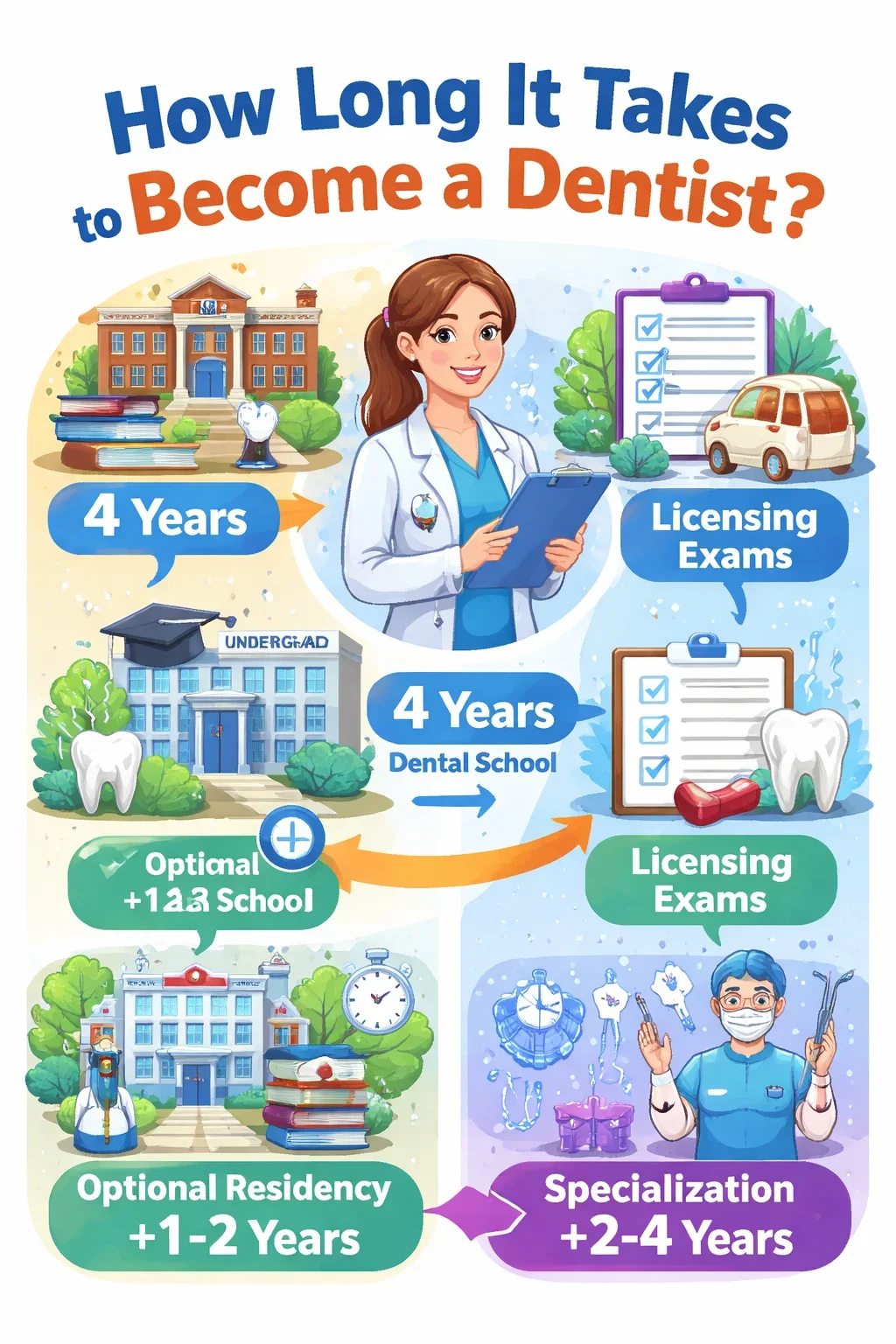
In simple terms, how long it take to become a dentist depends on your country, educational path, and whether you pursue specialization. However, in most cases—especially in the United States—it typically takes around 8 years after high school. This includes 4 years of undergraduate education followed by 4 years of dental school. If you decide to specialize, the answer to how long it take to become a dentist becomes longer, sometimes extending to 10–12 years in total.
Let’s break it down clearly. The first phase involves completing a bachelor’s degree, usually with a focus on science courses such as biology, chemistry, and physics. These foundational years are essential because dental schools require strong academic preparation. During this time, students also prepare for entrance exams such as the Dental Admission Test (DAT). So when calculating how long it take to become a dentist, you must count these 4 undergraduate years as mandatory.
The second major phase is dental school itself. Dental school generally lasts 4 years. During the first two years, students focus heavily on classroom learning, anatomy, physiology, oral biology, and laboratory practice. The last two years are more clinically oriented, meaning students treat patients under supervision. This hands-on training is crucial for developing practical skills. Therefore, if someone asks how long it take to become a dentist, the most common answer is 4 years of college plus 4 years of dental school.
But the timeline does not always stop there. After graduating, dentists must pass national and regional licensing exams. In the United States, this includes written board exams and clinical examinations. Only after successfully completing these steps can a graduate officially practice dentistry. So realistically, when evaluating how long it take to become a dentist, you should include exam preparation time as well.
Some students choose to enhance their qualifications further. Specializations such as orthodontics, oral and maxillofacial surgery, pediatric dentistry, or periodontics require additional training. These residency programs may add 2 to 6 more years. For example, orthodontics usually requires 2–3 additional years, while oral surgery may require up to 6 years of hospital-based training. In such cases, the answer to how long it take to become a dentist becomes significantly longer than the standard 8-year pathway.
It’s also important to understand that the journey is academically demanding. Students must maintain high grades, demonstrate strong manual dexterity, and develop excellent communication skills. Dentistry combines science, healthcare, and artistry. So when people wonder how long it take to become a dentist, they should also consider the intensity and dedication required during those years.
Financial planning is another key factor. According to estimates from the American Dental Association, the average annual tuition for dental school in the U.S. ranges between $40,000 and $90,000 depending on whether the school is public or private. Over four years, this may total between $160,000 and $360,000 in tuition alone, excluding living expenses. This financial investment is part of the overall timeline discussion when evaluating how long it take to become a dentist.
Globally, the timeline can vary. In some European countries, dental programs begin directly after high school and last 5 to 6 years without requiring a separate bachelor’s degree. In those systems, the answer to how long it take to become a dentist may be slightly shorter in terms of total years, but the program itself is intensive and comprehensive.
Ultimately, if you are passionate about oral health and patient care, the years of study are a worthwhile investment. Dentistry offers strong job stability, high earning potential, and the opportunity to improve patients’ confidence and quality of life. 😊 If you are exploring dental education options or seeking professional guidance, you can always reach out through the Redent Klinik Contact Page for more personalized information.
So, to summarize clearly: when asking how long it take to become a dentist, the standard path is about 8 years after high school, with additional years required for specialization. The exact timeline depends on your goals, country, and educational choices—but dedication and planning make the journey achievable and rewarding.
1. Understanding How Long It Take to Become a Dentist from Start to Finish
When students begin exploring careers in healthcare, one of the most common and practical questions they ask is how long it take to become a dentist. This question is not only about counting years—it’s about understanding the full educational journey, the milestones involved, and the commitment required from the first day of preparation to independent clinical practice. 🦷
To truly understand how long it take to become a dentist, you must look at the process step by step. Dentistry is a regulated healthcare profession, meaning it requires structured academic education, clinical training, and licensing. In most countries, especially in the United States, the total timeline averages around eight years after high school. However, the full answer to how long it take to become a dentist may extend beyond that depending on specialization and career goals.
The Standard 8-Year Educational Path
For most students in the U.S., the journey begins with a four-year undergraduate degree. During these years, students typically major in biology, chemistry, or another science-related field. While dental schools do not always require a specific major, they do require prerequisite science courses. Therefore, when calculating how long it take to become a dentist, the first four years are dedicated to building a strong scientific foundation.
After completing a bachelor’s degree, students must attend dental school, which usually lasts another four years. The first two years focus on theoretical knowledge and laboratory training. Students study anatomy, oral pathology, pharmacology, and dental materials. The final two years emphasize hands-on patient care under supervision. When someone asks how long it take to become a dentist, this 4+4 structure is the most common answer.
What Happens During Dental School?
Dental school is intensive. Students transition from textbooks to treating real patients. They learn procedures such as fillings, crowns, root canal treatments, and preventive care. These years are crucial because dentistry is both technical and clinical. Understanding how long it take to become a dentist also means understanding the depth of training required to ensure patient safety and high-quality care.
Licensing: The Final Mandatory Step
Even after finishing dental school, graduates are not immediately allowed to practice independently. They must pass national board examinations and clinical licensing exams. In the United States, these exams test both theoretical knowledge and clinical competence. Therefore, when analyzing how long it take to become a dentist, it’s important to include the preparation time for these exams.
Without passing these licensing requirements, a graduate cannot legally treat patients. This ensures public safety and maintains professional standards. The timeline from high school graduation to receiving a dental license typically spans eight years, but exam preparation may add several additional months.
Does Specialization Change the Timeline?
Many aspiring dentists choose to specialize. Specialties such as orthodontics, pediatric dentistry, endodontics, or oral surgery require advanced training programs that range from two to six additional years. In these cases, the answer to how long it take to become a dentist becomes longer—sometimes extending to 10–12 years in total.
Common Dental Specialties and Extra Years
- Orthodontics: 2–3 additional years
- Pediatric Dentistry: 2 additional years
- Endodontics: 2–3 additional years
- Oral and Maxillofacial Surgery: 4–6 additional years
So if you are aiming for a specialized career, you must factor this into your calculation of how long it take to become a dentist.
International Differences in the Timeline
The answer to how long it take to become a dentist may vary internationally. In many European countries, students enter dental programs directly after high school. These integrated programs usually last five to six years. While the total time may appear shorter, the curriculum is equally demanding and combines undergraduate and professional training into one continuous program.
In countries such as the United Kingdom or Germany, dental degrees often last five years, followed by foundation training. In Canada and Australia, the system closely resembles the U.S. model. Therefore, understanding how long it take to become a dentist requires looking at the specific educational structure of each country.
Beyond Education: Continuous Professional Development
Even after completing formal training, dentists must continue learning. Dentistry evolves rapidly with new technologies, digital imaging systems, laser treatments, and implant innovations. Professional organizations such as the American Dental Association emphasize ongoing education to maintain licensure and clinical excellence.
So while the structured educational path may take around eight years, professional development continues throughout a dentist’s career. This long-term commitment is part of the broader understanding of how long it take to become a dentist in both formal and practical terms.
If you are seriously considering this path and would like professional guidance about dental careers or treatment options, you can reach out via the Redent Klinik Contact Page for more information.
In summary, when evaluating how long it take to become a dentist, the standard answer is approximately eight years after high school, with additional years for specialization. However, the real journey involves academic rigor, clinical training, licensing, and lifelong learning. Dentistry is not only a profession—it is a long-term commitment to healthcare excellence and patient well-being. 😊
2. High School Preparation: The First Step in How Long It Take to Become a Dentist
When students begin asking how long it take to become a dentist, they often focus on college and dental school. However, the journey actually starts much earlier—during high school. While high school is not formally counted in the professional timeline, the preparation you complete during these years directly influences how smoothly you progress through the later stages. If you truly want to understand how long it take to become a dentist, you must begin with early academic planning. 🦷
High school is the foundation that shapes your readiness for university-level science courses. Strong performance in math and science significantly affects college admission opportunities. Therefore, even though the official path to answering how long it take to become a dentist usually begins after graduation, the groundwork starts here.
Choosing the Right High School Courses
Students who are serious about dentistry should prioritize science-heavy coursework. Biology, chemistry, and physics are especially important. Advanced Placement (AP) or International Baccalaureate (IB) courses can provide early exposure to university-level material. When calculating how long it take to become a dentist, being academically prepared can prevent delays later in college.
Recommended Subjects for Future Dentists
- Biology: Essential for understanding human anatomy and oral health.
- Chemistry: Critical for biochemistry and dental materials science.
- Physics: Important for understanding radiology and dental technology.
- Mathematics: Builds analytical and problem-solving skills.
- English: Enhances communication skills with future patients.
Strong academic performance in these areas ensures a smoother transition into pre-dental university programs. If students struggle early, it may indirectly extend how long it take to become a dentist because they may need remedial coursework later.
Developing Manual Dexterity Early
Dentistry is a hands-on profession requiring precise motor skills. High school students can begin developing manual dexterity through hobbies such as drawing, sculpting, playing musical instruments, or crafting. These activities strengthen fine motor coordination, which is essential in dental procedures.
Although manual skill development does not directly change how long it take to become a dentist, it can improve performance during dental school clinical training. Students with strong hand-eye coordination often adapt faster to practical procedures.
Volunteering and Shadowing Dentists
One of the most valuable steps during high school is gaining exposure to the profession. Shadowing a practicing dentist allows students to observe real patient care and understand daily responsibilities. This early experience helps confirm whether dentistry is truly the right career choice.
Why is this important when considering how long it take to become a dentist? Because dentistry requires a long-term commitment. Real-world exposure ensures students are motivated enough to complete the extended educational path without losing direction.
Benefits of Early Clinical Exposure
- Understanding patient communication skills
- Learning about infection control procedures
- Observing restorative and cosmetic treatments
- Gaining mentorship and career advice
These experiences not only strengthen future dental school applications but also provide clarity about the full answer to how long it take to become a dentist.
Building a Competitive College Application
Admission into strong undergraduate programs is highly competitive. Maintaining a high GPA, participating in science clubs, and engaging in community service all contribute to a strong application. Early preparation reduces the risk of academic setbacks that could extend how long it take to become a dentist.
Students should also begin researching universities that offer strong pre-dental advising programs. These institutions provide structured guidance for completing dental school prerequisites efficiently. Efficient planning helps maintain the standard timeline for how long it take to become a dentist without unnecessary delays.
Understanding the Long-Term Commitment
High school is also the time to mentally prepare for the dedication required. The answer to how long it take to become a dentist is not just about counting years—it is about understanding the intensity of study, clinical practice, and licensing exams. Dentistry requires persistence, discipline, and long-term focus.
Parents and students should also discuss financial planning early. Dental education can be expensive, and early savings or scholarship research can reduce financial stress later. According to information shared by the American Dental Association, tuition costs for dental school can be significant, making early financial awareness important.
If you are exploring dentistry as a future career and would like professional guidance, you can reach out through the Redent Klinik Contact Page for more information about dental pathways and mentorship opportunities.
In conclusion, while high school is not formally included when calculating how long it take to become a dentist, it plays a crucial preparatory role. Academic excellence, skill development, volunteer experience, and early career exploration all contribute to staying on track. By taking these steps seriously, students position themselves to complete the standard eight-year pathway efficiently and confidently. 😊
3. Bachelor’s Degree Requirements and Timeline
After completing high school preparation, the next major milestone in understanding how long it take to become a dentist is earning a bachelor’s degree. In most countries—especially in the United States—this step is mandatory before entering dental school. While some international systems combine undergraduate and professional education, the traditional American pathway requires four full years of university study. Therefore, when calculating how long it take to become a dentist, the undergraduate phase represents half of the standard eight-year journey. 🎓
A bachelor’s degree is not simply a formality. It is a critical academic stage where students build scientific knowledge, develop analytical thinking skills, and prepare for the rigorous demands of dental school. Understanding how long it take to become a dentist means recognizing that these four years are designed to strengthen your academic foundation and make you competitive for dental school admission.
Choosing the Right Major for Pre-Dental Students
Contrary to popular belief, there is no single required major for aspiring dentists. However, most students choose science-focused fields such as biology, chemistry, biochemistry, or biomedical sciences. These majors naturally include the prerequisite courses required by dental schools. Since prerequisites are mandatory, careful course planning ensures you do not accidentally extend how long it take to become a dentist by needing additional semesters.
Common Dental School Prerequisites
- General Biology with laboratory
- General Chemistry with laboratory
- Organic Chemistry with laboratory
- Physics with laboratory
- Biochemistry
- English composition
Completing these courses within four years keeps you on schedule. If prerequisite courses are delayed, graduation timelines may shift, increasing how long it take to become a dentist.
Maintaining a Competitive GPA
Dental schools are highly competitive. A strong Grade Point Average (GPA), particularly in science courses, significantly improves acceptance chances. Most successful applicants maintain a science GPA above 3.3–3.5 on a 4.0 scale. Academic performance during your undergraduate years directly influences how long it take to become a dentist, because rejection from dental school may require reapplication and additional time.
Consistency, disciplined study habits, and early academic advising help prevent delays. Students who plan strategically are more likely to transition directly from their bachelor’s degree into dental school without interruption.
Preparing for the Dental Admission Test (DAT)
In the United States, dental school applicants must take the Dental Admission Test (DAT). Preparation for this standardized exam usually takes several months. The DAT evaluates knowledge in biology, chemistry, perceptual ability, and reading comprehension. Performing well on this exam is essential to securing admission.
Because the DAT is typically taken during the third or fourth year of college, students must allocate sufficient preparation time. Failing to prepare properly may result in retaking the exam, potentially extending how long it take to become a dentist. Strategic planning during undergraduate studies prevents unnecessary delays.
DAT Cost and Financial Planning
The DAT exam fee is approximately $540 in the United States (subject to change). Additional costs may include preparation materials or review courses, which can range from $300 to over $2,000 depending on the program. Financial awareness during college helps students better manage the overall cost and timeline related to how long it take to become a dentist.
Gaining Clinical Experience During College
While academics are essential, dental schools also look for clinical exposure. Volunteering in dental clinics, shadowing dentists, or participating in community health programs strengthens applications. These experiences demonstrate commitment to the profession and provide practical insight into patient care.
Although gaining experience does not directly change how long it take to become a dentist, it increases the likelihood of acceptance on the first attempt. Efficient progression from college to dental school keeps the timeline predictable.
Undergraduate Tuition Costs
The financial aspect of a bachelor’s degree varies significantly. In the United States, average annual tuition costs range from:
- Public universities (in-state): $10,000–$25,000 per year
- Public universities (out-of-state): $25,000–$40,000 per year
- Private universities: $35,000–$60,000 per year
Over four years, this can total between $40,000 and $240,000 depending on the institution. These financial considerations are important when evaluating how long it take to become a dentist and the overall investment required.
For updated academic guidelines and professional standards, students often consult organizations such as the American Dental Association, which provides resources about dental education pathways.
Staying on Track Without Delays
Time management during undergraduate education is critical. Failing courses, switching majors late, or postponing required classes can extend graduation timelines. Since a bachelor’s degree is the gateway to dental school, any delays directly increase how long it take to become a dentist.
Students who carefully plan each semester, seek academic advising, and maintain consistent performance can complete this stage within four years and smoothly transition to dental school.
If you are considering dentistry as a career and would like more guidance about professional development or future opportunities, you can always visit the Redent Klinik Contact Page for additional information.
In summary, the bachelor’s degree phase typically lasts four years and represents a foundational portion of how long it take to become a dentist. During this time, students complete prerequisite coursework, prepare for the DAT, gain clinical exposure, and build competitive applications. With strategic planning and dedication, this stage sets the pathway for successful admission into dental school and keeps the overall timeline on track. 😊
4. Dental School: The Core Years of Professional Training
When discussing how long it take to become a dentist, dental school represents the most intensive and transformative phase of the journey. After completing a bachelor’s degree, students enter a four-year professional program that combines advanced scientific education with hands-on clinical training. These four years are central to understanding how long it take to become a dentist because they shape students into competent, licensed healthcare professionals. 🦷
Dental school is not simply an extension of undergraduate studies. It is a structured professional environment designed to prepare students for independent clinical practice. If you are evaluating how long it take to become a dentist, you must understand that these four years demand full-time dedication, academic excellence, and emotional resilience.
Year 1–2: Foundational Biomedical Sciences
The first two years of dental school primarily focus on classroom and laboratory education. Students dive deeply into subjects such as oral anatomy, physiology, histology, microbiology, pathology, and pharmacology. These sciences form the backbone of safe and effective dental care.
Understanding how long it take to become a dentist requires recognizing the complexity of these studies. Dentistry is not only about teeth—it involves systemic health, infection control, and patient safety. Students spend long hours mastering theory before they ever treat patients.
Preclinical Laboratory Training
In addition to lectures, students practice procedures in simulation labs. They learn how to prepare cavities, place fillings, design crowns, and perform root canal treatments using mannequins and dental simulators. This controlled environment allows students to build confidence and refine manual dexterity.
Although simulation training does not immediately shorten how long it take to become a dentist, it ensures that students are clinically competent before moving to real patient care.
Year 3–4: Clinical Practice with Real Patients
The final two years of dental school shift heavily toward clinical practice. Under the supervision of licensed faculty dentists, students begin treating patients. They perform examinations, create treatment plans, and carry out restorative and preventive procedures.
This clinical phase is a major milestone when calculating how long it take to become a dentist. Students transition from theory to practical application, gaining experience in real-world patient management.
Common Procedures Performed by Dental Students
- Dental cleanings and preventive care
- Composite fillings and restorations
- Crowns and bridge preparations
- Root canal treatments (basic cases)
- Simple tooth extractions
Each procedure is completed under supervision to ensure patient safety and student learning. These clinical hours are mandatory and directly contribute to licensure eligibility. Without fulfilling these requirements, students cannot complete the process of how long it take to become a dentist.
Academic and Clinical Workload
Dental school is academically demanding. Students often spend 35–40 hours per week in scheduled classes and clinics, with additional hours dedicated to studying and lab preparation. Exams, competency assessments, and patient case evaluations are frequent.
This rigorous workload explains why how long it take to become a dentist cannot realistically be shortened. The depth of education ensures that graduates are capable of diagnosing oral diseases, managing emergencies, and delivering high-quality treatment.
Cost of Dental School
Financial investment is another major factor when evaluating how long it take to become a dentist. According to recent estimates, annual dental school tuition in the United States typically ranges between:
- Public dental schools (in-state): $40,000–$70,000 per year
- Public dental schools (out-of-state): $60,000–$90,000 per year
- Private dental schools: $70,000–$100,000+ per year
Over four years, total tuition may exceed $250,000–$400,000, excluding living expenses. This financial commitment is a critical component of understanding how long it take to become a dentist, both in time and investment.
Students often rely on scholarships, financial aid, or student loans to manage these costs. Professional organizations such as the American Dental Association provide valuable resources regarding dental education standards and financial planning.
Degree Awarded: DDS vs. DMD
Upon graduation, students receive either a Doctor of Dental Surgery (DDS) or Doctor of Dental Medicine (DMD) degree. There is no difference in curriculum or clinical authority between these degrees. Both qualify graduates to take licensing exams and practice dentistry.
At this stage, students are very close to completing the timeline of how long it take to become a dentist, but licensure exams still remain.
Emotional and Professional Growth
Beyond academic knowledge, dental school fosters professional maturity. Students develop patient communication skills, ethical decision-making abilities, and leadership qualities. Dentistry requires empathy and precision, and these years help cultivate both.
Understanding how long it take to become a dentist also means appreciating the personal growth that occurs during these four transformative years.
If you are exploring dentistry either as a future professional or as a patient seeking expert care, you can learn more by visiting the Redent Klinik Contact Page for additional guidance.
In conclusion, dental school represents the core professional phase in determining how long it take to become a dentist. Typically lasting four years, this period combines advanced science education, hands-on simulation training, supervised patient care, and professional development. While demanding, these years ensure that every licensed dentist is fully prepared to provide safe, effective, and ethical treatment to patients. 😊
5. Licensing Exams and Clinical Requirements
After completing dental school, many students believe they have reached the end of the journey. However, when calculating how long it take to become a dentist, licensing exams and clinical certification requirements represent the final mandatory stage before independent practice. Graduation alone does not grant legal authority to treat patients. To fully answer how long it take to become a dentist, you must include the time needed to pass national board examinations and regional clinical assessments. 🦷
This stage ensures that every practicing dentist meets strict professional standards. Licensing protects public safety and maintains high-quality dental care. While the exam phase may only add several months to the timeline, it is a critical component in understanding how long it take to become a dentist from start to finish.
National Board Dental Examinations
In the United States, dental students must pass the Integrated National Board Dental Examination (INBDE). This exam evaluates biomedical knowledge, clinical judgment, ethics, and patient management skills. The INBDE typically takes place during the final year of dental school.
Preparing for this comprehensive exam often requires several months of structured study. Students review pathology, pharmacology, oral diagnosis, and treatment planning. Because the exam is challenging, careful preparation is essential. Failing the exam may delay licensure and extend how long it take to become a dentist.
Exam Structure and Format
- Computer-based testing format
- Multiple-choice and case-based questions
- Assessment of both scientific knowledge and clinical reasoning
- Focus on patient-centered decision-making
Passing this exam demonstrates that the candidate has the theoretical knowledge required for safe practice. However, theoretical knowledge alone is not enough to complete the process of how long it take to become a dentist.
Regional or State Clinical Licensing Exams
In addition to national written boards, most U.S. states require candidates to pass a regional clinical examination. These exams test hands-on skills and clinical competency. Students perform procedures such as restorative treatments or periodontal assessments under examination conditions.
This practical assessment ensures graduates can safely treat real patients without supervision. The preparation and scheduling process may take additional time, which must be considered when evaluating how long it take to become a dentist.
Alternative Pathways: Residency-Based Licensure
Some states now allow completion of an accredited residency program instead of a traditional live-patient clinical exam. In these cases, a one-year Advanced Education in General Dentistry (AEGD) or General Practice Residency (GPR) program may replace certain exam requirements.
While this pathway may provide enhanced training, it can also add one additional year to how long it take to become a dentist. However, many graduates choose residency training to improve confidence and clinical skills.
State Licensure Application Process
Once exams are successfully completed, candidates must apply for licensure through their state dental board. This process involves background checks, submission of official transcripts, exam score verification, and sometimes jurisprudence exams covering state-specific laws and ethics.
Although administrative in nature, this step is essential in finalizing how long it take to become a dentist. Processing times vary by state and may take several weeks or months.
International Licensing Differences
The answer to how long it take to become a dentist differs internationally when licensing systems are considered. In countries such as the United Kingdom, graduates must register with the General Dental Council (GDC). In Canada, candidates complete the National Dental Examining Board (NDEB) process. Each country has structured licensing protocols that may slightly affect the timeline.
For internationally trained dentists wishing to practice in the United States, additional credential evaluation and advanced standing programs may be required. This can significantly increase how long it take to become a dentist in a new country.
Costs of Licensing Exams
Licensing exams involve financial investment. Approximate costs in the United States include:
- INBDE Examination Fee: Approximately $680–$700
- Regional Clinical Exam Fees: $2,000–$3,000 depending on region
- State Licensure Application Fees: $300–$1,000
These expenses should be factored into the overall planning process when evaluating how long it take to become a dentist and the total financial commitment required.
Professional guidelines and updates about examination standards can be found through organizations such as the American Dental Association, which provides essential resources for aspiring dentists.
Why Licensing Is Non-Negotiable
Licensing exams exist to ensure patient safety. Dentistry involves surgical procedures, anesthesia administration, and infection control management. Without strict evaluation, public health risks would increase significantly. Therefore, this final phase is a critical part of how long it take to become a dentist, even if it feels like the final hurdle.
For students exploring dentistry as a career or seeking mentorship from experienced professionals, you can visit the Redent Klinik Contact Page to learn more about professional pathways.
In conclusion, licensing exams and clinical requirements mark the final official stage in determining how long it take to become a dentist. After completing four years of undergraduate study and four years of dental school, graduates must pass both written and practical examinations, apply for state licensure, and meet all regulatory requirements. While this phase may add several months—or even a year if residency is chosen—it ensures that every licensed dentist is fully qualified to provide safe and effective care. 😊
6. Optional Specializations and Extended Education
After completing dental school and obtaining a license, many professionals consider advancing their careers through specialization. At this stage, the question how long it take to become a dentist evolves into a more specific one: how long does it take to become a dental specialist? While general dentistry typically requires about eight years of post-secondary education, specialization can significantly extend how long it take to become a dentist depending on the chosen field. 🦷
Specialization allows dentists to focus on advanced procedures, complex cases, and specific patient populations. However, this additional expertise comes with more years of education, clinical training, and certification exams. Therefore, when evaluating how long it take to become a dentist, it is essential to include potential postgraduate training in your calculation.
Why Dentists Choose to Specialize
Dentists pursue specialization for several reasons. Some are passionate about a particular area of oral healthcare, while others seek advanced clinical challenges or higher earning potential. Specialization can also provide opportunities to work in hospital settings, academic institutions, or research environments.
However, specialization directly impacts how long it take to become a dentist because each advanced program requires additional years beyond the standard DDS or DMD degree.
Common Motivations for Specialization
- Interest in complex surgical procedures
- Desire to work with children or special-needs patients
- Focus on cosmetic or orthodontic treatments
- Academic or research career ambitions
Each pathway adds a unique dimension to how long it take to become a dentist in terms of both time and professional development.
Recognized Dental Specialties and Training Duration
In the United States, the American Dental Association recognizes several dental specialties. Each requires completion of an accredited residency program after dental school. These programs typically range from two to six additional years.
Major Specialties and Additional Years Required
- Orthodontics: 2–3 additional years
- Pediatric Dentistry: 2 additional years
- Endodontics: 2–3 additional years
- Periodontics: 3 additional years
- Prosthodontics: 3 additional years
- Oral and Maxillofacial Surgery: 4–6 additional years
- Dental Anesthesiology: 3 additional years
For example, if a dentist chooses oral and maxillofacial surgery, the total education period could extend to 12–14 years after high school. In such cases, the answer to how long it take to become a dentist changes significantly compared to the general dentistry pathway.
Residency Structure and Clinical Focus
Specialty programs are intensive and hospital-based in many cases. Residents manage complex patient cases, perform advanced surgical procedures, and often take on emergency on-call responsibilities. These programs combine academic coursework with high-volume clinical experience.
Understanding how long it take to become a dentist in a specialty field means recognizing the rigorous workload involved. Residents frequently work extended hours and manage medically compromised patients.
Board Certification and Examination Requirements
After completing a specialty residency, dentists must pass additional board certification exams. These assessments evaluate advanced knowledge and clinical competence within the specialty. Board certification enhances professional credibility and may increase career opportunities.
This certification process adds further time and preparation to how long it take to become a dentist when specialization is involved.
Financial Considerations of Specialization
Postgraduate residency programs may provide stipends, especially hospital-based ones like oral surgery. However, some specialty programs charge tuition. Additional training also delays full earning potential as an independent practitioner.
When calculating how long it take to become a dentist, it is important to consider not only educational years but also the opportunity cost of extended training.
Average Income Comparison
- General Dentist (U.S.): $160,000–$200,000 annually
- Orthodontist: $250,000–$350,000 annually
- Oral Surgeon: $300,000–$500,000 annually
While specialization may extend how long it take to become a dentist, it can also significantly increase long-term earning potential and professional satisfaction.
Is Specialization Worth the Extra Years?
The decision to specialize depends on individual goals. Some dentists prefer the diversity of general practice, while others thrive in focused, high-complexity fields. If your passion lies in advanced surgical procedures or highly technical treatments, extending how long it take to become a dentist may be worthwhile.
However, specialization requires careful planning, academic excellence, and strong clinical performance during dental school. Admission to specialty programs is competitive and selective.
If you are exploring advanced dental treatments or would like to learn more about specialized care options, you can visit the Redent Klinik Contact Page for more information about professional expertise and services.
In conclusion, optional specialization significantly influences how long it take to become a dentist. While general dentistry typically requires about eight years of post-secondary education, specialty training can extend the timeline to 10–14 years. Although demanding, this extended education offers advanced skills, greater career opportunities, and the potential for higher professional fulfillment. 😊
7. Residency Programs: Do They Add More Years?
After dental school and licensing exams, many graduates wonder whether additional residency training is necessary—and more importantly, how it affects how long it take to become a dentist. While general dentists can legally begin practicing after passing their board and clinical exams, some choose to complete a residency program to gain advanced clinical experience. This decision directly impacts how long it take to become a dentist, especially for those seeking extra confidence or specialized practice environments. 🏥
Residency programs are structured postgraduate training experiences that provide hands-on exposure to more complex cases. Although not always mandatory, certain states or employers may prefer or require residency completion. Therefore, when calculating how long it take to become a dentist, residency programs may add one or more additional years beyond the traditional eight-year academic pathway.
What Is a General Practice Residency (GPR)?
A General Practice Residency (GPR) is typically a one-year hospital-based program. Dentists in a GPR gain experience managing medically complex patients, dental emergencies, trauma cases, and multidisciplinary treatment planning. This environment differs significantly from dental school clinics.
Choosing a GPR program adds approximately one year to how long it take to become a dentist. However, it also strengthens clinical confidence and expands procedural competence.
Key Benefits of a GPR Program
- Experience treating patients with systemic medical conditions
- Training in hospital-based dentistry
- Exposure to dental trauma and emergency management
- Improved interdisciplinary collaboration skills
Although this additional year increases how long it take to become a dentist, many graduates consider it a valuable investment in professional growth.
Advanced Education in General Dentistry (AEGD)
Another common residency option is the Advanced Education in General Dentistry (AEGD) program. Unlike GPR programs, AEGD programs are usually clinic-based rather than hospital-based. They focus heavily on advanced restorative, cosmetic, and implant dentistry.
An AEGD typically lasts one year, though some programs extend to two years. Again, this directly influences how long it take to become a dentist for those choosing this pathway.
Skills Developed in AEGD Programs
- Advanced crown and bridge procedures
- Implant placement and restoration
- Comprehensive treatment planning
- Enhanced cosmetic dentistry techniques
For dentists interested in private practice with advanced clinical capabilities, an AEGD may be extremely beneficial—even if it extends how long it take to become a dentist by an additional year.
Are Residencies Mandatory?
In most U.S. states, a residency is not legally required to practice general dentistry. However, some states are beginning to allow residency completion as an alternative to certain clinical licensing exams. Additionally, military dental programs and some hospital systems require residency training.
Therefore, whether residency adds to how long it take to become a dentist depends largely on career goals and geographic location.
Financial Considerations of Residency Training
Unlike dental school, many residency programs provide a stipend rather than charging tuition. Annual stipends typically range between $50,000 and $70,000, depending on the institution. While this income is modest compared to full private practice earnings, it allows graduates to gain experience without accumulating additional educational debt.
When analyzing how long it take to become a dentist, residency may delay higher income potential by one year, but it can increase long-term earning capacity through advanced skills.
Residency vs. Specialization
It is important to distinguish between general residency programs (GPR/AEGD) and specialty residencies such as orthodontics or oral surgery. Specialty programs require multiple additional years and formal board certification. In contrast, GPR and AEGD programs enhance general practice skills without creating a specialty designation.
This distinction is essential when evaluating how long it take to become a dentist. A one-year residency is very different from a 4–6 year surgical specialty program.
Professional Advantages of Completing a Residency
Dentists who complete residencies often report higher confidence levels when handling complex procedures. Employers may view residency-trained candidates as more prepared for comprehensive patient care. Additionally, residency graduates may feel more comfortable performing procedures such as molar root canals or surgical extractions.
While residency increases how long it take to become a dentist by approximately one year, it may reduce professional stress during early independent practice.
For updated professional guidelines and educational standards, aspiring dentists can consult the American Dental Association, which offers resources regarding postgraduate dental education.
If you are considering advanced dental care or wish to consult experienced professionals, you may also visit the Redent Klinik Contact Page to explore available services and expert guidance.
In conclusion, residency programs can indeed add additional time to how long it take to become a dentist, typically extending the timeline by one year for general practice training. While not always mandatory, these programs offer valuable clinical experience, increased confidence, and improved patient management skills. Ultimately, the decision depends on individual career goals, geographic requirements, and professional ambitions. 😊
8. Comparing Different Countries: Is the Timeline the Same?
When exploring how long it take to become a dentist, it is important to understand that the timeline is not identical in every country. Educational systems, licensing structures, and professional regulations vary globally. While the United States typically requires about eight years of post-secondary education, other countries may offer integrated programs or alternative pathways. Therefore, answering how long it take to become a dentist depends heavily on geographic location. 🌍
Some countries combine undergraduate and dental education into one continuous degree, while others follow a structure similar to the U.S. model. Let’s explore how the timeline differs internationally and what that means for students considering dentistry abroad.
United States: The 8-Year Standard Path
In the United States, the standard answer to how long it take to become a dentist is approximately eight years after high school. This includes four years of undergraduate study followed by four years of dental school. After graduation, candidates must pass national and regional licensing exams.
If specialization or residency training is added, the timeline may extend to 10–14 years. The U.S. pathway emphasizes a strong scientific foundation before professional training begins.
United Kingdom: Integrated 5-Year Programs
In the United Kingdom, students typically enter dental school directly after high school. Dental programs usually last five years and lead to a Bachelor of Dental Surgery (BDS) degree. After graduation, dentists complete a one-year foundation training program before practicing independently.
So, when considering how long it take to become a dentist in the UK, the total timeline is about six years. Although shorter than the U.S. model, the program is highly intensive and combines academic and clinical education from the start.
Key Differences from the U.S.
- No separate bachelor’s degree required
- Earlier clinical exposure
- Mandatory foundation year after graduation
While the number of years may appear fewer, the intensity of training ensures the same professional competency.
Germany and Other European Countries
In Germany, dental education generally lasts five to six years and includes both academic coursework and clinical training. Students enroll directly after secondary school. After graduation, dentists must complete state examinations before licensure.
In this context, how long it take to become a dentist is typically around five to six years, depending on the university and examination schedule. However, students must meet rigorous academic standards throughout the program.
Canada: Similar to the U.S. Model
Canada closely follows the American system. Students complete a bachelor’s degree (often three to four years) before entering a four-year Doctor of Dental Surgery (DDS) program. Licensing exams are administered through the National Dental Examining Board of Canada (NDEB).
Therefore, how long it take to become a dentist in Canada is generally eight years or slightly less if students complete a three-year undergraduate degree. Specialization adds additional years, similar to the U.S.
Australia and New Zealand
In Australia, some universities offer five-year undergraduate dental programs, while others require prior university study. Postgraduate programs typically last four years. Licensing standards are strict, and graduates must register with the Dental Board of Australia.
Thus, how long it take to become a dentist in Australia can range from five to eight years, depending on the entry pathway chosen.
International Dentists Practicing Abroad
For internationally trained dentists who wish to practice in the United States or Canada, the timeline can increase significantly. Many must complete advanced standing programs, which typically last two to three years, followed by licensing exams.
In these cases, how long it take to become a dentist in a new country may extend beyond the original education timeline. Credential evaluation, language proficiency tests, and additional coursework are often required.
Global Professional Standards
Despite differences in structure, dental education worldwide follows strict accreditation guidelines. Organizations such as the American Dental Association help maintain high standards in dental education and professional conduct.
Regardless of country, dentistry requires comprehensive academic preparation and supervised clinical experience. The exact number of years may vary, but the depth of training remains consistent.
If you are considering dental treatment abroad or seeking international expertise, you can explore professional consultation options through the Redent Klinik Contact Page.
In conclusion, the answer to how long it take to become a dentist differs depending on the country. In the United States and Canada, the timeline is typically eight years post-high school. In the United Kingdom and much of Europe, it may be five to six years due to integrated programs. However, specialization, residency, and international licensing requirements can extend the process. While structures vary, the commitment to high-quality patient care remains universal. 😊
9. Continuing Education and Lifelong Learning in Dentistry
Even after completing dental school, passing licensing exams, and possibly finishing residency, the journey does not truly end. When discussing how long it take to become a dentist, many people focus only on formal education. However, dentistry is a constantly evolving field that requires lifelong learning. While the structured academic path may take around eight years, professional development continues throughout a dentist’s entire career. 🦷
Understanding how long it take to become a dentist also means recognizing that competence is not frozen at graduation. New technologies, materials, and treatment protocols emerge regularly. Dentists must stay current to provide safe, modern, and effective care to their patients.
Mandatory Continuing Education (CE) Requirements
In most countries, licensed dentists are required to complete Continuing Education (CE) credits to maintain their professional license. These requirements vary by region but typically range between 15 and 50 credit hours per year or over a renewal cycle.
This means that while the official timeline of how long it take to become a dentist may conclude with licensure, ongoing education is a legal and ethical obligation. Failure to complete CE requirements can result in license suspension or penalties.
Common Continuing Education Topics
- Advances in restorative materials
- Dental implant innovations
- Infection control updates
- Digital dentistry and CAD/CAM systems
- Pain management and anesthesia safety
These courses ensure dentists remain aligned with the latest evidence-based practices. Therefore, when evaluating how long it take to become a dentist, it is accurate to say that learning never fully stops.
Technological Advancements in Modern Dentistry
The rapid growth of digital dentistry has transformed clinical practice. Technologies such as 3D printing, digital impressions, intraoral scanners, and laser treatments require additional training. Dentists must invest time in mastering these tools to remain competitive and efficient.
This technological evolution adds another dimension to how long it take to become a dentist in practical terms. Even experienced professionals must regularly update their knowledge and skills.
Professional Conferences and Workshops
Many dentists attend national and international conferences to expand their expertise. Events organized by professional bodies such as the American Dental Association provide access to research updates, networking opportunities, and hands-on workshops.
Participation in these events enhances clinical competence and broadens professional perspectives. While they do not formally extend how long it take to become a dentist, they contribute significantly to long-term professional growth.
Subspecialty Certifications and Advanced Courses
Some general dentists choose to pursue advanced certifications in areas such as implantology, cosmetic dentistry, or clear aligner therapy. These programs may last from several months to a few years, depending on complexity.
Although these are optional, they influence the broader understanding of how long it take to become a dentist in terms of mastering specialized techniques. Advanced education allows dentists to offer more comprehensive services within general practice.
Benefits of Advanced Certification
- Expanded treatment capabilities
- Higher patient satisfaction
- Increased professional confidence
- Potential for greater income opportunities
Such certifications demonstrate that the learning process in dentistry is dynamic and ongoing.
Ethical Responsibility and Patient Safety
Continuing education is not solely about career advancement—it is also about patient safety. Updated knowledge ensures accurate diagnosis, safe treatment planning, and effective infection control practices. Dentistry directly impacts overall health, making continuous learning essential.
When considering how long it take to become a dentist, it becomes clear that professional responsibility extends beyond formal schooling. Ethical standards require dentists to remain informed about evolving guidelines and clinical recommendations.
Adapting to Changing Patient Expectations
Modern patients are well-informed and often research treatment options online before visiting a clinic. Dentists must stay updated to address patient questions about cosmetic treatments, digital smile design, and minimally invasive procedures.
Therefore, understanding how long it take to become a dentist includes recognizing the importance of communication skills, business knowledge, and technological adaptation throughout one’s career.
If you are interested in advanced dental treatments or wish to consult experienced professionals who prioritize continuous education, you can visit the Redent Klinik Contact Page to explore available services.
In conclusion, while the formal academic path of how long it take to become a dentist typically spans eight years after high school, lifelong learning is an essential part of the profession. Continuing education, technological training, professional conferences, and advanced certifications ensure that dentists provide high-quality, evidence-based care throughout their careers. Dentistry is not only a degree—it is a long-term commitment to growth, innovation, and patient well-being. 😊