
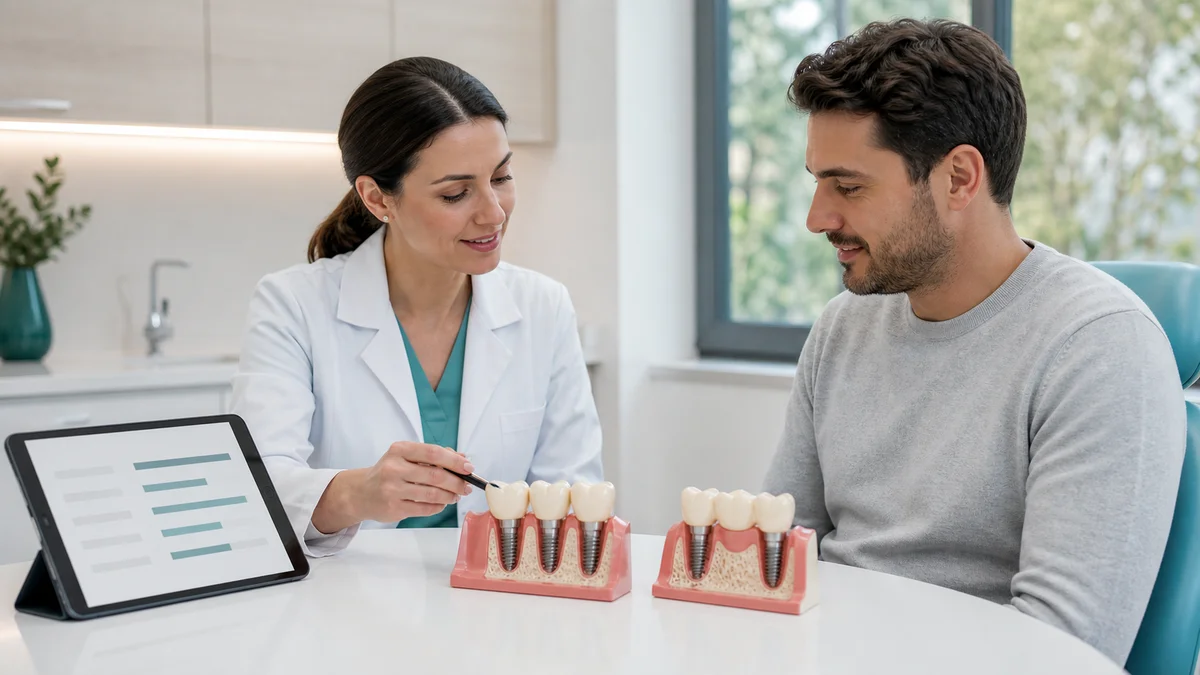
Quick answer: how much are dental implants for 3 teeth cannot be answered safely with one fixed fee. Three adjacent teeth may use three individual implants and crowns or an implant-supported bridge on fewer implants, depending on anatomy and bite. The total also depends on assessment, extractions, grafting, temporary teeth, components, materials, visits and maintenance.
A three-tooth implant quote can mean very different things. One clinic may be describing three implants with three separate crowns. Another may be proposing two implants supporting a three-unit bridge. A third quote may exclude the temporary teeth, bone graft, final abutments, sedation, imaging or management of existing infection. Comparing only the headline number can therefore compare different treatments.
The teeth may be adjacent or in separate parts of the mouth. A front-tooth site has different gum and appearance demands from a posterior chewing area. Three recently extracted teeth with preserved bone create a different plan from spaces that have been empty for years. Medical history, smoking, gum disease, bite and the condition of remaining teeth can all change candidacy and scope.
This guide does not publish a fixed price or promise that one implant layout fits everyone. It explains what should be included in an itemised proposal, why the number of implants is not simply the number of missing teeth, and how to compare the complete surgical, restorative and maintenance pathway.
how much are dental implants for 3 teeth depends first on the layout
The phrase “implants for three teeth” can describe at least three common patterns:
- Three individual sites: each missing tooth is in a different area and may need its own implant crown.
- Three adjacent missing teeth: the space may be restored with three individual implants and crowns or a bridge supported by a selected number of implants.
- A mixed plan: one site receives an implant crown while two adjacent teeth use another design or a non-implant alternative.
The American College of Prosthodontists’ dental implant overview explains that implants replace missing roots and can support single crowns, larger bridges and dentures. That is why “three teeth” does not automatically equal “three fixtures.” The prosthesis is planned first, then the number and position of implants required to support it are selected.
Using fewer implants is not automatically cheaper or better. A bridge places connected loads through its supports and has particular cleaning and component requirements. Three separate crowns may offer independent access and emergence profiles but need enough bone, spacing and safe anatomy for every fixture. The surgeon and restorative dentist must coordinate the final tooth positions before surgery.
Three common configurations compared
| Configuration | Typical use | Main cost drivers | Key advantage | Main trade-off |
|---|---|---|---|---|
| Three implants with three individual crowns | Three separate sites or adjacent sites with adequate space and anatomy | Three fixtures, three abutment/crown units, surgical sites and restorative components | Independent crowns and individual contact design | More implant positions, anatomy and components to plan and maintain |
| Two implants supporting a three-unit bridge | Selected three-tooth adjacent spans | Two fixtures plus bridge framework, pontic design, components and laboratory work | Can replace three adjacent teeth without three fixtures | Connected restoration with load, hygiene and repair considerations |
| One implant crown plus another replacement | Mixed distribution or differing site suitability | Implant unit plus bridge, denture, orthodontic or tooth-supported care elsewhere | Allows each site to receive a different solution | More coordination and potentially different maintenance systems |
| Non-implant replacement | Implants are unsuitable, unwanted or disproportionate | Tooth-supported bridge, removable partial denture, orthodontics or monitoring | Avoids implant surgery | Transfers demands to teeth, removable tissues, orthodontic care or the untreated space |
The table shows why a quote must name the prosthetic design. “Two implants” does not reveal whether the fee includes a three-unit bridge, temporary teeth, abutments, laboratory verification or future review. “Three implants” does not prove that each site can receive a separate crown without grafting or compromised spacing.
The 11 factors that build the total fee
1. Examination, records and diagnosis
Implant planning starts with a medical and dental history, clinical examination, gum assessment, evaluation of the remaining teeth and a review of the patient’s goals. Photographs, impressions or digital scans may be used to plan tooth position. Disease control should be identified before surgery rather than added unexpectedly during the restorative phase.
Guy’s and St Thomas’ NHS Foundation Trust describes pre-operative implant assessment as including radiographs and impressions, with several visits used to plan treatment and replacement teeth. A fee that excludes planning records is not directly comparable with one that includes them.
2. Two-dimensional and three-dimensional imaging
Routine radiographs can evaluate teeth and bone, while cone beam computed tomography may be justified to assess implant-site anatomy in three dimensions. A CBCT can help locate nerves, sinus spaces, root positions and bone volume. It should be prescribed for a clinical reason, use an appropriate field of view and be interpreted by a suitably trained professional.
Ask whether the scan, report and surgical planning are included. A free scan can still lead to an incomplete quote if interpretation, repeat imaging or a surgical guide is billed separately. More imaging is not automatically better; the benefit must justify radiation exposure.
3. Extraction and infection control
If the teeth are still present, the scope may include simple or surgical extraction, management of infection and preservation of the socket. Immediate implant placement may be possible in selected sites, but it is not guaranteed by the fact that extraction and implant treatment occur in the same area.
Active gum disease, decay or endodontic infection elsewhere can also affect sequencing. A low headline fee that assumes a healthy mouth may change after examination. Ask which teeth need treatment first and whether extraction, debridement, medication or temporary closure is included.
4. Number, position and type of implant fixtures
Fixture fees reflect more than a metal screw. Position, diameter, length, connection and restorative plan matter. Premium claims should be translated into traceable implant system details, component availability, documented regulatory status and the clinician’s rationale. A brand name alone cannot guarantee integration or long-term success.
Three separate fixtures create three surgical and restorative interfaces. A two-implant bridge uses fewer fixtures but a larger connected prosthesis. The appropriate architecture depends on span, force, bone, tooth dimensions and access for hygiene, not a package rule.
5. Bone grafting or ridge augmentation
Bone can be insufficient in width, height or contour after infection, trauma or time without a tooth. Grafting may occur before or with implant placement depending on the defect and plan. Materials, membranes, donor sites, surgical complexity and additional reviews can all alter cost and timing.
The NHS trust guidance notes that grafting may be needed when bone is insufficient and can extend treatment. This does not mean every three-tooth case needs grafting. Ask which site needs it, what clinical finding supports it, what material is proposed, and what non-graft alternatives exist.
6. Soft-tissue management
Gum volume and contour influence cleaning, comfort and appearance, especially around front implants. Soft-tissue grafting, contouring or provisional shaping may be recommended in selected cases. These procedures should have a defined goal rather than being described simply as a cosmetic upgrade.
A three-tooth front bridge may need careful pontic and gum architecture to avoid long-looking crowns or dark spaces. A posterior case may prioritise cleanability and durable contours. The proposal should state whether soft-tissue work is included, optional or only a possibility after healing.
7. Surgical guide, sedation and operating complexity
A surgical guide may help transfer the planned tooth position to implant placement. Its design and manufacture can add laboratory and digital planning costs. Guided surgery does not remove the need for clinical judgement, and freehand placement is not automatically inferior. The approach should fit the case and clinician’s workflow.
Local anaesthesia is common. Sedation may be considered for anxiety or complexity under appropriate medical and regulatory conditions, with separate assessment, monitoring and recovery requirements. Do not assume that a quoted “surgery fee” includes sedation, escort arrangements or hospital-level care.
8. Temporary teeth during healing
A visible three-tooth gap often needs a temporary aesthetic and functional plan. Options can include a removable temporary denture, resin-bonded provisional, temporary bridge or implant-supported provisional in selected stable cases. The choice depends on healing, implant stability, bite and appearance.
Immediate temporary teeth are not the same as definitive crowns and do not prove the implants are ready for normal loading. The ADA MouthHealthy implant information explains that replacement teeth may take time to make and that a temporary crown, bridge or denture may be used in the interim. Ask whether the provisional is included and how repairs are handled.
9. Abutments, framework and final restorative material
The visible replacement is a separate restorative phase. Components can include stock or customised abutments, screws, a bridge framework and veneering or monolithic material. Material selection should consider site, space, bite, appearance, repairability and component compatibility.
“Zirconia teeth” can refer to different designs and does not reveal whether the abutment, framework, connector design or laboratory quality is included. Ask for the definitive restoration type, number of units, retention method where relevant, component origin and what happens if a ceramic layer chips or a screw loosens.
10. Clinical and laboratory appointments
Restorative care may include impressions or scans, verification of implant position, jaw records, provisional trials, framework or aesthetic try-ins, fitting and bite adjustment. Complex three-tooth work can need more than one laboratory checkpoint to produce passive fit and acceptable contacts.
A lower quote may combine or omit stages; a higher quote may include specialist laboratory work and additional reviews. More visits do not automatically mean better quality, but the proposal should explain the purpose of each stage and which remakes or adjustments are covered.
11. Reviews, maintenance and complication planning
Implant care continues after the final bridge or crowns are fitted. Reviews examine gum health, plaque control, bone levels when clinically indicated, bite, screw or cement issues, ceramic integrity and hygiene access. Professional cleaning methods and intervals are personalised.
Ask whether early postoperative reviews, final restorative review and a maintenance appointment are included. A “lifetime implant” label is not a substitute for written terms. The fixture, components and crown can have different coverage, exclusions and repair processes, while biological complications are not product defects.
Why three missing teeth may use two or three implants
For three adjacent missing teeth, a bridge supported by two implants can sometimes replace the full span. The middle artificial tooth is a pontic, while the end units are connected to implant supports. This reduces the number of fixtures but creates one connected restoration. In other cases, three implant crowns may be preferred if anatomy, space and force distribution support them.
The American College of Prosthodontists states that implants can support single crowns and larger bridges. The Leeds Teaching Hospitals NHS Trust dental implant information likewise describes crowns for single teeth and bridges for multiple teeth. Neither source turns the choice into a fixed formula, because site-specific assessment remains essential.
Factors that influence the layout include:
- whether the teeth are adjacent or separated;
- front versus back position and the force expected;
- mesiodistal space and the size of the replacement teeth;
- available bone and distance from anatomical structures;
- root positions of neighbouring teeth;
- gum and ridge contours;
- opposing teeth and bite pattern;
- clenching or grinding;
- cleaning access beneath a bridge;
- material and connector requirements.
An online package cannot safely decide this architecture. A plan that simply divides a per-implant price by the number of missing teeth may ignore the prosthesis, and a plan that automatically uses fewer implants may compromise support or cleanability.
Front versus back: why the same tooth count changes the quote
Three front teeth require close coordination of tooth length, gum line, papillae, lip movement, colour, translucency and speech. Bone and gum defects can make replacement teeth look long unless the plan includes tissue management or a prosthesis that deliberately replaces some gum contour. Temporary teeth may be used to shape and test the appearance.
Three posterior teeth carry stronger chewing forces and need adequate restorative space, connector dimensions and hygiene access. The final appearance may be less visible, but mechanical design and bite management are demanding. A patient who clenches or grinds may need modifications and a protective appliance after treatment.
Upper posterior sites may be influenced by the sinus; lower sites may be limited by nerve anatomy. Anterior sites can have thin facial bone. These anatomical differences affect whether grafting, staged surgery or another replacement is appropriate, and therefore affect the scope more than the number “three.”
Health and candidacy can change both price and sequence
The ADA notes that general health matters to implant candidacy and that chronic illness or tobacco use can interfere with healing. Assessment should consider diabetes control, immune or blood conditions, medications affecting bone or bleeding, prior radiotherapy, smoking or nicotine exposure, and the patient’s ability to complete surgery and maintenance.
Oral conditions are equally important:
- active gum disease or uncontrolled plaque;
- untreated decay or infection;
- insufficient bone or unfavourable soft tissue;
- unstable bite, severe wear or bruxism;
- limited opening or difficult surgical access;
- poorly positioned adjacent teeth or inadequate restorative space;
- unrealistic appearance or timing expectations.
Stabilising these conditions can add treatment but protects the investment. A clinic that quotes implants without asking about periodontal health, smoking, medical history or maintenance is not providing a complete cost forecast.
Timeline and visit structure
Implant care usually has surgical and restorative phases. The NHS hospital guidance describes assessment, optional grafting, implant placement, healing and several restorative appointments. The exact interval varies with implant stability, site, grafting, health and the planned prosthesis; no universal completion date should be guaranteed.
A three-tooth pathway can include:
- Consultation and disease control: examination, imaging and treatment of active problems.
- Extraction or site preparation: if teeth remain or grafting is needed.
- Implant placement: two or three fixtures according to the approved plan.
- Healing and integration: with a temporary replacement if required.
- Exposure or tissue shaping: when a staged protocol or aesthetic contouring is used.
- Restorative records: scans or impressions, bite records and component selection.
- Try-in and fitting: bridge or crowns checked for fit, contacts, appearance and bite.
- Review and maintenance: hygiene instruction and ongoing monitoring.
Same-day implants and teeth may be appropriate in selected cases with favourable stability and controlled loading. “Same day” does not remove healing or convert a provisional into the definitive result. Ask exactly what is fitted that day and what later procedures remain.
How to compare two implant quotes fairly
When asking how much are dental implants for 3 teeth, request an itemised written plan rather than a single package label. Compare the same clinical scope line by line.
A useful quote should identify:
- diagnosis and which three teeth or spaces are included;
- number, position and system of implant fixtures;
- whether the result is three individual crowns or an implant-supported bridge;
- extractions, infection control and periodontal treatment;
- radiographs, CBCT interpretation, scans and surgical guide;
- graft material, membrane and soft-tissue procedures if proposed;
- local anaesthesia, sedation or theatre charges where relevant;
- temporary teeth and repairs during healing;
- abutments, screws, framework and final restorative material;
- laboratory stages, try-ins, fitting and bite adjustment;
- postoperative reviews, maintenance and complication terms;
- tax, currency, payment timing and quote validity.
Ask what is not included and what findings could increase the scope. If one plan is substantially lower, the difference may be a legitimate efficiency, a different implant layout or a missing stage. It should be explained, not guessed.
Alternatives to an implant solution for three teeth
Implants are not the only way to replace three teeth. Our guide to dental bridge alternatives compares fixed, removable, orthodontic and monitored-space pathways. For a three-tooth pattern, reasonable alternatives may include:
- a conventional tooth-supported bridge where support teeth are suitable;
- a removable partial denture replacing one or several spaces;
- orthodontic space closure or redistribution in selected cases;
- a mixed plan combining an implant with tooth-supported or removable care;
- monitoring one or more spaces when function and bite permit.
A tooth-supported bridge avoids implant surgery but may require preparation of adjacent teeth. A partial denture avoids fixed surgery and can replace several areas but is removable and has adaptation and support considerations. Orthodontics takes time and requires retention but can improve space or avoid a prosthesis. The cost comparison should include biological impact and maintenance, not just the first invoice.
Insurance, finance, currency and travel
Dental coverage varies by country, plan and reason for tooth loss. Some policies exclude implants, limit annual benefits, apply waiting periods or fund only a lower-cost alternative. The ADA MouthHealthy guidance on choosing a dental plan notes that implants may be excluded and that pre-existing missing-tooth clauses can affect coverage.
Ask the insurer for a written pre-treatment estimate using the proposed procedure codes and clinical documentation. Approval is not a guarantee of final payment, and the dental plan’s least expensive alternative clause may not define the treatment the clinician believes is best.
Finance can spread payment but adds contractual obligations, interest or fees. Compare the total repayment amount, refund rules if treatment changes, what happens after missed payments and whether financing is provided by the clinic or a separate lender. Do not let approval pressure replace informed consent.
For treatment abroad, compare currency, card or transfer charges, travel, accommodation, time away from work, companion costs, extra visits and access to urgent care. A three-tooth implant plan may require staged return visits. A low surgical fee can become a higher total if restorative components, grafting or follow-up are excluded.
Risks, maintenance and the meaning of a guarantee
Implant placement can involve pain, swelling, bleeding, infection, damage to nearby structures, altered sensation, sinus complications, graft problems or failure to integrate. Restorative complications can include screw loosening, cement problems, ceramic chipping, framework fracture, contact changes and bite discomfort. Peri-implant inflammation and bone loss can develop around integrated implants.
Three individual crowns and a connected bridge have different repair pathways. One crown may sometimes be repaired independently, while a bridge issue can affect the complete unit. Conversely, connected restorations can distribute load in a planned way. The decision depends on design rather than a general promise of durability.
Daily plaque control is essential. The team should demonstrate cleaning around each implant crown or beneath the implant bridge, identify suitable brushes or floss aids and set professional review intervals based on risk. Smoking, uncontrolled diabetes, previous periodontitis and poor plaque control can raise concern and require closer management.
Read any “warranty” carefully. It may apply only to an implant fixture from the manufacturer, not surgery, abutments, bridge material, gum or bone disease, accidental damage or labour. Conditions may require attendance at maintenance visits and documented hygiene. No written policy can guarantee biological healing.
Planning a three-tooth implant quote with Redent Klinik
Redent Klinik can be approached for an individual assessment and itemised proposal. Useful records include recent radiographs, the extraction date and reason, prior graft or implant records, periodontal history, current medications, medical conditions, smoking status and any history of clenching or grinding.
Photographs can support an initial conversation but cannot determine bone dimensions, nerve or sinus anatomy, gum stability, implant count or graft need. A provisional estimate should be labelled as such until the required clinical examination and imaging are complete.
Through the Redent Klinik contact page, patients can ask whether the quote is for three crowns or a bridge, which stages and components are included, and how follow-up is handled after travel. A responsible answer to how much are dental implants for 3 teeth should explain scope before price and should not promise a fixed outcome.
how much are dental implants for 3 teeth frequently asked questions
Do three missing teeth always need three implants?
No. Three teeth in separate areas may each need independent support, while selected three-tooth adjacent spans may use an implant-supported bridge on fewer fixtures. Bone, space, bite, force and cleanability determine the architecture. The final tooth design should guide implant number and position.
Are two implants and a bridge cheaper than three implant crowns?
They may use fewer fixtures, but the bridge has its own framework, units, components and laboratory work. Grafting, temporary teeth and complexity can outweigh a simple fixture count. Compare itemised complete plans rather than assuming the two-implant configuration always costs less.
What is usually excluded from a headline implant price?
Exclusions may include consultation, CBCT interpretation, extractions, grafting, sedation, temporary teeth, abutments, final crowns or bridge, laboratory stages, maintenance and repairs. There is no standard package definition. Ask for written inclusions, exclusions and findings that could change the scope.
Can all three teeth be replaced in one day?
Implants and a provisional restoration can sometimes be placed in one visit when anatomy, stability and loading are favourable. The implants still need biological healing, and the temporary teeth may later be replaced by the definitive bridge or crowns. Same-day treatment is not suitable for every case.
Will I need a bone graft?
Not necessarily. Grafting depends on bone volume, contour, implant position and the desired restoration. One of three sites may need grafting while another does not. The dentist should show the reason, describe the material and timing, and discuss alternatives when grafting adds significant burden.
Is the final crown included with an implant?
Not in every quote. The fixture, abutment and crown or bridge are distinct components and may be charged in surgical and restorative phases. Confirm the number of final units, material, retention method, laboratory work and temporary replacement in writing.
How long does treatment take?
There is no universal timeline. Assessment, disease control, extraction healing, grafting, implant integration, tissue shaping and laboratory stages vary. Ask for a staged estimate with reasons for each interval rather than a guaranteed completion date. Travel plans should allow for review and unexpected delays.
Does insurance pay for three dental implants?
Coverage depends on the policy, country, missing-tooth clauses, annual limits and accepted alternative treatment. Some plans exclude implants or contribute only toward a bridge or denture. Request a written pre-treatment estimate, but remember it may not guarantee final payment.
Can I replace three teeth with a removable denture instead?
Yes, a removable partial denture can replace three teeth in one or several areas without implant surgery. It has different comfort, support, appearance, cleaning and maintenance considerations. It may be transitional or definitive depending on design, oral health and preferences.
Why do implant quotes from different clinics vary so much?
They may describe different implant counts, bridge designs, records, grafts, temporary teeth, materials, laboratory stages, clinician expertise, maintenance and local operating costs. Currency and tax also matter. A fair comparison uses the same diagnosis and itemised scope, not only the total.
Are three individual crowns easier to clean than an implant bridge?
Individual crowns may allow conventional interproximal access, while a bridge needs cleaning beneath the pontic and around supports. Actual cleanability depends on contours, spacing, gum architecture and dexterity. The patient should be shown how to clean the proposed design before accepting it.
Final answer: price the complete plan, not the implant count
The safest answer to how much are dental implants for 3 teeth begins with the replacement design. Three individual implant crowns and a three-unit bridge on two implants are different treatments. The anatomy, location, bite and desired tooth positions decide whether either is suitable.
A complete quote then adds assessment, imaging, extractions, disease control, grafting if needed, surgery, temporary teeth, abutments, final restorative units, laboratory work, reviews and maintenance. Insurance, finance, travel and currency can change the patient’s true cost without changing the clinical fee.
Ask for the design, components, exclusions, alternatives and complication plan in writing. A transparent proposal may still change after examination or healing, but it should explain why. Avoid any package that guarantees integration, a permanent result or the same treatment for every three-tooth gap.
The World Health Organization oral health fact sheet links tooth loss with oral disease, function and quality of life. Implant planning should therefore include prevention and protection of the remaining mouth, not only replacement of the visible gaps.
Sources and further reading
- American Dental Association
- ADA MouthHealthy: Implants
- ADA MouthHealthy: Choosing the right dental plan
- American College of Prosthodontists: Dental implants
- Guy’s and St Thomas’ NHS Foundation Trust: Having a dental implant
- Leeds Teaching Hospitals NHS Trust: Dental implants
- Cambridge University Hospitals: Dental implants in restorative dentistry
- World Health Organization: Oral health fact sheet