
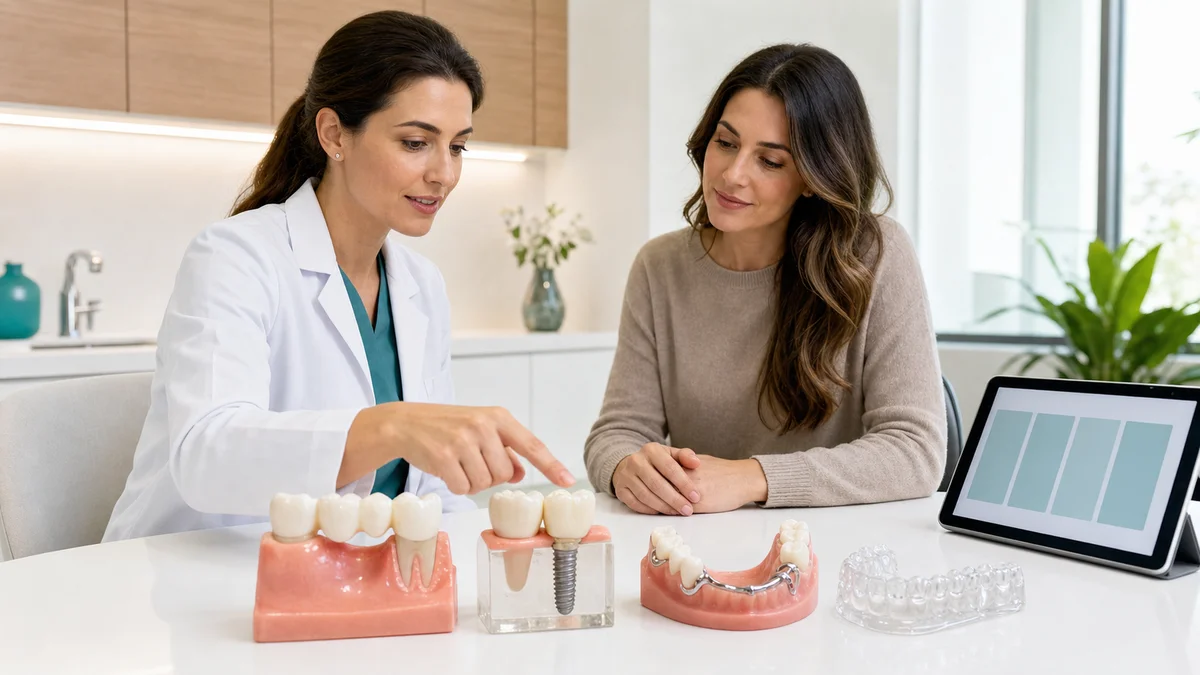
Quick answer: dental bridge alternatives include a single dental implant and crown, a removable partial denture, orthodontic space closure or redistribution, and accepting the gap in selected cases. Another bridge design may also preserve more tooth structure than a conventional bridge. The best choice depends on the site, supporting tissues, bite, health, hygiene and priorities.
A dental bridge is a well-established fixed way to replace one or more missing teeth, but it is not the only pathway. Some patients want to avoid preparing neighbouring teeth. Others cannot or do not want to undergo implant surgery. A removable option may suit a larger pattern of missing teeth, while orthodontic movement can sometimes close or reshape the space. In selected mouths, replacement may offer little functional benefit and the gap can be monitored.
The word “alternative” needs care. A resin-bonded bridge is still a bridge, but it can differ substantially from a conventional crown-supported bridge in tooth preparation and failure pattern. An implant crown is fixed but surgically supported. A partial denture is removable. Orthodontic closure moves natural teeth rather than adding an artificial tooth. No replacement avoids a device but has its own possible consequences.
This guide compares those pathways without recommending one from a photograph or keyword. Missing-tooth planning requires an examination, appropriate imaging when indicated, evaluation of the adjacent teeth and gums, and a discussion of the patient’s goals. There is no universally superior treatment and no guaranteed lifespan.
dental bridge alternatives start with why the tooth is missing
The reason and timing of tooth loss affect every later decision. A tooth may be absent because of decay, fracture, gum disease, trauma, developmental absence or a planned extraction. The space may be recent or long-standing. Adjacent teeth may be intact, heavily restored, tilted or already crowned. Bone and gum contours can change after loss, and the opposing tooth may have altered position.
Before discussing replacement, the dentist asks whether the tooth is definitely lost. A severely damaged tooth may still be assessable for restorative or endodontic care. Preserving a restorable natural tooth can avoid extraction and the need to compare replacements. Our guide to root canal alternatives explains why pulp-preserving care, root canal treatment, retreatment and extraction belong to different diagnostic stages.
If the tooth is already missing, the goal must be defined:
- restore chewing contact or improve the distribution of function;
- replace a visible tooth and support a natural-looking smile;
- improve speech in a space that affects sound production;
- stabilise or reorganise tooth positions within an orthodontic plan;
- avoid preparation of intact adjacent teeth;
- provide a temporary solution before definitive care;
- or confirm that monitoring the space is reasonable.
The aim should not be to fill every radiographic gap at any biological cost. Equally, a space should not be ignored merely because it is hidden. Function, appearance, tooth movement, food trapping, gum health, bite and future treatment all deserve assessment.
Missing-tooth options in one decision table
| Option | Support | Key advantage | Main trade-off | Maintenance focus |
|---|---|---|---|---|
| Conventional fixed bridge | Crowned natural teeth beside the space | Fixed restoration; can be useful when support teeth already need crowns | Requires preparation and links the supporting teeth | Margins, support-tooth health and cleaning beneath the replacement tooth |
| Resin-bonded bridge | Wing bonded to one or more adjacent teeth | Often preserves more tooth structure in suitable cases | Bond may detach; not suitable for every bite or span | Bonded interface, bite and hygiene around the wing |
| Single implant crown | Implant placed in jawbone | Does not normally require adjacent teeth to carry the replacement | Surgery, healing, anatomy and implant-specific risks | Gum health, plaque control, bite and professional review |
| Removable partial denture | Gums and selected remaining teeth, depending on design | Can replace several teeth without implant surgery | Removable, adaptation and movement or clasp considerations | Daily removal, appliance cleaning and support-tooth care |
| Orthodontic space closure | Natural teeth moved into a planned position | May avoid an artificial replacement in suitable cases | Treatment time, bite changes, retention and case limitations | Hygiene during treatment and long-term retention |
| Orthodontic space redistribution | Teeth moved to create a better restorative site | Can improve space, root position and future restoration proportions | Still requires a later replacement and coordinated care | Retention plus maintenance of the definitive prosthesis |
| No replacement with monitoring | No artificial support | Avoids surgery, preparation and a prosthesis | Possible functional, positional or aesthetic consequences | Review of tooth movement, bite, hygiene and symptoms |
The table is a discussion map, not a league table. The “least invasive” option depends on the whole case. Avoiding tooth preparation through implant surgery is not less invasive in every medical or anatomical context. A removable denture can be conservative surgically but may place loads on teeth and tissues. Orthodontics preserves tooth structure yet changes tooth positions and requires retention.
What a conventional dental bridge offers
The NHS dental treatments overview describes a bridge as a fixed replacement for a missing tooth or teeth supported by surrounding teeth. In a common conventional design, teeth beside the gap are prepared for crowns, and those crowns are connected to the artificial replacement tooth.
A conventional bridge can be efficient when the adjacent teeth already need full-coverage restorations because of large fillings, damage or existing crowns. It provides a fixed result without implant surgery and can sometimes be completed without waiting for implant integration. Material, span, support and bite determine the actual design and treatment stages.
The biological cost is preparation of support teeth. Removing sound structure can expose a tooth to sensitivity, pulpal complications, decay at restoration margins or future restorative needs. The support teeth also become connected: a problem in one part can affect the whole prosthesis. These risks do not make bridges unsuitable; they must be weighed against the condition of the support teeth and other options.
Cleaning requires access under the artificial tooth and around every margin. Ordinary floss cannot simply pass down between joined units, so the patient may need a floss threader, bridge floss, an interdental brush or another device selected for the design. A fixed restoration is not maintenance-free.
Resin-bonded bridges as a tooth-preserving bridge design
Some people searching for dental bridge alternatives actually want an alternative to extensive crown preparation. A resin-bonded bridge may address that concern in selected cases. It uses a metal or ceramic wing bonded to the back of an adjacent tooth, often with little or no preparation compared with a conventional bridge.
Suitability depends on the location and size of the space, condition and enamel available on the support tooth, bite contacts, tooth alignment and ability to isolate the bonding surface. These bridges are commonly discussed for single-tooth spaces, but not every anterior or posterior gap has favourable loading.
The conservative preparation is an advantage, while debonding is a recognised limitation. A detached bridge can sometimes be rebonded if the restoration and tooth remain suitable, but repeated failure requires reassessment of design, bite and alternatives. A wing should not be casually bonded across multiple healthy teeth without a clear rationale, because joining more teeth can complicate the system.
Cambridge University Hospitals’ patient information on implant bone grafting and alternatives distinguishes adhesive resin-bonded bridges from conventional bridges and explains that choice depends on the span, available tooth structure, bite and pulpal status. The information is useful because it shows that “bridge” is not one uniform operation.
Single dental implant and crown
A single implant replaces the missing root with an implant placed in the jawbone and supports a separate crown. It can replace one tooth without preparing adjacent teeth to carry a bridge. The ADA’s MouthHealthy implant overview presents implants as an option for people who want to avoid removing good tooth structure for a bridge, subject to professional assessment.
Implant treatment is surgical and staged. Assessment considers general health, medications, smoking, gum health, active disease, bone volume, soft tissue, the positions of roots, nerves and sinus spaces, and the final crown position. Three-dimensional imaging may be indicated for implant planning, but it should be justified for the individual rather than ordered as a marketing package.
Potential advantages include independent support, a fixed crown and preservation of adjacent tooth structure. Trade-offs can include surgery, healing time, grafting in selected cases, temporary replacement, cost, peri-implant disease, mechanical complications, aesthetic limitations and the need for lifelong maintenance. “Metal-free” or “lifetime” claims should not replace a transparent explanation of implant and restorative materials.
An implant is not immune to plaque or bite overload. The crown, abutment and implant can develop technical problems, while the surrounding tissues can become inflamed and lose support. Daily cleaning and professional review remain necessary. The implant crown also does not bleach like a natural tooth, so future colour changes must be planned.
Removable partial denture
A removable partial denture can replace one or several missing teeth with an appliance supported by the gums and, depending on design, remaining teeth. It may use a metal framework, acrylic base, clasps, rests or precision components. The exact design affects stability, appearance, tooth loading and cleaning.
The NHS denture guidance explains that partial dentures can replace one or more teeth and are removable for cleaning. This distinction makes a partial denture one of the clearest dental bridge alternatives for someone who cannot or does not want a fixed solution.
Advantages may include avoiding implant surgery, replacing multiple spaces in one appliance, modifying the denture if the mouth changes and providing a transitional option during healing. It can also replace some lost gum contour where a fixed tooth alone would look too long.
Trade-offs include bulk, movement, adaptation, visible clasps in some designs, food collection, speech changes and the need to remove and clean it. A poor fit can damage supporting tissues, and continuing to wear a loose or broken denture can worsen problems. The appliance and remaining teeth need periodic review.
The American College of Prosthodontists’ denture information notes that the number and location of missing teeth affect partial denture comfort and stability. It also describes implants as a possible way to improve stability in selected cases, showing that removable and implant options can sometimes be combined rather than treated as opposites.
Orthodontic space closure or redistribution
Orthodontic treatment can move teeth to close a missing-tooth space or create a more ideal site for a future implant, bridge or other restoration. It is particularly relevant for congenitally absent teeth, drifting after tooth loss, crowded arches or spaces with roots that are poorly positioned for an implant.
Guy’s and St Thomas’ NHS Foundation Trust explains in its 2025 hypodontia guidance that braces can close gaps or create space for replacement, while dentures, bridges and implants are possible replacement categories. Although developmental absence is a specific condition, the planning principle illustrates why tooth movement and prosthetic care can be coordinated.
Closing the space
Space closure moves neighbouring teeth into the gap and reshapes the dental arch without adding an artificial tooth. Some teeth may later need conservative reshaping, bonding or colour adjustment to resemble the tooth they replace. The bite, facial proportions, tooth size and gum levels must support the plan.
This option avoids a bridge or implant at the missing site but creates orthodontic treatment and retention responsibilities. It may not produce acceptable function or appearance for every tooth position. Closing one space also changes relationships elsewhere in the arch, so isolated cosmetic movement is not a complete plan.
Redistributing or opening the space
When the gap is too narrow, roots lean into the proposed implant site or the tooth proportions are uneven, orthodontics can prepare a better restorative space. The future crown position guides movement. The orthodontist and restorative dentist should agree on root spacing, crown width, gum levels and timing before treatment.
Space redistribution does not eliminate the need for replacement; it can improve the conditions for it. A temporary tooth may be incorporated into an orthodontic appliance or retainer during treatment, depending on the case. Long-term retention remains important because teeth can move after orthodontics.
Choosing no replacement and monitoring the space
Not every gap must be restored. If enough functional teeth remain, the appearance is acceptable, cleaning is manageable and the bite is stable, accepting the space may be a reasonable option. Cambridge University Hospitals includes “no tooth replacement” among alternatives in selected situations where sufficient functional teeth are present.
No replacement avoids preparation, surgery, an appliance and restorative maintenance. It can be particularly relevant to a non-visible posterior space where replacement would add limited benefit or disproportionate complexity. However, it is not automatically risk-free.
Possible consequences include movement or tipping of adjacent teeth, over-eruption of an opposing tooth, altered contacts, food trapping, changes in chewing and a more difficult future restorative site. These changes do not occur equally in everyone. Monitoring should record the rationale, current bite and what findings would prompt reconsideration.
A long-standing stable gap is different from a newly extracted tooth in a changing dentition. Age, growth, periodontal condition and orthodontic history matter. “Do nothing” is safest when it means informed observation, not absence of follow-up.
Clinical factors that change the best option
Choosing among dental bridge alternatives requires more than counting missing teeth. The replacement must fit a biological and mechanical system. Assessment commonly includes:
- the position, number and span of missing teeth;
- condition and restoration status of adjacent and opposing teeth;
- gum health, bone levels, ridge shape and soft-tissue contours;
- available space and root positions;
- bite contacts, jaw relationship, clenching or grinding;
- smoking, diabetes control, medications and healing factors;
- smile line, tooth proportions, speech and colour expectations;
- manual dexterity, hygiene habits and ability to clean the proposed design;
- growth status and orthodontic needs;
- tolerance for surgery, removable appliances, treatment time and review.
An intact adjacent tooth makes conventional bridge preparation a different biological decision from an adjacent tooth already needing a crown. Limited bone makes an implant more complex, but grafting is elective and may have alternatives. Several missing teeth can make one removable appliance more practical than multiple individual restorations. There is no single feature that decides every case.
Common patient scenarios
One front tooth is missing and adjacent teeth are intact
A resin-bonded bridge, implant crown and orthodontic plan may all enter the discussion. The choice depends on age and growth, bite, enamel for bonding, bone and gum contour, root positions and aesthetic expectations. A conventional bridge may involve a higher tooth-preparation cost when the neighbours are untouched.
One molar is missing beside heavily restored teeth
A conventional bridge can be reasonable if adjacent teeth already need crowns and can provide sound support. An implant may preserve their independence but requires suitable anatomy and surgery. Accepting the space may also be discussed if function remains adequate and the bite is stable. A single photograph cannot compare these trade-offs.
Several teeth are missing in different areas
A removable partial denture can replace multiple spaces in one design. Implant-supported crowns or bridges may provide fixed or improved removable support but add surgical and financial burden. Long-span tooth-supported bridges can create demanding loads and hygiene challenges. The plan should consider the whole arch rather than replacing each gap in isolation.
The patient is still growing
Implants are generally delayed until growth is complete because an osseointegrated implant does not move with the surrounding teeth and jaws. Orthodontic management, resin-bonded bridges, removable appliances or temporary solutions may preserve options. A multidisciplinary plan is particularly important for developmental tooth absence.
There is not enough bone for a straightforward implant
Grafting may be considered, but it is not compulsory. Bridge designs, a removable denture, orthodontic changes, a modified implant plan in selected specialist cases or no replacement may be alternatives. The added surgery, healing, donor site if relevant and uncertainty should be compared with the expected benefit.
Risk and maintenance comparison
Every replacement shifts risk rather than eliminating it. A conventional bridge places biological and mechanical demands on support teeth. A resin-bonded bridge may debond. An implant avoids natural tooth support but introduces surgical, peri-implant and component risks. A removable denture can move or load tissues and teeth. Orthodontics can produce root, gum, enamel or stability concerns and needs retention.
Daily care differs:
- Conventional or resin-bonded bridge: clean around margins and beneath the artificial tooth with demonstrated aids.
- Implant crown: control plaque around the implant and crown, and attend professional reviews.
- Partial denture: remove, clean and store it as instructed while cleaning every remaining tooth and supporting surface.
- Orthodontic treatment: clean around attachments or appliances and use retainers as directed after movement.
- Monitored space: keep the gap and neighbouring surfaces clean and review movement, food trapping and bite changes.
Seek assessment for looseness, fracture, new movement, pain on biting, gum swelling, bleeding, discharge, bad taste, increasing food trapping or a change in the bite. A detached bridge or loose implant crown should not be glued at home. A fractured denture should not be reshaped with household tools.
Cost, timing and treatment burden
No fixed price comparison is reliable without examination. A bridge quote may include preparation, provisional restoration, laboratory work, fitting and review, but may exclude treatment needed for support teeth. Implant care can include extraction, grafting in selected cases, implant placement, healing, abutment, crown, temporary replacement and maintenance. Denture cost varies by design and material, while orthodontic treatment involves active treatment and retention.
Timing is equally individual. A bridge may avoid implant integration, but gums or extraction sites may need healing before final design. An implant can involve several clinical and healing stages. A denture can be immediate, transitional or definitive. Orthodontic movement commonly takes longer than a purely restorative sequence but may improve the overall bite and site.
Ask for a written plan that states:
- which option and design are proposed, and why;
- what diagnostic records and preparatory treatment are included;
- whether a temporary tooth is included during healing or fabrication;
- which findings could require grafting, root canal care, gum treatment or redesign;
- the number and purpose of expected visits without promising exact healing;
- what laboratory, material, review and maintenance stages are included;
- how repairs, remakes or complications are handled.
Value should account for tissue preservation, function, comfort, appearance, cleanability and future treatment. The lowest initial fee may not include the full pathway, while the most technologically complex option may add little benefit in a stable, low-demand space.
Planning care with Redent Klinik
Redent Klinik can be approached for an individual missing-tooth assessment. Helpful records may include recent radiographs, the extraction date and reason, previous implant or bridge consultations, details of gum treatment, medical conditions, medications, smoking status and any history of clenching or grinding.
For international patients, remote records can support an initial conversation but cannot confirm bone dimensions, gum stability, support-tooth condition or bite. Ask which decisions require in-person examination, whether a temporary replacement is needed and how review or urgent care is managed after travel.
Through the Redent Klinik contact page, patients can ask for a staged, itemised proposal. A responsible plan should compare reasonable dental bridge alternatives, explain why an option is unsuitable, and avoid guaranteed longevity, perfect colour matching or complication-free claims.
dental bridge alternatives frequently asked questions
What is the best alternative to a dental bridge?
There is no universal best. A single implant crown may avoid preparing adjacent teeth, a partial denture can replace several teeth without implant surgery, orthodontics can close or improve the space, and monitoring may suit selected gaps. Anatomy, health, bite, hygiene and preferences determine suitability.
Is an implant always better than a bridge?
No. An implant can preserve adjacent tooth structure but requires surgery, suitable tissues, healing and implant maintenance. A bridge may be efficient when adjacent teeth already need crowns or surgery is unsuitable. Both can develop biological and mechanical complications and need long-term review.
Can I leave a missing tooth space empty?
Sometimes, if appearance and function are acceptable and the bite is stable. Possible tooth movement, over-eruption, food trapping and future restorative difficulty should be considered. The safest no-replacement choice includes documented assessment and monitoring rather than assuming the space will never change.
Is a resin-bonded bridge less invasive?
It often requires less tooth preparation than a conventional crown-supported bridge in suitable cases. Its success depends on enamel bonding, isolation, bite, span and design, and it may debond. “Less preparation” does not make it appropriate for every missing tooth.
Can braces close the gap instead?
Orthodontic space closure may avoid an artificial tooth when the bite, tooth sizes and facial plan allow it. Teeth may need reshaping or bonding afterward, and retention is required. Orthodontics can also open or redistribute space for a better implant or bridge site.
Can a partial denture replace just one tooth?
Yes, although the value of a removable appliance for one space depends on design, comfort, appearance, support and alternatives. Partial dentures are especially useful when several teeth are missing or as a transitional solution. They require daily removal, cleaning and periodic adjustment.
Does an implant stop bone loss?
An implant transfers load to surrounding bone and may help maintain local support, but it does not guarantee that bone levels will never change. Bone and gum tissues can be affected by anatomy, healing, plaque, inflammation, smoking, bite and time. Professional maintenance remains necessary.
What if the teeth beside the gap already have crowns?
A conventional bridge may be practical if those teeth need new crowns and offer suitable support. An implant can keep them independent, while a partial denture or no replacement may also be considered. Existing crowns must be assessed for condition, seal, root health and restorability.
How long do dental bridge alternatives last?
No option has a guaranteed lifespan. Implant restorations, dentures, orthodontic results and monitored spaces all have different biological and maintenance courses. Hygiene, bite, materials, health, smoking, appliance care and review affect outcomes. Ask about likely maintenance and repair rather than a promised date.
Do I need bone grafting if I choose an implant?
Not everyone needs grafting. The need depends on bone volume, implant position, timing after tooth loss and the desired restoration. If grafting is proposed, ask about its purpose, risks and alternatives such as a bridge, denture, orthodontic plan, modified implant approach or no replacement.
Final decision: match the replacement to the whole mouth
The strongest comparison of dental bridge alternatives begins with the missing-tooth site and the condition of the remaining mouth. A conventional bridge can be effective when support teeth benefit from crowns. A resin-bonded bridge may preserve more structure. An implant crown offers independent fixed support. A partial denture replaces one or several teeth without a fixed surgical restoration.
Orthodontics can close or redesign the space, while selected patients can accept and monitor a gap. None of these choices is automatically conservative, permanent or risk-free. The biological cost simply appears in different places: tooth preparation, surgery, removable support, tooth movement or the consequences of a space.
Ask what supports the replacement, what tissue is altered, how it will be cleaned, what happens if it fails and whether the result preserves future options. A good plan fits function, health and maintenance before it tries to win a product comparison.
The World Health Organization oral health fact sheet places tooth loss within preventable and treatable oral disease and quality of life. Replacing a tooth should be paired with controlling the reason it was lost and protecting the teeth and tissues that remain.
Sources and further reading
- American Dental Association
- ADA MouthHealthy: Dental implants
- NHS: Dental treatments, including bridges and implants
- NHS: Dentures
- Cambridge University Hospitals: Bone grafting and alternatives
- Guy’s and St Thomas’ NHS Foundation Trust: Hypodontia treatment options
- American College of Prosthodontists: Bridges
- American College of Prosthodontists: Dentures
- World Health Organization: Oral health fact sheet