
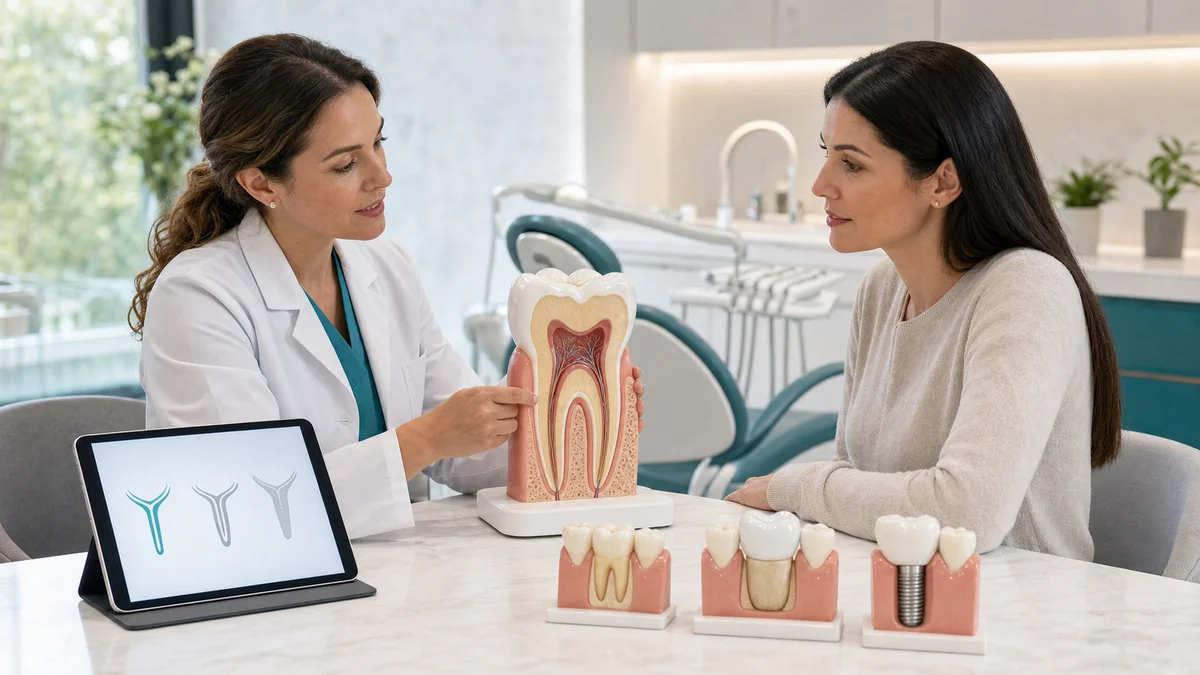
Quick answer: Safe root canal alternatives depend on the pulp diagnosis and whether the tooth can be restored. Selected vital teeth may qualify for pulp-preserving treatment. A previously treated tooth may need retreatment or endodontic surgery. If infection cannot be predictably controlled or the tooth is not restorable, extraction followed by an appropriate replacement discussion may be considered.
Searching for an alternative to root canal treatment often begins with fear, cost concerns, uncertainty about pain or a wish to avoid a complex procedure. Those concerns deserve a clear answer. An “alternative” is not simply anything that postpones treatment. It must address the diagnosed disease, control infection when present and leave a realistic plan for the tooth or the space after extraction.
The treatment choices are not the same at every stage. Early decay may be managed before the pulp is irreversibly damaged. A vital but inflamed pulp may sometimes be preserved with carefully selected vital pulp therapy. A necrotic or infected canal system generally needs endodontic treatment to retain the tooth, or extraction if the tooth cannot or should not be saved. A tooth that has already had root canal treatment enters a different decision tree involving review, nonsurgical retreatment, endodontic surgery or extraction.
This guide explains those pathways without diagnosing an individual tooth. Pain patterns overlap, infection can exist with few symptoms, and a photograph cannot show root anatomy, cracks, bone changes or restorability. Clinical tests and appropriate imaging are necessary before anyone can say which option is reasonable.
A safe review of root canal alternatives therefore separates procedures that preserve living pulp, procedures that save a previously treated tooth and extraction pathways that replace rather than retain the natural tooth.
root canal alternatives begin with the correct diagnosis
“I have toothache” is a symptom, not a pulpal diagnosis. Pain can come from decay, a cracked tooth, an exposed root, inflamed gums, bite trauma, sinus-related pressure, a failing restoration or another source. Even when the tooth is identified, the pulp may be normal, reversibly inflamed, irreversibly inflamed, necrotic or previously treated. Each category changes the possible treatment.
A dentist or endodontist may ask when pain starts, whether it lingers after hot or cold, whether it occurs spontaneously, and whether biting or release from biting hurts. Examination can include visual inspection, periodontal probing, percussion, palpation, mobility, bite tests and pulp sensibility tests. Radiographs are selected according to clinical need; three-dimensional imaging is not automatically required for every case.
The question is then split into four clinical decisions:
- Can the pulp recover? If inflammation is limited and the cause can be removed, conservative treatment may be possible.
- Can some healthy vital pulp be preserved? Selected teeth may qualify for a pulp cap or pulpotomy performed under controlled conditions.
- Can the whole tooth be predictably restored? Root canal treatment is not useful if the remaining tooth cannot support a durable restoration.
- Has treatment already been attempted? Persistent disease after a previous root canal may call for retreatment, surgery, monitoring in selected circumstances or extraction.
The diagnosis should also identify urgency. Facial swelling, fever, rapidly increasing pain, difficulty swallowing or breathing, eye symptoms, or a large mouth swelling can require urgent or emergency care. Comparing elective options should never delay management of a spreading infection.
Nine pathways compared in one decision table
| Pathway | When it may enter the discussion | What it aims to do | Critical limitation |
|---|---|---|---|
| Caries control and restoration | Decay has not caused irreversible pulpal disease | Remove or arrest disease and seal the tooth | Not enough once the pulp is irreversibly inflamed or infected |
| Indirect or direct pulp treatment | Selected vital teeth with a controllable pulpal exposure or deep decay | Preserve pulp vitality under a sealed restoration | Requires strict case selection, technique and follow-up |
| Partial or full pulpotomy | Selected vital teeth where healthy radicular pulp may remain | Remove inflamed coronal pulp while preserving viable pulp deeper in the root | Not a universal substitute for treating a necrotic canal system |
| Primary root canal treatment | Inflamed or infected pulp in a restorable tooth | Clean, disinfect, fill and seal the canal system to retain the tooth | Needs a sound final restoration and follow-up |
| Nonsurgical retreatment | Previous root canal treatment has persistent or recurrent disease | Re-enter and disinfect the canal system, then reseal it | Existing posts, restorations, anatomy or damage can complicate access |
| Endodontic surgery | Selected persistent disease or anatomy not manageable through the crown | Treat disease around the root end and seal the root from a surgical approach | Surgical access, anatomy and tooth condition must be suitable |
| Extraction without immediate replacement | The tooth is not restorable or retention is not a reasonable goal | Remove the diseased tooth and control the source | Creates a space with functional and restorative consequences |
| Extraction plus fixed replacement | A missing tooth is to be replaced with an implant-supported crown or bridge | Restore the space with a fixed prosthesis | Requires separate anatomy, support, surgery or tooth-preparation decisions |
| Extraction plus removable replacement | A removable partial or complete denture is appropriate | Restore multiple or selected missing teeth with a removable appliance | Fit, adaptation, hygiene and maintenance differ from natural teeth |
This table is not a ranking. Some entries prevent root canal treatment from becoming necessary; others are ways to manage a previously treated tooth; extraction options stop being tooth-preserving alternatives and begin a new missing-tooth pathway. The correct category depends on biological findings, restorability and patient values.
What root canal treatment is designed to treat
Root canal treatment removes inflamed or infected pulp tissue from inside a tooth, cleans and shapes the canal system, and fills and seals it to reduce the risk of reinfection. The tooth then requires an appropriate final restoration. The NHS root canal treatment guidance, reviewed in October 2025, describes the treatment as removal of infection from inside the tooth followed by cleaning and filling.
The pulp can be damaged by deep decay, cracks, trauma, repeated procedures or a defective restoration. Once tissue is irreversibly inflamed or necrotic, a simple filling cannot disinfect the internal canal anatomy. Painkillers can reduce symptoms temporarily, and antibiotics may be indicated in selected spreading or systemic infections, but neither procedure removes infected tissue or seals the canal system.
Root canal treatment is therefore a tooth-retention strategy, not simply pain management. The aim is to keep a restorable natural tooth functioning without leaving uncontrolled pulpal or apical disease. Its value depends on the entire tooth: a technically treated root beneath an unsealed, fractured or unmaintainable crown is not a complete treatment result.
The American Association of Endodontists explains in its patient guide to saving a natural tooth that endodontic treatment removes the diseased pulp, disinfects and seals the internal space, after which a crown or filling protects the tooth. It also recommends asking why if a patient is told the tooth cannot be saved and seeking specialist assessment when appropriate.
Alternatives before a full root canal becomes necessary
Some pathways described as root canal alternatives are only alternatives because the disease has not reached the stage that requires complete removal of the pulp. Early detection matters. The National Institute of Dental and Craniofacial Research notes in its tooth decay information that untreated decay can progress to pain, infection and tooth loss.
Caries prevention, remineralisation and a filling
An early non-cavitated lesion may sometimes be managed with fluoride exposure, dietary change, plaque control and professional monitoring. A cavity usually needs restorative management. If decay is removed or controlled and the pulp remains capable of recovery, a well-sealed restoration may resolve symptoms without endodontic treatment.
This does not mean “try a filling first” is safe for every painful tooth. Persistent spontaneous pain, lingering thermal pain, pulp exposure, apical findings or necrosis can change the diagnosis. Placing a restoration without understanding the pulp may delay definitive treatment or make symptoms worse.
Indirect or direct pulp treatment
Vital pulp therapy aims to preserve living pulp tissue after deep decay, trauma or a controlled exposure. Depending on the diagnosis and operative findings, this can include indirect pulp treatment, direct pulp capping or other procedures using a suitable biomaterial and a well-sealed restoration. Isolation, contamination control and the quality of the final seal are central.
The AAE position statement on vital pulp therapy describes pulp capping and partial or complete pulpotomy as procedures intended to preserve pulp vitality and function. It stresses diagnosis, caries management, pulp management, biomaterials and restoration rather than treating the procedure as a shortcut.
Partial or full pulpotomy
A pulpotomy removes inflamed tissue from the pulp chamber while attempting to preserve healthy tissue in the roots. It has long been associated with young permanent teeth, but contemporary vital pulp therapy can be considered more broadly in carefully selected mature teeth. Suitability depends on the preoperative diagnosis, bleeding and tissue findings, contamination control, restorability and the clinician’s training.
A pulpotomy is not a home remedy and it is not appropriate once the entire pulp is necrotic or the infection cannot be controlled by a vital pulp approach. Follow-up is required because preservation of vitality is an outcome to be monitored, not assumed at the appointment.
When extraction is the main alternative
When a restorable tooth has irreversible pulpal disease or an infected canal system, the direct alternative to endodontic treatment is often extraction. The NHS states that an infected tooth may need to be taken out if root canal treatment is not performed. Extraction removes the tooth and the internal infection source, but it also removes natural tooth structure and creates a new planning problem.
Among root canal alternatives, extraction has the clearest irreversible consequence: the original tooth cannot later be restored, so the decision should include the likely need, feasibility and maintenance of any replacement.
Extraction may be reasonable when the tooth has a non-restorable fracture, too little sound structure, severe periodontal loss, root damage that prevents predictable retention, uncontrolled recurrent disease or a prognosis the patient does not accept after informed discussion. It can also be selected after weighing medical factors, treatment burden, strategic importance and reasonable alternatives.
It should not be described as automatically easier, cheaper or more definitive. Healing, post-extraction complications and future replacement can add appointments and costs. The space may affect appearance, chewing or the position of other teeth, although the consequences vary by location and individual bite. Some spaces may be monitored; others are best restored.
Before extraction, useful questions include:
- Is the tooth definitely non-restorable, and what finding determines that?
- Would an endodontist’s assessment materially change the prognosis?
- What restoration will the tooth need after root canal treatment?
- What is the condition of the gums, bone and adjacent teeth?
- If the tooth is removed, should the space be replaced, and when?
- How do the total stages, risks and maintenance compare?
- What temporary plan is needed during healing or fabrication?
The AAE’s treatment options for a diseased tooth presents root canal treatment, retreatment and endodontic surgery as possible tooth-saving routes and extraction with prosthetic replacement when the tooth cannot be saved. This sequence supports a tooth-first evaluation without promising that every tooth is salvageable.
Replacement choices after extraction
Extraction is a procedure; replacement is a separate decision. The plan may involve an implant-supported crown, a tooth-supported bridge, a removable partial denture, orthodontic space closure or no immediate replacement in a selected case. The best choice depends on the missing tooth, anatomy, healing, adjacent teeth, gum and bone health, bite, hygiene, medical history and patient priorities.
Dental implant and crown
An implant can support a crown without preparing neighbouring teeth in many cases. It requires suitable bone and soft tissue, surgery, healing and long-term maintenance. Smoking, medical conditions, medications, periodontal history, anatomy and hygiene can affect candidacy and risk. Immediate placement or immediate loading is not appropriate for every site.
An implant is not a biological upgrade over a restorable natural tooth. It is a replacement for a tooth that has been lost or judged not worth retaining after assessment. It can be a reliable option in suitable circumstances, but it can develop complications and does not have a guaranteed lifetime.
Tooth-supported bridge
A bridge uses one or more supporting teeth to carry a replacement tooth. Conventional designs may require preparation for crowns; resin-bonded designs can be more conservative in selected situations. The condition of adjacent teeth matters: teeth that already need crowns create a different balance from intact teeth that would be prepared only to support the bridge.
Cleaning beneath the replacement tooth and around the margins is essential. Support teeth remain vulnerable to decay, gum disease, fracture and endodontic problems. A bridge can provide a fixed result without implant surgery, but it transfers restorative demands to the supporting system.
Removable partial denture
A removable partial denture can replace one or several teeth and may avoid surgery or extensive preparation. It must be removed for cleaning and may require adaptation in speech, chewing and comfort. Clasps, support, movement, fit and the effect on remaining teeth should be explained. Reviews and adjustments are part of care.
No immediate replacement
Some spaces can be monitored after healing, depending on location, function, appearance and the wider bite. This is an active decision, not an assumption that missing teeth never matter. The dentist should explain possible tooth movement, food trapping, chewing changes and future restorative implications, while avoiding claims that every untreated gap will produce the same outcome.
Options after a previous root canal has problems
A tooth that remains painful or develops disease after root canal treatment does not automatically need extraction. Symptoms may come from the treated tooth, an adjacent tooth, the bite, gums, a crack or another source. Diagnosis should review the original treatment, restoration seal, missed anatomy, root damage and the pattern of apical healing.
Nonsurgical endodontic retreatment
Retreatment reopens the tooth, removes previous filling material where possible, searches for untreated anatomy, disinfects the canal system and reseals it. A new final restoration is usually needed. Existing crowns, posts, separated instruments, calcification and altered anatomy can increase complexity or risk.
Retreatment is not simply “doing the same thing again.” It aims to correct a specific biological or technical cause. The clinician should explain what is thought to have failed, whether it is accessible, what damage may occur while gaining access and how the tooth will be restored afterward.
Endodontic surgery or apicoectomy
Endodontic surgery can address disease near the root end when nonsurgical access is unsuitable or insufficient. In an apicoectomy, the endodontist accesses the root through the gum, removes inflamed or infected tissue and the root tip, and seals the root end. Anatomy and surgical access must be evaluated carefully.
The AAE’s endodontic surgery guide notes that surgery can assist diagnosis, manage calcified anatomy, address persistent disease and treat damaged root surfaces or surrounding bone. It also clearly states that no surgical result can be guaranteed.
Monitoring a previously treated tooth
Selected teeth with uncertain or changing radiographic findings and no urgent symptoms may be monitored under a defined professional review plan. Monitoring is not the same as ignoring disease. It requires a rationale, comparison images when appropriate, symptom instructions and a trigger for intervention. Active infection, progression or significant symptoms can make delay unsafe.
Why antibiotics, painkillers and home remedies are not definitive alternatives
Analgesics may help control pain while a person arranges care, when they are safe for that person and used according to local instructions. They do not remove decay, clean a canal, repair a crack or restore the tooth. Repeatedly suppressing symptoms can allow the disease to progress while creating the impression that the problem has resolved.
Antibiotics are not a substitute for local dental treatment of an infected canal system. They may be prescribed when infection is spreading, there are systemic signs or another clinical indication exists. Unnecessary use can cause adverse effects and contributes to antimicrobial resistance. Do not use leftover medication or another person’s prescription.
Clove oil, alcohol, aspirin placed against the gum, acidic rinses, heat, bleach and internet “nerve killing” methods cannot disinfect and seal root canal anatomy. Some can burn oral tissues or delay emergency care. Temporary relief does not establish healing.
While waiting for an urgent dental appointment, follow advice from an appropriate local health service, use pain relief only if safe for you, keep the area gently clean and avoid chewing on a structurally weak tooth. Do not attempt to drain swelling or remove a temporary restoration yourself.
How restorability and prognosis shape the decision
A tooth may be technically treatable internally but not restorable externally. The dentist assesses the amount and location of sound tooth structure, cracks, decay below the gum, periodontal support, root shape, previous posts and whether a well-sealed restoration can be placed. A crown may be advised for some heavily damaged teeth, but not every root-treated tooth receives the same restoration.
Prognosis is not a single percentage that applies to everyone. It combines:
- pulpal and apical diagnosis;
- tooth type and canal anatomy;
- presence, depth and direction of cracks;
- remaining tooth structure and restoration quality;
- gum and bone support;
- bite forces, clenching or grinding;
- quality of infection control and coronal seal;
- medical, smoking and hygiene factors;
- ability to complete and maintain the full plan.
A second opinion from an endodontist can be valuable when anatomy is complex, symptoms persist, previous treatment has failed, a crack is suspected or extraction has been recommended for a tooth that may be savable. A second opinion does not guarantee retention; it clarifies diagnosis, options and trade-offs.
Comparing treatment burden, cost and timing
Fixed prices and universal timelines are unsafe because treatment scope varies. A primary root canal may include diagnosis, imaging, one or more treatment visits, temporary sealing, the endodontic procedure and a separate definitive restoration. Complex anatomy or specialist treatment can change the plan. Retreatment may require removal of a crown or post and fabrication of new restorative work.
Extraction costs should be compared with the whole replacement pathway, not with the extraction appointment alone. An implant route can involve extraction, grafting in selected cases, implant placement, healing, abutment, crown and reviews. A bridge involves support-tooth assessment, preparation where required, provisional care, laboratory work and fitting. A removable denture has design, fabrication, adjustment and maintenance stages.
Ask for a written plan that separates:
- confirmed treatment from care that may become necessary after examination or treatment begins;
- endodontic work from the final crown, filling or other restoration;
- extraction from temporary and definitive replacement;
- standard reviews from repairs, retreatment or complication management;
- clinical fees from laboratory or material choices where relevant.
Value includes preserving useful tooth structure, controlling infection, restoring function and keeping the result maintainable. The cheapest first procedure can become more expensive if it leaves an untreated problem or creates a replacement need that was not included in the comparison.
Managing fear without postponing infection care
Fear of root canal treatment can come from a previous experience, stories online, concern about anaesthesia or the belief that extraction will be quicker. Tell the dentist what you fear specifically. The team can explain anaesthesia, isolation, appointment structure, communication signals, breaks and aftercare. Complex anxiety may justify additional support according to local clinical rules.
Modern root canal treatment is performed with local anaesthesia. The goal is to relieve disease-related pain, not create it. Some soreness after treatment can occur, and expectations should be discussed. Extraction is also a dental procedure with anaesthesia, healing and possible postoperative discomfort; it is not a no-treatment option.
Seeking a second opinion is reasonable when the choice is unclear. Delaying solely to avoid a decision can reduce the available options if decay, fracture or infection progresses. A calm, staged discussion is safest when it still leads to timely disease control.
Urgent warning signs and when not to wait
The NHS dental abscess guidance states that an abscess needs urgent dental treatment and does not go away on its own. Symptoms can include intense toothache, redness, bad taste, difficulty opening the mouth, swollen face or jaw and fever.
Arrange urgent dental care for suspected abscess, increasing swelling, severe uncontrolled pain, fever, spreading redness, discharge or difficulty opening the mouth. Use the emergency service appropriate to your country and location.
Difficulty breathing, speaking or swallowing, a swollen or painful eye, sudden vision problems or extensive mouth swelling can indicate an emergency. Seek immediate emergency medical care rather than waiting for a routine dental appointment or travelling for elective treatment.
Discussing root canal alternatives with Redent Klinik
Redent Klinik can be approached for an individual assessment when a tooth is painful, has deep decay, has been recommended for root canal treatment or remains problematic after previous treatment. Useful records may include recent radiographs, a treatment summary, details of crowns or posts, the timing and pattern of symptoms, medications and relevant medical history.
Remote images and records can support an initial conversation, but they cannot confirm pulp status, cracks, restorability or emergency severity. Examination and appropriate tests remain necessary. A responsible plan should identify the diagnosis, whether the tooth is restorable, tooth-saving options, extraction consequences, replacement choices and what could change the plan.
Through the Redent Klinik contact page, international patients can ask which records to bring, how many clinical stages may be involved and how review or urgent support is arranged. No clinic should guarantee that a tooth will be saved, that treatment will be painless or that a restoration will last for a fixed period.
root canal alternatives frequently asked questions
Can a filling be used instead of a root canal?
A filling can treat a cavity when the pulp remains capable of recovery and the tooth can be sealed. It cannot remove infection from a necrotic canal system. If symptoms or tests indicate irreversible pulp inflammation or infection, placing only a filling may delay definitive care.
Is a pulpotomy a real alternative for adults?
Vital pulp therapy, including partial or full pulpotomy, may be considered in selected mature permanent teeth as well as younger teeth. It requires a sound diagnosis, controlled technique, suitable tissue findings, a reliable restoration and follow-up. It is not suitable for every inflamed or infected tooth.
Can antibiotics cure a tooth that needs root canal treatment?
Antibiotics do not clean and seal the infected canal space. They may be prescribed for selected spreading or systemic infection, alongside definitive dental care. Pain relief or temporary symptom improvement does not prove the source has been removed. Never self-prescribe leftover antibiotics.
Is extraction safer than root canal treatment?
Neither procedure is universally safer. Risk depends on the tooth, infection, anatomy, restorability, medical history and proposed replacement. Root canal treatment aims to retain a restorable natural tooth; extraction removes it and creates healing and replacement decisions. An individual examination is required.
What happens if I do nothing?
Untreated pulpal disease can progress to pain, abscess, swelling and tooth loss, although symptoms may fluctuate. A period without pain does not confirm healing if the pulp has died. Monitoring is appropriate only when a clinician defines why it is safe, how it will be reviewed and what changes require action.
Can a failed root canal be done again?
Many previously treated teeth can be assessed for nonsurgical retreatment. The endodontist evaluates the cause, access through existing restorations, canal anatomy, cracks and restorability. Endodontic surgery may be another tooth-saving route in selected cases. Extraction is considered when retention is not reasonable.
Is an implant better than keeping the natural tooth?
An implant is a useful replacement when a tooth is missing or cannot be saved, but it is not automatically better than a restorable natural tooth. Both options have indications, risks and maintenance needs. The comparison should include tooth prognosis, adjacent structures, surgery, timing, hygiene and patient priorities.
Does every root canal tooth need a crown?
No single restoration suits every tooth. Posterior teeth with major structural loss often need cuspal protection, while another tooth may have different restorative requirements. The decision depends on tooth location, remaining structure, cracks, access cavity, bite and the material needed to produce a durable seal.
When should I ask for an endodontist?
Specialist assessment can be useful for complex anatomy, severe calcification, previous treatment, persistent symptoms, suspected cracks, dental trauma, surgical options or uncertainty about whether a tooth can be saved. You can also request a second opinion before extraction when time and clinical urgency allow.
Can I travel while I have a dental abscess?
Do not postpone urgent assessment for travel. Swelling and infection can worsen unpredictably, and emergency access may be difficult away from home. Seek local dental care promptly. Breathing or swallowing difficulty, eye involvement or extensive swelling requires immediate emergency medical care.
Final perspective: preserve the tooth when reasonable, control disease without delay
The safest way to compare root canal alternatives is to ask what stage of disease is present. Before irreversible pulpal damage, caries control, restoration or selected vital pulp therapy may preserve vitality. Once a restorable tooth has an infected canal system, root canal treatment is the main tooth-preserving pathway. After previous treatment, retreatment or endodontic surgery may still save the tooth.
Well-chosen root canal alternatives are diagnosis-specific clinical pathways, not generic ways to avoid dental care.
Extraction becomes appropriate when the tooth cannot be predictably restored, disease cannot be controlled by a reasonable tooth-saving plan or the informed patient chooses removal after understanding the consequences. The implant, bridge, denture or observation decision then belongs to a separate missing-tooth plan.
Do not substitute antibiotics, painkillers or home remedies for diagnosis and source control. Ask for the pulpal and restorative diagnosis, reasonable options, expected maintenance and the full sequence of care. Preserve natural tooth structure when it is sensible, but do not preserve uncontrolled infection or an unmaintainable tooth at any cost.
The World Health Organization oral health fact sheet links untreated oral disease with pain, infection, impaired function and reduced quality of life. Timely, evidence-informed care is more important than the name of any single procedure.
Sources and further reading
- American Dental Association
- American Association of Endodontists: Saving your natural tooth
- American Association of Endodontists: Treatment options for the diseased tooth
- American Association of Endodontists: Vital pulp therapy position statement
- American Association of Endodontists: Endodontic surgery explained
- NHS: Root canal treatment
- NHS: Dental abscess
- National Institute of Dental and Craniofacial Research: Tooth decay
- World Health Organization: Oral health fact sheet