
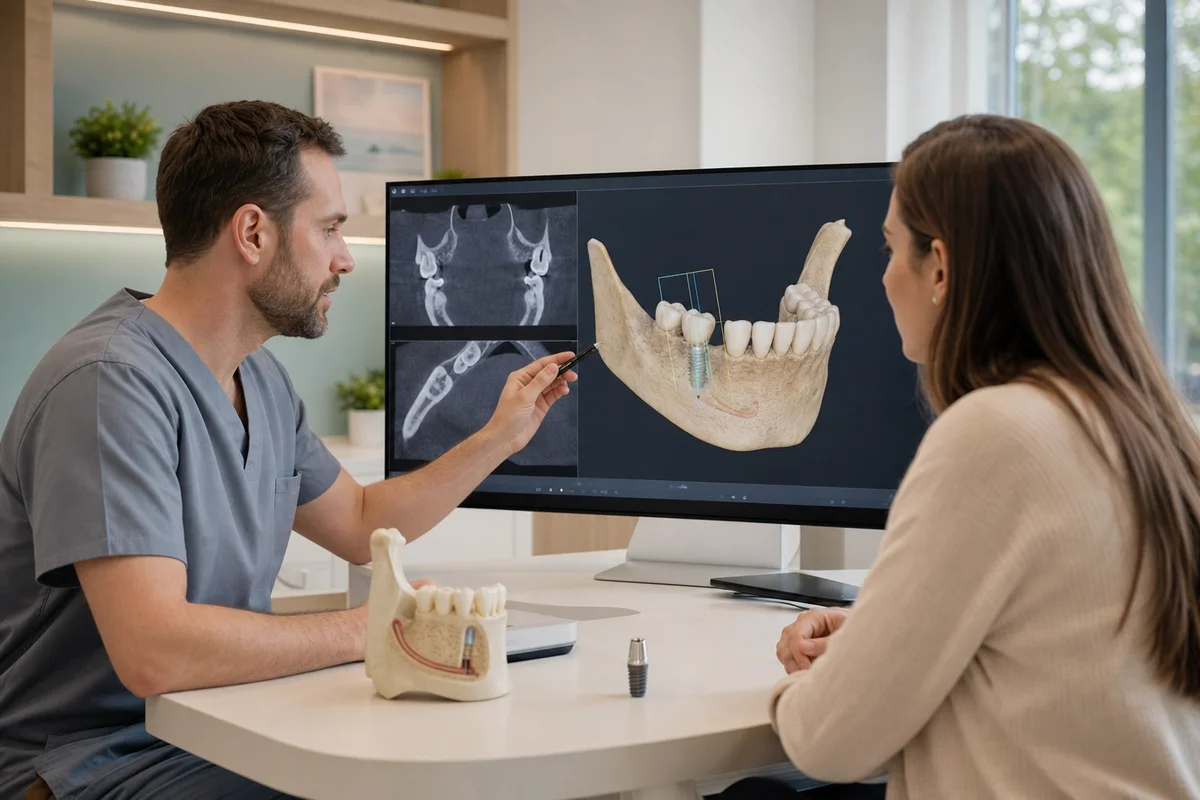
Quick answer: how much bone needed for dental implant has no universal millimetre answer. A dentist must assess ridge height, width and shape, nearby nerves or sinuses, bone quality, gum condition, the intended tooth position and the selected implant. A clinical examination and appropriately justified cross-sectional imaging are needed before deciding whether placement, augmentation, a different implant design or another restoration is safer.
If you are asking how much bone needed for dental implant, the most useful starting point is to replace the idea of one minimum number with a three-dimensional planning question. Bone must surround and support an implant in a position that can carry a cleanable, functional crown or bridge. A ridge may look tall on a panoramic image yet be too narrow, concave or close to a nerve. Another site may have limited height but offer a carefully planned alternative that avoids a larger graft. Only the treating team can decide after examining the mouth and relevant images.
This guide explains what clinicians measure, why two people missing the same tooth may receive different plans, and when grafting enters the discussion. It is educational rather than diagnostic. It does not tell you whether you personally have enough bone, prescribe an implant size or replace an individual risk–benefit conversation. For a site-specific review, Redent Klinik can explain the examination and planning pathway through its English contact page.
1. Why how much bone needed for dental implant is not one fixed number
An implant is not selected first and then squeezed into whatever bone happens to be present. Contemporary planning begins with the tooth that needs to be replaced: where its biting surface, contact points and gum line should be, how it will meet the opposing teeth, and whether the result can be cleaned. The planned restoration guides a preferred three-dimensional implant position. The clinician then asks whether the available hard and soft tissues can support that position safely.
The answer to how much bone needed for dental implant therefore changes with the tooth site, intended restoration, implant dimensions, ridge contour and neighbouring anatomy. A narrow lateral incisor space is different from a broad molar space. A single crown is different from a fixed full-arch bridge. An implant next to natural roots creates different constraints from one in a toothless region. Product-specific instructions, surgical experience and the patient’s health also matter.
A number found online may describe a study, a particular implant, a specific surgical protocol or an expert preference. It is not a personal clearance for surgery. Safe planning needs enough information to answer three separate questions: can an implant be placed in the restorative position, can vital structures be protected, and can the surrounding tissues be maintained and cleaned after treatment?
2. How much bone needed for dental implant includes height, width and contour
Patients often hear “bone height” because vertical measurements are easy to imagine. Height is important, but it is only one axis. Clinicians also assess buccolingual width—the amount of ridge from the cheek or lip side to the tongue or palate side—and the ridge’s cross-sectional shape. A ridge can be knife-edged, undercut, tilted or uneven. Its crest may appear wide while narrowing rapidly below the surface.
For how much bone needed for dental implant, three-dimensional volume and distribution matter more than a single line on an image. The desired implant should not be positioned outside the bony envelope simply to avoid a graft, because an off-axis implant may force a compromised crown shape, thin tissue coverage or difficult hygiene. Conversely, a short or narrow implant may be an evidence-supported option in selected sites, but it is not automatically appropriate for every bite or restoration.
- Height: the vertical space between the ridge crest and an anatomical boundary such as a nerve canal, sinus or nasal floor.
- Width: the facial-to-lingual or facial-to-palatal dimension around the intended implant position.
- Contour: concavities, undercuts, slopes and local defects that can change the safe path of drilling.
- Mesiodistal space: room between neighbouring roots, teeth or implants for a biological and restorative result.
- Bone distribution: whether support exists where the implant must sit, rather than somewhere else in the ridge.
3. The crown position comes before the answer to how much bone needed for dental implant
A well-integrated implant can still support a poor restoration if its position is dictated only by the available bone. Implant dentistry is therefore usually restoration-driven. The clinician or restorative dentist plans the future crown or bridge, then evaluates the bone underneath that virtual tooth. This sequence helps align the implant with chewing forces, emergence profile, speech, appearance and cleaning access.
When someone asks how much bone needed for dental implant, a clinically meaningful answer should identify the proposed final restoration. A central incisor needs careful facial tissue support and a natural emergence from the gum. A molar must accommodate load and crown width without creating an uncleanable overhang. A full-arch bridge needs implant distribution, prosthetic space and a maintenance design, not merely several isolated pockets of bone.
Digital planning may combine surface scans, photographs and cross-sectional imaging. A virtual implant can be placed under the proposed tooth to test the relationship with the ridge and vital structures. This is still a planning aid, not a guarantee. Findings during surgery, tissue quality, healing and adherence to aftercare can alter the final sequence.
4. How clinicians assess how much bone needed for dental implant
The assessment starts with history and examination. The dentist reviews why the tooth was lost or needs removal, previous gum disease or infection, healing after earlier surgery, current medications, smoking or vaping, diabetes control, immune or bleeding concerns and any history of radiotherapy or antiresorptive medication. None of these facts should be hidden, because they can change the balance of benefits, risks and timing.
The clinical examination evaluates the missing-tooth space, bite, jaw relationship, mouth opening, gum health, tissue thickness, keratinised tissue, ridge contour and hygiene. Existing teeth are checked for disease and restorability. A probe, diagnostic cast or intraoral scan can supply information that an X-ray cannot. The question how much bone needed for dental implant cannot be answered from a photograph of a smile alone.
Radiographs are selected for a reason, not as a blanket routine. The joint ADA–FDA selection guidance says imaging should follow the history and clinical examination and should be ordered when the expected information may affect care. The FDA notes that dental cone-beam computed tomography, or CBCT, can provide three-dimensional information but generally exposes a patient to more radiation than conventional dental X-rays. The field of view and exposure should therefore be justified and optimised for the clinical question.
5. CBCT and how much bone needed for dental implant
The American Academy of Oral and Maxillofacial Radiology position statement recommends cross-sectional imaging for the assessment of implant sites and identifies CBCT as the method of choice for obtaining that information. Cross-sectional views can show ridge dimensions and relationships that a two-dimensional panoramic image can obscure through magnification, distortion or superimposition.
CBCT can help assess how much bone needed for dental implant by showing the ridge slice by slice and in three planes. It may reveal a facial concavity, the course of the lower-jaw canal, the mental foramen, the floor of the maxillary sinus, adjacent roots and local pathology. The scan should be interpreted in the context of the clinical examination, and the entire captured volume should be reviewed by an appropriately trained professional.
Imaging software measurements are not self-validating. Image quality, patient movement, voxel size, artefacts, field of view, calibration and landmark identification can affect interpretation. A screenshot sent through a messaging app is not equivalent to the original diagnostic dataset. The clinician also needs to know the proposed implant and restoration, because an isolated measurement without a planned trajectory does not answer the treatment question.
6. How much bone needed for dental implant changes by anatomical zone
Jaw anatomy is not uniform. In the front upper jaw, the facial bone can be thin and the appearance of the gum line is especially important. After extraction, the ridge can remodel. If the facial plate or soft-tissue profile is deficient, the discussion may involve socket preservation, early placement, guided bone regeneration or a staged graft. Immediate placement does not stop all post-extraction modelling and should not be promised simply because the socket is visible.
In the posterior upper jaw, how much bone needed for dental implant is influenced by the maxillary sinus. The amount and quality of bone below the sinus, sinus health, ridge width, implant plan and surgical approach all matter. Some patients may be considered for a short implant; others may need a sinus augmentation or a different restorative plan. A sinus procedure is not interchangeable with routine ridge widening.
In the posterior lower jaw, the inferior alveolar canal and its nerve are major planning landmarks. In the premolar region, the mental foramen and possible anterior loop require attention. The front lower jaw has different anatomical and prosthetic constraints, especially for a full-arch restoration. Safety cannot be reduced to subtracting a generic online margin from a panoramic measurement.
7. How much bone needed for dental implant: quantity is not quality
Quantity describes available dimensions and volume. Quality is a broader clinical concept that includes cortical thickness, internal trabecular pattern and the way the site provides mechanical engagement during preparation. A large volume of relatively low-density posterior upper-jaw bone may behave differently from a smaller volume of denser anterior lower-jaw bone. Neither description by itself predicts healing.
When discussing how much bone needed for dental implant, clinicians also consider whether primary stability can be achieved without unsafe compression or a compromised trajectory. Primary stability is the mechanical stability at placement; osseointegration is the biological healing process that follows. High insertion resistance is not automatically better, and low density does not automatically make treatment impossible. Preparation technique, implant design, loading protocol and the restoration all interact.
Bone “quality” cannot be diagnosed reliably from a marketing label or visual impression alone. CBCT grey values are not universally interchangeable with medical CT density units, and clinical judgement remains necessary. A responsible plan describes uncertainty and contingency options rather than promising a fixed outcome from an image.
8. What happens when how much bone needed for dental implant is not available
Insufficient bone for the ideal position does not lead to one automatic procedure. The options depend on the type and size of the defect, the tooth region, the desired restoration, soft tissues, health factors, patient preferences and clinician expertise. In some cases, a modest contour augmentation can be performed with implant placement. In others, a staged augmentation is safer. Some patients may reasonably prefer an alternative restoration that avoids grafting.
The American Academy of Periodontology explains that ridge modification can rebuild an inadequate ridge with bone or bone substitute and that implant placement may occur at the same time in selected cases or after healing in others. The European Federation of Periodontology likewise notes that bone grafts or guided regeneration may be needed to increase jaw width or height. These procedures add surgery, healing, cost and their own risks; they are not minor extras to add without consent.
- Guided bone regeneration: a graft material and barrier membrane may be used to protect a space for bone formation.
- Ridge preservation: performed around extraction to limit, not abolish, dimensional change and support later planning.
- Horizontal augmentation: aims to increase ridge width where the restorative implant position lacks facial or lingual support.
- Vertical augmentation: addresses height deficiency and can be more complex and technique-sensitive.
- Block grafting: may be considered for selected larger defects and has donor-site and fixation considerations.
- Sinus augmentation: raises the sinus membrane to create a grafted compartment in selected posterior upper-jaw sites.
9. A decision table for how much bone needed for dental implant
This table is a conversation aid, not a treatment algorithm. The same apparent finding can lead to different plans after the full clinical and radiographic assessment.
| Planning finding | What the team must clarify | Possible discussion—not a prescription |
|---|---|---|
| Adequate height but narrow ridge | Facial and lingual contour, restoration position, soft-tissue coverage and defect size | Simultaneous contour graft, staged horizontal augmentation, a validated narrower implant or another restoration |
| Reduced posterior upper-jaw height | Sinus anatomy and health, ridge width, implant selection, load and clinician experience | Short implant, internal or lateral sinus approach, staged care or non-implant option |
| Reduced posterior lower-jaw height | Nerve canal position, ridge width, prosthetic space, implant length and risk tolerance | Short implant, alternative distribution, grafting in selected cases or another prosthesis |
| Facial defect in the visible zone | Three-dimensional implant position, gum phenotype, smile line and expected tissue support | Early or staged placement, hard- and/or soft-tissue augmentation, or a tooth-supported alternative |
| Fresh extraction socket | Socket walls, infection control, soft tissue, primary stability and restorative position | Immediate, early or delayed placement; ridge preservation; or staged regeneration |
| Full-arch plan | Bone distribution across the arch, prosthetic space, cleansability, bite, lip support and fallback strategy | Different implant number or angulation, augmentation, removable overdenture, staged treatment or preservation of suitable teeth |
10. Immediate placement and how much bone needed for dental implant
An implant placed on the day of extraction still needs a stable restorative position and adequate anatomy. The socket shape does not dictate the correct implant position, and a visible gap around an implant does not automatically mean the facial plate is protected. The International Team for Implantology notes that immediate placement carries specific risks and that site and patient risk assessment is required.
For how much bone needed for dental implant immediately after extraction, the team examines intact socket walls, facial bone, tissue phenotype, infection control, apical and palatal or lingual bone for stability, and the ability to make an appropriate temporary restoration. If these conditions are unfavourable, early or delayed placement may be more predictable. Waiting is not a failure; it can be an intentional safety choice.
Ridge preservation may reduce dimensional change after extraction, but it does not guarantee that no later graft will be needed. Similarly, placing an implant immediately does not prevent normal remodelling. Consent should cover the possibility that the final plan changes when the tooth is removed and the site is directly inspected.
11. Health factors behind how much bone needed for dental implant
Bone dimensions are only part of candidacy. Active periodontal disease, untreated decay, poor plaque control or an unstable bite should be addressed as part of the plan. Smoking and vaping can affect healing and peri-implant risk. Diabetes should be discussed with the dental and medical teams, including current control and medications. A history of radiotherapy to the jaws or medicines affecting bone metabolism requires individual medical coordination.
These factors do not create a simple yes-or-no rule for how much bone needed for dental implant. They influence infection risk, wound healing, graft choice, timing, maintenance and whether an alternative is more proportionate. Patients should provide a complete medication list, including injections and infusions, and report allergies, sleep apnoea, bleeding disorders, immune conditions and previous implant or graft complications.
Long-term maintenance also matters. An implant restoration must be cleanable, monitored and repaired when necessary. Bone is not merely required for the operation; peri-implant tissues must be protected through daily hygiene, professional review and management of risk factors. The World Health Organization’s oral-health overview reinforces prevention and management of common oral diseases as part of overall health.
12. How much bone needed for dental implant for one tooth versus a full arch
A single implant must relate precisely to two neighbouring teeth or spaces and the opposing bite. Root proximity, crown width, contact points and the visible gum line can constrain the placement. In a full-arch case, the team evaluates the distribution of several implants, anterior–posterior spread, available restorative space, jaw relationship, lip support and whether the prosthesis can be cleaned.
That is why how much bone needed for dental implant cannot be multiplied by the number of missing teeth. Full-arch solutions do not necessarily require one implant per tooth, and fewer implants are not automatically safer or more economical over a lifetime. Implant number, position, angulation and the bridge design must work as one system. If natural teeth may be maintainable, their prognosis and alternatives should be assessed before irreversible extraction.
For an overview of implant and restorative care pathways, visit the Redent Klinik English site. A remote review may help organise records and questions, but definitive suitability still depends on a clinical examination and diagnostic-quality imaging.
13. How much bone needed for dental implant with short or narrow designs
Modern implant systems include different lengths, diameters, shapes, surfaces and connections. ITI consensus statements recognise that short implants can be a valid option in selected reduced-height posterior sites and that narrow-diameter implants may reduce or simplify lateral augmentation in selected narrow ridges. Those statements do not mean the smallest product is always the best solution.
The question how much bone needed for dental implant must still include load, crown dimensions, implant material and design, anatomical safety, bone quality, parafunction, restoration type, maintenance and the evidence for the proposed product. A narrower implant may create mechanical or prosthetic limitations in one site yet be appropriate in another. A short implant may avoid an anatomical structure but still require sufficient width and a suitable loading strategy.
Ask the clinician to name the proposed implant dimensions and explain why they fit the restorative plan. The response should include alternatives, not merely a product claim. Manufacturer instructions and local regulations must be followed, and no online guide can substitute for those responsibilities.
14. Why online photos cannot show how much bone needed for dental implant
A photograph can show a missing-tooth space, gum contour or visible swelling, but it cannot show internal ridge width, root position, nerve canals or sinus boundaries. A panoramic image provides a broad overview, yet it is two-dimensional and may magnify or superimpose structures. A cropped screenshot also loses calibration and diagnostic context.
Therefore how much bone needed for dental implant should not be answered from a selfie, a photograph of a plaster model or an uncalibrated image. Remote screening can identify what records may be needed and whether an in-person assessment is appropriate. It cannot safely authorise surgery, rule out pathology or promise that grafting will not be required.
Be cautious if a provider offers a final implant plan, fixed graft promise or guaranteed immediate placement before reviewing the health history, mouth, bite and suitable imaging. A provisional plan can be useful, but its assumptions and possible changes should be written clearly.
15. Questions to ask about how much bone needed for dental implant
A good consultation about how much bone needed for dental implant should make the plan understandable without turning complex anatomy into false certainty. Bring existing original images and reports, but allow the clinician to decide whether they are recent, complete and diagnostically suitable. Ask who will interpret any CBCT, who will perform grafting if needed and who is responsible for the final restoration and maintenance.
- What final tooth or bridge position are you planning, and how does the implant support it?
- Which dimensions and anatomical boundaries are limiting this site?
- Why is the recommended imaging necessary, and can the field of view be limited?
- Is the bone deficiency mainly horizontal, vertical, combined or related to the sinus?
- Can implant placement and augmentation occur together, or is staged healing safer?
- What graft material and membrane are proposed, and what are their alternatives and risks?
- Could a validated short or narrow implant be considered, and what trade-offs would it create?
- What might cause the plan to change during surgery?
- How will the temporary restoration avoid harmful pressure while tissues heal?
- What maintenance, warning signs and local emergency arrangements are required?
16. How much bone needed for dental implant can change treatment timing
Some augmentation can be performed at implant placement; other defects need a separate operation and healing phase. Timing depends on defect size, graft stability, soft-tissue closure, infection control, implant stability and the restoration. Broad website timelines should not be treated as a personal schedule or travel guarantee.
If how much bone needed for dental implant leads to a staged plan, request a written sequence. It should distinguish extraction, ridge preservation, augmentation, implant placement, uncovering when required, temporary restoration, definitive restoration and maintenance. Ask which milestones depend on clinical or radiographic healing rather than a calendar date.
Healing cannot be rushed to meet a return flight or social event. Swelling or discomfort alone does not prove integration, and the absence of pain does not confirm that a graft or implant is ready to load. Review appointments are part of the treatment, not optional extras.
17. Planning dental travel around how much bone needed for dental implant
Travelling for implant care adds coordination. Original imaging, medical information and a restorative plan should be shared securely before travel where possible. Confirm whether the preliminary opinion may change after examination, who performs each stage, how many visits are realistically expected and what happens if healing takes longer than planned.
For how much bone needed for dental implant, do not accept a travel package as a substitute for anatomical assessment. An itinerary should remain flexible until diagnostic records are reviewed. Written consent should separate essential treatment from optional additions, identify the implant and graft materials, and explain who will provide urgent help after you return home.
Before booking, ask whether a local dentist is willing and able to provide routine maintenance, and how records, component information and radiographs will be transferred. Confirm the process for post-operative questions, suspected infection, altered sensation, sinus symptoms, exposed graft material, a loose temporary restoration or an implant that feels mobile. Urgent symptoms require prompt local assessment rather than waiting for an online reply.
18. Alternatives if how much bone needed for dental implant cannot be achieved
An implant is one way to replace teeth, not an obligation. Depending on the condition of neighbouring teeth and the number and location of missing teeth, alternatives may include a tooth-supported fixed bridge, resin-bonded bridge, removable partial denture, complete denture or implant-retained removable overdenture. In a visible space, an interim removable tooth may be appropriate while tissues heal.
If the answer to how much bone needed for dental implant would require surgery whose burden or risk does not match the expected benefit, a non-implant option can be a rational choice. A bridge may involve neighbouring teeth; a removable prosthesis has different comfort, support and maintenance needs. Each option should be compared for invasiveness, tooth preservation, hygiene, repairability, appearance, function, timeline and long-term review.
No alternative guarantees a result or remains maintenance-free. The aim is informed preference after a clinician explains realistic benefits, limitations, risks and the consequences of doing nothing.
19. Frequently asked questions about how much bone needed for dental implant
Can a dentist tell how much bone needed for dental implant from a panoramic X-ray?
A panoramic X-ray can provide a useful overview, but it is two-dimensional and subject to magnification and superimposition. It may not show ridge width or a facial concavity reliably. AAOMR recommends cross-sectional imaging for implant-site assessment, while FDA guidance emphasises that CBCT should be justified for the individual clinical question. The dentist must combine appropriate imaging with the examination and restorative plan.
Does how much bone needed for dental implant always mean a graft?
No. Some sites have a bony envelope that permits restoration-driven placement without augmentation. Others have a local contour defect that may be managed at placement, while larger or complex deficiencies may need staged grafting. The need depends on where the bone is relative to the intended implant, not simply whether the ridge looks small.
Can how much bone needed for dental implant be measured before extraction?
Pre-extraction records can support planning, but the final condition of socket walls, infection, soft tissue and stability may not be fully known until the tooth is removed. Extraction also begins a healing and remodelling process. A responsible consent discussion includes immediate, early and delayed options and explains what findings could change the plan.
Can how much bone needed for dental implant change with short implants?
Short implants can be considered in selected sites with reduced height and may reduce the need for an augmentation procedure, according to ITI consensus guidance. They still require adequate three-dimensional positioning, width, stability, restorative design and maintenance. They do not eliminate all surgical or mechanical risks, and their suitability is site- and patient-specific.
Does how much bone needed for dental implant depend on density?
No. Bone density affects preparation and stability, but more density is not automatically safer. Excessive compression can be undesirable, and lower-density bone can still be treated with an adapted plan. The clinician considers dimensions, quality, implant design, surgical technique and loading together rather than ranking one jaw region as universally good or bad.
What if how much bone needed for dental implant is adequate only in height?
That is a common example of why how much bone needed for dental implant is three-dimensional. The options may include horizontal augmentation, a different implant design within evidence and manufacturer guidance, a revised restorative approach or a non-implant restoration. The ridge contour and required facial and lingual support must be reviewed, not just the total width at one point.
Can gum thickness change how much bone needed for dental implant?
Hard and soft tissues have different roles. Soft-tissue augmentation may improve tissue volume, keratinised mucosa or appearance in selected cases, but it does not replace the bone needed for a safe implant trajectory and support. Some plans require hard-tissue augmentation, soft-tissue augmentation, both or neither. The visible gum line should be planned with the underlying anatomy.
Which warning signs matter after assessing how much bone needed for dental implant?
Contact the treating clinic promptly for worsening rather than improving pain or swelling, fever, pus, persistent bleeding, an opening wound, exposed material, new or persistent altered sensation, sinus fluid passage, a loose implant or restoration, difficulty swallowing or breathing, or any symptom the team identified as urgent. Breathing or swallowing difficulty and rapidly spreading swelling require emergency assessment.
20. The safe conclusion on how much bone needed for dental implant
The safest answer to how much bone needed for dental implant is not a universal threshold. It is enough three-dimensional bone, in the right location and quality, to place the selected implant under a functional and cleanable restoration while respecting vital anatomy and maintaining tissues. That answer requires a health history, clinical examination, restoration-driven plan and appropriately justified imaging.
If bone is deficient, the plan might involve simultaneous or staged augmentation, ridge preservation, sinus treatment, a validated short or narrow implant, a different distribution of implants or a non-implant restoration. The choice should follow a written explanation of risks, alternatives, timing, materials, maintenance and what could change. A careful plan protects patients better than an attractive one-number promise.
Sources
- US Food and Drug Administration: dental cone-beam computed tomography
- FDA and ADA: selection of patients for dental radiographic examinations
- American Academy of Oral and Maxillofacial Radiology: implant imaging position statement
- International Atomic Energy Agency: radiation protection in dental radiology
- American Academy of Periodontology: ridge modification
- American Academy of Periodontology: dental implant procedures
- International Team for Implantology: horizontal ridge augmentation consensus
- International Team for Implantology: post-extraction implant consensus
- International Team for Implantology: short implant consensus
- European Federation of Periodontology: dental implants and bone grafting
- American Dental Association
- World Health Organization: oral health fact sheet