
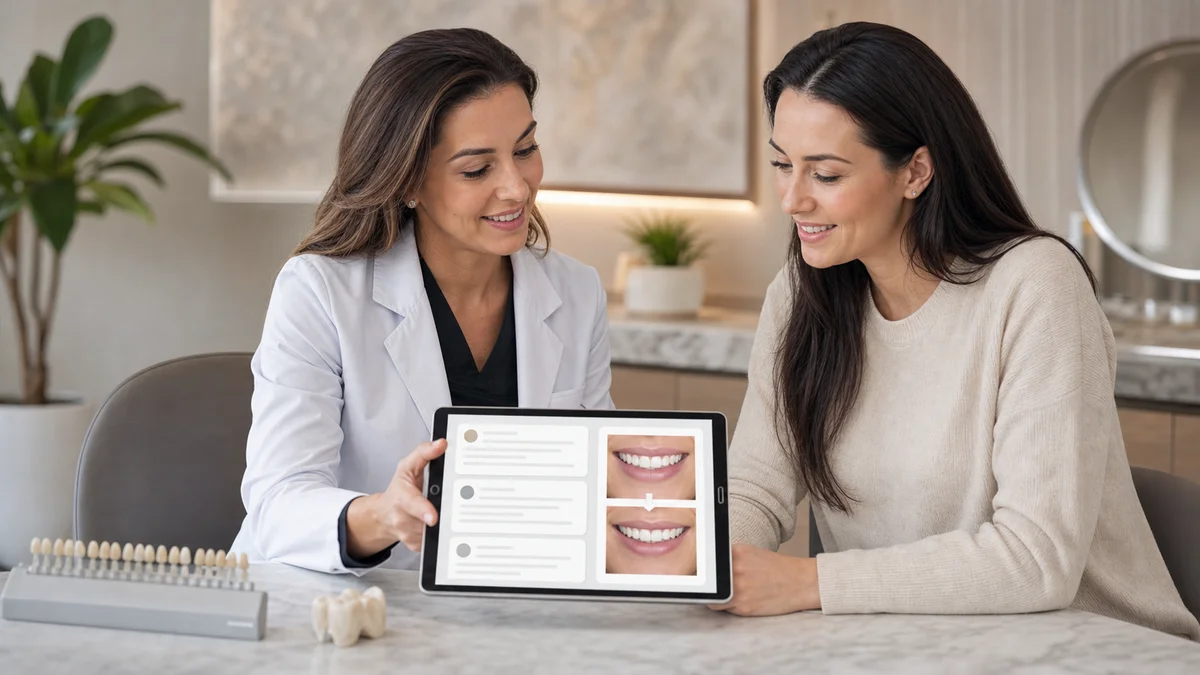
Quick answer: Veneers reviews are useful for identifying questions, communication patterns and aftercare themes, but they cannot establish whether veneers are right for you. Compare recent, detailed feedback across independent sources; verify the dentist, material, treatment scope and follow-up; and request an examination before making a decision. Treat dramatic promises, anonymous perfection and pressure to book as warning signs.
Reading veneers reviews can feel like looking through a window into another patient’s treatment. A thoughtful account may explain how the consultation felt, whether options were discussed, how temporary restorations were managed and what happened after the final fitting. Yet a review is still one person’s account, written for an audience that cannot see the clinical records, the starting condition of the teeth or the compromises discussed in the surgery.
That distinction matters. Veneers are thin restorations placed over the front surface of teeth, usually to change colour, contour, proportion or the appearance of minor irregularities. They may be made from porcelain or resin composite. They are not a universal answer to every cosmetic concern, and when enamel is removed, the treatment is not reversible. The American Dental Association’s patient resource also notes that decay or gum disease should be treated before veneers are considered. That is why veneers reviews should support a consultation, never replace one.
This evidence-led guide shows how to separate useful signals from persuasive noise. It does not diagnose your teeth or recommend a particular procedure. Instead, it gives you a repeatable way to read feedback, examine before-and-after images, compare clinics and ask safer questions. Every final recommendation should follow an in-person assessment, appropriate records and a conversation about alternatives, limitations and long-term maintenance.
Why Veneers Reviews Help—and Where They Can Mislead
Good veneers reviews reveal aspects of care that a treatment page cannot fully demonstrate. Patients can describe whether staff explained the sequence clearly, answered questions without pressure, offered a written plan and remained available when an adjustment was needed. Repeated themes across many detailed accounts may help you decide which questions deserve extra attention during a consultation.
However, popularity is not clinical suitability. A five-star rating does not show enamel thickness, bite forces, gum health, active decay, tooth grinding or whether another option could preserve more natural tooth tissue. It also cannot prove that the reviewer received the same material, clinician, laboratory, preparation design or follow-up you are considering. Even an honest story can be irrelevant to your mouth.
Online veneers reviews also contain selection bias. People with an exceptionally positive or negative experience may be more motivated to post than those whose treatment was uneventful. Platforms use different moderation and verification systems. Some reviewers update an account after months; others comment immediately after a smile reveal, before function, gum response and maintenance can be evaluated. Read the timing as part of the evidence.
- Useful signal: specific descriptions of consultation quality, consent, temporaries, comfort, adjustments and follow-up.
- Weak signal: a rating with no treatment details, date, clinician or context.
- Potential red flag: guaranteed language, identical wording across profiles, unexplained urgency or attacks on every alternative.
- Clinical gap: no review can determine your diagnosis, candidacy or safest treatment design.
A 12-Point Decision Table for Assessing Veneers Reviews
Use the table below as a practical filter. One missing detail does not prove that feedback is false, and one convincing story does not prove that a clinic is right for you. The aim is to evaluate patterns rather than hunt for certainty in a single post.
| Test | More useful evidence | Reason for caution | Question to ask the clinic |
|---|---|---|---|
| 1. Specificity | Explains consultation, material, stages and follow-up | Only says “perfect” or “best ever” | Can you give me a written step-by-step plan? |
| 2. Timeline | Includes early experience and a later update | Posted only at the final reveal | What reviews and maintenance occur after fitting? |
| 3. Treatment scope | States how many teeth and which concerns were addressed | Uses “full smile” without definition | Which teeth, if any, would you propose treating and why? |
| 4. Material | Distinguishes porcelain from direct or indirect composite | Calls every restoration “a veneer” | What material and laboratory process are proposed? |
| 5. Preparation | Acknowledges tooth preparation was case-specific | Promises “no shaving” for everyone | Would enamel be removed, and can you show me where? |
| 6. Alternatives | Mentions whitening, alignment, bonding or no treatment | Presents veneers as the only option | What less invasive alternatives apply to my goals? |
| 7. Images | Similar light, angle and expression with several views | Heavy filters, cropped gums or one distant image | May I see unfiltered cases with a similar starting point? |
| 8. Clinician | Names the treating dentist and clinic accurately | Credits only a coordinator or brand | Who will examine, prepare and fit my restorations? |
| 9. Consent | Describes risks, limitations and maintenance | Claims risk-free or lifetime-perfect results | Which risks are material in my case? |
| 10. Cost context | Explains what was and was not included | Quotes a universal headline price | What does my written estimate include and exclude? |
| 11. Independence | Disclosure of discounts, gifts or clinic relationship | Hidden incentive or repeated promotional script | How do you request, verify and display reviews? |
| 12. Problem handling | Explains how questions or adjustments were managed | Every concern is dismissed or removed | What is the process if I need an adjustment? |
Save the questions that matter to you and take them to your appointment. A responsible clinician should be able to explain uncertainty and patient-specific trade-offs. If the answers do not match what you inferred from veneers reviews, the clinical explanation and documented findings deserve more weight than a stranger’s rating.
How to Check Whether Veneers Reviews Look Authentic
The US Federal Trade Commission’s rule on consumer reviews and testimonials took effect in October 2024. It addresses practices such as fake or false reviews, buying reviews that express a required sentiment, certain undisclosed insider reviews, review suppression and false claims that a review site is independent. The rule does not make every vague or enthusiastic review fake, but it reinforces a simple principle: incentives, relationships and moderation practices affect how evidence should be interpreted.
Look for lived detail, not just polished emotion
Authentic veneers reviews often contain ordinary, verifiable detail: the reviewer had records taken, compared a preview, wore temporaries, returned for a bite check or needed time to adapt. False feedback can also contain detail, so this is not a proof test. It merely gives you more claims to compare with the clinic’s actual process.
Be cautious when multiple profiles use the same unusual phrases, publish in a tight cluster or describe identical outcomes without any individual context. Search a distinctive sentence in quotation marks. Check whether the profile has a plausible history, while respecting that a new or private profile may still belong to a genuine patient. Authenticity is a probability assessment, not a verdict based on one clue.
Check incentives and relationships
A reviewer may have received a discount, free upgrade, referral reward or other benefit. That does not automatically invalidate the account, but disclosure helps readers judge it. Influencers, staff, relatives and business partners can have relevant experiences while also having a relationship that should be clear. When reading veneers reviews, look for plain-language disclosure near the claim, not hidden in an unrelated profile page.
Compare independent and clinic-controlled channels
A clinic website naturally selects what it features. Treat its veneers reviews and testimonials as examples, then compare them with established third-party platforms, professional registration information and the clinic’s public responses to criticism. No platform is immune to manipulation. Agreement across genuinely independent sources is more informative than the number of stars on one page.
Read how the clinic responds to concerns
A professional response should protect confidentiality. A clinic cannot publicly reveal clinical details simply to win an online argument, so a brief invitation to discuss the matter privately may be appropriate. Look for courtesy, a clear route to contact and signs that feedback is taken seriously. Avoid expecting a public diagnosis or disclosure of protected health information.
What Before-and-After Photos Can and Cannot Prove
Images are often the most persuasive part of veneers reviews, but photographs are not complete clinical records. Camera distance, lens, lighting, lip position, hydration, exposure, tooth dryness and editing can change how colour and proportion appear. A close crop may hide the bite, gum line or untreated teeth. A single frontal smile cannot show all margins or functional contacts.
First verify that the images appear to show the same patient. Look for stable facial landmarks, tooth positions and soft-tissue features, while allowing for intentional changes. Then compare angle, magnification and lighting. A credible case gallery usually includes several views and explains the treatment without implying that another patient will receive the same result.
Ask whether the images show the treating dentist’s own work, whether the patient consented to publication and how long after treatment the final photograph was taken. A same-day photograph may demonstrate design and colour, but it cannot show longer-term maintenance. When veneers reviews include images, distinguish documentation from advertising polish.
- Request frontal smile, retracted front and side views where appropriate.
- Look for natural variation, translucency and proportions that suit the individual face.
- Check whether gum levels and tooth edges are visible instead of heavily cropped.
- Ask about material, number of restored teeth and any additional whitening or alignment.
- Do not assume a photograph proves comfort, bite stability, hygiene access or longevity.
Clinical Facts Missing From Most Veneers Reviews
A review describes an experience; a diagnosis explains the condition. The two are not interchangeable. According to the ADA’s patient information, veneers cover the front surface of teeth and may be porcelain or composite. When enamel must be removed, the treatment is not reversible. Veneers can chip, crack, wear or loosen, and clenching, grinding or a deep overbite may affect suitability. These points rarely fit into a star rating.
Oral health must come before cosmetic treatment
The World Health Organization describes dental caries and severe periodontal disease among the major oral-health burdens globally. For an individual considering elective treatment, the practical message is straightforward: active disease needs assessment and appropriate care before cosmetic planning. Healthy gums, manageable decay risk and sustainable hygiene are more important than copying an online smile.
A clinical examination may include gum assessment, decay screening, radiographs when justified, bite evaluation and a discussion of habits such as grinding. The exact records depend on the patient and local standards. Veneers reviews cannot reveal these findings, even when the reviewer’s starting smile seems similar to yours.
“No-prep” is not a promise for every patient
Some cases may allow minimal or no enamel reduction, while others require preparation to create space, control contour or manage existing restorations. Adding material without adequate planning can make teeth look bulky or create difficult-to-clean transitions. Ask the dentist to show the proposed change on your own records and describe where tooth tissue would be altered.
Any claim that one technique is suitable for everyone deserves caution. Ethical veneers reviews should not be interpreted as evidence that the reviewer’s preparation design can simply be copied. Your tooth position, enamel, shade, existing fillings and aesthetic goals can change the plan.
Veneers require maintenance and may require replacement
Restorations exist in a changing biological environment. Gums can recede, teeth can move, materials can wear and habits can create repeated stress. Home care, professional reviews, diet, risk control and protective appliances when clinically indicated may influence maintenance. No dentist can responsibly promise that veneers will remain unchanged for life.
When reading veneers reviews, give extra weight to accounts that discuss follow-up without turning an individual timeline into a universal forecast. Ask what signs should prompt a review, who handles maintenance if you live elsewhere and what happens if a restoration chips or debonds.
Materials, Preparation and Scope: Compare Like With Like
The term “veneers” can refer to different treatments. Porcelain veneers are generally made outside the mouth and bonded at a later appointment. Composite may be placed directly or fabricated indirectly, depending on the technique. Material choice affects the clinical sequence, repair approach, aesthetics, cost structure and maintenance conversation. Veneers reviews about direct composite cannot reliably predict an experience with laboratory-made ceramic.
Treatment scope matters too. One patient may receive a single restoration to address a localised issue; another may have several visible teeth treated after alignment or whitening. Existing crowns, fillings and missing teeth can alter planning. Before comparing veneers reviews, confirm that the cases describe broadly similar materials and goals.
Ask the clinic to identify the proposed material, brand only if clinically relevant, laboratory involvement, number of teeth and reasons for that number. Request alternatives. In some situations, whitening, orthodontic alignment, edge bonding, repair of existing restorations or accepting the natural appearance may preserve more tissue. The most appropriate plan is not necessarily the one with the most restorations.
Reading Cost Claims in Veneers Reviews
Cost comments in veneers reviews attract attention because patients want to plan, but headline figures can omit essential context. The total may depend on material, number of teeth, diagnostics, temporary restorations, laboratory work, treatment of existing disease, sedation if appropriate, travel, accommodation, maintenance and future repair. Currency and date also matter. A price posted years ago may not describe today’s plan.
Use veneers reviews to build a list of questions, not to calculate your personal fee. Ask for an itemised written estimate after assessment. It should identify what is included, what could change after further records, the terms for deposits or cancellations and how unexpected clinical findings are handled. Avoid transferring money solely because a social post advertises limited availability.
A lower figure is not automatically poor value, and a higher figure is not proof of quality. Compare clinician accountability, diagnostics, material, laboratory, consent, aftercare and the practical cost of returning for adjustments. If travelling, include time away from work and a realistic contingency plan. No article or clinic can responsibly provide a fixed universal price without knowing the case.
Using Veneers Reviews When Considering Treatment Abroad
International treatment can combine dental decisions with travel decisions, so veneers reviews need both clinical and logistical context. Verify the treating dentist’s identity and registration through the relevant professional authority. Confirm who performs each stage, how many appointments are planned and whether the schedule allows time for assessment, laboratory work, try-in and adjustments. A coordinator may help with logistics, but clinical consent should involve the treating dentist.
Read veneers reviews for practical themes such as communication before arrival, clarity of the written plan, translation support, realistic scheduling and access after returning home. Do not treat airport transfers or hotel convenience as evidence of clinical quality. Separate hospitality from diagnosis and treatment.
Ask for copies of relevant records, invoices, material information and aftercare instructions. Clarify who to contact during and outside normal hours, what can be assessed remotely and which symptoms require local urgent care. Travel insurance and ordinary health insurance may have exclusions for planned treatment or complications, so read the policy and obtain advice from the insurer rather than assuming coverage.
If you are researching care in Istanbul, the Redent Clinic English homepage outlines the clinic’s approach and treatment categories. A web page is only a starting point. Use the Redent Clinic contact page to request a clinician-led assessment and written, patient-specific explanation before deciding.
Red Flags That Matter More Than a Star Rating
The tone of veneers reviews can be reassuring, but the decision process matters more. Step back if you are promised a guaranteed result, told that every tooth needs treatment without adequate records or pushed to book before speaking with the treating dentist. Be cautious if the plan changes substantially after arrival without a documented clinical reason and renewed consent.
Other warning signs include refusal to name the clinician, unclear material descriptions, no discussion of alternatives, pressure to accept irreversible preparation immediately, poor infection-control explanations, no written aftercare route or requests to keep problems off public platforms. A clinic can have some negative feedback and still respond professionally; a page of perfect ratings cannot compensate for missing safeguards.
- Guaranteed “perfect” or “lifetime” outcomes.
- A treatment count decided from a filtered selfie alone.
- No screening for decay, gum health, bite or grinding.
- Unclear responsibility between coordinator, dentist and laboratory.
- Consent documents presented only after irreversible treatment begins.
- Universal claims about painless treatment or zero preparation.
- No realistic pathway for adjustments, maintenance or urgent concerns.
A Safer Consultation Checklist After Reading Veneers Reviews
Turn your research and the patterns in veneers reviews into a structured conversation. Bring a short description of what you want to change and what you want to preserve. Mention sensitivities, previous dental treatment, medications, relevant health conditions and habits. The dentist may need more information before suggesting options, and it is reasonable for a safe plan to take more than one conversation.
Ask to review your photographs, scans, radiographs when indicated and any proposed preview. Make sure a simulation is described as a planning aid rather than a guaranteed result. Confirm how the final colour and shape will be evaluated, what temporary stage may be used and what choices remain reversible at each point.
Finally, compare the consultation with the claims you saw in veneers reviews. Did the clinician explain limitations as clearly as benefits? Were alternatives discussed? Could you ask questions without pressure? Were costs and follow-up documented? A safe decision is one you understand, not merely one that resembles someone else’s result.
- What diagnosis or clinical findings explain the recommendation?
- Would whitening, alignment, bonding, repair or no treatment meet my goals?
- Which teeth are proposed for treatment, and why those teeth?
- How much enamel, if any, would be removed from each tooth?
- What material and laboratory pathway will be used?
- What are the material risks, limitations and maintenance needs?
- How will my bite and any grinding habit be managed?
- What is included in the written estimate and aftercare plan?
- Who should I contact if I have pain, a chip or a bite concern?
Frequently Asked Questions About Veneers Reviews
Can I trust veneers reviews with verified-patient badges?
A verification badge may indicate that a platform checked a transaction, appointment or identity using its own process. It does not prove that every clinical claim is accurate, that no incentive existed or that the treatment suits you. Read the platform’s verification method and compare the account with independent information. Verified veneers reviews are one input, not a substitute for examination and consent.
How many veneers reviews should I read?
There is no clinically meaningful number that guarantees a sound decision. Read enough to identify recurring themes across dates and platforms, then stop when new posts repeat the same information. Quality, specificity and relevance matter more than volume. Spend at least as much effort checking dentist registration, treatment safeguards, written plans and follow-up as you spend scrolling.
Are negative veneers reviews always a reason to avoid a clinic?
No. Healthcare involves different expectations and outcomes, and confidentiality can limit a clinic’s public response. Look at the substance, date, pattern and response rather than one rating. Repeated reports of pressure, unclear consent, inaccessible aftercare or the same unresolved process failure deserve attention. A calm, privacy-respecting response is more reassuring than an aggressive public argument.
Do veneers reviews prove how long my veneers will last?
No. A reviewer’s timeline reflects their material, preparation, bite, habits, oral health, maintenance and many other factors. Veneers may chip, crack, wear or loosen, and future treatment may be needed. Ask for a patient-specific maintenance discussion and avoid any guarantee of a fixed lifespan or permanent result.
Can social-media before-and-after posts replace a consultation?
No. Social images cannot show decay risk, periodontal health, enamel condition, bite contacts or all alternatives. They may also use lighting, filters and selective angles. Use photographs to describe aesthetic preferences, then allow a licensed dentist to assess whether those preferences can be approached safely and conservatively.
What should a high-quality veneer testimonial include?
The most useful account explains the starting concern, material, treatment stages, communication, consent, temporaries if used, follow-up and limitations. Disclosure of any incentive or relationship is important. Even then, a testimonial remains personal experience rather than clinical evidence. Good veneers reviews help you ask better questions; they do not prescribe your care.
Should I choose the clinic with the highest rating?
Not on rating alone. Platforms calculate scores differently, and a small difference may have little practical meaning. Compare clinician credentials, diagnostic process, consent, material explanation, case documentation, hygiene, written estimate and aftercare. Choose only after you understand the proposed treatment and feel able to decline or seek another opinion.
How can I discuss veneers reviews with my dentist?
Bring two or three examples and explain what attracted or worried you. Ask whether the treatment, starting condition and material are comparable to your case. A dentist should be able to separate achievable preferences from unsuitable expectations without criticising another patient. The goal is shared understanding, not reproducing a photograph exactly.
What if the consultation does not match the online promises?
Pause. Ask for the differences and reasons in writing, especially if the number of teeth, preparation, material, clinician, schedule or fee has changed. Do not consent under time pressure. You may request records and seek an independent opinion. Your ability to reconsider is an essential part of informed decision-making.
The Bottom Line: Use Reviews to Ask Better Questions
Veneers reviews are most valuable when they make your research more precise. They can point you toward questions about communication, materials, temporaries, maintenance and problem resolution. They become unsafe when star ratings are treated as a diagnosis, filtered images as a guarantee or another patient’s preparation as a template for your teeth.
Check the source, date, specificity, incentive, images and follow-up. Compare like with like. Then bring those observations to a licensed dentist who can examine your oral health, explain alternatives and document a patient-specific plan. Taking time to understand uncertainty is not a barrier to cosmetic care; it is part of safer care.
Sources and Further Reading
- American Dental Association, MouthHealthy: Veneers
- American Dental Association
- US Federal Trade Commission: Consumer Reviews and Testimonials Rule Q&A
- US Federal Trade Commission: Featuring Online Customer Reviews
- World Health Organization: Oral Health Fact Sheet
Sources accessed 29 July 2026. This educational article is intended for review by Dentist Esma Çevrük Çakır and does not replace an individual dental examination.