
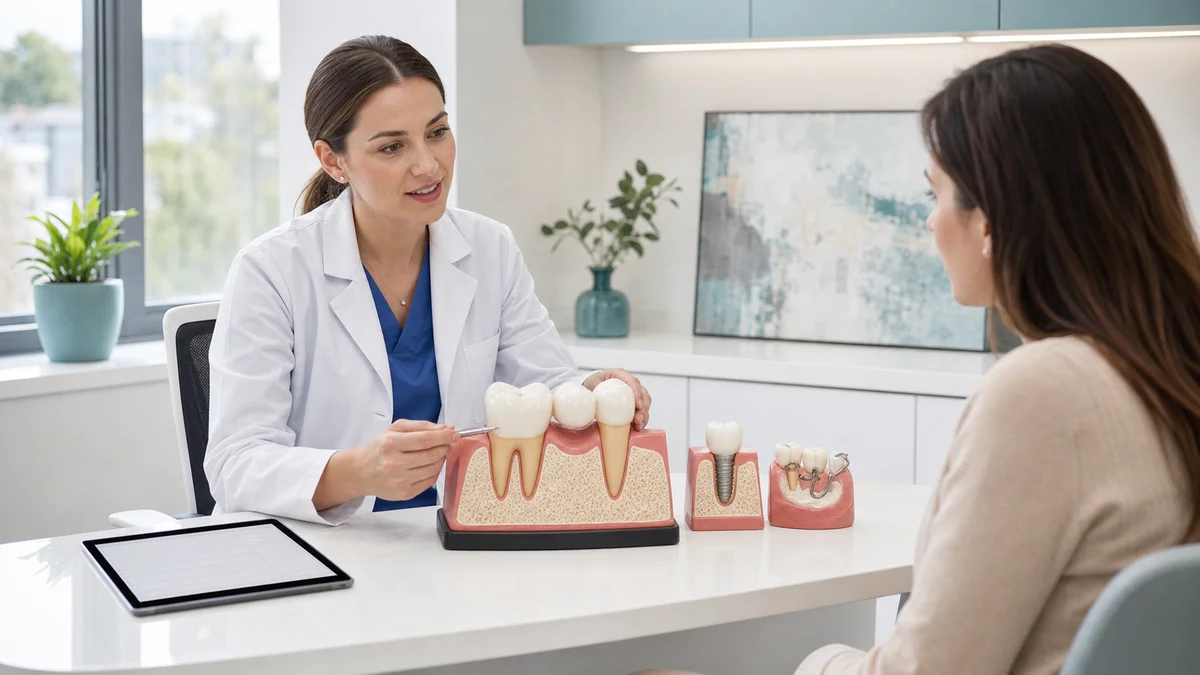
Quick answer: how much does a molar bridge cost has no safe universal answer. A quote may include two supporting retainers and one replacement tooth, but examination, imaging, decay or gum treatment, cores, root canal care, materials, laboratory work, a temporary bridge, fitting and maintenance can change the total. Compare the number of units, abutment prognosis, included services and alternatives in writing.
Searching how much does a molar bridge cost usually means a back tooth is missing or expected to be removed, and the patient wants a fixed replacement. The visible replacement tooth is only one part of a conventional bridge. The teeth next to the gap may need to be shaped and covered by retainers, while a laboratory-made false tooth, called a pontic, spans the space. In a common three-unit design, the fee therefore reflects three connected units rather than one isolated tooth.
That description is only a starting point. The gap may be at the end of the arch, there may be more than one missing molar, the potential supporting teeth may have large fillings or gum disease, or an implant-supported bridge may be considered instead. Material, laboratory, temporary protection, bite, tooth preparation and follow-up all affect scope. A remote headline cannot determine which design is safe.
This guide provides no fixed clinic fee, diagnosis or longevity guarantee. It explains how to read a molar bridge proposal, what can be billed separately, and why the condition of supporting teeth is more important than choosing a material from a price list.
1. What a molar bridge actually replaces
The American Dental Association’s MouthHealthy resource describes a fixed bridge as a replacement for one or more missing teeth that is attached to surrounding teeth for support. The artificial tooth occupying the gap is the pontic. The supporting portions are retainers, often crown-like restorations cemented to prepared teeth. A dentist removes a fixed bridge; the patient does not take it out for daily cleaning.
For one missing molar between two teeth, a conventional design may use a retainer on each adjacent tooth and one pontic. That is often called a three-unit bridge. The word “unit” matters for price because laboratories and practices may calculate or describe the restoration per retainer and pontic, not simply per gap.
However, not every molar gap can or should receive that design. A last-tooth or free-end space does not have a natural tooth behind it. The span may be too long, the supporting teeth too weak, or bite forces too demanding for a proposed cantilever. The choice requires examination, imaging and bite assessment.
2. First identify the exact bridge design
“Molar bridge” can refer to several restorations with very different preparation, components and laboratory work:
- Conventional tooth-supported bridge: one or more adjacent teeth are prepared for crown-like retainers connected to the pontic.
- Cantilever bridge: the pontic is supported primarily from one side; posterior forces and span make suitability highly case-specific.
- Resin-bonded bridge: a conservative wing or wings bond to supporting teeth; posterior indications and longevity depend on design, space and bite.
- Implant-supported bridge: implants rather than natural teeth support connected replacement teeth; surgery and implant components enter the budget.
- Bridge combined with a complex restoration: posts, cores, root canal-treated teeth or altered bite may require additional planning.
A proposal should name the design and show which teeth are supporting it. “Fixed porcelain bridge” is not enough to reveal the number of units, preparation or biological cost.
3. Supporting teeth determine whether a quote is realistic
A bridge depends on its foundation. The dentist assesses decay, filling size, cracks, remaining tooth structure, root length and shape, pulp status, mobility, gum and bone support, alignment and the load each potential abutment would carry. A beautiful pontic cannot compensate for a poorly selected foundation.
Evaluation may include clinical examination, periodontal probing, pulp tests where indicated, bite analysis and appropriate radiographs. If a potential supporting tooth has active decay or gum disease, those conditions should be stabilised before definitive bridge work. If the tooth cannot be restored predictably, including it may create a larger future failure.
Ask for the prognosis of each abutment separately. A tooth that already needs a crown may make a conventional bridge more logical than preparing an untouched neighbour, but that is not an automatic rule. Conversely, sacrificing substantial healthy enamel and dentine on sound teeth may strengthen the case for an implant or another conservative alternative.
4. how much does a molar bridge cost: decision table
The table below shows why two quotes can differ without one necessarily being wrong. It helps patients compare equivalent scope.
| Decision area | Simpler possibility | More complex possibility | Question for the quote |
|---|---|---|---|
| Span | One missing molar between two sound supports | Several missing teeth or free-end gap | How many retainers and pontics are planned? |
| Abutment condition | Stable teeth needing routine preparation | Large fillings, cracks, decay or periodontal problems | Which pre-bridge treatments are included? |
| Foundation | No core build-up needed | Core, post or endodontic care considered | Is each foundation a confirmed or conditional fee? |
| Material | Standard material appropriate for the bite | Custom multilayer, high-strength or precious alloy design | What material is used in the framework and visible surface? |
| Laboratory | Routine scan/impression and shade | Custom shade, complex bite records or specialist laboratory | Which trials, remakes and adjustments are included? |
| Temporary stage | Short-term routine temporary bridge | Longer provisional phase or repeated adjustment | What protects the prepared teeth while the bridge is made? |
| Alternative | Gap accepted or removable option | Implant crown with surgery and grafting | Was total lifetime cost compared, not only the bridge fee? |
A price comparison becomes meaningful only after each proposal fills the same rows.
5. Fourteen cost items in a complete molar bridge proposal
Not every patient requires every item. Mark each one as included, excluded or conditional:
- consultation and restorative assessment;
- periodontal and bite evaluation;
- radiographs or other records when clinically justified;
- treatment of decay or defective fillings;
- gum treatment before preparation;
- core build-up for a weakened supporting tooth;
- root canal assessment, treatment or retreatment if indicated;
- preparation of every supporting tooth;
- digital scan or conventional impression and bite record;
- temporary bridge and temporary cementation;
- retainers and pontic counted by unit;
- framework and surface material;
- dental laboratory, shade and trial stages;
- final fitting, bite adjustment, hygiene instruction and follow-up.
Insurance, travel, finance fees and future repairs sit outside this clinical list unless the proposal says otherwise.
6. Number of units is not always the number of missing teeth
A patient missing one molar may receive a three-unit conventional bridge: two retainers and one pontic. If two teeth are missing, a design could require more units and may need additional support. Long spans flex more and transfer greater load, so adding pontics is not simply a matter of paying for one more artificial tooth.
Some practices quote one total; others show a per-unit structure. Either can be transparent if the final document identifies every unit and service. Ask whether a unit price includes preparation, temporary restoration, laboratory, material and fitting or only the final laboratory restoration.
Do not use an online “per tooth” figure to calculate a bridge without knowing the retainers. It can substantially underestimate the scope or compare a pontic-only idea with a completed fixed prosthesis.
7. Why tooth preparation changes the value calculation
A conventional bridge often requires the supporting teeth to be shaped so retainers can fit over them. The University Hospitals of North Midlands patient information describes adjacent teeth on one or both sides as bridge supports and notes that preparation and impressions allow a dental laboratory to make the restoration.
Preparation removes tooth tissue and is generally irreversible. The amount depends on design, material, existing restorations and alignment. Benefits may include a fixed replacement, restoration of already damaged supporting teeth and avoidance of implant surgery. Costs include biological alteration of abutments and dependence of the connected restoration on their long-term health.
Patients should ask how much existing tooth structure is healthy, whether a less invasive bridge is feasible, and what happens if one supporting tooth later develops decay, fracture or pulpal disease. A connected bridge may need removal or replacement even when only one part has a problem.
8. Decay, cores and posts can be separate costs
Large fillings or decay may leave inadequate form to retain a bridge retainer. A core build-up can replace missing structure and create the foundation for the restoration. In a root canal-treated tooth with insufficient coronal structure, a post may sometimes be considered to retain the core. A post does not strengthen every tooth and is not automatically required.
Foundation work should be planned before the final scan or impression. If decay discovered during preparation changes the prognosis, the dentist may need to pause, revise the plan or select another abutment. The patient should see a revised explanation and estimate before additional irreversible work.
Ask whether the proposed core is a routine part of preparation or a conditional fee, what finding triggers it and whether it changes the bridge warranty or expected timeline.
9. Root canal treatment is not automatically part of a bridge
Healthy supporting teeth do not routinely need root canal treatment simply because they will receive bridge retainers. Endodontic treatment is considered when the pulp is inflamed or infected, or when another specific endodontic indication is diagnosed. Sensitivity after preparation does not by itself prove a root canal is needed, although persistent or severe symptoms require assessment.
A tooth with a previous root canal can sometimes support a bridge if its endodontic, periodontal and restorative prognosis are acceptable. The seal, remaining structure, presence of cracks and quality of the final foundation matter. Complex retreatment or uncertain healing can change whether it is a suitable abutment.
The quote should separate confirmed endodontic care from a contingency. If root canal treatment becomes necessary after the bridge is fitted, access through a retainer or bridge removal may be discussed; each option has risks and may affect the restoration.
10. Periodontal health can add treatment before the bridge
Supporting teeth need stable gums and bone. Bleeding, deep pockets, mobility, active periodontal disease or an inaccessible margin can threaten cleaning and long-term support. Periodontal treatment, healing review or redesign may be required before definitive preparation.
The pontic area also needs a cleansable tissue relationship. A shape that presses excessively on tissue or blocks cleaning can cause inflammation. A design with too much space may trap food or affect comfort. The final contour is a clinical and laboratory decision, not only a cosmetic one.
Periodontal fees should be itemised rather than hidden under “preparation.” Ask who confirms stability and what maintenance interval is recommended after placement.
11. Material affects laboratory work, strength and appearance
Dental bridges can be made from metal alloys, ceramics, porcelain fused to metal or combinations. MouthHealthy notes that bridges may use gold, alloys, porcelain or combined materials. Selection depends on bridge length, available space, bite forces, opposing teeth, appearance, preparation design, allergies and laboratory capability.
A back-tooth bridge experiences substantial chewing forces, but “strongest” is not a standalone indication. A very rigid material still depends on adequate thickness, connector dimensions, sound support and a balanced bite. Highly aesthetic layering can add laboratory stages and may behave differently from monolithic material.
Ask for both the framework and visible surface material. “Ceramic” or “zirconia” may not describe the complete construction. Brand prestige does not substitute for diagnosis, preparation, laboratory quality and fit.
12. The dental laboratory is part of the clinical result
The laboratory fabricates the bridge from the dentist’s design, records and prescription. Cost can vary with location, technician expertise, material, custom shade, digital or conventional workflow, trial stages and remake policy. A lower laboratory fee is not automatically poor, and a premium label is not a guarantee.
For a posterior bridge, the laboratory needs accurate margins, contacts, connector shape, occlusion and pontic contour. A digital scan can improve workflow in suitable cases, but it does not correct incomplete preparation, unstable gums or an inaccurate bite record. Conventional impressions can also be appropriate.
The proposal should identify whether a temporary, trial, shade visit, adjustment and remake for a verified fit issue are included. Ask who pays if new records are needed because the mouth changed during a long delay.
13. A temporary bridge protects the transition
After conventional preparation, a temporary bridge may protect teeth, maintain space, support comfort and appearance, and allow limited function while the final restoration is made. The NHS describes temporary coverage as common while laboratory crowns are prepared; bridge workflows similarly may use a temporary restoration.
Temporary material is not designed as a permanent bridge. It can loosen, fracture or wear, especially in the molar region. Follow dietary and cleaning instructions, and contact the clinic if it becomes loose or the bite feels high. Do not use household adhesive.
Ask whether the temporary bridge, recementation, repair and emergency replacement are included, and how long the provisional period is expected to last. Longer transitional use may require a more durable design and different fee.
14. Bite, clenching and available space alter the design
A molar bridge operates where chewing forces are high. The dentist assesses contact with the opposing teeth, jaw movement, bridge span, connector size and available vertical space. Clenching or grinding may increase stress on retainers, porcelain, connectors and supporting teeth.
Management can involve material selection, bite adjustment, changing the design, treating other unstable contacts or prescribing a protective appliance when indicated. A night guard is not needed by everyone and does not eliminate all risk. If recommended, ask whether it is included and when it will be made.
A bridge cannot always be thickened indefinitely for strength because space and hygiene matter. The design needs a balance between structural requirements, preparation, appearance and function.
15. Conventional, cantilever and resin-bonded fees are not comparable
A conventional bridge with two full-coverage retainers involves more tooth preparation than a resin-bonded design. A cantilever uses support from one side and changes how load is transferred. Material, retainers and laboratory steps therefore differ.
In the posterior mouth, the magnitude and direction of force can limit conservative designs. A resin-bonded or cantilever bridge that works in one location may be unsuitable for another. Selecting it only because the quoted fee or preparation is lower can create a false economy.
Request the reason the design is suitable for this gap, tooth support and bite. A diagram showing abutments and pontics is often more useful than a trade name.
16. Molar bridge versus implant crown
An implant crown can replace one missing molar without preparing adjacent teeth, but it introduces surgery, implant and abutment components, healing and possible grafting. A tooth-supported bridge can avoid implant surgery and may be quicker in selected circumstances, but it alters and links supporting teeth.
Comparison should include:
- health and restorative needs of adjacent teeth;
- bone and gum anatomy at the missing site;
- medical and surgical risk;
- time with a temporary replacement;
- implant body, abutment and crown costs;
- bridge retainers, pontic and foundation costs;
- cleaning access and maintenance;
- likely consequences if one component fails;
- travel and number of visits.
The American College of Prosthodontists notes that cost varies with patient needs and region. Its general comparison should not be read as a local price promise; only a case-specific estimate can show which pathway has the better total value.
17. Other alternatives may cost less or preserve more tissue
A removable partial denture can replace a molar without the same full-coverage preparation or implant surgery. It is removed for cleaning, can feel less fixed and may use clasps or other support. Cost and maintenance differ from a bridge.
Orthodontic space closure may be considered in selected cases, depending on age, bite, tooth positions and treatment burden. It is not a quick substitute for every molar gap. Sometimes accepting a gap with monitoring is reasonable when function, stability and tooth movement risks are acceptable. A missing wisdom tooth, for example, does not automatically need replacement.
The alternative discussion should include doing nothing and its likely consequences. Adjacent teeth may tip or opposing teeth may move, but the amount and significance are individual. Avoid replacement based solely on a generic claim that every gap must be filled immediately.
18. Insurance, coding and financing
Insurance may classify examination, radiographs, cores, root canal treatment, retainers, pontics and periodontal care separately. Benefits can depend on waiting periods, annual maximums, replacement frequency rules, missing-tooth clauses, network participation and pre-treatment review.
Ask the clinic for an itemised proposal with tooth numbers and units, then obtain written benefit information directly from the payer. Pre-authorisation or an estimate is not always a final payment guarantee, particularly if findings or coverage change.
Payment plans affect timing, not clinical total. Review deposit, interest, fees, instalments, cancellation and what happens if preparation reveals a poor-prognosis abutment. The finance agreement should not pressure the patient to continue with an unsuitable design.
19. Travel can change the real bridge cost
Patients travelling for a molar bridge should add transport, accommodation, time away from work, emergency access and possible return for adjustment. A conventional bridge may involve assessment, preparation, temporary restoration, fitting and review. Complex foundation or gum care can create additional stages.
A same-day milled restoration may be possible in selected practices and cases, but speed does not eliminate the need for diagnosis, stable tissue, accurate margins, bite assessment and follow-up. A fixed travel schedule should not force cementation when fit or symptoms require reassessment.
Before leaving, know who will manage a loose temporary, sensitivity, a high bite or a dislodged final bridge. A local dentist may charge separately and may need design or material information.
20. Maintenance and future repair are part of value
Teeth supporting a bridge remain vulnerable to decay, gum disease, fracture and pulpal problems. The bridge itself can loosen, chip, wear or fracture. A fixed restoration therefore needs lifelong home care and professional review.
Clean at the gumline and beneath the pontic using the tools recommended for the design, such as floss threaders, interdental brushes or another device. A water irrigator can be an adjunct but may not replace mechanical plaque removal where contact is needed. The supporting teeth and pontic tissue should be monitored.
Future costs can include:
- professional examinations and hygiene;
- radiographs when clinically indicated;
- recementation if appropriate;
- repair of chipped surface material;
- treatment of decay or gum disease around an abutment;
- endodontic access or treatment if a supporting tooth develops disease;
- replacement of the bridge when fit, support or structure fails;
- protective appliance adjustment or replacement.
A warranty may cover a specific laboratory defect, not every biological or technical event. Read duration, exclusions, maintenance conditions and travel responsibility.
21. Warning signs before or after bridge treatment
Seek prompt dental advice for increasing pain, swelling, fever, a gum swelling or drainage, a fractured supporting tooth, a bridge that moves, a bite that suddenly feels wrong or inability to clean an inflamed area. Facial or neck swelling with difficulty breathing or swallowing requires urgent assessment.
After preparation, temporary sensitivity may occur, but severe spontaneous pain, prolonged temperature pain or worsening symptoms should not be dismissed as routine. After fitting, a high bite can overload the bridge or supporting teeth and should be checked.
Do not recement a bridge with household glue. Keep a dislodged restoration safe and contact a dental professional. If travelling, obtain local urgent care when needed rather than waiting for a remote reply.
22. A 10-step written quote checklist
- Confirm which molar is missing and whether replacement is needed.
- Name the bridge design and every supporting tooth.
- Count retainers and pontics as separate units.
- Record each abutment’s restorative and periodontal prognosis.
- Separate decay treatment, cores, posts and root canal contingencies.
- Specify framework and visible material.
- Include scan/impression, temporary bridge, laboratory and fitting.
- Compare implant, removable and no-replacement alternatives.
- Confirm insurance assumptions, travel and payment terms.
- Write maintenance, repair and warranty responsibilities.
If two proposals differ greatly, compare diagnosis and design before negotiating the total. They may not describe the same restoration.
23. Preparing a Redent Klinik bridge consultation
The Redent Klinik English home page offers general information about the clinic’s dental approach. Use the Redent Klinik contact page to ask what records may help a preliminary discussion. Current radiographs, photographs, medical history, medicine list and any existing quote can organise questions.
A remote review cannot confirm decay, cracks, pulp health, periodontal support, bridge span, bite or personal cost. Final design requires clinical examination and appropriate current imaging. This content is intended for evidence-based review by Dentist Esma Çevrük Çakır and does not replace individual diagnosis.
how much does a molar bridge cost: FAQs
Why can one missing molar require three bridge units?
A common conventional design uses crown-like retainers on the teeth either side of the gap and a pontic between them. That creates two retainers plus one artificial tooth. The safe number of supports depends on span, tooth health, roots, gums and bite.
Is a temporary bridge included in the price?
It may be, but do not assume. Ask whether fabrication, recementation, repair and replacement are included and how long it is intended to serve. A temporary protects the transition; it is not the definitive bridge.
Do supporting teeth always need root canal treatment?
No. Root canal treatment requires a pulpal or endodontic diagnosis; it is not routine simply because a tooth is prepared. Existing deep decay, cracks or symptoms can change the need. Confirmed and conditional endodontic fees should be separated.
Does a molar bridge always need two supporting teeth?
No single design fits every gap. Conventional bridges often use support on both sides, while cantilever, resin-bonded or implant-supported designs differ. Posterior forces, free-end gaps and abutment strength must be assessed before selecting support.
Which material is best for a molar bridge?
There is no universal best material. The decision depends on span, available thickness, connector design, bite force, opposing teeth, appearance, allergies, preparation and laboratory expertise. Ask for the full framework and surface material, not only a marketing label.
Is an implant cheaper than a three-unit bridge?
Not universally. An implant pathway includes surgery, implant, abutment and crown, plus possible grafting and healing. A bridge includes preparation, retainers, pontic and laboratory, plus any abutment treatment. Compare case-specific total and biological consequences.
Can a bridge replace the last molar in the arch?
A free-end gap lacks a tooth behind it, so a routine two-sided conventional bridge is not possible. Cantilever, implant, removable or no-replacement options may be discussed, but suitability depends on bite, location, support and function.
How long does a molar bridge last?
No fixed lifespan is guaranteed. Longevity depends on abutment health, fit, material, bite, span, hygiene, decay risk, gum health, habits and maintenance. A bridge may need repair, recementation or replacement even when well made.
Can dental insurance cover a molar bridge?
Coverage depends on the contract. Waiting periods, annual maximums, missing-tooth clauses, replacement rules, networks and pre-treatment review may apply. Obtain an itemised quote and written information from the payer rather than relying on a verbal estimate.
How do I clean beneath a molar bridge?
The pontic does not have a natural gap for ordinary floss to pass from the biting surface. A clinician may recommend a floss threader, interdental brush or another tool appropriate to the design. Daily cleaning and professional review protect the abutments and gums.
Conclusion: compare foundation, units and lifetime care
A useful answer to how much does a molar bridge cost begins with the foundation, not the artificial tooth. Identify the gap, supporting teeth, retainers, pontics, material, laboratory and temporary stage. Then add any confirmed or conditional treatment needed to make the abutments stable.
Compare a bridge with implant, removable and no-replacement options using biological change, treatment time, cleaning, travel and future repair as well as the initial fee. An inexpensive bridge on weak supports can be costly later, while an expensive material cannot rescue an unsuitable design.
Choose a proposal that makes every unit and responsibility visible, allows the plan to change safely if hidden disease appears, and provides a realistic maintenance pathway.
Authoritative sources
- American Dental Association MouthHealthy: Bridges
- American Dental Association: Glossary of Dental Terms
- American Dental Association
- NHS: Dental Treatments, Bridges and Crowns
- University Hospitals of North Midlands: Crowns and Bridges
- American College of Prosthodontists: Dental Implant FAQs and Bridge Comparison
- American College of Prosthodontists: Caring for Restored Teeth
- World Health Organization: Oral Health Fact Sheet