
Quick answer: how much does it cost to get all teeth implants cannot be answered safely with one universal figure. “All teeth” usually means a full-arch prosthesis supported by selected implants, not an implant for every tooth. Total cost depends on one or two arches, remaining teeth, diagnostics, surgery, implant components, grafting, temporary teeth, final prosthesis, maintenance, travel and repair responsibilities.
People asking how much does it cost to get all teeth implants often expect a single package price. The phrase itself is ambiguous. It may describe one fixed full-arch bridge, two fixed arches, an implant-retained removable denture, extraction of remaining teeth followed by temporary teeth, or a staged plan that combines natural teeth and implants. Those are not financially or clinically equivalent.
A dental implant is also more than the part placed in bone. The U.S. Food and Drug Administration describes an implant system as an implant body, an abutment and often an abutment fixation screw. A full-arch restoration adds multiple components, laboratory work and a prosthesis. When a quote compresses all of that into “implants and teeth,” patients cannot tell what they are buying or what may be charged later.
This guide does not publish a fixed clinic price, diagnose anyone or promise a result. It shows how to turn a headline price into an itemised treatment budget. The safest comparison begins with whether existing teeth can be retained, then works backward from the intended final prosthesis to surgery, temporary care, travel and long-term maintenance.
1. “All teeth implants” rarely means one implant per tooth
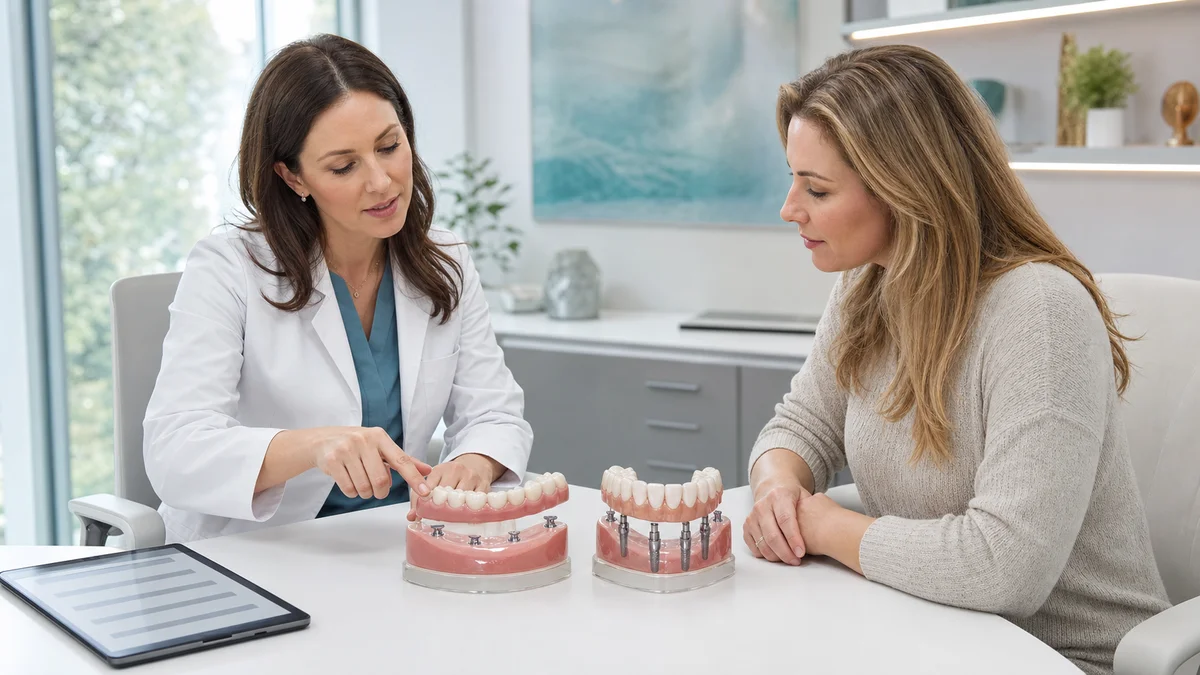
In full-arch treatment, a prosthesis can replace a complete row of teeth while being supported by a selected number of implants. Each implant does not necessarily carry one separate crown. The implants are distributed to support a bridge or removable prosthesis designed for the whole arch. The appropriate number and positions depend on anatomy, bone, prosthesis design, opposing teeth, hygiene access and future repair planning.
The International Team for Implantology consensus on complete-arch fixed prostheses recommends considering the final prosthetic plan when developing surgery. For a one-piece fixed full-arch prosthesis, it recommends a minimum of four appropriately distributed implants, while also stating that future implant loss or complications and options for segmented prostheses should influence the number selected. This is not a rule that four, six or any other number suits every patient.
Before comparing fees, define the product in plain language:
- upper arch, lower arch or both arches;
- fixed bridge or patient-removable overdenture;
- number and planned distribution of implants per arch;
- one-piece or segmented final prosthesis;
- temporary teeth during healing;
- final materials, framework and laboratory;
- maintenance and repair pathway.
A price without these definitions is a marketing label, not a comparable clinical proposal.
2. Existing teeth must be assessed before a full-arch quote
A full-mouth implant plan should not begin with an assumption that every remaining tooth will be removed. Teeth with advanced decay, untreatable fractures, severe periodontal support loss or other poor-prognosis conditions may require extraction. Other teeth may be restorable and useful. Removing a maintainable tooth solely to simplify a package creates an irreversible biological cost.
Assessment may include medical and dental history, periodontal examination, decay and fracture evaluation, bite and jaw relationship, available restorative space, speech and lip support, hygiene ability and appropriate imaging. Existing photographs or an older panoramic image can support an initial conversation, but they cannot establish the final extraction list, implant positions or grafting requirements by themselves.
The written plan should identify each tooth proposed for extraction and the reason. It should also explain whether reasonable options include periodontal care, endodontic or restorative treatment, a shortened dental arch, a combination of teeth and implants, or monitoring. When many teeth are scheduled for removal, an independent second opinion can help a patient understand the prognosis before consent.
3. Four broad treatment designs create very different budgets
Conventional complete denture
A conventional removable denture does not rely on dental implants. It may avoid implant surgery and can be removed for cleaning. Stability, chewing comfort, speech and tissue adaptation vary. Relines, adjustments and replacement can be needed over time. It remains a legitimate comparator when discussing the added value and risk of implant treatment.
Implant-retained removable overdenture
An overdenture uses implants to improve retention but is removed by the patient for daily cleaning. The cost includes implant surgery, attachments inside the denture, laboratory work and future replacement of wear components. Fewer visible implants does not mean zero maintenance.
Fixed complete-arch bridge
A fixed full-arch prosthesis is attached to implants and is not removed by the patient each day. It generally has a more complex surgical and prosthetic pathway. Design must allow cleaning beneath the bridge, and professional removal may be needed for selected maintenance or repair.
Staged or mixed tooth-and-implant plan
Some patients retain strategic natural teeth, receive implants in selected areas or move through treatment in stages. The initial cost may be distributed across time, but coordination and temporary restorations can add complexity. The value lies in preserving appropriate tissue and matching the plan to prognosis, not merely delaying expense.
These options should be compared on function, hygiene, surgery, reversibility, maintenance, travel and lifetime repair, not just on whether the final teeth appear fixed.
4. how much does it cost to get all teeth implants: decision table
The following table helps reveal what a quote actually includes. It does not rank one design as universally best.
| Decision | Lower-complexity possibility | Higher-complexity possibility | Question for the written quote |
|---|---|---|---|
| Coverage | One arch | Upper and lower arches | Are every implant and prosthesis counted per arch? |
| Restoration | Removable implant overdenture | Fixed full-arch bridge | Who can remove it, and what parts wear? |
| Existing teeth | Few routine extractions | Complex extractions and disease stabilisation | Why is each tooth removed or retained? |
| Bone and tissue | No additional grafting planned | Bone or soft-tissue procedures required | Which site, material, purpose and timing? |
| Temporary teeth | Existing denture adapted | New fixed provisional with backup option | What will I wear if immediate loading is unsafe? |
| Final prosthesis | Simpler removable design | Custom fixed framework and premium surface | What are the framework, teeth, gingival material and laboratory? |
| Follow-up | Local care near home | Return travel to the treating clinic | Who manages hygiene, emergencies and repairs? |
Two totals should only be compared after the rows describe comparable care. A higher proposal may include the final bridge, abutments and maintenance visits, while a lower headline may cover only implant placement and a temporary appliance.
5. The 18 items that can make up a full-mouth implant total
Not every patient needs every item, which is precisely why each should be marked included, excluded or conditional:
- comprehensive consultation and medical risk review;
- periodontal, restorative and bite assessment;
- panoramic imaging and three-dimensional imaging when justified;
- photographs, impressions or digital scans;
- treatment of active decay, gum disease or infection;
- routine or complex extractions;
- bone grafting, sinus-related procedures or ridge modification;
- soft-tissue grafting or contour management;
- implant surgery and a surgical guide if used;
- implant bodies with identifiable manufacturer and model;
- abutments, screws, cylinders and other prosthetic components;
- local anaesthesia and, if clinically appropriate, sedation or hospital services;
- immediate, early or delayed temporary teeth;
- postoperative checks, suture review and provisional adjustments;
- final impressions or scans, records and trial stages;
- definitive framework, teeth, gingival portion and laboratory work;
- delivery adjustments, hygiene instruction and protective appliance where indicated;
- long-term professional maintenance, component replacement and repair.
A quote that names only surgery and final teeth may leave several expensive transitions invisible. Ask for quantities, arch, brand or material, responsible provider and the trigger for every conditional fee.
6. One arch versus two arches is the first price divider
Many advertised full-mouth prices refer to one arch, even when patients imagine both upper and lower teeth. Treating two arches involves separate implant distributions and two prostheses. It may also require more extensive bite reconstruction, records, trial stages and adjustments.
The opposing dentition affects design. A fixed implant bridge opposing natural teeth, a removable denture or another implant bridge can create different force and material considerations. The laboratory cannot simply duplicate one arch for the other without assessing jaw relationships, restorative space, speech and aesthetics.
The proposal should contain separate upper and lower sections, with implant count, temporary solution and final prosthesis for each. If one arch is deferred, ask what the interim bite will be and whether work completed now could need modification later.
7. Diagnostics and planning are part of the cost
Detailed planning does not guarantee a complication-free result, but it reduces avoidable uncertainty. The clinician needs to understand the patient’s goals, general health, medicines, smoking or nicotine exposure, periodontal history, previous dental treatment, parafunction, hygiene capacity and ability to attend maintenance.
Imaging should answer a clinical question. Three-dimensional imaging may be indicated to assess bone and anatomical boundaries, but it should not be ordered or repeated automatically without justification. Digital scans and facial records help design the prosthesis; they do not replace examination of soft tissues or medical history.
Ask whether diagnostic fees are credited toward treatment, whether copies of records will be provided, and whether a changed plan creates a new planning charge. A remote estimate should be labelled provisional until findings are confirmed in person.
8. Extractions, bone grafting and tissue procedures
Extraction complexity varies with root anatomy, fractures, infection, retained roots and proximity to anatomical structures. Immediate implant placement may be possible in selected sites, but it is not automatically appropriate after every extraction. The final prosthesis and ideal implant distribution should guide decisions.
Bone grafting or ridge modification may be considered when available anatomy does not support implants in planned positions. Sinus-related procedures can be relevant in selected upper-jaw sites. Soft-tissue procedures may aim to improve tissue volume, stability or cleaning conditions. None is required for every full-arch patient.
If an additional procedure is proposed, the quote should identify:
- the exact arch and site;
- the clinical reason linked to the prosthetic plan;
- the material and expected source where relevant;
- whether it occurs with implant placement or as a separate stage;
- how it changes temporary teeth and loading decisions;
- how it changes healing, visits and travel;
- the alternative if the patient does not accept it.
“Grafting included” is not specific enough if the type, amount and clinical trigger remain unknown.
9. Implant bodies, abutments and screws need separate clarity
The FDA patient guidance distinguishes the implant body placed in bone, the abutment that extends toward the restoration, and an abutment fixation screw. Full-arch systems can require additional multi-unit components and prosthetic cylinders. These parts may be included in one proposal and billed separately in another.
Patients should receive the manufacturer and model of the implant system and keep this information. Diameter, length, location and traceability details such as lot information are useful for future care. Long-term availability of compatible components matters when a screw, abutment or prosthesis requires service years later.
A famous brand does not guarantee correct placement, healthy tissues or a durable prosthesis. An undocumented system can make future component identification difficult. Cost comparison should therefore include both device identity and the clinical plan in which it is used.
10. Immediate teeth are provisional and conditional
“Teeth in a day” generally refers to a temporary prosthesis fitted on the day of surgery or soon afterward. It is not necessarily the final bridge. Immediate loading depends on implant stability, distribution, bone conditions, grafting, prosthesis rigidity, bite forces and patient factors assessed during surgery.
The ITI consensus recommends considering systemic conditions, implant stability, the need for grafting, implant size and shape, and clinician experience for each planned site when selecting placement and loading protocols. A flight date, work commitment or advertising package cannot override those clinical conditions.
A safe quote contains a backup plan:
- What criteria must be met for a fixed temporary bridge?
- What will be used if those criteria are not met?
- Is the alternative temporary prosthesis included?
- Could new records or laboratory work add a fee?
- Would delayed loading require another journey?
- When and how is readiness for the final prosthesis assessed?
Changing to a safer temporary pathway is not proof of failure. The financial problem arises when that pathway was predictable but absent from the written proposal.
11. Temporary and final prostheses should never be one vague line
A temporary full-arch prosthesis can provide appearance and selected function during healing. It can also help assess speech, lip support, tooth length and bite. Its material and objectives differ from the definitive prosthesis, and repairs or adjustments during the provisional period may be expected.
The final prosthesis may require new scans or impressions, bite records, aesthetic trials and laboratory stages after tissues stabilise. Ask whether it is one piece or segmented, what the framework is made from, what forms the visible teeth and gingival portion, how screw channels are managed and whether the design can be cleaned.
Terms such as “zirconia,” “hybrid” or “premium” are incomplete unless the full material combination and construction are specified. Design should consider repairability, weight, opposing teeth, parafunction, hygiene access and future component service. The cheapest final material is not automatically economical if repair access is poor, while a more expensive material is not an outcome guarantee.
12. Sedation, medicines and hospital facilities
Many implant procedures are performed with local anaesthesia. Sedation or a hospital setting may be discussed according to medical history, anxiety, procedure complexity, local rules and provider qualifications. These services can create separate professional and facility charges.
The proposal should name the method, responsible clinician, monitoring, preoperative requirements, escort needs and recovery arrangements. Travel and accommodation plans must allow for individual postoperative advice. A patient should not select deeper sedation merely because it is included in a package, nor avoid necessary monitoring to reduce price.
Medicines should be prescribed according to personal medical needs. Do not stop anticoagulants, diabetes medicines or other regular treatment without coordination with the relevant clinicians. Ask whether prescribed medicines are included in the estimate and who manages an adverse reaction after travel.
13. Insurance and financing can make a headline misleading
Dental insurance and public coverage differ by country, plan, indication and provider. An insurer may treat extractions, implant surgery, components and prostheses as different benefits. It may apply waiting periods, annual or lifetime limits, exclusions, missing-tooth clauses, network restrictions or pre-authorisation rules.
The dental clinic can supply a diagnosis, itemised proposal and supporting records, but it cannot guarantee payment on behalf of an insurer. Obtain written information directly from the payer and identify which amount is an estimate rather than confirmed reimbursement.
Financing divides payments; it does not reduce the clinical total. Check deposit, interest or fees, currency, instalment dates, cancellation, refunds if the plan changes, and what happens if treatment stops. Keep the treatment consent and credit agreement as separate decisions.
14. Dental travel changes the real total
Patients travelling for treatment may need to add flights or ground transport, accommodation, companion costs, meals, time away from work, changes to tickets and extra visits. Hotel or transfer benefits are commercial services; they should not be confused with implant components, laboratory quality or clinical follow-up.
Full-arch treatment may involve consultation, surgery, temporary prosthesis adjustments, healing review, final records, trials, delivery and maintenance. The number and timing of visits depend on clinical findings and healing. A guarantee that everything will finish within a fixed holiday can create pressure to ignore safer sequencing.
Ask who provides urgent care after returning home, whether local clinicians can obtain compatible parts, and who pays for travel if a repair must be completed at the original clinic. A remote photo review can support communication but cannot replace every physical examination.
15. Health factors can alter treatment and cost
The FDA notes that general health affects candidacy, healing and how long an implant may remain in place. Smoking can impair healing, while uncontrolled diabetes may increase infection-related risk. Periodontal disease, plaque control, medicines, immune conditions, previous radiation, clenching and grinding, and ability to attend maintenance also matter.
Risk factors do not produce one automatic decision. They may lead to medical coordination, disease stabilisation, a modified surgical plan, delayed loading, a different prosthesis, a protective appliance or more intensive maintenance. Those changes can affect cost and schedule.
Patients should disclose medicines and diagnoses accurately rather than withholding information to keep a package unchanged. A revised plan after new medical information is a safety response, not necessarily an unexpected sales charge; the revision should still be explained and approved before new work begins.
16. Maintenance is a permanent budget category
Implants do not decay, but surrounding tissues can develop inflammation and bone loss, and prosthetic components can wear or loosen. The European Federation of Periodontology’s evidence-based guideline addresses prevention and multidisciplinary treatment of peri-implant diseases. Daily hygiene and supportive professional care remain central after delivery.
A fixed full-arch bridge must allow access beneath the prosthesis. The patient should receive hands-on cleaning instruction using tools appropriate to the design. Control frequency is personalised according to periodontal history, smoking, plaque, medical factors, prosthesis design and current findings.
Long-term costs can include:
- professional hygiene and peri-implant assessment;
- radiographs when clinically indicated;
- professional removal and refitting of a fixed prosthesis where needed;
- replacement of overdenture inserts or clips;
- screw, abutment or prosthetic component replacement;
- repair of worn, chipped or fractured prosthetic material;
- adjustment or replacement of a protective night appliance;
- treatment of peri-implant mucositis or peri-implantitis;
- replacement or redesign if support or function changes.
A low surgical price does not predict the cost of maintaining the system over many years.
17. Warranty language does not guarantee biological success
A warranty may refer to a manufacturer’s component, a laboratory defect, a clinic repair policy or a statutory consumer right. It cannot promise that bone will heal, tissues will remain healthy, no implant will be lost or no prosthesis will wear.
Request written terms that separate technical and biological events. They should identify duration, exclusions, required maintenance, who examines the problem, whether another clinic can intervene, and who pays travel and laboratory costs. “Lifetime warranty” without those definitions may offer little practical protection.
Implant looseness, screw loosening, chipped material and peri-implant inflammation are different problems requiring different assessments. Automatic replacement without diagnosis may be inappropriate. The FDA advises patients to tell their provider promptly if an implant feels loose or painful.
18. Keep an implant and prosthesis record
At completion, request a record or implant passport containing the site, manufacturer, model, diameter, length and traceability information for each implant. The prosthetic record should identify abutments, screws, framework and surface materials, laboratory and delivery date.
Useful records include:
- diagnosis and treatment plan;
- relevant preoperative and postoperative imaging;
- extraction and implant surgery report;
- graft or biomaterial information;
- implant system and component identifiers;
- temporary and final prosthesis specifications;
- bite and hygiene instructions;
- maintenance schedule and emergency contacts;
- invoices, consent and warranty terms.
These records are not a promise of durability. They reduce information loss if maintenance or repair takes place in another city or country.
19. Red flags in an all-teeth implant offer
- A permanent total is promised before examination and appropriate imaging.
- Maintainable teeth are scheduled for extraction without a documented prognosis.
- One arch and two arches are not clearly distinguished.
- Implant bodies, abutments and screws are grouped under an unnamed “premium system.”
- Temporary teeth are presented as the final bridge.
- Immediate fixed teeth are guaranteed regardless of surgical stability.
- Grafting is included without a site, purpose, material or alternative.
- The final prosthesis has no framework, surface material or laboratory specification.
- There is no written backup if the provisional cannot be fixed.
- Product records or an implant passport will not be provided.
- Insurance reimbursement is guaranteed by someone other than the payer.
- Long-term cleaning, emergency care and repair are absent.
- A complication-free or lifelong result is promised.
A low price is not proof of poor care, and a high price is not proof of quality. Unverifiable scope and responsibility are the real warning signs.
20. A 12-step method for comparing written proposals
- Confirm which remaining teeth can reasonably be retained.
- Define one arch or two and fixed or removable restoration.
- Compare implant number and distribution only after prosthetic design.
- Separate diagnostics, surgery, devices and prosthetic components.
- List every extraction and conditional grafting procedure.
- Write the clinical criteria for immediate temporary teeth.
- Specify the backup temporary solution.
- Define final framework, materials, trials and laboratory.
- Add insurance uncertainty, finance charges and travel.
- Include maintenance, wear components and repair access.
- Verify record delivery and responsible providers.
- Seek a second opinion when prognosis or scope differs substantially.
This method makes competing proposals more comparable without pretending that different patients should receive identical treatment.
21. Preparing a Redent Klinik consultation
The Redent Klinik English home page provides general information about the clinic’s dental approach. To ask which records are useful for a preliminary conversation, use the Redent Klinik contact page. Existing radiographs, mouth photographs, medical history, medicine list, previous implant records and written proposals can help organise questions.
Remote information is preliminary. Final tooth prognosis, extraction need, implant number, grafting, loading, prosthesis design and personal cost require clinical examination and suitable current imaging. The content is intended for evidence-based review by Dentist Esma Çevrük Çakır and does not replace individual care.
how much does it cost to get all teeth implants: FAQs
Does “all teeth implants” mean one implant for every tooth?
Usually not. A full-arch bridge or overdenture can replace a complete row of teeth while being supported by a selected number of implants. Number and distribution are chosen from the final prosthesis, anatomy, bone, hygiene access, opposing teeth and future complication planning.
Is the advertised price normally for one arch or two?
It varies, and many headline prices refer to one arch. A reliable proposal identifies upper and lower arches separately and lists implant, temporary and final prosthesis quantities for each. Never assume “full mouth” automatically includes both arches.
Are extractions included in a full-arch package?
They may be included, excluded or capped by number and complexity. Ask which teeth are being removed, why, whether complex extraction carries another fee and how a changed extraction plan affects implant placement and temporary teeth.
Does everyone need bone grafting?
No. Grafting depends on anatomy, planned implant positions and prosthetic design. If recommended, request the site, purpose, material, timing, alternatives and effect on loading, healing and visits. A photo or old panoramic image alone may not settle the question.
Are “teeth in a day” the final teeth?
Usually the same-day or early teeth are provisional. A definitive prosthesis often follows healing assessment, new records and laboratory stages. Immediate fixed loading is conditional on stability and other clinical factors, so a backup temporary option should be written.
Why do two clinics quote different implant numbers?
They may be planning different prostheses, segmentations, distributions or ways of managing anatomy and future complications. More implants are not automatically better, and fewer are not automatically cheaper or safer. Ask each team to explain the number from the final prosthetic design.
Is the final zirconia bridge always included?
No. Some offers cover implant surgery and a temporary bridge only. Even when “zirconia” is listed, ask about framework, surface material, tooth and gingival portions, one-piece or segmented design, trials, laboratory, adjustments and repairs.
Will dental insurance pay for all-teeth implants?
Coverage depends on the country and contract. Different benefits may apply to extractions, implant surgery, components and prostheses. Obtain an itemised proposal and written response from the payer. A clinic estimate is not an insurance guarantee.
What future costs should I expect?
Possible costs include professional hygiene, clinical reviews, indicated imaging, overdenture inserts, screws or abutments, prosthesis removal, repairs, protective appliances and management of peri-implant disease. Frequency and need vary, so ask for a maintenance pathway rather than a fixed promise.
Can full-mouth implants last for life?
No lifetime result can be guaranteed. Implants, surrounding tissues, screws, abutments and prosthetic materials have different biological and technical risks. General health, smoking, hygiene, bite forces, design and professional maintenance all influence long-term outcomes.
Conclusion: price the entire care pathway
A safe answer to how much does it cost to get all teeth implants begins by defining “all teeth.” One or two arches, removable or fixed prostheses, tooth preservation, implant distribution, temporary teeth and final materials must be clear before a total has meaning.
The complete budget includes diagnosis, surgery, implant system components, conditional grafting, temporary and final prostheses, travel, maintenance and repair. Immediate teeth should have written clinical criteria and a backup. Product identity and records should remain available for future care.
Compare the same scope, not competing headlines. Choose a plan that explains why each tooth and implant decision is made, who is responsible at every stage, and what happens if biology requires a safer change.
Authoritative sources
- U.S. Food and Drug Administration: Dental Implants – What You Should Know
- International Team for Implantology: Number of Implants for Complete-Arch Fixed Prostheses
- International Team for Implantology: Loading Protocols for Fixed Prostheses in Edentulous Jaws
- European Federation of Periodontology: Guideline on Treatment of Peri-Implant Diseases
- American Dental Association
- World Health Organization: Oral Health Fact Sheet