
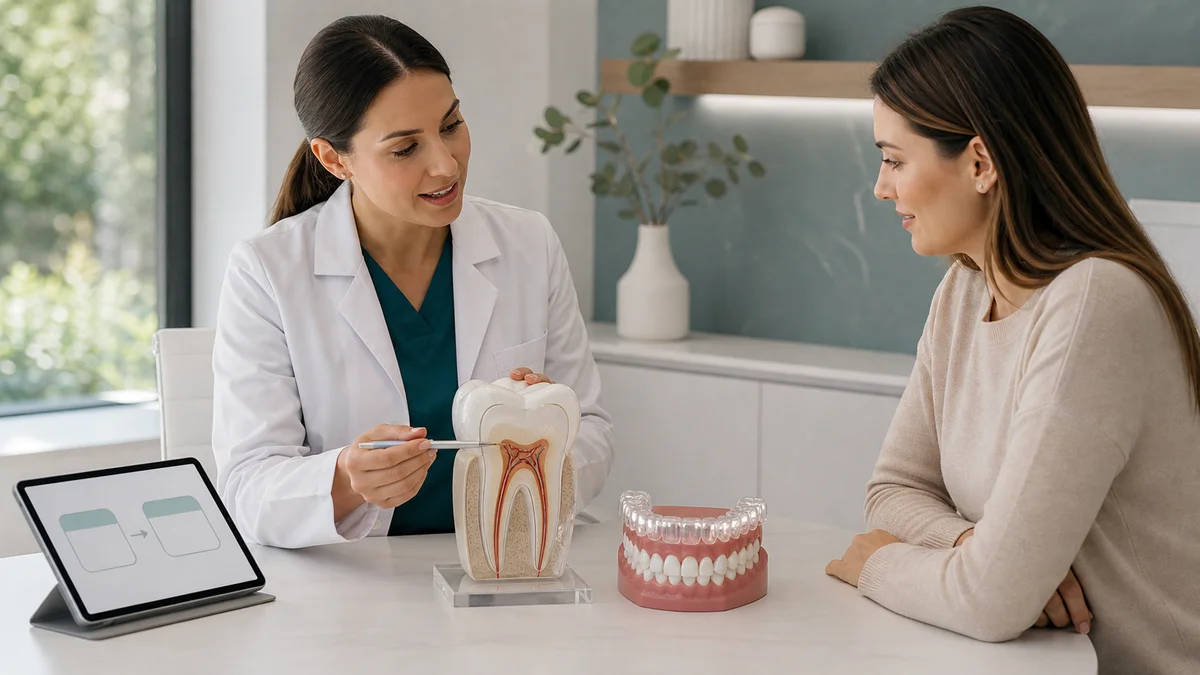
Quick answer: root canal vs clear aligners is not an either-or choice. Root canal treatment addresses inflamed or infected tissue inside a tooth; clear aligners apply planned forces to move teeth and improve alignment or bite. If both are relevant, the dental team should diagnose pain first, stabilise disease, confirm the tooth can be restored, and coordinate restoration shape with the orthodontic plan.
A search for root canal vs clear aligners can sound as though two competing treatments are being compared. They do fundamentally different jobs. Root canal treatment is an endodontic procedure for disease or injury affecting the pulp inside a tooth. Clear aligners are orthodontic appliances that move teeth through a planned sequence. An aligner cannot disinfect an infected root canal, while a root canal cannot straighten crowded teeth or correct a bite by itself.
The more useful question is often about order: what happens if tooth pain appears before an aligner scan, during treatment, or after a tray series has begun? The answer depends on diagnosis, restorability, infection control, periodontal health, the planned direction of tooth movement, and whether a filling or crown will change the tooth’s external shape. There is no universal timeline that fits every tooth.
This guide is educational. It does not diagnose pain, promise that a tooth can be saved, or guarantee orthodontic results. A dentist may coordinate care with an endodontist, orthodontist, restorative dentist or other clinician where complexity warrants it. The goal is to help patients understand why disease control, restoration and tooth movement need one shared plan.
1. Root canal and clear aligners solve different biological problems
Inside every mature tooth is a root canal system that once contained pulp tissue. Deep decay, cracks, repeated dental procedures or trauma may inflame or infect that tissue. The American Association of Endodontists explains that endodontic treatment removes the affected pulp, cleans and shapes the canal space, then fills and seals it. A filling, onlay, crown or another restoration may then be needed to protect the remaining tooth structure and restore function.
Clear aligners are thin, removable trays formed to fit the teeth. Each planned stage applies pressure intended to move selected teeth incrementally. The American Association of Orthodontists describes aligners as one orthodontic tool among several; they are not appropriate or equally predictable for every movement or bite problem. Diagnosis comes before appliance choice.
The two pathways therefore have different primary aims:
- Endodontic aim: diagnose pulpal or root-related disease, control infection or inflammation, relieve symptoms where possible, and retain a restorable natural tooth.
- Orthodontic aim: move teeth into planned positions while protecting roots, gums, bone and bite function.
- Restorative aim: seal and rebuild the tooth so it can tolerate function and fit the wider dental plan.
- Shared aim: preserve oral health with a sequence that does not let one treatment compromise the other.
Because these aims are complementary rather than interchangeable, selecting one treatment based only on appearance, speed or price can miss the underlying problem.
2. When root canal treatment may be considered
A root canal is considered after a clinical diagnosis, not from a symptom checklist alone. The AAE lists possible warning signs such as severe pain on biting, lingering sensitivity to hot or cold, a chipped or cracked tooth, gum swelling or tenderness, and a recurring spot on the gum. The NHS also notes that infection may follow decay, gum disease, a chip, break, crack or dental abscess. These features can have other causes, so examination and appropriate tests are essential.
Assessment may include the history and timing of symptoms, examination of the tooth and surrounding tissues, response to temperature or other pulp tests, percussion and palpation, periodontal probing, bite analysis and suitable radiographs. A visible dark area on an image does not automatically prove that conventional root canal treatment is the right answer; clinical findings need to match.
The tooth must also be restorable. Severe vertical root fracture, inadequate bone support, extensive loss of tooth structure or an inability to obtain a durable seal can make retention less predictable or impossible. Before irreversible treatment, patients should understand the tooth’s endodontic, periodontal and restorative prognosis, along with reasonable alternatives such as monitoring in selected situations, vital pulp therapy where indicated, retreatment, endodontic surgery, extraction and replacement options.
Root canal is not simply a treatment for any toothache
Pain can come from decay, a cracked tooth, gums, bite overload, sinus-related symptoms, jaw muscles or referred sources. Orthodontic movement can also cause temporary tenderness. Treating the canal without confirming pulpal or periapical disease risks addressing the wrong source. Persistent, severe or unusual pain deserves diagnosis rather than assumptions based on where it seems to be felt.
3. When clear aligners may be considered
Clear aligners may be used for selected crowding, spacing and bite problems after a full orthodontic assessment. Suitability depends on the type and amount of movement, root positions, bone and gum support, impacted teeth, existing restorations, oral hygiene, patient cooperation and the broader facial and bite relationship. A scan creates a digital surface model; it does not by itself diagnose disease beneath the gums or inside a tooth.
The AAO emphasises that in-person examination and monitoring are important because photographs and scans cannot show every root, bone or periodontal problem. Radiographs are prescribed when clinically justified, and gum health requires direct assessment. Orthodontic treatment should not begin on the assumption that straight front teeth are a purely cosmetic surface change.
Patients considering aligners should be prepared for:
- an examination of teeth, gums, roots and bite before treatment;
- completion or stabilisation of necessary dental work before the final appliance plan;
- wearing trays for the schedule prescribed by the treating clinician;
- removing aligners for eating and following cleaning instructions;
- attending reviews so movement and tissue health can be checked;
- possible attachments, elastics, refinements or a different appliance where needed;
- retention after active movement to help hold the new tooth positions.
Clear aligners are not a home cosmetic product independent of dental health. They apply biological force. Poorly planned or inadequately monitored movement can contribute to gum recession, root shortening, tooth mobility, bite problems or failure to achieve the planned correction.
4. root canal vs clear aligners decision table
This table separates the clinical questions. It is not a self-diagnosis tool; it shows which pathway needs investigation and where coordinated care may be required.
| Situation | Primary concern | Likely first clinical step | Why sequencing matters |
|---|---|---|---|
| Lingering temperature pain, biting pain or swelling | Pulpal or periapical disease, crack or another pain source | Prompt dental diagnosis; endodontic referral if indicated | Moving a tooth does not disinfect disease or resolve an abscess |
| Crowding or bite concern without pain or active disease | Tooth position and occlusion | Orthodontic records and suitability assessment | Appliance choice follows diagnosis of teeth, roots, gums and bite |
| A root-filled tooth is included in planned movement | Endodontic stability, restoration and periodontal support | Joint review of radiographs, symptoms and restorative status | The tooth may be movable, but forces and monitoring must be individualised |
| Root canal becomes necessary during aligner treatment | New or previously hidden pulpal disease | Pause or adapt active movement as the dental team advises | Access and restoration can alter tooth shape and tray fit |
| A large crown is planned on a tooth that will move | Final tooth shape and position | Coordinate temporary and definitive restoration timing | A final crown made too early may not match later contacts or aligners |
| Facial swelling, fever, swallowing or breathing difficulty | Potential spreading infection or urgent medical risk | Urgent dental or emergency assessment | Routine orthodontic scheduling must not delay urgent care |
If a situation appears in more than one row, that is a reason for coordination rather than for choosing one specialty in isolation.
5. If both are needed, which treatment usually comes first?
Active pain, swelling, suspected infection or an uncertain pulpal diagnosis generally needs timely investigation before elective tooth movement proceeds. This does not mean every sensitive tooth requires a root canal, nor does it create a fixed waiting period after treatment. It means unresolved disease and urgent symptoms should not be concealed behind an orthodontic schedule.
Where root canal treatment is confirmed, the endodontic phase and an adequate coronal seal are planned first. The restorative team determines whether the tooth needs a direct filling, onlay, crown or another design, considering how much tooth structure remains and where the tooth is located. The orthodontic team then confirms whether the tooth is stable enough to enter or resume movement and whether the appliance needs to be remade.
The definitive restoration may be placed before, during or after orthodontic treatment depending on fracture risk, remaining structure, required tooth movement, contacts and appliance fit. A badly weakened posterior tooth cannot simply be left unprotected for the sake of future positioning. Conversely, making an expensive definitive crown before substantial movement may create a shape or contact that later needs alteration. This is a clinical design problem, not a universal rule.
A practical sequencing conversation
Ask the team to name the endpoint of each phase: control symptoms and disease, create a durable seal, protect the tooth, move it to the planned position, then refine contacts and retention. The written plan should state who confirms each handoff and what finding would change the sequence.
6. Can a root canal-treated tooth move with clear aligners?
A tooth that has undergone endodontic treatment is not automatically excluded from orthodontic movement. The tissues surrounding the root remain biologically active and are the structures through which orthodontic movement occurs. However, eligibility cannot be inferred from the absence of pulp alone.
The team needs to assess whether endodontic disease has healed or is stable, whether symptoms remain, whether the root has cracks or resorption, whether periodontal support is adequate, and whether the crown or filling is sound. The planned direction and magnitude of movement matter too. A previously traumatised tooth, a tooth with an immature root, a persistent lesion or a complex retreatment history may need additional review and monitoring.
Radiographs should be chosen according to clinical need rather than repeated routinely without justification. Baseline information allows later changes to be interpreted. During treatment, pain that is intense, prolonged, localised to one tooth, associated with swelling or different from expected orthodontic tenderness should be reported promptly.
No clinician can promise that a root-filled tooth will move at exactly the same rate or without complication. The safe conclusion is conditional: orthodontic movement may be possible when endodontic, periodontal and restorative findings support it and when the case is monitored.
7. How fillings and crowns affect aligner fit
Clear aligners are manufactured to match the external shape of the teeth at a specific point in time. Root canal access, a temporary filling, a permanent filling or a crown can change that shape. Even a small change may affect how a tray seats, whether an attachment fits, or how force is delivered.
If endodontic treatment is completed before the final scan, the treating dentist should tell the orthodontic team whether the external contour is definitive. If treatment becomes necessary after trays have been manufactured, the existing aligner should not be forced over a restoration that prevents full seating. Depending on the stage and amount of change, the orthodontic clinician may adjust the tray, remove or replace an attachment, rescan, order a replacement, revise the sequence or temporarily pause movement.
A crown is not automatically necessary after every root canal. The decision depends on tooth location, remaining structure, cracks, previous restorations, functional load and restorative strategy. The AAE’s restoration standards emphasise that timely, appropriate final restoration is integral to prognosis. Patients should ask whether the proposed restoration is protective, temporary, transitional during movement or intended as the definitive shape.
Do not trim or force an aligner at home
Home modification can create sharp edges, distort force delivery or hide incomplete seating. If a tray no longer fits after dental work, contact the orthodontic team. Continue, pause or return to a previous tray only according to individual instructions.
8. What if tooth pain begins during aligner treatment?
Mild, short-lived pressure tenderness can occur when a new aligner is introduced, but not every pain during orthodontics comes from movement. Deep decay, a crack, a leaking restoration, gum inflammation, bite trauma or pulpal disease can arise before or during treatment. A tray may also fit poorly or create a local sore spot.
Note the pain’s location, onset, triggers, duration and whether there is swelling, fever, bad taste, a gum spot, fracture or trauma. Remove the aligner if the treating clinician has instructed you to do so for an urgent problem, but do not use intermittent wear as a substitute for assessment. Starting a new tray or adding stronger elastic wear without advice can complicate the picture.
Antibiotics are not a general cure for toothache. The American Dental Association guideline recommends prioritising definitive dental treatment for most pulpal and periapical pain and localised swelling in immunocompetent adults, with antibiotics reserved for situations such as systemic involvement according to clinical judgement. A prescription cannot clean and seal an infected root canal or repair a crack.
Signs that should not wait for a routine aligner review
- rapidly increasing swelling of the gum, face or neck;
- fever, malaise or feeling systemically unwell;
- difficulty swallowing, breathing or opening the mouth;
- severe spontaneous pain or pain that prevents sleep;
- trauma, a broken tooth or a displaced tooth;
- a localised gum swelling, drainage or persistent bad taste;
- a tooth that feels markedly mobile or hits first when biting.
Breathing or swallowing difficulty can represent an emergency. Seek urgent local care rather than waiting for an online reply from a distant provider.
9. What happens to the orthodontic timeline?
Neither root canal treatment nor clear aligner care has one guaranteed duration. Endodontic timing depends on diagnosis, tooth anatomy, infection, previous treatment, restorative needs and healing. Orthodontic timing depends on the movements required, biological response, tray wear, appliance fit, refinements, missed visits and oral health.
If a root canal interrupts a tray sequence, the impact may be small when the tooth shape is preserved and the aligner still seats correctly, or more substantial when a large restoration changes anatomy. The team may hold the current position with an appropriate appliance while the tooth is treated, then reassess. It is unsafe to promise that no delay, rescan or refinement will ever be needed.
Patients should ask for a conditional timeline:
- What is the planned sequence if the tooth remains symptom-free?
- What findings would pause active movement?
- When will endodontic healing or stability be reviewed?
- Can the current aligner be used as a passive retainer, and for how long?
- Would a filling or crown require a scan and replacement trays?
- Who authorises progression to the next aligner?
- How will missed wear or treatment delay affect retention?
A written plan with decision points is more useful than a fixed completion date that assumes biology and restorations will never change.
10. Cost comparison: separate treatment, appliance and restoration
Price is another reason patients search for root canal vs clear aligners, but the costs do not replace one another. If both treatments are clinically indicated, the total plan may include endodontic diagnosis, root canal treatment, a core or filling, a crown or other restoration, orthodontic records, aligners, attachments, reviews, refinements and retainers. Insurance may classify these categories differently.
Request itemised estimates rather than a single smile package. For endodontic care, ask whether examination, imaging, emergency treatment, root canal treatment, temporary seal, definitive restoration and retreatment contingencies are separate. For aligners, ask about records, active trays, attachments, elastics, replacement trays, refinements, review visits and retainers.
A lower initial aligner price may omit refinements or retention. A root canal quote may omit the final restoration. A crown may need to be delayed or designed as a transitional restoration because of planned movement. None of these differences proves poor care; undisclosed differences make comparison unreliable.
Where insurance is involved, obtain written pre-treatment information directly from the insurer. A clinical estimate is not an insurer’s payment guarantee. Confirm deductibles, annual limits, waiting periods, network rules, orthodontic lifetime limits, exclusions and whether benefits already used reduce the remaining amount.
11. Risks and limitations of root canal treatment
Root canal treatment aims to retain a tooth, but no procedure has a guaranteed outcome. Complex anatomy, calcified or missed canals, cracks, perforation, instrument complications, persistent infection, inadequate restoration or new leakage can affect prognosis. Some teeth need retreatment or endodontic surgery; some cannot be saved and ultimately require extraction.
Temporary tenderness can occur after treatment. Increasing swelling, fever, persistent severe pain, a lost temporary filling or a change in the bite should be reported. Patients should avoid chewing heavily on an unrestored tooth when advised, because the structure that was already lost to decay, cracks or previous restorations may increase fracture risk.
A root canal does not make a tooth immune to decay, gum disease or fracture. Brushing, interdental cleaning, appropriate fluoride exposure, a durable coronal seal and regular review remain important. The restoration and surrounding gums must also permit adequate cleaning during aligner wear.
12. Risks and limitations of clear aligners
Clear aligners can cause temporary pressure, tenderness, speech changes or soft-tissue irritation. Plaque and sugary or acidic liquids trapped under trays may increase decay and enamel damage risk. Poor cleaning or existing gum disease can worsen inflammation. Attachments may debond, trays may crack or fail to seat, and planned movements may need refinement.
Orthodontic risks can include root shortening, gum recession, loss of periodontal support, demineralisation, decay, unwanted movement and incomplete correction. Risk depends on the starting condition, force system, treatment length, hygiene, biology and monitoring. A digital simulation is a planning visual, not a guarantee that every tooth will follow the animated path.
Retention is part of treatment. Teeth can move after active therapy, so retainers and follow-up are prescribed according to the case. A root canal-treated tooth is not exempt from retention or from future dental maintenance.
13. Records the endodontic and orthodontic teams should share
Coordinated care becomes safer when each clinician understands the same diagnosis, tooth identity, restoration plan and movement goal. Patient permission and secure record transfer may be needed. A screenshot or a verbal message alone can omit clinically important detail.
- current medical history, medicines, allergies and relevant risk factors;
- tooth number and endodontic diagnosis;
- appropriate pre-treatment and follow-up radiographs;
- root canal treatment or retreatment report and any complications;
- type and date of temporary or definitive restoration;
- presence and location of cracks, posts, crowns or large fillings;
- orthodontic movement planned for that tooth;
- attachment design and whether a rescan is anticipated;
- symptoms or findings that would stop movement;
- named clinician responsible for each handoff and follow-up.
The patient should retain copies where possible, particularly when treatment occurs in different cities or countries. Records improve continuity but do not replace a current examination.
14. Alternatives depend on the actual diagnosis
The alternative to root canal treatment is not automatically clear aligners. Depending on diagnosis and restorability, alternatives may include monitoring, treatment of decay before pulp involvement, vital pulp therapy in selected teeth, endodontic retreatment, endodontic surgery, extraction, or replacement after extraction. Doing nothing may allow symptoms or disease to progress and should be discussed with its likely consequences.
The alternative to clear aligners is not automatically root canal treatment. Orthodontic alternatives may include fixed braces, limited treatment with clearly defined goals, combined appliances, restorative camouflage in selected cases, or no active movement with monitoring. Each option has different biological limits, hygiene demands and effects on the bite.
When a compromised tooth sits within a crowded arch, the plan may involve saving and moving it, saving it without movement, extracting it as part of a broader orthodontic strategy, or replacing it later. Extraction should not be chosen merely to avoid coordinating specialties, and heroic retention should not be pursued when the tooth cannot be predictably restored. The decision requires prognosis and patient priorities.
15. A 9-step appointment checklist
- Describe pain, swelling, sensitivity, trauma and timing accurately.
- Ask for the pulpal, periapical, periodontal and restorative diagnosis.
- Confirm whether the tooth is structurally restorable.
- Review reasonable tooth-saving and extraction alternatives.
- Explain any planned orthodontic movement for the affected tooth.
- Decide whether the external tooth shape will change before scanning.
- Write the conditions for pausing and restarting aligner movement.
- Separate endodontic, restorative, orthodontic and retention costs.
- Keep records and know whom to contact for urgent symptoms.
This checklist turns a vague comparison into a shared care plan. It also creates space for a second opinion when diagnosis, restorability or sequencing remains uncertain.
16. Preparing a coordinated consultation with Redent Klinik
You can review the clinic’s general dental information on the Redent Klinik English home page. For an initial discussion, the Redent Klinik contact page can be used to ask which records are needed. Existing radiographs, the date and type of root canal treatment, restoration details, current aligner stage, medicine list and symptoms can make the preliminary conversation more useful.
Remote information cannot confirm the source of pain, the quality of a root filling, restorability, periodontal support or safe orthodontic forces. A final diagnosis and plan require appropriate clinical examination and current imaging where justified. The content is intended for evidence-based review by Dentist Esma Çevrük Çakır, with patient safety and understandable health communication as priorities.
root canal vs clear aligners: frequently asked questions
Are root canal treatment and clear aligners alternatives?
No. Root canal treatment manages disease or injury inside a tooth, while clear aligners move teeth. A person may need one, both or neither after diagnosis. An aligner cannot treat an infected pulp, and a root canal does not correct crowding or bite by itself.
Can I start aligners before a recommended root canal?
Unresolved pain, swelling or suspected pulpal disease should be diagnosed before elective movement. If root canal treatment is confirmed, disease control, a reliable seal, tooth protection and appliance fit need coordination. The exact restart time is individual rather than a fixed number of days.
Can a tooth with a root canal be moved by clear aligners?
It may be possible when the tooth is endodontically stable, restorable, periodontally supported and suitable for the planned movement. Previous trauma, persistent disease, cracks, resorption or complex retreatment can alter risk and monitoring. Clinical and radiographic assessment is needed.
Will a crown make my current aligner stop fitting?
It can. A crown or large filling changes the tooth’s external contour, while an aligner is made to a precise earlier shape. The orthodontic team may need to adjust a tray, change an attachment, rescan or order replacement trays. Do not force a tray over a new restoration.
Does every root canal-treated tooth need a crown?
No. Restoration choice depends on tooth location, remaining tooth structure, cracks, previous fillings and functional load. Posterior teeth often need cuspal protection, but the design is individual. A temporary or transitional restoration may sometimes be coordinated with planned movement.
Is tenderness from a new aligner the same as root canal pain?
Not necessarily. Orthodontic pressure can cause temporary generalised tenderness, but pulpal pain may be spontaneous, severe, linger after temperature, localise to one tooth or occur with swelling. Symptoms overlap, so persistent or intense pain should be examined rather than self-diagnosed.
Can antibiotics replace root canal treatment?
Usually not for disease confined to the tooth and nearby tissues. ADA guidance prioritises definitive dental treatment for most pulpal and periapical pain and localised swelling in immunocompetent adults. Antibiotics may be indicated with systemic involvement or other clinical factors, but they do not clean and seal the canal.
Should I keep wearing aligners during a dental infection?
Contact the treating team promptly. Advice depends on swelling, pain, tray fit, the tooth involved and the urgency of care. Do not advance trays or modify them at home without instructions. Facial or neck swelling, fever, swallowing or breathing difficulty requires urgent assessment.
Will root canal treatment delay clear aligners?
It may or may not. Delay depends on disease, treatment complexity, restoration shape, healing, tray fit and the movement planned. A minor contour-preserving restoration may have little effect; a major crown or persistent symptoms may require a pause, rescan or revised sequence.
Which specialist should I see first?
For significant pain, swelling, trauma or suspected infection, seek prompt dental assessment; an endodontist may be involved. For alignment and bite planning, an orthodontist may be involved. A general dentist can help coordinate restorative needs. Urgency and diagnosis determine the order.
Conclusion: compare purposes, then coordinate the sequence
The safest answer to root canal vs clear aligners is that the treatments address different diagnoses. Endodontic care treats disease inside a tooth and aims to retain a restorable tooth. Orthodontic aligners move teeth and manage selected alignment or bite problems. Neither can substitute for the biological purpose of the other.
If both enter the same plan, diagnose pain first, control urgent disease, decide whether the tooth can be restored, protect it appropriately and share the intended movement with every clinician. Because restoration can alter aligner fit, the shape and timing of fillings or crowns deserve explicit coordination.
Seek urgent care for rapidly increasing swelling, fever with dental symptoms, or difficulty breathing or swallowing. For non-urgent planning, use written diagnoses, itemised estimates, shared records and clear handoff criteria. A coordinated plan is more valuable than a promise that one appliance or procedure solves every problem.
Authoritative sources
- American Association of Endodontists: Root Canal Explained
- American Association of Endodontists: Standards in Restoration of Endodontically Treated Teeth
- American Association of Orthodontists: Clear Aligners
- American Association of Orthodontists: Adult Orthodontic Treatment Questions
- American Dental Association: Antibiotics for Dental Pain and Swelling Guideline
- American Dental Association
- NHS: Root Canal Treatment
- NHS: Orthodontics
- World Health Organization: Oral Health Fact Sheet