
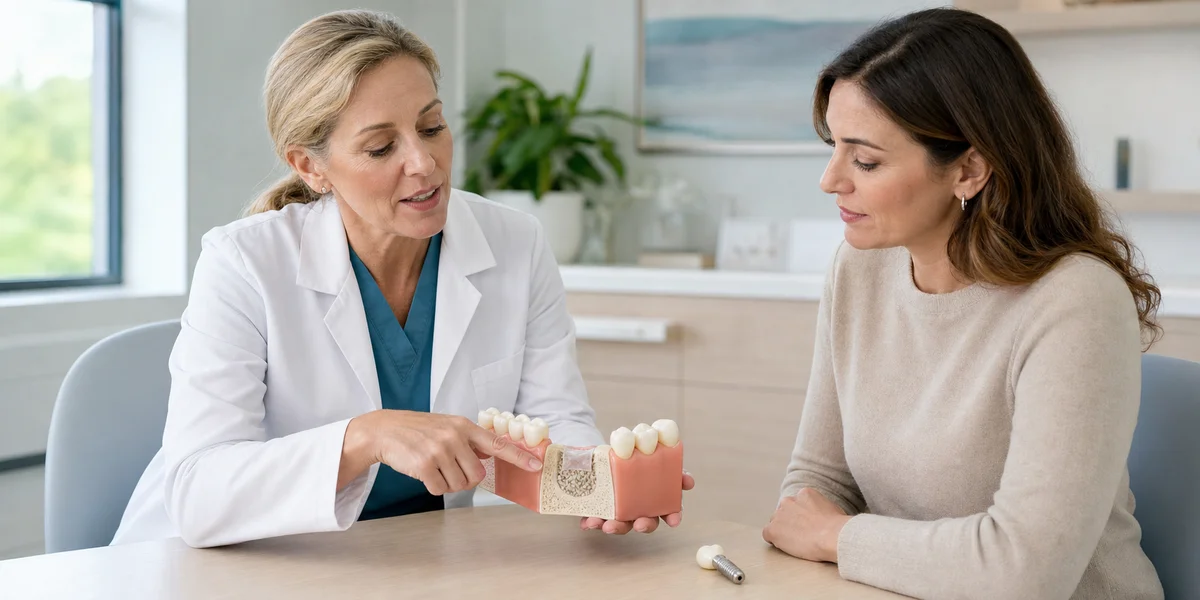
Quick answer: If you are asking how much does bone grafting cost for dental implants, there is no responsible universal figure. The total depends on the size and location of the bone defect, graft method and material, membrane or fixation needs, imaging, anaesthesia, whether grafting and implant placement occur together, follow-up and local fees. An examination and itemised written plan are essential.
The search how much does bone grafting cost for dental implants often produces a single number, yet “bone graft” covers procedures ranging from a small amount of material placed around an implant to staged reconstruction of a deficient ridge. These do not require the same amount of material, surgical time, anaesthesia, equipment or healing. A headline fee can therefore be misleading unless it names the exact procedure and what it includes.
Bone grafting is not automatically required for every implant. This is the clinical starting point for how much does bone grafting cost for dental implants. Its purpose is to increase or preserve bone when the planned implant position cannot be adequately supported or when the restorative outcome requires a different bone contour. The decision depends on clinical examination and imaging, the proposed implant position, gum condition, anatomy, health and alternative treatment designs.
This guide explains the variables behind how much does bone grafting cost for dental implants without advertising fixed prices or predicting your treatment. It also separates the graft fee from the cost of the implant body, abutment, crown or bridge. The objective is a complete, comparable quotation and a patient-safe consent discussion.
1. How much does bone grafting cost for dental implants, and why is there no standard fee?
A standard fee is difficult because the phrase can describe different clinical tasks. Cambridge University Hospitals explains that grafting techniques are used to increase jawbone for appropriate implant positioning, and that the choice depends on the amount needed, local anatomy and patient preference. A minor defect treated at implant placement differs substantially from a larger defect reconstructed months before implant placement.
The answer to how much does bone grafting cost for dental implants is influenced by professional time, the number and location of sites, surgical complexity, graft volume, material source, membranes, fixation devices, imaging, anaesthesia, facility use and postoperative care. Geographic overheads, laboratory arrangements, regulation and currency also affect local fees.
One clinic may quote the graft alone, while another may bundle imaging, implant placement or reviews. This difference can change the apparent answer to how much does bone grafting cost for dental implants. Neither format is inherently better, but the totals cannot be compared until they have the same scope. Ask whether the figure is confirmed, estimated or conditional on findings during surgery.
2. What exactly is a dental implant bone graft?
A bone graft is a surgical approach intended to add, preserve or reshape bone in an area planned for an implant. Its scope directly shapes how much does bone grafting cost for dental implants. The graft material acts as a scaffold while healing occurs. Depending on the defect, the clinician may use bone from the patient, material from another human source, animal-derived material, a synthetic substitute or a combination. A membrane may protect the grafted area during healing.
The FDA describes a dental implant as a medical device inserted into jawbone to support an artificial tooth. That implant needs a three-dimensional position that supports the planned crown, bridge or denture and can be maintained. Grafting should serve that restorative plan; it should not be treated as a generic upgrade.
When discussing how much does bone grafting cost for dental implants, request the clinical name of the proposed procedure. “A graft” might mean socket preservation after extraction, guided bone regeneration around an implant, ridge augmentation before implant placement, a sinus-related procedure or a block graft. The material and sequence differ.
3. Which graft procedures change the price most?
The extent and timing of surgery usually matter more than a simple material label. They are central to how much does bone grafting cost for dental implants. A small simultaneous augmentation can involve a limited quantity of particles and a resorbable membrane. A staged ridge procedure may need wider access, more graft volume, fixation pins or screws and a separate healing period. A block graft can add a donor or preparation site. A sinus-related approach has its own anatomy and risk discussion.
For the question how much does bone grafting cost for dental implants, these categories help organise a quote:
- Socket preservation: graft material placed after an extraction to help manage ridge change for a possible future restoration.
- Minor guided bone regeneration: a limited defect managed at or near implant placement, often with particulate material and a membrane.
- Staged ridge augmentation: bone volume created before an implant is placed, adding another surgical and healing stage.
- Block graft: a block of bone secured to the deficient area, sometimes involving a separate donor site.
- Sinus floor augmentation: a procedure in the upper back jaw planned around the sinus and available bone.
- Major reconstruction: larger-volume grafting that may require hospital resources or bone from outside the mouth.
These labels are educational, not a self-diagnosis. Two defects given the same label can still differ in size, soft-tissue condition and technical difficulty. The surgeon should explain why the selected approach is proportionate and what reasonable alternatives exist.
4. Decision table: what belongs in the total quote?
| Quote component | Why it may change the total | Question to ask |
|---|---|---|
| Assessment and imaging | Complex anatomy may require additional diagnostic planning. | Which examinations and scans are included, and why are they needed? |
| Graft procedure | Small simultaneous grafting and staged reconstruction involve different time and resources. | What is the precise procedure name, number of sites and intended volume? |
| Materials and membrane | Source, quantity, membrane, fixation and product handling differ. | Which products may be used, what are their sources and are they included? |
| Anaesthesia and facility | Local anaesthetic, sedation or hospital-based care have different staffing and monitoring needs. | Which setting and anaesthetic are planned, and who provides them? |
| Implant and restoration | The graft fee may exclude the implant, abutment, temporary tooth and definitive crown or bridge. | Does the total end with a functioning final tooth? |
| Reviews and contingencies | Healing checks, suture removal, additional imaging or management of graft exposure may be separate. | Which reviews are included and which findings could create another charge? |
A useful response to how much does bone grafting cost for dental implants identifies every row that applies. Reading the table through how much does bone grafting cost for dental implants also exposes missing items. It states what happens if the graft does not create enough bone or if the implant cannot be placed at the expected stage. Consent should cover clinical alternatives; the financial agreement should cover unperformed and additional stages.
5. Does the graft material determine the cost?
Material is one variable in how much does bone grafting cost for dental implants, but it is rarely the whole price. Autogenous grafting uses the patient’s own bone and can add harvesting time, another surgical site and donor-site risks. Other human-derived, animal-derived and synthetic materials avoid that same harvest but have different preparation, quantity and consent considerations. A membrane may be resorbable or non-resorbable, and fixation may be required.
Cambridge University Hospitals notes that graft material can come from the patient or from human, animal or synthetic sources and that a membrane may be used. Patients should be told what products could be used. If religious, ethical, allergy-related or personal concerns affect acceptance of animal- or human-derived products, raise them before treatment begins.
Do not answer how much does bone grafting cost for dental implants by choosing the cheapest material in isolation. The clinician must match the material and technique to the defect and treatment goal. More expensive does not automatically mean more suitable, and no product can guarantee graft or implant success.
6. How diagnosis and imaging influence the estimate
A quotation based only on a message or photograph cannot reliably answer how much does bone grafting cost for dental implants because it cannot define the defect. The clinician assesses medical history, medicines, smoking, gum health, infection, previous extractions, available space, bite and the condition of adjacent teeth. Two-dimensional radiographs may answer some questions; three-dimensional imaging may be justified when it changes planning around bone shape, the sinus, nerves or implant position.
Diagnostic costs in how much does bone grafting cost for dental implants should be transparent. Ask whether the consultation, radiographs, scan interpretation, digital planning and surgical guide are included. A scan should be obtained for a clinical reason and interpreted appropriately, not sold as a decorative technology package.
The proposed final tooth should be planned before the graft. Bone in the wrong location may not support a cleanable, functional and aesthetic restoration. Restorative planning, implant positioning and graft design should therefore be connected in the written explanation.
7. Simultaneous or staged grafting: why timing affects cost
Minor grafting can sometimes be performed at the same visit as implant placement. This timing changes how much does bone grafting cost for dental implants. More extensive grafting may need its own procedure and healing period before an implant is placed. Cambridge University Hospitals describes minimal grafting at implant placement and more extensive grafting at least months beforehand in its pathway. Guy’s and St Thomas’ describes a common graft-healing interval of several months before implant treatment. These are institutional examples, not promises for every patient.
Timing changes how much does bone grafting cost for dental implants because staged care can add appointments, anaesthesia, imaging and temporary tooth arrangements. It can also affect travel, time away from work and the benefit year in which an insurer considers each claim. A shorter plan is not automatically safer, and a longer plan is not automatically better.
Ask for a timeline showing extraction if needed, grafting, review, implant placement, integration, abutment and final restoration. Mark each interval as an estimate subject to healing. Avoid a schedule designed around travel dates if it conflicts with clinical review.
8. Anaesthesia, clinician and treatment setting
Many minor grafts are performed with local anaesthetic. Anaesthesia and setting are part of how much does bone grafting cost for dental implants. Sedation may be considered for selected patients and procedures, while major grafting may require a hospital environment and general anaesthesia. The fee can reflect the anaesthesia provider, monitoring, facility and recovery resources as well as surgical work.
The clinician’s training and the involvement of another specialist can affect how much does bone grafting cost for dental implants. Complexity may justify an oral and maxillofacial surgeon, periodontist, implant dentist, restorative dentist or coordinated team. A professional title alone does not determine value; ask who performs each stage and who is responsible for the complete result and follow-up.
Verify that emergency contact arrangements, postoperative review and management of complications are included. If surgery is provided away from your usual dentist, clarify how records and long-term maintenance will be shared.
9. What risks should be included in the consent discussion?
Bone grafting is surgery, and risk belongs in any answer to how much does bone grafting cost for dental implants. Expected short-term effects can include discomfort, swelling and bruising. Possible complications include bleeding, infection, wound opening or graft exposure, altered sensation, sinus-related problems in relevant sites, insufficient bone formation and the need for further treatment. Donor-site surgery adds risks at the harvest location.
Guy’s and St Thomas’ notes that grafts can fail to create enough bone and that smoking can increase healing risk. The FDA also advises that overall health and smoking affect implant candidacy, healing and long-term outcome. Share medical conditions and all medicines, including antiresorptive therapies, with the clinical team.
The possibility of another procedure affects how much does bone grafting cost for dental implants, but it should never be presented as an automatic extra sale. Ask what is included if exposure, infection or inadequate graft volume occurs, which urgent symptoms require contact and who pays for care outside normal hours. No ethical provider can guarantee graft integration.
10. Insurance and public coverage
Dental plans vary widely, so insured patients asking how much does bone grafting cost for dental implants need plan-specific answers. Bone grafting, implant placement and the final crown may be treated as separate procedures with different exclusions, deductibles, coinsurance, annual maximums, waiting periods or network rules. A pre-treatment estimate can clarify anticipated benefits, but it is not always a payment guarantee.
In the United States, CMS states that Original Medicare generally excludes routine services connected with the care or replacement of teeth and structures supporting them, including alveolar bone, except in limited circumstances where dental services are inseparably linked to covered medical care. Some Medicare Advantage plans may provide additional dental benefits, so details must be checked with the individual plan.
For an insured answer to how much does bone grafting cost for dental implants, ask for procedure codes and a written breakdown. Confirm whether the graft is covered only when the implant is covered, whether site limits apply, whether prior authorisation is required and whether treatment crossing benefit years changes payment. The American Dental Association notes that benefit plans commonly use annual maximums and other limitations.
11. Comparing local and overseas quotes
A lower clinic fee abroad does not establish how much does bone grafting cost for dental implants as a complete total. Add flights, accommodation, local transport, companion costs, time away from work, currency changes, travel insurance and return visits. Staged grafting and implant placement may require several trips separated by healing and reassessment.
When comparing how much does bone grafting cost for dental implants internationally, establish who manages postoperative concerns after you return home. Ask whether a local clinician has agreed to review the graft, whether records and material details will be supplied and who pays if a second trip is needed. A warranty cannot eliminate biological risk or replace accessible clinical care.
Obtain copies of imaging, consent forms, graft and membrane product information, implant system details and treatment notes. If a complication occurs, another provider needs more than a generic statement that “bone was added.”
12. Are there alternatives to bone grafting?
Sometimes the restorative design, implant position or implant dimensions can be reconsidered. That broader view changes how much does bone grafting cost for dental implants as a decision, but changes must remain compatible with anatomy, biomechanics, cleaning and the final restoration. Alternatives may include a tooth-supported bridge, removable partial denture, adhesive bridge, a different implant-supported design or no immediate replacement in selected circumstances. Saving a restorable natural tooth may also avoid extraction and implant reconstruction.
The alternatives matter to how much does bone grafting cost for dental implants because avoiding a graft can shift rather than eliminate costs and risks. A shorter implant or different angle is not automatically appropriate, and an extensive graft is not automatically necessary. Ask the clinician to explain why the proposed option best balances safety, function, maintenance and patient priorities.
For personalised assessment information, use the Redent Clinic contact page. Remote records can support preparation, but a final recommendation and quotation require suitable clinical evaluation.
13. How to compare two itemised quotations
To compare how much does bone grafting cost for dental implants, place both quotes into the same sequence. Start with diagnosis, then extraction or infection control, graft, implant, temporary restoration, abutment, definitive tooth and maintenance. Label every item as included, excluded, optional or conditional. Confirm the number of sites rather than assuming one fee covers the whole mouth.
A complete comparison for how much does bone grafting cost for dental implants should identify:
- consultation, radiographs, three-dimensional imaging and planning;
- the precise graft procedure and number of treated sites;
- graft source, estimated volume, membrane, fixation pins or screws;
- local anaesthetic, sedation or general anaesthesia and facility charges;
- medicines, suture removal, reviews and postoperative imaging;
- implant body, abutment, temporary tooth and final crown, bridge or denture;
- management terms if healing is delayed or another graft is proposed;
- travel, time away from work, finance charges and expected maintenance.
Do not compare a graft-only estimate with an implant-and-crown package. This is why how much does bone grafting cost for dental implants needs a complete-pathway answer. Ask for valid quotation dates and payment stages. If financing is offered, compare the total repayable amount, not only the monthly instalment.
14. Patient preparation and aftercare
Before surgery, give an accurate medical and medication history, follow instructions about eating and transport when sedation is planned, and discuss smoking support. Clarify how regular medicines should be handled; do not stop prescribed medication without advice from the appropriate clinician.
After grafting, follow the surgeon’s instructions for hygiene, diet, medicines and activity. Attend scheduled reviews. Contact the team for bleeding that does not settle, rapidly increasing swelling, fever or worsening illness, severe or escalating pain, breathing or swallowing difficulty, or any symptom identified in your discharge instructions.
Aftercare is part of how much does bone grafting cost for dental implants, not an optional extra. Confirm who provides advice outside normal hours and which postoperative visits are included. Long-term implant care also requires cleaning and regular professional review after the final tooth is fitted.
15. Questions to bring to the consultation
A consultation should convert how much does bone grafting cost for dental implants from a generic search into an individual plan. Bring your medication list, relevant health history, previous imaging and details of any earlier graft or implant. Explain priorities such as treatment time, temporary teeth, travel, material preferences and budget.
- Why is grafting recommended at this site, and what happens without it?
- What defect and final implant position are you planning to correct?
- Will grafting and implant placement be simultaneous or staged?
- Which material, membrane and fixation products may be used?
- Are any products human- or animal-derived?
- What are the material risks, alternatives and signs of a complication?
- Which stages, reviews and contingency costs are included?
- Who is responsible for the final crown and long-term maintenance?
The Redent Clinic English website provides general clinic information. Educational content cannot diagnose bone volume, choose a graft product or promise a particular outcome.
Frequently asked questions about bone graft pricing
How much does bone grafting cost for dental implants at one tooth?
There is no reliable universal one-tooth price. A socket graft, small simultaneous augmentation, sinus-related procedure and staged ridge graft can all involve one tooth area but very different materials, time and risk. An itemised plan after examination is needed.
Is the bone graft included in the implant price?
Sometimes, but not always. Ask whether the package includes diagnostics, graft material, membrane, fixation, anaesthesia, implant body, abutment, temporary restoration, final crown and reviews. The word “implant” may refer only to one component or procedure.
How much does bone grafting cost for dental implants with a membrane?
A membrane can add material and technique costs, but its use, type and size depend on the defect. Ask why it is recommended, whether fixation is required, what it is made from and whether removal is expected. Do not choose a membrane solely by price.
Can grafting and implant placement happen on the same day?
Sometimes a limited defect can be grafted when an implant is placed. Larger or less favourable defects may need staged healing first. Suitability depends on anatomy, implant stability, tissue condition and the planned restoration, not simply the preferred schedule.
How much does bone grafting cost for dental implants if a sinus lift is needed?
A sinus-related procedure has different approaches and complexity, so a generic online amount is unreliable. The estimate should state imaging, procedure type, graft and membrane materials, anaesthesia, implant timing, reviews and management of sinus-related risks.
Does insurance pay for dental bone grafting?
Coverage depends on the plan, diagnosis, procedure and associated implant benefits. Deductibles, exclusions, annual maximums, site limitations and prior authorisation may apply. Request a pre-treatment estimate and verify the policy directly, while recognising that final payment can differ.
Is using my own bone more expensive?
It can require another surgical site, added operating time or a different facility, but total fees vary. Material choice should be based on the defect, evidence, risks and preference rather than a price hierarchy. Ask about donor-site effects and alternatives.
What happens if the graft does not heal as planned?
The clinician reassesses the site and may discuss monitoring, additional healing, another graft, a revised implant plan or a non-implant alternative. Ask before treatment which reviews are included and how possible additional procedures are priced. No graft can be guaranteed.
Does a cheaper graft mean lower quality?
Not necessarily. Fees reflect many factors beyond material, including defect size, clinician time, setting and what is bundled. Conversely, a high fee does not prove suitability. Compare diagnosis, procedure scope, traceable materials, consent, follow-up and the final restorative plan.
Can I avoid grafting by choosing a different implant?
Sometimes a revised design may be considered, but it must remain anatomically safe, mechanically sound, cleanable and compatible with the final tooth. Avoiding grafting is not automatically safer. Ask for reasonable alternatives and the trade-offs of each.
Sources and further reading
- Cambridge University Hospitals — Bone grafting for dental implants
- Guy’s and St Thomas’ NHS Foundation Trust — Bone grafting for dental implants
- US Food and Drug Administration — Dental Implants: What You Should Know
- Centers for Medicare & Medicaid Services — Medicare Dental Coverage
- American Dental Association — Typical Dental Plan Benefits and Limitations
- World Health Organization — Oral health