
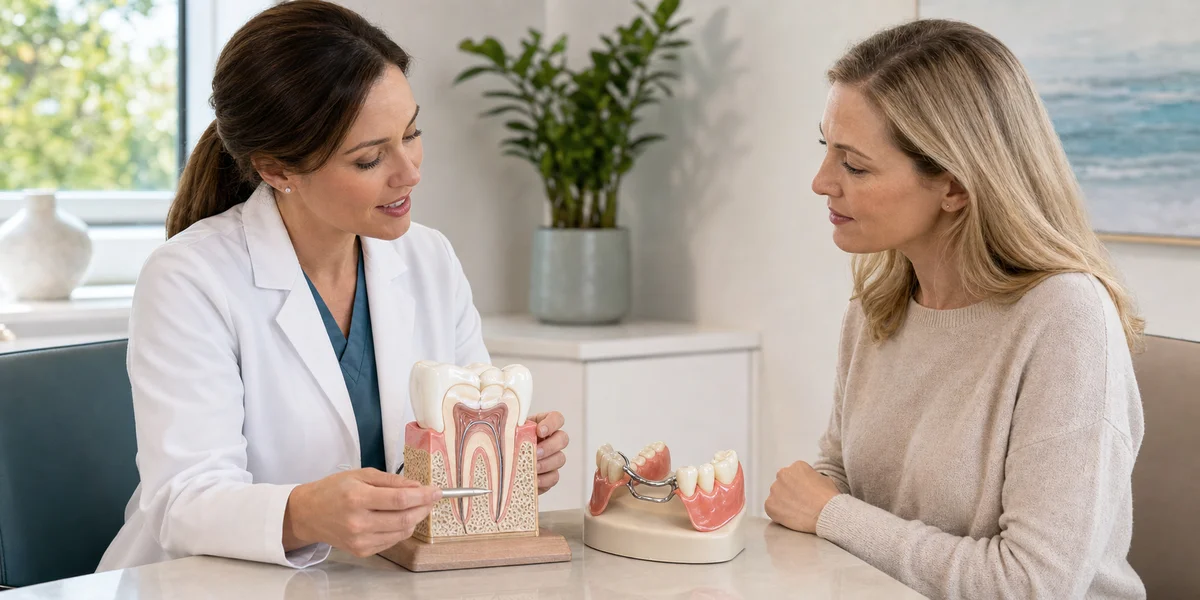
Quick answer: If you are asking root canal or dentures which is better, begin with whether the tooth can be predictably restored. Root canal treatment aims to retain an infected or inflamed natural tooth; a denture replaces one or more missing teeth after extraction or previous tooth loss. They are not direct substitutes, and an examination is essential before comparing them.
The question root canal or dentures which is better sounds like a choice between two versions of the same treatment. It is not. Root canal treatment, also called endodontic treatment, removes diseased or infected tissue from inside a tooth so the tooth can be cleaned, sealed and restored. A denture is a removable prosthesis that replaces teeth that are already missing or must be removed. The first strategy preserves a tooth; the second replaces lost teeth.
A safe answer to root canal or dentures which is better therefore starts with diagnosis, not preference or advertising. A dentist needs to determine whether the painful or damaged tooth is restorable, whether its gum and bone support are adequate, whether a crack changes its outlook and whether the rest of the mouth can support a partial or complete denture. Your health, comfort, appearance, budget, cleaning ability and tolerance for staged care matter too.
This guide does not tell you which treatment you personally need. A sound explanation of root canal or dentures which is better shows why a clinician may favour tooth preservation in one situation and a removable replacement in another. It also explains the full sequence, because comparing a root canal fee with a denture fee can omit the crown, extraction, temporary prosthesis, adjustments or maintenance that complete the plan.
1. Root canal or dentures which is better: why the treatments are different
According to the NHS, root canal treatment removes infection from inside a tooth; the inside is cleaned, shaped, filled and sealed. A crown may be needed when the tooth has been badly affected. The purpose is to keep a tooth that would otherwise remain infected or require extraction. The American Association of Endodontists likewise describes endodontic treatment as removal of inflamed or infected pulp followed by cleaning, disinfection, filling and restoration.
Dentures have another purpose. NHS guidance defines them as false teeth used to replace missing teeth. Complete dentures replace all teeth in an upper or lower arch, while partial dentures replace one or more missing teeth and may use remaining teeth for support or retention. They can help address difficulties with eating, speaking or appearance caused by tooth loss.
So, root canal or dentures which is better cannot be answered until the treatment goal is clear:
- Root canal treatment: treat the inside of a tooth and retain the natural tooth when it can be restored and maintained.
- Partial denture: replace one or more absent teeth with a removable appliance while other teeth remain.
- Complete denture: replace all teeth in an arch after they have been lost or removed.
- Immediate denture: provide a temporary or transitional removable replacement at the time teeth are removed, with later adjustment or replacement often needed as tissues heal.
A single infected tooth and many missing teeth may coexist. In that case, root canal treatment and a denture can even form parts of the same overall plan: a strategic tooth might be saved while a partial denture replaces other missing teeth. Thus, root canal or dentures which is better may occasionally involve both, and the labels should not be treated as rivals.
2. When might saving the natural tooth be considered?
When people search root canal or dentures which is better, they may assume pain automatically means extraction. Pain alone does not establish whether a tooth can be saved. Dentists consider the cause and extent of pulpal disease, remaining tooth structure, cracks, decay, periodontal support, previous treatment, restorative space and how the tooth contributes to the bite. Radiographs and clinical tests help build the diagnosis, but no single online symptom checklist can replace examination.
Root canal treatment may be considered when the pulp is inflamed or infected but the tooth has a reasonable path to restoration. In that setting, root canal or dentures which is better depends on the complete restorative pathway. The final seal above the root canal is crucial: depending on the tooth and structural loss, a filling, onlay or crown may be discussed. Saving a root without planning the final restoration can leave the decision incomplete.
The AAE emphasises considering natural-tooth preservation whenever possible, but that principle is not a guarantee that every tooth is treatable. It also does not make root canal or dentures which is better a universal rule. Some teeth have extensive structural loss, an unfavourable fracture, inadequate support or other problems that make predictable restoration difficult. An endodontic opinion can be useful when the diagnosis or technical feasibility is uncertain.
Questions that help define restorability
- What caused the pulpal infection or inflammation, and is the diagnosis clear?
- How much sound tooth remains above the gum, and can it support a durable restoration?
- Is there a crack, and where does it extend?
- Are the gums and supporting bone healthy enough to maintain the tooth?
- Has the tooth had previous root canal treatment, a post or a large restoration?
- Will a crown or another definitive restoration be required after treatment?
- Would referral to an endodontist or restorative dentist change the available options?
These questions make root canal or dentures which is better a prognosis discussion rather than a slogan. Prognosis is an informed estimate, not a lifetime promise. Even a technically successful root canal tooth needs daily cleaning, a sound restoration and ongoing dental review.
3. When might a denture be considered?
A denture becomes relevant when teeth are missing or extraction is part of the agreed plan. That distinction anchors any root canal or dentures which is better comparison. A partial denture can replace a small or large number of teeth; a complete denture replaces an entire arch. The design depends on remaining teeth, gum and bone shape, bite, hand skills, gag reflex, appearance, speech, medical history and the patient’s ability to insert, remove and clean the appliance.
For someone asking root canal or dentures which is better, a denture may be discussed if the tooth is not restorable, if several teeth have a poor outlook or if a removable solution better matches the broader clinical and personal situation. Yet extracting a single treatable tooth solely to make a denture is a significant irreversible step. Reasonable tooth-saving and fixed replacement options should be explained first.
Dentures are not “install and forget” devices. New appliances often require an adaptation period. Pressure areas can become sore and need adjustment. Immediate dentures may loosen as the extraction sites and jaw change during healing; NHS guidance notes that they often require adjustment or replacement during the following year. This maintenance affects the answer to root canal or dentures which is better. The NHS statement describes a common pathway, not a fixed timetable for every person.
4. A decision table for root canal or dentures which is better
| Clinical question | When root canal may enter the discussion | When a denture may enter the discussion |
|---|---|---|
| Is the tooth present and restorable? | The tooth is present, pulpal treatment is indicated and a durable restoration appears feasible. | The tooth is already absent or extraction is recommended after assessing restorability. |
| How many teeth are affected? | One or more individual teeth may be assessed separately for preservation. | A partial or complete denture may replace multiple missing teeth within one appliance. |
| What is the maintenance model? | Clean the natural tooth and restoration; monitor for decay, fracture, periodontal or endodontic problems. | Remove and clean the appliance; clean gums and remaining teeth; attend for fit, tissue and bite reviews. |
| Is the step reversible? | Root canal changes the tooth internally but retains it. | Extraction before a denture is irreversible; the denture itself can later be adjusted, relined or replaced. |
| What else should be compared? | Definitive restoration, retreatment options, fracture risk and strategic value. | Fixed bridges, implants, no immediate replacement in selected cases and future tissue change. |
The table is a conversation aid, not a scoring system. The answer to root canal or dentures which is better depends on findings that are not visible in a quotation: restorability, periodontal stability, disease across the mouth and the patient’s priorities. A written plan should connect each recommendation to those findings.
5. Comfort, chewing, speech and appearance
A retained natural tooth generally avoids the movement and coverage associated with a removable appliance, provided it can be restored and functions comfortably. This is one functional dimension of root canal or dentures which is better. Root canal treatment is usually performed with local anaesthetic. Tenderness may occur afterwards, and a temporary restoration may be used between visits. Persistent or worsening symptoms require professional review rather than self-diagnosis.
Dentures rest on oral tissues and may use remaining teeth or attachments for support. They can restore missing teeth, but chewing efficiency and sensation are not identical to natural teeth. These differences belong in a root canal or dentures which is better discussion. A partial denture’s clasps, framework, tooth arrangement and coverage can influence appearance, speech and comfort. A complete lower denture can behave differently from an upper denture because the anatomy and tongue environment differ.
When weighing root canal or dentures which is better, ask how each option would affect your specific bite and daily life. A front tooth raises different aesthetic questions from a back tooth. Someone with several missing teeth has different functional needs from someone with one infected molar. Request realistic limitations rather than before-and-after promises.
6. Treatment time and number of visits
The NHS explains that root canal treatment commonly takes two or more appointments and that a temporary filling may be placed before the permanent restoration. Therefore, root canal or dentures which is better cannot be compared by one visit alone. Complexity, tooth anatomy, infection, referral and the definitive restoration can change the number and spacing of visits. Emergency pain relief is not always the same appointment as completion of the root canal and crown.
Denture construction typically involves examination, impressions or scans, bite records, trials and fitting. Those stages also shape the root canal or dentures which is better timeline. Immediate dentures follow a different sequence because they are prepared before extraction and inserted around the time teeth are removed. Healing changes can then require adjustments, relining or replacement. Conventional dentures are usually made after tissues are sufficiently stable for the chosen pathway.
A fair root canal or dentures which is better timeline includes every stage, not only the first procedure. Ask when you will have a functional tooth or replacement, whether a temporary is needed, how many review visits are included and what could delay completion.
7. Comparing total cost without using a misleading headline
Price depends on country, clinic, tooth, complexity, materials and what the quote includes. A financial answer to root canal or dentures which is better needs the complete plan. A root canal proposal may separate consultation, imaging, endodontic treatment, core build-up and crown. A denture proposal may separate extractions, immediate appliance, final appliance, metal framework, additions, relines and repairs. Insurance or public-system eligibility is jurisdiction-specific.
To compare root canal or dentures which is better financially, request itemised written estimates for complete pathways:
- Tooth-retention pathway: diagnosis, root canal treatment, temporary seal, final restoration and follow-up.
- Extraction and denture pathway: extraction, any urgent care, immediate or conventional denture, adjustments, reline and expected replacement planning.
- Alternatives: monitoring when safe, endodontic retreatment, apical surgery, bridge, implant-supported restoration or another removable design.
- Long-term care: hygiene visits, repairs, component replacement, denture review and treatment of remaining teeth.
The lowest first invoice is not automatically the lowest total cost, but a higher price is not proof of superior care. Ask which parts are confirmed and which depend on findings or healing. Avoid any provider promising a fixed result before examination.
8. Risks and limitations to discuss
Every option has limitations. A risk-based root canal or dentures which is better discussion must acknowledge them. Root canal treatment may not resolve disease if anatomy cannot be adequately treated, if the tooth cannot be sealed or restored, or if a fracture or new decay undermines it. Retreatment, endodontic surgery or extraction may later be considered. These possibilities should be explained without implying that failure is inevitable.
Dentures can initially feel bulky, affect speech or create sore areas. They can loosen as the gums and jaw change, and they may wear or break. Poor cleaning can contribute to oral infection, decay in remaining teeth and gum problems. NHS advice includes removing dentures at night unless a dentist specifically recommends otherwise, cleaning the appliance and continuing to clean the gums, tongue and remaining teeth.
The safest answer to root canal or dentures which is better includes these trade-offs alongside benefits. Consent should cover likely experience, material risks, alternatives and what happens if the plan does not proceed as expected. A guarantee of painless care, permanent success or perfect adaptation is not credible.
9. What examination is needed before choosing?
A dentist usually begins the root canal or dentures which is better assessment with your symptoms, medical conditions, medicines, allergies and dental history. The tooth may be assessed for tenderness, response to tests, decay, restoration quality, mobility, gum pocketing, cracks and remaining structure. Radiographs help evaluate roots, surrounding bone and previous treatment. Additional views or specialist assessment may be justified when routine information is insufficient.
For denture planning, the clinician also examines the whole arch: remaining teeth, tissue health, ridge form, bite, jaw relationship, smile, speech and space for the proposed teeth. Existing dentures provide useful clues about comfort, wear and design. Disease should be stabilised where possible before relying on new prosthetic work.
This is why root canal or dentures which is better should not be decided from a photograph or price message alone. Remote information can support preparation, but final consent depends on an appropriate clinical assessment. You can use the Redent Clinic contact page to ask how to organise records or an appointment.
10. Other options may sit between root canal and dentures
The binary phrase root canal or dentures which is better can hide reasonable alternatives. If a previous root canal has developed a problem, nonsurgical retreatment or endodontic surgery may sometimes be assessed before extraction. If a tooth cannot be retained, a fixed bridge or implant-supported crown may be considered instead of a removable partial denture. When many teeth are missing, implant assistance may improve denture support for selected patients, but it introduces surgery, cost and maintenance.
Sometimes no immediate replacement is chosen for a particular space, provided the clinical and functional consequences are understood. In another situation, a transitional denture may preserve appearance while tissues heal before a definitive plan. The options depend on anatomy, disease, health and preference; none should be presented as universally superior.
A second opinion about root canal or dentures which is better may be especially useful when the tooth’s restorability is uncertain, several extractions are proposed, the plan is expensive or the explanation has focused only on one solution. Bring the same radiographs and records so the opinions can be compared on the same evidence.
11. Maintenance after treatment
After root canal treatment, protect the temporary restoration and attend for the definitive restoration and reviews. This follow-through matters when judging root canal or dentures which is better. Continue fluoride toothpaste, interdental cleaning suited to the tooth and regular professional assessment. A root-treated tooth can still develop decay or gum disease, and its crown or filling can wear, loosen or fracture.
After denture fitting, learn safe insertion and removal, clean the appliance as directed and keep cleaning oral tissues and remaining teeth. Start with foods and techniques recommended by the clinical team while adapting. Return if the denture slips, clicks, causes pain, breaks or is accompanied by red or bleeding tissues or persistent bad breath.
Maintenance often determines how the answer to root canal or dentures which is better feels years later. The most technically suitable plan can still struggle if it cannot be cleaned or reviewed. Tell the dentist about dexterity, vision, caregiving or travel barriers so the design and instructions are practical.
12. A patient-safe decision checklist
Before deciding root canal or dentures which is better, ask for a written explanation that answers:
- What is the diagnosis for each relevant tooth?
- Is the tooth restorable, and what evidence supports that assessment?
- What final restoration is required after root canal treatment?
- If extraction is advised, which tooth-saving options and referrals were considered?
- Would the denture be partial, complete, immediate or definitive?
- Which alternatives could be fixed, removable or staged?
- What are the expected visits, limitations, risks and maintenance tasks?
- What is included in each complete quote, and which costs are conditional?
Take time to consider the information unless urgent infection or another clinical problem requires prompt care. The Redent Clinic English website offers general clinic information, but no website can substitute for diagnosis. Seek urgent dental help for significant facial or mouth swelling, spreading infection symptoms, difficulty breathing or swallowing, or rapidly worsening illness.
Frequently asked questions: root canal or dentures which is better
For one infected tooth, root canal or dentures which is better?
If the tooth is restorable, root canal treatment may preserve it, while a denture would only become relevant after the tooth is missing or removed. The dentist must assess infection, tooth structure, cracks, gum support and the planned final restoration before advising.
Is extraction and a partial denture quicker than root canal treatment?
Not necessarily. Extraction may be one procedure, but healing, denture construction, fitting and adjustments add stages. An immediate denture can provide a quick replacement, yet tissue change may require later relining or replacement. Compare complete timelines rather than the first appointment.
Can a root-treated tooth support a partial denture?
Sometimes, if the tooth has an appropriate prognosis and restoration. Its periodontal support, position, structure, bite and the denture design all matter. Root canal treatment alone does not automatically make a tooth suitable as a support or clasp tooth.
Does a root canal always need a crown?
No universal rule applies to every tooth. The need and type of final restoration depend on tooth position, remaining structure, cracks, previous restorations and loading. The NHS notes that a crown may be needed when a tooth was badly infected. Ask for the restorative plan before starting.
Are dentures permanent?
Dentures can last for years with appropriate care, but they are not biologically permanent. Oral tissues and jaw shape change, and the appliance can wear or break. Reviews, adjustments, relines, repairs or replacement may be needed.
Which option is easier to clean?
They require different routines. A root-treated tooth is cleaned like other restored teeth, with attention to the gumline and interdental spaces. A denture must be removed and cleaned, while the gums, tongue and any remaining teeth also need care. Dexterity and design affect practicality.
Can antibiotics replace root canal treatment?
Antibiotics do not mechanically clean, shape and seal an infected root canal system. They may be prescribed in selected situations based on clinical signs and health, but they are not a routine substitute for definitive dental treatment. Do not use leftover or unprescribed antibiotics.
What if I am told the tooth cannot be saved?
Ask why, which findings determine restorability and whether an endodontic or restorative opinion could add value. A second opinion is reasonable when uncertainty is meaningful. It does not guarantee that the tooth can be retained, and urgent infection still needs timely management.
Is a denture the only replacement after extraction?
No. Depending on the site, remaining teeth, bone, health and preferences, options may include a fixed bridge, implant-supported restoration, a removable denture or no immediate replacement in selected cases. Each has different surgery, cost, maintenance and risk considerations.
How should I compare root canal and denture costs?
Compare complete written pathways. Include diagnosis, root canal treatment and final restoration on one side; include extraction, temporary or definitive denture, fittings, adjustments and likely later maintenance on the other. Check insurance or public funding rules directly with the relevant provider.