
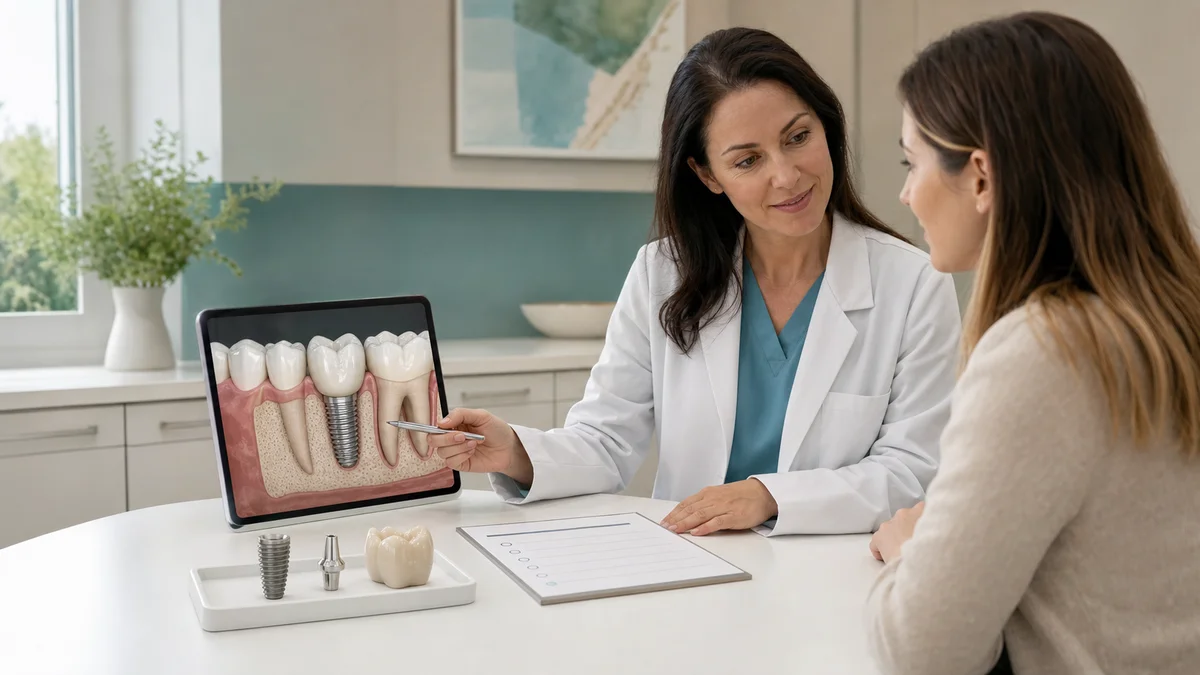
Quick answer: how much does it cost to get a molar implant cannot be answered safely with one universal figure. A complete written estimate may include examination, imaging, extraction, site preservation, grafting, implant placement, healing components, abutment, molar crown, anesthesia, temporary care and reviews. Jaw location, bone, gums, bite, health, materials, insurance and travel can change the scope.
When a person asks how much does it cost to get a molar implant, the first task is to define “implant.” The U.S. Food and Drug Administration describes a dental implant system as an implant body placed in the jaw and an abutment that supports an artificial tooth. A restored molar usually also requires a crown, diagnostic planning, surgical care, laboratory work and maintenance. An advertisement may include all of this, only the implant body, or something in between.
Molar sites introduce specific planning variables. Upper molars can be close to the maxillary sinus. Lower molars can be close to the inferior alveolar nerve canal. The space between neighboring roots, bone width and height, gum condition, opposing tooth and chewing forces influence whether an implant is suitable and which procedures are proportionate. A photograph or online form cannot measure these features reliably.
This guide explains how to build a comparable estimate without publishing a fixed fee or promising coverage. The answer to how much does it cost to get a molar implant must follow a diagnosis, not lead it. Prices vary by country, provider, clinical complexity, device and laboratory system, benefit plan and timing. A patient-safe quote names the exact treatment objective, separates required from conditional items and explains what happens if the plan changes.
How Much Does It Cost to Get a Molar Implant? Define the Finished Tooth
The phrase how much does it cost to get a molar implant can refer to at least three different products: the fixture in bone, the fixture plus abutment, or the complete implant-supported crown. Comparing unlike scopes is the main reason online figures appear inconsistent.
Ask whether the quote ends with a functioning definitive molar crown. Confirm whether it includes the implant body, cover screw or healing abutment, any second-stage access, final abutment, fixation screw, crown, laboratory fabrication, fitting, occlusal adjustment and follow-up. If a temporary tooth is proposed, ask whether it is fixed, removable or unnecessary for that posterior site and whether it has a separate charge.
A molar crown can be screw-retained or cement-retained, and the abutment may be stock or customized. Crown material, implant connection and laboratory workflow also vary. These are not decorative upgrades alone; they can affect restorative space, retrievability, cement control, occlusion, appearance and future service. The estimate should identify the proposed system rather than use “premium implant” as the entire description.
The 15-Line Table Behind How Much Does It Cost to Get a Molar Implant
This table turns how much does it cost to get a molar implant into a quote-audit exercise. It does not say every patient needs every line. “Conditional” means the item should be priced only if examination and planning show it is indicated.
| Quote line | Typical status | Question to ask |
|---|---|---|
| 1. Comprehensive examination | Usually required | Which teeth, gums, bite and medical factors are being assessed? |
| 2. Diagnostic imaging | Selected by clinical need | Which image is justified, and is interpretation included? |
| 3. Extraction | Conditional | Is the molar still present, and is preservation possible? |
| 4. Socket preservation | Conditional | Is grafting at extraction planned, and why? |
| 5. Ridge or sinus augmentation | Conditional | What defect or anatomical limitation makes it necessary? |
| 6. Surgical guide | Case-dependent | Is it included in planning or billed separately? |
| 7. Implant body placement | Core surgical item | Which system, diameter and length are planned? |
| 8. Anesthesia or sedation | Case and preference dependent | Which option is clinically appropriate and who provides it? |
| 9. Healing component | Usually part of the pathway | Are cover screw, healing abutment and changes included? |
| 10. Second-stage access | Conditional | Will a submerged implant require another procedure? |
| 11. Final abutment and screw | Required for most crown pathways | Stock or custom, and is the fixation screw included? |
| 12. Definitive molar crown | Required for a finished tooth | What material, design and retention method are planned? |
| 13. Temporary tooth | Optional or conditional | Is it useful in this posterior site and safe during healing? |
| 14. Reviews and adjustments | Essential | Which visits, radiographs if indicated and bite refinements are included? |
| 15. Maintenance and complication care | Ongoing | What is included, excluded and handled by another provider? |
Diagnosis Changes How Much Does It Cost to Get a Molar Implant
A safe answer to how much does it cost to get a molar implant starts by confirming that the tooth is missing or cannot predictably be preserved. Severe decay, fracture, periodontal loss, failed root canal treatment and other diagnoses do not have identical alternatives. A second opinion may be valuable before removing a restorable tooth.
The American Dental Association has emphasized that implant financing discussions should follow comprehensive examination and a conversation about the range of treatment options. Depending on diagnosis, options may include restoring the tooth, a conventional bridge, an adhesive bridge in selected circumstances, a removable prosthesis, orthodontic space management or accepting the space with monitoring. Each option changes biology, treatment time, maintenance and future flexibility.
If the molar is still present, the estimate should state whether extraction is included, who performs it and whether immediate implant placement is proposed. Immediate placement is not synonymous with an immediate final crown. Socket condition, infection, bone walls, primary stability, bite and patient risk determine timing. If the site is already healed, ridge dimensions and gum contours may create a different plan.
Imaging and Planning in How Much Does It Cost to Get a Molar Implant
Any online explanation of how much does it cost to get a molar implant should distinguish clinically justified imaging from a standard package. The clinician may use examination, intraoral radiographs, panoramic imaging, cone-beam computed tomography or a combination, depending on the question. More imaging is not automatically better; the selected study should provide information that can change management.
For an upper molar, planning may assess sinus position, bone volume and neighboring roots. For a lower molar, the nerve canal and lingual anatomy can be important. Restorative planning also evaluates the space for the crown, opposing dentition, implant position needed for a cleanable crown and whether a guide adds value.
Ask whether scan interpretation, digital planning, guide design and guide production are included separately. A surgical guide is a tool, not a guarantee. Accuracy still depends on data quality, guide support, manufacturing, fit, surgical execution and intraoperative judgment.
Extraction Timing and How Much Does It Cost to Get a Molar Implant
The answer to how much does it cost to get a molar implant changes when extraction and implant placement occur on the same day, after early healing or after complete site healing. Timing should be selected for biological and restorative reasons, not simply to reduce visits.
Same-day extraction and implant placement can be appropriate in selected cases, but a gap around the implant, damaged socket wall or soft-tissue need may prompt grafting. Active infection does not produce a universal rule; the clinician must assess debridement, site anatomy and patient factors. Delayed placement may allow healing or disease control but can require a temporary plan and additional appointments.
Request a branching estimate. It can state the planned pathway and the conditions that would trigger an alternative. For example, if extraction reveals an unsuitable socket for immediate placement, the consent and estimate should explain whether grafting, delayed placement and a later review will be recommended.
Bone and Sinus Procedures Affect How Much Does It Cost to Get a Molar Implant
Bone volume is one of the largest conditional factors in how much does it cost to get a molar implant. The American Academy of Periodontology notes that the upper back jaw can present reduced bone and close sinus proximity, while ridge defects can limit implant positioning. Some sites need no augmentation; others may need socket preservation, guided bone regeneration, ridge augmentation or a sinus procedure.
“Bone graft” is not one uniform service. Ask what defect is being treated, whether grafting occurs at extraction, implant placement or a separate stage, what material is proposed, whether a membrane or fixation is needed, and how healing will be assessed. The Cambridge University Hospitals patient resource explains that grafting is used to increase available jaw bone and has its own risks and healing requirements.
Grafting should not be sold as an automatic upgrade. It is justified when it helps create a maintainable implant position and the benefits outweigh alternatives and risks. A quote should identify it as confirmed or conditional, not quietly add it after an advertised package has been accepted.
Health Factors Behind How Much Does It Cost to Get a Molar Implant
Medical and behavioral risk can change both suitability and the pathway in how much does it cost to get a molar implant. The FDA advises patients to discuss overall health, healing and implant candidacy with their provider. Smoking may impair healing, and uncontrolled diabetes can increase infection-related concerns. Medication, allergies, immune status and previous head or neck treatment may also affect planning.
Provide a current health history and medication list, including non-prescription products. Mention tobacco and nicotine use, diabetes control, bleeding disorders, osteoporosis treatment, antiresorptive or antiangiogenic medicines, previous radiotherapy, immune suppression and past implant or gum problems. Do not stop prescribed medicine without instructions from the relevant clinician.
Additional consultations or modified timing may create costs, but their purpose is risk management rather than upselling. Ask which medical finding changes care, which professional needs to be contacted and whether a written clearance actually answers a specific clinical question.
Implant System Components and How Much Does It Cost to Get a Molar Implant
Device selection influences how much does it cost to get a molar implant, yet a higher device fee does not by itself establish a better result. Important questions include the implant system’s regulatory status, availability of restorative components, clinician familiarity, connection design, restorative options and traceable records.
The FDA recommends asking for the brand and model and keeping this information. Request an implant record or passport with the site, system, dimensions, lot or identifying data when available, placement date and relevant components. These records matter if a screw loosens, a crown needs replacement or care transfers to another country.
Confirm whether the quote includes only the implant body or also cover screw, healing abutment, impression or scan component, final abutment and restorative screw. Compatibility is system-specific. Future availability and local serviceability can be more important than a marketing tier name.
Crown Design Changes How Much Does It Cost to Get a Molar Implant
A completed answer to how much does it cost to get a molar implant must include the molar crown. Material and design may involve monolithic zirconia, layered ceramic, metal-ceramic or another indicated option. The best choice depends on restorative space, bite, opposing material, appearance, implant position, retrievability and laboratory capability.
A screw-retained crown can support retrievability when the access channel emerges in an acceptable position. A cement-retained crown may be considered in selected situations, but excess cement must be controlled carefully. A customized abutment can help manage contour or angulation in some cases. These choices should be explained, not hidden behind a single unit price.
Ask whether the crown fee includes the abutment, screw, laboratory characterization, fitting, contact adjustment, occlusal adjustment and polishing. Molar contacts should support chewing without creating an uncleanable food trap. The crown’s emergence profile must allow home care around the implant.
Anesthesia and Sedation in How Much Does It Cost to Get a Molar Implant
Anesthesia is another variable in how much does it cost to get a molar implant. Many single implants can be placed with local anesthesia, while anxiety, surgical complexity, medical needs or patient preference may lead to discussion of nitrous oxide, oral medication, intravenous sedation or a hospital setting.
Ask who administers sedation, what qualifications and monitoring are used, which medicines are included, whether an escort is required and what recovery restrictions apply. The least expensive or most intensive option is not automatically the safest. The choice should follow health assessment, procedure and patient needs.
Do not compare a local-anesthesia office quote with a sedated hospital pathway as if they are identical. Facility, anesthesia professional, monitoring and recovery charges may be separate. A written estimate should state the planned level and what could change it.
Healing Time and the Real Answer to How Much Does It Cost to Get a Molar Implant
Treatment time has financial implications even when it is not listed as a clinical fee. The FDA notes that healing can take several months or longer. The answer to how much does it cost to get a molar implant may therefore include travel, time away from work, temporary replacement, additional hygiene, medication and repeat visits.
An implant may be left submerged or fitted with a healing abutment. Loading can be immediate, early or delayed depending on primary stability, bone, bite, restoration and risk. An immediate temporary crown is not always useful for a posterior site and must be protected from inappropriate force. The definitive crown is usually fitted when clinical conditions support it.
Ask for a stage-based timeline rather than a promised finish date. The plan should state which events depend on healing, what will be assessed before restoration and how delays are managed. Biological healing cannot be guaranteed to match flights or leave dates.
Insurance and How Much Does It Cost to Get a Molar Implant
Coverage is plan-specific, so how much does it cost to get a molar implant should be separated into the provider’s fee, the insurer’s allowed amount, the plan benefit and the patient’s final responsibility. A benefit estimate is not a guarantee of payment, and a clinical recommendation is not a coverage decision.
For U.S. Marketplace coverage, HealthCare.gov states that adult dental is not an essential health benefit and plans do not have to offer it. Separate adult dental plans can have waiting periods. Official Medicare guidance states that, in most cases, Medicare does not cover routine dental services or items such as implants, although limited dental services directly linked to certain covered medical treatments may qualify.
Before treatment, obtain the current plan document and a written pre-treatment estimate when available. Ask about:
- whether implants, abutments and implant-supported crowns are covered categories;
- waiting periods, missing-tooth clauses or replacement intervals;
- deductibles, annual maximums and coinsurance;
- network rules and overseas-care exclusions;
- separate benefits for extraction, grafting, imaging, surgery and the crown;
- documentation, prior authorization and alternative-benefit provisions;
- what happens if the plan changes before the restorative stage.
Do not begin irreversible care solely because a telephone representative says “covered.” The contract and claim determination control. Keep the treatment plan, procedure descriptions, imaging reports and receipts needed for reimbursement or tax records.
Comparing Alternatives Before Asking How Much Does It Cost to Get a Molar Implant
Cost has meaning only beside the clinical alternatives. The question how much does it cost to get a molar implant should be considered with what each option requires from adjacent teeth, bone, gums, hygiene and future repairs.
- Preserve the molar: restorative, endodontic or periodontal care may be possible when prognosis and remaining structure support it.
- Conventional bridge: can replace a tooth without implant surgery but usually involves neighboring supports and its own cleaning and biological considerations.
- Removable partial denture: may replace one or more teeth with different stability, adaptation and maintenance demands.
- Orthodontic space management: may be considered in selected bite and tooth-position situations.
- No immediate replacement: may be acceptable in selected cases with monitoring, while other cases risk drifting, over-eruption or functional change.
Compare time horizon and repair pathway, not only the first invoice. An implant crown may need maintenance, screw service, repair or replacement. A bridge or removable prosthesis also has future costs. No option is permanent or maintenance-free.
How Much Does It Cost to Get a Molar Implant Abroad?
International treatment can change how much does it cost to get a molar implant because professional fees, laboratory costs, regulation, currency, travel and accommodation differ. A lower total can be real, but it should not reduce diagnostic quality, healing time, device traceability or follow-up access.
Remote photographs can support an initial conversation but cannot determine nerve or sinus relationships, three-dimensional bone, periodontal stability or final bite. Treat any remote quote as provisional until examination and indicated imaging. Ask whether the quoted pathway assumes no graft, immediate placement or a standard component that could change after assessment.
At Redent Klinik, a useful single-molar consultation should identify the site, diagnosis, alternatives, surgical and restorative components, conditional procedures and review plan. Bring recent imaging if available, medication and health information, extraction or graft records and any insurance requirements. Use the Redent Klinik contact page to request an individual assessment rather than relying on a headline package.
Travel planning should include:
- how many visits are expected and which depend on healing;
- whether extraction, grafting and implant placement are combined or staged;
- the temporary-tooth plan and eating restrictions;
- how complications are assessed after returning home;
- who funds unplanned travel, imaging, laboratory changes or local care;
- which implant and restorative records will be supplied in English;
- whether components and service are available in the home country.
Red Flags in How Much Does It Cost to Get a Molar Implant Quotes
A price-led answer to how much does it cost to get a molar implant deserves caution when the provider cannot explain the diagnosis, finished scope or conditions that alter the plan.
- The headline includes “implant” but excludes the abutment or crown without saying so.
- A fixed total is promised from a photograph before examination and imaging.
- Grafting is described as mandatory for everyone or guaranteed unnecessary.
- Brand tier replaces discussion of implant position, hygiene and restorative design.
- Immediate loading or a same-day final tooth is promised without stability and bite criteria.
- There is no itemized consent for anesthesia, conditional treatment or complications.
- The implant system and component records will not be provided.
- Follow-up, maintenance and post-travel responsibility are vague.
- A lifespan, healing result or insurance payment is guaranteed.
A transparent provider may not know every line before assessment. The safer response is to label uncertainty, explain the decision point and give an updated written plan before proceeding. Precision about what is not yet known is better than false certainty.
Maintenance Belongs in How Much Does It Cost to Get a Molar Implant
Long-term care is part of how much does it cost to get a molar implant, even when it is not prepaid. The FDA and American Academy of Periodontology advise careful home cleaning and regular follow-up. Implants do not develop tooth decay, but plaque-related inflammation, bone loss, screw problems, crown wear or fracture can occur.
Maintenance frequency should reflect gum history, smoking, diabetes, hygiene, implant design and other risk factors. Cleaning tools must fit the crown contour and contact. Professional care may include examination, probing used appropriately, radiographs when findings or intervals justify them, debridement with suitable instruments, bite review and component service.
Keep the implant record, crown material, abutment and screw information, laboratory details, placement and restoration dates and baseline imaging. If a problem develops, these records can reduce diagnostic delay and help another clinic identify compatible parts.
Frequently Asked Questions: How Much Does It Cost to Get a Molar Implant?
Why can’t a clinic answer how much does it cost to get a molar implant with one number?
Because how much does it cost to get a molar implant depends on the diagnosis and finished scope. Examination, imaging, extraction, grafting, implant body, anesthesia, healing parts, abutment, crown, temporary care and reviews may be included or separate. Site anatomy and healing can change the pathway.
Does how much does it cost to get a molar implant include the crown?
Not always. Some advertisements use “implant” for the fixture only. Ask whether the written total includes the implant body, healing components, final abutment, fixation screw, definitive molar crown, laboratory work, fitting, adjustments and reviews. Compare only quotes that finish at the same endpoint.
Does every molar implant need a bone graft?
No. Grafting depends on bone volume, socket condition, implant position and the restorative goal. Some sites need none; others may need socket preservation, guided regeneration, ridge augmentation or a sinus procedure. The clinician should show the indication and explain materials, timing, risks and alternatives.
Is an upper molar implant more expensive than a lower one?
Not automatically. Upper molar planning may involve sinus proximity, while lower molar planning may involve the nerve canal and other anatomy. Either site can be straightforward or complex. The clinically required procedures, not the jaw label alone, determine the scope.
Will insurance answer how much does it cost to get a molar implant?
Insurance can estimate a plan benefit, not the best clinical treatment or guaranteed final payment. Verify eligibility, covered categories, network, waiting periods, deductibles, annual maximum, alternative benefits and documentation. Obtain a written pre-treatment estimate when available and compare it with the provider’s itemized plan.
Does a cheaper implant brand make the full treatment cheaper?
The implant body is only one line. Planning, surgery, grafting, anesthesia, components, crown, laboratory work and follow-up may be more influential. Device traceability, component availability, clinician familiarity and future serviceability matter alongside purchase price. A brand tier alone does not predict outcome.
Can extraction and implant placement happen on the same day?
Sometimes. Socket anatomy, infection control, bone, soft tissue, primary stability, bite and patient risk determine suitability. Same-day placement does not necessarily mean a same-day definitive crown. The estimate should explain the backup plan if immediate placement is not safe after extraction.
What hidden lines change how much does it cost to get a molar implant?
Commonly missed lines include extraction, graft material, membrane, surgical guide, sedation, healing abutment, second-stage access, final abutment, restorative screw, temporary tooth, definitive crown, laboratory changes, reviews and maintenance. “Hidden” often means the original scope was not defined clearly.
What records should I receive after a molar implant?
Ask for the implant site, brand and model, dimensions, identifying or lot information when available, placement date, graft record, abutment and screw details, crown material, laboratory, restorative date, relevant imaging and maintenance instructions. These help future repair and cross-border care.
When should symptoms after implant treatment be assessed?
Contact the treating team for worsening pain, persistent bleeding, fever, bad taste, swelling, numbness, a changed bite, loose component or difficulty cleaning. Difficulty breathing or swallowing, rapidly spreading swelling, eye involvement, uncontrolled bleeding or a severe allergic reaction requires urgent local medical or dental care.
Final Checklist for How Much Does It Cost to Get a Molar Implant
Before accepting an answer to how much does it cost to get a molar implant, confirm that the written plan:
- identifies the diagnosis and alternatives;
- ends with a functioning definitive molar crown;
- separates the implant body, components, abutment and crown;
- labels extraction, grafting, guides and sedation as included, excluded or conditional;
- states the implant system and restorative design;
- explains timing, temporary care and healing checkpoints;
- distinguishes provider fees from insurance estimates;
- includes review, maintenance and complication pathways;
- provides transferable device and laboratory records;
- allows the total to be updated before any newly indicated procedure.
The most reliable response to how much does it cost to get a molar implant is not the shortest number. It is a diagnosis-led, itemized and conditional plan that lets the patient compare equivalent endpoints, understand alternatives and budget for both treatment and long-term care.
Authoritative Sources
- U.S. Food and Drug Administration: Dental Implants—What You Should Know
- American Dental Association: Diagnosis, Alternatives and Financing in Implant Care
- American Academy of Periodontology: Dental Implant Procedures and Follow-Up
- Cambridge University Hospitals NHS: Bone Grafting for Dental Implants
- HealthCare.gov: Adult Dental Coverage and Waiting Periods
- Medicare.gov: Dental Service and Implant Coverage
- Centers for Medicare and Medicaid Services: Dental Services and Limited Exceptions, 2025
- World Health Organization: Oral Health Fact Sheet